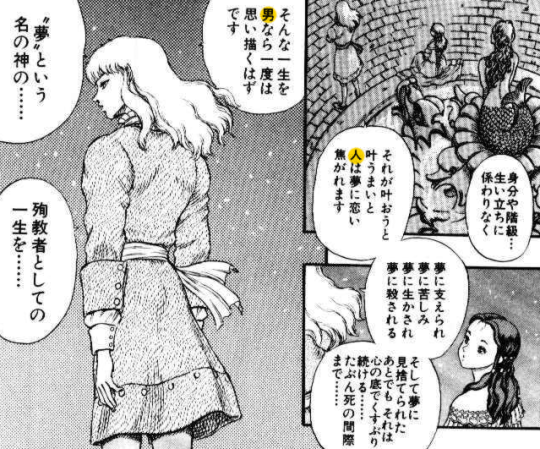
Huh now I’m actually curious if that speech is gender neutral in Japanese, because honestly the focus on men in that speech did seem like… pretty typical of Berserk in general lol. Like Miura really elevates same-gender relationships over opposite-sex relationships which are almost always romantic by default, and generally treated as lesser, or as stepping stones to that most important relationship (eg nina leaving with a dude so she can one day feel worthy of being luca’s friend) and the speech fits that pattern perfectly, so I always assumed it was deliberately gendered – not so much as a reflection on Griffith (tho again in the context of being repressed but desiring that all-important relationship with a man specifically… I’m still okay with it) but bc of Miura’s own biases.
But it’d be nice if it was actually gender neutral bc the focus on men men men, especially that first “but for a man he must first come upon one other precious thing” or w/e the line was, was pretty annoying.
sorry to bring bad news but that convo was anything but gender neutral. like, griffith started it by mentioning that charlotte asked him why /men/ love spilling blood so much so the men vs women divide was there from start to finish
actually the official translation was completely consistent with the original in terms of levels of gendering:
(男, otoko, officially translated as “man/men”)
(者, mono, officially translated as “one”)
(人, hito, officially translated as “people” and then 男, otoko, “man/men” again)
and then griffith ends the conversation like “sorry that must have been a boring topic for a lady (女性, josei)”
so like yeah japanese is a mostly gender neutral language in that its verbs and adjectives are not inflected by gender etc. but that doesn’t mean that all japanese conversations are completely gender neutral. far from it actually
Thank you! Yeah like I said, the way this convo is gendered fits the story to me and imo still reflects more on Miura than Griffith, but like, it doesn’t not fit Griffith imo. It still serves my interpretation of him so I’m cool w/ this.
Also yeah very good point about the abbreviation, ty for mentioning it. JP is definitely preferable if you’re going to shorten the word “japanese,” even if it’s just intended as shorthand and not a slur.
this is actually extra funny because the original japanese summary for vol. 6 doesn’t mention charlotte at all and (apart from the boring “it’s the middle ages and there’s war” stuff) just says that 1) guts thought the band of the hawk and griffith himself could become his “place of belonging” (lol) and also that 2) guts had never experienced such trust and kindness before (.. but shit’s about to go down, ofc)
lol you know i’ve never actually read most of them, i always just skip past. tho i just checked out volume 6′s and yeah lol @ growing attraction between the king’s daughter and griffith. like it doesn’t really surprise me that the summaries are aimed at a straight dude demographic + emphasize the macho manly action/horror, but still, that’s p egregious.
but i gotta say, using the phrase ‘callow beauty’ to describe griffith is kinda interesting. i’m so used to seeing everything about him described as calculating and machiavellian that it’s almost refreshing to see a summary of part of berserk that paints griffith as earnest and naive lol, even if it’s completely inaccurate.
also i kind of assumed they’re translated from the japanese covers instead of dark horse writing their own summaries but maybe they are straight from dark horse if they’re including like lotr references lol. or maybe it’s just creative license with translating.
I do not, but this is a good question and one I’m also curious about. I can say that the anime replaced it with “love” (whether the word itself changed or the translation, idk) so it wouldn’t surprise me if it sounds just as suggestive in japanese as in english, or more so.
@chaoticgaygriffith no pressure to answer this, but do you have any insight on the word? (i’m sure you know exactly the page we’re talking about but just in case, chapter 49)
And actually while I’m wondering about this I’ve always been curious, is it the same word Ganeshka uses on this page? (chapter 282)
the word used is 飢餓感 (きがかん/kigakan) which can mean either hunger literally or hunger as in a strong desire/wish for something
and seeing as how griffith was listing emotions here, moreso than physical sensations (although some emotions–like pain, or you could say even all of them ig–are at the same time physical sensations), i would argue that he meant the latter
though it’s probably unclear on purpose, or it’s like clever wordplay of sorts since he’s literally in pain and starved and also additionally emotionally in pain and starved
and no sadly it’s not the same word ganishka used (he used 飢え渇く/うえかわく/uekawaku) but i don’t think that means there’s no parallel to be drawn here
tyvm for the response! sounds like it basically has the same connotation of saying you feel hunger while thinking about someone in english.
i def don’t think he meant literal hunger since he’s listing feelings specifically for guts, but i like the idea that it could be deliberate wordplay (along with pain) to yk compare the torture to being without guts/his feelings for guts. which would be very fitting imo.
What is it he desires so much that he’d be reincarnated …
… as the Guardian Angel of Longing, and then transform the world this way?
Can you tell me?
you may recognise the word 渇望 (かつぼう/katsubou; craving, longing) from theseposts. it’s (sort of) the word that the beast of darkness used to describe guts’ feelings toward griffith in chapter 187. well, the kanji was that word anyway, but since manga writers like to complicate things the furigana used was a different word with a similar meaning. still, though.
ik every instance of the same word being used twice doesn’t necessarily have to be intentional and have some secret deep meaning behind it but tbh it’s just like. so easy to read into this because guts and griffith mirror each other, especially when it comes to desire/longing, so much already in canon
also i love how the narrative even poses this question, because that makes it clear that griffith motivations were never clear-cut and obvious. it was never just about the “kingdom” lol, like that would be nowhere near enough to go the length he went.
also of note is that “guardian angel” is written with the kanji for “lord,” “head,” “master” (主) instead of the typical kanji for “guarding,” “protection” (守) but idk what to make of that really. it might even just be an actual alternate form, or possibly even a different word, just with a similar enough meaning, that i don’t know about
@raseng0th I erred on the side of not reblogging your post just because I don’t want a giant unblockable slur on my blog lol, but yeah ia with the other commenters, I’ve seen that translation referred to a lot, mainly in the context of translators adding slurs which aren’t there in the original, so I assume the homophobia is a fan addition.
Here’s the official translation if you’re interested and don’t have it handy:
in the original he says てめェらバケモン共 which basically means “you (fucking) monsters,”
てめェら being the male, vulgar plural version of “you,” and バケモン共 being the plural of “monster”
lmao seriously? i was at least kind of assuming the word used might be one that’s sometimes aimed derisively at lgbt people in particular (yk kind of the way “freaks” is in english, where it doesn’t automatically have that connotation but maybe moreso than something super generic like “asshole” would) so yk it’d be an offensive reach-y translation but not completely invented.
guess not, yikes
(i wonder if the context of ganeshka just having asked if guts is one of griffith’s captains has anything to do with that. like an attempt to cram in a no-homo)
Ain’t this … … part of the path to your dream? You believe that, don’t you?
So what’s with this crap? Now, of all times …
… … You’re right …
aaaaaaaaaaaaaaaaaaaaaaaaaa
お前の夢につながる道 → path tied to your dream (or, apparently, possibly also “path that leads to your dream” ??)
何言ってやがる → やがる is used to show contempt/anger, and is often translated using curse words as intensifiers. imo the official translation is really elegant because it conveys that annoyance while not making it too rude, because we all know that’s not guts’ tone here.
今さら → i like this translation too, but i wanted to point out that the original expression carries a meaning of it being too late to do/say/change/fix something. like, you would use it too say, “well even if you turn in your homework now, it’s no use. the deadline was a month ago.” and, actually, in the translated manga the “now” is bolded and italicised.
and like. idk but the やがる combined with the 今さら must sound really accusatory to griffith, who is already feeling pretty vulnerable + shitty about himself right now. you done fucked up, guts.
# ok that bit about it being too late tho… reminding me of things the godhand said to him later # now of all times… now that you already have a pile of bodies stacked up # agh you stupid babies
i’ve talked about these lines before but let’s examine them again
グリフィス(あいつ)への執着を振り切って ここまで辿り着いたはずが・・・
I’ve come this far by letting go of my obsession …
i’m gonna gloss this in an unconventional way just to make it easier to understand what’s going on here grammar-wise
[griffith (him) – particle for direction – possessive particle – obsession (noun)] – object particle – [shake off/break off (verb in -te form)] [here] – particle for destination – [arrive (verb in past tense)] – suffix (?) that means sth like “should have” – particle that means “but”
or, simpler,
obsession with griffith – object particle – shake off/break off (te form) to here/this far – arrive (past tense) – should have – but
the key here is the -te form of the verb 振り切る, which is used for a number of things, among which are: connecting phrases, listing successive actions, and uhhh idk how to explain this but doing something by doing something else first. you know, sentences like “taking off my clothes, i entered the bath” and similar.
that last function of the -te form i mentioned is, i believe, the one used here. “i let go of my obsession with him, and i came this far,” or, more accurately, “letting go of my obsession with him, i came this far.” then there’s the はず part too, where guts expresses his uncertainty (meaning that he hasn’t really let go of his obsession and moved on), but that’s a little hard to translate accurately without it sounding weird in english.
the other thing is, 辿り着く is in past tense. so i really don’t understand what in the world the translators of OP’s photo were thinking. he’s come this far, and he did it by letting go of his obsession. there’s nothing that indicates this was his past hope or whatever, at least from what i can see.
So what I understand is that this translation includes the uncertainty but in doing so basically changes the overall meaning, whereas the version I have “I’ve come this far… by letting go of my obsession…” gets the tense right but misses the uncertainty? Which yk seems fair because it does sound hard to convey without losing the flow of the sentence, plus it’s kind of… infused into the panel just from the fact that Guts is thinking about that glimpse of Griffith on the hill, but obviously that’s the most intriguing part to me lol so I’m glad it’s there somewhat in the original text.
honestly that’s a good way of putting it, that might be what they were trying to do. they just kind of made it sound like this was a past goal of his, which is not really the case. はず is like a … an expectation, but with certainty. expectation that something took place/is going to take place/is currently the case etc. you would use it to say “the shop should be open right now” if it’s like 8 pm and you know that the shop works until 9. it’s like, based on everything i know/have seen, this is how it should be … but it might still not.
that’s the sort of uncertainty guts is expressing here. “i should have let go of my obsession with him by now, but … (did i?).” there’s nothing in this line in original japanese that indicates that he set that as a goal for himself and then failed to achieve it. honestly i have to say i really feel like rather than choosing to focus on the uncertainty, this translator or translation team simply wildly misunderstood the grammatical structure of the sentence, and in doing so accidentally achieved something that the official translators weren’t able to. but who’s to say.
According to @murdersounds apparently this is the official translation lol. I hadn’t realized it’d been released, but I guess so. The one I was quoting is a scanlation, but one of the more reputable ones afaik.
So… ?? not like I’m going to complain much about dark horse either accidentally or purposefully helping push my griffguts agenda lmao, but this does make me wonder what the translator’s thought process was.
i’ve talked about these lines before but let’s examine them again
グリフィス(あいつ)への執着を振り切って ここまで辿り着いたはずが・・・
I’ve come this far by letting go of my obsession …
i’m gonna gloss this in an unconventional way just to make it easier to understand what’s going on here grammar-wise
[griffith (him) – particle for direction – possessive particle – obsession (noun)] – object particle – [shake off/break off (verb in -te form)] [here] – particle for destination – [arrive (verb in past tense)] – suffix (?) that means sth like “should have” – particle that means “but”
or, simpler,
obsession with griffith – object particle – shake off/break off (te form) to here/this far – arrive (past tense) – should have – but
the key here is the -te form of the verb 振り切る, which is used for a number of things, among which are: connecting phrases, listing successive actions, and uhhh idk how to explain this but doing something by doing something else first. you know, sentences like “taking off my clothes, i entered the bath” and similar.
that last function of the -te form i mentioned is, i believe, the one used here. “i let go of my obsession with him, and i came this far,” or, more accurately, “letting go of my obsession with him, i came this far.” then there’s the はず part too, where guts expresses his uncertainty (meaning that he hasn’t really let go of his obsession and moved on), but that’s a little hard to translate accurately without it sounding weird in english.
the other thing is, 辿り着く is in past tense. so i really don’t understand what in the world the translators of OP’s photo were thinking. he’s come this far, and he did it by letting go of his obsession. there’s nothing that indicates this was his past hope or whatever, at least from what i can see.
So what I understand is that this translation includes the uncertainty but in doing so basically changes the overall meaning, whereas the version I have “I’ve come this far… by letting go of my obsession…” gets the tense right but misses the uncertainty? Which yk seems fair because it does sound hard to convey without losing the flow of the sentence, plus it’s kind of… infused into the panel just from the fact that Guts is thinking about that glimpse of Griffith on the hill, but obviously that’s the most intriguing part to me lol so I’m glad it’s there somewhat in the original text.
so i checked the “dreadful” thing and, no, it was an accurate translation–if you’re not nitpicky. here’s the original japanese:
しかし 恐ろしい男ですな あ・れ・は
But still … A most dreadful man he is.
末恐ろしい・・・・・・
Truly dreadful …
この男だ・・・!! この男が恐ろしいだから!!!
It’s him …!! It’s that this man is dreadful!!!
as you can see, they both use the word 恐ろしい, which means dreadful, terrifying, terrible, frightening, but also startling, surprising, amazing
but in the first scene they also use 末恐ろしい, a word that i wasn’t familiar with until now. the dictionary definition is “ominous; portentous; likely to grow worse,” which is kind of oddly specific, but if you google it you get a definition that basically means 恐ろしい + thinking about how that person, thing, whatever will evolve, what will become of them, and now it’s still too specific but it makes sense
the official translation chose to translate 末恐ろしい as “truly dreadful” which … while not accurate, was a good decision i feel? how else are you going to translate it succinctly, you know? sometimes you just have to let go of the subtext and move on. and like @bthump pointed out while we were chatting about this, that whole scene already had an ominous, foreboding feeling to it anyway
I’ve come this far by letting go of my obsession …
even though griffith is right there in the panel and it shouldn’t be unclear who guts was obsessed with, and even though “my obsession with him” may not be the happiest translating solution, i’m still side-eyeing the translators for leaving griffith’s name/the male pronoun out bc the original clearly says “my obsession with griffith (him)”
by the way, the word 執着 is defined as “being strongly drawn to[1] something, strongly[2] setting your heart on it[3] and being completely unable to forget about it[4]” and can be translated as “obsession” “attachment” “fixation” (i quickly looked up example sentences and it was like, attachment to money, results, victory, opinions; fixation in terms of fetishes/dating preferences; still being attached to one’s mother; clinging to hope/life etc. but also: being obsessed with someone specific, most likely in a romantic/sexual sense but not necessarily ig)
[1] drawn to = ひかれる, which means something like “to be attracted/drawn to” “to be fascinated by” “to be taken with” “to be charmed by” [2] the first “strongly” is 強く (”strongly”), the second “strongly” is 深く (”deeply”) but i couldn’t figure out how to use two different words and still make it make sense in english so i just used the same word twice [3] among the couple of meanings of 思い込む is “to firmly decide in your heart” or, as i put it up there, “to set one’s heart on” [4] the verb used here isn’t just 忘れる (”to forget”) but 忘れ切る (”to forget” + “to cut”) which is really like to completely forget all about something
Ain’t this … … part of the path to your dream? You believe that, don’t you?
So what’s with this crap? Now, of all times …
… … You’re right …
aaaaaaaaaaaaaaaaaaaaaaaaaa
お前の夢につながる道 → path tied to your dream (or, apparently, possibly also “path that leads to your dream” ??)
何言ってやがる → やがる is used to show contempt/anger, and is often translated using curse words as intensifiers. imo the official translation is really elegant because it conveys that annoyance while not making it too rude, because we all know that’s not guts’ tone here.
今さら → i like this translation too, but i wanted to point out that the original expression carries a meaning of it being too late to do/say/change/fix something. like, you would use it too say, “well even if you turn in your homework now, it’s no use. the deadline was a month ago.” and, actually, in the translated manga the “now” is bolded and italicised.
and like. idk but the やがる combined with the 今さら must sound really accusatory to griffith, who is already feeling pretty vulnerable + shitty about himself right now. you done fucked up, guts.
I won you with this. Your fight and your death, I hold both.
If you want to leave my grasp, then it’ll be the same as that time … Wrest yourself away by your sword.
勝ちとった → there’s a lot of this in japanese, where two verbs are put together to form a new one. in this case, it’s 勝つ (to win) and 取る (to take), forming the verb 勝ち取る, basically meaning “to win [sth]”
お前の戦場もお前の死もすべてオレのものだ → so, here griffith lists guts’ “battlefield” and his “death,” and then he says, literally, “everything is mine.” the “everything” does refer to the two things he listed, but i still would have went with “it’s all mine” or “i hold all of it” tbh
もぎとって行け → もぎ取る does literally mean “to wrest away from/wrench free,” it’s not just the official translation folks getting creative
i have some … thoughts, so let’s go through this in order.
this is nitpicky, but i can’t believe they translated
寝るの? as “do you sleep?” i mean sure, i guess, but the hound is clearly asking him if he’s gonna sleep. i guess they wanted to make it sound more dramatic.
also nitpicky, but even though there’s no desiderative in なぜあいつを追わないの? i personally would have translated it as “why won’t you chase (after) him?” i feel like in the original there is no suggestion to chase griffith that can be felt in “why don’t you chase him?” instead, it’s like chasing griffith is a given and the hound is (childishly) confused about why guts isn’t doing it. that’s how it feels to me, anyway. i could be wrong, i’m still learning + i have no experience as a translator, but yeah.
i’d just like to point out that in やっと会えたんじゃない, the verb 会う is in potential form. so it’s leaning towards “you finally got to (managed to, got a chance to etc.) meet with him”
もう少しじゃない was translated as “Just a little farther,” which i understand, but you should know that the original says “isn’t it just a little farther,” as in, isn’t he just outside your reach, isn’t he right in front of our eyes, let’s go to him, why won’t you? again, i’m not a native or even fluent speaker of japanese, but i’m almost certain this is a really childish way of speaking, which really says it all i think.
we’re getting into “who cares” territory but この女がいるから? literally means something like “because this woman is here?” and … idk why i feel like that’s relevant, i think it maaaybe emphasises the feeling of her getting in the way? but yeah, do with that what you will.
放っておこうよ → “Leave her be” is of course accurate, but i wish there was a better translation for the nuances of this expression as used in this context, because the one they went with sounds a bit more like, you know, “give her some peace,” whereas i feel like what the hound was saying is closer to basically telling guts to abandon her. you know what i mean? “just leave her,” something like that.
it’s a little hard to read some more complicated kanji with the quality of these images, but if the original really does say 残骸, then “shell” is a clever translation, but basically, the meaning of that word is like … something that’s been destroyed to the point of uselessness. google says even a corpse that was thrown away. dictionaries say “debris” “wreckage” “ruins.”
i think 傷口 is specifically like the “opening” of a wound. google says, “Metaphorically, past mistakes and weak points that you do not want people to touch.” which, duh.
グリフィスの残した痛み
→ this is, again, the pain that he left. “caused” is very much a one moment thing, like griffith hurt guts in the past and now guts wants to go back to that feeling. but the original implies that the pain is constant, and what’s more, guts doesn’t want to stop feeling it.
we’ve reached the meat of this post. the actual thing bthump asked me about. 「この女はグリフィスを渇望(こがれ)続けるための生贄さ」 so you know how in manga authors like to use kanji for one thing but then add furigana for another, in order to create layered meanings? that’s what’s happening here, and boy is it layered. 渇望 (read as katsubou) is “craving,” “longing,” “thirsting.” google says “to desire from the heart, the way someone who is thirsty wishes for water. to long for*.” but furigana says こがれ (from the verb 焦がれる). the dictionary definition of this word is literally “to yearn for” “to be in love with.” google says “to earnestly hope for. to yearn for and fret.” bear in mind this “yearn for” is 恋い慕う = to love + to pine for. basically, these are some pretty charged words, which is why i pulled up all these various definitions, since i can’t feel all the connotations of various japanese expressions. (*this ”to long for” is, again, just the dictionary translation of that synonymous expression (待ちこがれる), but i looked for a japanese definition and it says “to keep waiting and waiting and feel restless”)
excuse me? “you’ll get closer and closer to Griffith” doesn’t even cover もっと深く深くグリフィスと繋がる 深い = “deep”, but also “close,” sometimes “strong/intense.” 繋がる = you know this word. “to be tied/linked together.” i think anime translators often use the word “bond.” it’s not just about getting closer to griffith, it’s about them getting tied closer and closer together, being more and more deeply connected to each other. there’s no happy solution in terms of translating, but this is definitely one of those lines that need translation notes.
lol I don’t have anything to add but this is some Good Shit.
again per @bthump‘s request, we compare griffith’s “If I can’t have him I don’t care” with also griffith’s “That you, rather to have been with princess Charlotte, would have had her yourself?”
If in the instant our swords meet, the pressure from his alters the arc of mine even just a little … … I might really kill him!!
Even then … If I can’t have him …!!
I don’t care!!
here, the expression used is 手に入る, literally meaning “to enter someone’s hand,” with the actual meaning being “to obtain” “to get hold of” “to get one’s hands on.” i would have to check if it’s generally used for objects or people or both, but yeah.
another thing possibly of note is that there’s also 手に入れる (”to put into one’s own hand”) with pretty much the same meaning when translated into english–but clearly there are differences. for example, if something “entered your hand,” you didn’t do anything to obtain it, it just found its way there. likewise, if you “put something into your hand,” you did something to obtain it, you went out and got it for yourself.
bear with me though. there’s an issue here, and that is that when it comes to transitive/intransitive pairs of verbs (such as 入れる /
入る), in certain situations japanese speakers have a tendency to use the intransitive verb where speakers of other languages would more naturally use the transitive verb. for example, instead of asking “have you found your keys?” (mitsukeru, to find – transitive) they’ll ask, “have the keys been found?” (mitsukaru, to be found – intransitive). and i’m still not sure what the rules/patterns are here, really.
this means that i don’t know for sure if griffith using 手に入る instead of 手に入れる has any real semantic significance. but even if it really doesn’t, i still think it’s fitting, and interesting, since, as griffith understands it, guts is the one who won’t readily enter griffith’s grasp anymore (in fact, he wants to leave it: オレの手の中から出ていきたいのか!?)
and while we’re on the topic of grasps, if you’ll allow me to go on yet another tangent here,
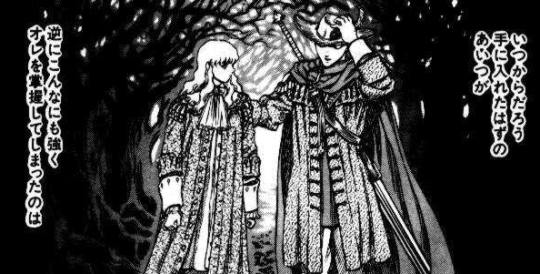
いつからだろう 手に入れたはずのあいつが 逆にこんなにも強くオレを掌握してしまったのは
How long ago did someone I was supposed to have in hand instead gain such a strong hold on me?
(i’ll talk more about this scene some other time)
now for the dungeon scene with the king.
それならば・・・・・・・・・・・・ それならば、いっそ・・・・・・
いっそ・・・ 私が・・・
抱きたいのですか? シャルロット様を・・・・・・ いや・・・
あなたが・・・ 抱・い・て・ほ・し・い・ のでは?
I’d rather … … rather that …
… That you … rather …
to have been with princess Charlotte … would have hadher yourself? No …
Don’t you … … want her to have you?
here, the verb used is 抱く, which can mean “to hold/embrace” literally or in the sense of “making love.” according to my dictionary, it can also mean “to have” (e.g. ambition) but i don’t … know what else you can “have” like that (people??).
my guess would be that griffith is basically saying “you wanted to hold her … no … you wanted to be held by her,” but since the king was talking about griffith having taken her virginity before griffith said this, it makes sense to translate it as “to have her,” as in, “to have her first.”
sadly though that means there’s a parallel in english that isn’t there in the original japanese, but i still think your overall reading of this scene is accurate.
Thank you so much! This is only mildly disappointing lol, the similar wording in the english translation was one of those things I referred to in some earlier post where I’d written the entire section beforehand and only noticed something seemingly obvious w/ the wording afterwards, so I tacked it on. I think the parallel stands up fine without it.
Nice nice nice wrt the connection to “how long ago did someone I was supposed to have in hand,” tho. i’m looking forward to your further thoughts on that someday!
All right, then I suppose you can deliver a message to your boss for me?
Wha- What message?
you can see it in the translation too, but guts is being sweet and polite here, using 答えて(くれ)and 頼まれてくれない in place of just your regular old impolite imperative which he normally defaults to
if you’re not familiar with glossing abbreviations you can check them out here, i thought i’d use them in case anyone wants to study the sentences more carefully
but basically looks like the fan translation team interpreted the first line (”what i wished for”) as like an opener line for what he wishes for and then “i killed” became “to be killed” even though the verb is not in passive form? then they totally skipped “it’s strange” and went ahead and interpreted the verb kanjiru as both ‘think’ and ‘feel’ as if he said two things and not one
i guess what i’m trying to say is don’t always trust fan translations over official ones, but also
they may not have been too far off because ore ga nozonda koto … ore ga koroshita CAN be interpreted as “i killed what i wanted” which i think has some interesting implications
〜はず means something like “should be,” “must be,” “ought to be” etc. as in “the store should be open right now.” added to a past tense verb, it means that you are sure something happened in the past. but spoken directly to guts like this, it’s like griffith is saying “didn’t i tell you?” “i told you, didn’t i?” even though it’s not really a question. it’s a (bitter) reminder.
# hmm would ‘i thought i told you then’ a la the 2nd duel be a fair translation? # translation info # i mean if the dh translator used different wording it’s probably not exactly the same but as a recurring theme (casca also says it # when reminding guts that griffith is only human) im intrigued # i say recurring theme but it’d be more a reference back for the sake of contrast i figure since the 2 instances i mentioned are about griff # being obsessed with guts not the dream @bthump
yep!! if the 1997 anime can be trusted, right before the second duel griffith says
あの時言ったはずだ
and when she attacks guts, casca also says
いつか言ったはずだ
which is also translated as “i thought i told you!! back then!!”
〜はず means something like “should be,” “must be,” “ought to be” etc. as in “the store should be open right now.” added to a past tense verb, it means that you are sure something happened in the past. but spoken directly to guts like this, it’s like griffith is saying “didn’t i tell you?” “i told you, didn’t i?” even though it’s not really a question. it’s a (bitter) reminder.
You should have known. This is the man I am. You, of all people.
“you, of all people” is a really powerful translation imo but the literal translation would be “just you” which i think ………….. is noteworthy
yesss like this line absolutely refers back to the fact that griffith let guts (and only guts) in to see the darker sides of his rise to the throne, and specifically tombstone of flame, and guts telling him his cruelty is a part of the path to his dream, and what griffith believed guts’ reason for leaving was etc, and it’s nice when learning more about the literal dialogue only solidifies my interpretation
… Ultimately to be born, and to then simply live for no better reason … I can’t abide such a lifestyle.
boring translation note: ~てしまう has two meanings. one is the meaning of finishing something, so, for example, you’ll use it when you say you’ve finished reading a book. the other is the meaning of either doing something bad/regrettable accidentally or something bad/regrettable happening on its own. basically, it means you fucked up, so you’ll use it when saying “sorry, i forgot my homework” and such.
here, griffith uses it with the verb 生まれる (umareru; to be born). “ultimately to be born” is an interesting translation choice, but it’s one i understand considering how small those speech bubbles are. but what griffith is really saying is something along the lines of “since you were already born,” as in, since you were unfortunately brought into this world against your will, you might as well live, for the sake of living. but this is either a mouthful or sounds weird in english (which is often the case with japanese), so i feel like the translation team did what they could.
I couldn’t find the raws, so I turned to the new anime
What the Hound says is:
「この女は、グリフィスを渇望続けるための生贄さ。」
Kono onna wa Gurifisu wo kogare tsuzukeru tame no ikenie sa.
Now, I had to google this line to check which kanji was used because I couldn’t believe what I was hearing lol
The verb
焦がれる (kogareru) means “to yearn for; to be in love with”
But the kanji used here is 渇望, which is generally read as “katsubou”, and I’m not familiar with this other reading. Might be one of those things where mangaka use kanji and furigana to convey a complex meaning
And 渇望 (katsubou) … means “craving; longing; thirsting” so ……. yep
The new anime translated it as “pining,” which I also enjoyed
Well damn for all the flaws of the new anime de-gaying it definitely isn’t one of them, omg.
Thank you for checking this out and sharing the info this is fantastic! I don’t think there’s any doubt then that the romantic overtones are there.






 you're the only one