mostly berserk meta. i'm into berserk mainly for griffguts and i'm a huge fan of griffith.
Tag: theme: true light
anyway everything from dreams to ascending to godhood are smokescreens
love is the true equalizer between them
and that’s why despite the fact that the odds of guts becoming femto/neogriffith’s literal equal as in ascending to another plane of existence and being as powerful as him are approximately -10000, i still have hope that the whole equals thing is gonna come full circle in a satisfying way
all plot, no substance. any heart bthumpy emotions NeoGriff is feeling are actually the fetus’ feelings. it’s his weakness™ and if Guts and Casca defeat NeoGriff they’ll be able to magically separate it out and fuse it with its soul, the Moonlight Boy, achieving a Happily Ever After™ as a Picturesque Family™
Or possibly if they defeat NeoGriffith they free their child’s soul to go to swirly soul heaven, and the ending is bittersweet™
Miura retcons Femto letting Guts go, and all the hints that NeoGriffith feels things that are entirely unrelated to whatever tf the fetus might care about are red herrings/misdirection.
In a flash forward we find out that Rickert and Erika are happily married in a terrible Guts/Casca parallel.
ummm what else… NeoGriff is defeated through a power-up/Elfland magic after a volume long physical battle.
Guts bones Casca and thus conquers his obsession with Griffith and is finally able to move on™ but NeoGriff attacks Elfhelm, forcing the final battle.
possibly the other godhand are there too, what with fusing the physical and spiritual worlds and miura hinting that void’s gonna be important yadda yadda yadda. it turns into Good Spirit Elemental Guardians against Evil Godhand in the most boring fight ever while Guts and NeoGriff fight.
Oooh Casca experiences some strong negative emotions upon regaining her sanity, but the Moonlight Boy appears to her and her maternal feelings™ soothe her.
Guts kills NGriff, rides off into the sunset with casca.
oh also there’s undertones of falconia being a naive fantasy while guts’ ‘just struggle your way through everything instead of finding/creating a safe happy paradise’ philosophy is touted as more mature and better
ok that’s enough dwelling on the negative
BEST CASE ENDING
the fetus is affecting Griffith only insomuch as being fused with its physical flesh makes his heart start beating because he’s corporeal and thus subject to those worldy emotions he’d thought he’d left behind.
The shot of it at the end of this chapter shows that Casca is kind of obsessed with it, and therefore when she wakes up with all her sanity and memories she demonstrates that her wishes were not Guts’ wishes and falls into despair and sacrifices that little fucker. I mean, half the apostle sacrifices we’ve seen have been parent/child, it’s possible right?
this destroys Moonlight Boy, aka the essence of the fetus, and whatever hope the audience had for a happily ever after family with Guts Casca and child. it’s meant to be seen as a tragic low point. I cackle gleefully.
I wouldn’t actually enjoy this but i think it would make sense: along with that low point Miura hints that NeoGriff’s feelings are gone thanks to Casca’s sacrifice – oh no, his one weakness! now he’s unstoppable! etc – but psych later on it turns out the feelings were his own all along.
casca, now an apostle, leaves to get revenge on neogriff. guts goes after her to either help or stop her, he’s not sure which. also if casca steals guts’ armour, i will die of happiness, but that + being an apostle might be overkill.
we get casca’s point of view, and it’s quite similar to black swordsman guts and full of parallels. guts has now achieved some character development which is why he’s torn between helping casca get revenge vs trying to just save her because she’s no match for neogriff (vs deep down wanting to save neogriff and/or stick his own sword in him because his feelings are still all fucked up. undertones of guts and casca’s old griffith-related romantic rivalry but dark)
thematically, Elfhelm is soured – the whole magical therapy for Casca thing turned out to be a terrible idea, the people there are unwilling to help clean up their mess because they’re isolationist dicks, AND maybe there are hints that the four spirit guardians schierke calls on for protection are other forms of the godhand?
however it happens, ultimately the thematic takeaway is that rather than there being a good vs evil thing going on in the spirit world, good and evil are two sides of the same coin and what you perceive really depends on what you’re calling on the spirit world for, and most things are both at once. yk, aren’t gods and devils the same thing?
i’m skipping over plot stuff and more theme stuff because i’m willing to accept a lot of possibilities and i really don’t care much.
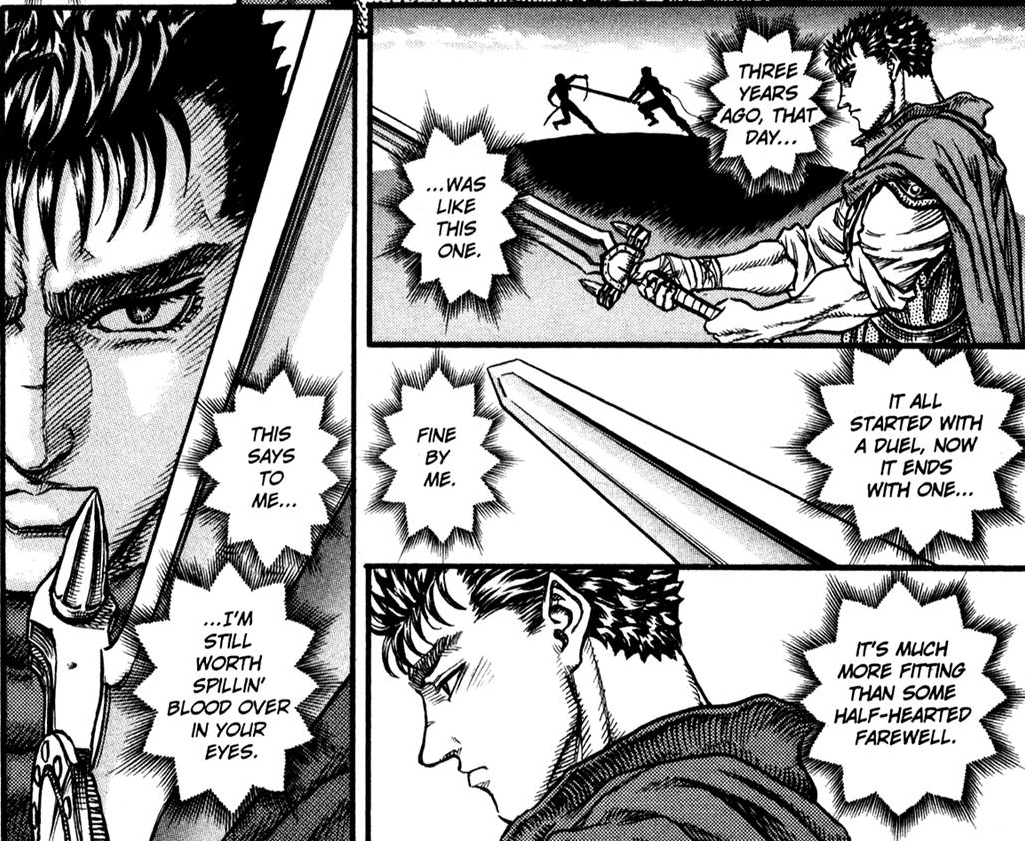
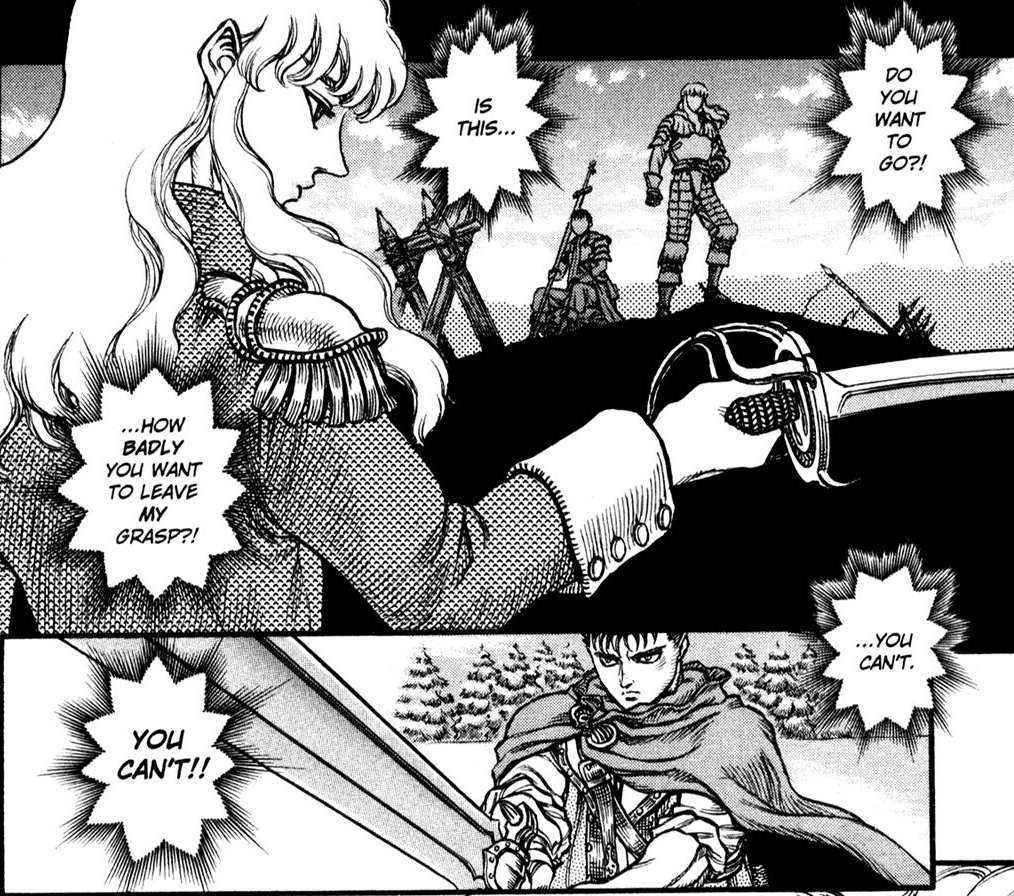
the important thing is that guts and griffith have a final emotional confrontation after the dust of the big action climax settles, and it comes in the form of a 3rd duel.
also at some point in the lead-up to it, they figure their shit out. possibly this involves schierke’s or sonia’s or both’s magical mind exploration magic. we see griffith’s unemotional facade starting to crack. we see guts’ ambivalence towards griffith – does he want to kill him or plead with him or fuck him or reject him entirely?
and guts realizes that griffith’s heart is beating again for him, and everything he wanted – griffith’s respect admiration and love is still there, residing in his worst enemy. and griffith realizes that guts admired and loved him and never once saw human him as the monster he saw himself and allowed himself to become.
tragically idk how you could depict both without looking really silly, but either guts’ residual guilt for his part in the lead up to the eclipse gets the better of him and he lets a still-repressed griffith kill him, the way he always lets himself get stabbed when he feels bad about something, OR neogriffith’s irrational love gets the better of him and he lets guts kill him – guts ends up sticking him in the throat in a mirror of how he killed gambino.
either way there’s a lot of crying and cradling a corpse.
tbh i’m leaning towards griffith killing guts for that devilman ending, and this way casca gets to play the role of angry god by swooping in and killing him. if that’s the case griffith lets her because his irrational emotions have finally truly burst free and taken hold over him after he kills guts. his crying is a call-back to his ‘last tear shed.’
(maybe casca becomes zodd 2.0, living for battle and becoming a sword just for herself. kind of a darkly fucked-up “happy” ending for her lol.)
BEST CASE ENDING WITH NO FUCKS GIVEN FOR PLAUSIBILITY
all of the above but after finally understanding each other they make out instead of dueling and then casca kills neogriff and an adult theresia kills guts, and they both ride off into the sunset with their respective girlfriends, farnese and jill.
Also speaking of the monologue I want to take a sec to just gush about how it’s structured. The way it begins with two pages of Griffith reminiscing about his dream. “It was the brightest thing I had ever seen.” Shining. The next page is Griffith with that light shining before him.
Then into darkness, deep darkness without even a trace of light. The darkness of the torture chamber, the darkness, one assumes, of having his dream ripped away from him. Only one thing is vivid.
And it’s Guts.
I just love how it’s set up as a bait and switch to really drive in the point that Guts has overtaken his dream. You turn the page, expecting to see Griffith consumed with longing for his lost dream, for the castle, the thing he just described as the brightest thing he’d ever seen, but nope, it’s Guts, like lightning blazing within him.
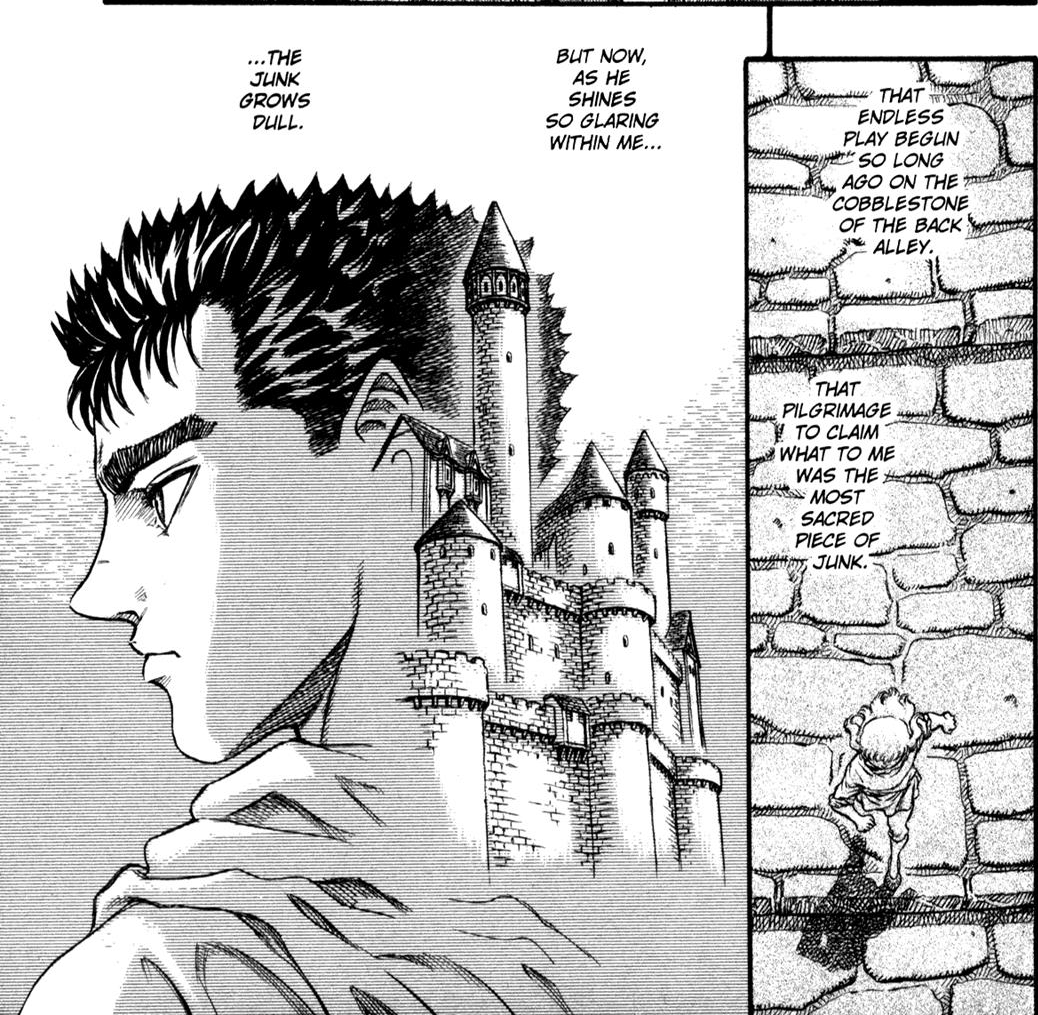
And then the monologue ends with Griffith returning to the subject of the dream only to say it’s dull compared to Guts.
Like this is straightforward but I still love how it’s set up to play with expectation, and to compare Griffith before and Griffith after Guts. The dream shining within him, replaced by Guts shining within him.
I love that Guts thinks of the Zodd debacle as something shared between him and Griffith, something they did together, even though they had a troop of Hawks with them.
And I think Griffith thinks of it the same way:
His reaction to Wyald’s transformation into a monster is to try to join Guts’ side, to help him face it or save him from it.
(And yeah I have no problem confidentally stating that that’s why Griffith fell over here lol. He tries it again when he tries to tear himself away from the men holding him when Casca is in danger, and before this he’d tried to grab his sword, so.)
Also to add an actual point, the call-backs to Zodd are rly effective in spotlighting Griffith’s helplessness in contrast, as well as spotlighting Guts’ solitary fight against monsters, again in contrast to his first fight beside Griffith.
He saves Casca but they don’t go on to fight Wyald together, he tells her to fuck off and let him do this himself, while Griffith is removed from everyone else watching helplessly from a distance. Without Griffith Guts is alone, and vice versa.
Miura was cockocking them with plot armour and miscommunication tropes. Let them fuck Miura you coward!
ikkkkkkkkr
the golden age is straight up a slow burn mutually requited pining story except instead of eventually figuring their shit out they ruin everything forever
like
they love each other and they can’t see that they’re loved in return and if miura just let them fuck everyone would’ve lived happily ever after
also speaking of comparing the torture chamber and griffith becoming femto:
idk seems like a fitting illustration of how by sacrificing guts, ie the light within him, a fissure opens up into which evil surges. even if it’s coincidental
[Insert Ganeshka’s backstory of isolation and fear here.]
eh? eh?
ok honestly I’m just throwing shit at the wall but Ganeshka’s lonely freakout really really intrigues me, that plus the talk of light and dark reminds me both of Griffith in the torture chamber and Griffith as he’s transforming into Femto, and while yeah NeoGriff’s “within darkness that true light is discovered” bit is much more metaphysical (yk more to do with the fact that Griffith had to become Femto to become the saviour of humanity, probably), the fact that it’s in response to Ganeshka’s total loss of himself and everyone around him, the fact that the light Ganeshka longs for has shifted from something he considers his enemy to the only connection he has in an unknowable lonely world just… resonates man. I love it.
“You can see. Because he who bears the light exists in the deepest shadow.” Ganeshka can see NeoGriffith’s true form because he’s the only one on the same plane of existence of him, and that plane is defined by despair – despair opens the behelit that makes him an apostle, despair in the face of an inevitable loss sends him into that reincarnation thing to become a god, and his brief existence as a god is defined by existential terror and isolation. In a way he and NeoGriff are both made out of the same stuff the Idea of Evil is made out of. that’s the “darkness” imo.
And despair is the darkness of the torture chamber (give or take the lightning blazing within him that is Guts) and it’s what Griffith succumbs to when he sinks into darkness and becomes Femto.
Also
while the “light” referred to might more literally be Griffith-as-godly-saviour, bringer of peace to humanity or whatever, I’m thinking it works as a symbol of that longing for connection.
like idk the way I take Berserk’s use of light and darkness as symbols is, essentially, darkness is the despair that opens the behelit and light is what you sacrifice. darkness – the swirling negative emotions that make up the idea of evil. light – connection, love, joy, family, peace, brotherhood yadda yadda yadda. or at least the potential for those things.
Griffith/Femto appears right after Ganeshka’s backstory of being unable to connect with anyone around him because of his paranoia – loneliness and fear. He gives Ganeshka that brief sense of connection before his death as the light envelops him.
I’m basically just thinking outloud in a disorganized way here bc tbqh I have such a hard time sussing out what “It’s within darkness that true light is discovered” means in the overall context of Berserk. Like, other than Griffith going ‘lol I’m evil but also saving the world.’ that’s too reductive. But I think longing (darkness) for connection (light) maybe works for me? thanks to Ganeshka’s whole thing being isolation.
Forgot to mention this when it comes to Griffith + Casca parallels (Guts leaves for a year/two years to pursue a dumb dream, abandoning someone who needs him, then he comes back, realizes he may have fucked up, and rescues them):
Im glad im not alone on this. Its so weird that casca was guts’s last chance to make the right choice but he still messed up in some way.
Ooh yk when you put it like that, what I find striking is that he did make the right choice, pre-Eclipse. He realized he shouldn’t’ve left and decided to stay with Griffith despite getting told multiple times to leave by Casca and Judeau.
It was Casca telling him to leave that fucked Griffith up lol, not Guts wanting to leave or being reluctant to stay.
Whereas with Casca he makes the same mistake again, and directly compares leaving Casca alone in a cave to leaving Griffith, but when he gets Casca back he’s his own worst enemy when it comes to sticking to his resolution to stay with her.
First he plans to leave her in the cave again anyway
and when it caves in he knows he’s not just gonna abandon her in a field somewhere but he’s reluctant af to postpone his revenge quest for her
and then when he decides taking her to Elfhelm is the thing to do he does it still fully intending to return to his revenge quest eventually. (Plus, yk, the fucked up Beast of Darkness shit that happens before he gathers some extra babysitters.)
I don’t really have a point other than Guts taking one step forward with Griffith and ending up like five steps back when the situation is repeated with Casca.
And I mean yeah a lot of shit went down in the interim and he has a pretty good reason to be obsessed with revenge, but the comparison between leaving Griffith and leaving Casca is made over and over by both Guts and the narrative so when you sit down and actually compare them it’s striking that Guts is still like, struggling to rise to the level of caring about someone over his “dream” (fighting stronger and stronger enemies/vengeful rampage) that he’d already reached once with Griffith right before the Eclipse.
I just noticed the parallel with Guts putting his cloak around both of them.
It’s so … quaint.
Also you’re absolutely right. While he sort of makes the decision to stay in both cases. In Griffith’s case it was a final decision he came to after going over his ‘this is where I belong after all’ and consciously admitting to himself that his dream side quest was stupid and unnecessary anyway. And he sticks by that realisation even after Judeau and Casca’s speeches. Casca telling him to leave wasn’t significant because it made Guts’ reconsider his decision, if I remember correctly we aren’t even shown Guts’ face in that panel- it’s significant for Griffith to hear and believe .
If anything Guts had already made the subconscious decision to stay waay before the raiders ran to him.
In the tent/wagon with Griffith he talks about the future once Griffith heals. “ We’ll be able to see that soon enough” he says we.WE.
Whereas with Casca his decision to stay always seems to be in lieu of there either being no other choice or in response to someone else’s prodding. Staying with Casca seems to be a means to an end where he can leave her in a safe and wholesome place and state and move on with a clear mind.
The only time there seems to be a real resolve behind his decision to stay is when he’s directly substituting the situation with already having failed at it with Griffith.
Even his “even if you put something back together piece by piece it may never be the same.” Dialogue ties in with this. He says this after his Griffith fueled Casca endeavor has sort of failed.
And yeah.
After Casca tells him “if you’re Griffith’s friend and equal… you have to. Even if it’s alone… you have to go” we get the “why do I always see these things… after they’re done and gone?” line. It seems p clear to me that that Guts is referring to his realization that he had his “dream” in the palm of his hand and threw it away by leaving to pursue it, ie he broke Griffith’s heart by leaving, though granted it’s not the plainest of statements.
But anyway yeah to me that sounds like Guts is absolutely unwavering in his resolve that he’s going to stay and he thinks leaving in the first place was a great big fuck up.
tbh I do wonder what Guts is thinking will happen when Casca gets her mind back, considering his brooding about the warnings he got. “She went to pieces because she can’t fully cope with it. What will she do if she does get her sanity back?” Like is he hoping she’ll join the trail of revenge with him? Is he planning to just play it by ear – take her with him if she wants to go, leave her in elfhelm if she wants to chill somewhere safe, etc? Cross his fingers and hope she doesn’t do something drastic?
I was kind of wondering if he’s hoping that getting her back the way she was will be enough motivation for him to take Godo’s advice and stay with the “irreplaceable things” instead of going back for revenge, but like I said, even on the ship he was still doing his “when this journey’s over, I’ll [not actually be able to finish this sentence]” thing, so I don’t think there’s much indication of that.
idk i’m just thinking outloud. it all comes back to griffith’s pull being like, the strongest force exerted on him lol, for both good and bad. devote himself to griffith, or leave to become griffith’s equal, or stay with griffith, or ditch casca to chase griffith, or stay with casca while comparing the situation to one with griffith, gritting his teeth, and anticipating being able to chase griffith again.
i wonder if it’s not so much that he’ll overcome the pull of griffith on him as the nature of it will shift again, from revenge to maybe realizing that his desire isn’t actually for revenge, but still to be griffith’s equal. maybe he’ll actually untangle some of his feelings at some point, considering things like “the instant I saw him… I forgot my urge to kill.”
Okay we’re finally on the last part of this giant self indulgent monster. Here I’m going to get into why I prefer to interpret Guts and Griffith’s relationship as mutual gay pining as opposed to one-sided, how I think the sexual attraction between them fits into the existing themes, and in general what makes it really work for me.
I wrote this thing because while I feel like a lot of fans can agree that there’s at least a strong indication that Griffith’s feelings for Guts aren’t strictly hetero, even lots of fans who acknowledge the gay subtext see it as one-sided. So I wanted to put a spotlight on Guts’ side of things.
And tbh, even ignoring all the stuff I’ve talked about so far, it boils down to one point: one-sided pining just doesn’t fit into the rest of Guts and Griffith’s relationship.
For me, the Golden Age tragedy works so well because it rests not on incompatibility or irreconcilable differences, but on a misunderstanding: both Guts and Griffith fail to realize that the other loves him.
This is just facts – you can call the love platonic if you must, since Miura never went beyond subtext with the romance, but that’s the plot of the Golden Age in a nutshell.
And if, like me, you think it’s pretty clear that Griffith the gay coded villain who irrationally risks his life for Guts multiple times, who is so gay Guts had to ask during their very first conversation and Griffith didn’t answer, so gay he thinks about Guts while having sex, so gay his feelings for Guts kept him sane during a year of torture, so gay that Guts is cheer captain and Casca’s on the bleachers, is romantically in love with Guts, then it follows that Guts’ feelings must also be romantic in nature.
Because again, this isn’t a story about unrequited love. The Golden Age is about two dudes who had a great relationship but fucked it up because they both misunderstood what that relationship was and failed to communicate. It’s not about a gay dude tragically in love with his straight bff. If attraction is part of Griffith’s feelings for Guts, then attraction is part of Guts’ feelings for Griffith.
The final arc of the Golden Age, after Guts returns from his stupid vacation, largely revolves around Guts’ slow realization that he was wrong when he thought Griffith looked down on him and didn’t care about him:
He’s realizing that Griffith’s breakdown after he left, Griffith losing his dream because he left, ultimately means that he didn’t need to leave at all, because Griffith didn’t look down on him. Griffith needed him. Griffith loved him.
Griffith’s corresponding misundertanding is that he didn’t know Guts left to become his equal, and almost certainly believed he left because he couldn’t stand to be around him after seeing Griffith’s “dirty side.”
This is a bit less straightforward because Guts gets most of the focus in the story, but I’ll do my best to briefly explain my reasoning.
Guts and Griffith’s final interaction together before the duel, that we get to see, is this night:
Griffith needs emotional reassurance in a revealing and intimate moment of vulnerability, and Guts fails to provide it. Instead of telling Griffith that no, he doesn’t think he’s cruel, he tells him something more akin to “yes but it’s necessary for your dream, remember?”
Griffith’s expression in the “You’re right,” panel is straight up the saddest thing I’ve ever seen, it might actually be my favourite image Miura’s ever drawn ngl. I love it so much.
Compare to how he looks at a dead kid before deciding the kid’s death means he has to have sex with a predatory pedophile, and then self-harms in the river the next morning while claiming he doesn’t feel guilty:
Down to framing and hair over his eyes these panels are so similar that I fully believe “You’re right,” is a purposeful call-back to this, giving us the necessary context to understand what Griffith is feeling.
This night of assassinations is Griffith’s corresponding Promrose Hall moment, imo. If only for a moment, he forgets his dream because what Guts thinks of him is more important, and when, instead of reassuring him, Guts reminds him that the path to his dream is paved with cruelty, he looks like all his self loathing hits him at once.
Also dude has a serious and depressing propensity for calling himself dirty.
So when we next see him and he’s falling apart because Guts is leaving, this is the context we have for his extreme reaction: his self loathing, the way he asks for reassurance, and the way he looks when Guts brings up his dream instead of giving him that reassurance.
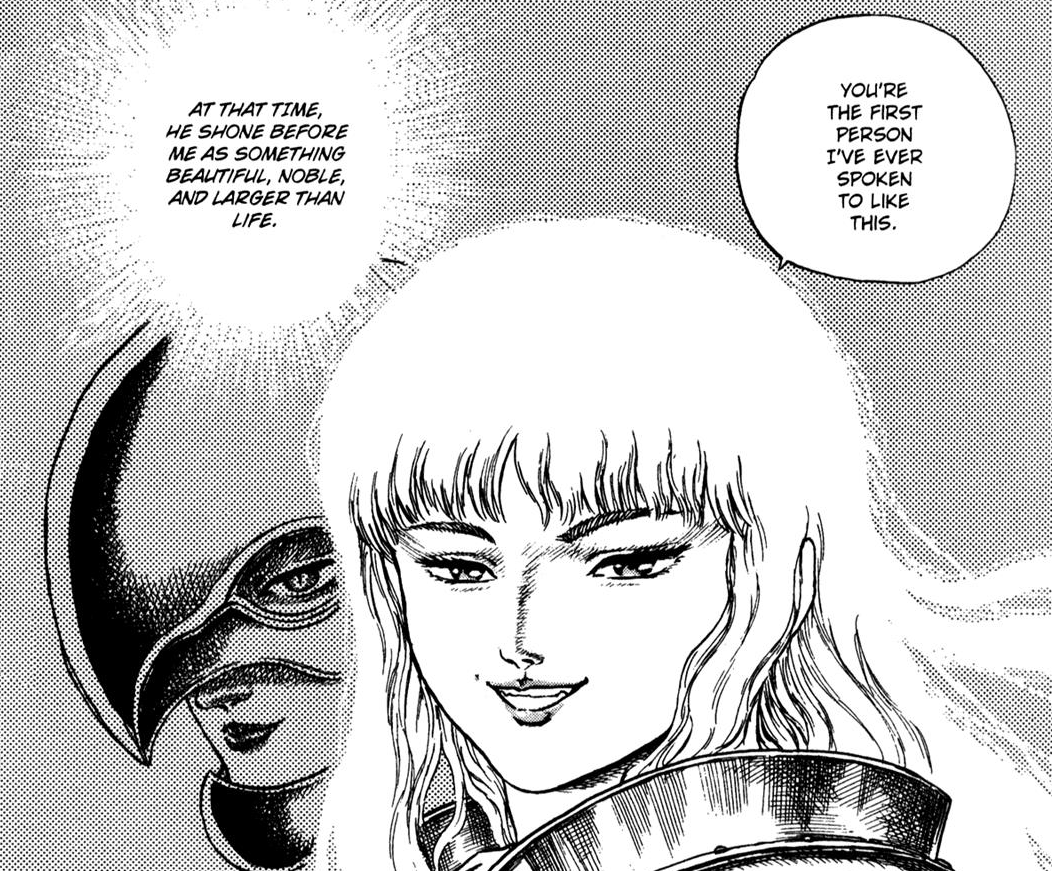
Look at the moment Griffith is remembering here: “It’s funny… you’re the first person I’ve ever spoken to like this.”
It’s ironic because we know exactly what Guts thought of him then, but Griffith is convincing himself that Guts hated him from the first glimpse he saw of the real Griffith, the Griffith no one else gets to see. The vulnerable, “dirty,” needy Griffith, the Griffith who questions his place in the world, the Griffith falling in love with Guts.
And like Guts, Griffith has no idea how Guts truly feels about him.
So yeah, this is why I think their feelings, all their feelings, from platonic to sexual and everything in between, are mutual. Because the point is that they’re two idiots who love each other but, thanks to their low self esteem, can’t see that they’re loved in return.
Which brings me to themes and shit, and why Guts and Griffith being sexually attracted to each other fits into Berserk like a puzzle piece.
Berserk is, at its core, about reactions to trauma. It’s right there in the title. Like every major adult character has childhood trauma that fucks them up. Serpico, Farnese, Casca, Guts, and Griffith.
When it comes to the Golden Age trio:
Casca was assaulted by a nobleman and saved by Griffith.
Griffith prostituted himself to a pedophile in a fit of extreme guilt while he was at most on the young end of teenaged, called himself dirty and self harmed afterwards.
Guts was raped by a soldier his abusive adoptive father sold him to.
Casca’s reaction to her trauma is to idolize Griffith as her saviour to the point where she has no sense of identity outside of him and helping him achieve his dream.
Griffith’s reaction is self-loathing, emotional repression (”I don’t feel guilty,” he says, while Casca begs him to stop hurting himself), and the beginnings of a vicious cycle in which he is driven to achieve his dream to make all the “underhanded” “dirty” things he does for it, and all the deaths on his head, worthwhile.
Guts’ reaction is his desperate desire to be loved and respected coupled with a mistrust of people.
All these traumas result in the bad decision pile-up that eventually leads to the Eclipse.
Guts’ desire to be loved and respected coupled with past experience making it all too easy for him to believe he’s not is why he ignores a mountain of evidence that Griffith loves him in favour of one overheard speech about how he has no friends, and then decides that it’s a good idea to abandon all his friends, including Griffith, in order to try to become his equal and earn his affection.
Griffith’s self loathing leads him to believe that Guts is abandoning him bc he’s desperate to get away from him after seeing some of his darker sides that he’s ashamed of. His emotional repression means he has no ability to understand or express his extreme emotional reaction to this. So he lashes out through a framework he does understand (”rules of the battlefield,” as Judeau says), then falls into despair, crashes and burns, and ends up in a torture chamber.
And Casca’s lack of identity leads to her transfering her obsession from Griffith to Guts – complete with sword metaphor – after they sleep together, which leads to her mistakenly prioritizing Guts’ previously expressed “dream” to go off and fight people, the same way she once prioritized Griffith’s dream, which leads to Griffith overhearing her telling him to leave, which leads to the Eclipse.
My point is that the Golden Age arc is basically the story of three traumatized people whose adverse reactions to their traumas fuck their relationships up. Because it’s a dark fantasy story ft gods and monsters and fate etc, fucking up their relationships results in the Eclipse.
This is a perfectly good story by itself. It doesn’t need sexual repression added to it, but at the same time, boy does sexual repression fit right in.
I think that, whether it’s intended by the author or not, Guts and Griffith are both extremely easy to read as repressed gay*** men.
Griffith’s got a whole narrative about his dream, a dream which he can only achieve through hetero marriage, being pitted against his love for a man. He does stupid irrational shit for Guts and Casca berates Guts for it because he could “take Griffith’s dream down with [him].” Overhearing him talking about his dream to Charlotte is what makes Guts decide to leave. Guts is the only one who makes him forget his dream. He has to sacrifice Guts, “burying his heart,” to attain his dream. Even when he becomes the saviour of the world as NeoGriffith, he still has to marry a woman to seal the deal on his dream.
The dream is associated with emotional repression and Guts is associated with emotional expression.
As for Guts, I just wrote over 10k words about his attraction to a man and 5k of those were about how his het romance revolves around his attraction to a man so I’m not going to reiterate all that. There are a few particularly noteworthy things about Guts and his narrative that scream repression to me though that I’ll mention.
The way it’s his deep, subconscious, instinctive id side, the Beast of Darkness, urging him to pursue Griffith, complete with a dark sexual undertone. (Relevant reminder: I’m only arguing that the gay is there, by accident or by design, I’m not arguing that it’s a positive portrayal lol.)
The way Guts’ statement to Casca after sex that only her touch was okay in the beginning is a) incorrect as I’ve shown earlier, and b) irrelevant bc the reason she was able to touch him was solely because she’s a woman, as we know from the way his burgeoning panic subsides when he realizes she’s not a man – and ever since then she’s been the only woman he knows. So it doesn’t feel like much of a jump to suggest that he had sex with Casca because she’s literally the only person he knows with whom sex wouldn’t automatically trigger him.
The way his matchmaking of Griffith and Casca seemed to be an attempt to get Casca to take his place, with the added layer of romance that he couldn’t envision for himself.
The way, in their first interactions, Guts seems transfixed by Griffith’s appearance, comments on his pretty face, suggests sex if he loses in a way that seems informed by his rape trauma, but then is once again entranced by Griffith, rather than angry or afraid or any other potential negative emotion you’d think he’d feel, when he does lose. This whole sequence gives me the impression that he wants to bone Griffith but can’t acknowledge it and can only relate the concept of same-sex desire to his trauma.
And, for both Guts and Griffith, the way their respective traumas are depicted is particularly relevant. I’ve explained how each formative traumatic experience gave these two a pile of issues that fuck up their relationship. But the thing is, none of those issues (for Guts a need to be loved and respected and a default belief that he isn’t; for Griffith emotional repression, guilt, and self loathing) are intrinsically tied to rape. For Guts, it’s Gambino’s betrayal of him that fucks him up, not the specific sexual nature of that betrayal. For Griffith, it’s the realization of the weight of his dream and the way he “dirties” himself for it – later examples of acts that make him feel “dirty” are assassinations, so there’s no narrative reason his first act has to be traumatic, non-consensual (as he’s a child) sex.
And this isn’t a critique of that, I actually think it’s great to see characters who have backstories involving rape without it being the sole thing that defines them. For every character it’s part of a tapestry of childhood trauma, not the only important part, or even the most important part.
But it’s really, really easy to fill in the blanks for how formative sexual trauma specifically also has a hand in informing the nature of and contributing to the destruction of Guts and Griffith’s relationship. We’re not explicitly shown or told this, but imo it is suggested when they first meet.
Guts makes the duel, and his first real meeting with Griffith in general, about sex by uncomfortably asking if Griffith’s gay and offering himself to him if he loses. Here either the narrative is choosing to deliberately point out that Griffith and Guts have some gay undertones going on in our introduction to their dynamic because this informs our understanding of the rest of their relationship going forward, or the narrative is choosing to remind us of Guts’ sexual trauma here because that trauma informs the rest of their relationship going forward. Or both.
It’s also suggested in the way we learn Griffith’s backstory with Gennon right before Casca finally expresses her jealousy of Guts and comes this close to telling Guts that Griffith is in love with him:
By revealing this backstory in the lead-up to this revelation of why Casca resents Guts, Griffith’s trauma and his feelings for Guts are tied together the same way Guts bringing up sex when he first duels Griffith ties his trauma to their relationship.
And the way these traumas may inform their relationship is that neither of them are capable of acknowledging or even recognizing their love and attraction.
Let’s be real here: if Guts and Griffith’s relationship was romantic there’d be no Eclipse.
This is what really makes the subtext and the idea that both of them are repressed dudes in love work for me. This is the number one reason I ship it: because they work so well together.
We’re shown exactly how compatible they are. The tragedy of the Golden Age is predicated on both of them failing to recognize the other’s feelings, but what makes it a real tragedy is the inherent lost potential when their relationship falls apart.
All Guts truly wanted was someone he loved, who loved him back and treated him with compassion and respect.
And he got that! That’s exactly who Griffith was to him, exactly how Griffith fulfilled his emotional needs.
Guts remembers the night he killed Gambino before dedicating his sword to Griffith. This is when Guts decides that maybe the Band – maybe Griffith – is what he’s been looking for. A home. Love. Someone to look his way – more than that, someone who cares about him enough to lay down his life for him.
This is the truest moment of Guts and Griffith’s relationship, imo. There’s no misunderstanding getting in the way and muddying the waters – there’s only Griffith admitting he had no reason to risk his life for him and casually saying he’d do it again (”each time I put myself in harm’s way for your sake”), and Guts recognizing how significant that is, and dedicating himself to him in return.
Right here and now Guts has everything he’s always wanted. Later he overhears the Promrose Hall speech and re-evaluates his relationship through a false lens, but as I said back at the beginning of this post, Guts eventually realizes that he was right the first time.
Now again this is less straightforwardly stated and relies more on my own interpretation, but I think Griffith’s corresponding issue that matches Guts’ desire to be loved is his desire to be truly seen and accepted.
He wants Guts to be privy to his dirty side and to want to remain at his side anyway. In order to fulfill his dream Griffith has to constantly project an image of perfection.
His reaction to Casca seeing him in a moment of extreme vulnerability is:
There are countless references to Griffith looking like something out of a fairytale, there’s his carefully constructed perfect-fiancee image he shows Charlotte, his perfect infallible leader image he projects to the Hawks. He’s a symbol to everyone – to the Hawks and the peasants etc who love him he’s a symbol of change for the better, of soaring up; to his opponents he’s a symbol of corruption and change for the worse, a “parasite.” To his rapist(s)*** he’s a symbol of perfect beauty. People either look up at him or down on him. When he says he has no equals, in fairness, it’s because no one treats him as an equal. In their last scene together before the speech even Guts had reframed a request from a friend into an order from a superior (”It ain’t like you. Just cut to the chase and order me to do it.”)
But Guts is still unique because he wants to be Griffith’s equal. He wants to “stand beside him,” he wants to consider Griffith a friend and treat him like a real person and not a symbol. And, more than anyone else, he does.
Guts dumps a bucket of water over his head in his first week with the Hawks while they laugh together. Guts disobeys orders constantly to the point where Griffith just plans around Guts’ impulses and Casca gets pissy about how much he gets away with. Casca sees Griffith as distant and unreachable after a battle, but Guts scoffs and takes her to go hang out with him. During their homoerotic duel, Guts punches him and says, “I bet that’s the first time that pretty face’s ever been hit,“ showing only irreverence for the image everyone else is obsessed with.
And this is the one man out of tens of thousands who makes Griffith forget his dream.
This is the foundation their relationship is built on. Love and respect, and irreverence and equality. They both come closer than anyone else to providing what the other needs. And they both help the other grow:
Griffith gives Guts a supportive environment, his trust and belief, his love and affection, and Guts grows into a responsible person who leads a group of men who freaking adore him, who cares for the people around him and lets them in instead of being standoffish, who is able, until an overheard speech, to accept that he is loved and that he has value.
Guts gives Griffith attitude, playfulness, irreverence, etc, and Griffith is able to trust him, is able to allow himself to be vulnerable around him and show his insecurities. He’s able to be himself with Guts.
Plus Guts makes him forget his dream. And Griffith’s dream is bullshit, it’s absolutely terrible for him, it’s a huge weight on his psyche, it’s built on guilt and a need for validation from the universe. But after three years, it’s Guts he turns to for validation instead. Griffith asking Guts “do you think I’m cruel?” is so pivotal because in that moment Griffith’s desire for Guts’ regard outweighs his dream. Guts has to remind him about his dream, and that reminder hurts.
Griffith raises Guts up and Guts brings Griffith down to earth a little, and they come so close to meeting in the middle – but, to bring this post back to my point, they never quite do.
Guts brushes off Griffith’s attempts to treat him as an equal (asking him to help him out by killing a man and Guts telling him to order him to do it; asking if Guts thinks he’s cruel and being reminded of his dream; Guts becoming blind to Griffith’s showings of love after overhearing the speech) and Griffith doesn’t seem able to recognize or admit his own feelings for Guts until spending a year in a torture chamber.
But yk what if they could’ve just fucking boned at some point all those problems would’ve been solved. Literally. That’s my argument in a nutshell: if Guts and Griffith could’ve recognized their romantic and sexual feelings for what they are, and acted on them, they would’ve lived happily ever after. And if they didn’t both have significant trauma related to same-sex desire, not to mention all the other traumatic factors contributing to their awful emotional intelligences and self esteems, they probably could have.
Realistically of course that’s not how relationships work, there’s never any happily ever after guarantee, but this is a story, and we’re given enough information about their relationship to draw the corresponding conclusion that if they were open about their feelings with each other, if they had grown closer instead of being pulled apart by misunderstandings, they would’ve been very happy together.
And I don’t mean to say that sex would automatically fix everything either – just that the story implies that if they had both been able to recognize that their feelings of love and adoration were returned by the other, Guts wouldn’t’ve felt the need to leave to earn Griffith’s friendship through finding his own dream, the second duel wouldn’t’ve happened, and Griffith wouldn’t’ve ended up in a torture chamber for a year. And being able to take the step to turn their relationship romantic and sexual is a natural part of figuring this out.
And while there’s no real reason Griffith would have to choose between his dream and Guts, it’s worth pointing out that the driving conflict of his narrative is Guts vs the dream, and Guts effectively wins.
Guts was replacing the function of the dream in Griffith’s mind. Griffith was beginning to seek out Guts for validation instead of trying to prove himself worthy by achieving an arbitrary goal. He says Guts made him forget his dream. In the torture chamber he reflects that the dream grows dull next to Guts.
Would he have been able to give it up and find contentment in a relationship with Guts? It’s a hard sell, but we’re shown the building blocks that support this conclusion. We’re explicitly told that Guts is more important to him than his dream, so yeah, absolutely in theory Griffith could’ve quit the stupid dream given a choice between it and Guts. Hell we saw him make that choice when he risked his life for Guts during the Zodd thing. And if you believe that part of his motivation for sleeping with Charlotte, at least subconsciously, was self-sabotage, he threw the dream away then too.
The Godhand only came down to offer him the sacrifice option when Griffith believed Guts was going to leave him again, and even then he had to be physically separated from Guts, had to be totally physically helpless and mute after a year of torture, and had to be taken on a fun guilt trip by the Godhand before he sacrificed him. And the final emotional reason Griffith chose to sacrifice Guts wasn’t because the dream was more important to him, it was because Guts was. “You’re the only one… who made me forget my dream.”
So yeah I think it’s absolutely possible, even plausible, that if Griffith was more self aware and capable of recognizing his feelings and acting on them he would choose Guts over the dream.
And obviously if Guts got together with Griffith – if Griffith gave up his dream for Guts, or prioritized Guts over his dream by, say, choosing him over Charlotte, or maybe even something as low-key as Griffith jeopordizing his ambition by beginning a relationship with Guts behind Charlotte’s back – Guts would know exactly how much he meant to Griffith, a la the rooftop scene. The speech would be meaningless in comparison to Griffith risking or losing the dream for him. Guts would be 100% secure in the knowledge that he is valued and loved.
But, thanks to Guts and Griffith’s traumas, they failed to recognize the possibilities in their relationship, they fell victim to self-doubt and insecurities, and they ruined everything. And that lost potential is what makes the tragedy so effective to me.
Like I said, this is already what their story is about, subtext or no subtext, platonic or romantic. Griffith could’ve chosen Guts over his dream platonically too (again), in theory. But the subtext adds another, very fitting layer to the story. It slots in neatly with the concept of missed opportunities and lost chances, and it fits with the characters’ histories and particular sex-related issues. And, having just written a 10k series of posts pointing out about half the subtext (Guts’ side), I think there’s a solid argument for considering sexual attraction part of the package.
One final thing I want to mention, from an out of universe perspective, is that one of my problems with Berserk is that every single textual instance of same-sex desire is evil and predatory and harmful. So I like the idea that the absence of gay sex between our two main characters
is what caused the Eclipse. Their mutual desire (or Griffith’s ~evil jealous~ desire) didn’t cause everything to go wrong, it was the fact that they failed to act on it that ruined everything. It doesn’t balance it out obviously, but reading the story this way just makes it more enjoyable for me.
tl;dr in conclusion Berserk is gay, Guts wanted to bone Griffith, and if he had Berserk would’ve been a much happier story.
*** I’m saying “gay” because this is my project and I hc both of them as gay. But if you see one or both as bi, more power to you.
*** The torturer’s “we were like husband and wife” sounds pretty suggestive to me but it’s left in creepy implication so who knows.
Thank you everyone who has read, liked, reblogged, and/or commented directly or in tags, etc ❤
fun fact guts has always had a dream and it’s not “fight tough dudes at exhibitions” or “fight monsters” or “avenge the hawks” or “be the best at the sword”
griffith’s dream:
guts’ dream:
guts’ dream:
guts’ dream:
guts’ dream:
which is why this is so utterly cutting:
and why this just left guts totally dejected and made him give up that dream:
and why if guts finds out that griffith’s heart is bthumping for him that’s going to be either a serious game-changer, or a serious test of guts’ resolve in moving on from his dream.
Time to finally lay out my thoughts on these parallels and contrasts between Gambino, Griffith and Femto/NeoGriff.
Ok so starting with Human Golden Age 100% Certified Organic Griffith, even tho the parallels start off strong in the Black Swordsman arc, whatever, we’ll go chronologically.
So I remember saying that I had many thoughts on this but going back an examining them I found that pretty much all of that was mostly just me agreeing with the things you had already gone over in your post.
One thing though, Guts visualising Griffith in the moon is kind of a very interesting image for me. Because we have two other strong instances of similar imagery. The night Guts kills Gambino and at the end of Run he makes from Godo’s cave post-eclipse. In both cases he’s down, flat on his back, exhausted, doubting everything he’s ever known, not having any particular desire to go on.
And just then he looks up at the moon, and slowly pulls himself up again.
The presence of the moon almost seems to galvanise his actions and light up the way for him. Guts in that moment, seeing Griffith’s face in the moon and dedicating his current life path to him kinda seems like a symbolic extension of this fact.
Actually It’s interesting how Griffith is visualised in Guts head as to do with sources of lights, On the stairs of promrose hall he appears like a beacon, visualised as light at the end of the tunnel, as an inferno, as the moon, campfires, “Dazzling”, “burns so bright”.
Guts is one of the maybe only characters who has never compared Griffith to inanimate things or commodities- Never a doll, painting, statue, fine wine, idol or sculpture.
Fires are quite alive.
Nice! I’ve been checking out the moon imagery as I read and scratching my head ngl. I feel like the full moon represents fulfillment of some kind. Magic is at its strongest, moonlight kid shows up, Guts finds the will to keep going, Guts dedicates his sword to Griffith, etc.
Conversely, the eclipse is technically a new moon, and non-full moons appear prominently occasionally during signficant moments like Guts and Griffith’s last assassination together, Sonia’s chapter on loneliness, Rosine flying back home and dying, Ganeshka leveling up to Eldrich Abomination status (”on a night when you can’t see the moon”), etc
But idk it’s not completely consistent or anything and it’s nothing I can draw conclusions from.
Also gooooood point about Griffith as a source of light to Guts I don’t have anything to add to that, but it’s perfect.







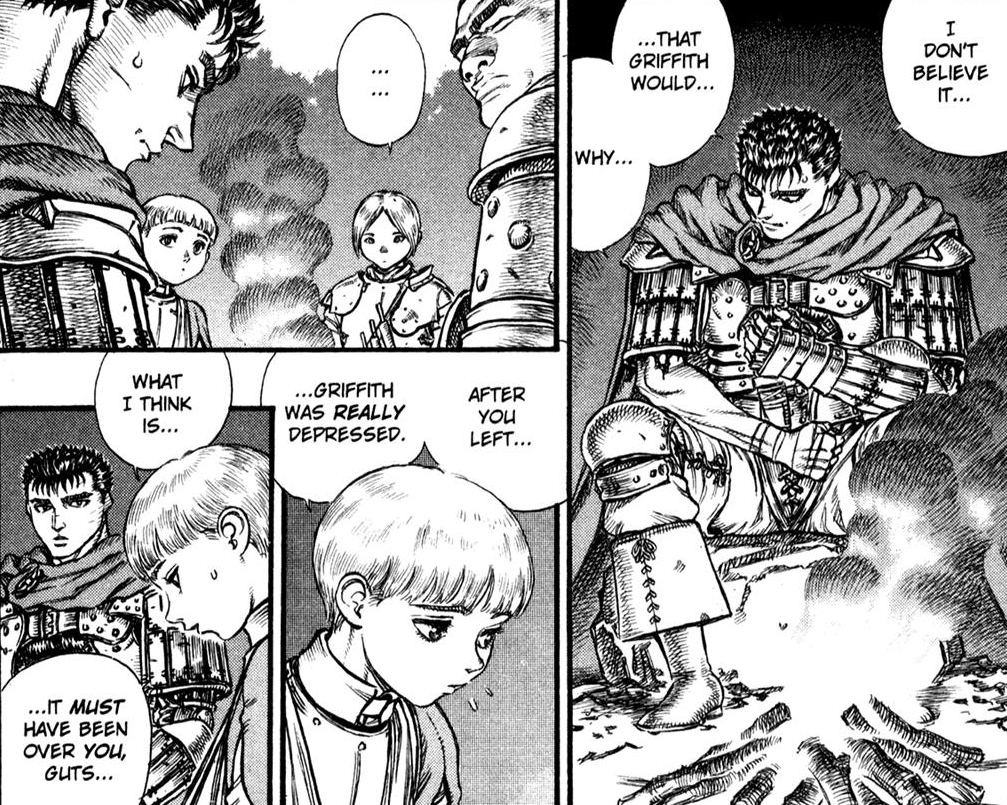


 you're the only one