yeah that is such a huge issue i have with like, everything post eclipse.
i mean i feel like, idk there are a few moments that suggest that rather than just fixing guts’ trauma and then immediately replacing it with eclipse trauma, it’s more that the eclipse echoed his childhood trauma and compounded it. i feel like that might’ve been miura’s intent even. eg:
And it absolutely was his clear intent during the Black Swordsman arc. But I feel like Miura let this just kind of, like, fall to the wayside, and totally failed to follow through on this idea through actual characterization, instead deciding to completely downplay Guts’ actual personal trauma.
Like there are so many moments that by rights should’ve referenced Guts’ csa trauma that glaringly ignored it. A big one I’m thinking of is when Guts assaults Casca. Like come on, he had a violent flashback during consensual sex with her and you’re telling me it’s not even on his mind after nearly raping her? Or maybe yk at some point during that arc right after the Eclipse that was all about child abuse and Guts becoming a monster. Or maybe during the actual Eclipse itself. At least show us that paralyzing fear that was strongly implied during the Black Swordsman arc instead of boring one dimensional outrage.
Well, not like I can argue that sexual violence is handled well in Berserk. Tangential, but I once read a book where shit was a motif. Like, literally shit. And that sounds super gross but the author knew what he was doing and it served a very intentional literary purpose. I would have (quietly) been okay if Miura was doing something similar, but it really does seem like he just breaks out the rape card whenever he needs to up the stakes.
imo the really annoying thing about rape in berserk is that sometimes it actually is well done but most of the time it’s… just not lol. Like I think Guts and Griffith and Casca’s (with a few caveats) backstories all work really well, depicted in varying degrees of graphic but for the most part effectively so, they inform the characters and their current values and motivations, and thematically their backstories potentially inform like, the entire story.
Which imo just makes it worse that so much of the rape we see in Berserk is so badly done and gratuitous. Like as a theme I think it could’ve been strong and effective, and like, sometimes it is, but overall there’s way more bad than good. So yeah I p much completely agree with you.
and lol I’m kinda curious now, what book was that?
I guess I’ve always assumed the Eclipse rape was there to give us a reason to hate Griffith. Like, in another setting committing murder would be “crossing the line” into villainy. In a story where all the dewy-eyed still-innocent major characters are also hired killers, escalation is bound to get awkward. Given how sympathetic Griffith’s storyline otherwise is, it feels like a effort to say “no really, this is supposed to be morally complicated, stop rooting for him.”
Yeah I don’t think you’re wrong about that. Though more than anything I think it’s meant to give Guts specifically a reason to hate him lol, because the way Miura wrote the sacrifice and Guts’ reaction to it
sacrificing him wasn’t nearly enough.
I mean personally I think the sacrifice could’ve still worked fine on its own if Guts had actually like, demonstrated some extreme feelings of betrayal, which I feel like he should’ve, because the sacrifice is meant to be an echo of his childhood trauma of being sold imo, and I feel like Miura kind of dropped that in favour of the more immediate shock value.
Like it wouldn’t’ve been enough to get me to hate him, but I’m kind of an exception lol, I feel like Guts expressing heartbreak and betrayal that echoes like, the scene where Gambino told him he sold him to Donovan, probably would’ve worked okay for most fans to make them at least very angry at Griffith/Femto.
Buuuuut you’re right that like, he is really sympathetic otherwise and Guts wanting to chase him down and kill him while he’s orchestrating world peace and ruling a utopia might make Guts seem less sympathetic without that visceral show of evil during the Eclipse to “justify” it. But then the Eclipse rape goes so far in the other direction that it completely fucks up the balance too. So idk.
I guess if I was writing it and I felt like the Eclipse needed something extra to prove that Femto is evil, which is fair since he’s supposed to be Griffith’s inner darkness with an additional boost of humanity’s evil in general, and you probably do want to demonstrate some of that, I’d opt for like, torture + maybe some magical mind torture or something if Casca needs to be driven insane, because that’s the kind of ott fantasy evil that none of the Berserk readership will have personally experienced. Rape as a gratuitous demonstration of evil has a whoooole lot of baggage that makes writing that character as a morally ambiguous antagonist later on extremely terrible imo.
tl;dr basically ia, I think the purpose was to immediately show how evil Femto is and make the readers and Guts hate him, and I mean it worked I guess lol, but I still think it was a bad decision and Miura should’ve done something else.
suddenly had the realization that we didn’t really get to see much of Griffith post-torture. Like yeah, he was there, we saw him, we got a great monologue about how in love with Guts he is, but what I mean is that like, all his trauma and all the pre-eclipse emotional devastation revolves around his permanent injuries rather than, yk like, ptsd.
We aren’t shown at all how the fact of being tortured constantly for a year might have traumatized him. Like everyone’s fucked up by the fact that he’s no longer physically capable of leading the Hawks, but like, even if he was, would he have been emotionally capable?
I mean a year of torture is huge, for any other character that would be the defining event of a narrative, whether he could physically recover or not. But Miura just kind of bypasses it entirely to focus on his physical dependency and his feelings for Guts. And I mean I love those feelings, I’m not complaining about the focus on that, but the lack of trauma wrt a year of experiencing extreme pain is kind of conspicuous.
Idk it feels like the torture was just kind of Miura’s convenient lead-in to the Eclipse and way to destroy Griffith’s dream, and it feels a little unfortunately shallow overall. Like he could’ve even just had a reference or two to how being tortured for a year might have affected him – like say Ubik using it to help convince him to make the sacrifice: doesn’t being an incorporeal being who can’t feel pain sound p tempting right now?
Also relatedly, consider this:
NeoGriffith isn’t just Golden Age Griffith transformed into a demon transformed into a mysterious wildcard. NeoGriffith is Golden Age Griffith + a year of torture transformed into a demon transformed into a wildcard. Like his “base” isn’t the Griffith we came to know and love over however many chapters of the Golden Age we got before Guts left, his base is, theoretically, an incredibly traumatized version of that Griffith we know.
Idk I just suddenly found myself wishing for more emotional/psychological exploration of the effects of that year of torture, and it made me wonder about NeoGriffith’s memories of being human. I feel like there’s potential there. I feel like there’s some thematic follow-through, along the lines of him being “beyond the reach of man” and Ganeshka’s empty threats, but some hints of emotional follow through would be v interesting.
tbh I actually love it in the Black Swordsman arc bc I don’t think it was meant to be anything particularly significant, like, plot-wise (tho lmao i wish, but it’s probably only a coincidence that it looked kind of like a fetus lol)
I think it was just supposed to be a recurring demon that represents like, the self destructiveness and futility of Guts’ revenge rampage. like a proto beast of darkness but instead of being scary and cool it’s just sad and pathetic. the twisted remains of yourself after you’ve been consumed by revenge.
which i say mainly because of that one image where guts sees it with vargas’ face. but also if you re-read its early appearances with that in mind it fits very nicely with the rest of the black swordsman arc’s themes and the way it unnerves guts more than anything else he sees, and the way it appears when he’s feeling self-doubt and fear of failure, makes a lot of sense.
also his chapter 2 nightmare where it chases him works super well with that in mind. This nightmare is later echoed by his chapter 13 nightmare where it’s a monstrous representation of donovan chasing him, which is echoed again after Guts kills Adonis and sees himself as that monster. It’s very neatly cyclical – chronologically, it goes Guts’ own personal monster followed by Guts’ fear of becoming a monster followed by Guts well on his way to becoming that monster. And I just love that the fetus thing isn’t a cool monster, it’s just pathetic, which is perfect in the Black Swordsman arc where Guts is paralleled to Vargas.
relatedly it’s really off-putting to re-read the scenes where it appears after miura retconned it into being his weird demon kid lol. Totally fucks up that interpretation. Like you can maybe read it as a reminder of Guts abandoning Casca/his repressed guilt over it, but I have no idea how that’s supposed to work with the nightmare, or the direct comparison to Vargas, etc.
Maybe it still kind of works as a symbol of Guts becoming a monster in that the fetus is is all demony because it was corrupted by Femto or w/e, but like… considering all its later appearances are helpful and protective rather than sinister, it really doesn’t work for me. It’s a big mess.
Can I just say all of chapter 2? I was tempted to go with the end of chapter one as a character establishing moment, yk Guts looking scarier than snake man as he gleefully tortures him, but honestly chapter 2 is where it’s at when it comes to Black Swordsman Guts.
4.
Guts finally, somberly realizing he shouldn’t’ve left, telling Judeau and Casca he’ll stay with Griffith, both of them telling him to leave because he did such a thorough job of proclaiming he’s got a nobler goal and separating himself, just hammering home how it was a mistake.
3.
This is a double feature because I couldn’t decide between these two scenes and they essentially say the same thing anyway:
and
Guts haunted by the fear and temptation of becoming a monster. I love the sewer nightmare, especially coming right before Promrose Hall. The way it conflates Zodd, Donovan, and Guts after he kills Adonis. Guts’ self-loathing here informing why he reacts so badly to the overheard speech too.
And then after Rosine and a fun child-killing spree, these ghosts voicing his inner thoughts. The self-loathing, muddied by the temptation of giving in and following in Griffith’s footsteps, ironically the same choice he made after Promrose Hall. Griffith’s dream made him a monster, and Guts’ dream is doing the same – and the Black Swordsman content is absolutely Guts pursuing his own dream, to fight stronger and stronger opponents.
2.
Guts channeling all his painful feelings into rage here. I can’t really say the whole rampage through Midland lol, there are moments I like less, but definitely the start of it, the reunion in the depths, killing the torturer, one man army-ing up the stairs and out the door. It’s just so good. Exactly how Guts avoids dealing with his feelings, really awesome to watch, nice sense of protectiveness, and excellently illustrative of how devastated he is to find Griffith after a year of torture.
1.
Guts finally, finally beginning to accept that he’s found a new home, the place where he belongs, here with the Hawks and Griffith, after Griffith risked his life to save him from a monster (in a particularly meaningful contrast to his childhood). Finally beginning to move on and heal a bit. This is the moment of greatest potential for Guts and p much the pinnacle of his life and it’s so effective at putting the reader and Guts at like, a height from which to fall.
Bonus 6:
This only gets a bonus spot bc I’ve mentioned it a few times before as one of my favourite Guts moments and I don’t want to be too predictable lol, but it’s so good. This whole scene. Guts ostensibly wanting to fight Femto but more than anything wanting his attention and only being spurred on to even stand up when Femto says that.
this is absolutely me projecting my own interp of griff but i feel like this reaction is an “i get asked this way too often and it bothers me bc i don’t want to have to answer it/bc i’m p sure i know the answer and i’m trying not to think about it”
tho to be more fun I could also see “shit was i that obvious?”
or “oh no, he’s straight.” (luckily he’s wrong)
also his reaction in the ova is more along the lines of “yes, dumbass.” or actually i think guts’ q there was ‘in what way’ so it could also be like, giggling when the hot person asks if you like them but playing it off bc you don’t want them to know you like them. I mean they are basically awkward teenagers lol.
and i guess on a more meta level i can say that the fact that griffith doesn’t answer is like, so telling. i have no idea what miura wanted me to think here if he didn’t want me to think griffith was gay. he could’ve easily had griffith say something like ‘no’ or ‘don’t be ridiculous i’m talking about your fighting’ or whatever. or, yknow, not brought up the question at all lol.
Like ok in response to that one ask yesterday I talked about how Guts is projecting his trauma here a bit, so in theory that’s why it’s brought up and why Griff couldn’t immediately shut him down, but honestly – it’s immensely unnecessary. Guts changes his tune immediately after losing lol and they become mutually pining bffs like a week later. As set-up to make Griffith seem more threatening before switching to portraying him as a good guy, it’s unnecessary bc we’ve already seen femto, he’s already imbued with a lingering senese of threat from the bs arc. Plus, yk, it’s homophobic and annoying, playing into that predatory gay shit.
There’s got to be more to it than that, or it’s like, plain old shitty writing. So that’s why it’s also an early indicator of the true nature of their relationship, and neatly foreshadows how trauma makes it impossible for them to see it. Because that takes it from bad writing to good, layered writing.
idk what miura intended but i like Good Berserk so idc.
honestly no, or at least, not in the way you probably mean. and this isn’t me being a griffith apologist and reaching to make excuses for him lol, this is me looking at each scene and getting a very different conclusion from them. like i really just don’t think they logically add up to griffith turning into a rapist demon when you examine each scene you mention, even though it’s admittedly a really really easy connection to draw at a surface level and I can see why people do draw that conclusion.
tho i guess the first duel is actually kind of a “sort of,” to be fair.
at this point the golden age stuff is really hardcore calling back to the black swordsman stuff in an excellent way, and making some v overt comparisons between Griffith and Femto, largely for the sake of… well, for the sake of establishing both similarities and eventual differences.
Griffith’s narrative is a gradual tearing down of our (and Guts’) expectations about him – we start with this larger than life mythical sort of figure who we already know eventually betrays Guts and becomes a demon, so we begin with showing his ambition, his drive, the deference his followers show him, his ability to take out Guts with one parry, etc.
He literally starts out as basically the same antagonist we saw a few chapters ago, at least in Guts’ eyes:
Like, this is meant to show the singleminded obsession that we’re led to believe is why he betrayed Guts to become a demon.
But it’s also a set up for a later revealing subversion of expectations:
In all fairness to Griffith, Guts is the one who gave him the chance to win his loyalty in a fight. Griffith didn’t demand he fight for his freedom or anything lol, he just asked Guts to join, was taken aback when Guts refused, and then leapt at the chance Guts provided to win him in a fight. He even offered to wait a while until Guts had healed more. That’s like, consent right there.
But by taking Guts up on his ridic offer he is definitely kind of pushing the limits of this whole need he has for people to freely choose to follow him, which is also an early sign that Guts is extra special.
Anyway the more overt rapey overtones to this fight, ie Guts basically offering sex slavery if he loses, say more about Guts from a characterization standpoint than they do about Griffith. Griffith is like, lol sure, clearly having no actual intention of taking him up on the sex offer.
But coming after a) the Black Swordsman arc, and b) Guts’ childhood, what this exchange does is draw a comparison between Griffith and the men who abused Guts as a child, both to the reader and in Guts’ mind. (I would argue that this is why Guts insists on fighting him – after Griffith one hitted him Guts is actually scared of him, and his rape trauma informs how he interprets and responds to fear. But I digress)
And again, this is both subverted and played straight. We should’ve already been able to draw comparisons between Femto and Gambino. We’re told about the sacrifice, told Griffith sacrificed Guts, then shown a flashback to Guts’ childhood in which his trusted father figure sold him to Donovan. That’s our explanation for Guts’ vendetta against Griffith/Femto. The sacrifice was a replay of his childhood trauma, and it fucked him up. And our introduction to Griffith here, with Guts projecting his trauma at him, plays off that.
The subversion is in the fact that Guts basically falls in love with Griffith, or insert some platonic phrase meaning essentially the same thing here, because I’m trying to be as objective as possible here lmao. It’s not another Gambino situation where Guts loved him because he was his father and the only family Guts knew, Griffith earns Guts’ love. Griffith is loveable, frankly. He risks his life to save Guts after a week, he‘s put together a merc group that behaves more like one big happy family than like a bunch of hired killers, and Guts spends the three happiest years of his life with him.
We also have Casca’s running commentary helpfully informing us that Griffith’s feelings for Guts are genuine because he’s acting very out of character around him already.
Like to bring this home, Griffith’s narrative is:
to
One reason it was so brilliant to start with the Black Swordsman arc is because it reverses the expected narrative – instead of being shocked when a character we love decides to sacrifice Guts to become a demon, we’re surprised over and over again when a character we were introduced to as a villain turns out to be motivated almost entirely by his intense, very human, very vulnerable, very sympathetic, love for Guts, rather than the expected sociopathic ambition. (And even that ambition has a very human, very vulnerable, very sympathetic source, ie, guilt.)
And, basically, the first duel starts this narrative off by emphasizing the qualities we expect to see in Griffith while simultaneously sowing the seeds of the qualities we end up surprised by. Hence the exchange that emphasizes Guts’ rape trauma – because it also foreshadows/calls back to the sacrifice.
tl;dr the first duel is rapey as part of a comparison between Guts’ childhood trauma and being sacrificed eventually, and it serves as a starting point on which Miura builds a shitload of complexity and basically immediately begins tearing down the image of Griffith as a haughty evil sociopath. Plus at this point idek if Miura had the Eclipse rape in mind – he’s mentioned he decided to have Guts and Casca get together for the sake of more Eclipse drama partway through, and this is pretty early on.
Okay, that’s one out of three. Now, as for scene #2
no I’m kidding, I’ve already written a lot about the other two scenes so I’m not going to reiterate it all here esp since my first answer was already way too long lol.
So I got a more thorough explanation here, but basically the narrative treats the night with Charlotte as consensual sex despite her “no,” and therefore I do too in my reading of the narrative, it’s shitty but so is Miura, the end. Like, I consider this scene the equivalent of Guts grabbing Casca’s tit during an argument. Yk, was that foreshadowing for Guts sexually assaulting her (again but in a dramatic scene next time), or was it Miura being a dumbass?
The super short version of that is that Griffith does have issues with consent – his own – and if you tilt your head a bit you can argue that it might inform the Eclipse rape as a reversal of power dynamics. But it’s not a preview of it, it’s a contrast.
One thing I’ll finish with, though, is that there is a scene that I think can arguably foreshadow the Eclipse rape better than any scene you mentioned, and it’s chapter 39.
This is my very very thorough explanation of it (in like the last 3rd or so of that post), but long story short everything Griffith calls the king out on is something he hates/fears about himself, and I would definitely argue that this scene shows the guilt + self-loathing Griffith feels after trying to keep Guts at his side by force, through a really unsavoury parallel to the King’s predatory lust for Charlotte, as well as the parallel between how their respective “rejections” destroy them.
So yeah, if there’s any scene that I think foreshadows Griffith’s inner darkness being rapey, it’s Griffith comparing himself to the King in a fit of self-loathing. But there’s a reason my explanation is like a million words long lol, it’s pretty subtle, and therefore kind of hard to state definitively.
Okay, and one very last thing to throw out there as a conclusion to this mess:
The Eclipse rape only has the shock value Miura wanted it to have if it’s a contrast. It’s there to demonstrate that new Evil Demon Griffith is a bad dude who does horrible things Our Griffith wouldn’t do, and draw a hard line between regular human Griffith and Femto, which is also what enables Guts to express his feelings thru murderous rage.
This is lost on a lot of fans because people are really, really eager to see Griffith as Pure Evil The Whole Time, but straight up, objectively, that is what the text is going for – the Eclipse rape is a defining character moment for Femto because it’s a harsh contrast to the Griffith we, and Guts, have come to know and love. It’s meant to shock the reader and make them – or remind them to – hate Femto lol, it’s not meant to give them a pat on the back and tell them they were right about Griffith being an evil predatory gay all along. That’s just a very unfortunate side effect.
Whether by accident or design (since yk from the sounds of it Miura wrote the first chapter or two before really figuring out where he wanted to go with the story) I actually consider the opening few pages to be very in character lol, which might be an unpopular opinion, idk.
Consider: it fits perfectly into Guts pattern of self-destructively doing whatever it takes to get close enough to his enemy to blow their head off. He’s deliberately let monsters throw him around, break bones, shove him through walls, eat him, and stab him just so he can maneuver himself into position to take them out. This is an apostle that likes to fuck her victims, ergo.
It also like… actually I’d never thought about this before so bear with me bc this is going to get rambly, but damn it’s actually perfect, because it also makes the connection between Guts’ sex related issues and his stupid monster fighting rampage very direct on page one.
Like if that’s not purposeful then Miura accidentally hit it out of the park with our intro to Guts. But actually it’s gotta be purposeful. Even if it’s just to equate Guts’ particularly phallic violence (big sword, shoving his fist into the monster’s mouth mid-sex and blowing her head off) to sex right off the bat because Miura wants to like… well I think it’s part of what Miura wanted to kind of examine. Swords are dicks in Berserk, just like they’re dicks in a lot of action stories. But what does that mean – why? What’s the connection between violence and sex that makes that imagery fit?
And the answer here is Guts’ rape trauma. Liiiiike ok I completely think that Guts lashes out at enemies, particularly enemies that are bigger and stronger than him, particularly monsters once he learns they exist, because of that trauma. He is very driven to destroy anything that scares him, and that’s the root of it. Monsters scare Guts, we see this very viscerally during the first Zodd encounter and the Wyald encounter, and (particularly after he abandons his emotional support in the snow) Guts is driven to destroy them.
So like on one level Guts fucking the apostle is like, a hook for the dudes and a surface image for Miura to unravel: cool manly action hero bangs chicks and kills monsters, sometimes at the same time! On a character level, it’s a self-destructive strategy to get close enough to kill her because Guts absolutely isn’t the kind of cool hero who regularly bangs chicks, he’s the kind of dumbass who would do anything to kill a monster. And potentially on a thematic level it’s a story opening that primes the audience to equate sex and sex related issues to Guts’ monster killing revenge rampage, ie set up for an undertone of Guts lashing out not because he’s righteously angry or a hero who protects the innocent and kills evildoers, but because he’s traumatized and killing monsters makes him feel better.
(god that panel is gr8 shorthand for everything i want to say lol)
Or idk maybe it’s not that deep. But damn it now I’m definitely going to include this scene in the next big meta post I write about Guts, his dream, trauma, and his relationship with Griffith.
Anyway I definitely 100% believe the first bit I said, about it being in character for Guts because it’s a self destructive ploy to kill her. The trauma theme stuff is more of a stretch but it’s worth thinking about.
(Also lol @ Guts being faithful to Casca when he left her to rot in a cave for two years. I mean they had sex once and the last significant interaction they had before the Eclipse was Casca essentially breaking off whatever form of relationship they’d begun.
I feel like people reach for that bc they need an explanation for why cool badass protagonist Guts is basically celibate and has never expressed attraction to a woman other than casca (and tbqh casca’s debatable), but honestly it’s cause he’s gay.)
This is a topic and a half lol. Ok, I have many many thoughts, and I’ll try laying some out.
To start, I’ve seen the heacanon that his mother was a prostitute a few times and tbh it makes a lot of sense to me and seems v plausible.
But also I don’t really get any indication that he views sex as a way to control/own others, at least not pre-Femto. I’d actually argue the exact opposite, that throughout the Golden Age sex for Griffith is indicative of his own powerlessness relative to others. Sex, to Griffith, is something that he can trade to people more powerful than him for something in return – or something people take from him.
(I mean you can argue that seduction and trading sex for power/security/etc is a way to control people, but everyone Griffith does this with has more societal power than him and Griffith never pursues sex with them for its own sake, so to me the dynamic comes across as less rakish rogue using sex to get what he wants and more csa victim with a warped view of sex as something to trade for the things he needs.)
under a cut for length and yk the whole topic
Gennon was straightforward prostitution, plus Griffith was a literal child whose guilt was taken advantage of by a pedophile. And as Griffith’s first sexual encounter we see, it certainly sets a tone and establishes the beginning of a pattern.
Later, as a villain, Gennon’s goal is literally just to rape Griffith, and Griffith is very aware of this, since he incorporates it into his battle plan. There’s also some indication that he’s been overtly getting his creep on for years on end, possibly explaining how Griffith knew Gennon would shoot himself in the foot just to get to him:
So Gennon is both a sexual threat and someone with power who gives Griffith something in exchange for sex.
Charlotte is a princess he has to seduce to realize his dream.
And when he does have sex with her I’d argue that it’s basically an attempt to escape from his feelings (rejection, need, self-loathing, being in love with Guts) through refocusing on his dream (which is consistently his alternative to and escape from Guts), essentially irrationally trying to prematurely seal the deal on the “transaction.”
It’s the sex version of this:
And it also negates every scrap of power he clawed his way up to and lands him in a dungeon.
Next you have the torturer and his incredibly creepy suggestiveness, which makes Griffith’s sexual victimization here technically subtext, but I mean, “we were like husband and wife,” the Gennon-like fixation on Griffith’s beauty, the tongue thing, the uh speculum he was holding in his introduction… it’s not subtle subtext.
Then when Griffith makes a move on Casca in the wagon he’s offering himself to her because he’s entirely out of options and kind of desperately grasping at something, now sunk from trading sex for a kingdom to trading sex for a caretaker, painfully highlighting his complete and total lack of power at this point in his life, and the future he envisions should she take him up on that offer makes him suicidal.
So like, four out of four sexual encounters we’re aware of pre-Eclipse focus on his vulnerability and powerlessness, then he turns into an evil demon and expresses his newfound power and invulnerability(/frozen heart) thru rape. So yk, there’s a thread there to pick up theoretically.
I mean I honestly have a really difficult time ascribing any meaning
to the Eclipse rape beyond assuming Miura wanted a cheap + shocking way
to piss Guts off, write out Casca, and presumably get himself off
judging by how he drew it, but yk… take the rest of the Golden Age and
the general concept of Griffith’s inner darkness raping Casca, the last person he felt that sexualized powerlessness to, while
ignoring the depiction of the actual scene, and you can read some amount of depth/cycle of abuse stuff into it. That was probably at least part of the point, if I’m being generous to Miura and his writing.
(Really given the amount of content in Berserk that
revolves around sexual violence you can read a million things into the
Eclipse rape. But yk if Miura wanted me to do that, he shouldn’t’ve
treated it like a sudden detour into actual porn. Ok mini rant over.)
(Oh I should probably add that obviously Casca was in no way complicit in Griffith feeling vulnerable to her there lol and I’m not suggesting she bears any responsibility at all. Griffith in the wagon and his subsequent dream was basically him projecting a bunch of issues on her. I feel like that goes without saying but I want to cover my bases.)
Then you get NeoGriffith with his magically heightened literally untouchable, beyond the reach of man vs an army of monsters is basically in love with him stuff.
There is approximately 0 chance the placement of that “hunger and thirst” panel is accidental js.
But now Griffith has all the power. His beauty and magical sex appeal can be used as a tool without Griffith ever having to make himself vulnerable.
(Also speaking of using sex to control others… like I don’t think it fits human Griffith based on what we see in canon, but imo there’s plenty of room to explore that with NGriff.)
This isn’t a real threat, Griffith can just go “lol” and completely destroy him without breaking a sweat. Now Griffith has switched from he who is taken from to he who takes.
Like, the stakes of the Battle of Doldrey, for instance, was the threat of Griffith being captured as a sex slave. Some of the tension came from Casca’s suggestion that Griffith volunteering for the battle may not have been a rational decision, because his rapist is the commander of that army. We don’t learn Griffith’s full plan until partway through, there are cliffhanger moments during the battle chapters where Our Heroes look like they might lose, and the sequence is tense and nervewracking as a result.
The war against Ganeshka has absolutely no tension at all. There isn’t even a moment where the outcome is not absolutely certain. And that’s a strong way of showing that NeoGriffith may face the same threats he did as human Griffith, but he’s no longer vulnerable to them.
Uh I guess my point is basically that NeoGriffith’s kind of sexualized untouchability feels like a narrative response to human Griffith’s particularly sexualized vulnerability. Enemies and monsters still go on and on about how hot he is, but they can’t act on that now.
But there’s still Charlotte. Like, despite all this godly distance and inability to be harmed and pointed contrast to human Griffith experiencing sex solely as a bargaining chip or a weapon, he’s still gotta marry her to make his dream official.
I feel like it’s unlikely that Miura intends me to read their relationship like this, so it’s not gonna be addressed, but ngl it’s something I find theoretically interesting. Like I see a lot of people assume that NeoGriffith is going to like, murder Charlotte after they get married, and tbqh I think that’s generally stupid, but if there’s one angle you can look at the story from and conclude “yeah NGriff may just off Charlotte with extreme prejudice as soon as possible” it’s this imo. Not to prove how pointlessly maliciously evil he is lol, but because she still has a form of sexualized power over him.
But I think it’s more likely that NGriff doesn’t give a fuck anymore, or if he does he won’t admit it to himself, because he carved out most of his emotions and it’s gonna take more than that to get him to admit it didn’t completely work.
Also speaking of Charlotte there’s the whole like, heteronormativity and repression aspect while we’re talking Griffith and his relationship to sex. The related fact that he deliberately performs a certain image/makes himself a symbol. And I barely even mentioned Guts. Agh actually there is a ton more to say about Griffith + sex, but I don’t want this to be even longer lol.
So ok, those are my thoughts on Griffith + sex + power specifically.
I’ll just link you other stuff I’ve written which kind of covers a wider variety of topics re: Griffith and sex, if you’re interested.
And then guts have sex wt casca and that stops. Now hes just a strong
character,never defeated, afraid only of himself bc ooh theres a scary
monster inside him teehee,like every shonen.He wants to defeat his evil
former bff with lingering sentiments (naruto?). His vulnerabilities, his
dependance on smo else opinion,his loneliness and lack of meaning of
his existence,which were rare traits in protag?disappeared. GA was how
life conditions impacted real ppl,now bersek is just a shonen wt rape
2/2
Yeaaaaah I agree with a lot of this. I’ve ranted about it before but I can always go on more about how much it bugs me that Guts’ personal trauma is basically ignored during and after the Eclipse in favour of switching to being angry about someone else’s trauma (someone who didn’t even get her own reaction to it, at least not for 20 years).
Cause yeah like ia, Guts’ trauma – and not just the csa trauma but also the more overarching abuse from Gambino as he was growing up – is so vital to his entire character in the first two arcs. It informs everything about him from his insecurities, to the way he fights, to the reason he stayed with the Hawks and the reason he left the Hawks, etc. In the Black Swordsman arc, the reason he’s so angry is because Griffith sacrificing him wasn’t just a betrayal, but a replay of that childhood trauma. The ghosts haunting him and claiming him are an echo of Gambino calling him cursed and selling him to someone else. It all fits together perfectly and it’s so good.
And it is a relatively unique backstory when it comes to badass manly man action hero protagonists. I mean to be nitpicky Berserk is a seinen, not a shonen, but the csa backstories seem to be more inspired by classic shojo, based on some of the influences Miura cites (like Kaze to Ki no Uta), and combining those elements with typical seinen action stuff, especially since imo Miura did it very thoughtfully and very well up til the end of the Golden Age, does create a unique and v interesting story.
And then during and after the Eclipse Guts’ trauma is basically dropped, and he does feel more generic to me – more typically cool and badass, much less interestingly vulnerable. Like eg, his very personal, actual fear-for-himself during the Black Swordsman arc was a really compelling element! And the only post-Eclipse instance I can think of where he was shown to be genuinely afraid for his own life and well-being, rather than afraid of his own potential to do harm or afraid for the people he’s trying to protect, is when Slan shows up in the troll cave. And because there was a sexualized threat there I do think that was a deliberate reference to Guts’ own trauma. But it was one scene over a hundred chapters ago that didn’t really have any emotional resonance (unlike, say, the early Golden Age Zodd encounter which changed everything, or the Wyald encounter which imo shed a lot of light on Guts’ dream), and was far from overt.
So like I unfortunately also get the impression that Miura has largely dropped Guts’ personal trauma as a significant factor of his character and story in favour of the far more common and boring fridged girlfriend backstory.
But! I also still have hope that that’s not the case. I feel like Guts’ post Eclipse monster hunting rampage was largely a way to avoid dealing with his complicated feelings, and I feel the same way about Guts’ fix Casca quest. Like, maybe it’s not Miura dropping Guts’ personal trauma to focus on manpain – maybe it’s Guts deliberately cultivating rage to avoid confronting his more difficult feelings like fear and loneliness and longing etc.
Avoidance is kind of his thing, after all.
This may be (is probably) wishful thinking, but it does give me hope
that if the fix Casca quest goes pear shaped (eg Casca uses the behelit,
or something), Guts’ issues – his childhood, guilt, all his mixed feelings regarding Griffith, etc – will come back front and centre. We
have all the ominous foreshadowing about the Beast of Darkness and the
armour,
and if something makes him go wild and succumb to it it would be nice if it wasn’t just like a one-off bad event but rather a cumulation of everything he’s (I hope) been spending the last 3 years trying to distract himself from.
And then at some point after that he can be pulled back from the armour and yk, actually grow as a person by confronting his issues rather than hitting stuff with a sword, now armed with the knowledge that avoiding stuff just makes them fuck you up harder when your avoidance strategies fail you.
ofc that said, even if that is the case I think Miura’s fucked up w/ pacing. It’s been 250 chapters since the Eclipse, there’s a reason I feel like this is a vain hope even if it does make perfect sense to me as an explanation lol. Plus like… some details do seem to not be pointing in that direction. Like:
Are we meant to regard his choice to take Casca to Elfhelm to be immersing himself in sorrow? Because that is absolutely not the vibe I’m getting, but the dichotemy between chase Griffith for revenge = avoidance vs stick with Casca = positive healing is so explicitly drawn here that maybe Miura’s just half-assing the positive healing to the point where it looks like avoidance lmao. Like that is my genuine fear, is that everything from chapter 130 on is actually meant to be seen as Guts dealing with his shit lol.
But idk like there are still intriguing elements that may be evocative of Guts’ deeper issues, back even to his childhood, that pop up now and then, that I can point to as evidence that they may still be actually dealt with in the future. Like the aforementioned Slan scene, the way he’s still drawn to Griffith as his “true light,” the fact that the Beast of Darkness is personified as a dog
uhhh the self-destructiveness of the armour (the way he doesn’t feel pain and it knits his broken bones together etc) as a metaphor for the way fighting is basically a form of self-harm for him… idk like none of these things are addressed, but they’re there to be picked up on and therefore will hopefully cumulate in something more interesting eventually.
Swords/dreams as poor substitutes for human connection in Berserk.
Your writing is so good! I love you brought up Guts tenderness and helping attitude with holding Shizu’s hand. I wonder how much different Gut’s life would be if she lived? He probably would be a Merc still but would he have the same characteristics that attracted Griffith to him?
thank you so much ❤ and yeah I find that moment so touching ngl, it’s such an interesting character establishing moment for Guts, after the Black Swordsman arc especially.
Good question tbh. We know at least some of Gambino’s abusiveness is rooted in blaming Guts for Shizu’s death (he says it’s why he sold him to Donovan), and it also contributed to the rest of the band considering him cursed. Plus yk just having a mother around, assuming Shizu would’ve been an alright mom, and I’m fine with defaulting to assuming parents aren’t going to suck, would probably be a good influence on Guts. So Guts’ issues with feeling like an ousider would be way lessened, probably.
He’d live a much happier life if Shizu never died imo. More love in his life, Gambino as a distant but maybe not actively horrible father figure. I imagine Guts would’ve started learning the sword at a more reasonable age under these circumstances, being mostly raised by Shizu until he’s actually old enough to fight. No oversized sword in this AU.
Also I think his rape trauma is largely responsible for his run directly into danger by himself and then claw his way back out style of fighting. I think it’s how he deals with a deep seated fear that started there (compounded w/ Gambino trying to kill him later too) and that hits him again every time he faces an opponent and makes him want to lash out to a somewhat irrational extent (tho he wouldn’t be conscious of it when it comes to typical human soldiers imo. monsters bring it out more). Hence things from pre-emptively charging the ram knights as a one-man army to insisting on taking wyald one on one.
So yeah without that trauma I think he would be much chiller on the battlefield. He wouldn’t be as strong as he is, or as driven, or as singular, and he might not’ve caught Griffith’s eye at all. Though I like to think there still would’ve been that spark between them. But they would lose that two lonely dudes finding their loneliness eased around each other vibe. Also Guts would probably not be as desperate for attention, though he might still be a little, since lbr Gambino wouldn’t be a doting parent under any circumstances.
I mean okay I guess I gotta admit that 99% of Guts’ character stems from his childhood and Gambino’s treatment of him, so if that changed, anything and everything could be different, and his relationship with Griffith especially is informed by his shitty childhood imo.
So even if Gambino and Shizu both died b4 he was 15 and he ended up with the Hawks anyway, I feel like his relationship with Griffith just wouldn’t have that intensity. He wouldn’t feel driven to be his equal and have him look at him, Griffith saying he wants him wouldn’t affect him much, Griffith saving him from Zodd wouldn’t have the same impact, same w/ Guts finding a new family with the Hawks, etc etc.
(Maybe this would be good actually lol. I could see this version of Guts telling Griffith what he needed to hear in Tombstone of Flame, eg. And he wouldn’t leave the Hawks even if he did overhear the Promrose speech. He’d probably be more in a position to recognize that Griffith isn’t so much admirable as fucked up. And he’d be more likely to actually apply Casca’s story about him to what he thinks he knows about Griffith and reach a greater understanding of him, when not blinded by a desperate need to be loved.)
mmmmmh really tho i don’t think griffith was fragile, not before he was broken at least
oh no you gave me an opening to talk about griffith. tbh it depends what you mean by fragile, like I might not even be disagreeing with you at all, but I have Strong Opinions on Griffith being a hot mess all his life and I can’t not take the opportunity to talk about them lol.
Basically overall I feel like this kinda sums it up:
I don’t think Griffith was fragile exactly – when Casca says he made himself strong, it’s not just a facade, he genuinely has the confidence to take 5,000 men and conquer an undefeatable fortress guarded by an army of 30,000, burn a queen to death while looking her in the eye, etc. Griffith is badass, and the fact that he basically deliberately chose to be as hardcore as he could to achieve a goal makes him extra badass imo. So if it’s a case of faking it til you make it he’s definitely made it.
But he makes himself that way by not just hiding but denying his vulnerabilities. Casca says Griffith had to make himself strong the first time after telling Guts about how he pretty much had a breakdown in front of her before smiling and telling her he’s fine.
imo Griffith is a giant self-loathing mess of guilt issues that he just almost never ever reveals or admits to himself, and while he uses his dream to help bury his weaknesses, Guts brings them out. It’s like, the dream is his emotional crutch, how he denies his guilt and self-loathing by telling himself it’s all necessary. But then Guts becomes an alternative to that – by the time they’re assassinating queens together Griffith wants Guts’ to assuage his guilt by telling him he’s good more than he wants to prove he’s doing the right thing by succeeding in his goal lol
And imo his emotional reliance on Guts starts as early as when he first met him, but we see the self-hate that he needs to build his defenses against even before that, during Casca’s flashback.
Oh also I say all this but I feel like Puck’s statement here is kind of a more universal statement on humanity than specifically calling the Count extra fragile. Everyone’s got issues, and got defense mechanisms to help deal with their issues, and everyone’s heart is fragile when they lose that armour.
Tho I def think Griffith has more than his fair share of issues.
(i promote this big griffith meta thing at every possible opportunity lol but it’s extra fitting for this topic so if anyone feels like reading this exact same point but in a whooooole lot more words, i got you covered)
lol this just sums up the guts-griffith-casca love triangle so perfectly.
Like… it sets up both the way Guts and Griffith use Casca as an intermediary for physical (and emotional) intimacy with each other, making her life a living hell, and the way Casca’s whole existence revolves around her gender in contrast to the men surrounding her, and ties those two things together.
Plus, with Guts’ nightmare and subsequent relief that it’s a woman rather than a man with him, it adds trauma to the mix. It ties everything together.
And man it is thematically neat as fuck.
Like what I’m saying is that if you choose to believe this is purposeful, then what the Golden Age is about is two dudes who are both attracted to each other and can’t act on it thanks to internalized (trauma)*** and externalized (heteronormativity) homophobia, and this fucks up both the dudes in question, and the woman/en (? Charlotte isn’t shown to suffer from this, but I imagine being in a one-sided relationship will eventually take its toll on her) they end up turning to instead out of that internalized and externalized obligation.
Casca’s story is almost entirely about dealing with misogyny, and this makes heteronormativity a part of that. It’s not just a woman’s duty to warm a man – another man can’t. Men can’t be physically intimate with each other, only with women, and more, they have to be physically intimate with women to attain like, an artificial sense of self-actualization – in Berserk, their dreams. And this harms both the men in their enforced isolation from each other and the women in their enforced intimacy with men.
Like, Guts even references Casca warming him here after they have sex, again, tying physical intimacy with her to his trauma.
And while Charlotte is Griffith’s means to achieving his dream, Casca is Guts’ – because attaining Casca’s affection, being “good” for her, means he’s more like Griffith, and closer to his goal of being Griffith’s equal.
I mean Guts leaving Griffith because they couldn’t share their feelings with each other, and Griffith sleeping with Charlotte as a means of denial (“take all those sad and frightening things and cast them into the fire”) and then Guts sleeping with Casca as a means of denial (”don’t think about those things. Right now all you need is to feel alive”) both lead directly to Griffith choosing to destroy his feelings so he can live solely for his dream. Draw your own conclusions about how this culminates in the most destructive display of heterosexuality in the story.
Once the nature of Guts’ dream switches from abandoning Griffith to pursuing him in rage things get murkier on Guts’ side, but this reading still works if you consider that Guts’ problem isn’t exactly his lingering, twisted feelings for Griffith, but his refusal to actually examine and untangle them, with revenge as just another distraction.
And to be perfectly crystal clear I’m not saying this is purposeful, or that even if it somehow is purposeful Miura doesn’t still go about it as offensively as possible. Like, by this reading internalized homophobia is essentially positioned as a result of evil gay pedophiles, to a much greater extent than any vague reference to societal norms. Both these dudes succumb to inner darknesses and assault a woman explicitly because of their feelings for the other dude. I’m not giving him a round of applause here lmao. It’s probably actually less offensive if it’s all accidental.
And lbr it’s probably a side-effect of writing a) a female character whose life revolves around misogyny, b) a homoerotic relationship between 2 dudes and c) a half-assed het subplot between one of those dudes and the aforementioned woman
But like still, it just fits together so freaking well. It’s ridiculous how neat this reading is during the Golden Age.
***to be clear i’m not saying internalized homophobia is always a result of trauma lol, I’m saying that’s how the story does it.
ok yk what
if half of the g*tsca sex scene is meant to be a positive step towards guts getting over his trauma, and ignoring my personal feelings by all rights it absolutely should be, because the central point of berserk is that interpersonal relationships are positive ways to heal from trauma and guts having a flashback and then talking it through in front of Casca b4 having comfort sex seems like it fits right into that theme
so yeah if that is meant to be a positive emotionally healing experience, then i simply do not understand why it… changes literally nothing.
guts’ dream is a distraction, swinging his sword is his way of not thinking about his issues, and after this he goes right back to harping on about his dream and insisting he’s gonna keep fighting stronger and stronger enemies.
during the wyald fight he refuses to let casca help and refuses to run because he feels like he’s got a score to settle with monsters as a concept, and therefore he has to beat wyald all by himself (”by my own sword”), which is also an indication that he’s still mired in his issues, obsessed with his dream, lashing out to assuage his personal pain.
and he finally, finally chooses to let go of his dream for someone else’s sake when it’s Griffith who needs him, not Casca.
having sex with Casca after the flashback should be Guts’ turning point. When Casca asks him to stay his answer should be yes, or at least be ambiguous enough to show that he’s seriously considering it. that he’s beginning to recognize that relationships > dreams and the Hawks are his family. He suggests that Casca come along, but makes it very clear that his dream gets first priority when he does. “Whether bein’ with you will get in the way of what I want to do… or the opposite… I can’t tell now.”
rather than considering staying when Casca asks, he immediately says he wants “to draw a line, keep things separate.” And ofc Griffith ends up being the turning point. Casca telling him Griffith destroyed himself because of him, thinking about Griffith’s emotional vulnerability during the rescue mission, finding Griffith after a year of torture and now dependant – these are all what lead to Guts wavering and wondering if leaving was a mistake. Not Casca yelling that he’s a selfish idiot who only cares about himself and dreams, but Casca yelling that Griffith ended up in a torture chamber because of him.
Miura even shows us Guts choosing to stay with Griffith before even consulting Casca.
Like he could’ve split the difference, had Casca tell Guts she can’t leave with him because she needs to take care of Griffith and have Guts make up his mind then, showing that his relationships with Casca and Griffith are at least equal in importance, but nope. Guts wants to stay with Griffith regardless of what Casca decides. It’s before they talk again that he reaches his conclusion that he fucked up and the Hawks were his home all along:
their relationship could not be more of an afterthought to Miura here. it’s so painfully clear that he added it just to destroy her character and motivate Guts, because where there should be a shitload of thematic resonance and character development in their relationship, there’s none. it’s absolutely unnecessary, it affects nothing at all except the eclipse rape, to such an extent that it’s awkward, because it would’ve been so easy and straightforward to tie it into existing themes and make their relationship matter, and Miura just didn’t bother.
Like if I shipped them I’d be mad lol, I’d feel ripped off. Instead I’m just weirded out by how badly written this one subplot is in the midst of the otherwise pretty outstanding Golden Age.
I allude to how the monsters Guts fights are reminiscent of his childhood trauma a lot, so I decided to finally illustrate it.
under a cut for length and for images implying sexual assault/csa
glowing/monstrous eye(s) in a dark background, reaching hands:
and Gambino gets similar visual treatment after telling Guts he sold him, neatly showing how Gambino’s betrayal compounds Guts’ trauma:
glowing/monstrous eyes and reaching hands in nightmare form:
in flashback form:
and in monster form:
this could be an interesting early version from his nightmare in chapter 2:
Skull Knight also gets this imagery:
and i’m ngl his consistently glowing eyes as a design choice make me highly suspicious lol:
here’s Guts’ vision in the sewer before promrose, the imagery depressingly contextualizing the self-loathing he feels:
more giant hands emphasizing helplessness:
And Guts himself gets a lot of this imagery ofc:
plus you can argue the design of the beast of darkness incorporates the bright eyes on a dark background motif:
Also it’s worth noting that while this imagery comes from Guts’ trauma, Miura uses it to illustrate fear in general from other characters’ points of view too:
and I’d argue this is the point of the stylization of Ganeshka’s backstory of extreme paranoia:
Berserk is Guts’ story after all and it makes sense to expand his own motifs to illustrate fear as a concept in general imo.
oddly Femto does not get this imagery very often at all. In fact this is the only instance I can think of that comes close:
Usually he’s stylized as monstrous by totally removing his face and just portraying the mask, or his face is shown in full. Now I could see an argument that his design automatically incorporates bright eyes in a dark background due to the black helmet:
But it’s really not emphasized, like even when we get five thousand closeups of his staring eyes during the rape scene, they don’t pop against a dark background, they’re not the brightest things in the panel like other monsters’ eyes:
So idk. Maybe the stylization of the mask, the way his face can disappear within it like so
is meant to be reminiscent of the more mundane and natural way Miura has of making someone/thing look intimidating, ie shadowing their eyes. Or maybe it was more important to him to be able to draw Femto as either monstrous (no face) or unnervingly human (fully visible human face) with little in between.
Anyway that’s just an aside, the only point of this post is to illustrate some recurring concepts and show how the imagery ties Guts’ urge to fight monsters back to his childhood trauma.
I mean it’s not exactly a hard sell lol, but I’m just like a big fan of
the recurring stylized imagery and I think it’s a great touch.
Yeah I really feel like the Eclipse just, hugely cheapened just about everything that was interesting about Guts in the Black Swordsman arc by putting all the focus on a) how someone else’s pain affects Guts and b) like you said, the suggested emasculation of Guts watching someone else give his girlfriend an orgasm. And that might be seen as an uncharitable take on the scene lol but Casca’s arousal seriously is the central visual focus, and it’s what the rape scene builds up to, and it remains all about Guts’ feelings, and it’s so simultaneously offensive and just… cheap and boring.
It straight up mystifies me how Miura decided to add g*tsca for more Eclipse drama (ie the rape scene) and somehow didn’t realize that not only does the Eclipse not require any additional drama, but it overwrites the actual drama the Eclipse should’ve had as a personally traumatizing event to Guts. It’s just so frustrating lmao.
Wrt the fetus you can kind of tilt your head and still see it as a symbol for the futility of revenge – in hindsight now it’s more like a haunting reminder of Guts abandoning Casca – but it doesn’t work nearly as well because in the BS arc it’s visually depicted as a representation of like, Guts’ own inner demon – the pathetic monstrousness left when revenge consumes the rest of you.
So you have things like Guts’ nightmare where it’s chasing him which is echoed in his chapter 13 nightmare where it’s Donovan chasing him, and then echoed again in his vision after killing Adonis where it’s Zodd/Donovan/himself. How’s that supposed to work thematically if the fetus is a symbol of a relationship/his humanity lmao? Or the vision Guts had of the fetus with Vargas’ face?
And I mean I love the Beast of Darkness bc i’m easy for evil dark sides lol, but honestly the vibe the fetus had in the BS arc was better, because of that patheticness. It wasn’t cool, it wasn’t powerful, it was just sad, like the Vargas parallels.
Anyway ty for this ask and giving me an opportunity to complain some more, I’m glad you agree.
I wouldn’t change either Guts or Griffith’s backstories tbh, I think they’re actually pretty well done, and important to their characters and narratives without being the be all end all. Well, I’d like to make Gennon less of an evil gay stereotype and Donovan less of a scary black man stereotype but yk, other than those details the existence of rape in their backstories isn’t something I’d change.
With Casca… tough call. Her story is all about gendered violence to the point where if you got rid of the rape attempts you’d have to come up with a whole new story for her. But it’s still a shallower and less well-rounded depiction of abuse than either guts or griffith’s backstories, bc it’s so emphatically gendered, like, rather than informing her personality or her choices it’s just framed as being a woman.
So actually I guess for Casca what I’d change is (actually pretty obviously lol) her motivations. She’s not in love with Griffith, she idealizes his dream because she knows he wants to dismantle those power structures that fuck her over and create a place where those w/ power can’t easily abuse their power over others. She hates Guts not because she’s jealous of him (tho she could still be jealous of his emotional closeness with Griffith, like she’d still admire Griffith here even if she’s not in love with him and I like that rival dynamic), but because she recognizes that he could end up destroying Griffith’s dream.
Also I think we can still cut out most of the rape threats she gets while still showing that she has something to fight against. Maybe keep Adon being a gross dick (in all fairness he kind of mirrors Gennon towards Griffith which kind of shows how they’re fighting for the same dream – ie a world where those kinds of dudes are shut down) but have Casca just fighting for her life rather than against rape attempts as she runs from the 100 man fight.
So nothing really changes much until Guts comes back from his vacation. And now Casca is genuinely, genuinely angry and hateful towards him, because he did exactly what she’s been afraid he was going to do – destroyed Griffith’s dream, and her hope for a better future.
Which means they don’t have sex lol, Casca was never into Guts, they began a friendship towards the end of the war but nothing more. And now that Guts has come back Casca is actively hostile to him, though after Guts lets her stab him she probably forgives him a bit bc it’s not like he intended to destroy absolutely everything, and he’s clearly fucked up about it.
Also no suicide attempt.
So their dynamic during the rescue mission is resentful allies, like a throwback to their first three years knowing each other.
Wyald still happens but no attempted rape w/ Casca obviously.
Now when it comes to the Eclipse, I want it to be all about Guts, and I want it to hit the audience over the head with parallels to his childhood. It’s the Eclipse, it doesn’t need to be subtle. Rather than looking wistful when Griffith sacrifices everyone, I want Guts to look betrayed, I want him to look just as sad and horrified as he did when he was 11 and Gambino told him he sold him to Donovan.
Agh I’d hate to lose the creepy silent monster vibe from Femto, but something like a cold, “you’re still alive?” would be v fitting w/ the “you should have died” parallels. Tho idk I’m torn on that.
And ok I said I want it to be all about Guts but I can’t just kill off Casca. But if she’s gonna live the Eclipse needs some serious personal meaning for her too. So maybe her reaction to being sacrificed, knowing it’s for the dream she’s dedicated her life to and in theory she should be willing to give her life for it, and trying to reconcile that with the horrificness of the situation and her desperate desire to survive anyway. So she survives long enough for Femto to show up, because she’s not the third best fighter in the Hawks for nothing, and then…
torture? Femto has monsters hold Guts down and tortures Casca in a way reminiscent of a kid pulling the wings off a fly. She loses an arm, Guts keeps his because he’s too busy being utterly terrified and possibly flashbacking to hack his own arm off in a rage.
Like, one thing about the Eclipse rape, is that if Miura had to have it as a way of emotionally affecting Guts, how the fuck did he manage to draw like two chapters of awful awful shit with Guts being held down by monsters that he’d just watched rape Casca, and completely fail to allude to Guts’ own rape trauma? How. Hooooow it’s mind boggling. It’s absurd.
But you don’t even need the graphic rape for that, like hell, Miura has absolutely adequately set up the correlation between giant monsters Guts is compelled to fight and his own childhood trauma imo to justify Guts having a very emotional traumatic reaction to just being held down and made helpless by monsters after being essentially given to them.
There’s Black Swordsman Guts in a nutshell, and this is exactly what was implied to have caused him to go full traumatized amoral asshole. Before g*tsca was a gleam in Miura’s eye all he had were those parallels to Guts’ childhood trauma – Guts being given away to monsters by someone he trusted – and that’s all he needed.
So anyway, because Casca lives, she has her own reaction to being casually tortured by Femto before being rescued, which is also a replay of her childhood trauma but without the agency of killing her attacker herself with a sword. So her reaction could very well be similar to Guts’ – a desire to kill monsters and get revenge. Maybe she’s lost her idealism wrt the dream, and she’s more cynical now – a better world is impossible, best you can do is survive this one.
She and Guts go their separate ways because they’re barely friends, let alone lovers, and remember 2 brands = big ghost problems.
After this the narrative splits 3 ways between NGriff, Guts, and Casca.
I’m reaching the limits of my creativity lol. So I’m just gonna suggest that Guts gets the behelit, Casca gets the armour and the rpg group, Casca gets the moving on arc and hooks up with Farnese while maybe finding a happy medium between changing the world and lashing out against the world, and Guts succumbs to his inner darkness and gets a highly emotional confrontation with Griffith. Since he has the behelit maybe he uses it upon realizing that Griffith’s heart is still beating for him, bc the emotional conflict is just too much, and sacrifices Griffith to become a Zodd-esque apostle wandering battlefields and fighting for no reason, basically returned to his pre-Griffith state.
It’s probably shorter than 355 chapters too lbr. I’d say NGriff creates Falconia right before the confrontation with Guts, so yk he achieves his dream b4 ironically getting sacrificed. Otherwise his story doesn’t change much. Maybe stronger suggestions that he’s not as unemotional as he looks, to build up to a guts confrontation better.
Like… I’m not a very creative or good writer lol but I feel this general outline could be written in a very good and satisfying way by someone with talent, like Miura.
lol i’m actually writing a thing right now that gets into that a little, tho it’ll be a while b4 i can post it
but yeah like femto specifically I would argue is essentially griffith’s guilt and self-loathing personified, just as the beast of darkness is guts’, and those feelings relate back to trauma for both of them.
For Guts it’s Gambino selling him and later telling him he’s cursed and evil and deserved it + the guilt of killing Gambino. This is v strongly visually suggested during his sewer nightmare right before he overhears Griffith’s promrose hall speech. Watches a monster kill gambino, then child!guts, then turns out the monster is himself. Voila. (also the trauma of the eclipse, buried guilt + self loathing wrt abandoning griffith leading to the eclipse, and his black swordsman sadism, traumatizing and killing children, etc, all makes the beast of darkness grow)
For Griffith it’s the guilt of the deaths of everyone who follows him and tbqh the deaths of people he kills too, and his self-loathing wrt “dirtying” himself in pursuit of his dream, so yk there’s trauma there too with Gennon. Also I think there’s a case to be made that the year of torture had a significant contribution to Femto’s existence, even if the psychological trauma of it isn’t rly discussed like the physical trauma is – I mean the mask he was forced to wear is incorporated into Femto’s design, that’s a big sign at least, plus the talk of darkness and feeling numb at the start of his torture chamber monologue which is echoed during his transformation into Femto.
idk basically strong yes imo, and i’m probably gonna come back and revisit this topic in greater detail eventually
oh i do actually think casca’s not gonna forgive guts though! say what you will about miura but at the end of the day he’s a brilliant writer, and i feel like whether or not he understands women and casca as a character, he knows what would make for a really bad story. guts and casca having a happily ever after would be the most boring shit ever, i don’t think he would do that
but i DO think that all the little
nuances of casca that make her so relatable to women and maybe
especially wlw were just kind of accidental. no man understands women
like that
ohh yeah i see what you mean then by Miura only ever accidentally writing women well. bc like I do think he sometimes does pretty good with writing women as interesting well rounded characters, but boy when he gets into gendered stuff specifically, yk that kind of men are like this and women are like this shit, or the experience of being a woman in a misogynistic world stuff, etc, it’s absolutely super basic at best and usually just Bad as we see over and over with Casca, among other examples.
So yeah when it comes to like, eg expectations of a nuanced and thoughtful portrayal of Casca’s reaction to her extremely gendered trauma I have basement level expectations, and it wouldn’t exactly surprise me if Miura thought Casca being in love with Guts and/or forgiving him was a reasonable emotional response as a woman-driven-by-her-emotions-for-men.
But yeah, characterization aside, narratively it would just not be good writing, and lbr we’ve had a ton of foreshadowing and it’s not pointing towards Guts and Casca getting a happily ever after. At least not any time soon. And I’m just gonna keep my fingers crossed that whatever actually happens effectively nips the romantic potential in the bud.
ohhh man re-reading those chapters in particular and like
there’s such a clear little mini-arc. This isn’t brand new information at all, but I love seeing it laid out like this so I’m going to talk about it.
Chapter 6 starts with Guts trying to visit Griffith while brooding about Casca’s “it’s your fault!”
He’s prevented by social status.
Casca punches him out and Guts leaves and sulks, and the rest of the Hawks have this exchange:
So we start with the statement that everyone’s feeling a little distanced from Griffith thanks to his promotions, and this is very much affecting Guts too, which is why he threw a couple guards down the stairs and made an ass of himself while trying to visit him.
Then we go straight to Guts angrily swinging his sword on the staircase.
He’s pissed off about Casca making him feel like an outsider. This is a dude who has clearly defined issues when it comes to being blamed for bad shit happening. See, eg, Gambino blaming him for the death of Shizu, calling him “cursed,” along with the rest of his first mercenary band.
Three years with the Hawks, and Guts is mostly content and happy, but there’s still this doubt, still this sense that he’s a little on the outside looking in, a little distanced, and Griffith more recently drifting away from everyone puts that background feeling into sharp relief. This is why we begin our narrative, after the three year gap, when Griffith gets promoted into the nobility.
Guts angrily swinging his sword, alone, probably brooding over Casca accusing him of not caring about his comrades since this scene is placed right after that confrontation, while Griffith gets promoted, rising away from him.
Chapter six returns us to Guts swinging his sword angrily and alone while brooding over his feelings of being an outsider. His place is with the Hawks, but is it really? When it’s “his fault” Griffith nearly died, when he’s accused of not caring about anyone but himself?
And then Griffith seeks him out, joining Guts at the midpoint of a staircase, for that extra bit of symbolism.
He talks about how much he hates the other nobles, talks about how nightmarish their encounter with Zodd was, but how it was also interesting theologically lol. A bit of philosophy, a bit of personal connection and emotional opening up. Guts asks the question.
And the turn of this little mini-arc is, of course, this:
The end of chapter six.
It’s Griffith completely assuaging those fears of being an outsider, of losing him to the nobles, of being looked-down on. It’s Griffith negating his deep-seated belief that his only worth is as an asset.
Three years ago Guts began this sentence:
And now, in chapter seven, he’s finally reached a place where he can finish it.
Idk basically this is the pinnacle of Guts’ search for belonging, and I love how well it’s built up to by emphasizing Guts’ outsider status first, through Casca’s angry tirades and through Griffith’s promotions.
Which ofc also provides a solid foundation for the dissolving of Guts’ feeling of personal fulfillment in another few chapters. Honestly it provides a solid foundation for literally everything that comes after. This is the skeletal structure of Berserk – Guts’ longing for love and acceptance vs Guts never quite feeling like he has it. Except right here and right now.
“Even so, incidentally, I found someone I really wanted… to have look at me.”
That feeling goes as easily as it came, with a few words, but it’s what motivates Guts at least until chapter 130 (potentially til chapter 182), after which trying to forget that feeling and focus on what he does have is what motivates him (”I came this far by letting go of my obsession…”) And we’ll see how that goes.
yk what as much as i absolutely adore guts’ total lack of rage here, i feel like this is a huge writing mistake.
and not only because miura basically used guts’ resignation upon being sacrificed to try to narratively justify the eclipse rape as a way of actually pissing him off, but also because, frankly,griffith sacrificing him should send guts into a giant tailspin of rage and hurt.
it’s a very clear replay of his childhood trauma.
like while i think it’s not necessarily ooc for guts to feel sad and wistful after griffith makes the sacrifice, rather than heartbroken and rageful, I think a) it would be just as in character for the sacrifice itself to send Guts into Black Swordsman mode, esp with watching all his friends die horribly and b) it would be thematically tighter and fit with what we see of the Black Swordsman arc better if that had been the case.
As of like, chapter 12, we know everything we need to know to understand Guts during the Black Swordsman arc. He’s a walking bundle of trauma because someone he loved essentially handed him over to a hoard of monsters and ghosts, and that reminds Guts of Gambino both calling him a cursed child who should’ve died and selling him to Donovan.
And having Guts be not really all that upset over the sacrifice, but more upset over Femto’s petty demonstration of evil afterwards completely shifts the focus from Guts’ personal trauma and feelings of betrayal to manpain over his girlfriend’s trauma.
like this?
Is extremely good shit, especially after we see his childhood later.
Guts’ frantic denial after Griffith does make the sacrifice, as he’s trying to “save” him, is also perfect set up for this in the way it echoes Guts denying Donovan’s assertion that Gambino sold him. But then instead of giving way to rage and betrayal, Guts just… resigns himself.
The rage and betrayal could’ve even be put on hold until Femto appears. All we’d need to see to justify Guts shifting from regret and dull sadness to pure unadultrated rage and pain would be something akin to what we saw in the Black Swordsman arc – Femto coldly telling Guts he should be dead/he’s nothing but a sacrifice/he belongs to the apostles/something along those lines. Ie an echo of Gambino telling Guts he sold him before trying to kill him.
(and we could have femto sic the apostles on guts + guts survive just long enough for skull knight to show up. we don’t even have to lose femto failing to kill him as he escapes.)
Imo the sense that Guts is personally very fucked up by the fact that he’s once again been traded away by someone he loves, respects, and admires is lost after the Golden Age in favour of the sense that Guts is fucked up by losing someone he loves and gaining an evil demon antagonist in his place, with a side of being mad about Casca.
On the plus side we get the sense that part of his rage comes from just missing Griffith, and I can’t deny that I absolutely enjoy the fact that Guts isn’t angry at human Griffith, but is only angry at demon Griffith. The way Guts separates the different versions of Griffith in his mind and still feels love and regret and guilt and fondness etc for human Griffith is good shit and it’s hard for me to say I’d give that up for anything lol.
But I think it would still be better writing if he was directly angry about the sacrifice, and if his feelings of love and regret and guilt were all mixed together with rage and betrayal and all aimed at all three versions of Griffith. And despite everything I would ultimately rather have that + no Eclipse rape than what we got.
@bthump i Guess that being founded by Griffith a man who betrayed his comrades, among other things shows that Falconia is based on a lie, and tragedy will come.
this response to you basically just became an excuse to disjointedly ramble about this subject more, sorry for how unnecessarily long it is lol
tbh the main point of that post was to demonstrate how personal the stakes are, and how falconia is essentially a response to the child abuse all three of our main characters have gone through, thematically. so if it does boil down to ‘welp the dude who enabled the existence of a utopia where lives aren’t bought and sold and more people aren’t traumatized the way our faves were is an asshole so throw out the whole thing’ i will find that very unsatisfying.
i think falconia poses a lot of interesting moral questions. is it worth griffith’s mountain of corpses? is granting humanity’s dream worth also granting their nightmares? was it worth the sacrifice? and those moral questions only work if falconia is portrayed as positive, which it has been so far (and as long as those negatives happened with the intention of creating the positive, hence why most of that post turned into complaining about the eclipse rape lol.)
i think miura could also go down a route where he portrays falconia more negatively in the sense that humanity shouldn’t wish for a saviour/escape, but should instead struggle through an uncaring universe. a la the lost children arc, essentially, which seems like a potentially very strong parallel.
though again, considering how personal the stakes are – always the child abuse, come on – i would find that message… sucky, to say the least. i mean honestly the message of the lost children arc basically boiled down to ‘child abuse happens, dwi kids bc running away is bad.’ i kind of hope that miura is either still going to complicate that at some point down the line (lol pipe dream) or at the very least that he does something different with falconia than he did with rosine’s land of the elves bc dear god i couldn’t stand a repeat of that shit lol.
I mean here’s one way of looking at it:
Guts, Griffith, and Casca all have experiences with csa. Guts’ way of coping is to lash out and kill everything that scares him. Casca’s way of coping is to latch onto a saviour. Griffith’s way of coping is to change the world.
Like, of the three, Griffith’s coping mechanism wins lol, and I’m not down with an overall message that says, you shouldn’t try to change things, you should just struggle your ass through life like Guts here, and fuck everyone else. I mean tbf I don’t think Guts’ method is shown in a great light, so it’s already a bit more complex than Griffith’s dream bad Guts’ dream good, but yk, I worry lol.
Again, like, the moral question shouldn’t be “is this place where people are free to live their lives without being exploited a good thing,” it should be “is this good thing worth all the bad things that led to its existence,” and I don’t want the story to answer that question for me, I want to be presented with the evidence and decide for myself. Do the ends justify the means narratives are only interesting as questions, not answers, imo.
so idk basically my response is yeah maybe some kind of tragedy will come to demonstrate that falconia was a doomed venture from the start, and/or that wanting to create a place without exploitation is an inherently flawed or immature desire, but if that happens i will be unimpressed lol. If falconia does end up being destroyed, ideally for me there would be negative consequences to that too, because there are no easy black and whites in Berserk (or there shouldn’t be.)
and like, the whole thematic connection to child abuse could be coincidental, but facts are that falconia is explicitly a place where the strong aren’t given free rein to exploit the weak, and our central and most emotionally resonant examples of strong given free rein to exploit the weak are the nobleman who bought casca, donovan, and gennon. Plus the apt Lost Children parallel. so if miura didn’t intend this he shouldn’t’ve filled berserk so full of thematically on the nose depressing backstories lol.
I’m gonna block you, which is why I capped this message instead of responding directly, but I do actually want to take a sec and answer your questions first lol, because hey it’s an excuse to talk about this shit, responding to these basic attempts at takedowns can occasionally be useful as validation for other shippers lol, and the first one is actually kinda worth discussing.
first question
Guts and Griffith both ended up opening up to Casca about their respective traumas because she happened to be there at a point when they were both particularly vulnerable.
Guts didn’t sit down with Casca and consciously decide to tell her his life story, Guts had a violent flashback during sex, strangled Casca, and then rambled about his childhood in a daze while hardly even noticing she was in front of him until she touched him and he jumped and realized what he’d just said and done.
If he’d been hitting Griffith from behind instead of Casca the exact same thing probably would’ve happened.
And if Guts had been around back then and happened upon Griffith in the river after seeing him with Gennon the previous night, the exact same thing probably would’ve happened then too, give or take Guts’ response to the “am I dirty” question.
And neither of these dudes would’ve brought these subjects up without a catalyst to anyone, including each other. Griffith because he’s repressed about it, and Guts because it wouldn’t even occur to him as something worth sharing until he’s mid-flashback.
And Griffith did have an equivalent conversation with Guts, when he asked, “do you think that I’m cruel?” That also had a catalyst, ie, they just carried out some assassinations together, but it was just as vulnerable and intimate a question as Griffith’s “am I dirty?” to Casca.
So basically the answer is: just because Guts has never had a flashback in front of Griffith doesn’t mean he’s not comfortable with him.
second question
well for a start, here are a few:
Also the entirety of the Count’s backstory in chapter 7. And a bunch of panels I skipped because I’m lazy and I’ve already posted a million collections of Gay Berserk Moments.
third question
he hasn’t chosen to sleep with a man bc a) trauma, b) he doesn’t even consciously recognize his own feelings for griffith, his subconscious beast of darkness is the one telling him he’s longing for him etc, c) even if he did figure it out during the golden age he doesn’t think he’s worthy of griffith lol there’s a whole arc about that, d) he’s only had sex twice in his life give him a chance, e) most relevantly, he’s the protagonist of a story in a seinen mag written by and for presumably hetero men.
someone keep men away from casca
like i know hes a gruff guy but this
isnt sweet or romantic its weird and their whole relationship was
pathetic
mood
but honestly tho guts isn’t even a gruff asshole in general (during the golden age b4 he went black swordsman), just mainly with casca.
like not to be so obviously on my gay shit but his interactions with griffith are always respectful, tender, protective, thoughtful, etc. I think he calls him an idiot twice, once while telling him to save his own life, once to diffuse tension in an attempt to reassure him. whereas even after he and casca bond he still belittles and insults her (remember when he went on a misogynist tirade about how women suck to ~inspire her~ to keep going on their trek back to the hawks and we were supposed to think it was sweet lmfao) and treats her as an accessory.
like to compare:
he finds griffith after being tortured for a year, weak, helpless, not at all what he was expecting, no longer the strong independant man guts respected, and he cries over him and cradles him and then goes on a rampage to rescue him. he deliberately takes pains to treat him the same as he used to, talks with him like nothing’s changed, and decides to forgo his “dream” to stay and take care of him.
he finds casca after she was traumatized into insanity, helpless, not at all the person he was expecting, no longer the strong independent woman guts respected, and he yells at her to snap out of it, forcefully grabs her twice after she flinched from his first attempt to touch her until she literally bites him to get away, terrifies her, then leaves her in a cave for two years.
(and this is a dude who has been raped and couldn’t stand to be touched for years afterwards, you’d think he’d have a bit of empathy, and yet)
save casca from men 2k18
This is about Falconia, bodies and lives being bought and sold, the natural order of the world, etc.
tw for csa (no graphic panels but still disturbing enough for a cut imo)
The Conviction Arc shows us in broadstrokes the world humanity’s collective unconscious wants to overturn through starving crowds, dungeons filled with tortured ‘heretics,’ rampant plague and the desire for a saviour, and nobles terrorizing peasants using god as an excuse, but this is the up close and personal version. Lives and bodies as commodities, weak trampled by the strong, poor ruled by the rich, and everyone accepting it as the way things are.
Our three main protagonists during the Golden Age all have very personal formative trauma that revolves around being bought and sold as a matter of course.
And Griffith’s dream, as someone wracked with guilt for lives lost in his battles, someone who has sold himself to a rich and powerful predator to save some of those lives, is to overturn this natural order of things.
And he does. Falconia is a place where children aren’t sold as sex slaves, where the powerful do not oppress the weak, where the rich don’t exploit the poor, where everyone is treated equally and with dignity, where Guts, Griffith, and Casca could’ve all had happy childhoods.
One of the important aspects of this theme re: societal power dynamics and exploitation is that these evil actions
are excused away. This is true of like, just about every abuser of power and
rapist in Berserk. Some think it’s okay because someone more powerful than
them told them they’re allowed (torturer, Wyald/probably the rest of
the apostles, Mozgus’ torturers, Mozgus and the inquisition in general
passing the buck onto God, Donovan because Gambino allowed it, etc),
some think it’s okay because that’s just the way things are (Donovan
again, Adon, Rosine’s got some of this, etc), some think it’s okay because
they’re powerful enough to do anything they want (implied with Gennon,
Ganeshka,
the Godhand, a lot of apostles, Casca’s attempted rapist nobleman), and finally some think it’s okay because the world wronged them (Gambino, apostles like Rosine again and Eggman, Jill’s dad, the baby eating heretics lmao, one could argue the King, Mozgus’ torturers again, etc).
Again, it all comes back to the “reason of the world,” the natural order of things that NeoGriff overturns. In the ordinary world these people with power can do whatever they want and justify it to themselves. In NeoGriffith’s world, they don’t. Apostles, our prime example of powerful preying on weak because they’re allowed to, no longer prey on humans, simply because of NeoGriffith’s existence.
It seems safe to assume nobles no longer exploit people either, if nobility is even still a thing in Falconia. Like granted, I’m taking some of this as read based on what we’re told Falconia is, but I feel like the apostles (and the explicit focus on equality) are a good representative example of the point of Falconia, which is to essentially fix everything we see wrong with the world in the Conviction arc and, like I laid out above, in our protagonists’ lives.
The fact is that Falconia isn’t just a utopia on a distant macro level, where the readers can look at it and go, hm seems nice I guess but w/e. On a micro level it’s a place where these horrible things that happened to the characters we personally love and care about wouldn’t’ve happened. I, at least, am emotionally invested in that utopia because of this, yk?
But here’s where I get critical of the portrayal:
Femto and the Eclipse rape is the epitome of the harmful power structure. Like, Femto hits every branch on his way down this tree lol. During his transformation he met God, God absolved him of his guilt and responsibility by telling him he can do whatever the fuck he wants and it’ll be the right thing. He’s taking the place of the nobleman he saved Casca from and exemplifying existing power structures of strong preying on weak, and it’s petty revenge.
One can easily argue that the Eclipse rape is a distillation of every abusive power structure in Berserk.
So okay, you have Falconia, a utopia that exists to eschew these power structures and create a place of equality where no one is exploited, created by a dude whose defining act is the epitome of these abusive power structures.
And frankly it’s fucking pointless. This feels like the shallowest of shallow hot takes lol. Like, oooh what if this wonderful place where all the horrible things that traumatized our favourite characters are no longer an accepted given was created by an evil demon rapist???
Like… okay? And then what? The Eclipse rape has nothing to do with the social structure of Falconia, NGriff seems to have completely delivered on his/humanity’s dream regardless, he is now the higher power making the calls and he hasn’t told everyone to do whatever they want no matter who it hurts. From what we’ve seen he’s done the exact opposite, existing as a tempering influence on the apostles who no longer prey on those weaker than them, ending the Holy See’s reign of terror, ending wars in general, and uniting people in their differences.
So it’s just like, an arbitrary evil act which creates an artificial sense of moral greyness. It has no deep meaning. I mean I suppose Miura could address it in the future – I’ve mentioned that I think it could theoretically be really interesting for Casca to visit Falconia and see the dream she devoted her life to having come to fruition because of her rapist. But even so, that doesn’t have any like… deeper intrigue. That’s interesting for Casca’s character, not as an examination of moral relativity or w/e.
Similarly, if NeoGriffith turns out to be more human than he looks he could reflect on this contradiction in a potentially interesting way.
But I can’t think of a way to make it an interesting examination of morality. It’s boring at its core imo. I mean you could argue that it’s still worthwhile on that personal character level, but let’s be real here – no amount of potentially interesting character stuff in Casca’s future is worth removing her from the story for 20 years, and anything w/ NeoGriffith would be a retread of human Griffith’s guilt issues and frankly I don’t see it happening anyway lol.
So yeah ultimately this whole egalitarian utopia created by a rapist demon thing just does not work for me at all. There’s no reason the creator of this paradise /had/ to be a symbol of this abusive power structure it exists to destroy, again, that’s just an arbitrary happenstance, not a pre-requisite to utopia building, so it doesn’t say anything about the nature of Falconia. It doesn’t say anything about utopias in general, it doesn’t say anything about those power structures that we don’t already know (ie they bad, equality good).
It’s like, fake deep tbqh.
The actual interesting and morally grey aspect of Falconia is the way world peace was achieved by setting a bunch of fantasy monsters loose on humanity, and that has nothing to do with the Eclipse rape. Like, that’s literally all you need for the moral complexity. We have world peace and a growing utopia that everyone is welcome to join, but the price is monsters everywhere, and this could not have happened without those monsters to unite humanity in fear. Is the world better or worse than it used to be?
And NGriff being a rapist, or his demon alter ego being a rapist, or whatever the deal is there, adds nothing to that question, rather, it distracts from it and devalues the actual moral ambiguity.
In fact, it makes me wonder whether Miura regrets going with rape as his way of demonstrating Femto’s evil. Because it’s been such a non-issue to the whole theme of power structures, utopias, equality, etc, that it feels like Miura is sweeping it under the rug lol – it’s less of an attempt at dark irony and more the elephant in the room. I can’t even say with confidence that Femto was intended to be a symbol of exploitative power structures, despite how obvious it seems, because it just… hasn’t impacted the themes of the story at all.
Man takes up the sword in order to shield the small wound in his heart sustained in a far-off time beyond remembrance.
Ok, this is my long and thorough explanation of how Guts’ decision to leave the Hawks was ultimately shown to be a mistake.
I’ve been kind of meaning to write this for a while because I tend to take this statement as read in a lot of my meta and I wanted to have something to point to for the sake of clarification whenever necessary lol. Also jsyk this isn’t quite as long a read as it looks bc there are a lot of illustrative images.
And before I get into it I just want to make something clear: when I say it was a mistake I’m not saying that it’s a decision that reflects badly on Guts. It reflects many of Guts’ issues, and it stems largely from growing up with an abusive father figure, but based on the information Guts had at the time, and based on his personality and his values it was a reasonable decision to make from his perspective.
It’s just one that he ended up wholeheartedly regretting for very good reasons.
This basically rests on three premises:
1. Guts was happy and felt personally fulfilled with the Hawks.
2.
Guts chose to leave for one reason and one reason only: Griffith’s Promrose Hall speech made him feel inadequate.
3. Griffith’s speech absolutely didn’t reflect either his actual feelings about Guts or a particularly worthwhile life philosophy, and eventually Guts comes to understand this.
So let’s demonstrate the first part, starting from when Guts joined the Hawks.
Cue the waterfight scene with Griffith. And afterwards:
Then Rickert knocks him off the step and congratulates him on already having ten men under his command.
Guts is happy with the Hawks. After only a week with them he’s already chilling out about being touched, he’s feeling accepted, he’s responsible for others and he’s rising to that responsibility. He reflects on the night he killed Gambino and fled his first home, thinks “I still don’t have an answer to that question [of where am I going?]…” but then when Rickert congratulates him he thinks, “for now…”
For now, he’ll make his home with the Hawks. He tells Rickert to call him Guts and their clasped hands get their own panel. He’s forging new relationships and bonds with people, beginning to heal from past trauma, and growing as a person. He’s no longer swinging his sword just to survive, but as part of a unit, to help his friends and comrades survive and thrive too.
Three years later, when Casca accuses him of not changing since he joined them, of not caring about his comrades, he’s incensed.
He’s proud of having changed. He’s proud of his place in the Hawks, of being their raider captain, of Griffith’s faith in him. Casca’s words wound him because he has deep seated insecurities related to being an outsider.
His rivalry with Casca draws these insecurities out but overall he is very happy with the Hawks, he does care about them, and Casca insinuating otherwise pisses him off for good reason.
When Griffith nearly dies saving him from Zodd and then says he did it for no reason and implies he’d do it again without question, Guts like, basically reaches the pinnacle of his life.
And like, it is straightforward textual canon that this is everything Guts has desperately wanted all his life, thanks largely to his big pile of issues stemming from his fucked up childhood:
That is exactly what he has, and more importantly, what he understands and recognizes he has, after this staircase conversation.
When he first joined the Hawks we saw him remember that question he asked himself the night he killed Gambino and ran from his first (shitty) family: “where’m I going?”
After this conversation he remembers that night again:
He’s chosen to replace that first family, the abusive father he killed, the first mercenary band he grew up with, with the Hawks and Griffith. He has an answer to why he’s swinging his sword, and it’s not just to survive – it’s “for his sake.”
For now…
That little “for now” is important. It’s what he thought when he joined the Hawks three years ago, and it’s what he thinks now, because frankly, he is terrible at committment. This is an important part of Guts’ character. He’s slow to trust that others care about him because of his terrible childhood, and he’s very quick to believe he is unloved and unwanted. That “for now,” sets us up for the way one overheard speech makes Guts decide to rebuild his entire life from the ground up.
But hey, for now, he’s happy. He knows he’s cared for, he knows people, particularly Griffith, love and respect and value him. That to Griffith he’s worth risking his life for. He’s ready to dedicate himself to Griffith in turn. This is huge for Guts.
So yeah, he’s content and feels personally fulfilled with the Hawks and Griffith at this point in his life.
But then comes the speech.
This completely wipes away Guts’ assurance that Griffith loves, values, and respects him.
It changes everything for Guts and inarguably informs his choice to leave:
The real question worth asking isn’t why Guts decided to leave the Hawks, but why did one overheard pretentious speech about how Griffith has no friends affect Guts so profoundly that he immediately stopped viewing Griffith as a fellow human who would happily risk his life for him and began seeing him as a distant and perfect godlike figure who Guts would do anything to reach?
Like this speech comes after Griffith has literally died “for [his] sake.” In the encounter with Zodd, Griffith was dead because he instinctively ran into danger to grab Guts personally – it was only an unforseen twist of fate that allowed him to survive. And Guts knows this is significant, which is why he questions him about it, gets his answer, and dedicates himself to Griffith in return.
The speech erases that.
Afterwards, he has this incredibly unsubtle conversation with Casca:
Casca is laying down some basic facts here that add up to a confirmation of everything Guts believed when he said “I’ll wield my sword… for his sake,” on that rooftop.
Guts is the first person Griffith has ever said he wanted. Casca
hoped it was for his strength as an aid for achieving his dream, but
that is clearly not the case since he has nearly sacrificed his life –
and dream, Casca specifies – for Guts twice.
Griffith values Guts even above the dream he’s dedicated his life to, as is thoroughly demonstrated by his actions.
But Guts
completely disregards this. Casca straightforwardly tells him that
Griffith feels some unique and irrational emotions for Guts, and his
actions are proof of that, but Guts never stops to consider that maybe
Griffith’s actions speak louder than his words. At the most, what Casca’s angry monologue might do is give Guts the confidence that he’s capable of becoming Griffith’s friend, and therefore inspires him to leave.
But it certainly doesn’t make him rethink the truth or the value of Griffith’s speech to Charlotte.
I’m not going to get heavily into Griffith’s point of view here, I’ve done that very thoroughly in the second part of this giant thing
for anyone rly curious, but suffice to say his Promrose Hall monologue doesn’t have a
damn thing to do with how Griffith actually feels about Guts lol.
Guts doesn’t fit his weird and narrow definition of friend, Guts is actually far more important to him than this definition leaves room for. A friend is someone who has his own dream and would prioritize it over friendship, allowing Griffith to prioritize his own dream as well – Guts, conversely, has already taken priority over Griffith’s dream when Griffith risked it for him twice.
Griffith isn’t about to consciously admit to himself that his dream is no longer his number one priority, but our trusty commentator of their relationship, Casca, knows the score, and explains it to Guts, and completely fails to get through to him.
And the reason Guts prioritizes the speech over actual evidence of what his relationship with Griffith actually is, both in the form of Griffith saving him and Casca explaining things to him, comes back to his abusive childhood:
He is convinced that Griffith looks down on him because this is what he’s grown up expecting from people he respects and loves. He expects to be seen as worth nothing more than the money he can bring in and the fights he can win, he expects to be ostracized and seen as “cursed,” so Griffith’s speech overrides Griffith risking his life and dream to save Guts twice, it overrides Casca’s jealousy of their relationship, it overrides Griffith freaking out and refusing to let Guts leave without another duel, hell, for a while it even overrides both Casca and Rickert telling him that Griffith destroyed his life because Guts left.
He’s gone from feeling like a trusted, respected, and valued friend to feeling like nothing more than an asset to Griffith’s dream.
Remember, he did not feel discontent before the speech. In his three years with the Hawks before overhearing the speech, he felt like he’d found the place he belonged. He felt worthwhile, he felt valued as a person and not just as a soldier, and moreover, he was right to feel that way.
The Hawks do love, respect, and value him, and Griffith demonstratably values him even over his dream whether he’s able to admit that to himself or not.
And it’s only after overhearing the speech, overhearing that Griffith can only see someone as a friend and equal if they have their own obsession to pursue, that Guts starts feeling once again like he’s only fighting to survive, as we see him ponder during the 100 man fight, and here:
Before the Promrose Hall speech he felt like he was fighting for his friends and comrades, for Griffith, and he was proud of that, but now he feels like he’s worthlessly fighting for nothing. It’s incredibly depressing imo. This is straight up a result of Guts’ low self esteem, thanks to his abusive childhood.
This is Guts’ tendency to feel like an outsider rearing its ugly head. This is because he grew up being told he was cursed, used only as a source of income for Gambino, and turned on and nearly killed by Gambino and then the rest of the mercenaries. This is Guts feeling like he can’t trust any companionship to be genuine other than his sword.
Basically what happened is that Guts overheard Griffith’s speech in a moment of particular vulnerability. He’d just accidentally killed a kid and he was feeling like a monster about it. He was trying to find Griffith, probably to feel that same sense of acceptance and love he felt during the staircase conversation – he needed reassurance, and instead his world came crashing down around him and his feelings of worthlessness resurged hard.
And because of his outsider issues he extrapolates Griffith’s speech to his feelings about being part of the Hawks as a whole. Every Hawk has a dream except him, therefore he’s an outsider and doesn’t really belong.
And on some level, Guts knows this is bullshit.
It’s been one day and, now feeling the full weight of being alone again and apart from what Rickert pointedly calls his family, he’s already having second thoughts, reflecting on the warm companionship he’s giving up and acknowledging that his goal is inherently contradictory.
He wants to find his own dream so he can live for himself, when his entire reason for wanting that is to become Griffith’s equal. He’s not going out to find a dream for the sake of his own sense of independence, or because he personally also believes that a person is only worthwhile if they’re pursuing something.
He’s doing it because he overheard Griffith say that’s the only way to be his friend.
As he declares his independence from Griffith he is literally parroting Griffith’s speech here lol; it’s a giant contradiction and proof of what he mused on the night he left – he got this idea in his head by overhearing Griffith’s words, therefore he’s not actually doing it for his own sake.
Guts left for the sole reason of fulfilling Griffith’s weird and specific friendship criteria.
And after Guts comes back his whole narrative pretty much revolves around his slow and painful realization that Griffith’s speech was functionally meaningless, and yeah it turns out he did end up throwing away something irreplacable that he’ll never have again by taking off.
Like, just to underscore how significant it is that Guts lets Casca stab him as he internalizes this information, this is a huge sign of guilt. We see Guts do the same thing when the possessed kid stabs him all the way back in chapter 2. He denies feeling responsible both times, but the fact that he let himself be stabbed contradicts those words.
It takes him several days and several pretty huge anvils dropped on him before he finally accepts the fact that not only was leaving entirely unnecessary because Griffith did not actually look down on him or consider him unworthy, but by leaving he destroyed the thing he left to obtain in the first place: he left to become Griffith’s equal and when he came back, by any standards these two idiots would use to define power and worth, Guts is by far Griffith’s superior now. Entirely because Guts left Griffith is now disabled, helpless, voiceless, dreamless, powerless, and dependent.
And let’s be real, it’s a pretty damn harsh thing to accept that you not only rearranged the focus of your entire life and left your found family for no reason, but by doing so you lost the thing you rearranged your life and left your family to try to get. It’s no wonder Guts holds out for so long.
He keeps telling himself that Griffith is above the kind of emotion that would lead to him being declared a traitor one day after Guts left, that Griffith is untouchable, that Griffith has always had everything under control and always will. He insists to himself that Griffith is perfect and soaring distantly above him, because his reason for leaving is to become just like him. He has to believe it to justify his decision.
Since before he left:
to after he comes back:
But his ability to deny not just Griffith’s flawed humanity but also his devastatingly powerful feelings for him is growing weaker. Guts is beginning to realize that the fact that Guts was able to destroy him by leaving is itself proof that he didn’t need to leave.
Guts already had as strong a hold over Griffith as Griffith had over him. They were already functionally equals in this way.
Then I’ve made a huge mistake.
To make a long story short (too late), this is why Guts left:
And this is how Griffith really feels about Guts:
These two monologues exist to play off each other. Guts monologuing about his feelings for Griffith, how dazzling he is, how he needs to leave so he can be Griffith’s equal instead of feeling like Griffith is looking down on him. And Griffith’s monologue about his feelings for Guts, how the dream he’s spent every waking moment of his life pursuing pales in comparison to him, how strong Guts’ hold on him is, how he’s the sole sustenance keeping him alive.
It’s a point/counterpoint. Griffith’s monologue directly states that Guts is wrong about his reasons for leaving.
And again, I don’t think Guts’ decision to leave was actually stupid, or that it reflects badly on him. Griffith himself didn’t properly recognize his feelings for Guts until it was too late, and Guts had good reasons, both internal (a history of abuse) and external (Griffith’s stupid speech), for believing Griffith looked down on him.
But nevertheless he was still wrong, and here’s where Guts finally, finally realizes it properly, without pushing that realization away and denying it some more:
Unfortunately he realizes this about 30 seconds too late, which is what makes Berserk a tragedy.
Anyway, that’s about it. It may be worth noting that his regret over leaving informs significant chunks of the rest of his narrative, such as realizing he’s been being a dick by leaving Casca in a cave for two years:
And refusing to leave her again:
“Don’t abandon what you can’t replace. Weren’t those Godo’s parting words?”
Guts realizing he fucked up and shouldn’t’ve left the Hawks informs his most significant moments of personal growth over the series. Realizing he’s repeating that mistake is what finally sways him from the self-destructive path of rage and revenge to putting his energy into protecting Casca.
The fact that companions and loved ones are more important and genuinely healthier things to prioritize than dreams is one of the central themes of Berserk, and Guts choosing to leave the Hawks, his family, to pursue a dream, thereby losing all of his friends and loved ones, is the main illustration of this theme.
Also worth noting: the dream Guts eventually landed on was to just keep swinging his sword, getting better and stronger and fighting better and stronger enemies, except alone this time, instead of among comrades and friends. You know what that describes to a tee? The Black Swordsman arc, as is neatly pointed out after the Eclipse:
Guts would’ve been much, much better off staying with the Hawks and continuing to find personal fulfillment in his relationships and feelings of being loved and valued, but years of being told his only worth is as an asset, rather than as a person, blinded him to the truth and made it too easy for him to believe he’s looked down on.
Part of the tragedy of the Golden Age hinges on Guts’ low self esteem and inability to see that he’s loved because of it. This is what happens when you’re the protagonist of a really well-written, really tragic story: you make some wonderfully disastrous, character-revealing mistakes.

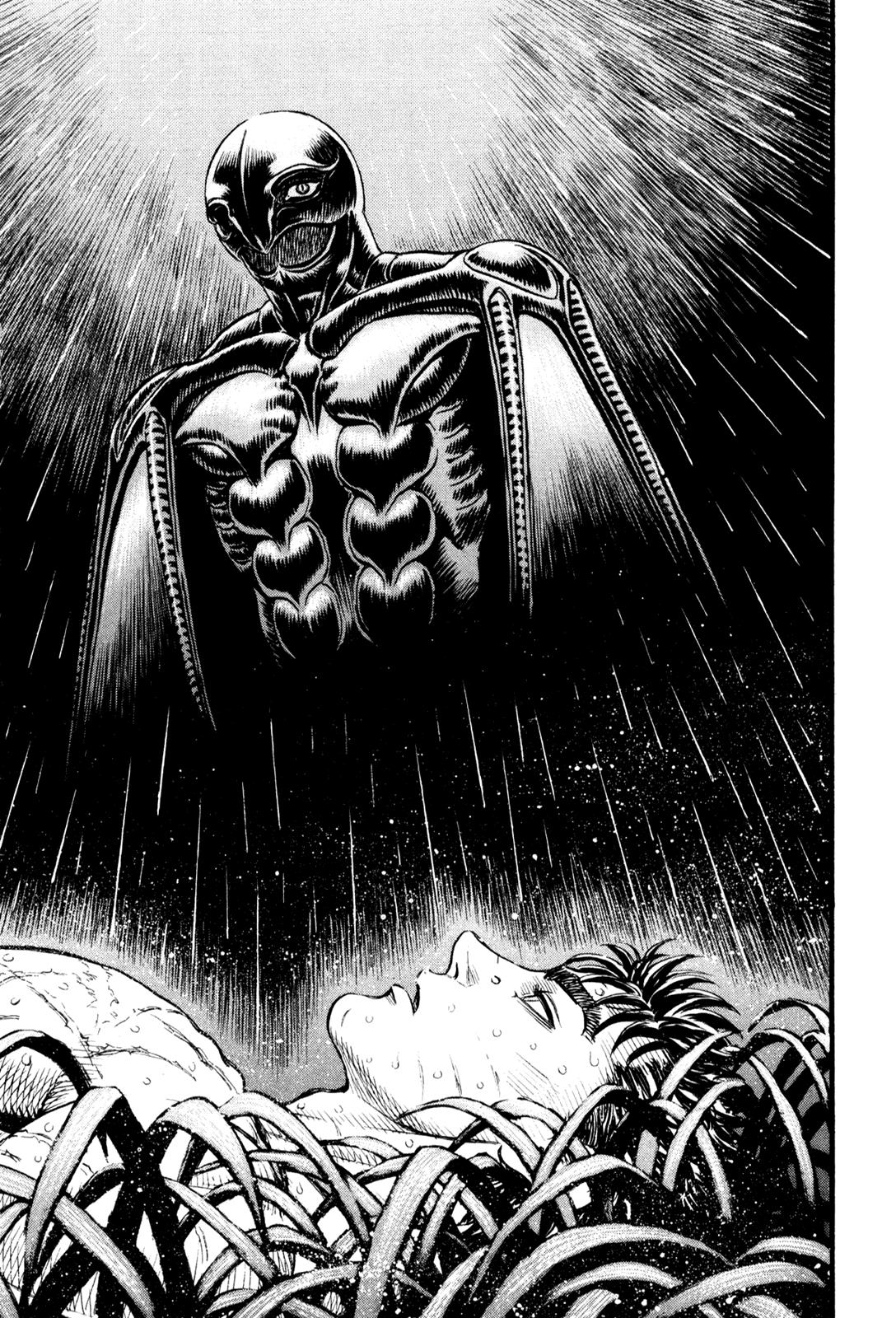

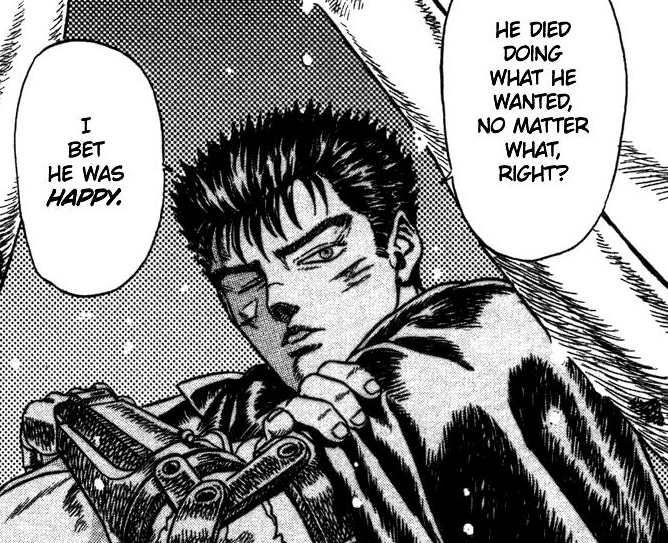
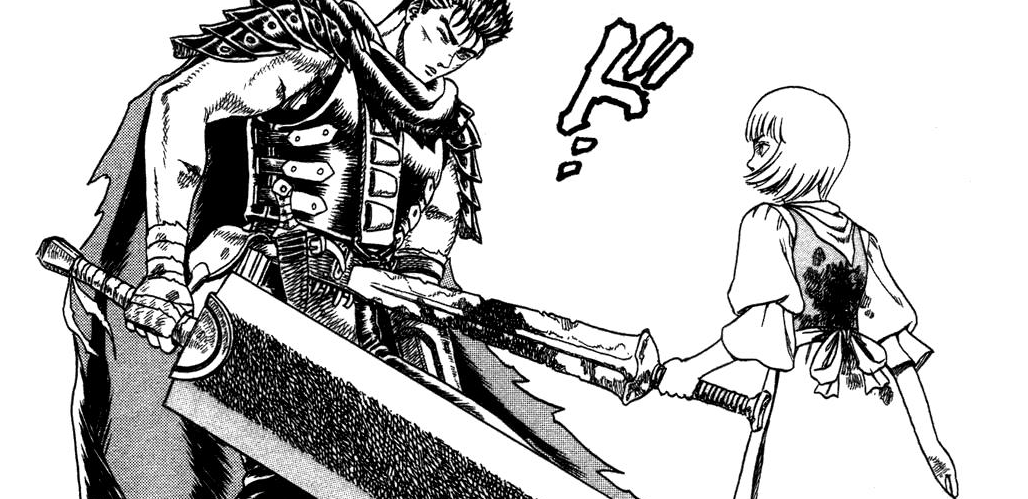

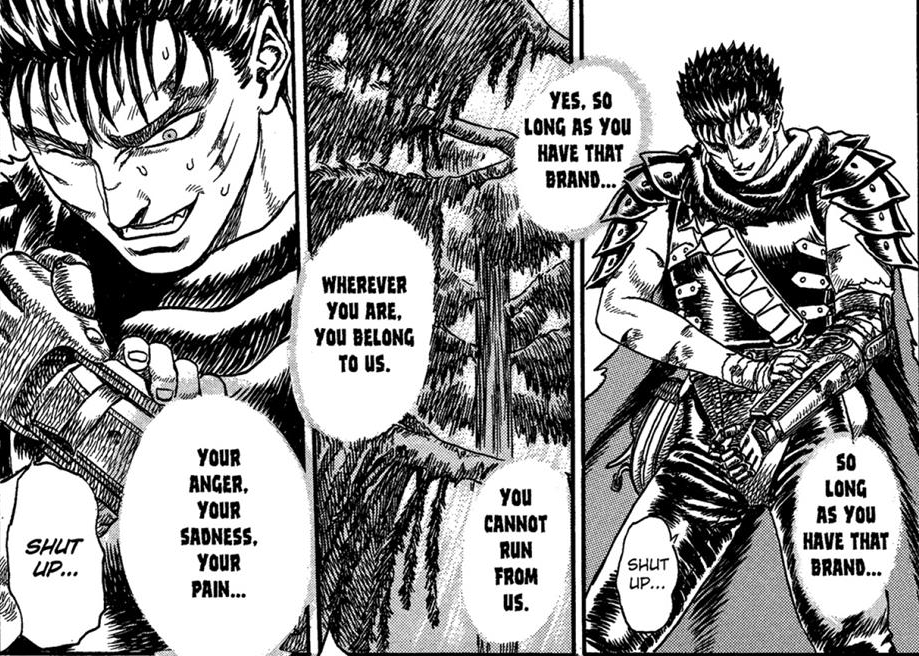


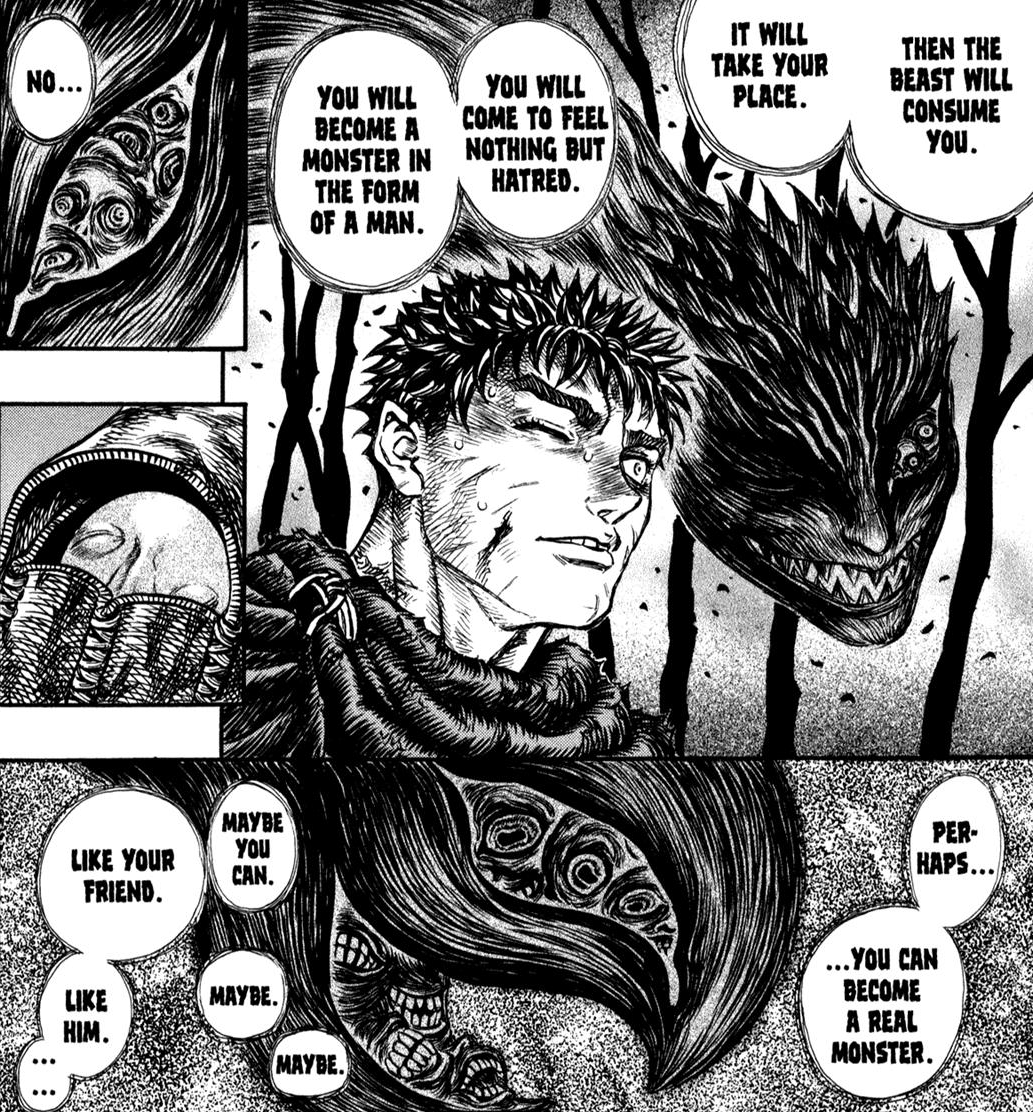


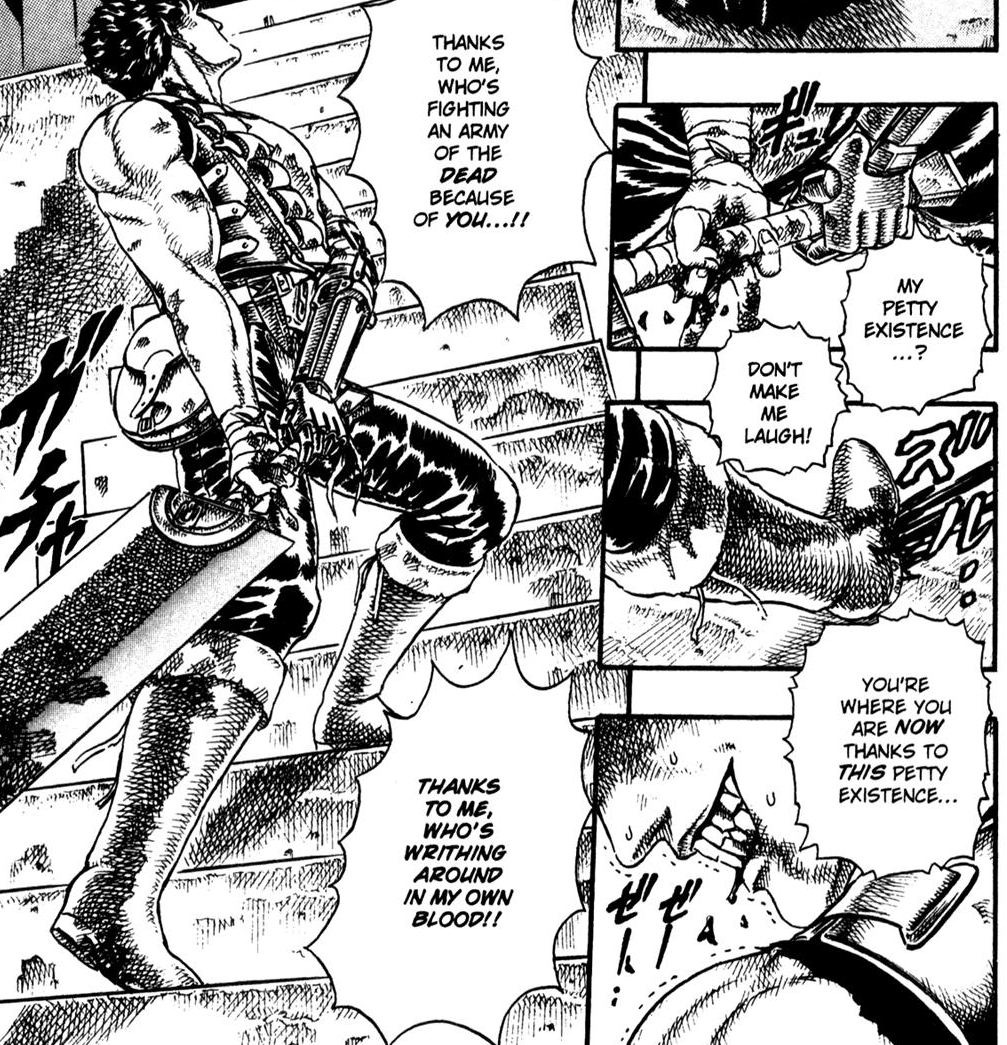


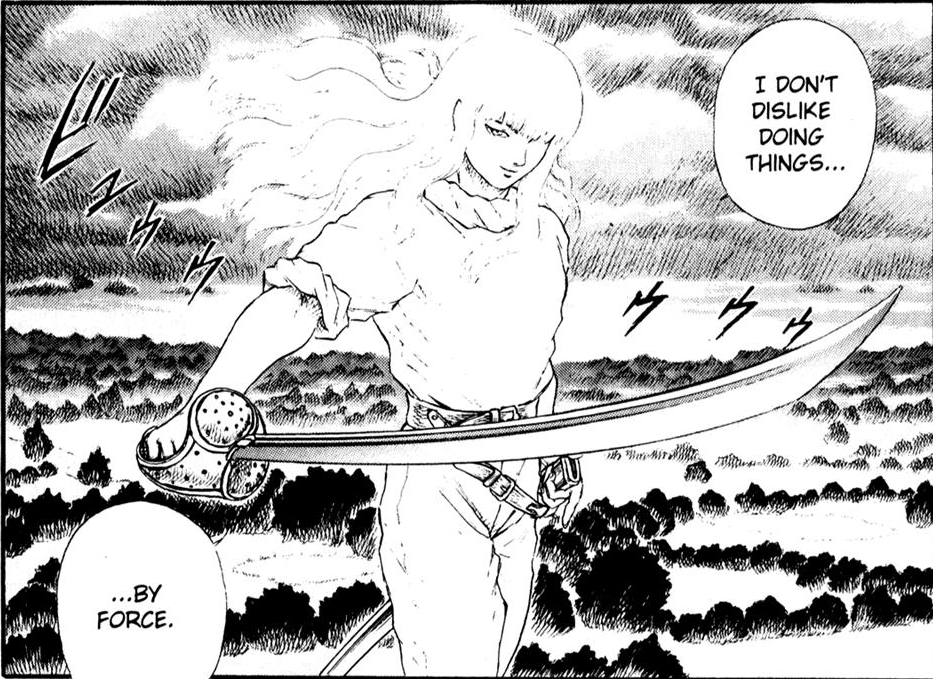
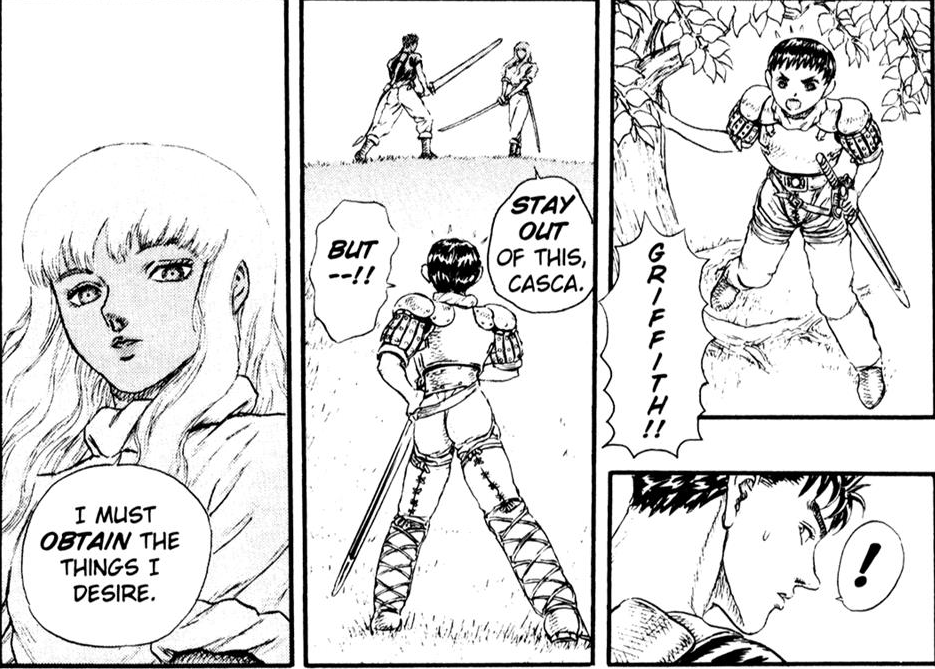
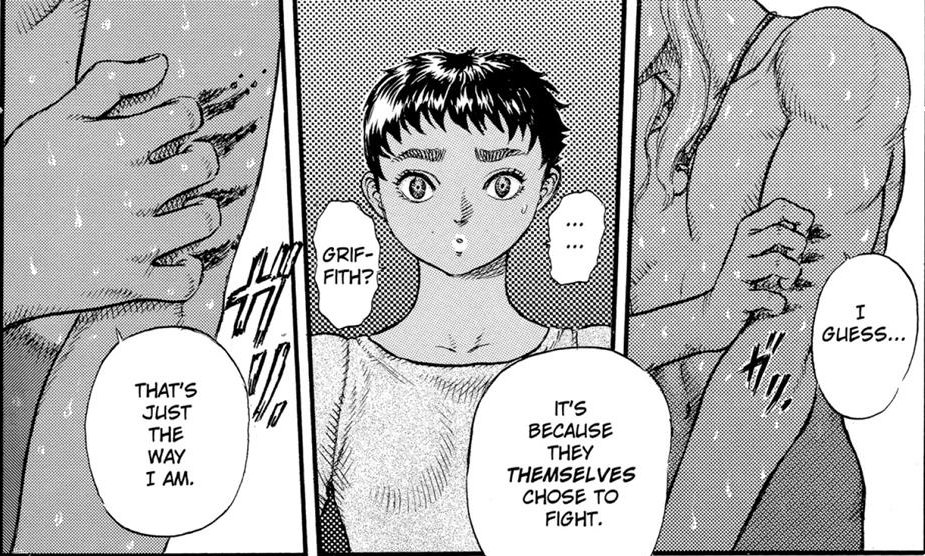


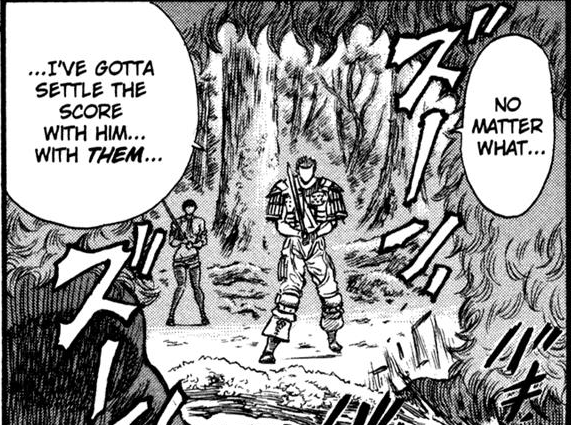


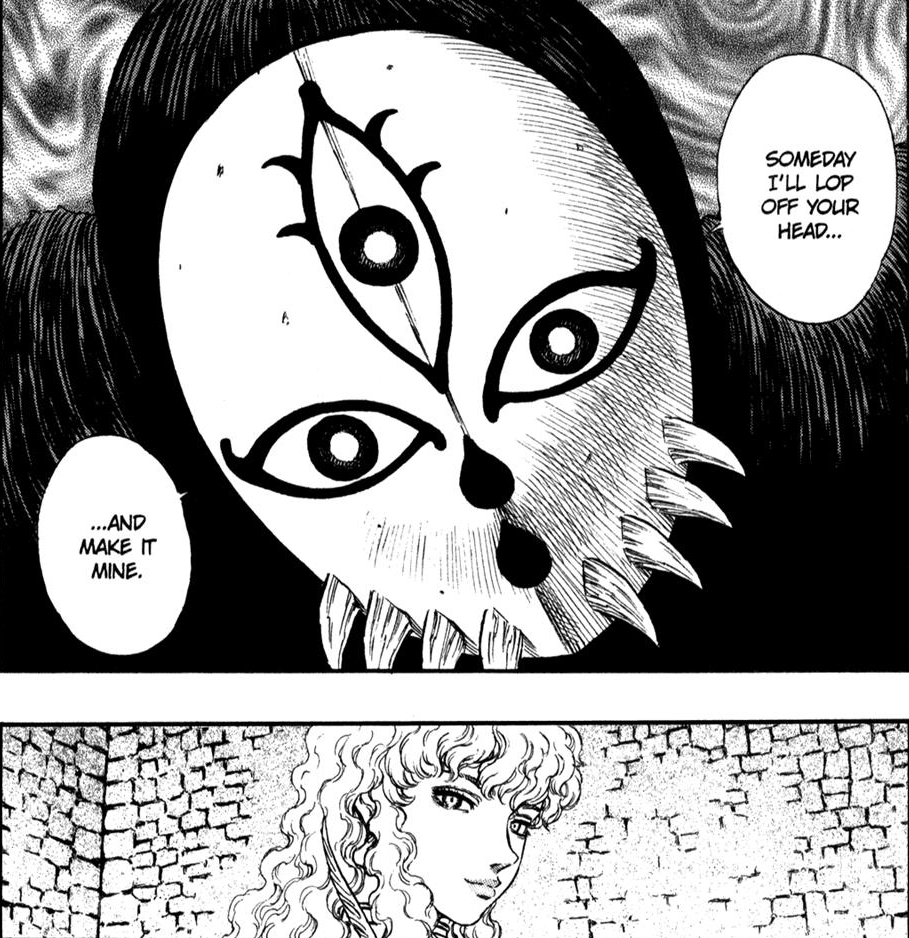


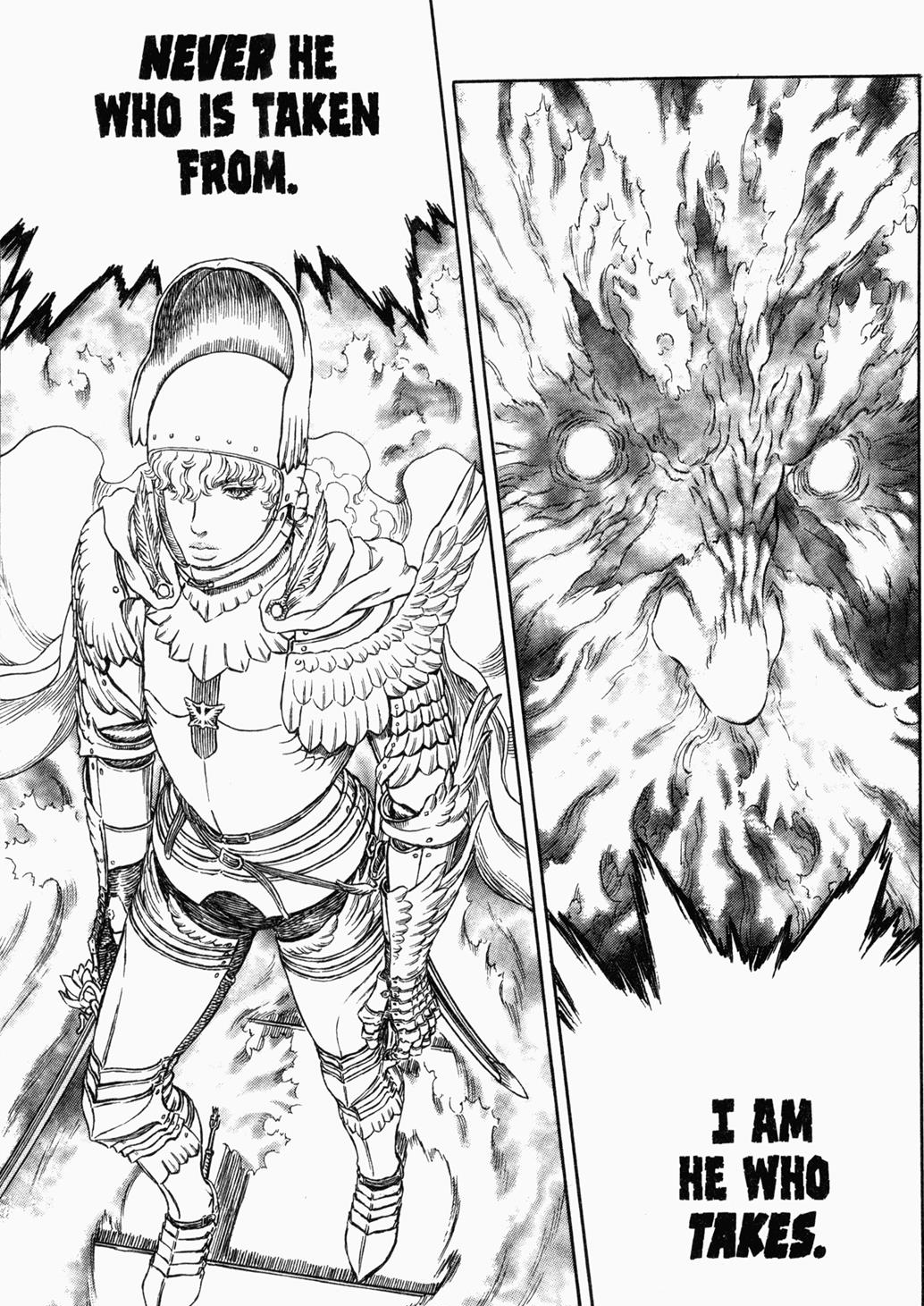


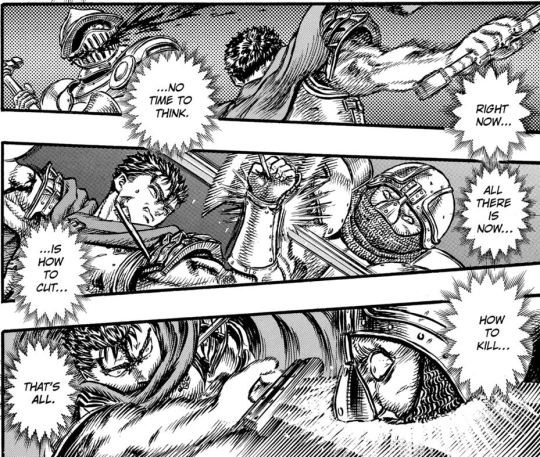
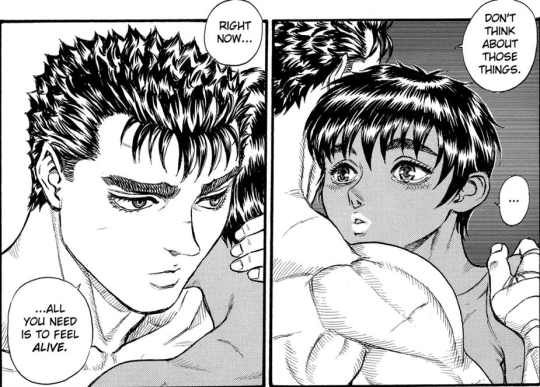

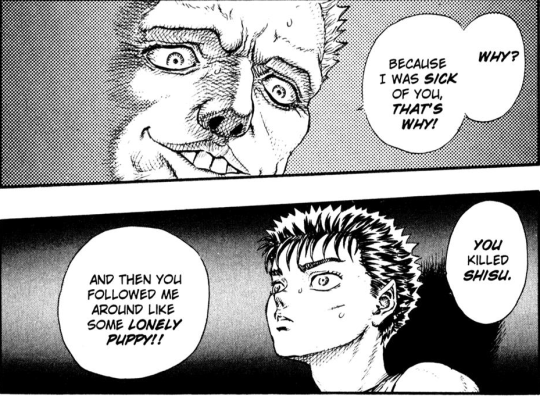


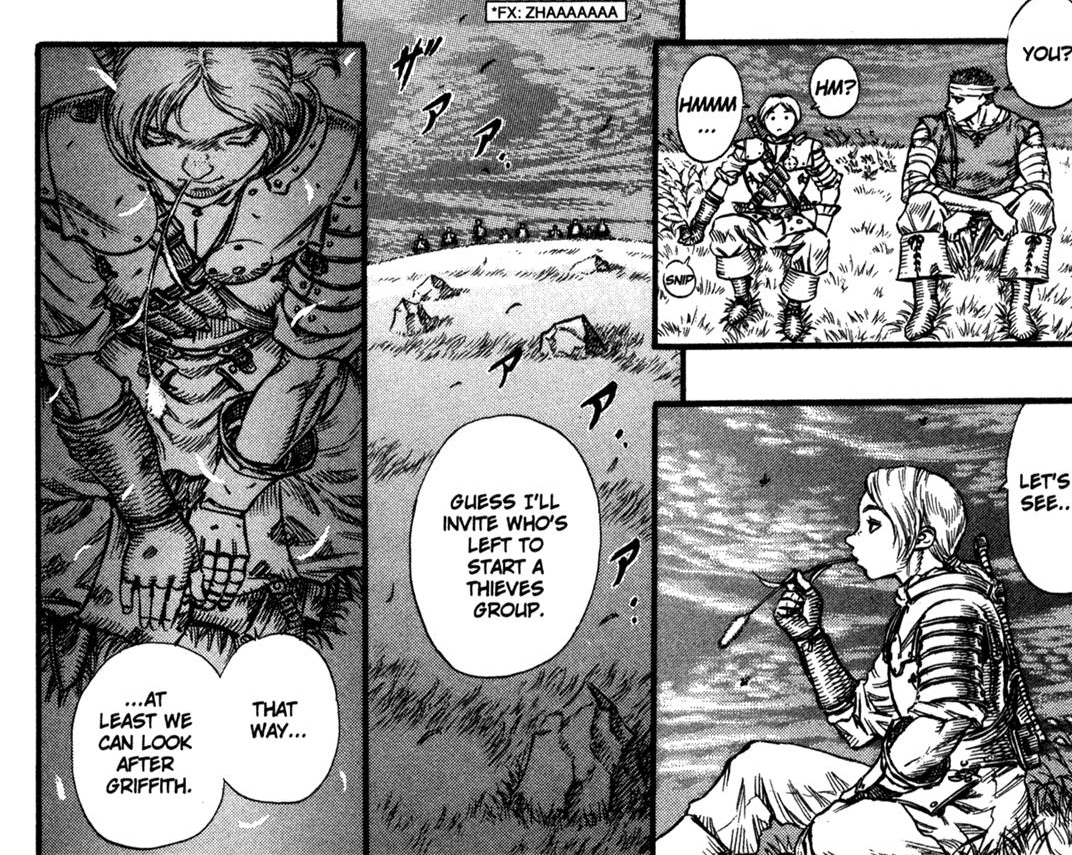


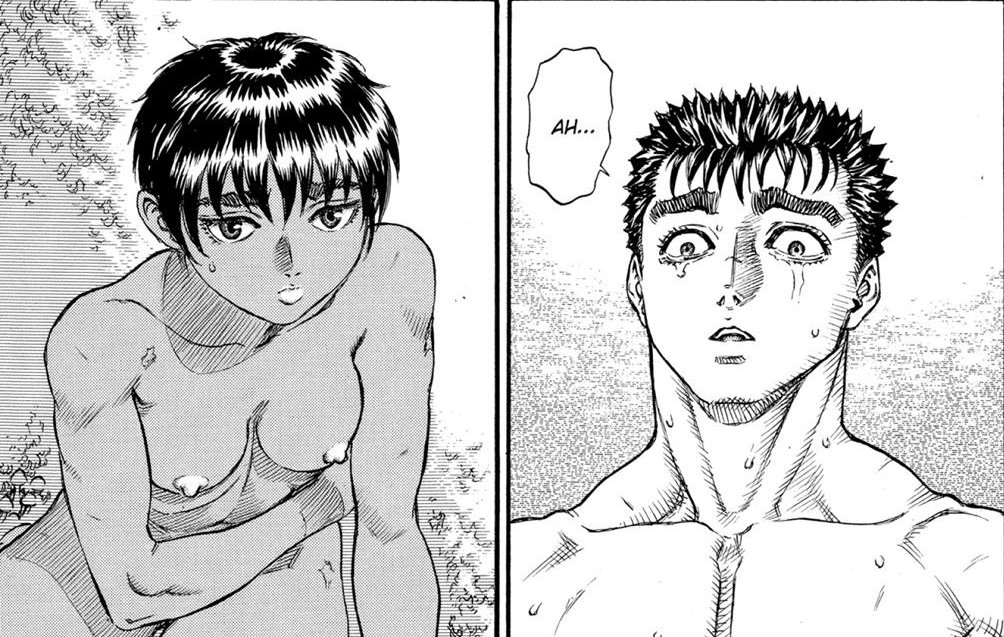
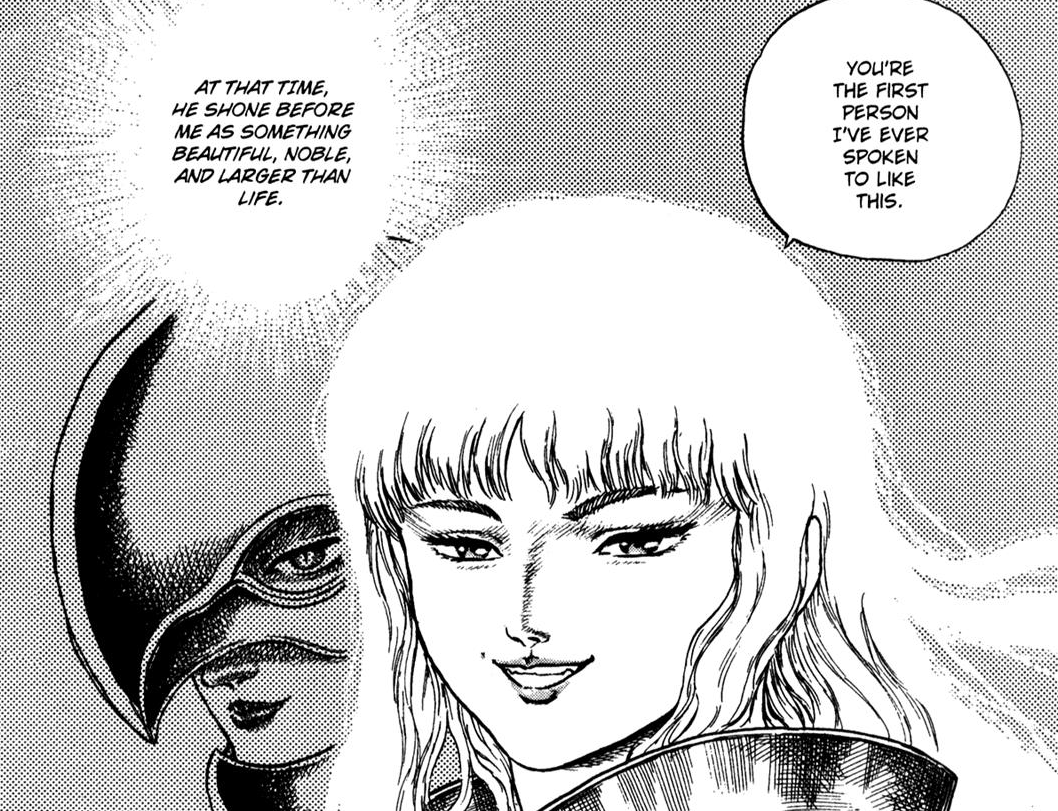


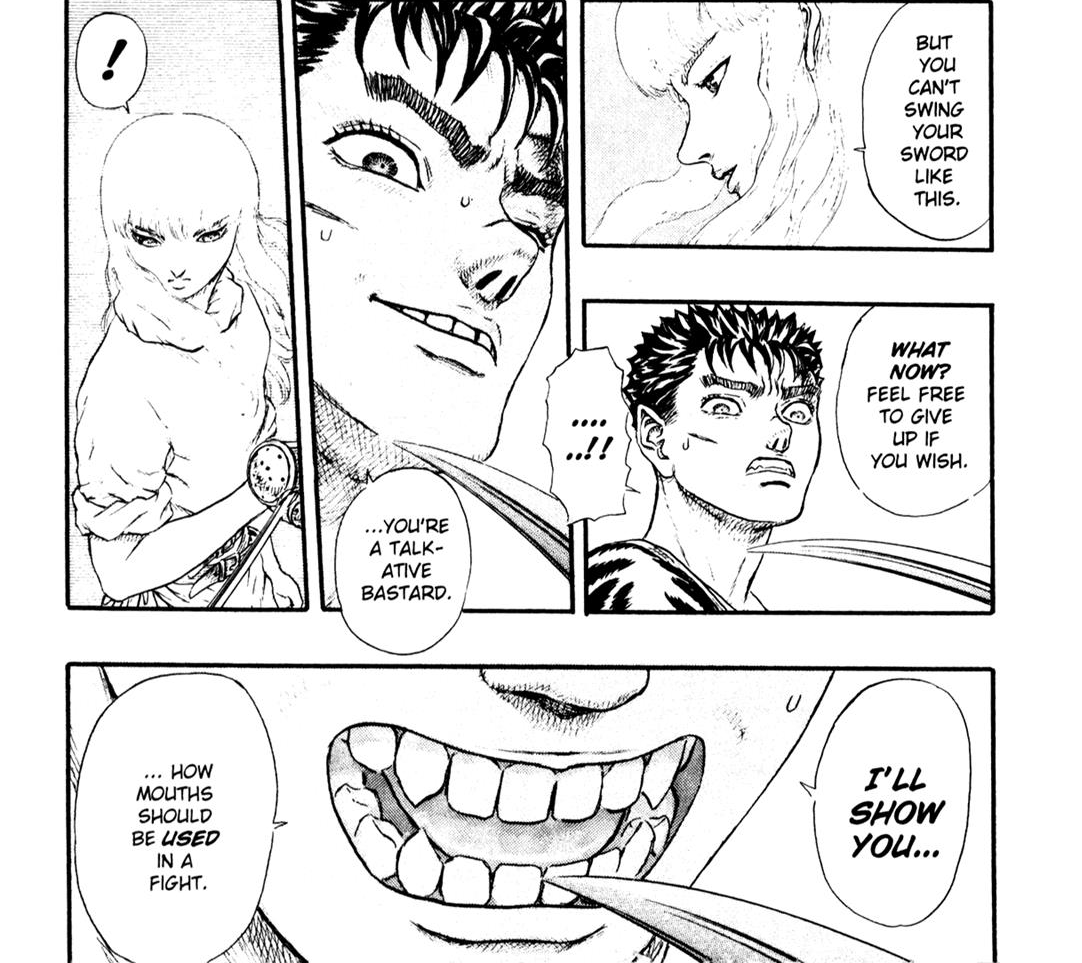


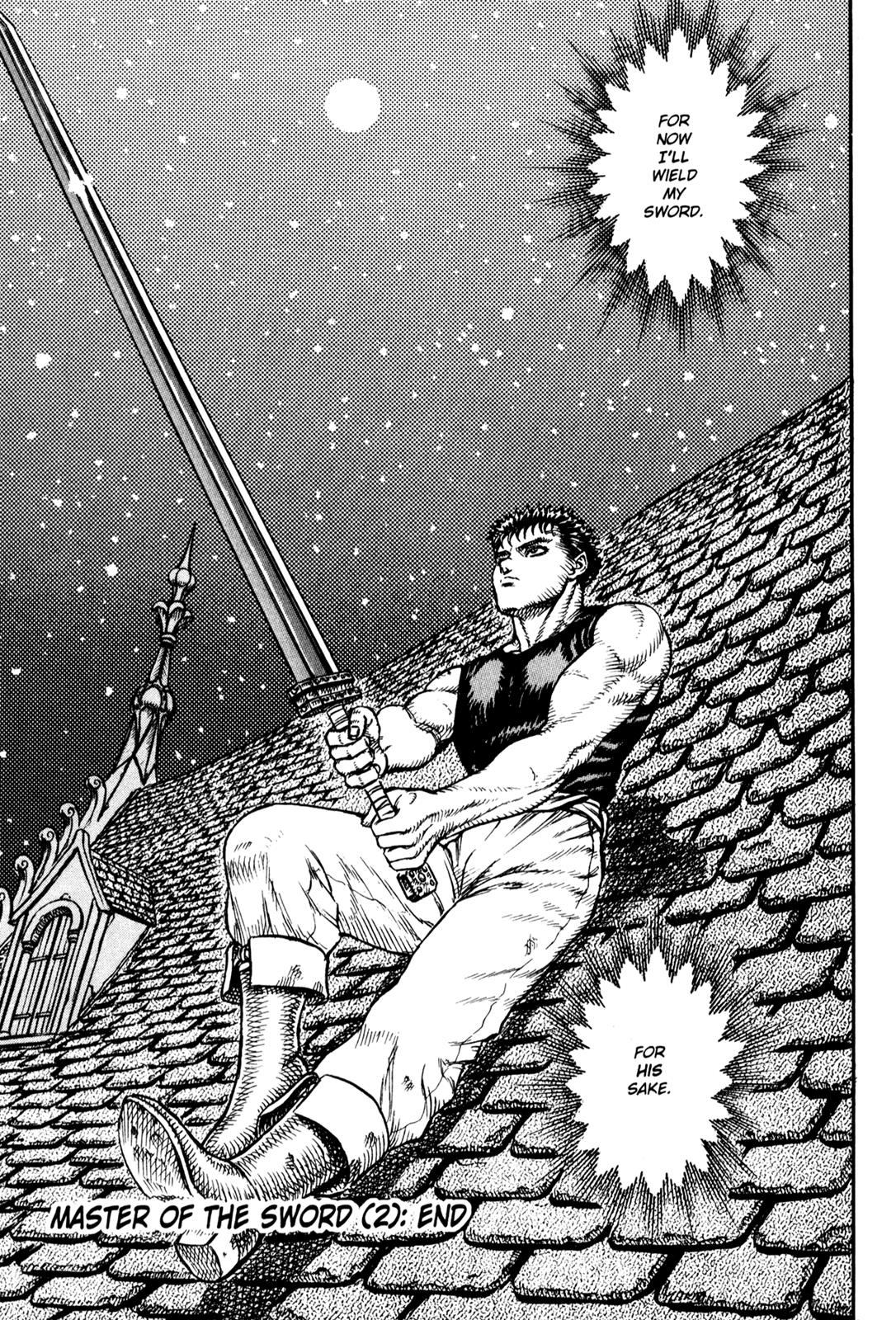

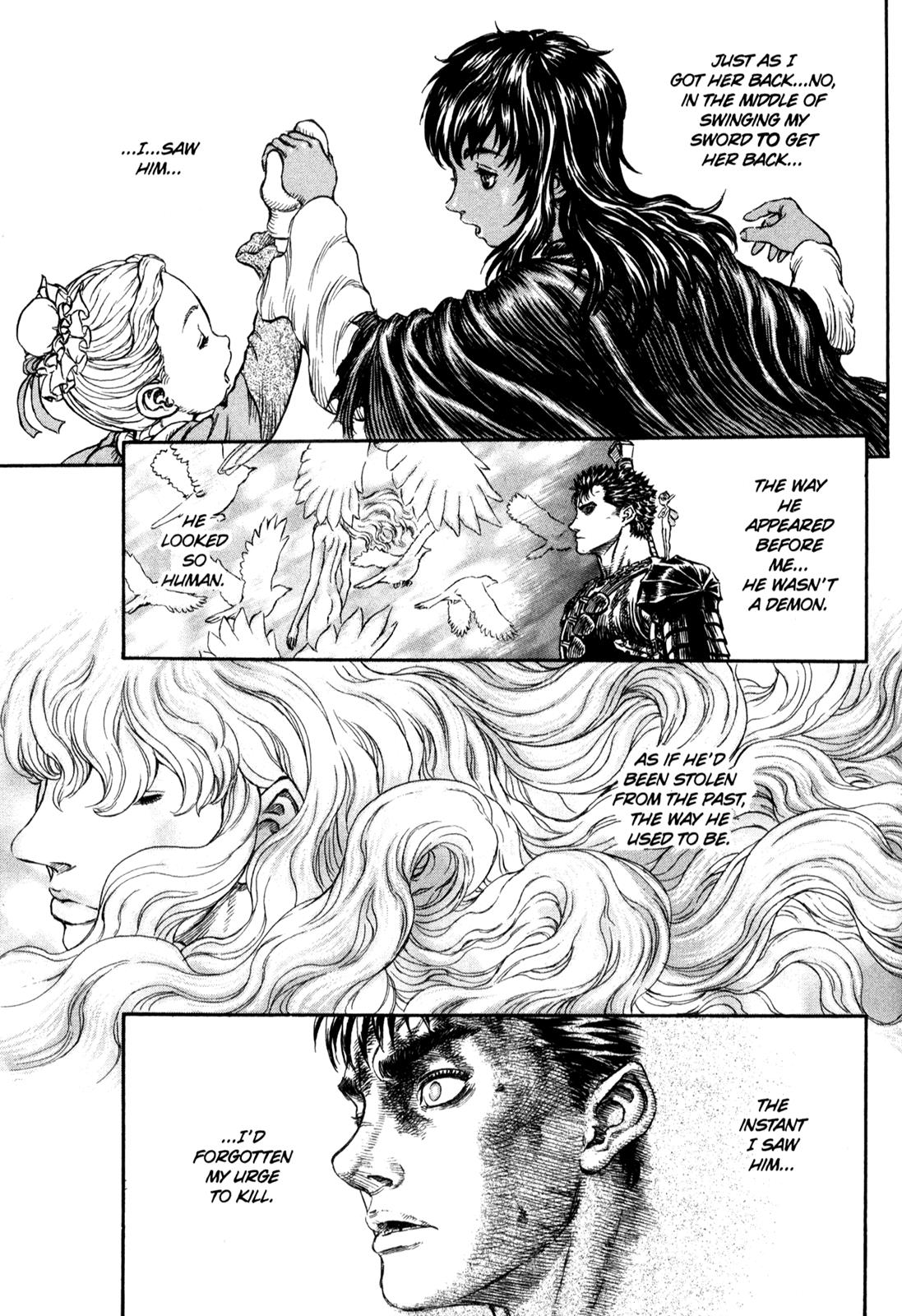


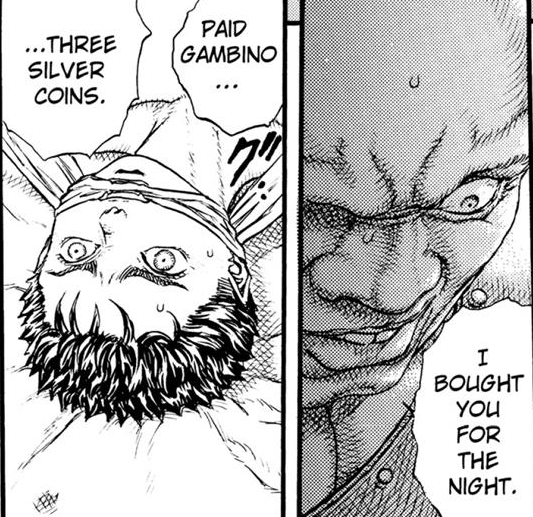


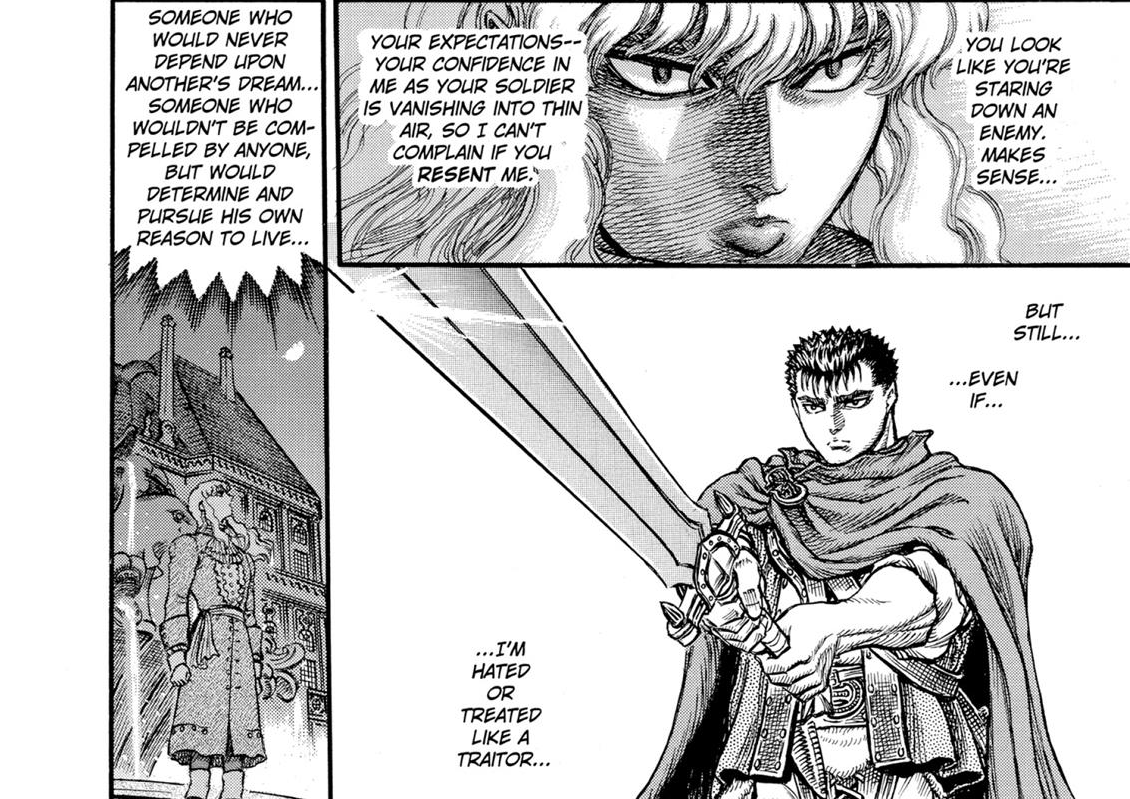


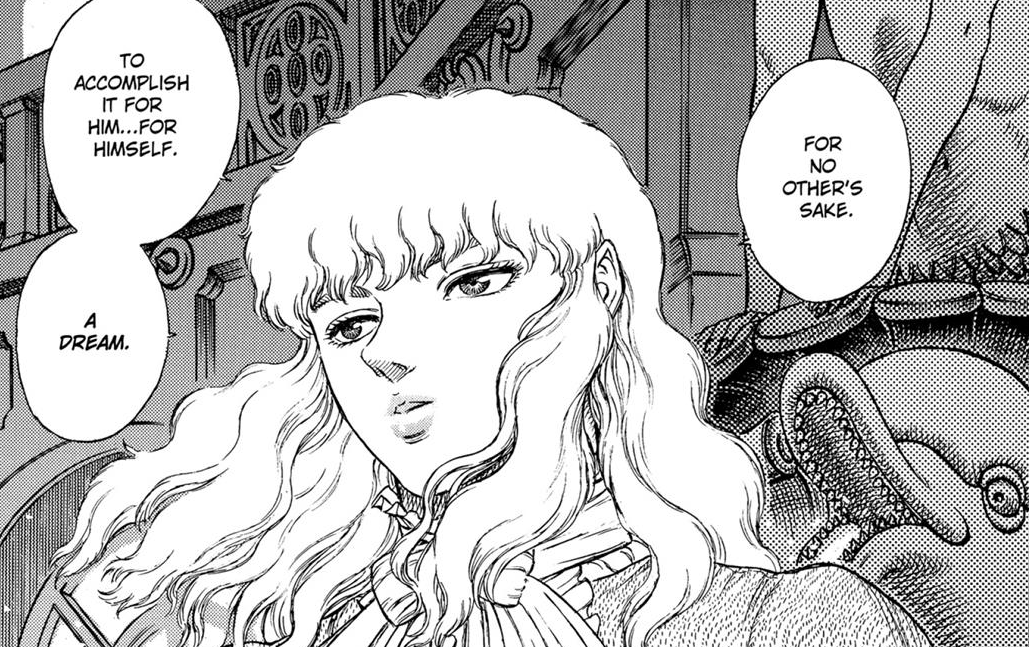


 you're the only one