I’d say that argument is directly and unambiguously contradicted over and over again in the story, including by Griffith himself.
And like, literally the last thing Griffith thinks before sacrificing Guts is that Guts is more important than his dream. That’s why he’s sacrificing him. “You’re the only one who made me forget my dream.”
The main point of the Golden Age is to hammer home the concept that Guts is more important to Griffith than the dream, and it does it over and over and over lol. Everything revolves around that fact. And the sacrifice is a really clever (imo) culmination of that theme, not a weird last-minute contradiction of it.
Also I might try to add a quick explanation of my reading of the dream, ie it’s a defense mechanism/way for Griffith to escape his feelings, both guilt and the feelings for Guts that make him vulnerable and essentially destroyed his life, “the life of the person you loved the most and hated the most! you gave it to us so that you could bury your fragile human heart!” all that jazz. Which explains why Griffith chooses his dream over Guts even though he cares about Guts more (because he cares about him more). But idk if I could manage that without writing an essay, or more likely, linking one I’ve already written lol.
Wrt the second bit, idk what the fact that he had to sacrifice the other Hawks too has to do with it, it’s pretty clear to me that Godhand sacrifices are bigger and more epic than apostle sacrifices, but Guts still gets the spotlight even though there’s 30-40 others in the group. He’s the one Griffith’s last thoughts are directed to, he’s the one Slan singles out as a particularly excellent sacrifice, he’s the one Zodd directed his “prophecy” to and even makes sure to save so he can be sacrificed later (when he threw him a sword during the battle of Doldrey), while Rosine and the Count and Wyald killed a bunch of Hawks before the Eclipse without causing any issues. He’s the one Skull Knight singles out to give a warning to.
I like that the rest of the Hawks are included because it proves that Griffith does in fact care very much about all of them. I mean Casca’s flashback already proved that, but yk, it never hurts to underline Griffith’s capacity for caring about others, because Griffith himself downplays it as much as possible lol, to say nothing about the fandom. But I don’t think it detracts from Guts as the most important sacrifice either. He’s still above and beyond. He’s the one who caused Griffith’s behelit-opening despair, and he’s the one Griffith sacrifices to escape that despair.
Idk man, the sacrifice is like half the reason I ship griffguts, so I definitely don’t think it downplays or diminishes Griffith’s feelings for Guts in any way, imo it emphasizes how they’re front and centre as Griffith’s number one priority and central motivation in an immensely satisfying way.
it’s been a while since i read any of the lost children arc but i looked over some of it the other day and lol, there goes my assumption that Guts doesn’t actually know that a sacrifice has to be someone’s most important person/people.
and tbh I like this way more than Guts being in the dark and regarding the sacrifice as maybe a sign he wasn’t as important to Griffith as his dream after all. It fits Guts’ attitude towards Griffith better post-Eclipse, like the way he still knows that he was as important to Griffith as he wanted to be.
And his pretty significant devastation when NeoGriffith claimed he didn’t feel anything anymore.
And while he was unconscious while the Godhand were discussing it during the Black Swordsman arc, and they didn’t really say anything that revealing that everyone could hear during the Eclipse iirc, it still makes sense for me to assume that Guts could put 2 and 2 together re: the sacrifice requirements based on what he does know. Like he missed “it must be someone important to you, part of your soul” but he heard “the life of the person you loved the most and hated the most” so, that’s still pretty indicative.
Plus it really adds a certain something to Guts’ revenge campaign.
Like with the sacrifice as active proof of his importance to Griffith, it makes me wonder about what kind of complicated feelings that, say, the brand hurting in the presence of monsters might invoke.
THANK YOU i think in particular the part abt the sacrificed person being who you most love *and* hate in that moment gets ignored, like the fact that in the canon examples the person(s) you love the most has betrayed you or ruined your life etc etc is glossed over??
it’s very easy to say
“well, *i* wouldnt do it” and pat your back smugly for being a good and
moral person if you can’t imagine ever facing that level of betrayal
from your loved ones
yeah it’s an important part of the whole equation. maybe it’s not the case in every single sacrifice, but it seems to generally hold true and it makes sense because in Berserk fate basically arranges circumstances for the highest possibility of someone saying “yes.” Except with Theresia, the sacrifice is always the reason for the behelit owner’s despair. It’s, ‘cut this out of your life and you will never feel despair like this again.’
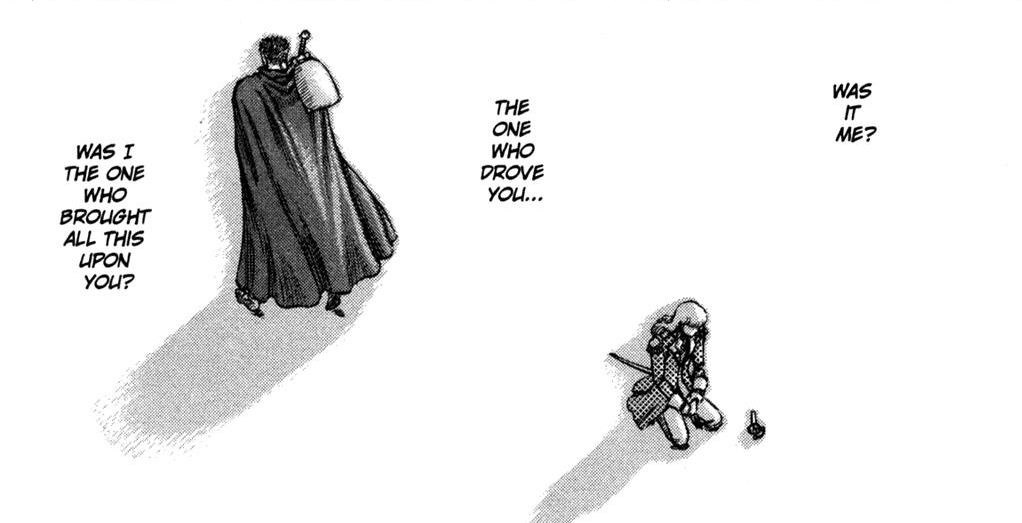
idk I guess it’s less obvious with Guts and Griffith because Guts like, didn’t just try to kill him or anything, the betrayal Griffith perceives from him is a lot more subtle and blameless. More of a, I destroyed my dream because I’m in love with you and you’re going to leave me again, kind of thing. He says, “you’re the only one who made me forget my dream,” like an accusation. But I mean Guts himself acknowledges that he’s the one who drove Griffith to despair while he’s riding after him, so Guts being the source of Griffith’s pain is pretty explicitly part of the Eclipse.
So like yeah, even if you wouldn’t sacrifice someone you love who is totally innocent under any circumstances, let’s be real most of the people who say they’d never sacrifice someone aren’t thinking of a cheating spouse, or a son who just tried to kill them, or someone they love whose perceived rejection lead to a year of torture.
Yeah I pretty much agree with you. Whenever I see someone who’s like, “I would never ever sacrifice someone I cared about no matter what,” I’m like, well that seems like a v high and untested opinion of yourself.
Idk maybe they’re just a lot more idealistic than me and believe the majority of people wouldn’t choose to sacrifice someone in a moment of pure despair, or maybe they genuinely are that self-sacrificing lol, but I’m with you – I’d say most people would. Especially in the world of Berserk, where behelits generally end up with people who have extremely strong values/desires/drives that make them more likely to sacrifice one thing for the sake of another thing. Add the fact that every apostle we see (except Count Slug’s second attempt) sacrificed someone/thing they both loved and hated in that moment, and the fact that moments of despair are tailored by fate to each individual – to be their worst moment, playing on their specific fears and insecurities etc, and yeah, I’d say just about everyone would make the sacrifice under those conditions.
And tbh one thing I love about Griffith’s narrative is that I actually find it really relatable/understandable. I think Miura did an amazing job of showing us what Griffith values, what he prioritizes, what he believes, what he feels, and how his life has driven him to the point of the Eclipse. When he says, “I sacrifice,” it’s so good because it’s been completely built up to. We got to really see all the elements that come together at that moment to make him choose the sacrifice, and it’s absolutely a realistic decision for his particular character. And personally one of my favourite things about fiction is that feeling of understanding why someone does something terrible, or evil, or stupid, or self-destructive, etc etc. I find it very cathartic, and Berserk is perfect for that.
Like it’s fair if ppl find the same thing uncomfortable or off-putting. A story about relatable/realistic people making bad choices for understandable reasons is definitely not for everyone, but that’s absolutely what Berserk is, at least the Golden Age, and misreading it as the story of an evil dude doing evil things because he’s evil doesn’t change that.
[Insert Ganeshka’s backstory of isolation and fear here.]
eh? eh?
ok honestly I’m just throwing shit at the wall but Ganeshka’s lonely freakout really really intrigues me, that plus the talk of light and dark reminds me both of Griffith in the torture chamber and Griffith as he’s transforming into Femto, and while yeah NeoGriff’s “within darkness that true light is discovered” bit is much more metaphysical (yk more to do with the fact that Griffith had to become Femto to become the saviour of humanity, probably), the fact that it’s in response to Ganeshka’s total loss of himself and everyone around him, the fact that the light Ganeshka longs for has shifted from something he considers his enemy to the only connection he has in an unknowable lonely world just… resonates man. I love it.
“You can see. Because he who bears the light exists in the deepest shadow.” Ganeshka can see NeoGriffith’s true form because he’s the only one on the same plane of existence of him, and that plane is defined by despair – despair opens the behelit that makes him an apostle, despair in the face of an inevitable loss sends him into that reincarnation thing to become a god, and his brief existence as a god is defined by existential terror and isolation. In a way he and NeoGriff are both made out of the same stuff the Idea of Evil is made out of. that’s the “darkness” imo.
And despair is the darkness of the torture chamber (give or take the lightning blazing within him that is Guts) and it’s what Griffith succumbs to when he sinks into darkness and becomes Femto.
Also
while the “light” referred to might more literally be Griffith-as-godly-saviour, bringer of peace to humanity or whatever, I’m thinking it works as a symbol of that longing for connection.
like idk the way I take Berserk’s use of light and darkness as symbols is, essentially, darkness is the despair that opens the behelit and light is what you sacrifice. darkness – the swirling negative emotions that make up the idea of evil. light – connection, love, joy, family, peace, brotherhood yadda yadda yadda. or at least the potential for those things.
Griffith/Femto appears right after Ganeshka’s backstory of being unable to connect with anyone around him because of his paranoia – loneliness and fear. He gives Ganeshka that brief sense of connection before his death as the light envelops him.
I’m basically just thinking outloud in a disorganized way here bc tbqh I have such a hard time sussing out what “It’s within darkness that true light is discovered” means in the overall context of Berserk. Like, other than Griffith going ‘lol I’m evil but also saving the world.’ that’s too reductive. But I think longing (darkness) for connection (light) maybe works for me? thanks to Ganeshka’s whole thing being isolation.
Lol I’m glad he doesn’t hate Griffith, it always sucks when your friends hate the characters you like. But yeah I definitely agree that his theory doesn’t really make sense. Though at the moment I only have manga related reasons because I haven’t watched the entire anime in years and years.
tbh the main thing I’d want to say in response is that if Griffith was evil all along and secretly planning to sacrifice his friends from the start then Berserk is a really boring story.
Like in what way is a story about a sinister dude manipulating his friends for power more interesting than a story about a dude with good intentions being driven to the point where he feels like sacrificing his friends is the correct moral choice?
Or how is a story about a dude whose bff turned out to be a lying dick all along better than a story about two dudes who love each other (platonically if he doesn’t ship it) accidentally ruining their relationship through a complex character-based misunderstanding and being torn apart in an epic way?
Berserk is great because its characters are complex and interesting and have a ton of layers, and interpreting Griffith as evil all along just makes it shallow and boring.
Though if you want concrete evidence that Griffith isn’t evil I’d point out stuff like Griffith asking Guts “do you think I’m cruel?” and Guts being the one to reassure him that killing people is nbd and his dream is worth it. And Griffith risking his life (and, consequently, his dream) for no reason to save Guts from Zodd. I mean I guess if you think Griffith somehow knows what the behelit is you could argue that he knew he’d survive, but lol.
There’s Griffith ignoring the nobles to rescue Guts and Casca, which is also a risk to his dream because he’s supposed to be sucking up to them.
There’s Griffith self harming while denying his feelings of guilt, which is the most obvious indication that he has extreme feelings of guilt I’ve ever seen (especially in combination with the aforementioned “do you think I’m cruel?”)
There’s Griffith reaching to grab Guts as he falls during the first few minutes of the Eclipse, even despite Guts being the source of his despair.
tbh the problem is that if his premise is “Griffith knew he needed sacrifices so he valued his friends lives only so he could sacrifice them later,” those examples still might not convince him. You could show him this bit from the manga (idk if it’s repeated at all in the anime):
Griffith’s sacrifice canonically wouldn’t work if he didn’t feel genuine love for them, and if he’s been planning to sacrifice them the whole time then he obviously doesn’t really love them. For him to be able to sacrifice Guts and Casca etc he has to care about them so much it’s like they’re part of him.
Also there’s always the fact that the Godhand had to take him on a guilt trip and convince him that he has to sacrifice his friends for the sake of thousands of people who already died for his dream, which would hardly be necessary if he already knew how the behelit worked and wanted to sacrifice everyone anyway.
(oh and btw if he’s thinking Griffith’s “I will choose the place where you die” line is an indication that he’s evil and knows about the sacrifice, the better explanation for that is that it’s a reference to Griffith’s guilt for leading people, like that one kid, to their deaths. he’s owning that fact, because as a mercenary leader it’s p much true – people die in the battles he fights on the road to his dream. by stating it up front he’s denying and repressing his feelings of guilt. It also sets up the mentality that leads to him making the choice to sacrifice, and it’s foreshadowing. But it doesn’t mean Griffith literally knows he’s going to sacrifice Guts in a magic ritual – it means he’s already mentally prepared to sacrifice his followers in battle for his dream.
Mental preparation that, as we saw in flashback, came with a dose of self-harm and sacrificing himself as well in a way by sleeping with a predatory pedophile, so, hardly an indication of evil.)
Thesis statement of this goddamn thesis: Guts is sexually attracted to Griffith.
Now, this is long. This is the shortest part of a four-part series, and this isn’t a short post. And basically my intention is to show why I find it so incredibly easy to read Guts as attracted to Griffith, and explain how this reading adds layers of meaning that fit neatly within Berserk’s themes and enrich the story. I’m not going to speculate on Miura’s motives for adding a ton of gay subtext, like, it could be anything from trying to be as gay as possible without pissing off his publishers to it all being totally coincidental and meaningless with an alternate explanation for every point I have, or anywhere in between.
My point is only that Berserk readily lends itself to gay readings, with a focus on Guts’ sexual attraction to Griffith (as I feel like it tends to be neglected in favour of interpretations that Griffith has a one-sided crush.)
Part one covers the Black Swordsman stuff and the way Guts and Griffith’s relationship is revealed to the audience, part two covers the first several chapters of the Golden Age with a focus on visuals and how Guts sees Griffith, part three tackles Casca’s role in the story, and part four is more of an overview on why I think reading Berserk through a gay lens works so well.
So here we go.
Part One – Our Introduction to the Concept of Guts and Griffith
We’re introduced to Guts and Griffith’s relationship near the end of the Black Swordsman arc. Before the appearance of the Godhand we know that Guts is really fucking angry, we know he’s monster slaying because he’s out for revenge, we know he’s looking for a group called “the Godhand,” and thanks to Puck spelling some stuff out we know that he’s also sad and deeply afraid that he’s fighting a losing battle.
The comparison to Vargas hints that maybe he lost some loved ones, plus an eye and a limb to an apostle which is close enough to the truth to be decent foreshadowing.
But it’s not until the Godhand show up as the Count’s about to die that we learn what’s really going on with Guts. The information is given to us surprisingly straightforwardly, and the way the information is revealed to us is pretty telling.
The first six chapters have been teasing the mystery of what happened to Guts to piss him off so much, from the way we kick off in media res, to hints about his issues and trauma (eg the aforementioned Vargas comparison, the way he lets the possessed corpse of the kid stab him, etc), to Puck directly asking what the hell happened to him outloud for the benefit of the audience. We start to get our answer in chapter 7.
The Godhand that Guts has been searching for shows up, Femto front and centre, and Guts’ rage is directed right at him. When Guts screams “Griffith!” at him we see Puck asking “Griffith? Who’s Griffith?”
My point with this is just to emphasize that the driving hook of the Black Swordsman arc is the build-up of the mystery and what makes Guts tick, the tension pretty much entirely coming from the audience wondering why Guts is so obsessed with revenge, and the reveal of the sacrifice is the climax of this arc.
And our example of a sacrifice, which we are explicitly told is also what happened between Guts and Griffith? A husband and wife.
In fact, the sacrifice that serves the main purpose of setting us up for Guts’ story is the only sacrifice of a romantic partner we ever see – the rest are all parent/child, weirdly abstract a la Eggman sacrificing “the world,” and ofc Guts and Griffith’s undefined, suggestive thing.
The details of this sequence make the parallels stand out even more.
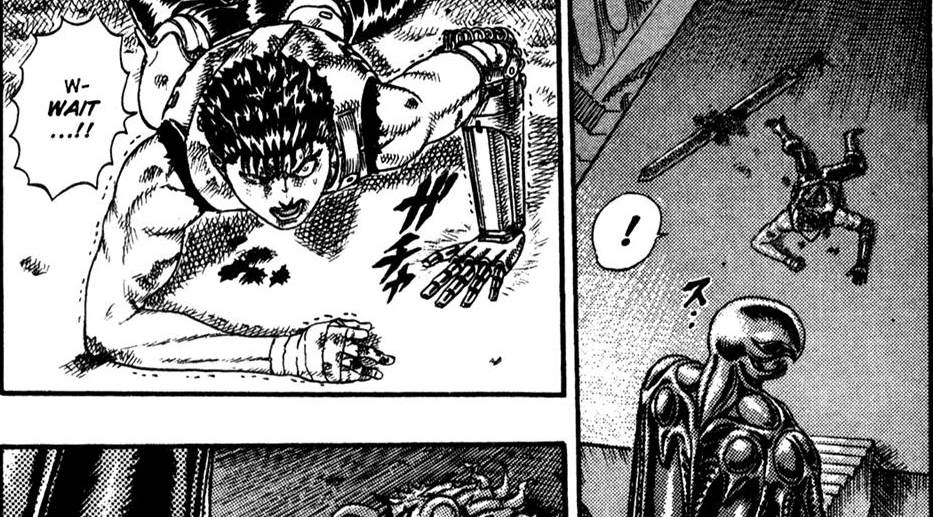
First of all, before we learn much of anything, we see Guts’ reaction to Griffith/Femto. The rage we expect:
Guts taken aback and offended, which is less expected:
And then begging for attention when Femto turns away from him to address the matter at hand, which should definitely come as a surprise for a first time reader:
The audience is expecting rage and violence, and what we get is neediness. Guts, more than anything, wants Femto’s attention.
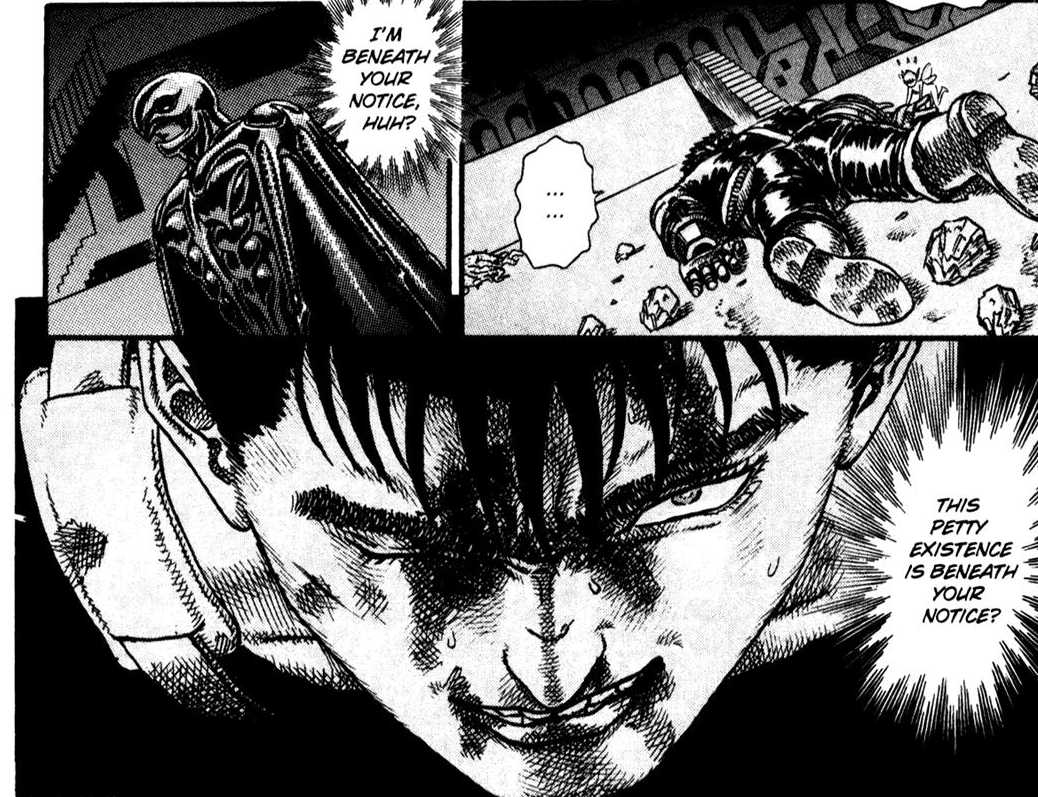
Guts is finally spurred into action when Femto directly says he doesn’t give a fuck:
(Something, btw, that Guts is still brooding about a chapter later lmao:
like, this arc couldn’t be more blatant about Guts wanting Griffith/Femto’s attention.)
But even now the focus is on the potential for more revealed backstory, not on Guts’ attempt at turning talk into action.
Throughout this arc the audience is lead to expect a dramatic, action-packed, and revealing confrontation between Guts and the object of his ire. By the time we get to the climax, Guts can barely stand, we discover the guy he’s mad at is a god he can’t even touch, and his feelings are a lot more complex and vulnerable than just rage and fear of failure. The focus is taken away from possible action and given to hints of backstory. When Guts is standing with sword in hand, advancing on Femto, these are the moments that pique our interest:
Guts makes a very impressive stand considering how fucked up his body is but he can’t even touch Femto before getting telekinesised against a wall. A fight is out of the question – Guts’ willpower, and what spurs him on and makes him fight through the pain, are what the audience is meant to be interested in.
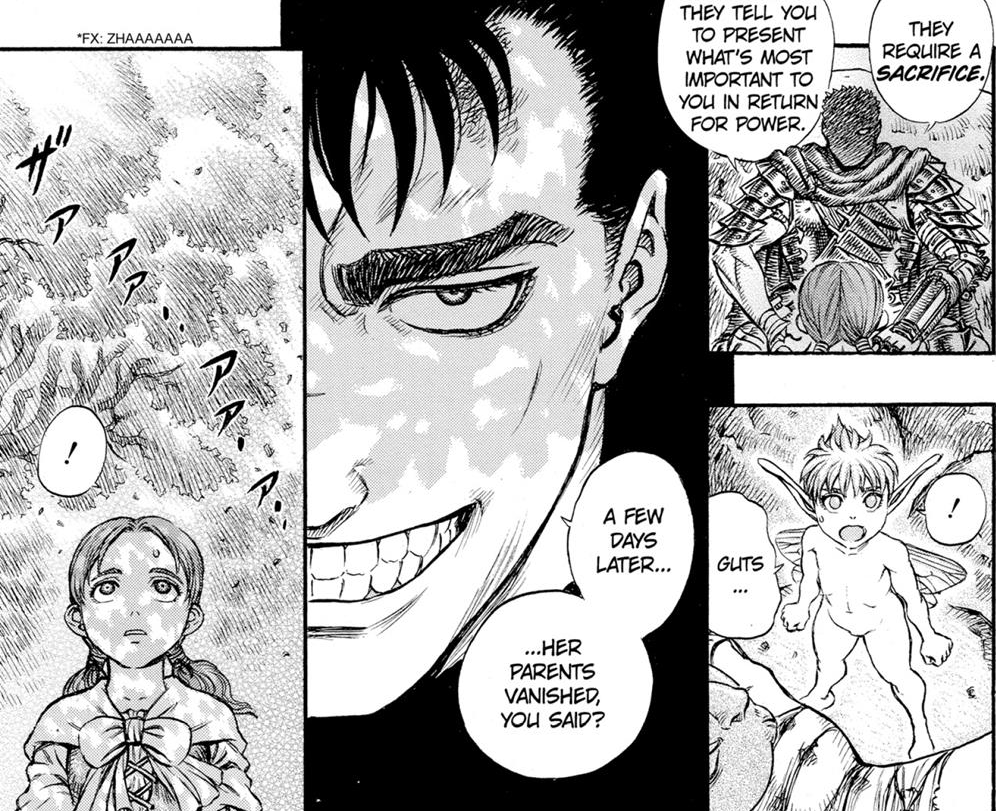
After Guts is magically thrown against a wall we get more hints. The Count tries to offer Guts as an offering. Slan tells him, The boy is merely your enemy. As a sacrificial offering for the Invocation of Doom, not just any lump of flesh and blood will do. It must be someone important to you, part of your soul… someone so close to you that it’s almost like giving up a part of you.
Femto points at Theresia.
That should be more than enough, right? We’ve learned like, everything we need to know. Griffith/Femto is responsible for the brand of sacrifice on Guts’ neck, therefore he sacrificed Guts at some point, therefore they were close friends or maybe related, but Griffith betrayed Guts for demonic power, now Guts is real mad and Griffith has become a monster, as you do.
But we don’t stop there.
Now, in fairness, this does pad out the chapter and give us more build-up to the Count’s decision wrt Theresia. Miura obviously needed something to make the pacing work. And hey Ubik likes to fuck with potential sacrificers and make them feel like shit, so it makes sense for him to start telling everyone the Count’s backstory for funsies. But it’s here that the implications really ramp up, which tells us what the real point of this sad backstory is.
It’s during this story that Guts wakes up:
We get some pissed off reaction shots from him as they all watch the drama:
On the image of monster Count eating his wife:
And in the panels immediately following:
Here’s when Femto is most explicitly compared to the Count. That thoughtful over-the-shoulder look in reaction to Ubik’s words – The life of the person you loved the most and hated the most! – tells us everything we need to know. Especially since Femto’s been absent for the last few pages of Godhand reactions and this is our first image of him (aside from one long shot of the back of his head) since Ubik started telling the story, despite getting several reaction shots from the rest of the Godhand. This panel feels significant, and it exists to tell us that Ubik’s words fully apply to him as well.
And, while this is pretty obvious I’ll note it just in case, it’s only after Ubik’s story is over that Guts is like, “oh yeah,” and asks Puck to heal him so he can hold a sword, so those reaction shots are all about Guts reliving painful memories and not about his injuries or getting Puck’s attention.
Basically, the Count being told to sacrifice Theresia tells us what a sacrifice is and who it applies to, but the Count and his wife are our window into Guts and Griffith’s turbulent past, as we can clearly see by how they react to it, and how the narrative and visuals frame the story in relation to them.
And, if you already know the plot of Berserk, you should also be able to see some parallels here – “a family, the very picture of happiness.”
When it comes to infidelity, I actually don’t think that jealousy was Griffith’s main source of despair, but boy do these many panels of Griffith watching Guts and Casca and looking upset between the rescue and the Eclipse demonstrate that it was a factor. Eg:
Part of the point of the Count’s backstory is to show that it’s not lust for power that leads to someone making a sacrifice, or at least, not necessarily – the Count wanted to bury his human heart. He felt betrayed; his wife was the direct cause of his suicidal despair, and he was desperate to escape that despair.
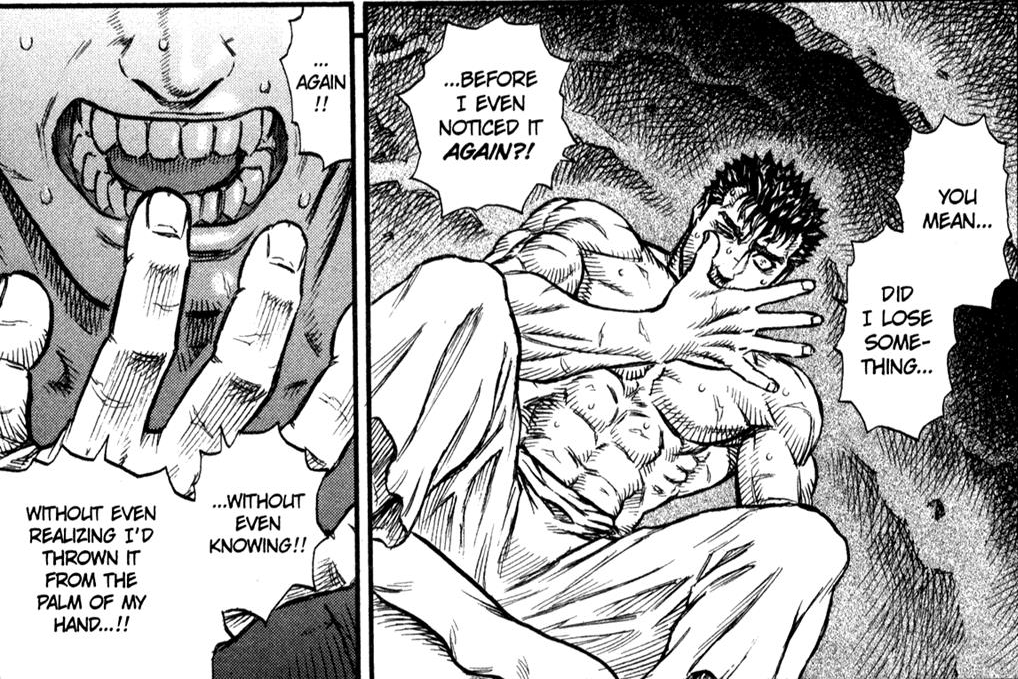
As Guts was the direct cause of Griffith’s despair. The behelit only opens when Guts touches Griffith again – not after losing his dream, not after losing the use of his limbs or his tongue, not even after believing he was losing Guts again too – but the touch of Guts’ hand.
Guts eventually recognizes how Griffith’s feelings for him caused his despair as well.
All things considered, the Count’s sacrifice is certainly closer to Guts’ story than any other sacrifice we’ve seen, making it pretty fitting as our first introduction to Guts and Griffith’s epic love/hate relationship.
Plus as a bonus:
Griffith has been described as half of Guts as well in the same sacrificial context:
Just fyi.
This whole first arc has been building up to a climactic reveal about Guts’ past and the reason for his revenge quest, from pacing and emphasis to Puck, the audience expy, straightforwardly asking, “what happened between those two?” And the answer we’re given is that something similar to the Count’s backstory happened.
So now the apparent answer to Puck’s question is, “oh, well, I guess they were like in love, but then some shit went down, maybe Guts betrayed Griffith? Idk, Guts must’ve done something that made Griffith fall into pure despair and decide to sacrifice him to become a demon. So Guts is pissed off because Griffith branded him and now he has to fight ghosts all the time. Cool.“
And really, does anything in the following 344 chapters disabuse you of that notion? Sure it’s a lot more complex, there’s a lot of additional factors, but that’s the bare bones of it in a nutshell.
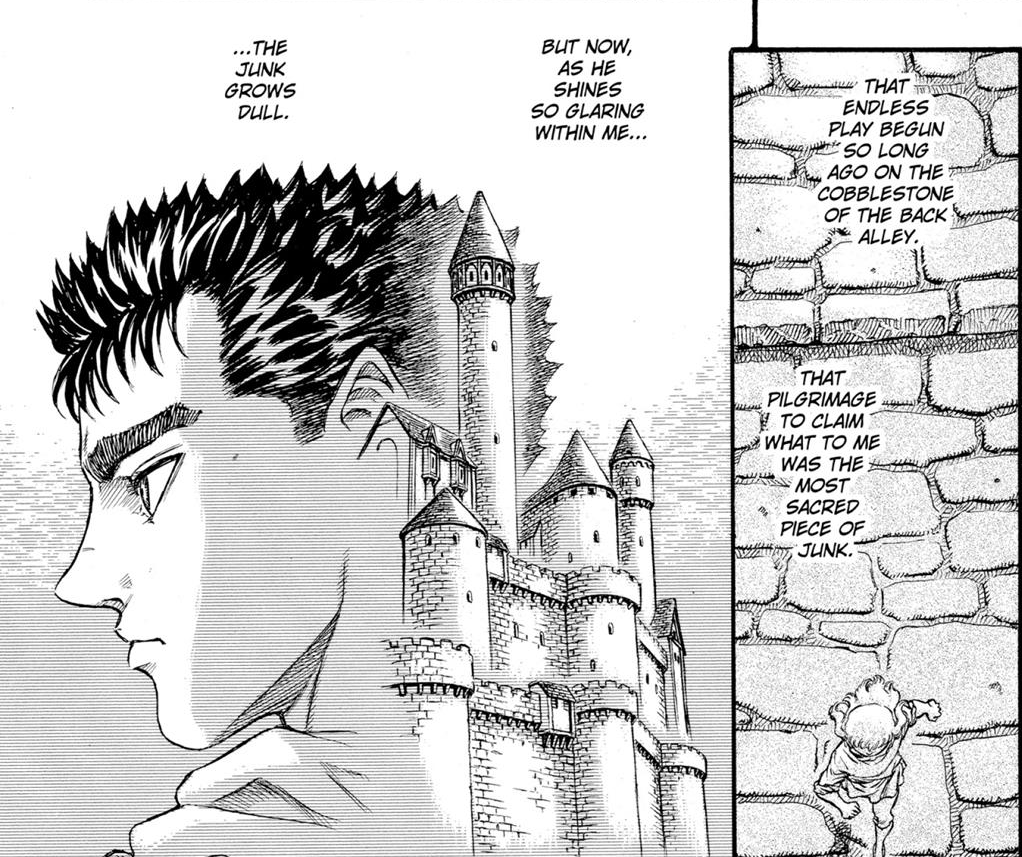
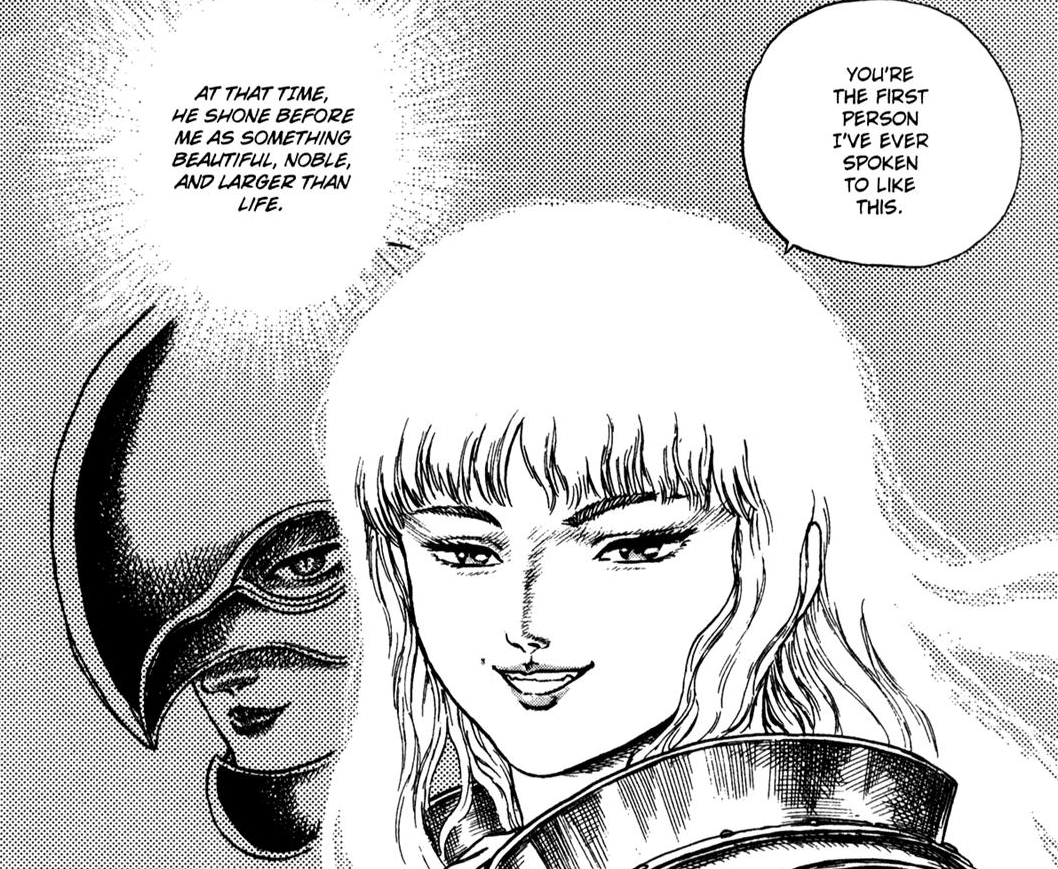
So then the next chapter opens on our very first glimpse of Guts and original flavour Griffith together. Early days, Guts is his 15 year old self pre 3 year flash forward. Still sullen lol. Griffith gives his keys that set the world in motion speech which, while illuminating thematically, is paced to set up this particular, emotionally revealing moment:
With the additional context of the parallel we’ve just seen between the Count and his wife, how does this come across? I mean come on, from Griffith’s side we have the statement that Guts stands alone as closer to him than anyone else has ever been, already – he’s the first and only person Griffith has ever felt comfortable voicing his internal thoughts to, his deep desire to know who he is at his core and what he’s capable of.
From Guts side we have “At that time he shone before me as something beautiful, noble, and larger than life.”
This reads as the beginning of a romance as far as I’m concerned, and not a one-sided one. Griffith’s quote tells us they have a uniquely close and emotionally intimate relationship, Guts’ quote tells us it’s a relationship that encompasses admiration/awe and thinking about how “beautiful” the other is.
The best illustration Miura came up with to introduce us to the nature of their epic love/hate relationship is a happy marriage broken by betrayal. And it’s not just because Griffith is in love with Guts (which hopefully we can all agree is fairly obvious), because, even beyond Guts’ neediness when confronted by Femto and the many suggestions of his complex not-just-rage emotions, I mean the first thing we see after 20 pages worth of that married couple parallel is Guts calling Griffith beautiful.
And boy do the first seventeen chapters of their relationship demonstrate that Guts is calling him beautiful for a reason.
ETA 18/03/24: mildly retooled the parallels to the Golden Age part because i realized on re-read that i skipped the most blatant one
I think a part of Griffith’s motivation for making the sacrifice is actually Guts’ death tbh.
It’s mostly the guilt trip, but I do think getting to sacrifice Guts along with the rest is a feature, not a bug for him.
Here’s the thing: Griffith is ridiculously in love with Guts. Before the year of torture he was willing to risk his life (and all-consuming dream) for him, Guts made him irrational, Guts leaving him drove him to self-destructive despair, Guts was the only one he shared the dark underbelly of his dream with, etc etc. Like by all metrics, Griffith’s love for Guts was already pretty epic.
Then add a year of torture during which Guts is the only thought that occupies his mind and keeps him sane. Guts is like lightning in his mind and now the dream, which had driven every aspect of his life previously, is dull. Many of his thoughts towards Guts are negative (”sorrow,” and “malice” are some of the words he associates with him eg,) and when he first sees Guts again his immediate reaction is to strangle him.
But all it takes to move his hand from Guts’ throat to Guts’ hand is Guts expressing emotion towards him by crying over him. Like, Guts takes him on a seriously extreme emotional roller coaster.
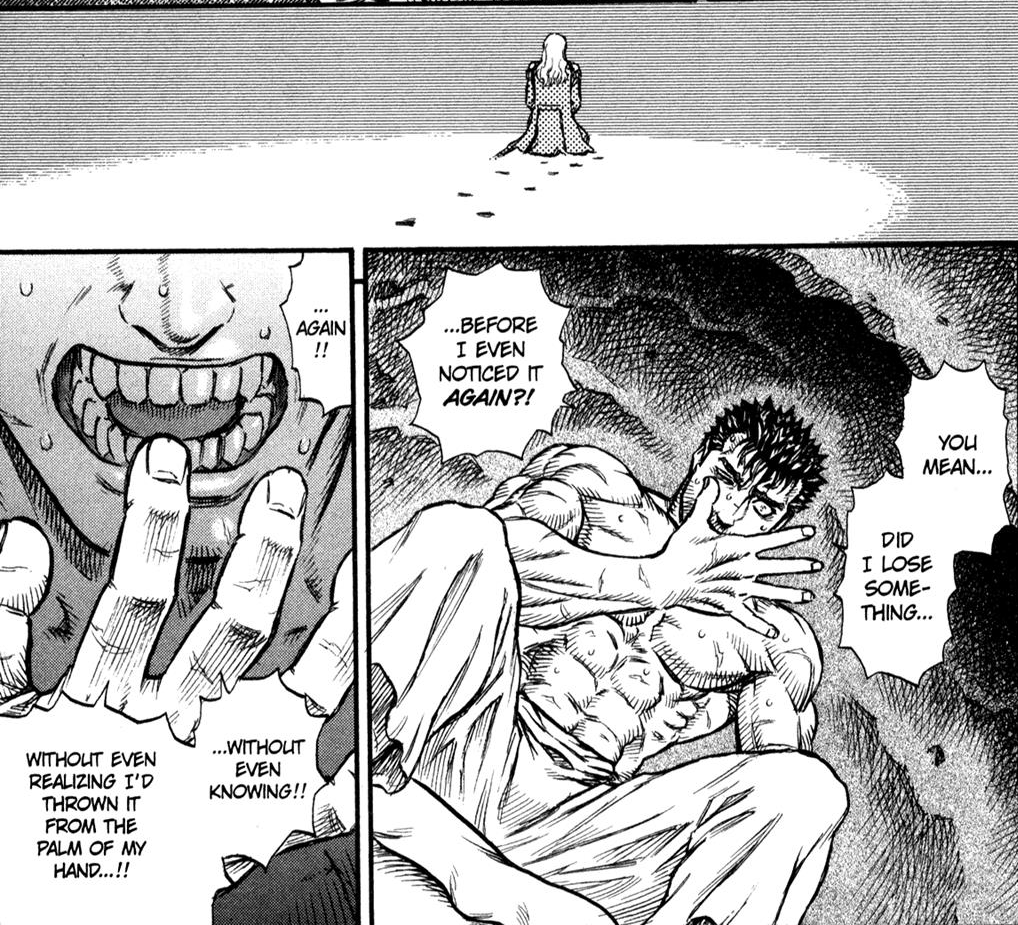
The moment that finally unlocks the behelit and calls the Godhand down isn’t when he lets go of his dream and it’s not when he thinks Guts is going to leave him again and it’s not when he tries to kill himself. It’s when Guts touches him again after all that. “Never again with you.”
I’ve talked about how I love that before but I’ve never rly said why, and really it’s because I think it shows that what finally truly sends Griffith into despair is knowing how utterly emotionally fucked up he is for Guts. To split hairs, it’s not because he thought Guts would leave him, it’s because he knew that if Guts left it would destroy him. It’s because of how Guts gained “such a strong hold over [him].”
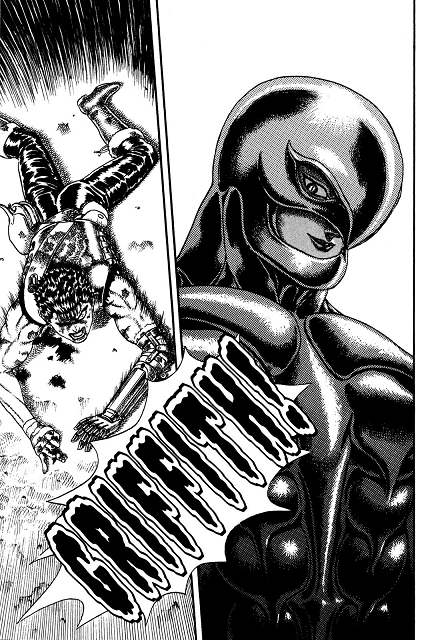
Because he’s irrational, because he’s weak, because Guts overtook the dream by a mile in the last year of torture, because if Guts leaves him Griffith will basically become an empty shell (as we could surmise from Griffith’s vision/dream/hallucination of a future with Casca), because Griffith is so wholly and utterly emotionally dependent on Guts, because even after Guts’ touch makes him feel so much despair the Godhand shows up he reaches to save Guts from falling – that’s what made Guts the person Griffith “loved and hated the most,” to quote the Godhand on a parallel situation.
In that last glimpse Guts sees of Griffith, he’s smiling. I interpret his expression as tender – I’d say there’s love in his eyes – but not regretful or agonized or horrified at himself or the circumstances that caused him to make a choice like this. This is me taking this concept and running with it but I think if it was anyone else in the Band he’d laid eyes on in that moment, he wouldn’t be smiling. He’d probably be unable to look them in the eye, he’d feel ashamed, he’d feel, if not regret, then at least inner conflict and emotional turmoil. But when he sees Guts, he looks serene in his choice.
And I think this is because, like the other sacrifices we see (Count’s wife, Rosine’s abusive parents, Eggman’s world that shunned him, Ganeshka’s assassinating son) Griffith sacrificed Guts because at least part of him wanted Guts gone. Guts was the source of the final nail in the coffin of despair, and Griffith was at the point where a part of him hated Guts because, ironically, he loved Guts so much.
So yeah I don’t think Griffith chose to sacrifice Guts out of malice or jealousy/possessiveness or betrayal exactly, but because he loved him to the point where he couldn’t function without him, and I think he resented (to put it mildly) that dependence. Believing Guts would leave him was his final wake-up call to how lost he was without Guts. So when the Godhand offered him an escape from his despair and a way to cut it off at the source, he agreed.
(Which is not to diminish the driving force of guilt behind his choice, but I don’t think his complicated yet overwhelmingly powerful feelings towards Guts can be disregarded either.)














 you're the only one