You get a bit more info about the whole merging of the worlds thing in the next like 10-15 chapters, w/ Rickert
visiting Falconia and talking to Locus, and some dudes talking about how
the world was altered in Elfhelm, so if you want to just keep reading and draw your own conclusions then ignore the rest of this response.
But basically I think the idea behind it is that for humanity (including apostles) to unite and yk stop being dicks to each other on a grand scale, they need a common enemy. And merging the worlds allows humanity’s collective imagination into the real world, turning it into a high fantasy and giving humanity a shitload of their own nightmares to deal with as that common enemy.
I think Falconia is also a side effect of this – humanity, or at least Midland and co, collectively willed it into existence as a safe utopia with a bird theme because Griffith just saved the world and they all want him to lead them. There’s that historical memory/legend of Gaiseric’s empire, so this is like version 2.0.
Quick and easy way for Griffith to gain a utopian kingdom with full support of the vast majority of the people in it. Plus saving the world, turning it into high fantasy, and ruling the only peaceful kingdom in it kind of gives you carte blanche to do whatever you want. Societal expectations are out the window. Human Griffith as king probably would’ve faced huge obstacles when it came to gaining support and implementing even small changes in, say, how much power the nobility had, while NeoGriffith can do whatever the hell he wants.
There’s also the effect of allowing the Godhand to exist physically in the world, I think, which will probably turn out to be important. Does it grant them more power? Does it make them vulnerable? Both? Something else? idk yet but it’s intriguing.
These lines are only 4 pages apart.
I’ve been thinking of running away as like… something Berserk contextualizes as immature and negative. Rosine running away to her land of the elves and eventually regretting it when she flies home to die. Guts running away so his malice could burn inside him. This dude:
Griffith’s sacrifice:
yadda yadda yadda.
And I’ve been kind of reluctantly expecting Falconia to follow suit as an immature, ultimately negative escape from the realities of the world.
But, in addition to Godo’s first statement up there, there are also lines like Casca’s as Guts fights Wyald:
“Why does he… always have to fight…? It’s alright… to just run away sometimes…”
So there’s a distinction to be made between running away so you can fuck shit up and express your anger (Guts’ revenge campaign, apostles making a sacrifice in despair and turning into monsters) vs running away from war and hatred and violence. Maybe running to a peaceful place where the monsters help humanity.
Like, maybe it is an important distinction that Rosine’s land of the elves was essentially a place where she could reenact the violence done to her on other people and call it a game, while Falconia is… just a sweet place to live lol. A kingdom where the violence suffered and perpetuated by its more monstrous inhabitants has no place anymore.
@bthump i Guess that being founded by Griffith a man who betrayed his comrades, among other things shows that Falconia is based on a lie, and tragedy will come.
this response to you basically just became an excuse to disjointedly ramble about this subject more, sorry for how unnecessarily long it is lol
tbh the main point of that post was to demonstrate how personal the stakes are, and how falconia is essentially a response to the child abuse all three of our main characters have gone through, thematically. so if it does boil down to ‘welp the dude who enabled the existence of a utopia where lives aren’t bought and sold and more people aren’t traumatized the way our faves were is an asshole so throw out the whole thing’ i will find that very unsatisfying.
i think falconia poses a lot of interesting moral questions. is it worth griffith’s mountain of corpses? is granting humanity’s dream worth also granting their nightmares? was it worth the sacrifice? and those moral questions only work if falconia is portrayed as positive, which it has been so far (and as long as those negatives happened with the intention of creating the positive, hence why most of that post turned into complaining about the eclipse rape lol.)
i think miura could also go down a route where he portrays falconia more negatively in the sense that humanity shouldn’t wish for a saviour/escape, but should instead struggle through an uncaring universe. a la the lost children arc, essentially, which seems like a potentially very strong parallel.
though again, considering how personal the stakes are – always the child abuse, come on – i would find that message… sucky, to say the least. i mean honestly the message of the lost children arc basically boiled down to ‘child abuse happens, dwi kids bc running away is bad.’ i kind of hope that miura is either still going to complicate that at some point down the line (lol pipe dream) or at the very least that he does something different with falconia than he did with rosine’s land of the elves bc dear god i couldn’t stand a repeat of that shit lol.
I mean here’s one way of looking at it:
Guts, Griffith, and Casca all have experiences with csa. Guts’ way of coping is to lash out and kill everything that scares him. Casca’s way of coping is to latch onto a saviour. Griffith’s way of coping is to change the world.
Like, of the three, Griffith’s coping mechanism wins lol, and I’m not down with an overall message that says, you shouldn’t try to change things, you should just struggle your ass through life like Guts here, and fuck everyone else. I mean tbf I don’t think Guts’ method is shown in a great light, so it’s already a bit more complex than Griffith’s dream bad Guts’ dream good, but yk, I worry lol.
Again, like, the moral question shouldn’t be “is this place where people are free to live their lives without being exploited a good thing,” it should be “is this good thing worth all the bad things that led to its existence,” and I don’t want the story to answer that question for me, I want to be presented with the evidence and decide for myself. Do the ends justify the means narratives are only interesting as questions, not answers, imo.
so idk basically my response is yeah maybe some kind of tragedy will come to demonstrate that falconia was a doomed venture from the start, and/or that wanting to create a place without exploitation is an inherently flawed or immature desire, but if that happens i will be unimpressed lol. If falconia does end up being destroyed, ideally for me there would be negative consequences to that too, because there are no easy black and whites in Berserk (or there shouldn’t be.)
and like, the whole thematic connection to child abuse could be coincidental, but facts are that falconia is explicitly a place where the strong aren’t given free rein to exploit the weak, and our central and most emotionally resonant examples of strong given free rein to exploit the weak are the nobleman who bought casca, donovan, and gennon. Plus the apt Lost Children parallel. so if miura didn’t intend this he shouldn’t’ve filled berserk so full of thematically on the nose depressing backstories lol.
This is about Falconia, bodies and lives being bought and sold, the natural order of the world, etc.
tw for csa (no graphic panels but still disturbing enough for a cut imo)
The Conviction Arc shows us in broadstrokes the world humanity’s collective unconscious wants to overturn through starving crowds, dungeons filled with tortured ‘heretics,’ rampant plague and the desire for a saviour, and nobles terrorizing peasants using god as an excuse, but this is the up close and personal version. Lives and bodies as commodities, weak trampled by the strong, poor ruled by the rich, and everyone accepting it as the way things are.
Our three main protagonists during the Golden Age all have very personal formative trauma that revolves around being bought and sold as a matter of course.
And Griffith’s dream, as someone wracked with guilt for lives lost in his battles, someone who has sold himself to a rich and powerful predator to save some of those lives, is to overturn this natural order of things.
And he does. Falconia is a place where children aren’t sold as sex slaves, where the powerful do not oppress the weak, where the rich don’t exploit the poor, where everyone is treated equally and with dignity, where Guts, Griffith, and Casca could’ve all had happy childhoods.
One of the important aspects of this theme re: societal power dynamics and exploitation is that these evil actions
are excused away. This is true of like, just about every abuser of power and
rapist in Berserk. Some think it’s okay because someone more powerful than
them told them they’re allowed (torturer, Wyald/probably the rest of
the apostles, Mozgus’ torturers, Mozgus and the inquisition in general
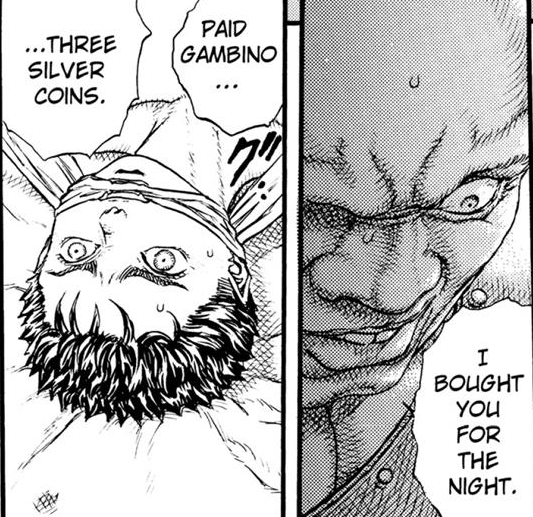
passing the buck onto God, Donovan because Gambino allowed it, etc),
some think it’s okay because that’s just the way things are (Donovan
again, Adon, Rosine’s got some of this, etc), some think it’s okay because
they’re powerful enough to do anything they want (implied with Gennon,
Ganeshka,
the Godhand, a lot of apostles, Casca’s attempted rapist nobleman), and finally some think it’s okay because the world wronged them (Gambino, apostles like Rosine again and Eggman, Jill’s dad, the baby eating heretics lmao, one could argue the King, Mozgus’ torturers again, etc).
Again, it all comes back to the “reason of the world,” the natural order of things that NeoGriff overturns. In the ordinary world these people with power can do whatever they want and justify it to themselves. In NeoGriffith’s world, they don’t. Apostles, our prime example of powerful preying on weak because they’re allowed to, no longer prey on humans, simply because of NeoGriffith’s existence.
It seems safe to assume nobles no longer exploit people either, if nobility is even still a thing in Falconia. Like granted, I’m taking some of this as read based on what we’re told Falconia is, but I feel like the apostles (and the explicit focus on equality) are a good representative example of the point of Falconia, which is to essentially fix everything we see wrong with the world in the Conviction arc and, like I laid out above, in our protagonists’ lives.
The fact is that Falconia isn’t just a utopia on a distant macro level, where the readers can look at it and go, hm seems nice I guess but w/e. On a micro level it’s a place where these horrible things that happened to the characters we personally love and care about wouldn’t’ve happened. I, at least, am emotionally invested in that utopia because of this, yk?
But here’s where I get critical of the portrayal:
Femto and the Eclipse rape is the epitome of the harmful power structure. Like, Femto hits every branch on his way down this tree lol. During his transformation he met God, God absolved him of his guilt and responsibility by telling him he can do whatever the fuck he wants and it’ll be the right thing. He’s taking the place of the nobleman he saved Casca from and exemplifying existing power structures of strong preying on weak, and it’s petty revenge.
One can easily argue that the Eclipse rape is a distillation of every abusive power structure in Berserk.
So okay, you have Falconia, a utopia that exists to eschew these power structures and create a place of equality where no one is exploited, created by a dude whose defining act is the epitome of these abusive power structures.
And frankly it’s fucking pointless. This feels like the shallowest of shallow hot takes lol. Like, oooh what if this wonderful place where all the horrible things that traumatized our favourite characters are no longer an accepted given was created by an evil demon rapist???
Like… okay? And then what? The Eclipse rape has nothing to do with the social structure of Falconia, NGriff seems to have completely delivered on his/humanity’s dream regardless, he is now the higher power making the calls and he hasn’t told everyone to do whatever they want no matter who it hurts. From what we’ve seen he’s done the exact opposite, existing as a tempering influence on the apostles who no longer prey on those weaker than them, ending the Holy See’s reign of terror, ending wars in general, and uniting people in their differences.
So it’s just like, an arbitrary evil act which creates an artificial sense of moral greyness. It has no deep meaning. I mean I suppose Miura could address it in the future – I’ve mentioned that I think it could theoretically be really interesting for Casca to visit Falconia and see the dream she devoted her life to having come to fruition because of her rapist. But even so, that doesn’t have any like… deeper intrigue. That’s interesting for Casca’s character, not as an examination of moral relativity or w/e.
Similarly, if NeoGriffith turns out to be more human than he looks he could reflect on this contradiction in a potentially interesting way.
But I can’t think of a way to make it an interesting examination of morality. It’s boring at its core imo. I mean you could argue that it’s still worthwhile on that personal character level, but let’s be real here – no amount of potentially interesting character stuff in Casca’s future is worth removing her from the story for 20 years, and anything w/ NeoGriffith would be a retread of human Griffith’s guilt issues and frankly I don’t see it happening anyway lol.
So yeah ultimately this whole egalitarian utopia created by a rapist demon thing just does not work for me at all. There’s no reason the creator of this paradise /had/ to be a symbol of this abusive power structure it exists to destroy, again, that’s just an arbitrary happenstance, not a pre-requisite to utopia building, so it doesn’t say anything about the nature of Falconia. It doesn’t say anything about utopias in general, it doesn’t say anything about those power structures that we don’t already know (ie they bad, equality good).
It’s like, fake deep tbqh.
The actual interesting and morally grey aspect of Falconia is the way world peace was achieved by setting a bunch of fantasy monsters loose on humanity, and that has nothing to do with the Eclipse rape. Like, that’s literally all you need for the moral complexity. We have world peace and a growing utopia that everyone is welcome to join, but the price is monsters everywhere, and this could not have happened without those monsters to unite humanity in fear. Is the world better or worse than it used to be?
And NGriff being a rapist, or his demon alter ego being a rapist, or whatever the deal is there, adds nothing to that question, rather, it distracts from it and devalues the actual moral ambiguity.
In fact, it makes me wonder whether Miura regrets going with rape as his way of demonstrating Femto’s evil. Because it’s been such a non-issue to the whole theme of power structures, utopias, equality, etc, that it feels like Miura is sweeping it under the rug lol – it’s less of an attempt at dark irony and more the elephant in the room. I can’t even say with confidence that Femto was intended to be a symbol of exploitative power structures, despite how obvious it seems, because it just… hasn’t impacted the themes of the story at all.
Enh, to be fair some warlock dude in Elfhelm kinda suggested this.
Though I definitely think this is just, like, his opinion, man.
I think we’re getting two sides to this whole Falconia thing, and we’re meant to draw our own conclusions. Like, yeah Griffith’s country is the only chill place now, which is shitty, but on the other hand it’s also 50x better than the world was even before he flooded it with monsters, and it seems that his plan is to keep expanding it into an inclusive empire.
It’s not that NeoGriff is a con man or w/e, forcing people to buy his world peace, it’s that flooding the world with monsters is the only way to make people stop being shitty and work together in a nice utopia that values equality over social status, and it’s up to the reader whether the ends justify the means or not.
Plus it’s worth noting that this is what humanity wants. The Conviction arc was largely dedicated to showing us how shitty the world is. Nobles torture and torment peasants, outcasts are miserable, the holy see sucks, the heathens suck, plague everywhere, people starving, pretty much everyone except the richies is unhappy. Griffith’s new world order is essentially a response to all the bullshit we see up close and personal in the Conviction arc, a world where outcasts are welcomed, people are valued for what they can do rather than what family they were born to, apostles no longer eat people, no inquisitions, no discrimination that we see – like it’s fitting that the prostitutes from the Conviction arc return in Falconia as tour guides/organizers.
Griffith, as “the desired” of humanity, presumably fulfills humanity’s desires. Of his own free will and for his own maybe shifty reasons, but free will and fate are not mutually exclusive in Berserk – people’s choices always play into fate’s hands. The Idea of Evil told him he’d either save or doom humanity by doing whatever the hell he wants. I kind of assume this means less saving/dooming the world and more a metaphysical Jesus-y saving/dooming people’s souls – or quite possibly saving humanity from themselves or dooming them to more of their own subconsciousness dicking with them. You know, either getting rid of the Idea of Evil by shaping humanity’s point of view, or dooming them to continue having their mass subconscious manifest in a malicious entity who controls fate.
That’s just a theory tho, we don’t really know what the Idea of Evil means afaik, and even if I’m right I have no idea if what NeoGriffith is doing is more likely to save or doom humanity lol. Or hell maybe he’s on the road to “dooming” humanity but, similar to how letting Guts go kicked off the series of events leading to his rebirth as NeoGriffith, something in his faulty, Guts-obsessed demon soul is going to cause him to do something unexpected and better/freeing for humanity. /more theorizing
ANYWAY all that said I actually fully expect Miura to come down more on Guts’ side, since he is the protagonist and all. Personally I’m into Falconia, I like the whole ‘can’t make a utopia without breaking a few eggs’ thing, but since Guts, on a more philosophical level, represents free will and raging against fate and struggling against your situation while Griffith more represents being saved by someone who comes along and makes your life easier (i think), and Berserk is all about The Struggle, I think there’s an undertone of it being better to suffer in an uncaring world than to have a happy easy life in a utopia.
you think the torturers being outcasts collected by and devoted to mozgus is supposed to be a preview of neogriff’s apostles/war demons
tbh actually it makes sense bc it’s easy to view mozgus and neogriff as foils. like they both got that sinister angelic thing going on but their differences are more light-shedding than any similarities – the whole conviction rebirth arc was largely about outcasts and creating enemies out of other groups to strengthen your group (ie religion) while the point of falconia is to unite humanity with literal fantasy monsters as the enemy. mozgus’ outcasts tortured people, griffith’s save people. mozgus condemned most people, griffith accepts everyone. mozgus upheld the status quo and the way of the world (those with power trample those without) while griffith creates a world with a new status quo
and this is humanity’s deepest desire so it’s basically a direct response to mozgus and people like him dividing and conquering and demonizing outsiders and upholding nobility while making the lower classes suffer etc.
there’s a whole false god vs true saviour w/ divine right vibe i get from this comparison. and i mean the true saviour is still a largely cynical depiction since berserk is in part a criticism of religion, “god” included, but neogriff’s utopia is a lot less easy to denounce as fucked up and evil than mozgus’ inquisition thing.




 you're the only one