My Big Gay Berserk Analysis 4

Why I Ship It

Part One
Part Two
Part Three

Okay we’re finally on the last part of this giant self indulgent monster. Here I’m going to get into why I prefer to interpret Guts and Griffith’s relationship as mutual gay pining as opposed to one-sided, how I think the sexual attraction between them fits into the existing themes, and in general what makes it really work for me.

I wrote this thing because while I feel like a lot of fans can agree that there’s at least a strong indication that Griffith’s feelings for Guts aren’t strictly hetero, even lots of fans who acknowledge the gay subtext see it as one-sided. So I wanted to put a spotlight on Guts’ side of things.

And tbh, even ignoring all the stuff I’ve talked about so far, it boils down to one point: one-sided pining just doesn’t fit into the rest of Guts and Griffith’s relationship.

For me, the Golden Age tragedy works so well because it rests not on incompatibility or irreconcilable differences, but on a misunderstanding: both Guts and Griffith fail to realize that the other loves him.


This is just facts – you can call the love platonic if you must, since Miura never went beyond subtext with the romance, but that’s the plot of the Golden Age in a nutshell.

And if, like me, you think it’s pretty clear that Griffith the gay coded villain who irrationally risks his life for Guts multiple times, who is so gay Guts had to ask during their very first conversation and Griffith didn’t answer, so gay he thinks about Guts while having sex, so gay his feelings for Guts kept him sane during a year of torture, so gay that Guts is cheer captain and Casca’s on the bleachers, is romantically in love with Guts, then it follows that Guts’ feelings must also be romantic in nature.

Because again, this isn’t a story about unrequited love. The Golden Age is about two dudes who had a great relationship but fucked it up because they both misunderstood what that relationship was and failed to communicate. It’s not about a gay dude tragically in love with his straight bff. If attraction is part of Griffith’s feelings for Guts, then attraction is part of Guts’ feelings for Griffith.

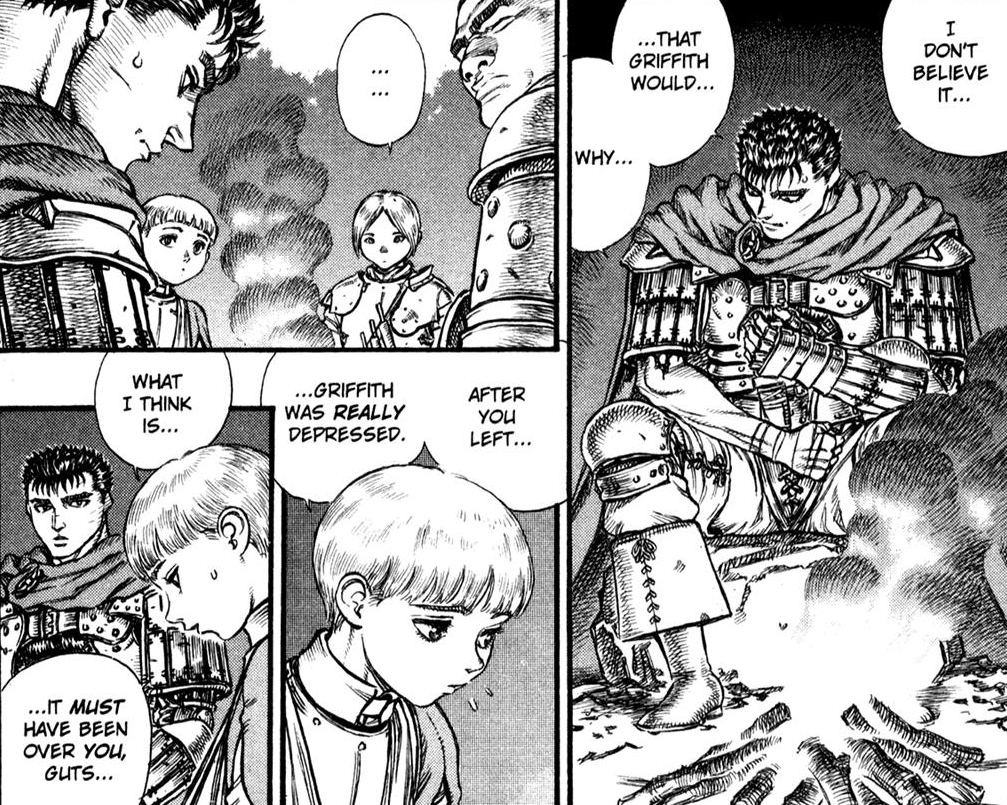
The final arc of the Golden Age, after Guts returns from his stupid vacation, largely revolves around Guts’ slow realization that he was wrong when he thought Griffith looked down on him and didn’t care about him:
image
image
image
image
image
image
image
image
image
image
image
image
image

He’s realizing that Griffith’s breakdown after he left, Griffith losing his dream because he left, ultimately means that he didn’t need to leave at all, because Griffith didn’t look down on him. Griffith needed him. Griffith loved him.

image
image

Griffith’s corresponding misundertanding is that he didn’t know Guts left to become his equal, and almost certainly believed he left because he couldn’t stand to be around him after seeing Griffith’s “dirty side.”

This is a bit less straightforward because Guts gets most of the focus in the story, but I’ll do my best to briefly explain my reasoning.

Guts and Griffith’s final interaction together before the duel, that we get to see, is this night:

image
image
image

Griffith needs emotional reassurance in a revealing and intimate moment of vulnerability, and Guts fails to provide it. Instead of telling Griffith that no, he doesn’t think he’s cruel, he tells him something more akin to “yes but it’s necessary for your dream, remember?”

Griffith’s expression in the “You’re right,” panel is straight up the saddest thing I’ve ever seen, it might actually be my favourite image Miura’s ever drawn ngl. I love it so much.

Compare to how he looks at a dead kid before deciding the kid’s death means he has to have sex with a predatory pedophile, and then self-harms in the river the next morning while claiming he doesn’t feel guilty:

image

Down to framing and hair over his eyes these panels are so similar that I fully believe “You’re right,” is a purposeful call-back to this, giving us the necessary context to understand what Griffith is feeling.

This night of assassinations is Griffith’s corresponding Promrose Hall moment, imo. If only for a moment, he forgets his dream because what Guts thinks of him is more important, and when, instead of reassuring him, Guts reminds him that the path to his dream is paved with cruelty, he looks like all his self loathing hits him at once.

image
image
image

Also dude has a serious and depressing propensity for calling himself dirty.

So when we next see him and he’s falling apart because Guts is leaving, this is the context we have for his extreme reaction: his self loathing, the way he asks for reassurance, and the way he looks when Guts brings up his dream instead of giving him that reassurance.

image
image
image

Look at the moment Griffith is remembering here: “It’s funny… you’re the first person I’ve ever spoken to like this.”

It’s ironic because we know exactly what Guts thought of him then, but Griffith is convincing himself that Guts hated him from the first glimpse he saw of the real Griffith, the Griffith no one else gets to see. The vulnerable, “dirty,” needy Griffith, the Griffith who questions his place in the world, the Griffith falling in love with Guts.

And like Guts, Griffith has no idea how Guts truly feels about him.

image
image

So yeah, this is why I think their feelings, all their feelings, from platonic to sexual and everything in between, are mutual. Because the point is that they’re two idiots who love each other but, thanks to their low self esteem, can’t see that they’re loved in return.

Which brings me to themes and shit, and why Guts and Griffith being sexually attracted to each other fits into Berserk like a puzzle piece.

Berserk is, at its core, about reactions to trauma. It’s right there in the title. Like every major adult character has childhood trauma that fucks them up. Serpico, Farnese, Casca, Guts, and Griffith.

When it comes to the Golden Age trio:

Casca was assaulted by a nobleman and saved by Griffith.

Griffith prostituted himself to a pedophile in a fit of extreme guilt while he was at most on the young end of teenaged, called himself dirty and self harmed afterwards.

Guts was raped by a soldier his abusive adoptive father sold him to.

Casca’s reaction to her trauma is to idolize Griffith as her saviour to the point where she has no sense of identity outside of him and helping him achieve his dream.

Griffith’s reaction is self-loathing, emotional repression (”I don’t feel guilty,” he says, while Casca begs him to stop hurting himself), and the beginnings of a vicious cycle in which he is driven to achieve his dream to make all the “underhanded” “dirty” things he does for it, and all the deaths on his head, worthwhile.

Guts’ reaction is his desperate desire to be loved and respected coupled with a mistrust of people.

All these traumas result in the bad decision pile-up that eventually leads to the Eclipse.

Guts’ desire to be loved and respected coupled with past experience making it all too easy for him to believe he’s not is why he ignores a mountain of evidence that Griffith loves him in favour of one overheard speech about how he has no friends, and then decides that it’s a good idea to abandon all his friends, including Griffith, in order to try to become his equal and earn his affection.

Griffith’s self loathing leads him to believe that Guts is abandoning him bc he’s desperate to get away from him after seeing some of his darker sides that he’s ashamed of. His emotional repression means he has no ability to understand or express his extreme emotional reaction to this. So he lashes out through a framework he does understand (”rules of the battlefield,” as Judeau says), then falls into despair, crashes and burns, and ends up in a torture chamber.

And Casca’s lack of identity leads to her transfering her obsession from Griffith to Guts – complete with sword metaphor – after they sleep together, which leads to her mistakenly prioritizing Guts’ previously expressed “dream” to go off and fight people, the same way she once prioritized Griffith’s dream, which leads to Griffith overhearing her telling him to leave, which leads to the Eclipse.

My point is that the Golden Age arc is basically the story of three traumatized people whose adverse reactions to their traumas fuck their relationships up. Because it’s a dark fantasy story ft gods and monsters and fate etc, fucking up their relationships results in the Eclipse.

This is a perfectly good story by itself. It doesn’t need sexual repression added to it, but at the same time, boy does sexual repression fit right in.

I think that, whether it’s intended by the author or not, Guts and Griffith are both extremely easy to read as repressed gay*** men.

Griffith’s got a whole narrative about his dream, a dream which he can only achieve through hetero marriage, being pitted against his love for a man. He does stupid irrational shit for Guts and Casca berates Guts for it because he could “take Griffith’s dream down with [him].” Overhearing him talking about his dream to Charlotte is what makes Guts decide to leave. Guts is the only one who makes him forget his dream. He has to sacrifice Guts, “burying his heart,” to attain his dream. Even when he becomes the saviour of the world as NeoGriffith, he still has to marry a woman to seal the deal on his dream.

The dream is associated with emotional repression and Guts is associated with emotional expression.

As for Guts, I just wrote over 10k words about his attraction to a man and 5k of those were about how his het romance revolves around his attraction to a man so I’m not going to reiterate all that. There are a few particularly noteworthy things about Guts and his narrative that scream repression to me though that I’ll mention.

The way it’s his deep, subconscious, instinctive id side, the Beast of Darkness, urging him to pursue Griffith, complete with a dark sexual undertone. (Relevant reminder: I’m only arguing that the gay is there, by accident or by design, I’m not arguing that it’s a positive portrayal lol.)

The way Guts’ statement to Casca after sex that only her touch was okay in the beginning is a) incorrect as I’ve shown earlier, and b) irrelevant bc the reason she was able to touch him was solely because she’s a woman, as we know from the way his burgeoning panic subsides when he realizes she’s not a man – and ever since then she’s been the only woman he knows. So it doesn’t feel like much of a jump to suggest that he had sex with Casca because she’s literally the only person he knows with whom sex wouldn’t automatically trigger him.

The way his matchmaking of Griffith and Casca seemed to be an attempt to get Casca to take his place, with the added layer of romance that he couldn’t envision for himself.

The way, in their first interactions, Guts seems transfixed by Griffith’s appearance, comments on his pretty face, suggests sex if he loses in a way that seems informed by his rape trauma, but then is once again entranced by Griffith, rather than angry or afraid or any other potential negative emotion you’d think he’d feel, when he does lose. This whole sequence gives me the impression that he wants to bone Griffith but can’t acknowledge it and can only relate the concept of same-sex desire to his trauma.

And, for both Guts and Griffith, the way their respective traumas are depicted is particularly relevant. I’ve explained how each formative traumatic experience gave these two a pile of issues that fuck up their relationship. But the thing is, none of those issues (for Guts a need to be loved and respected and a default belief that he isn’t; for Griffith emotional repression, guilt, and self loathing) are intrinsically tied to rape. For Guts, it’s Gambino’s betrayal of him that fucks him up, not the specific sexual nature of that betrayal. For Griffith, it’s the realization of the weight of his dream and the way he “dirties” himself for it – later examples of acts that make him feel “dirty” are assassinations, so there’s no narrative reason his first act has to be traumatic, non-consensual (as he’s a child) sex.

And this isn’t a critique of that, I actually think it’s great to see characters who have backstories involving rape without it being the sole thing that defines them. For every character it’s part of a tapestry of childhood trauma, not the only important part, or even the most important part.

But it’s really, really easy to fill in the blanks for how formative sexual trauma specifically also has a hand in informing the nature of and contributing to the destruction of Guts and Griffith’s relationship. We’re not explicitly shown or told this, but imo it is suggested when they first meet.

Guts makes the duel, and his first real meeting with Griffith in general, about sex by uncomfortably asking if Griffith’s gay and offering himself to him if he loses. Here either the narrative is choosing to deliberately point out that Griffith and Guts have some gay undertones going on in our introduction to their dynamic because this informs our understanding of the rest of their relationship going forward, or the narrative is choosing to remind us of Guts’ sexual trauma here because that trauma informs the rest of their relationship going forward. Or both.

It’s also suggested in the way we learn Griffith’s backstory with Gennon right before Casca finally expresses her jealousy of Guts and comes this close to telling Guts that Griffith is in love with him:

image

By revealing this backstory in the lead-up to this revelation of why Casca resents Guts, Griffith’s trauma and his feelings for Guts are tied together the same way Guts bringing up sex when he first duels Griffith ties his trauma to their relationship.

And the way these traumas may inform their relationship is that neither of them are capable of acknowledging or even recognizing their love and attraction.

Let’s be real here: if Guts and Griffith’s relationship was romantic there’d be no Eclipse.

This is what really makes the subtext and the idea that both of them are repressed dudes in love work for me. This is the number one reason I ship it: because they work so well together.

We’re shown exactly how compatible they are. The tragedy of the Golden Age is predicated on both of them failing to recognize the other’s feelings, but what makes it a real tragedy is the inherent lost potential when their relationship falls apart.

All Guts truly wanted was someone he loved, who loved him back and treated him with compassion and respect.

image
image
image
image

And he got that! That’s exactly who Griffith was to him, exactly how Griffith fulfilled his emotional needs.

image
image
image

Guts remembers the night he killed Gambino before dedicating his sword to Griffith. This is when Guts decides that maybe the Band – maybe Griffith – is what he’s been looking for. A home. Love. Someone to look his way – more than that, someone who cares about him enough to lay down his life for him.

This is the truest moment of Guts and Griffith’s relationship, imo. There’s no misunderstanding getting in the way and muddying the waters – there’s only Griffith admitting he had no reason to risk his life for him and casually saying he’d do it again (”each time I put myself in harm’s way for your sake”), and Guts recognizing how significant that is, and dedicating himself to him in return.

image
image

Right here and now Guts has everything he’s always wanted. Later he overhears the Promrose Hall speech and re-evaluates his relationship through a false lens, but as I said back at the beginning of this post, Guts eventually realizes that he was right the first time.

Now again this is less straightforwardly stated and relies more on my own interpretation, but I think Griffith’s corresponding issue that matches Guts’ desire to be loved is his desire to be truly seen and accepted.

He wants Guts to be privy to his dirty side and to want to remain at his side anyway. In order to fulfill his dream Griffith has to constantly project an image of perfection.

image
image

His reaction to Casca seeing him in a moment of extreme vulnerability is:

image

There are countless references to Griffith looking like something out of a fairytale, there’s his carefully constructed perfect-fiancee image he shows Charlotte, his perfect infallible leader image he projects to the Hawks. He’s a symbol to everyone – to the Hawks and the peasants etc who love him he’s a symbol of change for the better, of soaring up; to his opponents he’s a symbol of corruption and change for the worse, a “parasite.” To his rapist(s)*** he’s a symbol of perfect beauty. People either look up at him or down on him. When he says he has no equals, in fairness, it’s because no one treats him as an equal. In their last scene together before the speech even Guts had reframed a request from a friend into an order from a superior (”It ain’t like you. Just cut to the chase and order me to do it.”)

But Guts is still unique because he wants to be Griffith’s equal. He wants to “stand beside him,” he wants to consider Griffith a friend and treat him like a real person and not a symbol. And, more than anyone else, he does.

Guts dumps a bucket of water over his head in his first week with the Hawks while they laugh together. Guts disobeys orders constantly to the point where Griffith just plans around Guts’ impulses and Casca gets pissy about how much he gets away with. Casca sees Griffith as distant and unreachable after a battle, but Guts scoffs and takes her to go hang out with him. During their homoerotic duel, Guts punches him and says, “I bet that’s the first time that pretty face’s ever been hit,“ showing only irreverence for the image everyone else is obsessed with.

And this is the one man out of tens of thousands who makes Griffith forget his dream.

This is the foundation their relationship is built on. Love and respect, and irreverence and equality. They both come closer than anyone else to providing what the other needs. And they both help the other grow:

Griffith gives Guts a supportive environment, his trust and belief, his love and affection, and Guts grows into a responsible person who leads a group of men who freaking adore him, who cares for the people around him and lets them in instead of being standoffish, who is able, until an overheard speech, to accept that he is loved and that he has value.

Guts gives Griffith attitude, playfulness, irreverence, etc, and Griffith is able to trust him, is able to allow himself to be vulnerable around him and show his insecurities. He’s able to be himself with Guts.

Plus Guts makes him forget his dream. And Griffith’s dream is bullshit, it’s absolutely terrible for him, it’s a huge weight on his psyche, it’s built on guilt and a need for validation from the universe. But after three years, it’s Guts he turns to for validation instead. Griffith asking Guts “do you think I’m cruel?” is so pivotal because in that moment Griffith’s desire for Guts’ regard outweighs his dream. Guts has to remind him about his dream, and that reminder hurts.

Griffith raises Guts up and Guts brings Griffith down to earth a little, and they come so close to meeting in the middle – but, to bring this post back to my point, they never quite do.

Guts brushes off Griffith’s attempts to treat him as an equal (asking him to help him out by killing a man and Guts telling him to order him to do it; asking if Guts thinks he’s cruel and being reminded of his dream; Guts becoming blind to Griffith’s showings of love after overhearing the speech) and Griffith doesn’t seem able to recognize or admit his own feelings for Guts until spending a year in a torture chamber.

But yk what if they could’ve just fucking boned at some point all those problems would’ve been solved. Literally. That’s my argument in a nutshell: if Guts and Griffith could’ve recognized their romantic and sexual feelings for what they are, and acted on them, they would’ve lived happily ever after. And if they didn’t both have significant trauma related to same-sex desire, not to mention all the other traumatic factors contributing to their awful emotional intelligences and self esteems, they probably could have.

Realistically of course that’s not how relationships work, there’s never any happily ever after guarantee, but this is a story, and we’re given enough information about their relationship to draw the corresponding conclusion that if they were open about their feelings with each other, if they had grown closer instead of being pulled apart by misunderstandings, they would’ve been very happy together.

And I don’t mean to say that sex would automatically fix everything either – just that the story implies that if they had both been able to recognize that their feelings of love and adoration were returned by the other, Guts wouldn’t’ve felt the need to leave to earn Griffith’s friendship through finding his own dream, the second duel wouldn’t’ve happened, and Griffith wouldn’t’ve ended up in a torture chamber for a year. And being able to take the step to turn their relationship romantic and sexual is a natural part of figuring this out.

And while there’s no real reason Griffith would have to choose between his dream and Guts, it’s worth pointing out that the driving conflict of his narrative is Guts vs the dream, and Guts effectively wins.

Guts was replacing the function of the dream in Griffith’s mind. Griffith was beginning to seek out Guts for validation instead of trying to prove himself worthy by achieving an arbitrary goal. He says Guts made him forget his dream. In the torture chamber he reflects that the dream grows dull next to Guts.

Would he have been able to give it up and find contentment in a relationship with Guts? It’s a hard sell, but we’re shown the building blocks that support this conclusion. We’re explicitly told that Guts is more important to him than his dream, so yeah, absolutely in theory Griffith could’ve quit the stupid dream given a choice between it and Guts. Hell we saw him make that choice when he risked his life for Guts during the Zodd thing. And if you believe that part of his motivation for sleeping with Charlotte, at least subconsciously, was self-sabotage, he threw the dream away then too.

The Godhand only came down to offer him the sacrifice option when Griffith believed Guts was going to leave him again, and even then he had to be physically separated from Guts, had to be totally physically helpless and mute after a year of torture, and had to be taken on a fun guilt trip by the Godhand before he sacrificed him. And the final emotional reason Griffith chose to sacrifice Guts wasn’t because the dream was more important to him, it was because Guts was. “You’re the only one… who made me forget my dream.”

So yeah I think it’s absolutely possible, even plausible, that if Griffith was more self aware and capable of recognizing his feelings and acting on them he would choose Guts over the dream.

And obviously if Guts got together with Griffith – if Griffith gave up his dream for Guts, or prioritized Guts over his dream by, say, choosing him over Charlotte, or maybe even something as low-key as Griffith jeopordizing his ambition by beginning a relationship with Guts behind Charlotte’s back – Guts would know exactly how much he meant to Griffith, a la the rooftop scene. The speech would be meaningless in comparison to Griffith risking or losing the dream for him. Guts would be 100% secure in the knowledge that he is valued and loved.

But, thanks to Guts and Griffith’s traumas, they failed to recognize the possibilities in their relationship, they fell victim to self-doubt and insecurities, and they ruined everything. And that lost potential is what makes the tragedy so effective to me.

Like I said, this is already what their story is about, subtext or no subtext, platonic or romantic. Griffith could’ve chosen Guts over his dream platonically too (again), in theory. But the subtext adds another, very fitting layer to the story. It slots in neatly with the concept of missed opportunities and lost chances, and it fits with the characters’ histories and particular sex-related issues. And, having just written a 10k series of posts pointing out about half the subtext (Guts’ side), I think there’s a solid argument for considering sexual attraction part of the package.

One final thing I want to mention, from an out of universe perspective, is that one of my problems with Berserk is that every single textual instance of same-sex desire is evil and predatory and harmful. So I like the idea that the absence of gay sex between our two main characters

is what caused the Eclipse. Their mutual desire (or Griffith’s ~evil jealous~ desire) didn’t cause everything to go wrong, it was the fact that they failed to act on it that ruined everything. It doesn’t balance it out obviously, but reading the story this way just makes it more enjoyable for me.

tl;dr in conclusion Berserk is gay, Guts wanted to bone Griffith, and if he had Berserk would’ve been a much happier story.


*** I’m saying “gay” because this is my project and I hc both of them as gay. But if you see one or both as bi, more power to you.

*** The torturer’s “we were like husband and wife” sounds pretty suggestive to me but it’s left in creepy implication so who knows.


Thank you everyone who has read, liked, reblogged, and/or commented directly or in tags, etc ❤

meta masterlist

As an illustration of Guts realizing he threw what he desperately wanted away (Griffith) by leaving to earn him, these two pages are amazing.

“If you’re Griffith’s friend and equal” with the larger than life beautiful and noble image of Griffith dwarfing them, to “Why do I always see these things… after they’re done and gone…?” with what Griffith has become, tiny and weak, because Guts broke him by leaving to become his equal, itself proof that leaving was unnecessary.

Griffith as the image Guts wanted to rise up to join, whose love and affection and respect he craved vs Griffith as the human Guts was already equal to, who craved Guts’ love and affection and respect in kind.

i usually think abt guts love for griffith bc its so ignored, but ngl griffiths love for guts is super interesting too, bc its often reduced down to possessiveness/him being evil?idk love them

Man ia Guts’ love for Griffith is ignored way too much, but also yeah reducing Griffith’s love for Guts down to ~evil possessiveness~ is one of my pet peeves.

imo he’s possessive because he’s stunted emotionally (like most of Berserk’s cast lol), but that doesn’t mean he only loves Guts as an asset, it means he has v little ability to recognize and compartmentalize his emotions so he responds to extreme feelings generally pretty badly.

Like Guts is compared to Griffith’s dream a lot which to me is saying that when Griffith fell in love with Guts he’d never felt so strongly about anything else, other than his dream. (”I want you, Guts.” “Griffith’s never said a thing like that… not to anybody!”) And because his whole raison d’etre is seizing his dream, now that something else makes him feel the same amount of need and desire, he “must obtain” him. He has no other frame of reference for what he’s feeling lol.

But in actual action he’s not controlling. Guts does whatever the fuck he wants in battle and Griffith plans around it, eg. Griffith asks Guts to help him out with his assassinations, which the narrative specifically draws attention to, and Guts is the one who wants it to be an order. Griffith risks his life and dream for Guts multiple times and can never explain why. Griffith, according to Casca, doesn’t control Guts enough as a leader. Griffith self-consciously asks Guts if he thinks he’s cruel for asking him (or maybe ordering him after Guts’ response to Griffith phrasing it as a question for the first assassination) to help him with the bonfire assassinations. Griffith’s whole speech about friendship is about desiring an equal who he doesn’t own, and can’t control, and his monologue in the torture chamber is about realizing that Guts was that person.

I really love Griffith’s inner monologue during the second duel because it’s such a powerful emotional breakdown imo, and it feels so childish to me. It seems like he’s falling back on “you can’t leave, I own you” because he has nothing else, no other way to respond to the thought of being abandoned, no other way to contextualize what he’s feeling. He’s clinging to a sense of ownership bc it’s the only part of his relationship to/feelings for Guts he really understands, and it’s a defense against the uncontrollable messiness of his feelings – a way to repress his love and need and feelings of rejection and loss and self-loathing, and a way to repress his realization of “when did someone I was supposed to have in hand… instead gain such a strong hold over me?” – that ultimately fails.

It just feels so consistent with the childish aspects of Griffith’s character, and the part of him that represses his emotions until they seep out in horrifying ways (eg self harm, risky sex, thinking it’s better to risk killing Guts than to let him “reject” him, etc).

Idk basically I like Griffith’s possessiveness because it’s a flaw that rears its ugly head to fuck up his relationship with Guts, and is actually entirely counter-productive to the relationship he genuinely wants with Guts (equality). But it’s nowhere close to the be-all end-all of his feelings for him.

yk i think about this scene when i think about why griffith would’ve fallen for guts, bc i tend to think that at least part of the reason is that guts treats him like a person, rather than as a beacon of hope or portent of doom lol. which is exemplified when he dumps a bucket of water on his head.

but man how about why guts fell for griffith? guts, who never got to be a kid, who was trained as a mercenary since like age 4, never had any friends growing up, no one around his own age. he’s never played with friends before. like this is probably the first time he’s ever had fun with someone his own age.

If Griffith wanted someone to treat him as a person(/equal), well, that’s also what Guts wants, just from the opposite side. Griffith gets too much regard, positive and negative, and Guts doesn’t get enough, positive or negative.

Like sure this scene ends with Griffith talking about becoming a king and Guts looking up at him, blinded by the sun, but the potential is right here.

ooh also now that i’m contemplating this topic i think the scene in the river with Casca could be viewed as a choice for Griffith between letting her in and growing closer to her or keeping her at a distance. When he freezes up as she hugs him, then turns around and represses his feelings and comforts her instead, that’s him choosing to keep her at a distance rather than be vulnerable around her.

So really his speech to Charlotte about not having friends is a self-fulfilling prophecy. like Griffith could have a bunch of friends but that requires letting people see your imperfections. the way Griffith describes a friend – as an equal who also has a goal and would challenge and oppose him if need be – it’s like he wants someone to fight past his barriers and climb over his walls and make him their friend, because he’s unwilling to expose himself to the possibility of rejection while emotionally vulnerable.

Guts is the exception, the one person he actually tries to let in who keeps placing him at a distance. Asking him to kill Julius instead of ordering and Guts reinforcing the mercenary hierarchy instead; asking if Guts thinks he’s cruel and getting ‘who cares your dream is more important’ as an answer; doing irrational things for him because his brain takes a back seat when Guts is involved and Guts dismissing those moments as irrelevant compared to the overheard friendship speech; etc.

Which is another reason it’s tragic and ironic that Guts takes the friendship speech to heart, because he’s probably the only person in Griffith’s life who didn’t need to follow that advice to become his friend, he just needed to accept Griffith’s overtures of friendship instead of accidentally rebuffing him.

Anyway, on Griffith always facing away in Guts’ memories:

Guts left Griffith in the snow in an attempt to become Griffith’s equal. When he came back, by all standards of measurement these two dudes give a fuck about, Guts is by far his superior. Griffith was broken by Guts leaving, then broken by torture, and is dependent physically and emotionally on him.

It’s a very be careful what you wish for thing lol.

However, one side-effect of the Eclipse, not intended by Griffith but intended by the narrative, is it’s a reset button on their stupid power dynamic obsession – Guts has another shot at achieving his dream, ironic as that is.

Guts left, when he came back he discovered in as brutal a way as possible that he left for no reason. The fact that his leaving destroyed Griffith was proof that his attempt to become Griffith’s equal was based on misinformation. However, after the Eclipse, Griffith is a god and now Guts is back at square one.

image

This is basically directly stated when Guts thinks of Griffith’s friendship speech while declaring war on him.

So I think part of the reason he usually remembers Griffith with his back turned is basically because he’s in a cycle of pursuing him, first to stand beside him, and now to drag him down to him.

image
image
image
image

Which begs 2 questions imo:

1. Can Guts break free of this cycle?
2. Does Guts need to pursue Griffith at all to be his equal, or does the irony of the Golden Age (I left to be your equal but turns out I already was lol whoops) still hold true? ie, how emotionally compromised is NeoGriff?

@mastermistressofdesire

i’m in an attaching whatever shit i think of while looking at something to the post instead of keeping to the tags mood rn so

this has to come full circle at some point, right? this is one of the most important themes of berserk it can’t just be left dangling with no resolution

so there are 2 ways (imo) for it to come full circle – Guts finally becomes Griffith’s equal (either they’re equalized in some way that makes the whole absolute god incarnate thing irrelevant, eg focusing on emotions rather than power, or Guts becomes a god, or Griffith loses godhood)

or the fact that Griffith is now absolute and therefore totally alone and Guts is achieving his new-found goal of not caring anymore gains significance

i’m expecting the latter tbh. bc i mean like… this can’t just never come up again, how unsatisfying would that be? it’s the driving force behind the wedge between Guts and Griff and was replayed when Guts was seeking revenge after the Eclipse, and there’s no conclusion to that thread yet.

mastermistressofdesire:

baawri:

Britney Spears on Sabrina the Teenage Witch

This was actually what I took away from the fountain speech between Charlotte and Griffith the first time I watched it. Honestly the ‘Omg he’s such an asshole for not considering them friends’ was new to me until I saw others talking about it.

I once remember saying I can make everything about Berserk.

@bthump  I remember you once saying something similar.

i love that this is on a britney spears gifset lmao, your talent for making anything about Berserk is impressive.

but yeah strong agree, like, Griffith doesn’t call them friends but they don’t treat him like a friend, they treat him like a leader and figurehead. even guts does when it comes down to it.

the scene between Guts and Griffith that comes right before the Promrose Hall speech was Griffith asking Guts to assassinate Julius for him, which I find really telling. Griffith words it carefully, very pointedly not giving him an order but simply making it a request – it was Griffith treating Guts like an equal and friend and co-conspirator. And Guts’ response was, “just order me to do it.”

Which yk makes sense and is a perfectly reasonable and kind of amusing and dry response, but it’s another thing Griffith could and probably did take as a mild rejection (especially if he’s looking back on their relationship after everything goes south). It was easily interpretable as Guts saying “I’m doing this because I’m your soldier, not for you.”

freewilllife:

bthump:

The fact that Guts decides to pursue an equal
relationship with Griffith after hearing the speech is what singles his
relationship with Griffith out as unique. Everyone else in Griffith’s life is content to
either look up at or down on him.

Even the Princess, his future wife,
just marvels at the speech while literally looking up at him, rather than showing any desire to find a
dream herself and become “worthy” of calling herself his equal.
Because Guts is the only one who wants to genuinely connect with
Griffith – who wants to stand beside him by achieving something of his own – Guts is Griffith’s only “true” relationship, the only
relationship he has based on real affection and genuine desire for the
person, and not just what he represents, either as a symbol of hope and achievement (for the Hawks), a symbol of security and happiness (for Charlotte) or a symbol of corruption and loss of power (for those plotting against him).

Which just makes it so wonderfully ironic that Guts is the only one who made Griffith forget his dream.

Yes. Though we have to add that Guts perceives Griffith still as someone “different from a normal human being”.

His perplexed reaction that Griffith has weaknesses, when he comes back…or that he could be the reason for that.

I think it is more like…Guts  wasn t aware that he didn t had to climb the mountain, but maybe just had to look at Griffith differently.

tbh i spent a good chunk of my golden age re-read pondering how guts and casca relate to griffith in different, opposing ways, and never coming to any proper conclusions

but i find it interesting that guts does see griffith as different, and godlike, and perfect (at least after overhearing the speech) while casca sees him as a vulnerable, real person with insecurities and issues of his own, and keeps trying to tell guts that.

and yet casca is the one who showers him with worship while guts treats him with irreverence, disobeying his orders, insisting they go and hang out with him after casca muses over how “distant” he is after a battle, questioning him, letting loose and acting playful around him, deliberately placing himself to protect griffith at the battle of doldrey, “he’s the only person i can’t stand looking down on me,” etc.

i have a vague idea that the discrepency between how guts thinks of him vs how guts treats him is at least partially bc guts planned to uproot his life and abandon his friends to get on griffith’s level, which lbr is a bad decision to make if you don’t believe griffith is on a level somewhere way above you, so he subconsciously ignores and deflects all indications that griffith is just a flawed person in his singleminded focus on his own “dream.”

which is similar to what i perceive griffith does wrt his own dream. like, if the castle is what shines in griffith’s mind, then griffith is what shines in guts’ mind. and i feel like griffith also has to subconsciously convince himself that his dream is worth pursuing despite the negative consequences. ~parallels

and omg yes @ your last sentence. i rly think the golden age was all about false perceptions, yk?

The fact that Guts decides to pursue an equal
relationship with Griffith after hearing the speech is what singles his
relationship with Griffith out as unique. Everyone else in Griffith’s life is content to
either look up at or down on him.

Even the Princess, his future wife,
just marvels at the speech while literally looking up at him, rather than showing any desire to find a
dream herself and become “worthy” of calling herself his equal.
Because Guts is the only one who wants to genuinely connect with
Griffith – who wants to stand beside him by achieving something of his own – Guts is Griffith’s only “true” relationship, the only
relationship he has based on real affection and genuine desire for the
person, and not just what he represents, either as a symbol of hope and achievement (for the Hawks), a symbol of security and happiness (for Charlotte) or a symbol of corruption and loss of power (for those plotting against him).

Which just makes it so wonderfully ironic that Guts is the only one who made Griffith forget his dream.

mastermistressofdesire:

dicks-out-for-griffith:

Some rambling, based on this post by bthump ♥

Guts has always been so hungry for love and somehow, I think this has always been his dream from the start – to have someone want HIM, not necessarily his fighting skill whatsoever, but someone to appreciate him as a person, to trust him, to care for him, to watch his back, to just give a damn. I think Guts too had to make himself strong (just like Griffith), so he could survive in a world, where nobody gave horse shit for a young unfortunate boy. He sought love and attention in Gambino, he so much longed for the affection of his so called father, but he only ever got the opposite. Once Gambino died, Guts sort of lost himself, he belonged nowhere, so he would fight his way through the lands of the world and live day for day.

But then Griffith came along – a boy who knew nothing of Guts, yet was ready to fight to make him his. And even if Guts was irritated by it (and in his ears, none of what Griffith said probably made sense), I think in the end, we wanted to feel as if he actually belonged somewhere – and Griffith became this ‘somewhere’. Hell, it took one gesture to render Guts speechless and make him ‘obey’ (because I can’t believe he would have stayed, only cuz he lost a duel if he hated the idea of it)- it was a chance to finally get, what he wanted the most in the world – someone, who actually cared for him.

And after the Zodd encounter, we see him watch the moon, remember Griffith saying he has put himself in harm’s way for his sake and he is pondering if this is the answer he has been looking for all along. And the question is stated few chapters back, when we see the little Guts lie on the ground, after having killed Gambino – where is he going if the world has nothing good to offer? But maybe Griffith’s care and affection is this ‘good’ he longs for.

So he eventually leaves – because he wants to EARN his place by Griffith’s side – he isn’t simply aiming for a home, for warmth, he wants more – just like Griffith. Guts’s dream is, in a way, to stand by Griffith’s side and to be worthy of the care and affection Griffith has given him and not be eventually ‘left behind’ by the hawk, who always aims so high. Because by Griffith’s side is where he wants to be the most.

Another thing I would like to add is, that I don’t think Guts was unaware of Griffith’s feelings, I think in a way, he always knew. Which is I think he is rather shown to feel guilty, whenever Casca confronts him about it, than actually deny it. I think he felt guilty to be a special person to Griffith, even though he didn’t do anything to deserve it, while Casca made this her dream and fought for it. And when she told him about her life and how she came to fight for Griffith, the realisation hit even harder. He didn’t feel as if he would lose Griffith’s affection if he stayed, I think he believed he had already lost it and had to gain it back by becoming his equal.

@dicks-out-for-griffith

This is amazing meta and actually makes perfect sense.

The point you bring up about guilt seems so fitting. It would explain why when Guts was leaving, he was trying so hard to convince himself that Griffith would recover from it, that it was nothing more than a stumbling stone, and imo the heightened emphasis on that really made it seem like he was convincing himself rather addressing his internal monologue to Griffith.

Also the reason why Guts refuses to look at Griffith after defeating him. (and okay from Griffith’s point of view that must have hurt like hell) I think it is because he already knew what kind of expression Griffith might be making. He just didn’t want to look at the hurt and trauma he at least subconsciously knew must be there because he knew that if he did turn around and see the slightest bit of genuine vulnerability in Griffith’s face he’d never be able to leave.

And leaving was necessary for his bigger goal of having Griffith ” look at him”.

In my opinion Guts at this point wasn’t just looking for affection anymore. As unworthy as he might have believed himself to be of it at that point, Guts knew that his friends cared about him, he knew Griffith cared too. He acknowledges as much when he says “Atleast this confirms that to you I’m still worth spilling blood for.”

I think Guts was looking for admiration here. Infact very specifically admiration from Griffith.His words along the lines of “I’m tired of always looking up at him….I want him to look at me too.” The words ‘look up at me’ are not said but at least to me they seemed heavily implied.

Somehow I got the vibe that Guts desired to have some sort of power over Griffith here. “Make him look’ ‘compelled to’ these are power words. Guts isn’t just trying to improve his chances here, he’s trying to initiate a shift in power dynamics.

Griffith effectively said that he wants to have someone who can stand up to him or put him down and Guts fully intends to be that guy. There’s actually also a shift in Guts character from this point. 

It’s an arc we don’t pay as much attention to but the one year after Guts leaves, his behavior has shifted. It seems more traditionally ‘masculine’ . He seems more confident, nearly complacent , powerful, calm almost playful.

…Almost a little like the Griffith we were introduced to in the beginning of Golden Age.

And this is fairly interesting to me.

iirc the official translation goes for more of an equals feeling with Guts saying that he’s sick of looking up at Griffith from within his dream and he wants to stand beside him by achieving something of his own.

But I still get the same vibe you do tbh despite that. And I think it’s because Berserk’s take on equality, at least between Guts and Griff, isn’t that neither has power over the other, but that they both have an equal amount of power over the other. Because for them, emotional attachment is power. (”When did someone I was supposed to have in hand… instead gain such a strong hold over me?” eg).

I totally think Guts wants Griffith to love him/admire him/etc and that comes with an implicit understanding that it gives Guts power over Griffith, the same power Griffith already has over him.

Like look at this page right after Guts leaves.

“I got this idea in my head from hearing Griffith’s words. If I hadn’t… so… can I say I’ve set out by my own will?”

image

I rly get the sense that Guts’ immense sense of admiration for Griffith is something he desperately wants returned because it makes him feel insignificant. Contrast this to the post-Zodd scene where he pledges his sword to Griffith after the reveal that Griffith saved his life “for his sake” – there Guts is holding his sword up, looking up at the sky, open body language, determined expression and monologue, meeting Griffith’s imaginary gaze, powerful. Here Guts is curled in on himself, no sword, second-guessing himself, looking down and away from imaginary Griffith, and Griffith dwarfs him.

He needs to return to the point in time where he believed (knew) Griffith had strong feelings for him and it made him feel powerful and limitless.

Add the way he keeps himself detached from the Band when he gets back and still plans to leave right up until they rescue Griffith, and I feel like his aloofness is both a) totally very similar to Griffith, parallels which delightfully continue for the rest of the manga, and b) defensive because he wants to prove that he’s not dependent on Griffith’s feelings towards him. Well, defensive is a strong word. But I do think he’s keeping himself detached on purpose because he’s cautious against Griffith’s “hold” over him, his own (he believes unrequited) emotional attachment to Griffith, yk?

And one step further, I feel like Griffith post-torture could’ve been kind of a wake up call that this line of thinking is a little silly. That Griffith was just a person, and Guts was just a person, and they wanted an emotional connection, and all these thoughts of Griffith looking down on Guts and Guts wanting to stand by his side as an equal and believing that he wasn’t there yet etc just got in the way.

The fact is that Guts went out to become Griffith’s equal and when he got back, by any metric these two dudes employ to measure power and equality, Griffith was no longer even on the playing field. And Guts was just realizing that he threw everything away for a dream that ended up not even mattering in the end… when everything went to hell, Griffith leveled up by becoming a demi god, and they ended up back at square one playing the sequel game, mortal enemy edition.

Gambino vs Griffith

Time to finally lay out my thoughts on these parallels and contrasts between Gambino, Griffith and Femto/NeoGriff.

Ok so starting with Human Golden Age 100% Certified Organic Griffith, even tho the parallels start off strong in the Black Swordsman arc, whatever, we’ll go chronologically.

Griffith is everything Gambino never was, but that Guts needed him to be. Dude has daddy issues, let’s be real here, and Griffith was a bigger, better, brighter Gambino who actually loved him. Who risked his life to save him and didn’t even have a reason. To Gambino he was p much only worth the money he brought in, but to Griffith he was worth risking his life for, for no reason or reward at all. Griffith in turn is similar to Gambino in that he’s a mercinary leader with a hold over Guts, but he’s otherwise superior in every way. More noble than Gambino in that he’s driven by ideals rather than money, has greater ambitions, greater skill, better manners, better morals, etc.

He was another person Guts respected, admired, and looked up to, and another person who Guts desperately wanted to have look at him, with some v explicit comparisons drawn by the manga:

image
image
image

After the Zodd debacle but before the Promrose Hall speech is a period of just about limitless potential for them. Guts accepts that Griffith loves him, or at least feels some kind of strong emotions for him – he recognizes the significance of the words “for your sake” here – and returns the sentiment by pledging his sword to him.

image
image
image

I don’t know if this is the answer I was searching for or not… but for now… For now I’ll wield my sword. For his sake.

Look at that – recalling the night he killed Gambino just before he pledges his sword to Griffith. Replacing one man with a new, vastly improved version.

This is also why the Promrose Hall speech hits him so hard, imo. Because for a  brief period here Guts knew some extent of Griffith’s feelings, and the speech ripped that knowledge away and made him feel insignificant in Griffith’s eyes. We the audience know perfectly well that Griffith is head over heels regardless of the speech, but all Guts knows is he isn’t seen as Griffith’s friend/equal and he desperately wants to be. Because he needs him to be that better version of Gambino who actually loves him, not Gambino all over again.

image
image

Of course unlike Gambino, Guts’ perception of Griffith is based on a misconception, likely fueled and heightened by his own issues. Guts doesn’t get to see Griffith crash and burn when he leaves and then contemplate how brightly he shines within him, even compared to his castle, but we do.

Anyway so Guts inadvertantly breaks everything, fast forward a year and Griffith, like Gambino was for a time, is now disabled and dependant and really fucked up about it. Like Gambino he blames Guts, though unlike Gambino he still loves and almost immediately forgives Guts, and also unlike Gambino Griffith’s state actually is in part because of Guts (ofc you can’t blame Guts for Griffith’s own shitty decision-making, but you also can’t dismiss the fact that Guts leaving without explanation caused Griffith to have a breakdown lol). And, finally, like Gambino, this culminates in lashing out at Guts.

Gambino irrationally blames Guts for the death of his lover and all his bad luck since, Griffith blames Guts for making him fall in love with him (”only you made me forget my dream.”). Very different reasons, very similar result.

Now, and this isn’t a direct parallel imo but it’s one that I feel may be somewhat suggested, Guts blames himself for both Gambino’s death, and Griffith’s “death.”

image

Gambino was a terrible person who Guts killed accidentally in self defense, and he still has serious guilt issues because of it. When he has a flashback his panicky explanation to Casca ends with him crying and saying, “I’m sorry Gambino. Father…” Guts acknowledges and understands that Gambino betrayed him but that doesn’t make his feelings about him simple, and it doesn’t lessen his guilt.

I think this is also a large part of the reason Guts takes ages to stop hacking at Femto’s egg and trying to save Griffith after “I sacrifice.” Because he does blame himself. And even after he admits to himself that Griffith did betray him, this is how he looks back before leaving and fighting more monsters:

image

Anyway this brings me to Femto I guess.

image
image

In a way the Black Swordsman arc is a version of Guts’ missing years between Gambino and the Hawks: cursed and a bad omen, but now very literally because he draws evil spirits who kill people who get too close. “You should have died eleven years ago beneath your mother’s corpse!” = you should’ve died when you were sacrificed during the Eclipse.
Routine fighting to survive vs literally fighting every night to survive thanks to the brand.

Continuing on after killing Gambino vs continuing on after Griffith becomes Femto, with hints of survivor’s guilt all around, and strong visual comparisons:

image

But the real parallels are in how he responds to Femto.

Guts still craves acknowledgement.

image
image
image

His first reaction isn’t raaaagh I’ll kill you, that’s what he does after Femto dismisses him to focus on the issue at hand. His first reaction is hurt followed by, straight up, a need to be acknowledged. This scene starts with Guts basically fighting for attention, powering through his attack on Femto while the rest of the Godhand cheers him on until Femto knocks him into a wall and they move on to the Count’s backstory. Void even tries to get them back on track and then has his ‘…okay ANYWAY’ moment lmao (Enough of the sideshow.)

Same thing happens when he meets NeoGriff for the first time. His initial reaction isn’t to swing his sword at him, it’s to let Rickert hold him back while he pleads for him to acknowledge his betrayal (which, as this post points out, is similar to his morning confrontation with Gambino).

image

In fact, there’s a pretty interesting contrast drawn just in the Gambino
chapters – when Gambino lashes out and gives him the scar on the bridge
of Guts’ nose, he admits he might’ve been a dick and gives Guts
medicine for it. “Perhaps it was for no other reason than to soothe his
guilty conscience.” When Gambino sells him to Donovan, he doesn’t even acknowledge what he did let alone regret it, and even throws it in Guts’ face to hurt him a couple years later.

But this comes back after Guts’ flashback.

image

Despite just violently reliving the worst thing Gambino did to him, the last thing he thinks of is his seemingly contradictory mild kindness.

NeoGriffith never gives him the regret he wants him to feel either. But despite that:

image

My point is that Guts’ feelings are just as complex towards Femto/NeoGriffith as they are towards Gambino. He feels betrayal and rage, but also inadequacy, guilt, and a continuing desire to be looked at and acknowledged. He’s still driven by a v basic need to make Gambino proud – it transferred to Griffith during the Golden Age, and now it’s still there, complicating his hatred.

Which ties into the larger themes of Berserk, the good and evil in the heart of humanity. Gambino demonstrates this subtly – he’s a dick who shows just enough complexity and v mild compassion for Guts to crave more kindness from him. He’s very human in a very negative way. Griffith is the larger-than-life fantasy equivalent, who starts out as a positive version of Gambino – loves and is interested in Guts, behaves selflessly for him, is admirable in a fantasy-hero kind of way, etc – and literally transforms into a personification of evil, becoming a more heightened version of all the negative humanity in Gambino.

Also one more thing:

image
image

js.

(@mastermistressofdesire bc you wanted to be tagged.)