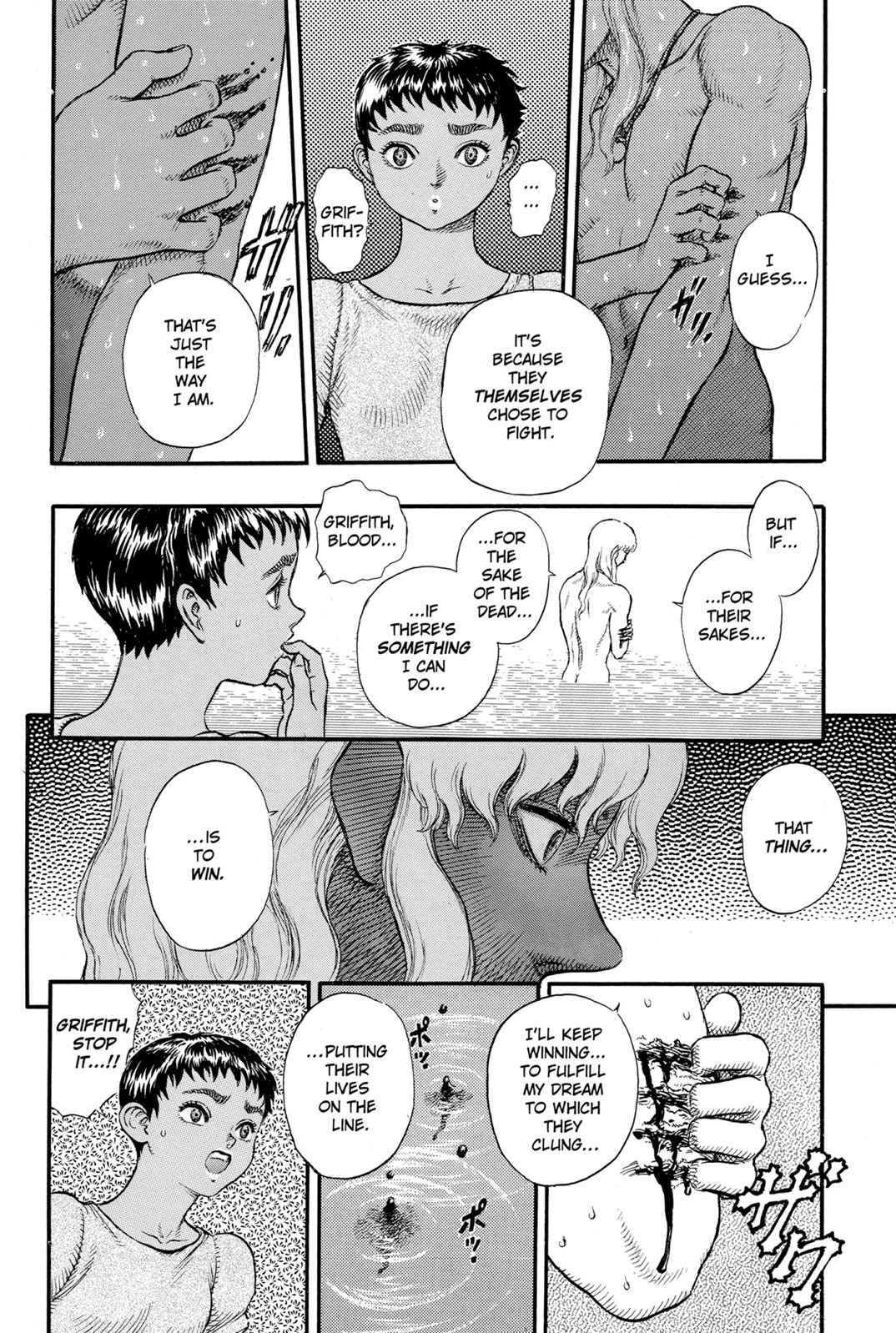
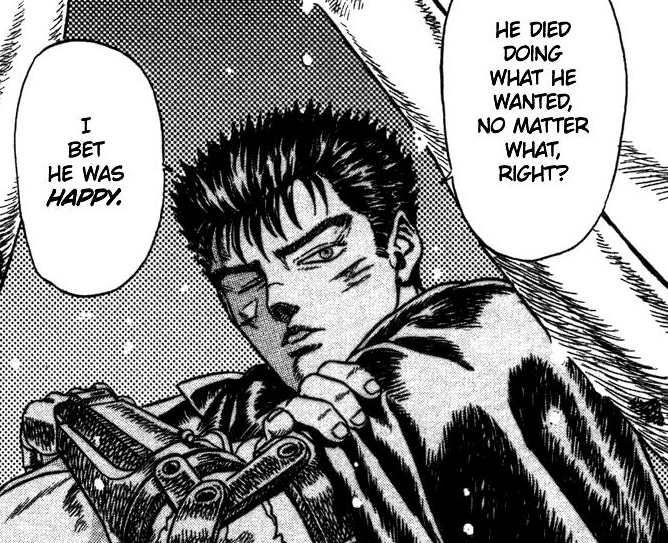
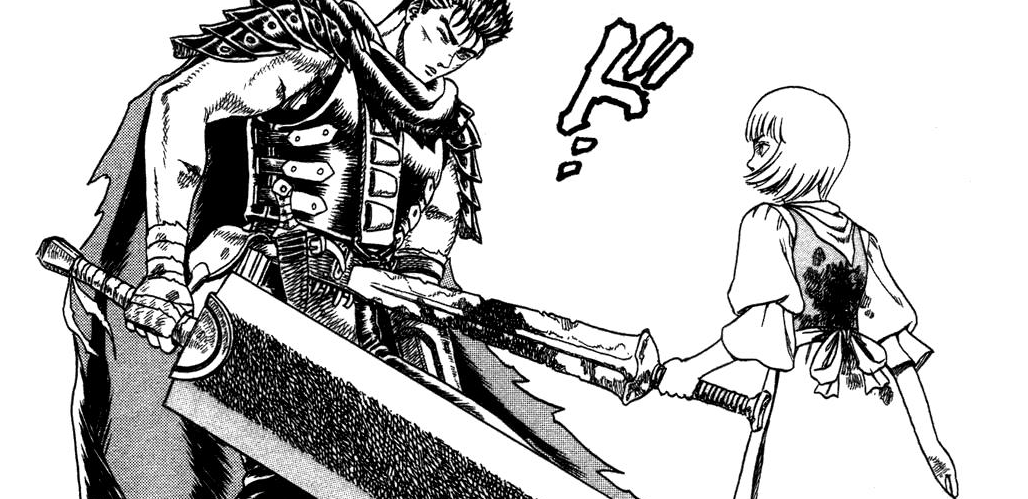
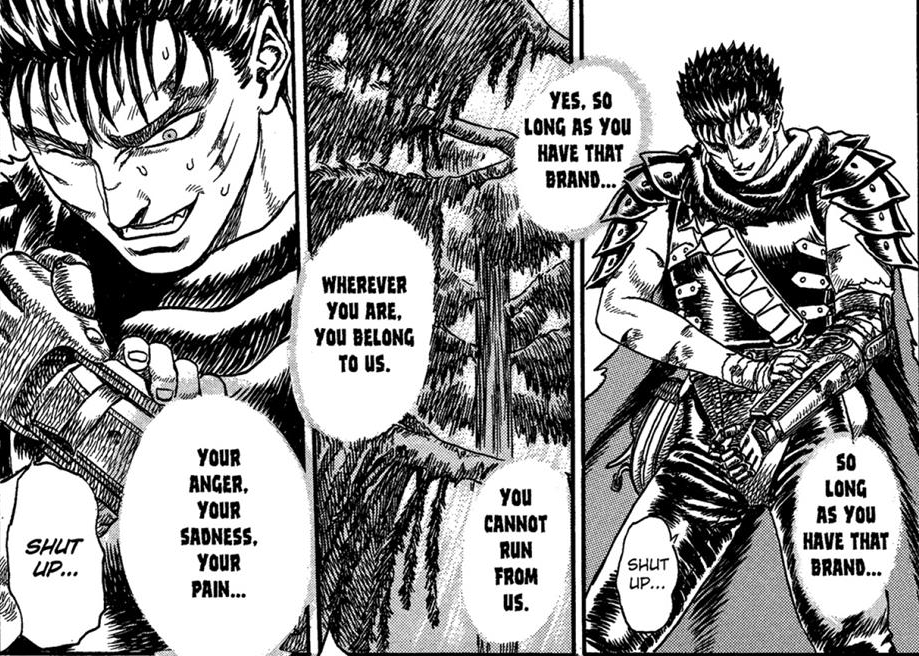
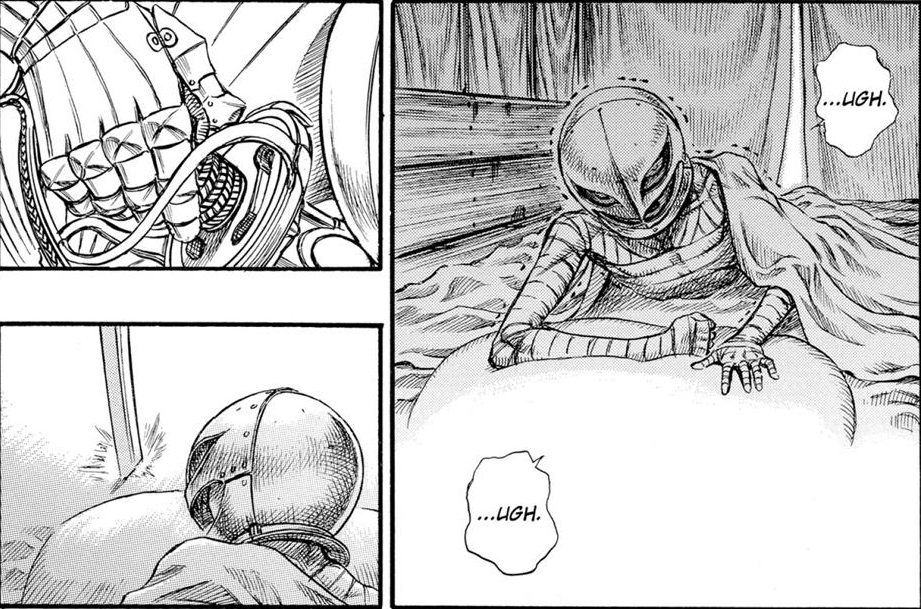
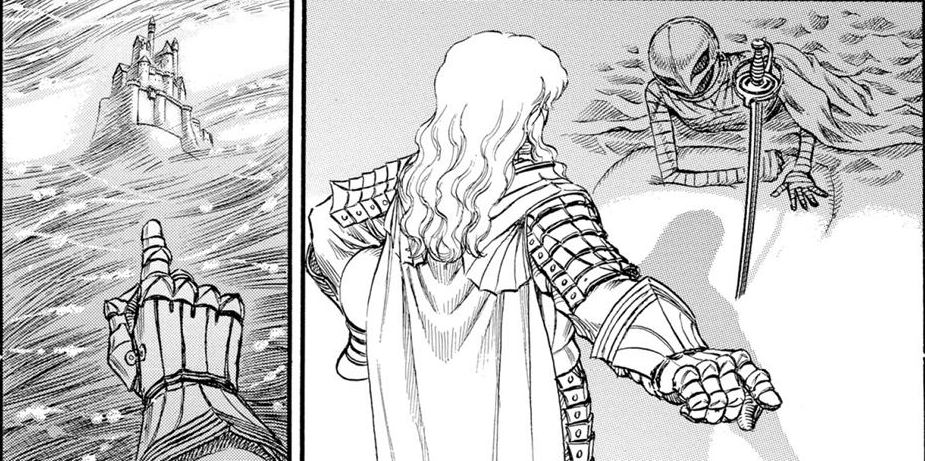
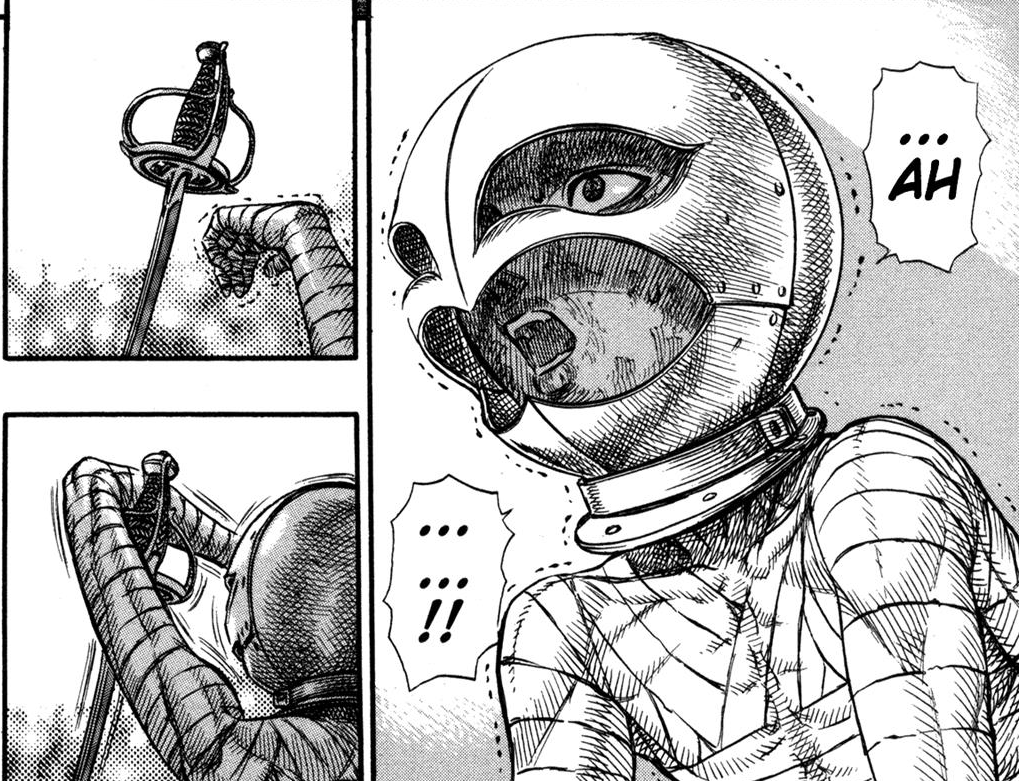
what are the things you like and dislike about the ’97 anime and the films?

ty for asking, i’m just gonna write a few long lists lol

97 anime likes:

  • the animation, including the like, yk the more detailed stills they pan over in place of action or to punctuate important moments, i love it
  • the gorgeous backgrounds
  • most of the colour choices. red eclipse, femto’s blue eyes, casca’s skintone, griffith’s mauve clothes, etc.
  • how close it is to the manga. like, it’s a solid adaption just by virtue of making very few changes.
  • so like, most of it really, because i like the manga
  • special mention to the entire lead up to the eclipse from griffith’s reality break to the sacrifice tho, because i think that was all pretty damn perfect. it’s the most important scene and they did it right.
  • actually also shout out to casca’s flashback to griffith and the dead kid, gennon, the river scene, all that. another difficult v emotional sequence that they nailed imo.
  • griffith thinking about how he “loves” guts during the monologue
  • skipped most of the griffith/charlotte sex scene iirc which i approve of
  • the glimpse of black swordsman guts in ep 1. it’s not perfect but it’s way better than the ovas starting w/ 15 yr old guts
  • the opening and closing themes. fucking love both songs ngl
  • also the opening monologue. never get tired of hearing it
  • the score
  • the portrayal of griffith was honestly pretty solid imo. i have very few issues there. and lbr that’s important lol

97 anime dislikes:

  • not a big fan of griffith or guts’ character designs.
  • just about everything that isn’t identical to the manga is a change for the worse
  • turned griffith’s scratch marks into that giant unexplained scar
  • adding extra scenes where casca is secretly impressed with guts’ skills in battle in an attempt to build up their relationship better, which instead just made casca look unfair for still being a dick to him for 3 years and made guts stupidly gary stu-ish
  • obviously the straightforwardly romantic portrayal of guts and casca’s relationship
  • through several seemingly minor changes (eg, skipping guts’ night of self-doubt after he leaves, giving guts’ stay with godo its own half-episode, making guts inviting casca along super romantic rather than the incredibly casual and assholish way he does it in the manga, etc) it makes Guts’ dream seem legitimately noble and worthwhile, with none of the like… implicit critique the manga has. like honestly it completely fucks up what i consider one of the central themes of the story lol
  • the pre eclipse stuff also fails to sell guts’ sense of regret – through things like playing guts’ theme while judeau is telling guts to leave, not repeating guts’ statement of regret after casca tells him to leave again, the tone remains consistently in favour of guts’ dream. wrong and bad.
  • like it really reads like the suggested tragedy is that guts doesn’t get the chance to ditch griffith with judeau and take off with casca and the raiders lol
  • also fucks it up by never directly mentioning guts’ csa trauma
  • also fucks it up by losing guts’ self-destructive single-minded urge to fight monsters that we saw thru the wyald stuff. i’m not gonna say that losing wyald was a bad decision, but they should’ve at least moved erika suggesting that guts just wants to fight zodd again to the fucking waterfall scene in question, which they portrayed completely sans zodd discussion, completely sans implication of the self-destructiveness of guts’ dream
  • like in the manga he nearly gets killed by the falling logs and just laughs it off like a dumbass while erika is concerned and suggests that guts is driven by something irrational and not actually a ~noble~ dream, ie, wanting to fight zodd again (ie, going deeper, his csa trauma), while in the anime we get a 2nd scene where he successfully slices through the logs as a super basic symbol of growth and a narrative pat on guts’ back that shouldn’t be there!
  • honestly just fucking everything about the portrayal of guts’ dream lol it just takes it at face value in a way the manga consistently never did and always undermined and critiqued, and it bugs the hell out of me.
  • guts is just drawn in a way that makes him look angry way too often and he often feels ooc to me bc of it. like he lacks a lot of the warmth he has in the manga imo
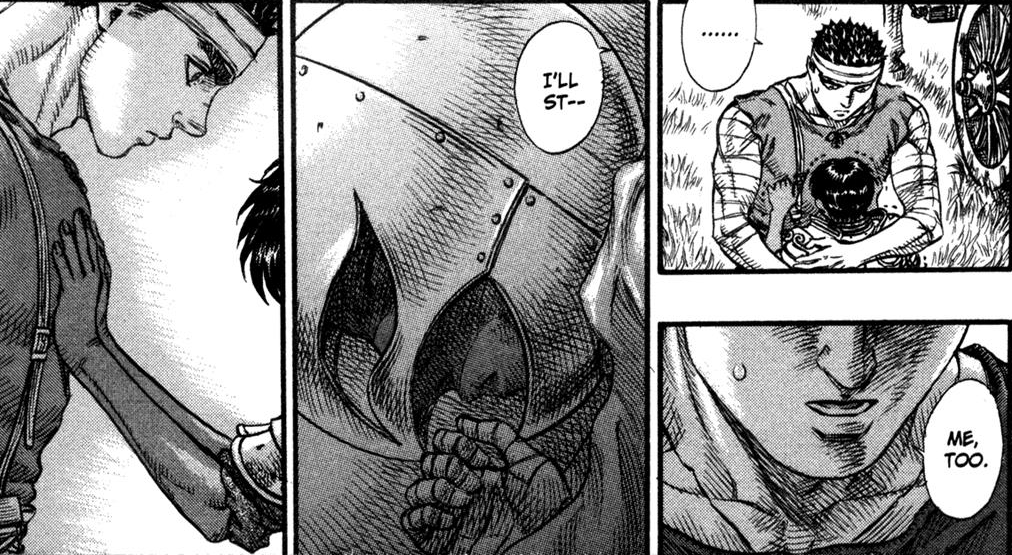
  • showing that griffith is awake when guts says “i’ll stay too” even tho in the manga those words are placed over a panel of him asleep for a reason like, ffs
  • lots of other random nitpicky details that only i give a fuck about because my opinions and feelings about the story are too strong lol. like not showing griffith’s face when he asks if guts thinks he’s cruel
  • oh huge one: moving the scene where the torturer rips off griffith’s behelit from about a day after he was imprisoned to right before his rescue. completely trivializes griffith’s torture because it still looks like he’s been in there for a day at most
  • why on earth did it end where it ended????????????? who’s bright idea was that? the perfect ending is skull knight riding tf out with guts and casca and femto not killing them, but then they also cut out skull knight’s first appearance so idfk man.
  • oh some downplaying of griffguts, like i can’t complain too much about this because it was still p homoerotic, but things like omitting guts assuming griffith wants to fuck him right before their first duel. boo.

ultimately at the end of the day as much as i do genuinely like the anime, it’s not telling quite the same story the manga was – the story it’s telling is more boring and basic. but because it sticks so close to the manga the good story still shines through? it just means there’s inconsistent tone choices and stuff, like the aforementioned grievances.

it’s like, they kept casca’s diatribe at guts line for line while she’s screaming that griffith needed him and a man can’t live on dreams alone, but they don’t extend that train of thought to guts going off to pursue his dream, while the manga does.

anyway despite that giant list of dislikes i still think the anime is pretty fantastic overall. i just also like, blame it for a lot of wrong fandom takes lol.

movie likes:

  • character designs! honestly imo everyone looked pretty great.
  • they played up the homoeroticism and i appreciate that
  • illustrating griffith being torn between guts and his dream through that lovely moment when he catches guts when he nearly falls off the stairs right before he catches charlotte, and in a more romantically suggestive way
  • the whole scene where griffith shows up at charlotte’s window thoroughly improved on the manga, so hats off there. loved how completely out of it he was to the point where he barely realized where he was and immediately turned to leave when charlotte was like ‘woah dude wtf,’ love that charlotte was the one to ask him to stay and then physically move his hand back to her tit, love how emphatically griffith was thinking about guts during that sex scene, etc. like it’s still not perfect, but it is a vast improvement.
  • griffith showing up in person after the hundred man fight was a nice touch
  • it was cool that they got a lot of the same english vas from the anime dub back, and they all did a gr8 job. like it’s a pretty good dub imo.
  • i liked that they moved ‘the crystalization of your last tear shed’ to after guts’ post-eclipse breakdown
  • compared to the anime at least gtsca was more low-key and chill rather than dramatically romantic. still don’t want it there, and still not as… unromantic as the manga, but i’ll take what i can get
  • the animation during griffith’s transformation into femto, yk that whole sequence, was cool
  • slan’s english voice was super sexy
  • ummmmm i feel like they conveyed the whole dreams are stupid theme, and guts’ decision to leave being a mistake, better than the anime? like i got the sense that the ova ppl recognized that was a theme, at least. i’d have to watch them again to really be sure of that tho

movie dislikes:

  • GRIFFITH’S. NARRATIVE.
  • like holy fuck they completely destroyed his character lmao
  • i cannot believe
  • no backstory! no tombstone of flame! no ‘do you think i’m cruel?’ THAT WAS THE REASON HE MADE THE SACRIFICE FFS HOW DO YOU SKIP IT????
  • no dead kid angst, gennon only in vague implication, no self harm – oh no wait we saw self inflicted scratches, they were just completely contextless and meaningless to the point where we could assume charlotte’s nails made them
  • no torture chamber monologue
  • no guts monologue in the tavern either for that matter
  • no rooftop scene
  • again barely the implication of guts’ childhood trauma, both the sexual abuse and the general parental abuse. one vague flashbacky nightmare doesn’t cut it, it’s the cornerstone of the story
  • like i get it, it’s a movie trilogy, you have to cut some things, but goddamn, cut out gtsca. trim the hundred man fight. add 20 minutes to the first ova and take the insanely long rape scene out of the third. trim down the whole eclipse sequence. don’t cut out like… the story. like they cut out SO MANY emotionally relevant scenes and kept so many much less relevant scenes, idek.
  • and like let’s be real here, they turned griffith from an immensely interesting and complex character into a 1 dimensional dude who is torn between a vaguely evil ambition and being in vaguely evil love with guts, just for the sake of streamlining the least interesting aspects of the story
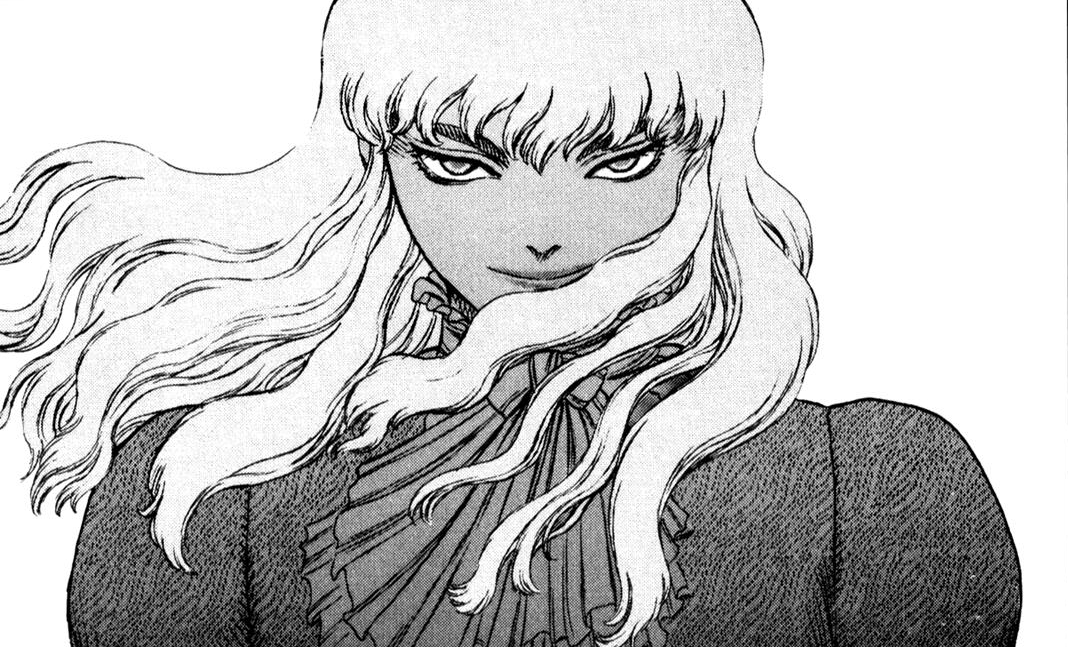
  • they don’t even try to pretend otherwise lol, look at his fucking hilarious evil smile here
image
  • also while i’m looking at it, in general i think they failed at the whole eclipse sequence. looks, lighting, colour, build up of tension… there are a few minor improvements here and there (eg casca’s point of view shot of femto, femto telekinesising guts back a la the black swordsman arc which emphasizes his failure to act when he escapes), but overall it doesn’t work for me at all. like imo the anime has the exact same highs and lows as the manga, but while the ova avoids some lows it never reaches those highs.
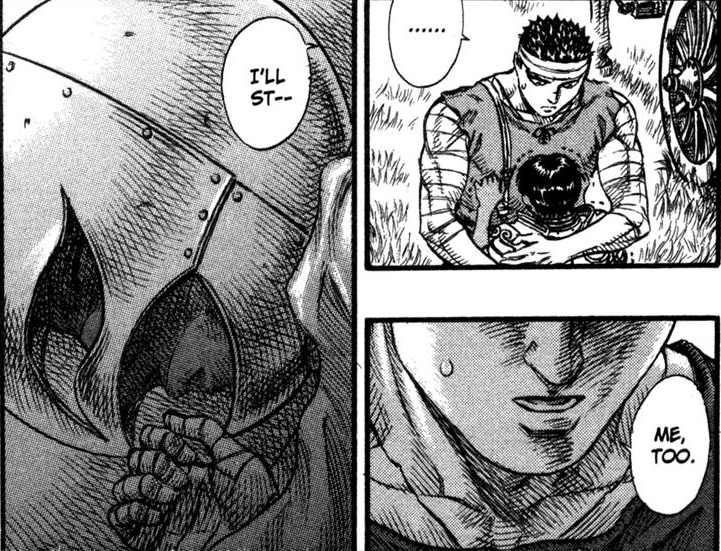
  • they also had griffith overhear guts saying he wants to stay. i really don’t get why this happened twice lol, like… ok his face is kind of shadowed here but he’s still very clearly asleep? this is an important detail, guts’ interrupted words are even on that very panel, so why would you go out of your way to show that he’s awake and listening at that point.
image
  • the pacing sucked. 3rd movie was too long, 1st was too short, and they skipped waaaaaay too many significant scenes that should’ve been there as emotional beats
  • honestly the movies are pretty, they’re nicely fanservicey in ways, they capture some good subtleties and nuances at times, but they’re a husk of the story
  • oh did i mention the music during the eclipse rape? incredible.

also i am actually generally positive about the movies too despite what it seems like here lmao. i’ve watched them all like, 3 or more times and i find them v enjoyable.

i just have a way easier time listing nitpicky flaws than positives honestly. the flaws stand out to me, the virtues pass me by because i’m just enjoying them and not dwelling on them

and lbr here at the end of the day no adaption will ever really satisfy me unless i somehow find several million dollars lying around and make my own lol. and that would probably be a flop anyway.
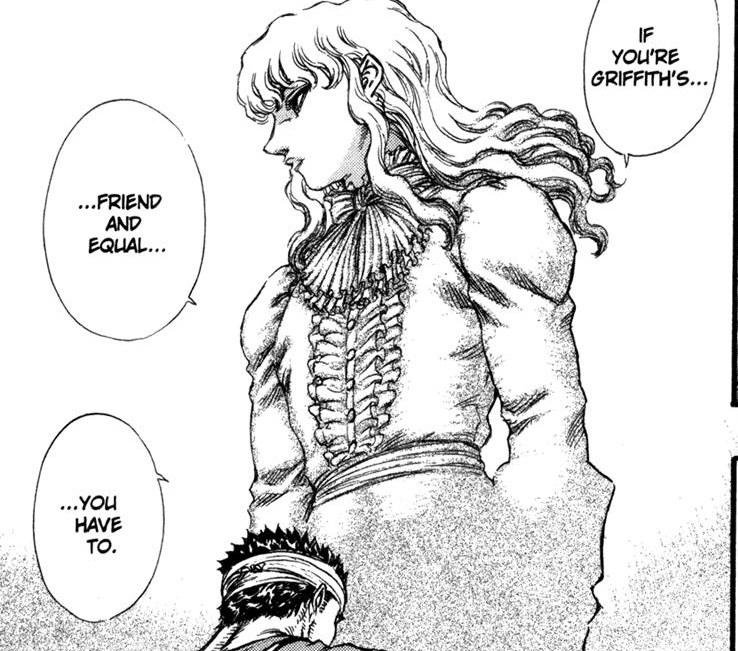
I remember when Casca told Guts to go without her and to abandon her and Griffith. Do you think it is foreshadowing anything?

hmmmmm yeah in a way I’d say so.

image
image

cut to

image

It is kind of an additional little suggestion that Black Swordsman Guts is in fact pursuing his dream, and is still motivated by his desire to be Griffith’s friend and equal, and have his attention on him (in yk kind of a fucked up way Guts doesn’t really acknowledge to himself). He does go off alone to fight stronger and stronger enemies, leaving Casca behind, and in the Lost Children arc especially the risk of Guts becoming a monster himself and joining Griffith again that way comes to the forefront.

image

And in general it fits nicely with the sense that Guts leaving people and doing his own thing is bad shit, and Guts staying with people who need him is positive and good. Casca’s encouragement is misguided, leads to the Eclipse, and ironically fits Guts’ dumb actions post-Eclipse.

So yeah I’d call it forshadowing for Guts leaving Casca behind in the cave to pursue a version of his dream.

what do you think of griffith smiling when he hears julius and adonis are dead? i see lots of ppl use it as proof that he was ~evil~ all along

Fucking love that moment lol.

image

glorious.

Like, this is a moment of Griffith’s inner darkness shining through. It’s perfect because it comes right after his long dream speech to Charlotte, as he’s learning that he’s achieved a particularly horrible step on the path to his dream. His dream just caused an innocent kid to be killed, and he’s smiling about it.

It’s a very strong way to equate dreams to darkness early on – and it’s great foreshadowing for Guts’ own descent too. This speech that ends with Griffith smiling over the death of a child – that causes that smile – is the very thing that inspires Guts to leave to pursue his own dream! Which ends up being the Black Swordsman arc.

image

Like compare Griffith’s evil smile to Black Swordsman Guts’ slasher smiles as he’s, yk, fighting “stronger and stronger opponents,” ie pursuing his own dream. Dreams are terrible all around for everyone and I love it.

This is also part of Griffith’s set up that’s very soon knocked down in a subversion of the reader’s expectations. Like I’ve talked about how Griffith’s narrative begins with an image and eventually peels that away to the truth – we start with Femto, then we get early larger-than-life knight in shining armour Griffith who would do anything for his dream, here w/ the assassination we get the darker aspects of that emphasized, and then only five chapters later we get our first full pull-back of the curtain style reveal of the real Griffith, in Casca’s flashback.

Compare Griffith smiling when a child dies on the path to his dream up there to:

image

and

image
image

It’s Griffith burying his guilt – getting much better at burying it through consistent practice lol – and demonstrating his willingness to do so in order to achieve his dream, which, ironically, he’s pursuing because of that guilt. It’s perfect.

I think I’ve phrased it before as like, after learning about Griffith’s dead child related guilt issues in Casca’s flashback shortly after, that smile when he finds out Adonis is dead can only mean one of two things:

either in the intervening years he’s changed so fundamentally that he no longer has those guilt issues, and therefore Casca’s flashback chapters are functionally meaningless and unnecessary to an almost comedic extent.

or it means he’s successfully buried his guilt so thoroughly in this moment as he’s pontificating to Charlotte about his dream that his reaction is pleased – he’s kind of like, becoming the mask, doing that good a job of convincing himself it’s all necessary for the sake of his dream.

And we see Griffith’s guilt issues crop up again in Tombstone of Flame
and again when Ubik’s convincing him to make the sacrifice, soooo we
know it’s not option one lol.

idk it’s a great example of the fucked up duality that comes from living in denial and eventually leads to choosing to become a monster because you already see yourself as one, basically, and it’s something I absolutely love about Griffith’s character.

tl;dr griffith isn’t evil, he’s interesting.

the end of this post also gets into my take on this scene, and it’s probably better said there lol.

also this post kind of illuminates more of my thinking wrt dark sides in berserk

what are your top 5 favorite guts centric scenes?

this is a really hard list to narrow down ngl

5.

image
image
image
image
image

Can I just say all of chapter 2? I was tempted to go with the end of chapter one as a character establishing moment, yk Guts looking scarier than snake man as he gleefully tortures him, but honestly chapter 2 is where it’s at when it comes to Black Swordsman Guts.

4.

image
image
image

Guts finally, somberly realizing he shouldn’t’ve left, telling Judeau and Casca he’ll stay with Griffith, both of them telling him to leave because he did such a thorough job of proclaiming he’s got a nobler goal and separating himself, just hammering home how it was a mistake.

3.

This is a double feature because I couldn’t decide between these two scenes and they essentially say the same thing anyway:

image

and

image

Guts haunted by the fear and temptation of becoming a monster. I love the sewer nightmare, especially coming right before Promrose Hall. The way it conflates Zodd, Donovan, and Guts after he kills Adonis. Guts’ self-loathing here informing why he reacts so badly to the overheard speech too.

And then after Rosine and a fun child-killing spree, these ghosts voicing his inner thoughts. The self-loathing, muddied by the temptation of giving in and following in Griffith’s footsteps, ironically the same choice he made after Promrose Hall. Griffith’s dream made him a monster, and Guts’ dream is doing the same – and the Black Swordsman content is absolutely Guts pursuing his own dream, to fight stronger and stronger opponents.

2.

image
image
image
image

Guts channeling all his painful feelings into rage here. I can’t really say the whole rampage through Midland lol, there are moments I like less, but definitely the start of it, the reunion in the depths, killing the torturer, one man army-ing up the stairs and out the door. It’s just so good. Exactly how Guts avoids dealing with his feelings, really awesome to watch, nice sense of protectiveness, and excellently illustrative of how devastated he is to find Griffith after a year of torture.

1.

image
image
image

Guts finally, finally beginning to accept that he’s found a new home, the place where he belongs, here with the Hawks and Griffith, after Griffith risked his life to save him from a monster (in a particularly meaningful contrast to his childhood). Finally beginning to move on and heal a bit. This is the moment of greatest potential for Guts and p much the pinnacle of his life and it’s so effective at putting the reader and Guts at like, a height from which to fall.

Bonus 6:

image

This only gets a bonus spot bc I’ve mentioned it a few times before as one of my favourite Guts moments and I don’t want to be too predictable lol, but it’s so good. This whole scene. Guts ostensibly wanting to fight Femto but more than anything wanting his attention and only being spurred on to even stand up when Femto says that.

image
image

Oh Guts. ilu

@freewilllife I’m c/ping this bc that post is really long to reblog imo lol

I half-wonder if this is an issue with Miura writing some of Berserk
while depressed lol, considering how utterly cynical the Conviction arc
is.

I think this is the case.Depending on the real life issues of the author…and yes I think it somehow is fitting…

Because
sometimes a relationship even an unequal one is better than being
alone, however it can turn out worse if the dependent state doesn´t
develop…

Somehow I think ( I know what a  thought…most
Griffith/Guts fans do know that I suppose) that Griffith and Guts had a
dependency on each other that could have turned into a nice
relationship, but fate and their own insufficient communication skills
prevented it.

Guts wished to be the equal of Griffith…he
wished to acquire it…The way he chose was…It would have not been bad if
he had somehow come to another realisation than committing murder is his
“dream” ( That is just my priority maybe?).

Casca on the other
hand wished to maintain an unequal relationship at all cost…she wished
to be near Griffith, later Guts. It is depicted as if Casca only wished
to be Griffith´s sword since she wished to stay in his shadow…Whereas
Guts wished to obtain an own dream in order to be his equal…


Yeah there’s something to be said for Guts and Casca’s (and Charlotte’s) respective reactions to hearing Griffith’s dream speech. Even if it was a stupid speech and Guts’ decision was misguided, he’s still the only one who was like, well I’d better go out and achieve something so I can be his bff.

And it’s also very telling that Guts invited Casca along on his dream adventure – it shows that Guts is not thinking of her as an equal, he’s thinking of her as support for him, the way she was support for Griffith, rather than someone who could achieve her own dream and become an equal w/ him and Griffith.

(This probably says more about how Miura sees romantic (het) relationships as opposed to All-Important Bonds Between Men, but yk.)

Like imo the whole notion of dreams + equals is stupid as fuck, but it’s what Guts is basing his life around at that point and Casca just doesn’t figure in as a potential equal as far as he’s concerned.

Also of course I completely agree that Guts and Griffith’s relationship could’ve been exactly what they both needed, and could’ve been (and was for a time) a hugely positive influence on both of them, but fate and their own issues interfered and ruined it. Like I don’t think they were ever not equals – regardless of their stupid arbitrary standards, their feelings for each other made them equals, and I s2g the water fight is symbolic of that fact.

Like, not literally but symbolically, Griffith won the first fight, Guts won the second – the waterfight. So when Guts won a third – the second duel – it fucked up the balance and resulted in Griffith losing everything, and demonstrated that Guts was leaving based on a false premise.

(also lmao yeah the dream Guts landed on is kind of hilarious in how terrible it is. i love that you describe it as ‘committing murder’ bc it’s not exactly far off)

chaoticgaygriffith:

chaoticgaygriffith:

there’s something to be said about how this turns into a “men vs women” type of conversation where griffith takes men’s side with his bullshit dream spiel and pretends like it’s this profound thing women will never understand

and by that i mean that it comes off as trying too hard, the same way him talking about what a ‘friend’ is to him comes off as trying too hard. before i was a little hesitant to believe that griffith feels forced into masculine roles rather than choosing to take them bc it’s the fastest way to achieving what he’s trying to achieve, but after re-examining this scene i think i feel a little differently about that

#other ppl’s meta #totally it’s posturing – more for himself than charlotte too #the image that goes with the dream which is (how does this always fit so perfectly) an attempt at a heteronormative masculine ideal #the men are like this stuff fits that so well as does charlotte suggesting ‘family or a sweetheart’ which ofc sums up what griffith #is torn between (‘family’ if you don’t want to be saccharine and include the rest of the hawks he sacrifices) and what guts ends up #abandoning for /his/ dream

@bthump what you said here, “more for himself than charlotte,” that’s exactly what i mean, somehow it didn’t register to me, until today, that the part of this where he puts up a masculine facade is ALSO for himself, and not just for charlotte. you know, when i think @yesgabsstuff and i talked about how griffith would be more feminine without all this bullshit weighing on him, i said i didn’t think his choice to present and act more masculine was one he made out of fear. and i still think that, to an extent, but there’s no denying that he felt forced into that masculine role bc …………… it’s so tightly woven together with his dream. and since it’s something he has to do for the sake of his dream, then fear also has to be involved, even if in a sort of roundabout way. that is to say, i don’t think griffith is afraid of like, getting punched or called a faggot if he wears a dress or w/e. but i think there’s no denying that he is afraid of letting this image falter, and that’s what this is really about

I feel this tbh, like imo Griffith wouldn’t really have a visceral fear for his physical safety, he’s been the best w/ a sword since he was like 10 from all appearances lol, and honestly I feel like as a peasant mercenary with the force of personality he has he would in theory be able to get away with some gnc presentation and attraction to men if all he wanted was to fight and make money. Same way Casca could lead the Hawks even though she’s a woman in the world of Berserk lol.

but his fear of failure is a major aspect – he needs the correct image while climbing higher in society, to achieve his dream.

and also i think he needs the dream to justify hiding behind the image, which is partly what i get out of that speech to charlotte. it reads to me like he’s justifying his dream to himself as worthwhile in and of itself, in a contrast to how he justifies it to himself in the river w/ casca a few chapters later, as something he owes the dead.

idk it all goes into how his dream is a defense mechanism from his self loathing and a way to justify his existence, but he doesn’t think of it that way 99% of the time, he has to see it as inherently worthwhile to avoid acknowledging the actual reason (self-loathing) he’s pursuing it.

and some of that self loathing is guilt, some is a belief of his inherent worthlessness, but some is also connected to his sexuality, both in his traumatic experience with Gennon after which he called himself dirty, and his love for Guts, which is especially shown through how Guts is pitted against his dream and how Guts “made him weak” and his feelings for him led to him losing everything. Griffith’s feelings for Guts are connected to his belief of his inherent worthlessness, because they exist in opposition to his dream. (this is thematic moreso than literal)

So part of his reason for pursing the dream is to bury those parts of himself – like it goes both ways, basically, imo. He has to be a heteronormative masculine ideal for the sake of the dream, but he obsesses over the dream partly as a way to bury the parts of himself that aren’t that ideal?

um i feel like this doesn’t really make sense lol sorry. it’s hard to explain how my brain makes connections sometimes.

image
image
image
image

Maybe it’s a bit much to equate Guts swinging his sword several hundred times until his hand is covered in blisters to Griffith scratching himself, but hey both are forms of self-harm associated with their dreams. (Plus the blisters work as a solid symbol of Guts’ typical self-destructive way of fighting, letting monsters stab him so he can shoot them, that kinda thing).

Anyway I just noticed that Guts’ hand was bandaged the morning he left the Hawks despite it having been a month since he had to kill anyone, and was like, hmm.

I allude to how the monsters Guts fights are reminiscent of his childhood trauma a lot, so I decided to finally illustrate it.

under a cut for length and for images implying sexual assault/csa

glowing/monstrous eye(s) in a dark background, reaching hands:

image
image

and Gambino gets similar visual treatment after telling Guts he sold him, neatly showing how Gambino’s betrayal compounds Guts’ trauma:

image

glowing/monstrous eyes and reaching hands in nightmare form:

image

in flashback form:

image

and in monster form:

image
image
image
image
image
image
image
image
image
image

this could be an interesting early version from his nightmare in chapter 2:

image

Skull Knight also gets this imagery:

image

and i’m ngl his consistently glowing eyes as a design choice make me highly suspicious lol:

image

here’s Guts’ vision in the sewer before promrose, the imagery depressingly contextualizing the self-loathing he feels:

image
image
image

more giant hands emphasizing helplessness:

image
image
image
image
image
image

And Guts himself gets a lot of this imagery ofc:

image
image
image

plus you can argue the design of the beast of darkness incorporates the bright eyes on a dark background motif:

image
image

Also it’s worth noting that while this imagery comes from Guts’ trauma, Miura uses it to illustrate fear in general from other characters’ points of view too:

image
image
image

and I’d argue this is the point of the stylization of Ganeshka’s backstory of extreme paranoia:

image

Berserk is Guts’ story after all and it makes sense to expand his own motifs to illustrate fear as a concept in general imo.

oddly Femto does not get this imagery very often at all. In fact this is the only instance I can think of that comes close:

image
image

Usually he’s stylized as monstrous by totally removing his face and just portraying the mask, or his face is shown in full. Now I could see an argument that his design automatically incorporates bright eyes in a dark background due to the black helmet:

image

But it’s really not emphasized, like even when we get five thousand closeups of his staring eyes during the rape scene, they don’t pop against a dark background, they’re not the brightest things in the panel like other monsters’ eyes:

image

So idk. Maybe the stylization of the mask, the way his face can disappear within it like so

image

is meant to be reminiscent of the more mundane and natural way Miura has of making someone/thing look intimidating, ie shadowing their eyes. Or maybe it was more important to him to be able to draw Femto as either monstrous (no face) or unnervingly human (fully visible human face) with little in between.

Anyway that’s just an aside, the only point of this post is to illustrate some recurring concepts and show how the imagery ties Guts’ urge to fight monsters back to his childhood trauma.

image

I mean it’s not exactly a hard sell lol, but I’m just like a big fan of
the recurring stylized imagery and I think it’s a great touch.

chaoticgaygriffith:

#the damn dream is everywhere

@bthump literally the conclusion i came to when i was thinking about scenes in which he was, to some degree, relaxed

i want to like brainstorm personality traits that he didn’t deliberately manufacture to help him achieve his dream now lol.

like yeah, playful. i think he’s naturally confident, charismatic, and a leader type. competitive, but still a graceful loser. empathetic too tbqh, he’s very aware of ppl’s feelings and he genuinely cares, and you’d see that way more if he didn’t constantly bury it lol. also a bit of a mediator? he doesn’t like real interpersonal conflict (his reaction to guts and casca’s rivalry, or casca being pissy at corkus, etc). he still cares what people think of him, dream or no dream imo. but he might take pride in being hated by awful people. i don’t think he’d necessarily try to get everyone to like him – just the people he likes.

would he still be ambitious? if he didn’t have the one dream, would he find another, maybe less soul destroying goal to latch onto? I think he’d still feel a need to prove his worth as a person, to justify his existence by contributing something to the world. but if he didn’t get people killed when he first started maybe he’d be more chill about it. maybe he’d volunteer at a non profit or something instead.

would he still be a complete idiot about his own feelings or would he be more self-aware if he didn’t need to bury his emotions for the sake of his dream? i could def see him being more self-aware, but that’s not as fun lol.

welcome to controversy country

Griffith’s decision to sacrifice the Hawks was perfectly reasonable not just taking into account Griffith’s own values and priorities, ie ensuring the thousands of dead posthumously achieve the thing they died for, but taking into account the Hawks’ own attitudes towards their lives, including Guts’.

It’s all there in Requiem of the Wind.

image
image

“More than half of us’ve been killed…”

These are the core group of Hawks. These are the ones who believe in Griffith so strongly that they’re willing to spend a year living as outlaws, dying in raids, so they can rescue him – so Griffith can lead them again.

There were lots of deserters over that year. People who didn’t think it was worth risking their lives for a chance at achieving Griffith’s dream. They’re presumably out there living happily ever after.

These Hawks are the ones who are willing to risk their lives, not out of friendship or loyalty to a man, but out of loyalty to what the man symbolizes for them, what he can bring them, the success that comes to them when they follow him. Out of loyalty to the dream.

Corkus is the only one throwing a tantrum, but he’s voicing all their thoughts, as we can see when his words are placed over their depressed faces.

image
image

Wyald spells it all out.

This is who Griffith is to them. He’s the facilitator of their dreams, dreams that each and every one of them is willing to risk their lives for.

image

And when he can’t be that to them anymore, what happens? He becomes a burden to them.

Judeau offers to take care of him because it’s the least he can do, because he owes it to him, but mostly because if he doesn’t he thinks Casca will, and he thinks it will be a life ruining burden for her. His offer is a personal sacrifice.

Casca offers to take care of him because it’s the least she can do, he’s so small now, he needs someone, and because if she doesn’t Guts will, and she thinks it will be a life ruining burden for him. Her offer is a personal sacrifice.

Guts’ offer is probably the only one based on a genuine desire to stay with Griffith.

Now, Guts doesn’t see Griffith as the guy who can grant him his dreams. Guts is the exception to that. He sees Griffith as a guy he wants to be friends with.

But here’s Guts’ take on the situation:

image
image
image

Finish the battles you start.

Well, that’s exactly what Griffith chose to do. The Eclipse is, in part, a narrative rebuke of Guts’ stubbornness lol, it happens because he seized on the concept of finding his own dream and couldn’t let it go until it was a moment too late.

image
image

When Guts finally drops his own “battle” in favour of staying with Griffith, ie makes the right choice contrary to his dogged nature, it comes too late because he’d successfully convinced Casca that he was dedicated to his dream at the expense of his friendships with the Hawks. “I want to draw a line, keep things separate.” He told her he didn’t want to stay with the Hawks, and she believed him, and that attitude is what ruins everything.

And ironically that’s the exact path Griffith chose when he agreed to the sacrifice. Drop his friends and relationships in favour of renewing his committment to a dream, and finishing his own battle.

For the rest of the Hawks, the Eclipse is a rebuke of their choice to live and risk their lives for tomorrow’s success rather than today’s existence.

Now, this absolutely isn’t me arguing that the Hawks deserved to die or anything lol, this is just me saying that Requiem of the Wind is largely set-up for the sacrifice, and I think it’s a clever way of like… depicting the sacrifice not just as a random tragedy that befell a group of people, but as a darkly fitting end to the way they live their lives.

It shows that the sacrifice is consistent with everything the Hawks profess to believe in.

image
image
image

They are all willing to lay down their lives for a victory they may never see.

The Eclipse is the fucked up yet logical conclusion to the Hawks’ very existence as a mercenary band that fights for an ideal, a dream, rather than just day to day living. They agree to potentially sacrifice their lives in every battle. The Eclipse is just one more battle, by this logic, and it’s one they win by losing their lives in it. By dying, they achieve their ultimate victory.

And I think by taking this whole philosophy of dedicating one’s life to a dream to its logical and horrific conclusion, Berserk is basically critiquing the concept of living for an ideal. In making the sacrifice, Griffith gave the Hawks what they wanted at a cost they’ve already agreed to by choosing to risk their lives for Griffith’s victories and the success he can bring them.

Of course, in the moment, knowing that death was inevitable, they would have preferred to live. None of them would knowingly trade their life for a future they won’t live to see. But that’s essentially what they’re doing by fighting battles for future hopes and dreams.

At the end of the day, the moral of Berserk’s story is really simple and basic: live for the sake of being alive. Guts had it right during his three years with the Hawks, before overhearing the Promrose Hall speech: no grand dream, no living for a potential future, nothing but doing the job of a mercenary with a group of people he considered family, enjoying life day to day, fighting just to live a life he considered worthwhile.

Personally I have mixed feelings about this message, but I’m pretty sure that’s basically the point of Berserk.

Black Swordsman: living for revenge (and, for extra irony, Guts’ own dream of fighting stronger and stronger enemies) is bad, living day to day with those “irreplacable things” – friends – is good.
Golden Age: “I was too stupid and stubborn to notice it, but what I really wished for back then was here.” Guts left for a dream and by leaving threw away what he truly wanted – companionship.
Conviction arc: the people who survived the shadow Eclipse were the people who acted to save their own lives, rather than out of a conviction, their faith in a higher power.
Millennium Falcon: “Dreams can make for courageous challenges or opportune escapes” – emphasis on escapes. Troll village dude wanted to escape the darkness of life through a dream as a child, but eventually found greater fulfillment just living an ordinary life in his village.
etc etc. Stop dreaming, focus on living.

And essentially the despair we see from the Hawks upon their realization that the fight is over and Griffith is no longer able to lead them to a greater dream leads directly to the Eclipse and gives it a layer of dark irony.

Have you noticed that in the movie Griffith doesn’t have the single wound on the shoulder but multiple scratch ones? I dunno if they got Miura to suggest it or if they took some liberties, but it always bothered me how in the manga he had that weird wound: it didn’t look like his scratching from the Casca flashback at all.

Okay, this is totally overkill, I know, but your ask has motivated me to just lay it all out, so ty!

image

Yeah, I can see why people look at this image and see it as one huge raised scar. It’s fairly ambiguous looking, and it’s the visual interpretation the anime went with, which reinforces this common perception:

image

But look at this:

image

You can see when he traces it that the “outline” of that “wound” fits his two fingers exactly. It’s not one scar, it’s two self-inflicted parallel scratch marks.

image

They’re not in the same place as the river scratches, there are only two instead of four, and they’re also older and therefore either mostly healed scabs or scars which he’s tracing instead of tearing open in that moment, which is why they’re not the same as the bleeding open wounds we see in chapter 17, but they are definitely two separate marks, not the edges of one giant scar.

Tbh I think Miura put them on his shoulder instead of his arms this time mainly for dramatic effect so Griffith is more curled in on himself when he traces them.

image

imo the movie is closer to the spirit of the manga in making them scratch marks and showing Griffith seemingly tempted to add to them. It’s still a little weird considering their placement further back, and idk what they expected new audiences to think since they cut out every relevant aspect of those marks being there, ie his backstory and the night Guts and Griffith assassinate the Queen and co. But whatever, it’s close enough for me.

And to just briefly explain those scratch marks a bit further, basically, as much as it looks a bit like a big scar in the manga, like you said, it really makes no sense for it to be.

If Guts’ sword had hit him in the second duel he’d either have a gaping wound or a discoloured bruise later that day, not a scar, and if he got it somewhere else that we never get to see then he has absolutely no narrative reason to trace it and cry while thinking about Guts. It would be nonsensical and meaningless for him to trace some random mysterious scar that has no relevance in this highly emotionally charged moment.

On the other hand we know he has a history of self-harming by scratching himself, and we’ve seen him viciously scratch himself under circumstances very similar to Tombstone of Flame Part 2 – the moment Griffith flashed back to just as we see his bare shoulder with those marks on it for the first time in that first image up there: “You believe that, don’t you?”

Griffith has done something he considers “dirty” for the sake of his dream, asks someone else what they think of him (”Am I dirty?” // “Do you think that I’m cruel?”), both Casca and Guts inadvertantly reinforce his belief that he’s dirty/cruel with their responses (”N- why… why were you alone with him before?” and “Ain’t that part of the path to your dream?”), and in the river in front of Casca he self harms while talking himself through the necessity of dirtying himself for his dream, so it feels safe to assume that sometime shortly following his conversation with Guts in Tombstone of Flame he also self harmed while telling himself it’s necessary to be cruel for his dream.

Now that Guts has left in what Griffith believes is a rejection of the “cruelty” and “dirtiness” that he let Guts in to see, he traces those old scratch marks and tries to convince himself again that it’s worth it for his dream. And the point of this moment is that he can’t convince himself this time. Instead he just curls up and sobs, because in the face of Guts’ apparent rejection, it’s not worth it.

Like I said lol, this is overkill as a response to your ask, but like I saw an excuse to explain my take on this moment in its own post, instead of buried in a much longer post, so I took it.

image
image

I wanna improve my skills more and challenge myself by crossin’ swords with stronger and stronger enemies… If I stay there may be no lack of battles… but I’m sure there wouldn’t be enough of the battles I want. I’ve made up my mind. I’ll never entrust my sword to another again. I’ll never hang from someone else’s dream.

(for clarity’s sake this is an illustration of Guts’ dream of becoming Griffith’s equal, not a ship thing lol)

ok i’m sorry but in addition to the excellent way this hugely significant moment of triumph for Griffith’s dream concludes with Griffith seeking Guts out across a crowded ballroom and through a window so he can smile at him:

image
image

Contrast that to the way Charlotte keeps trying and failing get Griffith’s attention in these two chapters lmao.

image
image
image

Like this is just a perfect little microcosm of where Griffith’s emotional priorities now lie lol, his dream is Right There but he only has eyes for Guts.

guts and griffith’s hetero relationships during the golden age are both symbols of their dreams, and exist in opposition to their relationship with each other

charlotte as a symbol of griffith’s dream is painfully obvious, but lemme outline casca as a symbol of guts’ quick:

  • guts’ dream is to become griffith’s equal and winning casca’s affection is framed as a step on that path, since casca loved and admired griffith
  • casca metaphorically becomes guts’ sword after they sleep together, now supporting his dream instead of griffith’s
  • guts tells casca all about his dream, repeating a lot of what griffith said to charlotte at promrose hall
  • guts invites casca along on his dream journey as long as she doesn’t get in the way of what he wants to do
  • casca is the one who tells guts to leave to pursue his dream instead of staying with griffith
  • and overhearing that completely fucks griffith up much the same way overhearing griffith talking to charlotte about his dream fucked guts up

the question is does this change after the eclipse? and i think it does – casca without her character represents a responsibility distracting guts from his dream (plus she’s the last “feeble flame” of that campfire he abandoned when he left to pursue a dream, so she represents the Hawks) whereas now neogriffith represents his dream.

however – consistently sex with casca has still been connected to his dream. when the beast of darkness taunts him, and when he assaults her, it’s “to get closer and closer to Griffith.”

i don’t have a conclusion to this or a point rly, i’m just thinking outloud

well i guess my point is “the golden age can be interpreted as a cautionary tale about heterosexuality and that’s why it’s the best arc” lol

the end of the lost children arc fucks me up because i find rosine’s regret over sacrificing her parents and wanting to return home as she dies to be extremely sad and emotionally affecting, and very understandable and relatable as a character choice

but contrasting that to jill’s “i’m going to go home and just deal with my alcoholic physically abusive dad and his pedo friends :D” ending completely ruins it

like, if that’s presented as the alternative, yeah i give rosine a high five for sacrificing her parents and becoming a monster. good for her. fuck her parents, she should’ve been allowed to die with no regrets.

like it’s one thing for, eg, old man troll fight to talk about how dreams can be opportune escapes from reality when his reality was taking care of a sick parent and working for a living, but when your reality is an abusive family, yeah escaping from that is good, actually. and i feel like that nuance is unaccounted for in berserk lol. like you can say it’s bad to kidnap children and transform them into monsters and kill people etc without also saying it’s bad/weak/immature/whatever to want to escape from your abusive home.

and by having rosine regret the sacrifice and long for home as she dies, contrasted to jill grinning and bearing her abuse, the narrative is essentially placing the blame on rosine for not being able to cope with abuse rather than where it should be, ie, on her father for abusing his kid and orchestrating his own death.

like, the lost children arc should’ve been about condemning abusive parents but… it wasn’t, and it’s fucking bizarre really. the abusive parents are just like, generic 2 dimensional stand-ins for any kind of life struggle, and the kids get the burden of reacting to life struggles correctly. we’re not shown that the parents should’ve or even could’ve made different choices, the parents just exist as trials to test these children, essentially.

and ok fine if you want to focus on reactions to abuse, rather than the perpetuation of it, that’s fair enough, but to then condemn one kid for seizing on the only escape she had and give another kid a pat on the back for deciding not to escape but rather to just suck it up… like damn. this fucking arc lol.

smo108

replied to your post

“This is about Falconia, bodies and lives being bought and sold, the…”

@bthump i Guess that being founded by Griffith a man who betrayed his comrades, among other things shows that Falconia is based on a lie, and tragedy will come.

this response to you basically just became an excuse to disjointedly ramble about this subject more, sorry for how unnecessarily long it is lol

tbh the main point of that post was to demonstrate how personal the stakes are, and how falconia is essentially a response to the child abuse all three of our main characters have gone through, thematically. so if it does boil down to ‘welp the dude who enabled the existence of a utopia where lives aren’t bought and sold and more people aren’t traumatized the way our faves were is an asshole so throw out the whole thing’ i will find that very unsatisfying.

i think falconia poses a lot of interesting moral questions. is it worth griffith’s mountain of corpses? is granting humanity’s dream worth also granting their nightmares? was it worth the sacrifice? and those moral questions only work if falconia is portrayed as positive, which it has been so far (and as long as those negatives happened with the intention of creating the positive, hence why most of that post turned into complaining about the eclipse rape lol.)

i think miura could also go down a route where he portrays falconia more negatively in the sense that humanity shouldn’t wish for a saviour/escape, but should instead struggle through an uncaring universe. a la the lost children arc, essentially, which seems like a potentially very strong parallel.

though again, considering how personal the stakes are – always the child abuse, come on – i would find that message… sucky, to say the least. i mean honestly the message of the lost children arc basically boiled down to ‘child abuse happens, dwi kids bc running away is bad.’ i kind of hope that miura is either still going to complicate that at some point down the line (lol pipe dream) or at the very least that he does something different with falconia than he did with rosine’s land of the elves bc dear god i couldn’t stand a repeat of that shit lol.

I mean here’s one way of looking at it:

Guts, Griffith, and Casca all have experiences with csa. Guts’ way of coping is to lash out and kill everything that scares him. Casca’s way of coping is to latch onto a saviour. Griffith’s way of coping is to change the world.

Like, of the three, Griffith’s coping mechanism wins lol, and I’m not down with an overall message that says, you shouldn’t try to change things, you should just struggle your ass through life like Guts here, and fuck everyone else. I mean tbf I don’t think Guts’ method is shown in a great light, so it’s already a bit more complex than Griffith’s dream bad Guts’ dream good, but yk, I worry lol.

Again, like, the moral question shouldn’t be “is this place where people are free to live their lives without being exploited a good thing,” it should be “is this good thing worth all the bad things that led to its existence,” and I don’t want the story to answer that question for me, I want to be presented with the evidence and decide for myself. Do the ends justify the means narratives are only interesting as questions, not answers, imo.

so idk basically my response is yeah maybe some kind of tragedy will come to demonstrate that falconia was a doomed venture from the start, and/or that wanting to create a place without exploitation is an inherently flawed or immature desire, but if that happens i will be unimpressed lol. If falconia does end up being destroyed, ideally for me there would be negative consequences to that too, because there are no easy black and whites in Berserk (or there shouldn’t be.)

and like, the whole thematic connection to child abuse could be coincidental, but facts are that falconia is explicitly a place where the strong aren’t given free rein to exploit the weak, and our central and most emotionally resonant examples of strong given free rein to exploit the weak are the nobleman who bought casca, donovan, and gennon. Plus the apt Lost Children parallel. so if miura didn’t intend this he shouldn’t’ve filled berserk so full of thematically on the nose depressing backstories lol.

What Griffith’s dream is about? What does he want to achieve? I didn’t get it, take a kingdom for himself.. sounds lame, and the manga writer haven’t flashed it out yet or just talk about it in a selfish or dark way. What do you think?

hooo boy ok long story short, it’s a coping mechanism. I personally think it’s likely it started out as childish whimsy, and when people started dying to achieve it (he became a mercenary leader when he was still a kid) it became an absolutely necessary goal because those deaths would only be justified if he achieved it.

I also think it’s possible that it just straight up started out as a coping mechanism, a dream of a paradise where he has the power to make whatever changes he wants to the world, to fix whatever plagued him as a child – poverty, nobles abusing their power, lives being bought and sold, whatever. Either way, the guilt as motivation came afterwards, and then consumed him.

It’s all there in his monologue to Casca in the river. I think Miura actually did a great job of fleshing his dream out, but it is largely between the lines, rarely outright stated.

like here we learn that people dying for money, on the whims of those more powerful than them, bothers him:

image

Here we find out that he has let himself be bought and sold for the sake of saving as many lives as he could, showing us that he has a personal stake in why people’s lives being treated as commodities and subject to the whims of nobility bothers him:

image
image
image
image

Here we find out that he feels like he has to achieve his dream for the sake of the dead:

image

Here we see the kingdom directly depicted as an escape from the darkness of the real world:

image
image

Here we find out that he wanted to do something, change something, with the power of the throne (the monster is war):

image

And knowing what we know about Griffith’s feelings of guilt, his disgust at nobility, and what Falconia ends up looking like, it’s reasonable to conclude that he wanted to have the power to carve out a place where people aren’t exploited by those more powerful than them.

And, as an aside, it’s largely talked about in a selfish and dark way because Griffith himself denies this deeper meaning. It’s personal, it’s vulnerable, it doesn’t fit the image of the perfect leader of the Hawks, and therefore we only see glimpses of how he really feels in his more vulnerable moments. He frames it to himself as just something he wants just for the sake of wanting something, because it’s noble to have a goal, but we’re shown enough glimpses through that misleading and shallow explanation to figure out the truth – that it’s a coping mechanism born out of guilt with a side of a deep-seated desire for a safe place where people are treated equally.

If you want the long version, I wrote this a little while ago:

https://bthump.tumblr.com/post/171634331901/the-brightest-thing-a-griffith-analysis

The first part in particular is all about Griffith’s dream as a coping mechanism, though the other three parts expand on that a lot.

robbffs
replied to your post “It sucks that Casca is reduced to support for other people’s dreams at…”

When guts invites casca to go with him he doesnt have a dream yet at that point, he was just chillin at godo’s the whole year training, when he invites casca to go with him, he invites her to the journey of searching a purpose to live. They could search for that dream… together.. at least that’s what i think

image
image

yk that does sound pretty nice and a lot more inspiring and romantic, but guts invites casca after a long monologue explaining that he found his dream – fighting stronger and stronger enemies and becoming the best.

and moreover, this is how he invites her (after, i want to add, grabbing her tit while she’s yelling at him, but I don’t want to post an image of that bc it’s awful):

image

you should come with me as long as you don’t get in the way of what i want to do, because i want to have more sex.

It sucks that Casca is reduced to support for other people’s dreams at the same time Guts is absolutely determined to achieve a dream so he can be Griffith’s equal.

Like Guts inviting her along. It kind of randomly occurred to me that he would never have in a million years invited Griffith along on the road to his dream lol, because that would’ve defeated the entire purpose. Guts adopted Griffith’s view of equality as having an obsessive dream. Guts hugely respects Griffith’s dream and would never try to sway him or stand in his way. Guts wants to be like Griffith in that way and feel as though he has something as respectable to shoot for himself.

Casca? Guts never even begins to conceive of her as a potential equal.

Casca tries to kill herself because the strain of supporting the dream of someone who doesn’t love her and might not even be alive is too much, and instead of say, encouraging her to find a dream and live for herself, since it’s working so great for him and at this point Guts genuinely believes that having your own dream is the pinnacle of existence, Guts encourages her to come along on his journey and support his dream instead.

And while Berserk is overall kind of like, dream-negative lol, bc the whole achieving a dream to be Griffith’s equal thing was misguided from the start, Guts’ priorities are still all about Griffith – leaving to be his equal, or realizing that it was misguided and choosing to stay, both for Griffith.

And I mean, I like that Berserk blatantly devalues het romance compared to homoerotic + thematically resonant relationships between dudes, obviously lol, but it pisses me off that Casca’s character gets fucked over and over and over again because of it, because her character revolves around that devalued romance.

Like, basically the concept of pursuing a dream to feel like your bff’s equal is depicted as negative, but Guts inviting Casca along on his dream journey is never questioned by the narrative – it’s just assumed that Casca, as the romantic object of affection, defaults to playing support while the men are obsessed with the idea of equality and power dynamics. I’d like to believe this is also intentionally shown to be negative, but like, I don’t really think it is, I don’t think Miura really questioned this.

contaminatedbreastcheese
replied to your post “Ok, this is my long and thorough explanation of how Guts’ decision to…”

While I agree that leaving behind the Hawks/his family in pursuit of proving his “worthiness” was misguided, I’m hesitant to call it a “mistake.” Living (and dying) as an accessory solely for the benefit of someone else isn’t particularly good or healthy.

I’d agree if Guts’ life with the Hawks was ever framed as “living and dying as an accessory solely for the benefit of someone else,” but it isn’t.

I assume you’re referencing this:

image

Which is Griffith’s answer when Guts asks why Griffith risked his life to save him.

Basically Griffith denying any emotional investment in Guts by emphasizing his role as a military leader who sends people to their deaths regularly.

Guts calls him out on basically lying here three years later, in the post-Zodd conversation.

image

So yeah, while this is nice foreshadowing for the Eclipse, it’s explicitly not how Griffith actually feels wrt Guts, and Guts figures that out.

Guts was never just an accessory to Griffith’s dream, and there was a point where Guts knew that perfectly well, before the overheard Promrose Hall speech fucked it all up lol.

And just to add a few more things:

even if Griffith really did see Guts as just another soldier who could help him achieve his dream, I don’t think it would necessarily be unhealthy for Guts to stay with the Hawks. Being a mercenary is a line of work, and being a mercenary with the Hawks is a line of work with much greater rewards, much greater camraderie and friendship, and a greater sense of purpose than being a mercenary with any other band. Guts comments early on about how the Hawks are different than any other mercenary band he’s fought with because they’re happier, because they have a personal stake in Griffith’s dream.

Guts doesn’t particularly care about being raised into the peerage, or even about the idea of Griffith becoming a King beyond thinking Griffith is “absolutely incredible” for having such a lofty dream and actually getting close to achieving it, but he does care about his friends, and during the three years in which he presumably felt like he was mainly just doing a job, he was happier than he’s ever been before or since.

So imo it would still be the case that Guts would find greater personal fulfillment in a mercenary band full of happy people who love him as a friend and respect him as a leader, rather than wandering around alone crossing swords with anyone who looks strong – specifically, it’s implied in a flashback during the Wyald fight, monsters like Zodd:

image

Again, it’s another little piece of sad irony, knowing how Guts spent two years after the Eclipse.

And lol I know this response is getting long, sorry, but w/e I love talking about this shit so one more last little thing:

Griffith also doesn’t see any of the Hawks as just accessories to his dream, let alone Guts. He cares about the Hawks more than probably any other mercenary leader.
I mean this is a dude who prostituted himself to a pedophile to prevent
as many deaths in the line of duty as possible, and self-harmed in a
river while monologuing about how he has to win for the sake of the men
who’ve died for his dream.

He represses the hell out of his guilt and emotional attachment to them, because they die a lot and if he didn’t he’d be a wreck, but the very fact that he could offer them up as sacrifices means they were all extremely important to him:

image

Ok, this is my long and thorough explanation of how Guts’ decision to leave the Hawks was ultimately shown to be a mistake.

I’ve been kind of meaning to write this for a while because I tend to take this statement as read in a lot of my meta and I wanted to have something to point to for the sake of clarification whenever necessary lol. Also jsyk this isn’t quite as long a read as it looks bc there are a lot of illustrative images.

And before I get into it I just want to make something clear: when I say it was a mistake I’m not saying that it’s a decision that reflects badly on Guts. It reflects many of Guts’ issues, and it stems largely from growing up with an abusive father figure, but based on the information Guts had at the time, and based on his personality and his values it was a reasonable decision to make from his perspective.

It’s just one that he ended up wholeheartedly regretting for very good reasons.

This basically rests on three premises:

1. Guts was happy and felt personally fulfilled with the Hawks.

2.
Guts chose to leave for one reason and one reason only: Griffith’s Promrose Hall speech made him feel inadequate.

3. Griffith’s speech absolutely didn’t reflect either his actual feelings about Guts or a particularly worthwhile life philosophy, and eventually Guts comes to understand this.

So let’s demonstrate the first part, starting from when Guts joined the Hawks.

image
image

Cue the waterfight scene with Griffith. And afterwards:

image
image
image
image
image

Then Rickert knocks him off the step and congratulates him on already having ten men under his command.

image
image
image
image

Guts is happy with the Hawks. After only a week with them he’s already chilling out about being touched, he’s feeling accepted, he’s responsible for others and he’s rising to that responsibility. He reflects on the night he killed Gambino and fled his first home, thinks “I still don’t have an answer to that question [of where am I going?]…” but then when Rickert congratulates him he thinks, “for now…”

For now, he’ll make his home with the Hawks. He tells Rickert to call him Guts and their clasped hands get their own panel. He’s forging new relationships and bonds with people, beginning to heal from past trauma, and growing as a person. He’s no longer swinging his sword just to survive, but as part of a unit, to help his friends and comrades survive and thrive too.

Three years later, when Casca accuses him of not changing since he joined them, of not caring about his comrades, he’s incensed.

image
image

He’s proud of having changed. He’s proud of his place in the Hawks, of being their raider captain, of Griffith’s faith in him. Casca’s words wound him because he has deep seated insecurities related to being an outsider.

image
image
image
image
image

His rivalry with Casca draws these insecurities out but overall he is very happy with the Hawks, he does care about them, and Casca insinuating otherwise pisses him off for good reason.

When Griffith nearly dies saving him from Zodd and then says he did it for no reason and implies he’d do it again without question, Guts like, basically reaches the pinnacle of his life.

image

And like, it is straightforward textual canon that this is everything Guts has desperately wanted all his life, thanks largely to his big pile of issues stemming from his fucked up childhood:

image
image
image
image

That is exactly what he has, and more importantly, what he understands and recognizes he has, after this staircase conversation.

image

When he first joined the Hawks we saw him remember that question he asked himself the night he killed Gambino and ran from his first (shitty) family: “where’m I going?”

After this conversation he remembers that night again:

image
image
image
image
image

He’s chosen to replace that first family, the abusive father he killed, the first mercenary band he grew up with, with the Hawks and Griffith. He has an answer to why he’s swinging his sword, and it’s not just to survive – it’s “for his sake.”

For now…

That little “for now” is important. It’s what he thought when he joined the Hawks three years ago, and it’s what he thinks now, because frankly, he is terrible at committment. This is an important part of Guts’ character. He’s slow to trust that others care about him because of his terrible childhood, and he’s very quick to believe he is unloved and unwanted. That “for now,” sets us up for the way one overheard speech makes Guts decide to rebuild his entire life from the ground up.

But hey, for now, he’s happy. He knows he’s cared for, he knows people, particularly Griffith, love and respect and value him. That to Griffith he’s worth risking his life for. He’s ready to dedicate himself to Griffith in turn. This is huge for Guts.

So yeah, he’s content and feels personally fulfilled with the Hawks and Griffith at this point in his life.

But then comes the speech.

image
image
image
image

This completely wipes away Guts’ assurance that Griffith loves, values, and respects him.

It changes everything for Guts and inarguably informs his choice to leave:

image
image
image

The real question worth asking isn’t why Guts decided to leave the Hawks, but why did one overheard pretentious speech about how Griffith has no friends affect Guts so profoundly that he immediately stopped viewing Griffith as a fellow human who would happily risk his life for him and began seeing him as a distant and perfect godlike figure who Guts would do anything to reach?

image
image

Like this speech comes after Griffith has literally died “for [his] sake.” In the encounter with Zodd, Griffith was dead because he instinctively ran into danger to grab Guts personally – it was only an unforseen twist of fate that allowed him to survive. And Guts knows this is significant, which is why he questions him about it, gets his answer, and dedicates himself to Griffith in return.

The speech erases that.

Afterwards, he has this incredibly unsubtle conversation with Casca:

image
image
image
image
image
image

Casca is laying down some basic facts here that add up to a confirmation of everything Guts believed when he said “I’ll wield my sword… for his sake,” on that rooftop.

Guts is the first person Griffith has ever said he wanted. Casca
hoped it was for his strength as an aid for achieving his dream, but
that is clearly not the case since he has nearly sacrificed his life –
and dream, Casca specifies – for Guts twice.
Griffith values Guts even above the dream he’s dedicated his life to, as is thoroughly demonstrated by his actions.

But Guts
completely disregards this. Casca straightforwardly tells him that
Griffith feels some unique and irrational emotions for Guts, and his
actions are proof of that, but Guts never stops to consider that maybe
Griffith’s actions speak louder than his words. At the most, what Casca’s angry monologue might do is give Guts the confidence that he’s capable of becoming Griffith’s friend, and therefore inspires him to leave.

But it certainly doesn’t make him rethink the truth or the value of Griffith’s speech to Charlotte.

I’m not going to get heavily into Griffith’s point of view here, I’ve done that very thoroughly in the second part of this giant thing
for anyone rly curious, but suffice to say his Promrose Hall monologue doesn’t have a
damn thing to do with how Griffith actually feels about Guts lol.

Guts doesn’t fit his weird and narrow definition of friend, Guts is actually far more important to him than this definition leaves room for. A friend is someone who has his own dream and would prioritize it over friendship, allowing Griffith to prioritize his own dream as well – Guts, conversely, has already taken priority over Griffith’s dream when Griffith risked it for him twice.

Griffith isn’t about to consciously admit to himself that his dream is no longer his number one priority, but our trusty commentator of their relationship, Casca, knows the score, and explains it to Guts, and completely fails to get through to him.

And the reason Guts prioritizes the speech over actual evidence of what his relationship with Griffith actually is, both in the form of Griffith saving him and Casca explaining things to him, comes back to his abusive childhood:

image
image

He is convinced that Griffith looks down on him because this is what he’s grown up expecting from people he respects and loves. He expects to be seen as worth nothing more than the money he can bring in and the fights he can win, he expects to be ostracized and seen as “cursed,” so Griffith’s speech overrides Griffith risking his life and dream to save Guts twice, it overrides Casca’s jealousy of their relationship, it overrides Griffith freaking out and refusing to let Guts leave without another duel, hell, for a while it even overrides both Casca and Rickert telling him that Griffith destroyed his life because Guts left.

He’s gone from feeling like a trusted, respected, and valued friend to feeling like nothing more than an asset to Griffith’s dream.

Remember, he did not feel discontent before the speech. In his three years with the Hawks before overhearing the speech, he felt like he’d found the place he belonged. He felt worthwhile, he felt valued as a person and not just as a soldier, and moreover, he was right to feel that way.

The Hawks do love, respect, and value him, and Griffith demonstratably values him even over his dream whether he’s able to admit that to himself or not.

And it’s only after overhearing the speech, overhearing that Griffith can only see someone as a friend and equal if they have their own obsession to pursue, that Guts starts feeling once again like he’s only fighting to survive, as we see him ponder during the 100 man fight, and here:

image
image

Before the Promrose Hall speech he felt like he was fighting for his friends and comrades, for Griffith, and he was proud of that, but now he feels like he’s worthlessly fighting for nothing. It’s incredibly depressing imo. This is straight up a result of Guts’ low self esteem, thanks to his abusive childhood.

image

This is Guts’ tendency to feel like an outsider rearing its ugly head. This is because he grew up being told he was cursed, used only as a source of income for Gambino, and turned on and nearly killed by Gambino and then the rest of the mercenaries. This is Guts feeling like he can’t trust any companionship to be genuine other than his sword.

Basically what happened is that Guts overheard Griffith’s speech in a moment of particular vulnerability. He’d just accidentally killed a kid and he was feeling like a monster about it. He was trying to find Griffith, probably to feel that same sense of acceptance and love he felt during the staircase conversation – he needed reassurance, and instead his world came crashing down around him and his feelings of worthlessness resurged hard.

And because of his outsider issues he extrapolates Griffith’s speech to his feelings about being part of the Hawks as a whole. Every Hawk has a dream except him, therefore he’s an outsider and doesn’t really belong.

And on some level, Guts knows this is bullshit.

image
image
image

It’s been one day and, now feeling the full weight of being alone again and apart from what Rickert pointedly calls his family, he’s already having second thoughts, reflecting on the warm companionship he’s giving up and acknowledging that his goal is inherently contradictory.

He wants to find his own dream so he can live for himself, when his entire reason for wanting that is to become Griffith’s equal. He’s not going out to find a dream for the sake of his own sense of independence, or because he personally also believes that a person is only worthwhile if they’re pursuing something.

He’s doing it because he overheard Griffith say that’s the only way to be his friend.

image
image
image
image
image
image

As he declares his independence from Griffith he is literally parroting Griffith’s speech here lol; it’s a giant contradiction and proof of what he mused on the night he left – he got this idea in his head by overhearing Griffith’s words, therefore he’s not actually doing it for his own sake.

Guts left for the sole reason of fulfilling Griffith’s weird and specific friendship criteria.

And after Guts comes back his whole narrative pretty much revolves around his slow and painful realization that Griffith’s speech was functionally meaningless, and yeah it turns out he did end up throwing away something irreplacable that he’ll never have again by taking off.

image
image
image
image
image
image
image

Like, just to underscore how significant it is that Guts lets Casca stab him as he internalizes this information, this is a huge sign of guilt. We see Guts do the same thing when the possessed kid stabs him all the way back in chapter 2. He denies feeling responsible both times, but the fact that he let himself be stabbed contradicts those words.

image
image

It takes him several days and several pretty huge anvils dropped on him before he finally accepts the fact that not only was leaving entirely unnecessary because Griffith did not actually look down on him or consider him unworthy, but by leaving he destroyed the thing he left to obtain in the first place: he left to become Griffith’s equal and when he came back, by any standards these two idiots would use to define power and worth, Guts is by far Griffith’s superior now. Entirely because Guts left Griffith is now disabled, helpless, voiceless, dreamless, powerless, and dependent.

And let’s be real, it’s a pretty damn harsh thing to accept that you not only rearranged the focus of your entire life and left your found family for no reason, but by doing so you lost the thing you rearranged your life and left your family to try to get. It’s no wonder Guts holds out for so long.

He keeps telling himself that Griffith is above the kind of emotion that would lead to him being declared a traitor one day after Guts left, that Griffith is untouchable, that Griffith has always had everything under control and always will. He insists to himself that Griffith is perfect and soaring distantly above him, because his reason for leaving is to become just like him. He has to believe it to justify his decision.

Since before he left:

image
image

to after he comes back:

image
image
image

But his ability to deny not just Griffith’s flawed humanity but also his devastatingly powerful feelings for him is growing weaker. Guts is beginning to realize that the fact that Guts was able to destroy him by leaving is itself proof that he didn’t need to leave.

Guts already had as strong a hold over Griffith as Griffith had over him. They were already functionally equals in this way.

image
image

Then I’ve made a huge mistake.

To make a long story short (too late), this is why Guts left:

image
image
image

And this is how Griffith really feels about Guts:

image
image
image

These two monologues exist to play off each other. Guts monologuing about his feelings for Griffith, how dazzling he is, how he needs to leave so he can be Griffith’s equal instead of feeling like Griffith is looking down on him. And Griffith’s monologue about his feelings for Guts, how the dream he’s spent every waking moment of his life pursuing pales in comparison to him, how strong Guts’ hold on him is, how he’s the sole sustenance keeping him alive.

It’s a point/counterpoint. Griffith’s monologue directly states that Guts is wrong about his reasons for leaving.

And again, I don’t think Guts’ decision to leave was actually stupid, or that it reflects badly on him. Griffith himself didn’t properly recognize his feelings for Guts until it was too late, and Guts had good reasons, both internal (a history of abuse) and external (Griffith’s stupid speech), for believing Griffith looked down on him.

But nevertheless he was still wrong, and here’s where Guts finally, finally realizes it properly, without pushing that realization away and denying it some more:

image
image
image

Unfortunately he realizes this about 30 seconds too late, which is what makes Berserk a tragedy.

image

Anyway, that’s about it. It may be worth noting that his regret over leaving informs significant chunks of the rest of his narrative, such as realizing he’s been being a dick by leaving Casca in a cave for two years:

image
image

And refusing to leave her again:

“Don’t abandon what you can’t replace. Weren’t those Godo’s parting words?”

image
image

Guts realizing he fucked up and shouldn’t’ve left the Hawks informs his most significant moments of personal growth over the series. Realizing he’s repeating that mistake is what finally sways him from the self-destructive path of rage and revenge to putting his energy into protecting Casca.

The fact that companions and loved ones are more important and genuinely healthier things to prioritize than dreams is one of the central themes of Berserk, and Guts choosing to leave the Hawks, his family, to pursue a dream, thereby losing all of his friends and loved ones, is the main illustration of this theme.

Also worth noting: the dream Guts eventually landed on was to just keep swinging his sword, getting better and stronger and fighting better and stronger enemies, except alone this time, instead of among comrades and friends. You know what that describes to a tee? The Black Swordsman arc, as is neatly pointed out after the Eclipse:

image
image

Guts would’ve been much, much better off staying with the Hawks and continuing to find personal fulfillment in his relationships and feelings of being loved and valued, but years of being told his only worth is as an asset, rather than as a person, blinded him to the truth and made it too easy for him to believe he’s looked down on.

Part of the tragedy of the Golden Age hinges on Guts’ low self esteem and inability to see that he’s loved because of it. This is what happens when you’re the protagonist of a really well-written, really tragic story: you make some wonderfully disastrous, character-revealing mistakes.

A boy who wanted to be a soldier had a toy knight with him reminds me of Princess Charlotte giving Griffith a pendant that looked like a knight. When the boy died, Griffith was talking about the death of his dream. After Griffith made love to Charlotte, she saw the pendant in her bed. Soon after we see Griffith captured and his own dream is soon destroyed.

Hmm, like if the toy soldier was a symbol of the boy’s dream, the magnetic knight that goes with the female figure is a symbol of Griffith’s, and leaving it with Charlotte is symbolic of the immediate loss of his dream?

Bc I could definitely see it. I actually rly like the idea of that pendant being a symbol of Griffith’s dream bc it’s another way it’s intrinsically tied to heterosexuality in opposition to his feelings for Guts, a theme I both enjoy and am depressed by.

Plus it’s fitting since after he leaves the pendant with Charlotte and gets caught he’s able to acknowledge his feelings for Guts.

ty for sharing this 🙂

One thing I noticed about the scene where Griffith gives Casca the sword is that he tells her “If you have something to protect, pick up that sword.” It makes me sad that he feels guilt about the way that his dream has to be accomplished then because he’s already laid out that this is a real matter of life and death/basic autonomy for him in that sentence. Just a thought.

ngl while my “official” take is that the dream started out as a stupid kid’s fantasy and snowballed horrifically and gained deeper significance as a coping mechanism/escape after the kid’s death and gennon (i’m pretty sure we’ve had some conversations about this ages ago lol), every time I read the scene where he saves Casca I’m like, nope there’s gotta be something else going on there.

He just lays everything out so plainly (”does being born of the nobility mean you’ve been chosen by god?” “if you have something to protect, take up that sword,” “you know how to fight already, don’t you?” “you might die you know,”) that it’s like, there’s no way the kid’s death and gennon was his wake-up call to how shitty the world is, everything’s already in place right here.

Like I guess it can’t be more than headcanon because if there was more to his story I’m sure Ubik would’ve said something while he was fucking with him to make the sacrifice, but chapter 16 like, establishes all of Griffith’s motivations/attitude towards nobility/making sure everyone follows him of their own choice/etc, which really seems to indicate that the kid’s death and gennon wasn’t the beginning of his bitterness re: people’s lives being bought and sold by nobles and his guilt re: ppl dying for his dream. It’s just like, an example.

lol in short, ia!

The scene where Griffith gives Casca a sword reminds me of when a tortured Griffith was having a vision of his former self giving him a sword to remember his dream of the castle before the eclipse. Casca took the sword and defied her fate, while Griffith took the sword but succumbed to fate.

oh damn this is a really good connection and i am actually really pissed off at myself for not noticing it. not even just the chapter 72 bit – like I swear to god I have a total blind spot when it comes to this fucking scene because first while I was writing that Griffith meta like 75% of the point was “Griffith’s dream is a coping mechanism” and it wasn’t until I was almost finished writing all four parts that I realized “what do you fear in this place” and then vision Griff pointing to the castle was basically Berserk stating that fact directly.

AND NOW you’ve pointed out that vision Griff throws down a sword and I’m like !!! what the fuck I’ve been thinking about swords as coping mechanisms in Berserk for ages now how did I miss this too???? even after connecting this very page to Griffith retreating into his dream as a coping mechanism???

like look at this

image
image
image
image

So thank you for sending this ask lol.

Wrt defying vs succumbing to fate, I think you have an interesting point there. While Casca isn’t technically defying her fate, knowing how fate works in Berserk, she is defying the “natural way of things,” ie strong prey upon the weak, as is Griffith. It turns out that Griffith’s fate all along is to overturn the natural way of things. But with the way later Berserk kind of sets up Guts defying fate vs Griffith succumbing to it, it’s ironic that in order to fulfill his (and Casca’s) dream and change the world Griffith essentially accepts fate’s mastery over his life and in doing so becomes the strong who preys upon the weak first, essentially taking the nobleman’s place here.

I don’t rly know where to go with that rn, but it’s something to think about.

For my part, I want to take this parallel as another indication of how swords and dreams are emotional defense mechanisms in Berserk (as you may have guessed from how I opened this response lol).

When Griffith throws the sword to Casca the straightforward reading is that he’s telling her to defend herself.

image
image

Which he is. But there’s another level where she’s protecting not just her body but her heart. With the sword she does defy what seems to be her fate, and switches from meekly accepting that this is just how the world works to fighting back.

image

And that’s what Griffith represents to her, which is the big reason I think she’s so uttery devoted. He represents that defiance, and that potential to change the world. And her dream to be Griffith’s “sword” after taking up the sword he threw her is basically her way of coping with the general shittiness of the world and how it’s fucked her over throughout her childhood by fighting back.

image
image

idk at some point I’m going to have to sit down and hammer all this out.