This is a topic and a half lol. Ok, I have many many thoughts, and I’ll try laying some out.
To start, I’ve seen the heacanon that his mother was a prostitute a few times and tbh it makes a lot of sense to me and seems v plausible.
But also I don’t really get any indication that he views sex as a way to control/own others, at least not pre-Femto. I’d actually argue the exact opposite, that throughout the Golden Age sex for Griffith is indicative of his own powerlessness relative to others. Sex, to Griffith, is something that he can trade to people more powerful than him for something in return – or something people take from him.
(I mean you can argue that seduction and trading sex for power/security/etc is a way to control people, but everyone Griffith does this with has more societal power than him and Griffith never pursues sex with them for its own sake, so to me the dynamic comes across as less rakish rogue using sex to get what he wants and more csa victim with a warped view of sex as something to trade for the things he needs.)
under a cut for length and yk the whole topic
Gennon was straightforward prostitution, plus Griffith was a literal child whose guilt was taken advantage of by a pedophile. And as Griffith’s first sexual encounter we see, it certainly sets a tone and establishes the beginning of a pattern.
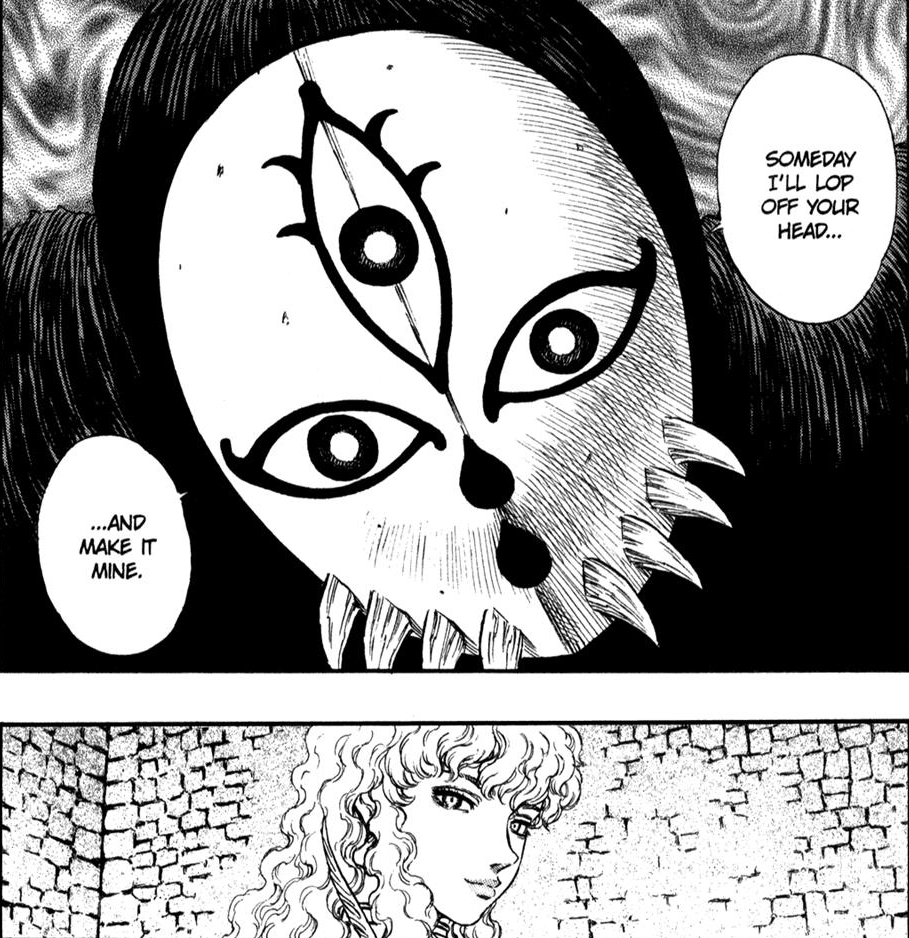
Later, as a villain, Gennon’s goal is literally just to rape Griffith, and Griffith is very aware of this, since he incorporates it into his battle plan. There’s also some indication that he’s been overtly getting his creep on for years on end, possibly explaining how Griffith knew Gennon would shoot himself in the foot just to get to him:
So Gennon is both a sexual threat and someone with power who gives Griffith something in exchange for sex.
Charlotte is a princess he has to seduce to realize his dream.
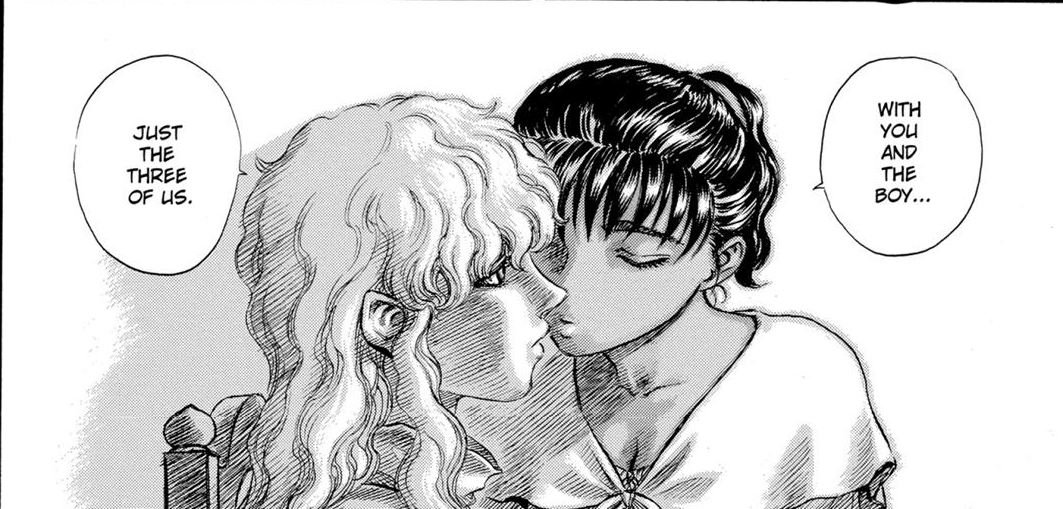
And when he does have sex with her I’d argue that it’s basically an attempt to escape from his feelings (rejection, need, self-loathing, being in love with Guts) through refocusing on his dream (which is consistently his alternative to and escape from Guts), essentially irrationally trying to prematurely seal the deal on the “transaction.”
It’s the sex version of this:
And it also negates every scrap of power he clawed his way up to and lands him in a dungeon.
Next you have the torturer and his incredibly creepy suggestiveness, which makes Griffith’s sexual victimization here technically subtext, but I mean, “we were like husband and wife,” the Gennon-like fixation on Griffith’s beauty, the tongue thing, the uh speculum he was holding in his introduction… it’s not subtle subtext.
Then when Griffith makes a move on Casca in the wagon he’s offering himself to her because he’s entirely out of options and kind of desperately grasping at something, now sunk from trading sex for a kingdom to trading sex for a caretaker, painfully highlighting his complete and total lack of power at this point in his life, and the future he envisions should she take him up on that offer makes him suicidal.
So like, four out of four sexual encounters we’re aware of pre-Eclipse focus on his vulnerability and powerlessness, then he turns into an evil demon and expresses his newfound power and invulnerability(/frozen heart) thru rape. So yk, there’s a thread there to pick up theoretically.
I mean I honestly have a really difficult time ascribing any meaning
to the Eclipse rape beyond assuming Miura wanted a cheap + shocking way
to piss Guts off, write out Casca, and presumably get himself off
judging by how he drew it, but yk… take the rest of the Golden Age and
the general concept of Griffith’s inner darkness raping Casca, the last person he felt that sexualized powerlessness to, while
ignoring the depiction of the actual scene, and you can read some amount of depth/cycle of abuse stuff into it. That was probably at least part of the point, if I’m being generous to Miura and his writing.
(Really given the amount of content in Berserk that
revolves around sexual violence you can read a million things into the
Eclipse rape. But yk if Miura wanted me to do that, he shouldn’t’ve
treated it like a sudden detour into actual porn. Ok mini rant over.)
(Oh I should probably add that obviously Casca was in no way complicit in Griffith feeling vulnerable to her there lol and I’m not suggesting she bears any responsibility at all. Griffith in the wagon and his subsequent dream was basically him projecting a bunch of issues on her. I feel like that goes without saying but I want to cover my bases.)
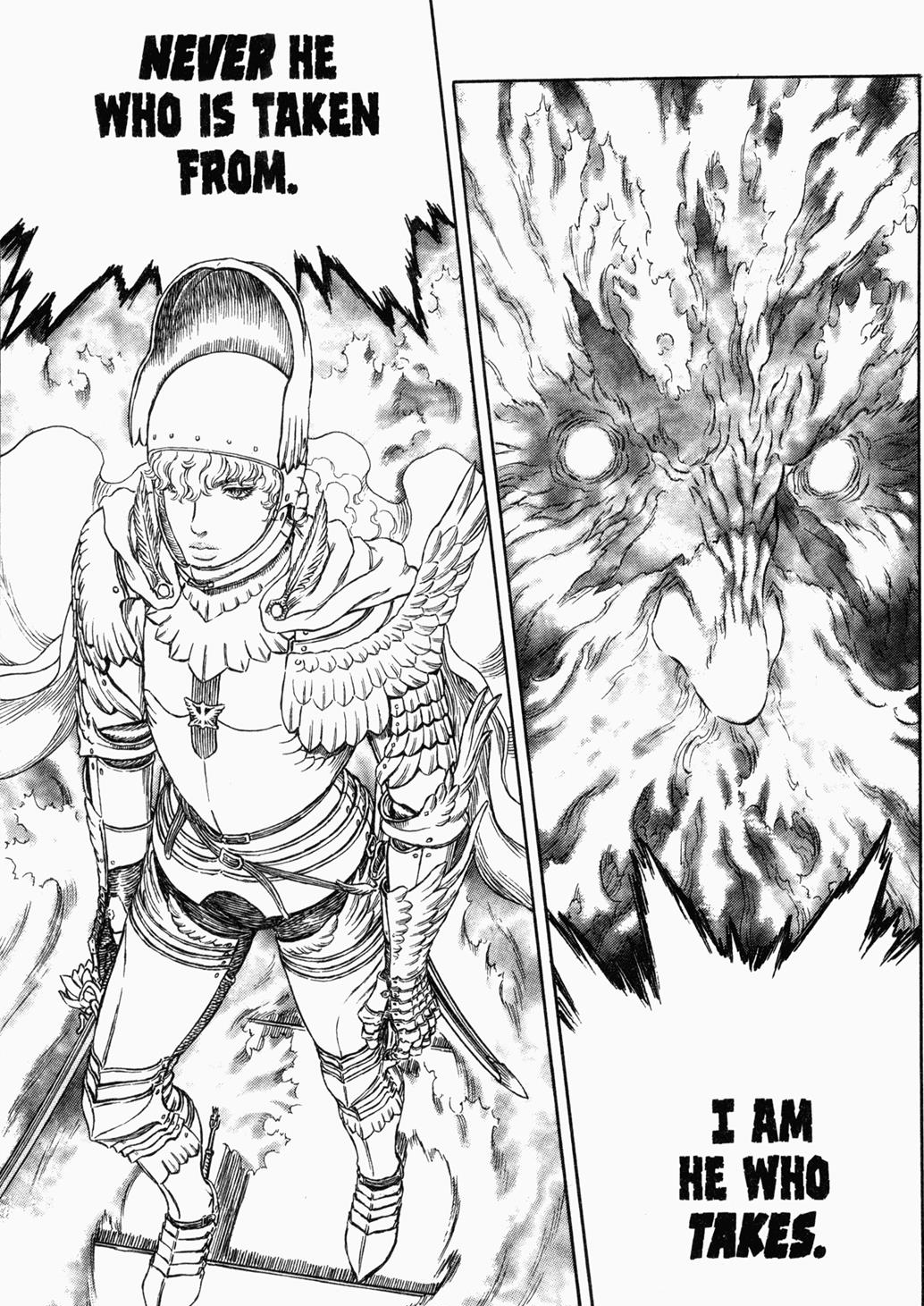
Then you get NeoGriffith with his magically heightened literally untouchable, beyond the reach of man vs an army of monsters is basically in love with him stuff.
There is approximately 0 chance the placement of that “hunger and thirst” panel is accidental js.
But now Griffith has all the power. His beauty and magical sex appeal can be used as a tool without Griffith ever having to make himself vulnerable.
(Also speaking of using sex to control others… like I don’t think it fits human Griffith based on what we see in canon, but imo there’s plenty of room to explore that with NGriff.)
This isn’t a real threat, Griffith can just go “lol” and completely destroy him without breaking a sweat. Now Griffith has switched from he who is taken from to he who takes.
Like, the stakes of the Battle of Doldrey, for instance, was the threat of Griffith being captured as a sex slave. Some of the tension came from Casca’s suggestion that Griffith volunteering for the battle may not have been a rational decision, because his rapist is the commander of that army. We don’t learn Griffith’s full plan until partway through, there are cliffhanger moments during the battle chapters where Our Heroes look like they might lose, and the sequence is tense and nervewracking as a result.
The war against Ganeshka has absolutely no tension at all. There isn’t even a moment where the outcome is not absolutely certain. And that’s a strong way of showing that NeoGriffith may face the same threats he did as human Griffith, but he’s no longer vulnerable to them.
Uh I guess my point is basically that NeoGriffith’s kind of sexualized untouchability feels like a narrative response to human Griffith’s particularly sexualized vulnerability. Enemies and monsters still go on and on about how hot he is, but they can’t act on that now.
But there’s still Charlotte. Like, despite all this godly distance and inability to be harmed and pointed contrast to human Griffith experiencing sex solely as a bargaining chip or a weapon, he’s still gotta marry her to make his dream official.
I feel like it’s unlikely that Miura intends me to read their relationship like this, so it’s not gonna be addressed, but ngl it’s something I find theoretically interesting. Like I see a lot of people assume that NeoGriffith is going to like, murder Charlotte after they get married, and tbqh I think that’s generally stupid, but if there’s one angle you can look at the story from and conclude “yeah NGriff may just off Charlotte with extreme prejudice as soon as possible” it’s this imo. Not to prove how pointlessly maliciously evil he is lol, but because she still has a form of sexualized power over him.
But I think it’s more likely that NGriff doesn’t give a fuck anymore, or if he does he won’t admit it to himself, because he carved out most of his emotions and it’s gonna take more than that to get him to admit it didn’t completely work.
Also speaking of Charlotte there’s the whole like, heteronormativity and repression aspect while we’re talking Griffith and his relationship to sex. The related fact that he deliberately performs a certain image/makes himself a symbol. And I barely even mentioned Guts. Agh actually there is a ton more to say about Griffith + sex, but I don’t want this to be even longer lol.
So ok, those are my thoughts on Griffith + sex + power specifically.
I’ll just link you other stuff I’ve written which kind of covers a wider variety of topics re: Griffith and sex, if you’re interested.
ia, I think Guts and Serpico have a lot of potential for an interesting relationship dynamic, parallels, contrasts, both wrt their relationships and each other as individuals. Yk in the conviction arc serpico and farnese had some griffguts vibes (well everyone in the conviction arc did lol), they both have abusive childhoods that involved taking care of a parent and eventually killing them, they’re actually both relatively chill people but guts has a force of personality and a drive that serpico doesn’t have, idk there’s a lot of interesting comparisons to make imo.
tbh their relationship feels way shallower than it could, but honestly I feel the same way about most aspects of guts’ narrative from the millenium falcon arc on. so I’d love to see more development, but I’m not like counting on it lol.
(maybe it’s purposefully shallow to show that Guts isn’t really fully connecting with anyone in his new group. like guts and serpico dueled but… guts doesn’t really give a fuck. serpico saved guts from zodd but guts doesn’t really reflect on that or care. anything interesting between them is from serpico’s point of view, eg reflecting on how being around guts has changed him. guts just gets his bland little ‘hey thanks for the help you guys’ moment in elfhelm and that’s about it.
i’d like to think that’s a purposeful contrast to guts’ actual meaningful relationships of the golden age lol, buuuuuuut yeah right lol, that’s wishful thinking. miura’s just halfassing it.
it’s like guts going to get farnese back from her family. it’s nice, it makes me happy that guts values farnese, but what does that mean for guts? how does his relationship with farnese, or serpico, or schierke, or isidro, etc, make him feel? he likes them, he wants to protect them, but how do they fit in to his complex inner life? i can come up with a million ways griffith and the hawks reflected and refracted guts’ childhood for instance, but not the rpg group.
maybe the difference is that guts is now fulfilling gambino/griffith’s role. he’s switched from needer of attention to distant giver of attention. there are parallels there in theory, yk farnese’s admiration, teaching isidro to fight, casca/shizu similarities potentially, serpico comparing guts to fire/blazing inferno that is griffith, blah blah blah. but they also… don’t seem to emotionally affect guts much. like damn imagine if guts himself was making a comparison between himself and gambino and fearing his own potential to be a shitty abusive life ruiner. instead that all gets channeled into the beast of darkness stuff, easily blamed on a magic suit of armour, without a hint of awareness on guts’ part of the potential parallels there.
uhhhh i went off on a weird tangent, sorry lol.)
the end of the lost children arc fucks me up because i find rosine’s regret over sacrificing her parents and wanting to return home as she dies to be extremely sad and emotionally affecting, and very understandable and relatable as a character choice
but contrasting that to jill’s “i’m going to go home and just deal with my alcoholic physically abusive dad and his pedo friends :D” ending completely ruins it
like, if that’s presented as the alternative, yeah i give rosine a high five for sacrificing her parents and becoming a monster. good for her. fuck her parents, she should’ve been allowed to die with no regrets.
like it’s one thing for, eg, old man troll fight to talk about how dreams can be opportune escapes from reality when his reality was taking care of a sick parent and working for a living, but when your reality is an abusive family, yeah escaping from that is good, actually. and i feel like that nuance is unaccounted for in berserk lol. like you can say it’s bad to kidnap children and transform them into monsters and kill people etc without also saying it’s bad/weak/immature/whatever to want to escape from your abusive home.
and by having rosine regret the sacrifice and long for home as she dies, contrasted to jill grinning and bearing her abuse, the narrative is essentially placing the blame on rosine for not being able to cope with abuse rather than where it should be, ie, on her father for abusing his kid and orchestrating his own death.
like, the lost children arc should’ve been about condemning abusive parents but… it wasn’t, and it’s fucking bizarre really. the abusive parents are just like, generic 2 dimensional stand-ins for any kind of life struggle, and the kids get the burden of reacting to life struggles correctly. we’re not shown that the parents should’ve or even could’ve made different choices, the parents just exist as trials to test these children, essentially.
and ok fine if you want to focus on reactions to abuse, rather than the perpetuation of it, that’s fair enough, but to then condemn one kid for seizing on the only escape she had and give another kid a pat on the back for deciding not to escape but rather to just suck it up… like damn. this fucking arc lol.
@bthump i Guess that being founded by Griffith a man who betrayed his comrades, among other things shows that Falconia is based on a lie, and tragedy will come.
this response to you basically just became an excuse to disjointedly ramble about this subject more, sorry for how unnecessarily long it is lol
tbh the main point of that post was to demonstrate how personal the stakes are, and how falconia is essentially a response to the child abuse all three of our main characters have gone through, thematically. so if it does boil down to ‘welp the dude who enabled the existence of a utopia where lives aren’t bought and sold and more people aren’t traumatized the way our faves were is an asshole so throw out the whole thing’ i will find that very unsatisfying.
i think falconia poses a lot of interesting moral questions. is it worth griffith’s mountain of corpses? is granting humanity’s dream worth also granting their nightmares? was it worth the sacrifice? and those moral questions only work if falconia is portrayed as positive, which it has been so far (and as long as those negatives happened with the intention of creating the positive, hence why most of that post turned into complaining about the eclipse rape lol.)
i think miura could also go down a route where he portrays falconia more negatively in the sense that humanity shouldn’t wish for a saviour/escape, but should instead struggle through an uncaring universe. a la the lost children arc, essentially, which seems like a potentially very strong parallel.
though again, considering how personal the stakes are – always the child abuse, come on – i would find that message… sucky, to say the least. i mean honestly the message of the lost children arc basically boiled down to ‘child abuse happens, dwi kids bc running away is bad.’ i kind of hope that miura is either still going to complicate that at some point down the line (lol pipe dream) or at the very least that he does something different with falconia than he did with rosine’s land of the elves bc dear god i couldn’t stand a repeat of that shit lol.
I mean here’s one way of looking at it:
Guts, Griffith, and Casca all have experiences with csa. Guts’ way of coping is to lash out and kill everything that scares him. Casca’s way of coping is to latch onto a saviour. Griffith’s way of coping is to change the world.
Like, of the three, Griffith’s coping mechanism wins lol, and I’m not down with an overall message that says, you shouldn’t try to change things, you should just struggle your ass through life like Guts here, and fuck everyone else. I mean tbf I don’t think Guts’ method is shown in a great light, so it’s already a bit more complex than Griffith’s dream bad Guts’ dream good, but yk, I worry lol.
Again, like, the moral question shouldn’t be “is this place where people are free to live their lives without being exploited a good thing,” it should be “is this good thing worth all the bad things that led to its existence,” and I don’t want the story to answer that question for me, I want to be presented with the evidence and decide for myself. Do the ends justify the means narratives are only interesting as questions, not answers, imo.
so idk basically my response is yeah maybe some kind of tragedy will come to demonstrate that falconia was a doomed venture from the start, and/or that wanting to create a place without exploitation is an inherently flawed or immature desire, but if that happens i will be unimpressed lol. If falconia does end up being destroyed, ideally for me there would be negative consequences to that too, because there are no easy black and whites in Berserk (or there shouldn’t be.)
and like, the whole thematic connection to child abuse could be coincidental, but facts are that falconia is explicitly a place where the strong aren’t given free rein to exploit the weak, and our central and most emotionally resonant examples of strong given free rein to exploit the weak are the nobleman who bought casca, donovan, and gennon. Plus the apt Lost Children parallel. so if miura didn’t intend this he shouldn’t’ve filled berserk so full of thematically on the nose depressing backstories lol.
This is about Falconia, bodies and lives being bought and sold, the natural order of the world, etc.
tw for csa (no graphic panels but still disturbing enough for a cut imo)
The Conviction Arc shows us in broadstrokes the world humanity’s collective unconscious wants to overturn through starving crowds, dungeons filled with tortured ‘heretics,’ rampant plague and the desire for a saviour, and nobles terrorizing peasants using god as an excuse, but this is the up close and personal version. Lives and bodies as commodities, weak trampled by the strong, poor ruled by the rich, and everyone accepting it as the way things are.
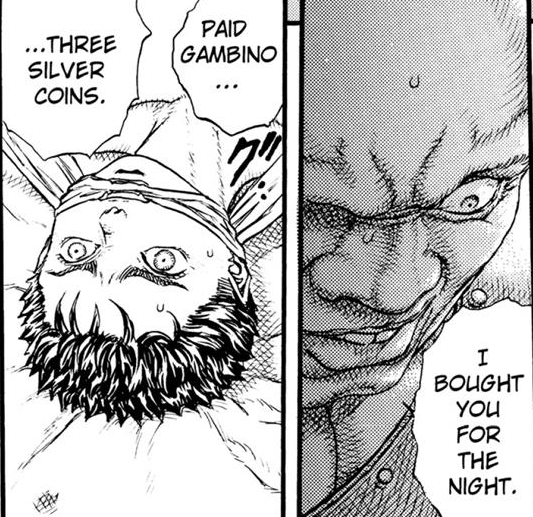
Our three main protagonists during the Golden Age all have very personal formative trauma that revolves around being bought and sold as a matter of course.
And Griffith’s dream, as someone wracked with guilt for lives lost in his battles, someone who has sold himself to a rich and powerful predator to save some of those lives, is to overturn this natural order of things.
And he does. Falconia is a place where children aren’t sold as sex slaves, where the powerful do not oppress the weak, where the rich don’t exploit the poor, where everyone is treated equally and with dignity, where Guts, Griffith, and Casca could’ve all had happy childhoods.
One of the important aspects of this theme re: societal power dynamics and exploitation is that these evil actions
are excused away. This is true of like, just about every abuser of power and
rapist in Berserk. Some think it’s okay because someone more powerful than
them told them they’re allowed (torturer, Wyald/probably the rest of
the apostles, Mozgus’ torturers, Mozgus and the inquisition in general
passing the buck onto God, Donovan because Gambino allowed it, etc),
some think it’s okay because that’s just the way things are (Donovan
again, Adon, Rosine’s got some of this, etc), some think it’s okay because
they’re powerful enough to do anything they want (implied with Gennon,
Ganeshka,
the Godhand, a lot of apostles, Casca’s attempted rapist nobleman), and finally some think it’s okay because the world wronged them (Gambino, apostles like Rosine again and Eggman, Jill’s dad, the baby eating heretics lmao, one could argue the King, Mozgus’ torturers again, etc).
Again, it all comes back to the “reason of the world,” the natural order of things that NeoGriff overturns. In the ordinary world these people with power can do whatever they want and justify it to themselves. In NeoGriffith’s world, they don’t. Apostles, our prime example of powerful preying on weak because they’re allowed to, no longer prey on humans, simply because of NeoGriffith’s existence.
It seems safe to assume nobles no longer exploit people either, if nobility is even still a thing in Falconia. Like granted, I’m taking some of this as read based on what we’re told Falconia is, but I feel like the apostles (and the explicit focus on equality) are a good representative example of the point of Falconia, which is to essentially fix everything we see wrong with the world in the Conviction arc and, like I laid out above, in our protagonists’ lives.
The fact is that Falconia isn’t just a utopia on a distant macro level, where the readers can look at it and go, hm seems nice I guess but w/e. On a micro level it’s a place where these horrible things that happened to the characters we personally love and care about wouldn’t’ve happened. I, at least, am emotionally invested in that utopia because of this, yk?
But here’s where I get critical of the portrayal:
Femto and the Eclipse rape is the epitome of the harmful power structure. Like, Femto hits every branch on his way down this tree lol. During his transformation he met God, God absolved him of his guilt and responsibility by telling him he can do whatever the fuck he wants and it’ll be the right thing. He’s taking the place of the nobleman he saved Casca from and exemplifying existing power structures of strong preying on weak, and it’s petty revenge.
One can easily argue that the Eclipse rape is a distillation of every abusive power structure in Berserk.
So okay, you have Falconia, a utopia that exists to eschew these power structures and create a place of equality where no one is exploited, created by a dude whose defining act is the epitome of these abusive power structures.
And frankly it’s fucking pointless. This feels like the shallowest of shallow hot takes lol. Like, oooh what if this wonderful place where all the horrible things that traumatized our favourite characters are no longer an accepted given was created by an evil demon rapist???
Like… okay? And then what? The Eclipse rape has nothing to do with the social structure of Falconia, NGriff seems to have completely delivered on his/humanity’s dream regardless, he is now the higher power making the calls and he hasn’t told everyone to do whatever they want no matter who it hurts. From what we’ve seen he’s done the exact opposite, existing as a tempering influence on the apostles who no longer prey on those weaker than them, ending the Holy See’s reign of terror, ending wars in general, and uniting people in their differences.
So it’s just like, an arbitrary evil act which creates an artificial sense of moral greyness. It has no deep meaning. I mean I suppose Miura could address it in the future – I’ve mentioned that I think it could theoretically be really interesting for Casca to visit Falconia and see the dream she devoted her life to having come to fruition because of her rapist. But even so, that doesn’t have any like… deeper intrigue. That’s interesting for Casca’s character, not as an examination of moral relativity or w/e.
Similarly, if NeoGriffith turns out to be more human than he looks he could reflect on this contradiction in a potentially interesting way.
But I can’t think of a way to make it an interesting examination of morality. It’s boring at its core imo. I mean you could argue that it’s still worthwhile on that personal character level, but let’s be real here – no amount of potentially interesting character stuff in Casca’s future is worth removing her from the story for 20 years, and anything w/ NeoGriffith would be a retread of human Griffith’s guilt issues and frankly I don’t see it happening anyway lol.
So yeah ultimately this whole egalitarian utopia created by a rapist demon thing just does not work for me at all. There’s no reason the creator of this paradise /had/ to be a symbol of this abusive power structure it exists to destroy, again, that’s just an arbitrary happenstance, not a pre-requisite to utopia building, so it doesn’t say anything about the nature of Falconia. It doesn’t say anything about utopias in general, it doesn’t say anything about those power structures that we don’t already know (ie they bad, equality good).
It’s like, fake deep tbqh.
The actual interesting and morally grey aspect of Falconia is the way world peace was achieved by setting a bunch of fantasy monsters loose on humanity, and that has nothing to do with the Eclipse rape. Like, that’s literally all you need for the moral complexity. We have world peace and a growing utopia that everyone is welcome to join, but the price is monsters everywhere, and this could not have happened without those monsters to unite humanity in fear. Is the world better or worse than it used to be?
And NGriff being a rapist, or his demon alter ego being a rapist, or whatever the deal is there, adds nothing to that question, rather, it distracts from it and devalues the actual moral ambiguity.
In fact, it makes me wonder whether Miura regrets going with rape as his way of demonstrating Femto’s evil. Because it’s been such a non-issue to the whole theme of power structures, utopias, equality, etc, that it feels like Miura is sweeping it under the rug lol – it’s less of an attempt at dark irony and more the elephant in the room. I can’t even say with confidence that Femto was intended to be a symbol of exploitative power structures, despite how obvious it seems, because it just… hasn’t impacted the themes of the story at all.
under a cut because a) this is largely about the hot button issue of griffith + sexual assault and b) it’s pretty off the cuff rather than carefully thought out so i want to reserve control over it lol
i’m gonna be honest, my biggest issue with the theme of griffith + beauty + sexual victimization is that it’s both very loud and clear, like it’s absolutely an intrinsic part of griffith’s narrative, but for some unknown reason it’s also more subtle than every other instance of sexual victimization we see? and i have no idea why miura was so coy about it but it makes it difficult and a little awkward to just take it as read
like even at the start w/ gennon. guts’ csa trauma is unambiguous – it’s violent, guts struggles and fights, etc. casca’s is also unambiguous attempted rape. she tries to run, and then is able to kill her attacker. but griffith’s is “voluntary” enough that like a majority of berserk fans don’t even see it as rape, despite gennon literally being a pedophile with a harem of child sex slaves, and griffith being a child, “who could still be called a boy in his innocence,” according to casca. the next morning griffith himself frames it as seducing gennon. also, unlike the other two instances, we don’t see what happened. All we have is Casca’s glimpse of Gennon’s hand on his shoulder and Griffith’s explanation the next morning.
And I actually have no issue at all with how it’s portrayed in canon, like anyone who isn’t a rape apologist and has an iota of reading comprehension should be able to figure out that it is rape and griffith was traumatized by it. I definitely don’t think Miura thinks Griffith freely consented or intended it to be read as ambiguous either. Griffith saying he seduced Gennon says way more about Griffith than about what actually happened. But compared to our other two protagonists and their formative traumas, it’s not nearly as in your face.
Then you have Griffith and the torturer, which is all left in creepy innuendo. Like it’s blatant enough that it seems willfully blind to assume there was no sexual assault going on, but again, it’s not like Miura shies away from depicting rape everywhere else in Berserk, so why is it only left in innuendo?
And yk what I think there’s a throughline from those – Gennon and the torturer as sexual predators obsessing over Griffith’s beauty – and both Griffith offering himself to Casca in the wagon and then Griffith’s vision of his future with Casca, t b q h. In that nightmare he’s attractive again, he’s virtually immobile, and again there’s the implication that Casca is having sex with him.
like I don’t think it’s a stretch at all to take all this together and say Griffith has some serious issues with sex even if Miura doesn’t come right out and say it like he does for everyone else.
like terrible, terrible depiction aside, this is probably the best set up for the eclipse rape we have. sex to griffith being a show of power or lack of power, and with griffith it’s always been the lack of it. with gennon, and charlotte, and casca in the wagon it’s been a trade – griffith giving them the only thing he has to offer in exchange for something they, with their greater power can give him. money, a kingdom, and… idk my reading of the wagon scene changes with the winds, but in this context i suppose it would be security, possibly griffith thinking if casca stays then guts will stay too after seeing them together.
and then this vision depicting a life like that. like the wagon scene and this nightmare seem to exist mainly to set up why the dark negative evil side of griffith would take this out on casca specifically, because griffith had just been projecting these issues onto her and when he gains power and loses his “goodness” he spitefully reverses their perceived roles.
BUT AGAIN this is both unnecessarily subtle and also a huge fucking mess thanks to how terribly written and depicted the eclipse rape was (and also the depction of the charlotte scene doesn’t help lbr) so I feel like i’m making shit up to make griffith more sympathetic lol. even though i’m like 90% sure it’s purposeful and also it doesn’t rly make griffith more sympathetic because i wholeheartedly sympathize with him even without all this lol, and femto is a literal demon made of evil so it doesn’t make him more sympathetic either. it just kind of ties a lot of themes together.
My thoughts very much line up with yours. I tend to think being raised in an environment that was probably physically dangerous as well as living through periods of involuntary starvation probably cultivated his detachment. Also I’m not sure he thought of himself as attractive? Like he might see his looks as a vulnerability since the folks that have given him attention for it have hurt him.
yeah ia with this.
i’m sure he knows he’s attractive and probably cultivates it since yk he’s trying to marry a princess, but i don’t think it’s something he’d like, be proud of or that would feed his ego or anything. i think he’d deliberately try to see it in a utilitarian way rather than having any feelings about his looks, positive or negative, bc the less rational feelings he does have would probably be negative – beauty is an asset to achieving his dream (not just in marrying charlotte but also looking the part of the hero of midland and gaining general acceptance), but it’s also something he associates with being preyed on by gennon, so he focuses on the first part.
huh, this isn’t rly something I’ve ever thought about, interesting question.
I’d say that in general he’d think about it in a utilitarian way – he knows what he’s capable of with it and he’d work to keep it that way. that includes fighting and being able to seduce a princess, or whoever else may be necessary. it’s a tool.
you could probably make a good argument for him having some issues with it/detachment from it though, that could feed into him thinking about his body as a tool rather than a part of him. like, looking at the way griffith said he seduced gennon eg, it seems like a way of removing himself from what actually took place – rather than thinking of it as gennon using him, griffith used a tool (his body) to get what he wanted, that kind of thing. a way of granting himself a sense of autonomy and detaching himself from the body which he’s washing in the river and thinking of as dirty now.
plus i feel like that attitude would make for some interesting character study-ish thought processes during his torture, with both the pain inarguably tying his body to him (also possibly related – his self harming habit?), and the torturer’s fetishization of his physical beauty, and afterwards when his body is no longer useful as a tool and he’s grown so used to the pain he feels numb and “like [his body is] floating in mid air.”
and ngl neogriffith’s feelings towards his body could also be interesting. femto was like, on the astral plane, his body was arguably not even real, but then neogriffith incarnates in flesh and blood again. he’s probably more concerned about his feelings lol, but he’d likely be like, super detached from his physical form, due to having lived on another plane of existence and being a pseudo god or w/e, and also literally untouchable. now it truly is nothing more than a tool, and one that can’t be broken or forcibly tied to him because no one can even inflict pain on him.
and therefore his thought processes could be extremely interesting if/when he is touched. though for me interesting is basically griffith lying badly to himself about not caring/not feeling/etc.
ngl while my “official” take is that the dream started out as a stupid kid’s fantasy and snowballed horrifically and gained deeper significance as a coping mechanism/escape after the kid’s death and gennon (i’m pretty sure we’ve had some conversations about this ages ago lol), every time I read the scene where he saves Casca I’m like, nope there’s gotta be something else going on there.
He just lays everything out so plainly (”does being born of the nobility mean you’ve been chosen by god?” “if you have something to protect, take up that sword,” “you know how to fight already, don’t you?” “you might die you know,”) that it’s like, there’s no way the kid’s death and gennon was his wake-up call to how shitty the world is, everything’s already in place right here.
Like I guess it can’t be more than headcanon because if there was more to his story I’m sure Ubik would’ve said something while he was fucking with him to make the sacrifice, but chapter 16 like, establishes all of Griffith’s motivations/attitude towards nobility/making sure everyone follows him of their own choice/etc, which really seems to indicate that the kid’s death and gennon wasn’t the beginning of his bitterness re: people’s lives being bought and sold by nobles and his guilt re: ppl dying for his dream. It’s just like, an example.
lol in short, ia!
You clash head-on with your own destiny. Compared to my cooled demeanor, that is a life similar to being scorched by hellfire itself.
i want to say something about serpico and how he and guts make a good compare/contrast as basically opposite reactions to an abusive childhood, but i don’t really know what to say so i’m just going to throw some stuff at the wall and see what sticks
serpico’s coping mechanism is emotional repression and calm acceptance, where he just takes absolutely everything thrown at him by his mother’s expectations and childhood bullies at first (learning quickly that fighting back led to worse) and then farnese, while guts fights back and struggles, killing donovan, defending himself against gambino’s attack, etc. i mean one was a mercenary and one was a servant, one was taught by his father figure to fight and the other was taught by his mother to bear everything, so yk it makes sense.
both killed a parent: serpico killed his mother bc he was pressured to by circumstances and did so when farnese told him to (imo farnese making it an order and holding the torch with him is what made him capable of doing it), basically just numbly doing what he’s directed to do, while guts killed his father in reactive self defense, and both are pretty messed up about it.
serpico lay down to die bc it was easier and was found by farnese who nursed him back to health; guts lay down to die bc it was easier and then got back up and fought wolves.
it feels easy to compare gambino and serpico’s mother in that both guts and serpico were their caregivers for a while. and i want to compare serpico’s mother telling him he’s noble vs gambino telling guts he’s cursed but i’m not sure where to go with that. both statements kinda fucked them up tho.
they both have tendencies to fight in a self-destructive way now that i think of it: guts throws himself into the fray and just tries to kill before he gets killed, serpico otoh lets himself be wounded in order to fight to a draw + avoid making trouble.
guts and serpico both found themselves nursed back to health and then kept by haughty insecure blond ppl, and both relationships were extremely intense and exclusive. only yk guts and griff were in love and farnese and serpico are gay bffs/siblings, and neither farnese nor serpico have epically fucked their relationship up yet.
in conclusion: i have no conclusion, idk. turns out everyone responds differently to abuse and berserk is largely about that? surprise surprise guts is active and serpico is passive? guts and serpico might have more stuff to talk about if they ever got 3am drunk together than you’d think?
actually speaking of griffith/rosine parallels one thing i’m real worried about is that falconia is going to end up being another land of the elves style thing compared to guts’ jill.
not in the sense that children are murdering each other or even that there’s a dark underbelly at all, just in that falconia will be portrayed as a childish immature fantastical escape from the horrors of the world compared to the more ‘mature’ concept of just dealing with your life being terrible instead of actively trying to escape or change things, a la rosine’s escape from abuse to her fake fantasy vs jill being portrayed as more admirable for going back home and just… taking the abuse?
i hated the end of the lost children arc, is what i’m saying, but it seems like very apt set up for falconia, which worries me. i don’t want guts and griffith to be jill and rosine 2.0
well that’s a lie i absolutely do, but yk, just with the gay vibes, not with those particular themes.
I don’t really have much to say about Charlotte tbh, nothing about her character really grabs me, but if anything comes to mind or she gets more meaty content in the story eventually, I’ll def write something. Though I don’t really think Casca’s reaction to trauma should be used as a benchmark for how strong anyone else is lol, because her reaction was v unrealistic and pretty much just Miura’s convenient way of getting her out of the way and explaining why she wasn’t around during the Black Swordsman arc despite being alive. I don’t think it means she’s suffered more than anyone else (she may have, but it’s not relevant), or that she’s emotionally or mentally weaker than anyone else.
Charlotte is pretty resilient though, totally agree.
Yeah I’m assuming we’re not far from seeing some revealing emotional NeoGriffith moments, after his interaction with Rickert, but we’ll see I guess. I have my doubts that it has anything to do with the magic baby, but again, we’ll see.
Though speaking of, one thing I can say is that I don’t think it will be a tantrum because things aren’t going his way. We’ve never seen that from human Griffith – when things get bad for him, he’s serene about it. He deals with people plotting against him easily, he uses something that could be very distressing (facing Gennon at the most important battle of the war) and turns it to his advantage, he faces Zodd with calm battle tactics and determination even when the odds of him succeeding are nil, when he’s captured after fucking Charlotte he reaches for his sword and then peacefully gives up when he remembers he’s unarmed, he smugly taunts the king after losing everything and being whipped, and the torturer even comments on how quiet and non-responsive he is during torture, at least during the first day or two.
The only circumstances we saw that made him lose control emotionally were sex with Gennon/guilt + self-loathing, and Guts-related stuff (including Femto failing to kill him and NeoGriffith’s heart going off).
So when NeoGriff does eventually show some emotion, my bets are on it being because of Guts.
Okay we’re finally on the last part of this giant self indulgent monster. Here I’m going to get into why I prefer to interpret Guts and Griffith’s relationship as mutual gay pining as opposed to one-sided, how I think the sexual attraction between them fits into the existing themes, and in general what makes it really work for me.
I wrote this thing because while I feel like a lot of fans can agree that there’s at least a strong indication that Griffith’s feelings for Guts aren’t strictly hetero, even lots of fans who acknowledge the gay subtext see it as one-sided. So I wanted to put a spotlight on Guts’ side of things.
And tbh, even ignoring all the stuff I’ve talked about so far, it boils down to one point: one-sided pining just doesn’t fit into the rest of Guts and Griffith’s relationship.
For me, the Golden Age tragedy works so well because it rests not on incompatibility or irreconcilable differences, but on a misunderstanding: both Guts and Griffith fail to realize that the other loves him.
This is just facts – you can call the love platonic if you must, since Miura never went beyond subtext with the romance, but that’s the plot of the Golden Age in a nutshell.
And if, like me, you think it’s pretty clear that Griffith the gay coded villain who irrationally risks his life for Guts multiple times, who is so gay Guts had to ask during their very first conversation and Griffith didn’t answer, so gay he thinks about Guts while having sex, so gay his feelings for Guts kept him sane during a year of torture, so gay that Guts is cheer captain and Casca’s on the bleachers, is romantically in love with Guts, then it follows that Guts’ feelings must also be romantic in nature.
Because again, this isn’t a story about unrequited love. The Golden Age is about two dudes who had a great relationship but fucked it up because they both misunderstood what that relationship was and failed to communicate. It’s not about a gay dude tragically in love with his straight bff. If attraction is part of Griffith’s feelings for Guts, then attraction is part of Guts’ feelings for Griffith.
The final arc of the Golden Age, after Guts returns from his stupid vacation, largely revolves around Guts’ slow realization that he was wrong when he thought Griffith looked down on him and didn’t care about him:
He’s realizing that Griffith’s breakdown after he left, Griffith losing his dream because he left, ultimately means that he didn’t need to leave at all, because Griffith didn’t look down on him. Griffith needed him. Griffith loved him.
Griffith’s corresponding misundertanding is that he didn’t know Guts left to become his equal, and almost certainly believed he left because he couldn’t stand to be around him after seeing Griffith’s “dirty side.”
This is a bit less straightforward because Guts gets most of the focus in the story, but I’ll do my best to briefly explain my reasoning.
Guts and Griffith’s final interaction together before the duel, that we get to see, is this night:
Griffith needs emotional reassurance in a revealing and intimate moment of vulnerability, and Guts fails to provide it. Instead of telling Griffith that no, he doesn’t think he’s cruel, he tells him something more akin to “yes but it’s necessary for your dream, remember?”
Griffith’s expression in the “You’re right,” panel is straight up the saddest thing I’ve ever seen, it might actually be my favourite image Miura’s ever drawn ngl. I love it so much.
Compare to how he looks at a dead kid before deciding the kid’s death means he has to have sex with a predatory pedophile, and then self-harms in the river the next morning while claiming he doesn’t feel guilty:
Down to framing and hair over his eyes these panels are so similar that I fully believe “You’re right,” is a purposeful call-back to this, giving us the necessary context to understand what Griffith is feeling.
This night of assassinations is Griffith’s corresponding Promrose Hall moment, imo. If only for a moment, he forgets his dream because what Guts thinks of him is more important, and when, instead of reassuring him, Guts reminds him that the path to his dream is paved with cruelty, he looks like all his self loathing hits him at once.
Also dude has a serious and depressing propensity for calling himself dirty.
So when we next see him and he’s falling apart because Guts is leaving, this is the context we have for his extreme reaction: his self loathing, the way he asks for reassurance, and the way he looks when Guts brings up his dream instead of giving him that reassurance.
Look at the moment Griffith is remembering here: “It’s funny… you’re the first person I’ve ever spoken to like this.”
It’s ironic because we know exactly what Guts thought of him then, but Griffith is convincing himself that Guts hated him from the first glimpse he saw of the real Griffith, the Griffith no one else gets to see. The vulnerable, “dirty,” needy Griffith, the Griffith who questions his place in the world, the Griffith falling in love with Guts.
And like Guts, Griffith has no idea how Guts truly feels about him.
So yeah, this is why I think their feelings, all their feelings, from platonic to sexual and everything in between, are mutual. Because the point is that they’re two idiots who love each other but, thanks to their low self esteem, can’t see that they’re loved in return.
Which brings me to themes and shit, and why Guts and Griffith being sexually attracted to each other fits into Berserk like a puzzle piece.
Berserk is, at its core, about reactions to trauma. It’s right there in the title. Like every major adult character has childhood trauma that fucks them up. Serpico, Farnese, Casca, Guts, and Griffith.
When it comes to the Golden Age trio:
Casca was assaulted by a nobleman and saved by Griffith.
Griffith prostituted himself to a pedophile in a fit of extreme guilt while he was at most on the young end of teenaged, called himself dirty and self harmed afterwards.
Guts was raped by a soldier his abusive adoptive father sold him to.
Casca’s reaction to her trauma is to idolize Griffith as her saviour to the point where she has no sense of identity outside of him and helping him achieve his dream.
Griffith’s reaction is self-loathing, emotional repression (”I don’t feel guilty,” he says, while Casca begs him to stop hurting himself), and the beginnings of a vicious cycle in which he is driven to achieve his dream to make all the “underhanded” “dirty” things he does for it, and all the deaths on his head, worthwhile.
Guts’ reaction is his desperate desire to be loved and respected coupled with a mistrust of people.
All these traumas result in the bad decision pile-up that eventually leads to the Eclipse.
Guts’ desire to be loved and respected coupled with past experience making it all too easy for him to believe he’s not is why he ignores a mountain of evidence that Griffith loves him in favour of one overheard speech about how he has no friends, and then decides that it’s a good idea to abandon all his friends, including Griffith, in order to try to become his equal and earn his affection.
Griffith’s self loathing leads him to believe that Guts is abandoning him bc he’s desperate to get away from him after seeing some of his darker sides that he’s ashamed of. His emotional repression means he has no ability to understand or express his extreme emotional reaction to this. So he lashes out through a framework he does understand (”rules of the battlefield,” as Judeau says), then falls into despair, crashes and burns, and ends up in a torture chamber.
And Casca’s lack of identity leads to her transfering her obsession from Griffith to Guts – complete with sword metaphor – after they sleep together, which leads to her mistakenly prioritizing Guts’ previously expressed “dream” to go off and fight people, the same way she once prioritized Griffith’s dream, which leads to Griffith overhearing her telling him to leave, which leads to the Eclipse.
My point is that the Golden Age arc is basically the story of three traumatized people whose adverse reactions to their traumas fuck their relationships up. Because it’s a dark fantasy story ft gods and monsters and fate etc, fucking up their relationships results in the Eclipse.
This is a perfectly good story by itself. It doesn’t need sexual repression added to it, but at the same time, boy does sexual repression fit right in.
I think that, whether it’s intended by the author or not, Guts and Griffith are both extremely easy to read as repressed gay*** men.
Griffith’s got a whole narrative about his dream, a dream which he can only achieve through hetero marriage, being pitted against his love for a man. He does stupid irrational shit for Guts and Casca berates Guts for it because he could “take Griffith’s dream down with [him].” Overhearing him talking about his dream to Charlotte is what makes Guts decide to leave. Guts is the only one who makes him forget his dream. He has to sacrifice Guts, “burying his heart,” to attain his dream. Even when he becomes the saviour of the world as NeoGriffith, he still has to marry a woman to seal the deal on his dream.
The dream is associated with emotional repression and Guts is associated with emotional expression.
As for Guts, I just wrote over 10k words about his attraction to a man and 5k of those were about how his het romance revolves around his attraction to a man so I’m not going to reiterate all that. There are a few particularly noteworthy things about Guts and his narrative that scream repression to me though that I’ll mention.
The way it’s his deep, subconscious, instinctive id side, the Beast of Darkness, urging him to pursue Griffith, complete with a dark sexual undertone. (Relevant reminder: I’m only arguing that the gay is there, by accident or by design, I’m not arguing that it’s a positive portrayal lol.)
The way Guts’ statement to Casca after sex that only her touch was okay in the beginning is a) incorrect as I’ve shown earlier, and b) irrelevant bc the reason she was able to touch him was solely because she’s a woman, as we know from the way his burgeoning panic subsides when he realizes she’s not a man – and ever since then she’s been the only woman he knows. So it doesn’t feel like much of a jump to suggest that he had sex with Casca because she’s literally the only person he knows with whom sex wouldn’t automatically trigger him.
The way his matchmaking of Griffith and Casca seemed to be an attempt to get Casca to take his place, with the added layer of romance that he couldn’t envision for himself.
The way, in their first interactions, Guts seems transfixed by Griffith’s appearance, comments on his pretty face, suggests sex if he loses in a way that seems informed by his rape trauma, but then is once again entranced by Griffith, rather than angry or afraid or any other potential negative emotion you’d think he’d feel, when he does lose. This whole sequence gives me the impression that he wants to bone Griffith but can’t acknowledge it and can only relate the concept of same-sex desire to his trauma.
And, for both Guts and Griffith, the way their respective traumas are depicted is particularly relevant. I’ve explained how each formative traumatic experience gave these two a pile of issues that fuck up their relationship. But the thing is, none of those issues (for Guts a need to be loved and respected and a default belief that he isn’t; for Griffith emotional repression, guilt, and self loathing) are intrinsically tied to rape. For Guts, it’s Gambino’s betrayal of him that fucks him up, not the specific sexual nature of that betrayal. For Griffith, it’s the realization of the weight of his dream and the way he “dirties” himself for it – later examples of acts that make him feel “dirty” are assassinations, so there’s no narrative reason his first act has to be traumatic, non-consensual (as he’s a child) sex.
And this isn’t a critique of that, I actually think it’s great to see characters who have backstories involving rape without it being the sole thing that defines them. For every character it’s part of a tapestry of childhood trauma, not the only important part, or even the most important part.
But it’s really, really easy to fill in the blanks for how formative sexual trauma specifically also has a hand in informing the nature of and contributing to the destruction of Guts and Griffith’s relationship. We’re not explicitly shown or told this, but imo it is suggested when they first meet.
Guts makes the duel, and his first real meeting with Griffith in general, about sex by uncomfortably asking if Griffith’s gay and offering himself to him if he loses. Here either the narrative is choosing to deliberately point out that Griffith and Guts have some gay undertones going on in our introduction to their dynamic because this informs our understanding of the rest of their relationship going forward, or the narrative is choosing to remind us of Guts’ sexual trauma here because that trauma informs the rest of their relationship going forward. Or both.
It’s also suggested in the way we learn Griffith’s backstory with Gennon right before Casca finally expresses her jealousy of Guts and comes this close to telling Guts that Griffith is in love with him:
By revealing this backstory in the lead-up to this revelation of why Casca resents Guts, Griffith’s trauma and his feelings for Guts are tied together the same way Guts bringing up sex when he first duels Griffith ties his trauma to their relationship.
And the way these traumas may inform their relationship is that neither of them are capable of acknowledging or even recognizing their love and attraction.
Let’s be real here: if Guts and Griffith’s relationship was romantic there’d be no Eclipse.
This is what really makes the subtext and the idea that both of them are repressed dudes in love work for me. This is the number one reason I ship it: because they work so well together.
We’re shown exactly how compatible they are. The tragedy of the Golden Age is predicated on both of them failing to recognize the other’s feelings, but what makes it a real tragedy is the inherent lost potential when their relationship falls apart.
All Guts truly wanted was someone he loved, who loved him back and treated him with compassion and respect.
And he got that! That’s exactly who Griffith was to him, exactly how Griffith fulfilled his emotional needs.
Guts remembers the night he killed Gambino before dedicating his sword to Griffith. This is when Guts decides that maybe the Band – maybe Griffith – is what he’s been looking for. A home. Love. Someone to look his way – more than that, someone who cares about him enough to lay down his life for him.
This is the truest moment of Guts and Griffith’s relationship, imo. There’s no misunderstanding getting in the way and muddying the waters – there’s only Griffith admitting he had no reason to risk his life for him and casually saying he’d do it again (”each time I put myself in harm’s way for your sake”), and Guts recognizing how significant that is, and dedicating himself to him in return.
Right here and now Guts has everything he’s always wanted. Later he overhears the Promrose Hall speech and re-evaluates his relationship through a false lens, but as I said back at the beginning of this post, Guts eventually realizes that he was right the first time.
Now again this is less straightforwardly stated and relies more on my own interpretation, but I think Griffith’s corresponding issue that matches Guts’ desire to be loved is his desire to be truly seen and accepted.
He wants Guts to be privy to his dirty side and to want to remain at his side anyway. In order to fulfill his dream Griffith has to constantly project an image of perfection.
His reaction to Casca seeing him in a moment of extreme vulnerability is:
There are countless references to Griffith looking like something out of a fairytale, there’s his carefully constructed perfect-fiancee image he shows Charlotte, his perfect infallible leader image he projects to the Hawks. He’s a symbol to everyone – to the Hawks and the peasants etc who love him he’s a symbol of change for the better, of soaring up; to his opponents he’s a symbol of corruption and change for the worse, a “parasite.” To his rapist(s)*** he’s a symbol of perfect beauty. People either look up at him or down on him. When he says he has no equals, in fairness, it’s because no one treats him as an equal. In their last scene together before the speech even Guts had reframed a request from a friend into an order from a superior (”It ain’t like you. Just cut to the chase and order me to do it.”)
But Guts is still unique because he wants to be Griffith’s equal. He wants to “stand beside him,” he wants to consider Griffith a friend and treat him like a real person and not a symbol. And, more than anyone else, he does.
Guts dumps a bucket of water over his head in his first week with the Hawks while they laugh together. Guts disobeys orders constantly to the point where Griffith just plans around Guts’ impulses and Casca gets pissy about how much he gets away with. Casca sees Griffith as distant and unreachable after a battle, but Guts scoffs and takes her to go hang out with him. During their homoerotic duel, Guts punches him and says, “I bet that’s the first time that pretty face’s ever been hit,“ showing only irreverence for the image everyone else is obsessed with.
And this is the one man out of tens of thousands who makes Griffith forget his dream.
This is the foundation their relationship is built on. Love and respect, and irreverence and equality. They both come closer than anyone else to providing what the other needs. And they both help the other grow:
Griffith gives Guts a supportive environment, his trust and belief, his love and affection, and Guts grows into a responsible person who leads a group of men who freaking adore him, who cares for the people around him and lets them in instead of being standoffish, who is able, until an overheard speech, to accept that he is loved and that he has value.
Guts gives Griffith attitude, playfulness, irreverence, etc, and Griffith is able to trust him, is able to allow himself to be vulnerable around him and show his insecurities. He’s able to be himself with Guts.
Plus Guts makes him forget his dream. And Griffith’s dream is bullshit, it’s absolutely terrible for him, it’s a huge weight on his psyche, it’s built on guilt and a need for validation from the universe. But after three years, it’s Guts he turns to for validation instead. Griffith asking Guts “do you think I’m cruel?” is so pivotal because in that moment Griffith’s desire for Guts’ regard outweighs his dream. Guts has to remind him about his dream, and that reminder hurts.
Griffith raises Guts up and Guts brings Griffith down to earth a little, and they come so close to meeting in the middle – but, to bring this post back to my point, they never quite do.
Guts brushes off Griffith’s attempts to treat him as an equal (asking him to help him out by killing a man and Guts telling him to order him to do it; asking if Guts thinks he’s cruel and being reminded of his dream; Guts becoming blind to Griffith’s showings of love after overhearing the speech) and Griffith doesn’t seem able to recognize or admit his own feelings for Guts until spending a year in a torture chamber.
But yk what if they could’ve just fucking boned at some point all those problems would’ve been solved. Literally. That’s my argument in a nutshell: if Guts and Griffith could’ve recognized their romantic and sexual feelings for what they are, and acted on them, they would’ve lived happily ever after. And if they didn’t both have significant trauma related to same-sex desire, not to mention all the other traumatic factors contributing to their awful emotional intelligences and self esteems, they probably could have.
Realistically of course that’s not how relationships work, there’s never any happily ever after guarantee, but this is a story, and we’re given enough information about their relationship to draw the corresponding conclusion that if they were open about their feelings with each other, if they had grown closer instead of being pulled apart by misunderstandings, they would’ve been very happy together.
And I don’t mean to say that sex would automatically fix everything either – just that the story implies that if they had both been able to recognize that their feelings of love and adoration were returned by the other, Guts wouldn’t’ve felt the need to leave to earn Griffith’s friendship through finding his own dream, the second duel wouldn’t’ve happened, and Griffith wouldn’t’ve ended up in a torture chamber for a year. And being able to take the step to turn their relationship romantic and sexual is a natural part of figuring this out.
And while there’s no real reason Griffith would have to choose between his dream and Guts, it’s worth pointing out that the driving conflict of his narrative is Guts vs the dream, and Guts effectively wins.
Guts was replacing the function of the dream in Griffith’s mind. Griffith was beginning to seek out Guts for validation instead of trying to prove himself worthy by achieving an arbitrary goal. He says Guts made him forget his dream. In the torture chamber he reflects that the dream grows dull next to Guts.
Would he have been able to give it up and find contentment in a relationship with Guts? It’s a hard sell, but we’re shown the building blocks that support this conclusion. We’re explicitly told that Guts is more important to him than his dream, so yeah, absolutely in theory Griffith could’ve quit the stupid dream given a choice between it and Guts. Hell we saw him make that choice when he risked his life for Guts during the Zodd thing. And if you believe that part of his motivation for sleeping with Charlotte, at least subconsciously, was self-sabotage, he threw the dream away then too.
The Godhand only came down to offer him the sacrifice option when Griffith believed Guts was going to leave him again, and even then he had to be physically separated from Guts, had to be totally physically helpless and mute after a year of torture, and had to be taken on a fun guilt trip by the Godhand before he sacrificed him. And the final emotional reason Griffith chose to sacrifice Guts wasn’t because the dream was more important to him, it was because Guts was. “You’re the only one… who made me forget my dream.”
So yeah I think it’s absolutely possible, even plausible, that if Griffith was more self aware and capable of recognizing his feelings and acting on them he would choose Guts over the dream.
And obviously if Guts got together with Griffith – if Griffith gave up his dream for Guts, or prioritized Guts over his dream by, say, choosing him over Charlotte, or maybe even something as low-key as Griffith jeopordizing his ambition by beginning a relationship with Guts behind Charlotte’s back – Guts would know exactly how much he meant to Griffith, a la the rooftop scene. The speech would be meaningless in comparison to Griffith risking or losing the dream for him. Guts would be 100% secure in the knowledge that he is valued and loved.
But, thanks to Guts and Griffith’s traumas, they failed to recognize the possibilities in their relationship, they fell victim to self-doubt and insecurities, and they ruined everything. And that lost potential is what makes the tragedy so effective to me.
Like I said, this is already what their story is about, subtext or no subtext, platonic or romantic. Griffith could’ve chosen Guts over his dream platonically too (again), in theory. But the subtext adds another, very fitting layer to the story. It slots in neatly with the concept of missed opportunities and lost chances, and it fits with the characters’ histories and particular sex-related issues. And, having just written a 10k series of posts pointing out about half the subtext (Guts’ side), I think there’s a solid argument for considering sexual attraction part of the package.
One final thing I want to mention, from an out of universe perspective, is that one of my problems with Berserk is that every single textual instance of same-sex desire is evil and predatory and harmful. So I like the idea that the absence of gay sex between our two main characters
is what caused the Eclipse. Their mutual desire (or Griffith’s ~evil jealous~ desire) didn’t cause everything to go wrong, it was the fact that they failed to act on it that ruined everything. It doesn’t balance it out obviously, but reading the story this way just makes it more enjoyable for me.
tl;dr in conclusion Berserk is gay, Guts wanted to bone Griffith, and if he had Berserk would’ve been a much happier story.
*** I’m saying “gay” because this is my project and I hc both of them as gay. But if you see one or both as bi, more power to you.
*** The torturer’s “we were like husband and wife” sounds pretty suggestive to me but it’s left in creepy implication so who knows.
Thank you everyone who has read, liked, reblogged, and/or commented directly or in tags, etc ❤
Yeah I think Griffith + Femto is morally grey if you combine them into one entity (which… I guess is just saying Griffith is morally grey lol since Femto is his dark side unleashed or w/e). I’m v curious about how NeoGriff fits in. One theory I have is that if Femto is Griffith with all the “good” parts of his humanity stripped away, then maybe NeoGriff has the “evil” parts stripped away too, and all that’s left is like, a heart full of neutrality (and whatever feelings made him call off Zodd and save Casca from rocks), making him the perfect fulfiller of humanity’s desires.
bc you’re right, he hasn’t done anything malicious. He’s been darkly pragmatic in eg sending apostles after Flora, but that’s not really any different than Guts and Griffith assassinating the queen from his point of view.
Ofc NeoGriff could just be Femto in a human suit who’s gotten better at concealing his petty side, who knows?
Also wrt Femto negating Griffith’s good deeds, ia – I think especially the rape is meant to be a v direct contrast to Griffith saving her from attempted rape the first time. The movie even uses the same Casca point of view shot to make the connection painfully clear. Though I don’t necessarily think that’s deliberate on Femto’s part (tho it could be) so much as the narrative drawing a strong contrast between Griffith and Femto. Griffith was Casca’s saviour, Femto then destroyed her, that kind of thing. Femto was a part of Griffith, but always tempered by Griffith’s ideals and morals, so stripping that part of him away is shown by negating his good deeds.
There’s also the way he literally replaces the nobleman who tried to rape Casca – he says, “do you think you’re chosen by God?” to him when he saves her. Now it turns out Femto literally has been chosen by God. Coupled with Berserk’s cynical take on religion, God being the Idea of Evil, etc, you get the sense that divine right isn’t any better or more noble than the class system enabling predators.
But again NeoGriff is all about that divine right and he hasn’t done anything malicious yet so the ultimate message might end up being more complicated than that.
(also i just want to be clear that theorizing about why miura had femto rape casca during the eclipse isn’t me saying i think it was a good writing choice. it makes sense in context of berserk’s themes, but that’s bc casca’s character is defined by rape and rape attempts from beginning to end, which sucks)
i was gonna post something that’s like, “anyone who thinks guts killing griffith and riding off into the sunset would be a happy ending needs to re-read chapter 4, because Berserk’s got something to say about the nature of revenge and it’s not subtle”
but in fairness one thing i actually really like and appreciate about berserk is that it’s not 100% anti revenge. i tend to hate narratives that are just like, revenge is bad, the end. i’m a fan of revenge lol.
guts killing donovan is not condemned. neither is griffith perfunctorily killing gennon after he’s already been defeated, neither is julius getting assassinated after trying to kill griffith (adonis is a different can of worms). even setting the queen on fire is depicted as badass and awesome, not overly fucked up. things start to get a little dicey when we get to guts slicing out a dude’s tongue before killing him, eg, and we get to see the horrified expressions of onlookers, but it’s not really condemned either – it’s dark, a little fucked up, but understandable, and the audience is probably meant to be torn between going ‘shit, dude’ and cheering him on.
what IS condemned is “living for revenge” or obsessing over the past to the detriment of your future. Guts’ revenge quest is condemned not because killing bad people who deliberately hurt you is Wrong, but because it’s actively fucking him up psychologically, harming his current salvageable relationships, preventing him from healing his own emotional wounds, forcing him to bury his vulnerabilities under a shell of darkness (the hound), and is basically a glorified years-long act of self harm.
and idk i appreciate the nuance. it’s like the best of both worlds – guts stalking around seeking revenge against griffith/femto is bad bc of the circumstances of what he’s doing and what he has to become to do it, so the final epic confrontation between them will probably be a lot more complex than guts killing him and riding off into the sunset. which is great. but it’s also great that in this story guts can kill his rapist by shooting him in the back and stabbing him through the mouth and the main reaction the audience is meant to have is “good for him.”
(incidentally this makes me wonder what the moral of the story would be if casca wakes up and ends up with the revenge torch passed to her. because i would really dislike it if she wanted revenge and got the same ‘living for revenge is bad’ message guts got, but at the same time all my good revenge examples are from the golden age and the moral of the revenge story has been pretty consistent since, so idk.)
Also speaking of Griffith and Casca and transformations
Once you get down to it using the behelit and becoming an apostle or godhand is in part a magical fantasy metaphor for dealing badly with trauma, right? Within the confines of the fantasy story Griffith’s dark side emerged heightened by the power of evil and turned into a demi god, his heart was frozen, and he became a monster, but metaphorically u can say he’s lashing out and repeating patterns of abuse.
Idk whether Miura would put that in the same words but yk, it’s pretty explicit that you become a monster as a reaction to profound suffering in Berserk (+fate and a magic talisman), and then you turn into a giant dick and it’s basically letting your dark side reign free bc life fucked you and you’re mad about it. It’s not the most kind or sensitive of metaphors lol, especially when it comes to victims like Rosine (and Griffith imo) rather than say a dude who was just mad bc his wife was sleeping around with heathens, but that’s a berserk for u.
Guts is also struggling with the same thing but his magical fantasy metaphor is the berserker armour making him lose control in a rage, so he’s more caught in between, struggling to better himself but occasionally falling into abusive and violent patterns. There’s also the hound, but since he got the armour they’ve basically merged into one metaphor.
Casca is the only one who didn’t get a magical fantasy metaphor, she just broke. Which is partially why I want the behelit to be hers – I dislike the woman being the only “pure” one who passively internalizes pain rather than lashing out, yk?
I feel like I had more of a point with this… idk. Let Casca go on a rampage too, basically.
Also related to that last ask but my response was getting way too long so I’ll mention this separately:
I feel like part of my problem with the current lighter tone is that a lot of the darkness, specifically the emotional angst, of Berserk so far was based on the fact that all the main characters are traumatized and have shitty coping mechanisms. Guts Casca and Griffith sure, and also Farnese and Serpico (neglected throughout childhood and coped by burning people alive and terrorizing ppl, and abused by peers and Farnese + weird expectations from his mother and coped by becoming an unfeeling doormat). And none of them have really dealt with it?
Griff transformed into a monster so fine his story has a conclusion, and Casca’s is maybe coming to fruition soon, but Guts’ trauma just transferred from rape and abuse to feeling manpain about Casca’s trauma, which is a huge disservice to both characters if it’s never brought up again and dealt with.
And while Farnese is bettering herself we’ve never really seen her actual issues addressed, and her whole sadism burning ppl alive thing just kind of easily melted away in favour of a new helping someone philosophy. I wished for more internal conflict there, basically, and I hope it’s addressed in the future but for now it seems like a pretty abrupt change and a missed opportunity. And Serpico is still Serpico. He hasn’t changed a whole lot but his issues haven’t negatively impacted anything either.
In the Golden Age all the psychological baggage these characters had contributed to its absolute disaster of a climax. And I’d love, love to see that happen again, esp with Farnese and Serpico adding more shit to the pile, or I’d love to see their issues flare up but have them manage to overcome them now that they’ve grown in a happier, healthier contrast to the Golden Age.
But throughout the Millenium Empire arc all these issues the characters have never really affected them adversely. I’m hoping that now that we’re delving into Casca’s psyche things will start to snowball and we’ll see that these traumas haven’t just been forgotten but only put on hold for a while so this group can be happy and hopeful.
But for now I do miss reading about fucked up characters and the internal and external challenges posed by their issues.










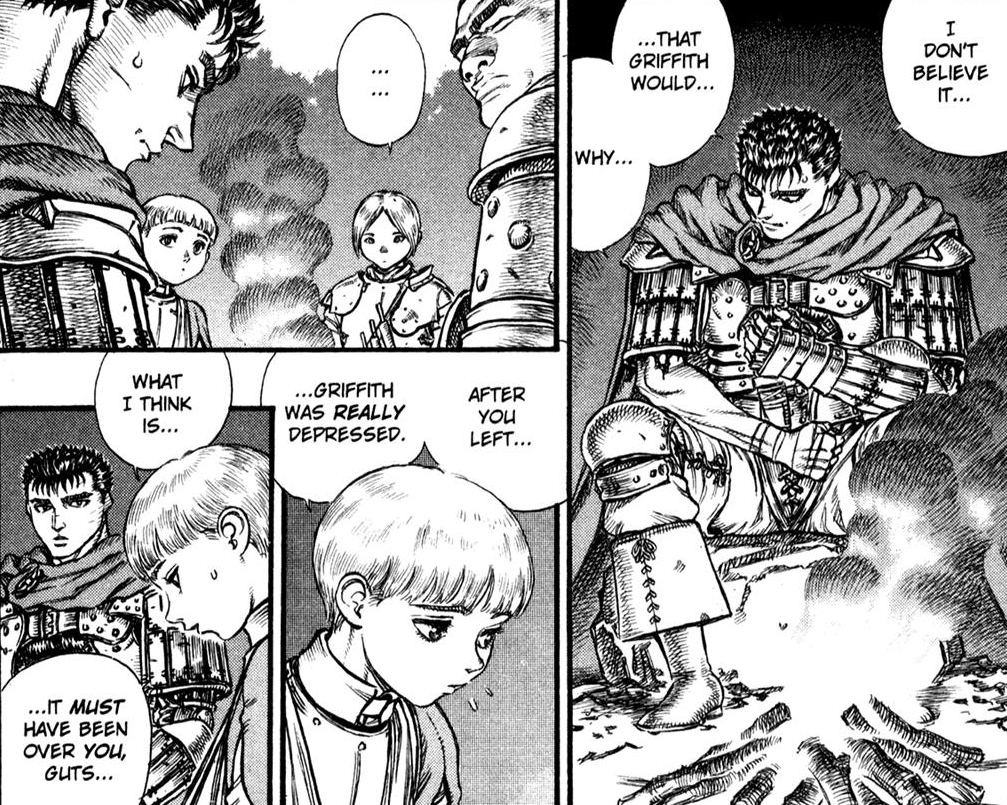


 you're the only one