I think they don’t understand Griffith at all and probably willfully ignore a huge amount of his story.
A god complex is an unshakable belief characterized by consistently inflated feelings of personal ability, privilege, or infallibility.
I mean I’ve talked about my take on Griffith enough that I could collect it all into a book at this point lmao, but in essence no he is full of self loathing and guilt and exists by living in denial and trying to bury it.
He portrays an image of utter confidence and security, maintains it well enough that he buys his own con to an extent, but even that confident self-assured image isn’t god-complexy. His assessment of his own abilities is realistic. He knows he’s good, he has confidence in his abilities, but he also knows when he’s outclassed.
He doesn’t think by default he’s one of the people he believes are fated to change the world, he just hopes he is. He wants to see how far he can go, and not for the sake of being important, but in service to a greater goal which is fueled by disgust at the state of the world and his own sense of guilt.
He doesn’t have a falsely inflated perception of himself, if anything his self-image is much more negative than it should be.
You see any other mercenaries in Berserk who feel guilty for the enemy soldiers their underlings kill?
And like, eg, Griffith feels ashamed about assassinating people while Guts thinks he should be telling the rest of the Hawks all about it and has absolutely zero problem with burning a room full of nobles and royalty alive.
And as Casca lays out here
his confidence isn’t an ingrained personality trait, it’s something he manufactured and wears like armour, which is why sometimes it shatters and reveals the exact opposite – the guilt, the self-loathing, the insecurity – underneath.
Idk it seems like the same type of Berserk fan who calls Griffith a sociopath or a narcissist or a control freak or whatever. Like… no. That’s a wild misreading of his character, and honestly the story isn’t exactly subtle about his giant heap of issues that drive him so idk why so many people refuse to see it.
Like, re-read chapter 17 and this time look at the pictures of him self-harming too, bc that adds a little necessary context to statements like:
Like, this is so far from subtle that people just choose not to understand it lol.
(This isn’t directed at you anon, just yk, the fans you’re talking about.)
There is really something to be said about the significance of physical contact between Guts and Griffith.
Like the fact is that this intense moment of Guts racing for Griffith, wondering what on earth he can possibly do, is a lead-up to a single touch that sends Griffith into despair. This touch is what causes the Eclipse.
A similar physical touch marks the moment Griffith thinks of when he wonders when Guts gained such a strong hold over him:
Their first duel is the only fight either of them ever engage in, as far as I recall, featuring direct physical contact rather than swords (or other weapons) clashing, and moreover, the scene depicts the sense of a gradual physical pull between them. Before the duel, Guts wakes up from a nightmare featuring his childhood trauma, falling into a near panic as he wakes up and feels a body on top of him, until he realizes she’s a woman, not a man.
Touch is highlighted as a concept to take note of here, particularly Guts’ aversion to it.
Guts remembers Griffith as the figure on a horse that he couldn’t reach before collapsing, gazing down at him:
Then they duel. The fight begins at a distance, with swords. Griffith nearly wins without touching him, and again while on a higher plane than Guts bc goddamn Miura gets a lot of mileage out of that imagery:
But then Guts bites Griffith’s sword, they lose those swords, roll down a hill, and Guts just starts punching. We get significant commentary from onlookers highlighting the uniqueness of this fight bringing Griffith down from his heights of untouchability:
As well as from Guts:
Griffith wins with a hold, and finally:
The sequence leads up to this intense moment of physical contact: Griffith pulling him up and gazing into his eyes.
Throughout the Golden Age there aren’t a lot of casual touches between them, but when we do see them touch (pre-torture) it’s usually during a very significant moment.
(Or once, casually, right after Griffith has reminisced about this particular fight:
Not particularly emphasized, but still during a nicely fitting and illustrative moment.)
Griffith remembers another moment of physical contact between them while thinking about how he loses his composure when it comes to Guts:
And this is the scene that leads to the highest point in their relationship, when Griffith admits he had no logical reason to save Guts and Guts dedicates his sword to him in turn. Plus Casca’s outrage also serves to highlight touch as a feature of the closeness of their relationship – and that relationship’s potential to destroy Griffith(’s dream):
And of course, at the climactic moment of the arc as a whole, we get this moment:
Griffith reaches down to pull Guts up to him at the beginning of the first scene we see between them (a contrast to Guts looking up at a distant Femto at the top of the stairs):
We get a nice close up of their handclasp the first time Griffith saves Guts’ life (again, pulling Guts up):
A full page the very last time Griffith saves Guts’ life:
And we get another panel of their hands when Guts lets him go and falls away from him:
Which brings me to the way there is also a particular emphasis given to the lack of
touch between them, compounding the impression that the physicality
between them is significant.
For instance, in contrast to their first fight where they lost their swords, swords – which each represent their respective dreams here – uh… come between them in chapter one, foreshadowing how dreams tear them apart and also highlighting Guts’ more immediate concern that Griffith is growing distant as he gets promoted and draws closer to attaining his dream:
(also i love having an excuse to post those 2 subsequent panels)
Eyes meeting across a vast ballroom and through a window as they smile at each other, after another reminder that Guts is planning to leave very soon:
Guts’ sword falling where we later see Griffith with self-inflicted scratch-marks:
I obviously can’t skip over Griffith thinking about Guts’ departure at the exact moment he
penetrates Charlotte, followed by Charlotte reflected in his frantic
eyes, emphasizing Guts’ absence here in contrast to Charlotte’s presence. All on the same page in 4 subsequent panels. While he’s fucking Charlotte.
Like, this is by far the gayest hetero sex scene I’ve ever seen.
Guts reaching for him fruitlessly here:
Frankly, and not fun but still unfortunately significant to the story, Femto raping Casca while staring at Guts, later compounded by the Beast of
Darkness telling Guts to do the same to get closer to him.
There’s also Femto’s use of telekinesis rather than physical force to keep Guts away from him in the Black Swordsman arc, and the aforementioned staircase of inequality between them.
And of course NeoGriffith’s distance. Both literally:
And symbolically:
Physical touch emphasizes their closeness. It punctuates the strong emotions between them. It pulls Guts up and brings Griffith down until they meet together in the middle, illustrating the fact that their emotions for each other make them equals despite their predetermined + false notions of what equality is.
Again:
It’s highlighted during the moments of their relationship that signify their emotional closeness:
It’s a contrast to the distance which signifies their relationship falling apart:
For instance, Guts holding Griffith throughout like half of the post-torture content shows us that he doesn’t want to leave again long before the story tells us that directly.
Griffith asking for his armour rather than taking off his mask, placing a physical barrier between them, shows us that he wants to keep some emotional distance from Guts, because their closeness is devastating to him. And that foreshadows his choice to sacrifice Guts to escape his vulnerability. His demon form incorporates his mask and, so far, they never touch again.
Basically physical touch is one of the tools Miura uses to illustrate their intense relationship, either through its presence or its pointed, painful absence, and I just wanted to take a moment to illustrate some of that, bc I dig it.
If I was Casca I would’ve just said “he’s leaving because of what you said at the Promrose hall. Goddamn. Now can you two please talk it out because there have obviously been some miscommunication”
Like Casca understands those two perfect and knew why Guts was leaving
When she went to get
Griffith she could’ve literally told him “Guts is leaving. He’s going
because of what you said at the Promrose hall, may be you should pull
him aside and talk to him privately”
Knowing Casca that’s probably something that she did say but Griffith didn’t act upon it because of emotions. Damn emotions
mercenaries gonna mercenary i guess
to be fair I think Casca telling Griffith why Guts wanted to leave would be kind of a betrayal of trust. Guts’ reasons are pretty personal. (ON THE OTHER HAND she had no problem telling Guts all about Griffith’s incredibly personal issues, so lmao that’s kind of an inadequate excuse.)
And tbh I feel like she got Griffith to show up to keep Guts from leaving because she thought they’d be able to talk it out. Honestly I think you’re basically right lol, it’s kind of just plot convenience that she doesn’t tell Griffith why Guts was planning to leave. There’s no real reason for her to hold back.
I definitely don’t think she told Griffith though, based on his inner monologue before the duel and like… idk just from everything I feel I understand about Griffith’s narrative and inner conflicts it makes the most sense for him to take Guts leaving as a rejection. If he knew Guts was leaving because he admired him his reaction would still probably be negative, he might even still just default to challenging Guts to another duel to avoid examining how he actually feels lmao, but I think his thoughts would be very different and I don’t think he’d have a huge breakdown after if that was the case.
Guts, and Griffith, and Judeau, and Pippin, and Corkus:
Because it’s true lol, this is genuinely a conflict they could’ve theoretically fixed by talking it out.
Tho I do think the story really effectively shows us why neither of them are going to talk it out, so it doesn’t feel like… stupidly frustrating the way dumb miscommunication does in fiction. It’s rooted deeply in character – Griffith can’t explain why he needs Guts to stay bc he doesn’t really know, Guts can’t explain why he wants to leave because that defeats the whole purpose, ie:
Like, I’m rearranging my entire life to be your friend based on some weirdly specific criteria you have that I happened to overhear, criteria which explicitly precludes basing your life around another person, so it’s kind of awkward to fully explain.
So even if they did try to talk I could easily see it going nowhere because neither is quite able to explain themselves without additional motivation/understanding/etc. But yk, if they had that motivation and an opportunity to hash it out I could also see them figuring their stuff out, and then their lives would’ve been a lot happier lol.
Like if Casca had resorted to the old “lock them in a room together” sitcom plot lmao.
I think Griffith traumatised himself for losing the duel, so he simply hurt himself on the same place Gut’s sword “hit” him. It’s the pain of losing the battle.
yeah i could also see that as an explanation, and it’s actually what i used to think. like ngl i really like the idea of griffith scratching himself because guts’ sword didn’t even touch him. nicely fits the sexualized scar discussion later on between guts and casca too lol. “I too want a wound that I can say you gave me” js.
these days i’m very solidly on my tombstone of flame related explanation, but yeah yours is also gr8.
Okay, this is totally overkill, I know, but your ask has motivated me to just lay it all out, so ty!
Yeah, I can see why people look at this image and see it as one huge raised scar. It’s fairly ambiguous looking, and it’s the visual interpretation the anime went with, which reinforces this common perception:
But look at this:
You can see when he traces it that the “outline” of that “wound” fits his two fingers exactly. It’s not one scar, it’s two self-inflicted parallel scratch marks.
They’re not in the same place as the river scratches, there are only two instead of four, and they’re also older and therefore either mostly healed scabs or scars which he’s tracing instead of tearing open in that moment, which is why they’re not the same as the bleeding open wounds we see in chapter 17, but they are definitely two separate marks, not the edges of one giant scar.
Tbh I think Miura put them on his shoulder instead of his arms this time mainly for dramatic effect so Griffith is more curled in on himself when he traces them.
imo the movie is closer to the spirit of the manga in making them scratch marks and showing Griffith seemingly tempted to add to them. It’s still a little weird considering their placement further back, and idk what they expected new audiences to think since they cut out every relevant aspect of those marks being there, ie his backstory and the night Guts and Griffith assassinate the Queen and co. But whatever, it’s close enough for me.
And to just briefly explain those scratch marks a bit further, basically, as much as it looks a bit like a big scar in the manga, like you said, it really makes no sense for it to be.
If Guts’ sword had hit him in the second duel he’d either have a gaping wound or a discoloured bruise later that day, not a scar, and if he got it somewhere else that we never get to see then he has absolutely no narrative reason to trace it and cry while thinking about Guts. It would be nonsensical and meaningless for him to trace some random mysterious scar that has no relevance in this highly emotionally charged moment.
On the other hand we know he has a history of self-harming by scratching himself, and we’ve seen him viciously scratch himself under circumstances very similar to Tombstone of Flame Part 2 – the moment Griffith flashed back to just as we see his bare shoulder with those marks on it for the first time in that first image up there: “You believe that, don’t you?”
Griffith has done something he considers “dirty” for the sake of his dream, asks someone else what they think of him (”Am I dirty?” // “Do you think that I’m cruel?”), both Casca and Guts inadvertantly reinforce his belief that he’s dirty/cruel with their responses (”N- why… why were you alone with him before?” and “Ain’t that part of the path to your dream?”), and in the river in front of Casca he self harms while talking himself through the necessity of dirtying himself for his dream, so it feels safe to assume that sometime shortly following his conversation with Guts in Tombstone of Flame he also self harmed while telling himself it’s necessary to be cruel for his dream.
Now that Guts has left in what Griffith believes is a rejection of the “cruelty” and “dirtiness” that he let Guts in to see, he traces those old scratch marks and tries to convince himself again that it’s worth it for his dream. And the point of this moment is that he can’t convince himself this time. Instead he just curls up and sobs, because in the face of Guts’ apparent rejection, it’s not worth it.
Like I said lol, this is overkill as a response to your ask, but like I saw an excuse to explain my take on this moment in its own post, instead of buried in a much longer post, so I took it.
oh and like, the second duel is less guts winning his freedom/equality and more guts demolishing griffith and costing him his freedom, both literally and figuratively
like we knew that already – guts left to establish their equality but it was wrongheaded and when he returned griffith had been tortured for a year was totally dependent and had just had a monologue reflecting on guts’ hold on him – but yk the waterfight is a little extra point now.
ok anime aside, anyone know if there’s any proof that these are guts’ thoughts, like in the original japanese wording or smthn? because they read so griffith to me in phrasing, and also if these are guts’ lines then it kills alot of my sympathy for him lol.
like kinda turns it from guts leaving without a word bc he didn’t think griffith would care, to guts leaving without a word despite knowing he was causing some amount of emotional damage, bc he’s thinking w/e griffith will get over it. like, surprise dude, he did not get over it. or, to be more cutting, he did in fact eventually stand up and start walking, and that was a bad time for everyone.
(on the other hand if i was adapting this and if it is genuinely ambiguous, i’d rly want to have both vas say these lines lol. i mean maybe it’s not completely a bad thing for guts to not be super sympathetic in his choice to leave. understandable, yes, but a mistake is a mistake and if guts gets these lines that’s just kind of underscoring it.)
honestly I never even doubted that these were 100% guts’ words, I mean now that you’re bringing it up I guess maybe they could be griffith’s (the like stumbling on a rock, a small thing part aka him lying to himself about how much it impacts him) but that makes zero sense to me considering in this very moment he’s just sitting there utterly defeated (like… even more so mentally than physically) so him internally monologuing this deeply feels really out of place. (i always considered him so completely shocked there everything else was just static to him. like he hears no sounds. doesn’t even feel the cold. can’t think. it’s just guts walking further and further away booooo) but you’re right about it killing a bit of the guts sympathy tho because yeah, why leave at all if you’re aware you’re already important enough to cause griff at least SOME form of pain. I mean isn’t that what he wanted all along like why willingly walk away if you’re semi-aware you already mean enough to someone to cause them a minor breakdown. (lol understatement of the century but then again guts at this point knew nothing of the true depth of griff’s feelings)
and this brings up another issue, if these are guts thoughts, and we then assume he was aware he was at least ‘a rock on griff’s road’ yet still left, can we then also safely assume that whatever he was aware of that griff felt for him, was not enough for him, like this whole scene always read to me as guts leaving because he wanted MORE (like yeah i know that’s the whole plot but hear me out) and steeling his resolve to go by winning back his freedom because his eventual return as griffith’s equal would magically undo the hurt and anger griff might’ve felt over guts breaking from his hold. like he had to at the very least know damn well that griffith valued him greatly as a captain and treated him different than the rest of the band, casca deadass tells him that and the only thing that stands in the way of him accepting it personally is his inferiority complex or whatever you wanna call it.
I know guts is a self-unaware idiot esp. in the golden age but cmon dude, he saw the way griff was sitting there stunned before him after that strike, he saw how he was completely shocked he’d lost the duel and thus his hold on guts. take into consideration guts’ own represses feelings for griff and you can imagine his heart must’ve ached at seeing griff so completely shook up.
BUT HE STILL WALKS OFF, monologues the above complete bs of an excuse to himself to justify why it is somehow okay for him to leave and become worthy of being griffith’s equal (that in any case, he already more than was but hnngg berserk is not a happy love story unfortunately)
Its actually good if that kills some of the sympathy because yes this is what inevitably kicked off all events that led to the eclipse and yes it was partly guts fault and YES he should feel very fuckin sorry.
and since the whole plot of berserk is in essence based on the weight of choice and how much of it is really your own or set in stone by fate this is a really good example of a really realllly reallllllly bad one with unimaginable consequences.
tldr; those have to be guts’ lines and yes its cool if you resent him alil for them lmao because this page is the arguably the worst moment in the entire manga cause it kicks off the end of all good things era.
It’s funny bc I just assumed they were Griffith’s words when I read it, since I didn’t remember the scene in the anime at all at the time, and imo it feels like something Griffith would think. Tho I do get your point about Griffith being beyond internally monologuing to himself, and idk I’m kind of torn… like I don’t rly disagree, he is absolutely emotionally fucked here lol, but the way I see Griffith, if there’s anything that would be running through his head at this moment it would be, “it’s fine it’s nbd idc at all it’s nothing” all the while kneeling frozen in the snow while the rest of the hawks there shuffle their feet and glance at each other awkwardly.
But I’m like, all about Griffith denying his feelings to himself so it’s an aspect of his character I mmmmay exaggerate a bit lmao.
But yeah wrt it being from Guts’ pov, I agree with everything you said, and like… yeah it rly does work. tbh I don’t think you’re wrong about anything there, there’s a lot of evidence that Guts at least knows Griffith has strong feelings for him and was devastated when he walked away. But omg I just… can’t handle that lmao.
Like, I need to see Guts as completely blinded by his inadequacy issues because otherwise I feel actual anger towards him and honestly I almost never get angry at fictional characters, I’m generally way more detached than that, so this is a very weird feeling lmao.
Like, it really does shift my attitude towards Guts leaving from seeing it as a
very innocent mistake since he never in a million years believed leaving would genuinely hurt griffith, to really actually
assigning him some serious blame bc he knew it would hurt griffith and
the only mistake there was miscalculating how much.
And like, that’s not just low self esteem, that’s callousness, and it’s callousness that resulted in my fave being tortured for a year and then deciding to become a monster so like, i guess that’s probably why it pisses me off lol. fuck you guts.
So tbh I still want to cling to things like Guts’ complete lack of understanding and denial when he comes back, during Casca’s tirade and his chat with Rickert, and in the tunnels on the way to rescue Griffith, etc, as evidence that Guts’ mistake was being genuinely blind to Griffith’s feelings towards him no matter how obvious they are bc of his low self esteem and inadequacy issues, rather than like, knowing Griffith cared to an extent but miscalculating how easily he’d get over it. And like, “this says to me I’m still worth spillin blood over in your eyes,” also kind of makes me hope that he thought Griffith only gaf about him as a soldier.
idk it’s a lot more palatable to me as another mistake in a big pile of golden age mistakes that no one can really be blamed for because they all have serious issues fucking them and their relationships up, alongside things like griffith failing to recognize his feelings and making his speech to charlotte, and casca running to grab griffith to stop guts from leaving, and both of them choosing to fight rather than talk, etc. And idk maybe if I was unbiased it would still feel like another one of those mistakes bc it’s not like Guts’ issues aren’t contributing lol, but idk it feels like Guts walking away goes above and beyond.
And agggh yeah like that moment is given an above and beyond treatment in Guts’ memories and related guilt issues, so that’s still perfectly reasonable… lmao it feels weird to be the one wanting to defend Guts when I was just saying that narratively everything is his fault and tbh I always feel like most of the fandom lets him off the hook way too much lol.
tl;dr I think you’re most likely right but that makes me feel negative feelings :((( and yeah ok those negative feelings fit the story but still :(((
To Griffith, the dream is emotional security. It’s assurance that if he’s dirty, then it’s because it’s necessary to be so, so he can keep winning for the sake of the dead. It’s a way for him to repress his guilt and self loathing, because when he gets that kingdom-shaped seal of approval, it will have been worth it.
So when I say that Griffith’s relationship with Guts is beginning to replace the dream, that’s what I mean – rather than relying on the dream to reassure himself that everything he’s done, even his very existence, is worthwhile, he could rely on Guts for that. He starts opening up to Guts, rather than repressing through his dream.
Despite Griffith’s Promrose Hall speech, nothing actually changes on his end. He prioritizes Guts above the dream again when he sends a search party after him and Casca despite the nobles he’s trying to suck up to telling him he shouldn’t. He drops everything during the Battle of Doldrey to have a quiet panic attack when Guts’ sword breaks. His first reaction upon achieving a huge milestone on the path to his dream when the Band is officially integrated into the royal army is to find Guts and share the moment with him.
And boy I love how the chapter that depicts Griffith’s moment of triumph for his dream ends with Griffith just smiling at Guts across a vast ballroom.
The story between Promrose and the end of the war is filled with little moments that are suggestive of Griffith’s reliance on Guts. Another of my favourites:
I just hope he stays calm and composed.
Casca worried that volunteering to defeat an army of thirty thousand with five thousand men might be an act of recklessness because a predatory pedophile who took advantage of Griffith’s extreme self loathing when he was like fourteen is the leader of that army? Naaaaaah impossible, Griffith would never let that faze him. Oh and speaking of Griffith being calm and composed, this is my last battle, it’s almost time to leave.
But those moments are just for spice. Tombstone of Flame is where the real meat of this analysis is.
This is the second night of assassinations, and it’s a neat mirror to the first. Where Guts came away from Julius’ assassination consumed with inadequacy, self-loathing, and generally feeling like a monster, now it’s Griffith who comes away totally fucked up and filled to the brim with self hatred.
Between Promrose and Tombstone we learn Griffith’s backstory. This adds to the mirror image effect between these assassinations by revealing Griffith’s insecurities to us so we can understand his perspective, and it serves as its own parallel to this scene.
And this is the scene where we see that not only does Guts surpass the dream in importance to Griffith, but he could have potentially become a much more emotionally healthy alternative to it. This is where we see how Griffith could have not just prioritized Guts, but replaced the function of the dream with his relationship with Guts.
And I want to emphasize the emotionally healthier part. One of Berserk’s most consistent themes imo is that relationships with others are a superior way of dealing with your issues compared to dreams and swords.
eg, Godo, our favourite dispenser of wisdom, has some pretty telling lines to that effect.
You
were right beside those irreplacable things… yet you couldn’t bear to
immerse yourself together in sorrow with them. So instead… you ran
away so that your own malice could burn inside you.
Guts’ personal growth post-Eclipse is associated with making friends; his backsliding and mistakes are associated with going off on his own to fight monsters; he begins to overcome his revulsion to touch when he becomes part of the Hawks;
on the rooftop after the Zodd conversation Guts recalled the night he killed Gambino and wondered if this was the answer he’d been searching for since then (family) before dedicating his sword to Griffith; part of his healing process for his childhood trauma is talking about it to Casca; etc. And Guts and Griffith’s relationship is very much included, even though it’s far more of a tragic missed opportunity.
The second half of Tombstone of Flame Part 2, aka my favourite chapter of Berserk, abruptly shifts tone from triumph and pure badassery to quiet, contemplative vulnerability halfway through. As a chapter I feel like it really encompasses the highs and lows of Griffith’s character, from defeating his enemies and cooly predicting Foss’ actions to wrap everything up in a neat little bow, to highlighting his guilt, self-loathing, and emotional dependency on Guts.
Here, Griffith opens up to Guts in an intensely vulnerable moment.
I involved you in this filthy scheme… and I didn’t even get my hands dirty. I left all the dangerous, taxing work to you…
Idiot! What kinda question’s that for the guy who killed a hundred men?
This is another scene the significance of which cannot be overstated. There’s so much to unpack here I hardly know where to start. Like… this is the moment. This is what Griffith flashes back to when he’s fucking Charlotte and burning his life down around him. This is a moment Guts remembers when slowly realizing that Griffith loves him. This is exactly what the Godhand shows Griffith to get him to agree to make the sacrifice. Guts remembers this after Griffith makes the sacrifice. This moment is the linchpin of Berserk.
This is both a mirror to Guts overhearing the Promrose Hall speech, and a call-back to Griffith in the river after Gennon.
So first, the set-up of this chapter recalls Promrose Hall strongly. It’s the second night of assassinations, Promrose Hall took place on the first night. When Guts assassinated Julius he came away from that encounter wracked with guilt over accidentally killing Adonis as well, strongly and traumatically reminded of his childhood, and basically thinking of himself as a monster in a way inseparable from his own childhood trauma:
Guts is consumed with self-loathing, comparing himself to monsters like Zodd overtly, and like Donovan symbolically. He’s also reminded of killing Gambino, like, basically this event just brings a pile of old issues crashing down on Guts’ head.
In a concussed daze he wants nothing but to find Griffith, presumably for reassurance. I don’t want to get too heavily into Guts’ side of things here, but remember that this is shortly after he dedicated himself to Griffith when Griffith told him he risked his life for him for no reason. I think it’s safe to say that he wants that reassurance again, he wants to feel the same sense of being valued and respected that he got during that staircase conversation.
And instead he overhears Griffith telling Charlotte that he has no friends. More to the point, what he gets is Griffith’s dream blocking the emotional bridge that Guts is trying to cross like a damn troll.
In Tombstone, Guts and Griffith assassinate the Queen and this time it’s Griffith who turns to Guts for emotional reassurance in a moment of vulnerability.
The way killing Adonis reminds Guts of his many, many issues is echoed in the strong parallel between Tombstone and Griffith in the river. We don’t get to see what’s going through Griffith’s head the way we see into Guts’, but we can infer an awful lot based on this comparison.
In the river, Griffith asked someone for reassurance after doing something he considers shameful for the sake of his dream.
Casca’s response isn’t all that reassuring.
She cuts herself off in the process of automatically reassuring him and instead she asks why he was with Gennon. This is totally understandable and not at all something I blame Casca for lol. She’s a kid, she’s understandably disgusted at the thought of Griffith having sex with Gennon willingly knowing that he’s a pedophile, and she’s out of her depth in a highly charged, difficult discussion. But that doesn’t change the fact that Griffith probably took her answer as a “yes.”
Griffith then goes into his self-harming dream spiel, as he reiterates to himself exactly why it was worth it to dirty himself for his dream while tearing open his arms. What may have been his first attempt to open up to someone else in a moment of extreme emotional vulnerability was shut down, inadvertently, so he violently returns to his original justification and defense measure, his dream.
The saddest thing about Tombstone, to me, is that this time Guts brings up the dream for him.
Ain’t this part of the path to your dream? You believe that, don’t you?
Guts’ answer is a depressing double-whammy of both implicitly agreeing that Griffith is cruel, and reminding him that the cruelty is necessary to achieve his goals. This second time we see Griffith try to open up to someone is also shut down, inadvertently, and the fact that Guts is the one to bring up his dream this time rather than Griffith tells us that the dream wasn’t even on his mind. Guts’ answer comes as a very painful reminder.
Like, imo this is huge. In the first part of this meta I tried to show how wholly reliant Griffith is on his dream. It’s what he clings to as his shield against his intense self-loathing and guilt. It’s a way for him to tell himself that everything awful and dirty that he’s done was worth it, and that one day he’ll be able to prove that.
Well this moment shows Griffith forgetting all that in the face of Guts’ potential acceptance, until Guts reminds him and his self loathing comes crashing down on him all at once.
If his dream was what he turned to for validation from fate or some higher power, then now Guts is who he turns to for validation. He needs Guts’ reassurance that he isn’t cruel. He needs Guts to see his “dirty side” and continue to remain by his side – that is all the validation he needs now. Not fate, not a kingdom, just love.
The same way the only thing Guts needed in order to feel like he was where he belonged wasn’t his own dream, but the knowledge that Griffith loved him, the knowledge that he had after their staircase conversation about Zodd, and which dissolved after Promrose.
But instead Guts, with Griffith’s dream on his mind getting in between them again, says the wrong thing and Griffith looks the exact same way he looked when he felt like he was responsible for a kid’s death.
So, to sum up, Griffith feels self-loathing, tries to open up to other people to assuage his sense of self-loathing in the hope that, having seen him at his worst, they don’t see him as filthy/cruel the way he sees himself, and each time his self loathing is only reinforced. The first time he clings to his dream in lieu of Casca’s reassurance, while the second time Guts is the one who brings up his dream, in so many words pushing Griffith away and telling him to cling to the dream instead of him.
Each time the dream serves as a replacement for real human connection and love.
The first time Griffith was able to close himself off, place a hand on her shoulder, and tell Casca, “it’s nothing,” when he realized how emotionally vulnerable he was in that moment. But when it comes to Guts, he’s much too far gone to separate himself and play the perfect leader.
Now, as opposed to putting the mask of perfection on and saying, “it’s nothing,” with Guts he says:
Unlike Promrose Hall, Guts putting the dream in between him and Griffith and thwarting Griffith’s efforts to open up to him and take comfort in his potential reassurance doesn’t immediately ruin their relationship. I’d say that Griffith is very accustomed to seeing himself as a monster by now, so while Guts’ implicit confirmation of that fact is incredibly fucking depressing considering what could have been, it’s nothing Griffith didn’t expect to hear.
Guts remains the man allowed to see behind the mask and into the real him.
And then there’s this contrast:
This is depicted as a cute moment, but it’s also indicative of how utterly weak and emotionally vulnerable Griffith is now that he’s let Guts in. With Casca he was still able to step back and remove himself, put the mask back on, and be the one to comfort her despite clearly needing it more.
Now Guts is the one to put his hand on Griffith’s shoulder. It’s not depicted as a hugely significant and character revealing action the way this moment in the river is, but it’s a perfect illustration of what Griffith finally realizes after it’s too late:
And it’s exactly the moment Miura uses to show us how emotionally vulnerable Griffith has become to Guts. Griffith couldn’t separate himself when he tried, and now he doesn’t try, he just accepts Guts’ assessment that his cruelty is necessary with a sad smile, and intends to continue on with Guts at his side.
Finally, there’s seemingly one thing missing from this comparison between Griffith in the river and Griffith in Tombstone of Flame: the self harm.
But, well, it’s not actually missing, we just don’t get to see it until a month later:
And the reason we’re not shown Griffith’s self-harm scratches*** until this scene is because it’s actually another big contrast between Griffith’s reaction to Casca and his reaction to Guts.
Presumably, based on the other parallels I drew between Tombstone and Casca’s flashback, and based on the placement of these panels – Griffith’s memory of Guts reminding him about his dream and questioning Griffith’s resolve followed immediately by our first glimpse of those scratch marks on Griffith’s shoulder – Griffith self-harmed at some point closely following the assassinations.
One can imagine it following exactly the same pattern we saw with Casca: Griffith asks someone if they think he’s X thing he hates about himself, doesn’t hear a no, and then some time following he reinforces his resolve, tells himself that it’s ok, it’s necessary for him to do these dirty, cruel things for the sake of achieving his all-important dream, for the sake of the people who have given their lives for it, for the sake of making their sacrifices meaningful, etc, while self-harming. Just like he did in the river.
The contrast comes now, after Guts has left.
Griffith could probably convince himself after Tombstone that the things he does for the sake of his dream are necessary and important and it’s worth becoming a monster to achieve his goal. “You believe that, don’t you?” Guts had to remind him, but Griffith agrees. “You’re right.”
But after Guts leaves him?
When Guts leaves, Griffith takes it as a rejection. Those little moments that by themselves never ruined their relationship or amounted to more than mild rebuffs have probably turned into wholesale condemnations in Griffith’s mind. Guts saying, “just order me to do it,” goes from a mild reminder that they don’t have an equal relationship to, “I won’t dirty myself voluntarily, but I’ll do it if you order me to because that’s my job.” Guts saying, “ain’t this part of the path to your dream?” turns into, “your dream is paved with cruelty and I’m sick of being dragged through the dirt with you.”
Griffith winning Guts’ loyalty in a fight turns into Guts being forced to associate with him, and leaving as soon as he’s accomplished what he thinks Griffith wanted him for, thereby fulfilling his end of the bargain.
The moment Griffith is remembering here is our first glimpse of them together. “It’s funny… you’re the first person I’ve ever spoken to like this.” It’s a memory of Griffith choosing to open up to someone and share his innermost thoughts for the very first time. And he’s convincing himself that Guts was disgusted by him from the very first glimpse he got of the Griffith underneath the perfect image, and wanted to escape him since the beginning.
Ironically, we know exactly how Guts felt in this moment: “At that time he shone before me as something beautiful, noble, and larger than life.” It makes the choice of this particular memory all the more painful.
The other thing this particular memory signifies is Griffith’s driving motivation behind his dream. This is the scene where he tells Guts all about his belief in fate and his desire to know what he’s destined for – it’s our first indication of what Griffith’s dream means to him. It’s a contrast: Griffith then, just beginning to open up to Guts and explaining the pragmatic philosophy behind his dream, and Griffith now, falling to pieces because he believes Guts is rejecting him.
In other words, Griffith then, reliant on his dream, vs Griffith now, reliant on Guts.
The very fact that Griffith is the one challenging him, refusing to let Guts go without a fight demonstrates how far the dream is from Griffith’s mind. Remember how important it is for the Hawks to choose to follow him? How even when Guts first joined, the duel and the stakes were chosen entirely by Guts and Griffith just went along with it? Now that’s not even a factor. The feelings of guilt lying just below Griffith’s surface don’t matter at all in the face of Guts leaving. Griffith is now so far beyond distancing himself from Guts with reminders that he may die for his dream that he’s willing to risk killing him directly, in an irrational attempt to negate Guts’ rejection.
“I guess it’s because they themselves chose to fight,” is a careful rationalization, and Griffith is no longer anywhere close to capable of rationalization in this moment. This is what happens when the emotions he buries and spends his life denying burst to the surface. Despite being more emotionally open with him than he’s ever been with anyone before, he’s never put a label on his feelings for Guts and never even identified them to himself. He asks Guts, “do I need a reason each time I put myself in harm’s way for your sake?” he tells Guts, “it’s for those reasons that I’m asking you to do this,” he tells Guts, “you’re rough enough to share this with. To the end,” he tells Guts, “you’re the first person I’ve ever spoken to like this,” but he never tells Guts that he cares for him, prioritizes him, trusts him, loves him, and I don’t think he’s ever told himself either.
Having ignored and rationalized away his emotions for most of his life, now he’s finally run out of logic and rationalizations. He has no experience dealing with feelings like this because he lives in denial of them; I genuinely don’t think he himself understands what he’s feeling or why as Guts announces that he’s leaving, so he ends up lashing out through an established framework that he does understand, that Guts himself once suggested as a way to win his loyalty, that, might I point out, Judeau, Corkus, and Pippin all think is reasonable, and Guts is reassured by lol.
Griffith won Guts in a fight, so Griffith will keep Guts through another fight, because he can’t bear the thought of Guts rejecting him.
Which brings me back to the scratch marks on his shoulder.
He remembers the moment Guts implicitly agreed that Griffith is cruel and called his resolve into question. “You believe that, don’t you?”
A month earlier his answer was yes. He scratched himself and told himself that everything was necessary for the sake of his dream.
Here’s his answer now:
No.
He doesn’t scratch himself – he traces the marks, trying to remind himself that yes, it’s worth becoming a monster for the sake of his dream, even if it drove Guts away… but it isn’t. Now instead of self-harming he curls up and cries. No blood this time, just tears.
Griffith scratching himself is tied to affirming his dream and repressing his feelings of self-loathing, and the pointed absence of scratching here tells us that he can no longer affirm his dream or repress his self-loathing. It’s not worth dirtying himself for, it’s not worth the deaths on his head, it’s not worth becoming a monster, because that, he believes, is why Guts left, and nothing was worth losing Guts, not even his dream.
This whole sequence with Charlotte*** is Griffith’s attempt to fall back on his dream after losing Guts. Charlotte represents his dream perfectly – Judeau even reminds the audience of that fact in the chapter preceding the second duel (chapter 34). The key to his dream is Charlotte, and Griffith showing up at her window is an irrational attempt to attain his dream now, no matter how premature it is, because he is in dire need of the emotional reassurance his dream provides him.
Guts is gone, seemingly having rejected him, and Griffith retreats to his dream the way it’s always been a defense against his self-loathing and a way of repressing his emotions.
Take all the frightening and sad things… and cast them into the fire.
But again, it doesn’t work this time – it’s not enough to cope with the loss of Guts.
I think there is also a strong component of self-destruction here. Griffith knows how risky sleeping with Charlotte is, she even points it out while he’s standing in a tree outside her window. The King alludes to Griffith “destroying himself,” as well, and everyone and their horse except Corkus, stubbornly, connects Griffith’s meltdown after Guts left to the way he and the Hawks are declared traitors the next morning. It may not be a planned suicide, but it’s an act of self-immolation just the same, and something Griffith did knowing the risks full-well.
It’s no surprise when he lands himself in a dungeon.
Oh this chapter. This chapter this chapter this chapter. I’ll admit, it’s been giving me some trouble, not because it doesn’t fit with my point, but because it fits too well lol. I debated for a long time whether I’d try really delving into it or whether I’d omit some stuff and just like, ignore the fact that I genuinely believe this is the meaning behind it.
But lbr I’m taking the first option, as hard as it’s been to find a way to talk about this shit that doesn’t like… give entirely the wrong impression, because it’s basically the capstone to this part of Griffith’s character arc, and therefore this part of this meta, and it encapsulates everything about Griffith’s self-loathing perfectly.
Everything he calls the King out on is something he hates about himself.
You’ve lived on by resigning yourself to the monster [war] you envision. But you’ve by no means tried to harness that monster.
The second part is fairly obvious. The King was born to the throne and didn’t even bother to use his power for anything worthwhile. Griffith wasn’t born into that power but he spent his life trying to attain it, and just as he was about to succeed he threw it away, ultimately accomplishing nothing. “This is… worthless.”
The first part, the mockery of the King’s feelings for Charlotte, was the part that tripped me up for a while, because frankly, it’s such a parallel to Griffith’s feelings for Guts, to the point where when I tried to write this section while ignoring it it felt like a really glaring omission, but oh man, let’s be real here, it’s unpleasant as fuck.
I’m choosing to give Miura the benefit of the doubt because while I don’t think he’s above comparing gay pining to incestuous rape, I do think, as I’ve said, that this scene is about Griffith’s self loathing, and Griffith considering his own feelings to be just as pathetic and grotesque as the King’s lust for his daughter makes a depressing kind of sense to me.
First I want to explain why this parallel is so clear to me because I’d hate to look like I’m making this up. First of all, once we’re agreed that the King bemoaning the weight of lives on his shoulders and assuming Griffith has no idea what that’s like, and getting a very knowing look from Griffith in response, is as clear a parallel as you get, I feel like it’s impossible to ignore how neatly obsessive love for someone fits in as well.
Griffith’s feelings for Guts have been defined by giving himself in exchange for him, risking his life and his dream/kingdom for him, as Casca points out at every possible opportunity. And now he finally has given up a kingdom for him – or at least, because of him.***
We know why Griffith is in that dungeon. Griffith knows why he’s in that dungeon. (“He was the reason I’ve been thrown into this darkness”) Casca knows why he’s in that dungeon. (“Because you left us! Because you abandoned Griffith!”) Rickert, a little kid, knows why he’s in that dungeon. (“What I think is… it must’ve been over you, Guts.”) Eventually even Guts gets a clue. (“Was I the one who brought all thisupon you?”)
Like, just to reiterate the main point of this meta, Griffith’s narrative so far is about becoming emotionally reliant on Guts as a defense against the weight of death on his shoulders, instead of the dream which had been his defense until Guts. This scene is about the King’s emotional reliance on Charlotte as a defense against the weight of death on his shoulders instead of using the “sword called the throne” to defend himself against that weight by doing something worthwhile with it – something to justify what the King’s subjects have been dying for.
And it’s no coincidence that the throne is described as a sword.
In Berserk, swords are coping mechanisms. Griffith is mocking the King for his emotional dependence on someone else to shield his heart rather than using his “sword” for that purpose, which is, of course, exactly what led to Griffith ending up in a dungeon.
The King goes on this diatribe:
I would give myself… even this kingdom in exchange for her! She’s my whole life!
What value is there in this world? Wars rage on and the people’s lives are lost like they were insects! After how many decades of war and how many tens of thousands of corpses, we’ve finally built a time of remembered peace, but it’s only for an instant! On the underside, the monster named war is always seeking new blood, starting to brew itself anew! In the face of that monster, the will of one land’s king is powerless! The wisdom of one man is folly! And yet I cannot cease being king! There’s no way I can stop! In this… blood stained, meaningless world… if there is one single ray of hope to be found… it is… warmth. Only warmth covers and protects me from this world.
You’ve taken that one flower that gives me that warmth… and plucked it! Unforgiveable!
Alas, my poor Charlotte. I’ve brought her up for seventeen years. She knowing no impurity… now that she’s given herself up to the sport of a commoner… I’d rather that… rather that…
Directly from the King lamenting that monster called war and the lives lost to it, to declaring Charlotte his one defense against the world. His one means of protection from the weight of “the lives of all the people, all on [his] shoulders.”
Again, Guts was becoming Griffith’s defense against his feelings of guilt. A large portion of Griffith’s story revolves around how his relationship with Guts is in part a coping mechanism, a defense against self-loathing.
And not in a negative way – remember, compared to dreams and swords as coping mechanisms, finding emotional support in a connection with someone else is by far the superior option, according to Berserk as a whole.
Griffith’s expression of his feelings for Guts wasn’t altogether healthy, because Griffith is not altogether emotionally healthy lol. He’s an extremely repressed guilt-ridden obsessive dude who self harms and thinks achieving an arbitrary goal will justify his existence, and who fell in love, had no way to understand those feelings, and became very emotionally dependent without even noticing.
Hence freaking the fuck out, challenging Guts to a duel and thinking as he strikes that he’d rather kill him than let Guts reject him. But despite that, overall, we’re shown that Griffith’s feelings for and relationship with Guts could’ve helped him grow as a person, had their relationship been given a chance to flourish without misunderstandings getting in the way.
I’m pointing all this out because I’m trying very hard to avoid coming across like I’m saying that Griffith’s relationship with Guts is at all equivalent to the King’s relationship to his daughter.
Griffith and Guts’ relationship falls apart because of a failure to communicate and because neither realize that their feelings are mutual. Griffith believes that Guts is rejecting him when he leaves, but we the readers know that in reality Guts is leaving entirely because he loves Griffith and wants to be worthy of his friendship.
I believe that the parallel here between Griffith and Guts and the King and Charlotte is so utterly loathsome because it reflects how Griffith feels about himself, not because it’s anything close to an objective parallel or a commentary on relying on relationships with other people as a means of emotional support.
The King is nothing more than a lonely, miserable man who can’t find any reason to live beyond the one person he loves, while Griffith threw his life away over Guts’ perceived rejection, and he knows it. As much as he represses, he can’t deny this – when he curls up and weeps beside Charlotte, that’s Griffith failing to deny his feelings for Guts, and he later describes him as the reason he’s been thrown into the darkness of the torture chamber, and the sole sustenance keeping him alive. Griffith is realizing that somewhere down the line his life had switched from revolving around the dream to revolving around Guts, and he thinks it’s pathetic.
The distinction Griffith makes between the King wanting Charlotte to have him rather than having Charlotte is relevant too. I used to take this line as little more than Miura feeling like he needed to justify why the King eventually flees instead of continuing his sexual assault attempt – ie because Charlotte’s rejection was too much to bear – but it works within the framework of Griffith’s feelings for Guts very well, particularly in light of the second duel.
I mean
And again like, ngl I hate to do this lol, like I said I’m not thrilled by this parallel, but fuck, it works perfectly and I do think it’s deliberate:
The King attacking Charlotte is a parallel to Griffith challenging Guts to the second duel. In a way. Again, not an objective way, not in a way that’s truly comparable – hell, we get Guts’ inner monologue and he’s literally comforted by Griffith’s challenge while Judeau and co think it’s perfectly reasonable as former mercenaries – but within Griffith’s self-loathing mindset where he sees himself as a rejected monster, he sees himself in the King and his fucked up attraction to Charlotte. The King’s subsequent attack and “rejection” by Charlotte mirrors Griffith’s perception of attacking Guts and then being left, rejected, in the snow.
Griffith makes the distinction between having and wanting to be had because everything about his own breakdown revolves around Guts’ perceived rejection of him. Griffith thinks Guts sees him as a monster, and, through their duel, from Griffith’s perspective, Griffith was trying to keep Guts with him despite that rejection, against Guts’ will. In hindsight, removed from the heightened emotions of the moment, he believes his actions to be as pathetic as the King’s lust for Charlotte. He tried to “have” Guts against his will, when what he wanted was to be “had” by him – wanted by him, loved by him, accepted by him. He wanted Guts to want to stay with him, not to be forced to stay.
And of course, the supreme irony is that Guts did love Griffith, and that’s exactly why Guts was leaving. He wanted Griffith to want him, he just didn’t recognize Griffith’s irrational actions as a show of desperate need until it was too late. This is directly stated in the text several times, so I’m not going to try to justify this statement through a big tangent about Guts’ decision to leave. Here’s one of the most self-explanatory moments where Miura tells us what happened from Guts’ perspective:
So, again, the King attacking Charlotte is not an actual objective parallel; it’s a parallel when filtered through Griffith’s false framing of what happened between him and Guts as a vicious rejection, which makes sense because Griffith is the one bringing it all up and condemning both the King and himself.
At the end of the day I don’t particularly care whether “If I can’t have him, I don’t care,” is taken as a super dark moment or barely a drop in the pond when it comes to dark things people do in Berserk. Judge Griffith harshly for it or go ‘meh people try to kill each other in Berserk all the time, he wasn’t even trying so much as accepting the possibility,’ I just want to draw a clear distinction between that and a father trying to rape his daughter, which I think is fair.
And now the King’s final condescending judgement.
“Such a worthless matter.” We know what that worthless matter is. The King thinks it was lust for Charlotte that landed him there, but we (and half the cast of Berserk, vocally) know that it was his feelings for Guts.
And on the very next page we transition to the King’s assault of Charlotte. The King is doing some projecting himself here – he mocks Griffith for destroying himself over lust for Charlotte (Guts) which is what the King immediately proceeds to do. This attempted rape decimates him as a person; the next time we see him he looks like he’s aged thirty years, and he’s growing senile – just as Griffith is tortured to irreversible physical damage after Guts’ rejection.
After Charlotte wakes up and screams a horrified no, we return to Griffith for the last page of the chapter:
Charlotte’s assault is perfectly bookended by Griffith in the dungeon, and the repetition of “worthless,” a word used three times in this chapter.
The first time it refers overtly to the King not utilizing his power to justify his existence and assuage the guilt on his shoulders, instead comforting himself with Charlotte, with the implication that this is how Griffith feels having thrown away his dream over Guts.
The second time the King uses it to refer to the matter that Griffith destroyed himself over, ie stupid, impulsive actions based on feelings for another person. The King thinks it’s Charlotte, but we know it’s Guts.
The third time is how Griffith feels about himself, a final conclusive statement after his mockery of the King’s feelings for Charlotte, the King’s accidental mockery of his feelings for Guts, and Charlotte’s assault. The way this chapter is structured essentially tells us that the attempted rape scene applies in some way to Griffith’s final declaration of his own worthlessness, and hopefully I’ve made a convincing case for how it’s an illustration of his self-loathing regarding his feelings for Guts.
Griffith, thrown into the darkness of the dungeon, may as well have been plunged into his own self-loathing. “Worthless.”
SO! What’s left? The torturer rips off Griffith’s behelit a short while later, nicely symbolic of the lost dream. A year passes. Guts returns. And Casca neatly condenses this enormous meta into the four sentences I stole for titles and writes the conclusion to this section for me:
Griffith had to make himself strong – remember, that refers to the way he represses his emotions and projects his image of perfection, the way he smiled at Casca and put his hand on her shoulder after violently self harming.
Guts made Griffith weak because Griffith was starting to open up to him rather than repressing those emotions and relying solely on his dream to defend against everything that haunts him. Do I need a reason? It’s for those reasons that I’m asking you to do this. Do you think that I’m cruel?
After being rejected by Guts and believing that Guts sees him as a monster, the promise of his dream was no longer enough for him to rely on, and he crashed and burned in an implosion of self-loathing and feelings of worthlessness.
Griffith’s no good without Guts anymore because his feelings for Guts made him weak. He came to rely on Guts to sustain his heart, because people need other people, and Guts was the person Griffith needed.
Wish Casca could’ve written this whole thing for me, it would’ve been a lot shorter and neater lbr.
That’s the end of Part Three. The next and final part is going to explore how Guts growing more vital to Griffith than the dream leads, contrary to expectations, to Griffith sacrificing Guts for his dream.
*** There is a common misconception that this is one big, thick scar rather than scratch marks, probably thanks to the anime depicting it as such, but frankly, the anime got it wrong. There is zero reason for Griffith to have a scar there, and it would have no significance – Guts’ sword didn’t touch him, and if it had he’d have either a bruise or a gaping wound lol, not a scar. They are two parallel lines that you can see Griffith trace with two fingers right as he starts crying, and since we already know Griffith has a tendency to scratch himself, this leaves no doubt to me that they are two scratch marks, not one big mark of unknown origin.
*** I think the scene with Charlotte is deeply flawed, and I’m treating it as consensual sex in this analysis because I believe that’s what Miura intended it to be read as, despite shitty, misogynist, tropey writing. More on that here, if you’d like a further explanation.
*** I remember an old conversation I had with I think @yesgabsstuff and @mastermistressofdesire where one of you suggested that Griffith burning his life down by fucking Charlotte could be interpreted as a childish act of bargaining, at least subconsciously. Griffith trying to trade his dream for Guts. And I’m js, that rang true to me and this comparison made me remember it.
Yeah, I’d say whether Femto is a different person from Griffith comes down to semantics and what someone considers personhood, but to me undergoing a magical transformation that augments the “evil” in your heart (which, in Berserk, exists in the hearts of all people) and removes the “goodness” or w/e, as visually depicted by literally losing fragments of himself:
makes you different enough that I have no problem mentally separating human Griffith and Femto, and definitely don’t hate Griffith for Femto’s actions, same way I don’t hate Guts for trying to murder his friends when the armour takes over.
If you (general you) wanna hate Griffith for agreeing to sacrifice his friends, or challenging Guts when he left, or w/e, I’ll disagree but I think that’s fair game. But hating him for Femto’s actions after we’re taken step by step through his magical transformation into an entity made out of evil really doesn’t make sense to me.
Also, do you mean Griffith would’ve taken Guts back if he’d returned, say, a year after the duel, like in canon, but Griffith hadn’t gotten caught fucking Charlotte and therefore hadn’t spent that year in a dungeon?
I think Griffith probably would take him back, because he’s desperate and needy and irrational and in love, but I could see an argument where the duel is a big wake-up call to how emotionally compromised he is by his love for Guts, which could make him view Guts as a huge threat lol, and he might refuse to let him return to try to protect himself from his own destructive, dream-endangering feelings.
Though I think it’s also likely that Griffith isn’t that self aware even after the duel, and would still manage to deny his feelings. Like Guts would come back and Griffith would somehow logic himself into returning to their close relationship without admitting to himself that he just really needs Guts in his life. Like, “it’s not because I desperately want him back at my side, it’s because he knows I assassinated the queen and co and therefore I need him as my ally and not my enemy.” Or something along those lines. Though of course his feelings would be that much harder to deny now, and eventually something would have to give.
Or he could be aware of his feelings now, but too far gone to refuse Guts, a la “if I can’t have him, I don’t care!” Like, “ok Guts’ existence could clearly ruin me, but fuck it, he came back and I’ll be damned if I’m letting him leave me again ever.” Which would open its own associated emotional can of worms lol.
lol sorry I love thinking about Griffith’s stupid feelings and how he deals or doesn’t deal with them.
(And now I’m wondering what if Guts turned around and walked back two minutes after leaving Griffith in the snow. I feel like if that was the case Griffith would be incapable of anything but genuine emotional expression, either in the form of being overwhelmed with relief that Guts came back and immediately taking him back, or rage followed by a sobbing breakdown or smthn.
This is a great topic to muse on lol)
I wonder if, if Guts turned around and walked back, if Griffith would be too vulnerable for relief/rage? Like, Guts just almost left, and Griffith made a fool out of himself by completely letting his emotions get the best of him. I feel like anger, pride, and just plain exhaustion might stop him from acting up again, although … they also might not, damn, I don’t think we can know for sure.
Idk the way he falls to the snow and stares into space, unable to even pretend he’s okay for the Hawks who are just standing there awkwardly, personally has me thinking it’s a v rare moment where he’s not capable of self-control. I’d give it maybe a few minutes before he smiles, stands up, and pretends “it’s nothing,” but if Guts caught him before that point I think his reaction would be raw af.
though there’s def some wishful thinking here because it’s a reaction I’d love to see even if I don’t think I can completely picture it.
If Guts caught him after he put the mask on again I think his reaction could be very different. Maybe angry and prideful, maybe something like, “you won your freedom, so gtfo,” something indicating an “i don’t want your pity” kinda feeling, idk. but i’m just throwing headcanons at the wall lol, like I could see a lot of different reactions as ic depending on how it’s depicted.
Yeah, I’d say whether Femto is a different person from Griffith comes down to semantics and what someone considers personhood, but to me undergoing a magical transformation that augments the “evil” in your heart (which, in Berserk, exists in the hearts of all people) and removes the “goodness” or w/e, as visually depicted by literally losing fragments of himself:
makes you different enough that I have no problem mentally separating human Griffith and Femto, and definitely don’t hate Griffith for Femto’s actions, same way I don’t hate Guts for trying to murder his friends when the armour takes over.
If you (general you) wanna hate Griffith for agreeing to sacrifice his friends, or challenging Guts when he left, or w/e, I’ll disagree but I think that’s fair game. But hating him for Femto’s actions after we’re taken step by step through his magical transformation into an entity made out of evil really doesn’t make sense to me.
Also, do you mean Griffith would’ve taken Guts back if he’d returned, say, a year after the duel, like in canon, but Griffith hadn’t gotten caught fucking Charlotte and therefore hadn’t spent that year in a dungeon?
I think Griffith probably would take him back, because he’s desperate and needy and irrational and in love, but I could see an argument where the duel is a big wake-up call to how emotionally compromised he is by his love for Guts, which could make him view Guts as a huge threat lol, and he might refuse to let him return to try to protect himself from his own destructive, dream-endangering feelings.
Though I think it’s also likely that Griffith isn’t that self aware even after the duel, and would still manage to deny his feelings. Like Guts would come back and Griffith would somehow logic himself into returning to their close relationship without admitting to himself that he just really needs Guts in his life. Like, “it’s not because I desperately want him back at my side, it’s because he knows I assassinated the queen and co and therefore I need him as my ally and not my enemy.” Or something along those lines. Though of course his feelings would be that much harder to deny now, and eventually something would have to give.
Or he could be aware of his feelings now, but too far gone to refuse Guts, a la “if I can’t have him, I don’t care!” Like, “ok Guts’ existence could clearly ruin me, but fuck it, he came back and I’ll be damned if I’m letting him leave me again ever.” Which would open its own associated emotional can of worms lol.
lol sorry I love thinking about Griffith’s stupid feelings and how he deals or doesn’t deal with them.
(And now I’m wondering what if Guts turned around and walked back two minutes after leaving Griffith in the snow. I feel like if that was the case Griffith would be incapable of anything but genuine emotional expression, either in the form of being overwhelmed with relief that Guts came back and immediately taking him back, or rage followed by a sobbing breakdown or smthn.
This is a great topic to muse on lol)
the fact that he’s remembering the very first moment we saw them together when we know guts thought of him as “beautiful, noble, and larger than life,” where griffith said, “i’ve never spoken to anyone like this,” is killer tbh. thinking about that early moment of vulnerability, wondering if guts has been hating/resenting him all this time.
2/2 So I’m a bit puzzled and I am wondering about your
interpretation, if you’ve already written a meta about that scene. What I
think is that Guts definitely sees Griffith romantically so he was
doubly heartbroken after hearing that he doesn’t see him as a friend or
equal, so he wanted to leave in order to make him care about him
seriously. But Griffith already loves Guts and respects him, so his
speech is a bit contradictory. Sorry for the long ask btw I love your
blog 🙂
Hi there 🙂 Yk, I don’t think I actually have really talked about this scene in much depth.
My general default reading of Guts and Griffith’s relationship is that they are both romantically in love with each other but neither of them actually realize that they are. (Well, I don’t think Guts has ever quite realized it, at least not consciously, but I do think that Griffith figured it out during his year of torture.)
So in my opinion, Griffith meant his friendship speech.
I also don’t think it’s a coincidence that the conversation that comes right before the assassination attempt and then Griffith’s speech in the narrative included this exchange:
Griffith asking Guts to assassinate Julius was, in a way, a gesture of friendship. It was a request for Guts to do this for him, as a favour for a friend rather than an order from a superior, and Guts picked up on Griffith’s careful phrasing and accidentally rebuffed him. I think Guts meant this as a lighthearted joke, but while we don’t get to see Griffith’s reaction to it, I’m willing to bet he took it as a rejection.
Maybe not even a purposeful rejection – but certainly a sign that Guts doesn’t see him as a friend, but sees him as a superior first. I think this leads directly to Griffith’s speech to Charlotte where he proclaims that he has no equals. Like, it’s completely accurate, whether or not it’s arrogant as well – people either look up at him as a saviour or symbol of their ability to rise in the world, or look down on him as a symbol of corruption in the system.
I also think there’s another important aspect to his speech.
What he describes to Charlotte as a friend is someone who has his own dream, separate from Griffith’s, and would pursue it even if it meant clashing with him.
To Griffith, whose life revolves around his dream and who frames things like that because it’s how he sees the world, what this translates to is that a friend is someone who won’t die in service to his dream.
I think he tries to keep an emotional distance between himself and his Hawks because, frankly, they tend to die in battle, and it fucks him up (as we see in Casca’s flashback to the dead kid and the morning after Gennon.)
So he says the Hawks aren’t his friends because he can’t think of them that way. They see him as a perfect leader, he sees them as people who he will one day send to their deaths, simply by ordering them into whichever battle eventually kills them.
So when Guts re-establishes that he sees Griffith as a leader and tells him to order him to do things instead of requesting favours, it’s a reminder to Griffith to distance himself.
Of course, it doesn’t actually work. He can’t turn off his feelings for Guts even if he tries to ignore and downplay them (also see: I had no reason at all for risking my life for you. He can acknowledge that yeah, he did do that, but he can’t acknowledge why – because he loves him – not even to himself.) Guts is still the only person who Griffith allows to see and participate in the shady shit he does to rise to the top, the stuff that makes him feel dirty. He still risks his life for Guts. He still sends a search party after Guts and Casca despite going against the wishes of the nobles he’s supposed to be sucking up to, and then ditches an important meeting to see them in person. He still expresses concern for Guts’ safety before the Battle of Doldrey. And he crashes and burns harder than anyone has ever crashed and burned after Guts leaves lol.
(Now there is an obvious contradiction in that Griffith wants to be Guts friend and equal rather than the superior who will send him to his death eventually, but also won’t let him leave the Hawks, but that’s plain old fear of rejection imo, and not understanding Guts’ reasons for leaving, and an irrational emotional implosion lol.)
AND I think there’s a third aspect that ought to be explored: Griffith can only call an equal who would fight for his own dream a friend because this definition allows him to continue prioritizing his dream. To save Guts’ life at the risk to his own, rather than let Guts be killed for his dream, is, at its core, a betrayal of his dream, and the thousands of people who’ve died for it. But if his “friend” was an “equal” with his own obsessive dream, then in theory he’d never have to choose between his friend and his dream – it would be understood that their respective dreams would be prioritized. Another reason for the “and should anyone trample that dream he would oppose him body and soul… even if that threat were me myself” clause.
At the end of the day Griffith already loves and respects Guts, of course – he has from day one – but he can’t admit that yet, not even to himself, imo, because it’s a serious, serious threat to everything he’s built his life around.
Tbh I feel like there’s a lot more to say on this topic, especially how and why Griffith represses and denies his feelings for Guts, and what his dream means to him, etc, but I think I’m definitely going to end up writing a long ass analytical post about him soon because I’m really feeling all this nitty gritty Griffith stuff at the moment lol. But yeah when it comes to Promrose Hall I think this is pretty much my thoughts on what Griffith’s speech is about.
Anyway, thanks for the message, I love talking about this kinda stuff 🙂 And ty I’m glad you enjoy my blog.
I love love looooooove Griffith’s immediate reaction to finding out Guts intends to leave. At that point I don’t think he had forgotten about Guts boss-zoning him, and him wanting to just … leave without a goddamn word only rubbed salt into that wound. In my opinion, along with impulsive irrationality fueled by pure fear, this is one of the reasons he so quickly resorted to basically saying “You can’t leave because I own you.” It’s spiteful out of hurt–if you’re going to treat me like a stranger, then I’m going to treat you like one too.
Yessss ia! And I also think that along those lines, while Griffith might not have been like hugely devastated Guts’ apparent rejection of his attempt to lower that barrier of commander/soldier between them at the time (yk he might’ve taken it as the light joke it was meant to be as well as just an incidental reminder that that’s not their relationship), after he learned that Guts wanted to leave I’ll bet he replayed that moment in his head and it turned into Guts asking to be ordered because he wouldn’t do it as a friend.
Like a judgement – I won’t voluntarily do this abhorrent dirty work for you, but I’ll do it if you order me to because I’m a soldier.
Griffith asking him instead of ordering him imo had another level of wanting Guts’ acceptance of his “dirty side.” It was a show of trust.
So I could def see “wrest yourself away by your sword,” coming from a place of spite + desperation from that angle too. You’ll only stay by my side if I order you to? Then that’s what I’ll do.
okay further on this point which is also in the blurb on the back of this volume, “brought to his knees by his first defeat” isn’t saying he’s so wounded that guts physically won their duel– I give griffith more credit for knowing guts strength– the defeat is guts leaving and griffith being unable to stop that/not having planned for it at all
right like this is one line out of like 20 of casca and others saying griffith was fucked up because guts left – this just underscores that Guts leaving was a defeat. Yk, like he’s defeated emotionally by this turn of events, not that he’s devasted just because he lost a duel lol. Guts leaving happens along with his first ‘defeat in battle’ to emphasize the emotional significance of Guts leaving and how unprecedented Griffith’s feelings here are, it doesn’t contradict the million other times ppl described him as totally gone to pieces because Guts abandoned him
but berserk fans always take this one line out of context and ignore everything else 😡
Man ia Guts’ love for Griffith is ignored way too much, but also yeah reducing Griffith’s love for Guts down to ~evil possessiveness~ is one of my pet peeves.
imo he’s possessive because he’s stunted emotionally (like most of Berserk’s cast lol), but that doesn’t mean he only loves Guts as an asset, it means he has v little ability to recognize and compartmentalize his emotions so he responds to extreme feelings generally pretty badly.
Like Guts is compared to Griffith’s dream a lot which to me is saying that when Griffith fell in love with Guts he’d never felt so strongly about anything else, other than his dream. (”I want you, Guts.” “Griffith’s never said a thing like that… not to anybody!”) And because his whole raison d’etre is seizing his dream, now that something else makes him feel the same amount of need and desire, he “must obtain” him. He has no other frame of reference for what he’s feeling lol.
But in actual action he’s not controlling. Guts does whatever the fuck he wants in battle and Griffith plans around it, eg. Griffith asks Guts to help him out with his assassinations, which the narrative specifically draws attention to, and Guts is the one who wants it to be an order. Griffith risks his life and dream for Guts multiple times and can never explain why. Griffith, according to Casca, doesn’t control Guts enough as a leader. Griffith self-consciously asks Guts if he thinks he’s cruel for asking him (or maybe ordering him after Guts’ response to Griffith phrasing it as a question for the first assassination) to help him with the bonfire assassinations. Griffith’s whole speech about friendship is about desiring an equal who he doesn’t own, and can’t control, and his monologue in the torture chamber is about realizing that Guts was that person.
I really love Griffith’s inner monologue during the second duel because it’s such a powerful emotional breakdown imo, and it feels so childish to me. It seems like he’s falling back on “you can’t leave, I own you” because he has nothing else, no other way to respond to the thought of being abandoned, no other way to contextualize what he’s feeling. He’s clinging to a sense of ownership bc it’s the only part of his relationship to/feelings for Guts he really understands, and it’s a defense against the uncontrollable messiness of his feelings – a way to repress his love and need and feelings of rejection and loss and self-loathing, and a way to repress his realization of “when did someone I was supposed to have in hand… instead gain such a strong hold over me?” – that ultimately fails.
It just feels so consistent with the childish aspects of Griffith’s character, and the part of him that represses his emotions until they seep out in horrifying ways (eg self harm, risky sex, thinking it’s better to risk killing Guts than to let him “reject” him, etc).
Idk basically I like Griffith’s possessiveness because it’s a flaw that rears its ugly head to fuck up his relationship with Guts, and is actually entirely counter-productive to the relationship he genuinely wants with Guts (equality). But it’s nowhere close to the be-all end-all of his feelings for him.
i was browsing thru all the pages i have saved looking for smthn to talk about and this one here hit me with the sudden thought:
what if those scratch marks aren’t from that day, but earlier?
idk the way we’re in the midst of the sex scene and then Griffith’s first startling, intruding memory isn’t Guts leaving but Guts saying “you believe that, don’t you?” back after the assassination, followed by the reveal of the marks on Griffith’s shoulder made me go hmm.
Last time I talked about those scratches I mentioned that Griffith showed up at Charlotte’s window in the same clothes he was wearing during the duel so if the marks came from that day you have to imagine him holing up in his room, taking his clothes off, self-harming, and then redressing – which is fine, but it’s an extra step you have to add yourself as a reader, and therefore a little counter-intuitive.
Whereas the placement of panels here feels like cause and effect to me.
Last time we saw Griffith self harming it was while talking about his “blood-soaked dream,” after doing something that makes him feel dirty for the sake of that dream. This time we see SI marks after a panel in which Guts reminds him about that dream and calls his resolve into question, after doing something that makes him feel dirty for the sake of the dream (the assassinations).
Why does Guts question his resolve? Because Griffith needed emotional reassurance from Guts – he needed Guts to tell him he wasn’t cruel for involving him, for “dirtying” Guts by proxy, essentially (”I involved you in this filthy scheme… and I didn’t even get my hands dirty.”) Like I think he needs reassurance that he isn’t dragging Guts down or making him feel dirty himself by virtue of being close to him, and involving him in the darker aspects of his rise to the top. And Guts’ response to that is only to remind him that it’s necessary.
So my point is that “do you think I’m cruel” is another version of “is it… too dirty?” Is he dirty, are people going to feel disgusting too if they get close to him, if they know about what he’s done?
So imagine: Guts tells Griffith, hey, w/e man all this fucked up shit is necessary for your dream. You believe that, don’t you? Griffith does this:
And then he thinks about Guts’ words while he’s getting ready for bed that night or bathing the next morning, thinks about what he’s done and what he’s had Guts do for the sake of his dream, thinks about Guts asking, “you believe that, don’t you?” and tears up his shoulder, convincing himself that he does believe it, the same way he tore up his arms in the river as he talked himself through how necessary it is to dirty himself for his “blood-smeared” dream.
(And it’s been a month since then but lbr if he’s scratching as deep as he did last time those marks would still be very visible here.)
And then Guts leaves. And Griffith thinks it’s because he feels dirty by proxy, because Griffith revealed too much of himself and Guts didn’t like what he saw, because of his dream.
Griffith remembers, “you believe that, don’t you?” and he remembers Guts walking away.
He’s remembering when he hurt himself and why, he’s telling himself, “yes I believe it, it’s necessary, even if it’s why you left my dream is worth it. This is the evidence.” He traces those marks but this time he doesn’t scratch himself.
He’s finally lost his conviction, because losing Guts isn’t worth it and there’s no way he can convince himself that it is.
(this is kind of built on a lot of stuff i wrote here lol, hopefully it makes sense without that but just in case there’s a pseudo part one.)
ps if griffith already had those self-inflicted marks on his shoulder when guts won the duel a hair’s breadth away from wounding griffith exactly on that spot… well griffith self harms as an expression of his feelings of guilt and to drive himself towards his dream. feels symbolic of guts obliterating that dream and being a stronger force than griffith’s guilt, at least for a while.
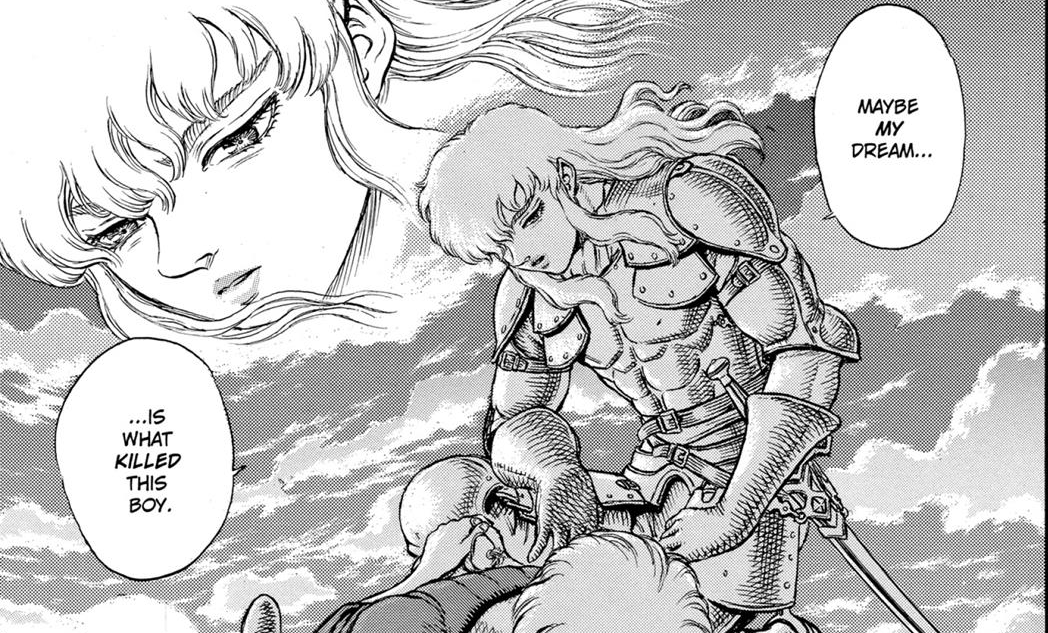


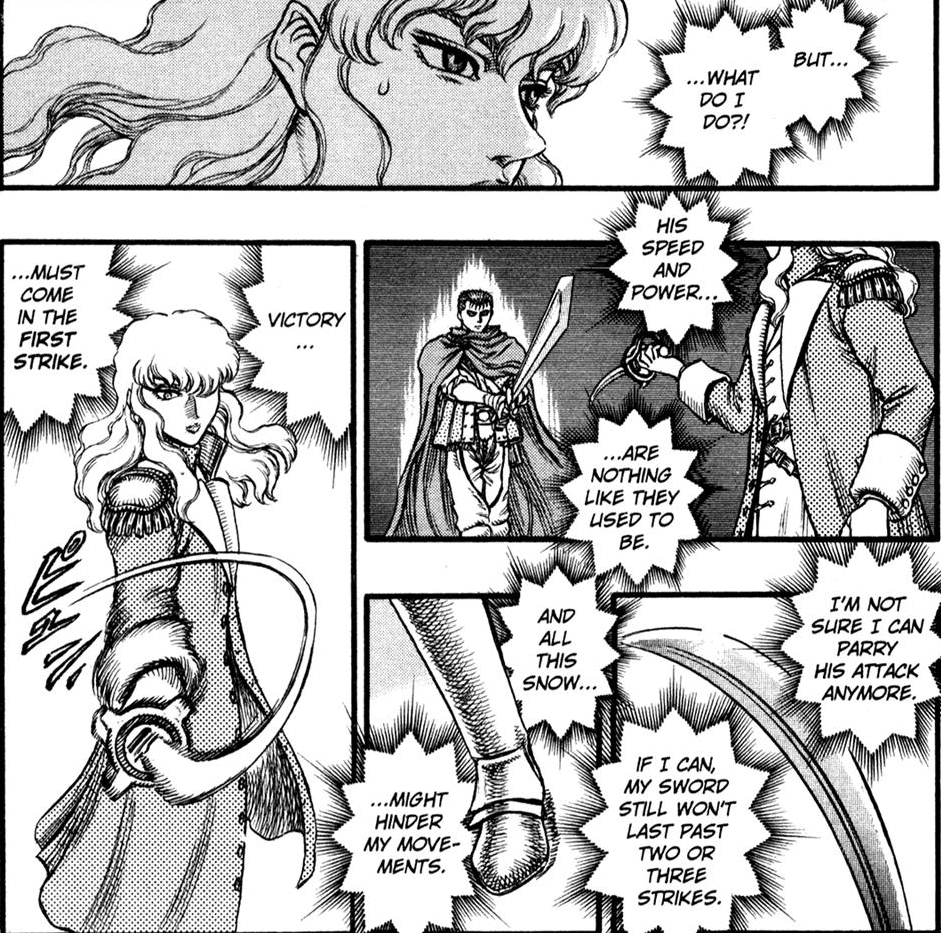


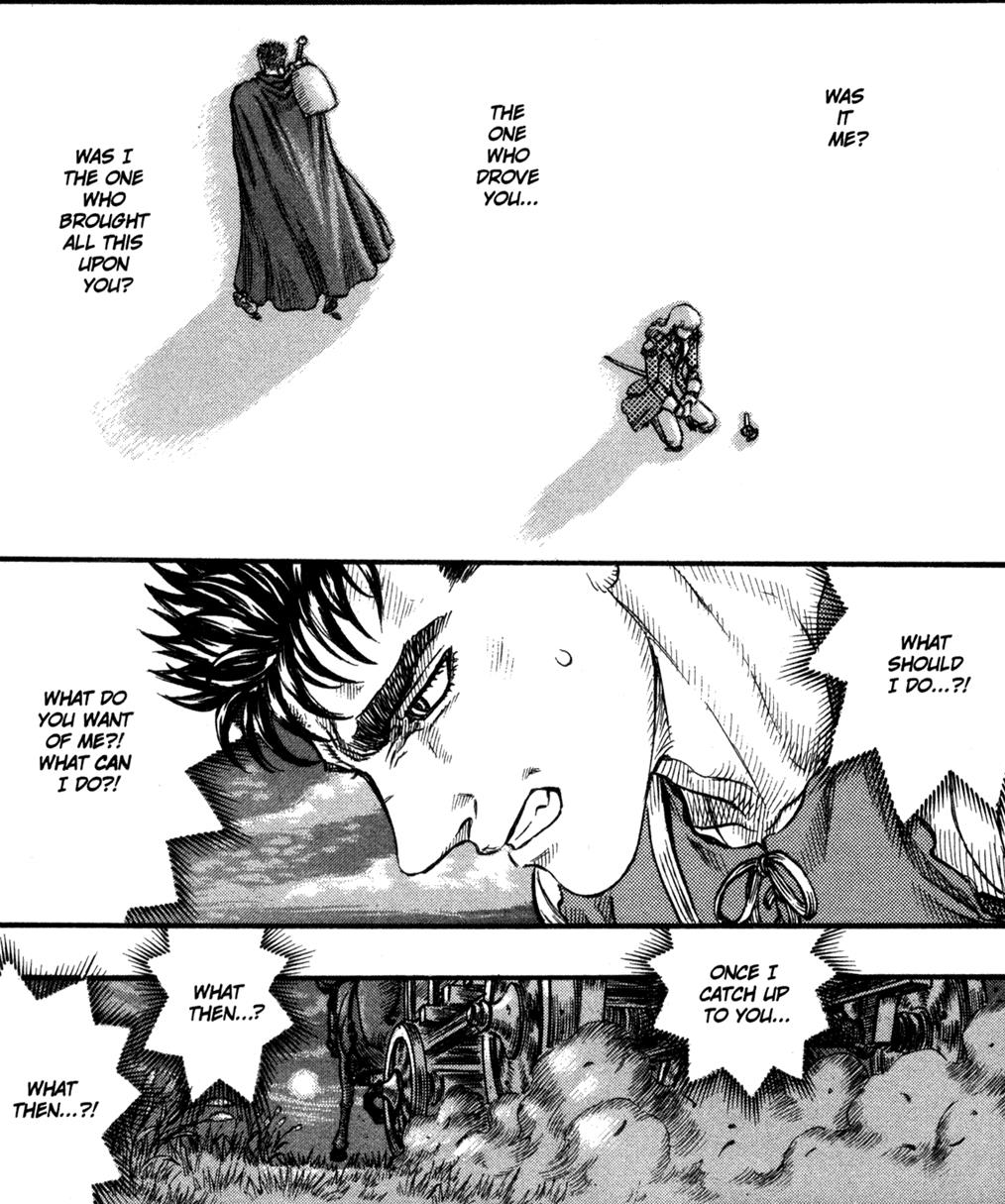
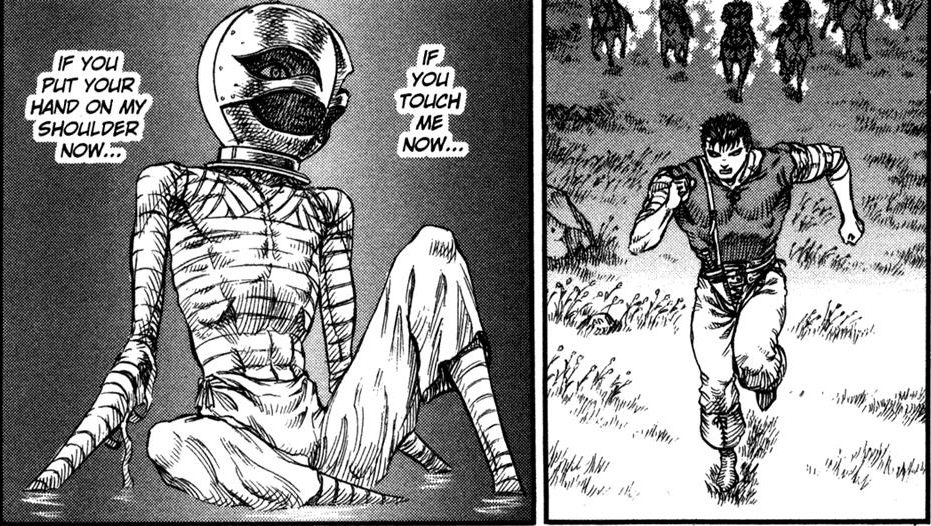
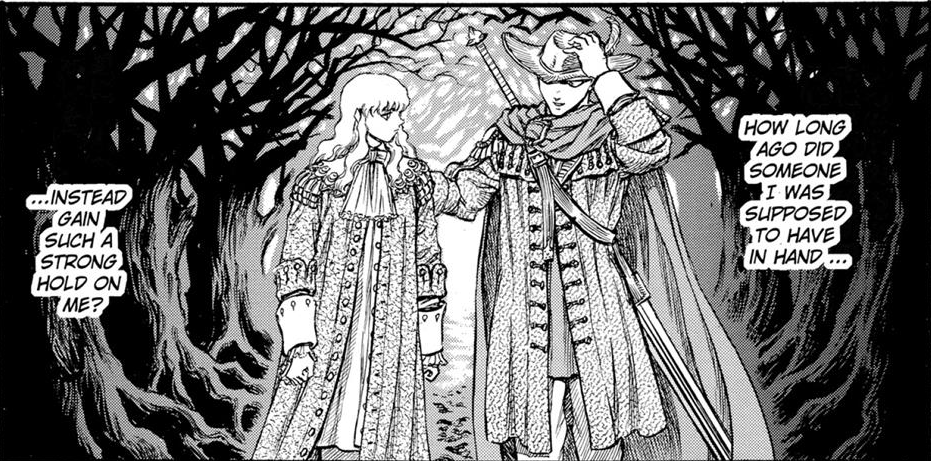


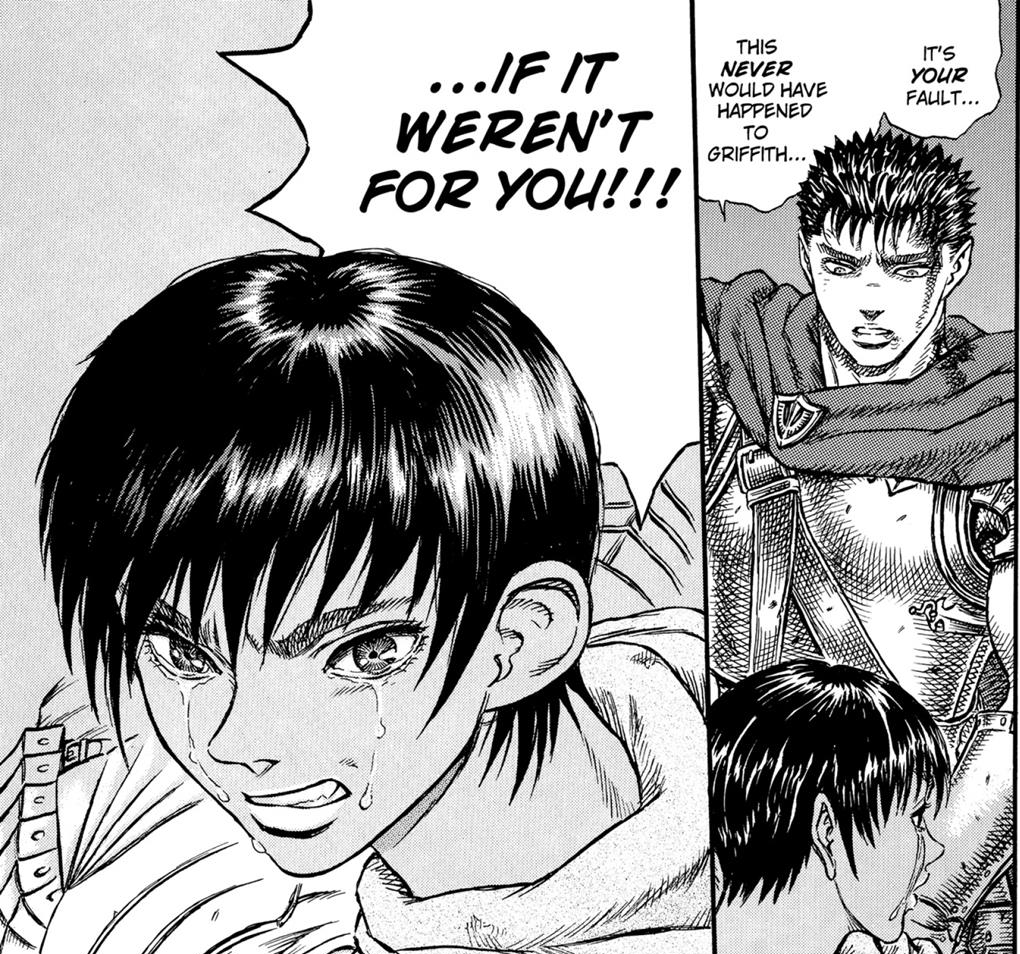


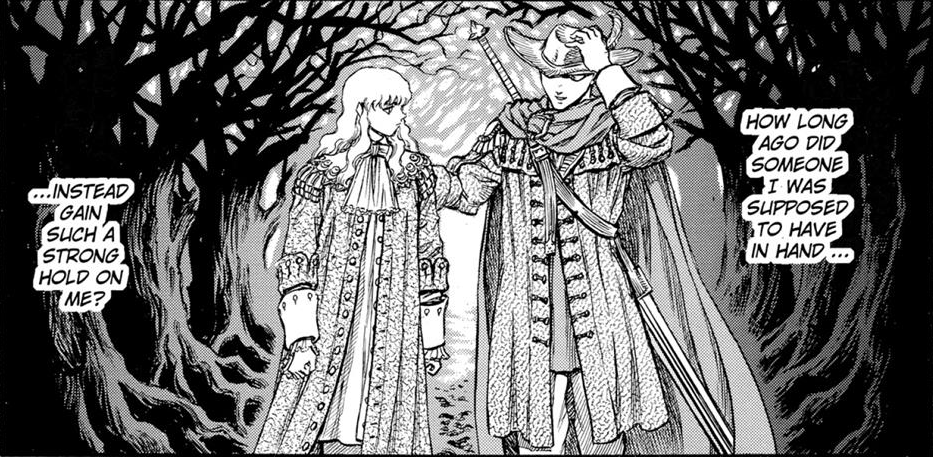


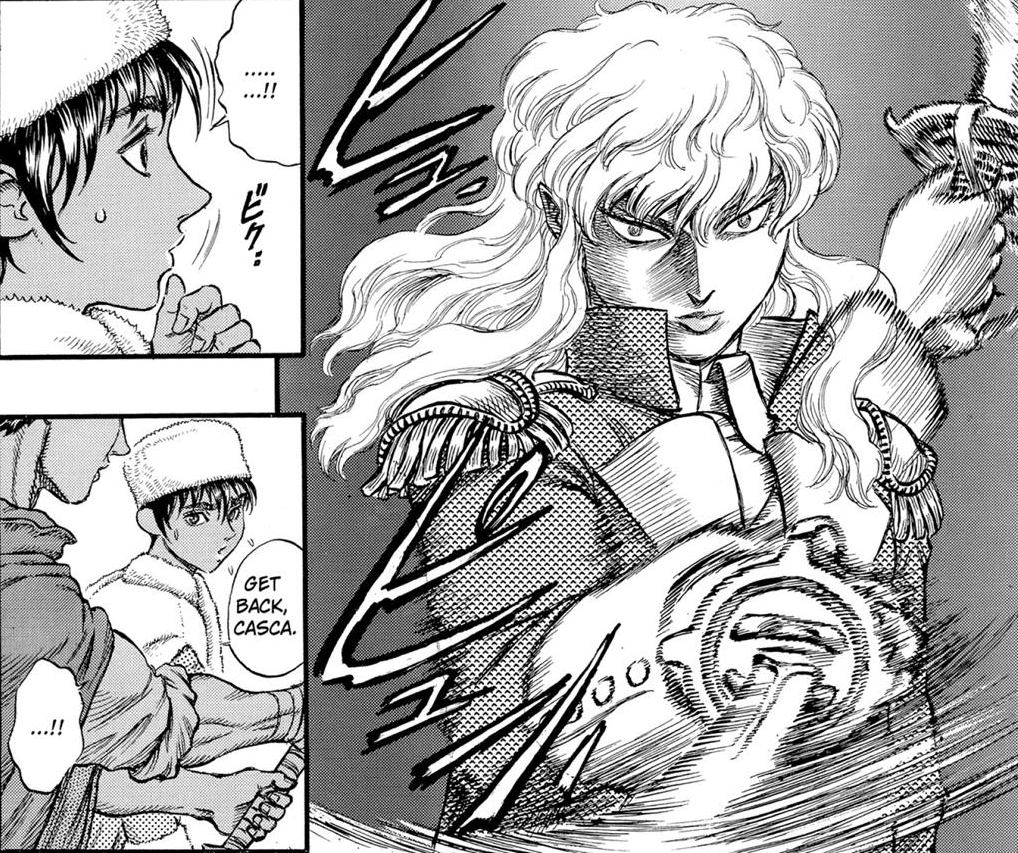


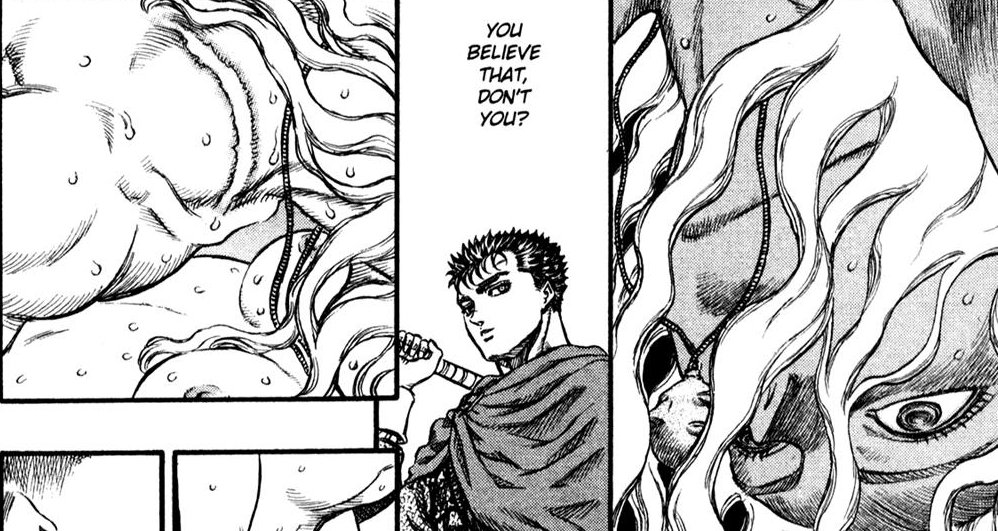


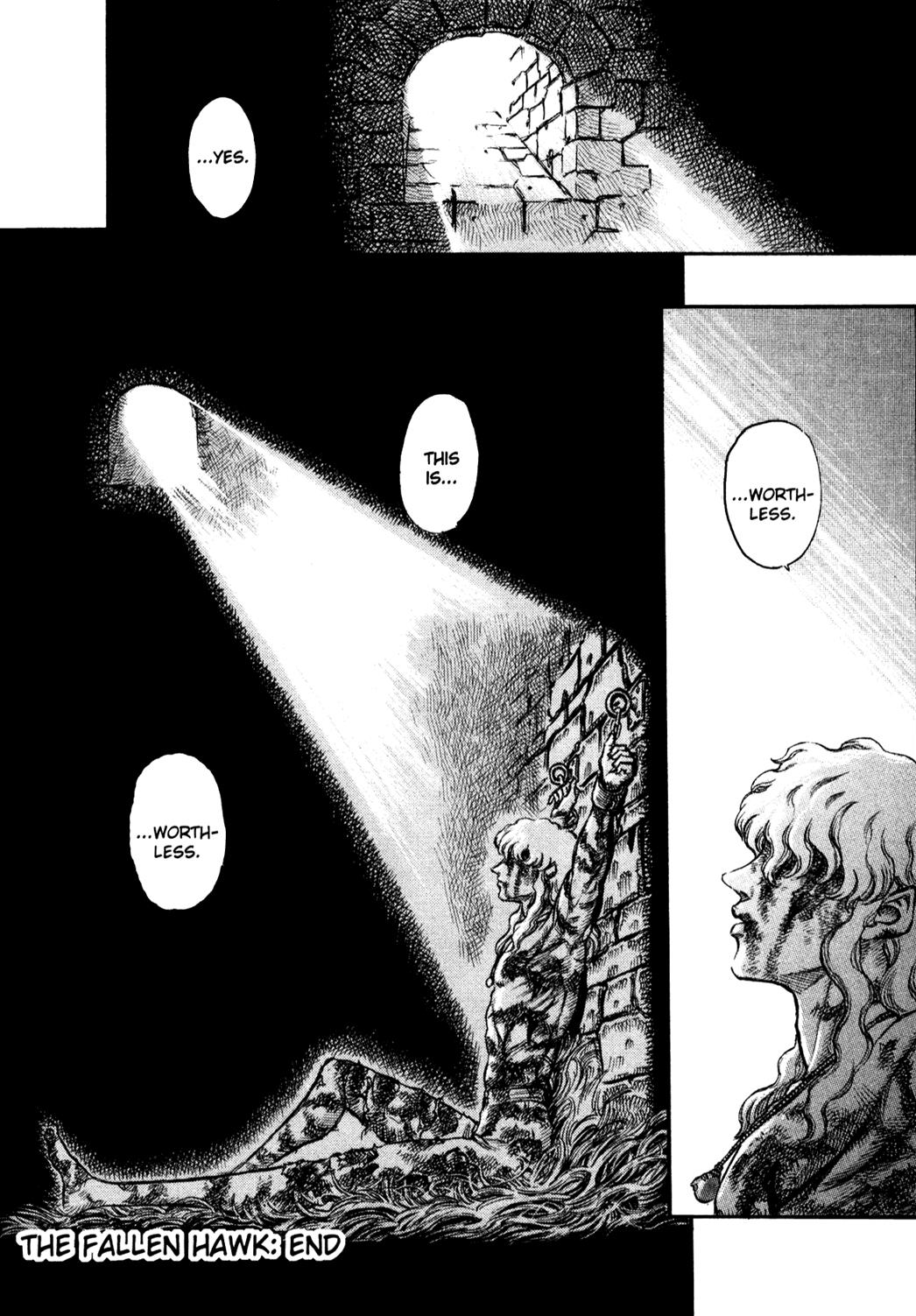


 you're the only one