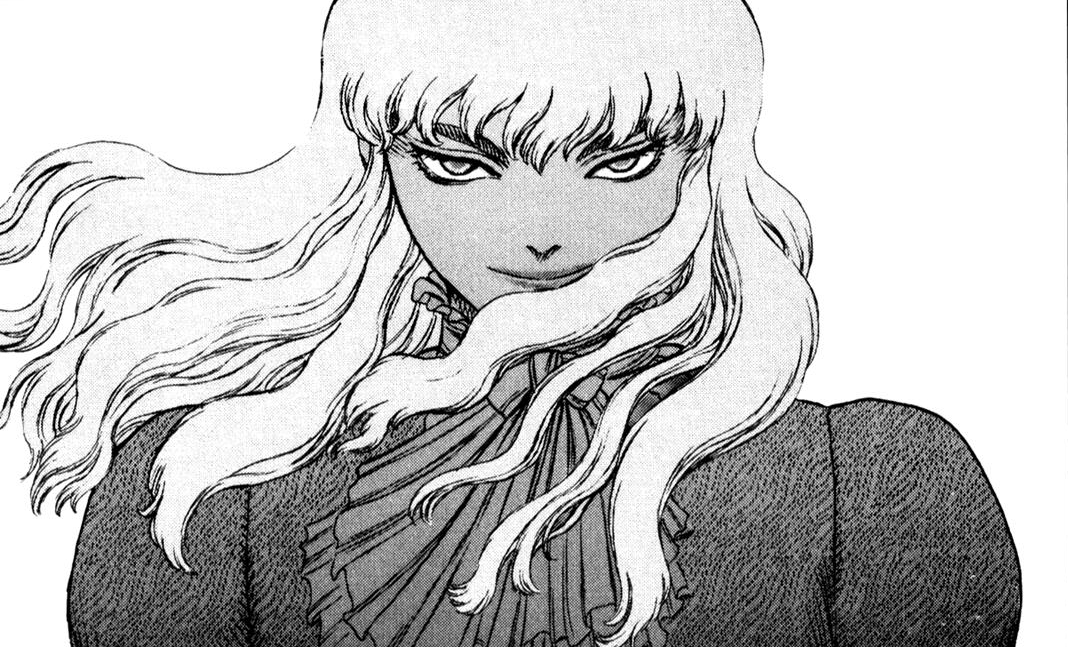
Like, this is a moment of Griffith’s inner darkness shining through. It’s perfect because it comes right after his long dream speech to Charlotte, as he’s learning that he’s achieved a particularly horrible step on the path to his dream. His dream just caused an innocent kid to be killed, and he’s smiling about it.
It’s a very strong way to equate dreams to darkness early on – and it’s great foreshadowing for Guts’ own descent too. This speech that ends with Griffith smiling over the death of a child – that causes that smile – is the very thing that inspires Guts to leave to pursue his own dream! Which ends up being the Black Swordsman arc.
Like compare Griffith’s evil smile to Black Swordsman Guts’ slasher smiles as he’s, yk, fighting “stronger and stronger opponents,” ie pursuing his own dream. Dreams are terrible all around for everyone and I love it.
This is also part of Griffith’s set up that’s very soon knocked down in a subversion of the reader’s expectations. Like I’ve talked about how Griffith’s narrative begins with an image and eventually peels that away to the truth – we start with Femto, then we get early larger-than-life knight in shining armour Griffith who would do anything for his dream, here w/ the assassination we get the darker aspects of that emphasized, and then only five chapters later we get our first full pull-back of the curtain style reveal of the real Griffith, in Casca’s flashback.
Compare Griffith smiling when a child dies on the path to his dream up there to:
and
It’s Griffith burying his guilt – getting much better at burying it through consistent practice lol – and demonstrating his willingness to do so in order to achieve his dream, which, ironically, he’s pursuing because of that guilt. It’s perfect.
I think I’ve phrased it before as like, after learning about Griffith’s dead child related guilt issues in Casca’s flashback shortly after, that smile when he finds out Adonis is dead can only mean one of two things:
either in the intervening years he’s changed so fundamentally that he no longer has those guilt issues, and therefore Casca’s flashback chapters are functionally meaningless and unnecessary to an almost comedic extent.
or it means he’s successfully buried his guilt so thoroughly in this moment as he’s pontificating to Charlotte about his dream that his reaction is pleased – he’s kind of like, becoming the mask, doing that good a job of convincing himself it’s all necessary for the sake of his dream.
And we see Griffith’s guilt issues crop up again in Tombstone of Flame
and again when Ubik’s convincing him to make the sacrifice, soooo we
know it’s not option one lol.
idk it’s a great example of the fucked up duality that comes from living in denial and eventually leads to choosing to become a monster because you already see yourself as one, basically, and it’s something I absolutely love about Griffith’s character.
Is it possible also that on one level he’s smiling specifically because Guts killed a child for him? Because he can take that as pretty strong evidence that Guts is loyal to him and more importantly won’t turn away from Griffith’s dark side or judge him for his darker actions? Like, on top of everything else that’s happening in his fluffy head in that moment.
Huh, interesting idea, I never thought of it that way before.
I’ve gotta give this a solid maybe, because I could see an argument either way. Like, I guess I don’t think it would be an intended reading on Miura’s part, mostly because of how completely sinister and creepy that smile is lol. Like I feel that if Miura wanted to convey a sense of Griffith being relieved in a way by Guts going the extra mile and killing a kid, his smile might seem more like… emotionally complex? Kind of tender?
I’m feeling a little deprived now because I’m imagining Griffith smiling in a more fond way rather than an evil villain way after hearing the news and I’m really loving that idea lol.
Anyway regardless of potential authorial intent, I really like this suggestion, in part because of how emotionally vulnerable and insecure he is in Tombstone of Flame, after another round of comparatively justified assassinations. I like the idea of Griffith maybe wanting to believe that Guts killing Adonis means he’s ride or die for him and won’t judge him for what he does to get to the throne, maybe letting that knowledge make him a little more secure in his relationship with Guts between Promrose and Tombstone, but still being terrified that it’s like, a really fucked-up example of Griffith dragging Guts down with him, and something that makes Guts want to run.
It adds another little layer to the rug being pulled out from under him when Guts does leave. Another action to add to his own self-loathing – it’s not that Guts killed a kid for Griffith, maybe indicating that they share a certain darkness, it’s that Griffith caused him to kill a kid, Griffith dragged him into the darkness, and Guts presumably hates him for it.
(Also there is something absolutely delightful about Guts hating himself after killing Adonis and seeing himself as a monster and unworthy of Griffith’s friendship, even as it makes Griffith feel more secure, more able to open up to Guts, and then later makes Griffith feel more like a monster dragging Guts down. Like, it fits right into the rest of their giant misunderstanding, and it’s the kind of fucked up scenario I live for.)
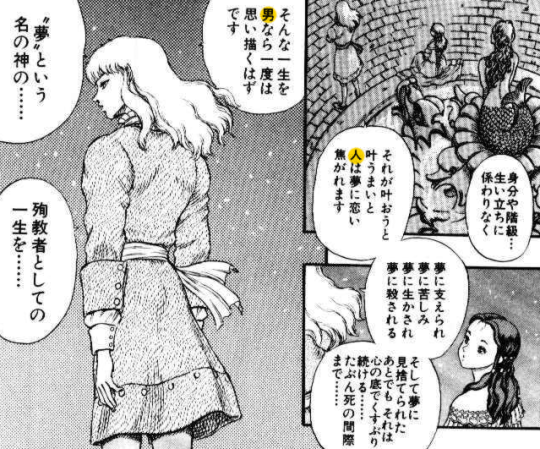
Huh now I’m actually curious if that speech is gender neutral in Japanese, because honestly the focus on men in that speech did seem like… pretty typical of Berserk in general lol. Like Miura really elevates same-gender relationships over opposite-sex relationships which are almost always romantic by default, and generally treated as lesser, or as stepping stones to that most important relationship (eg nina leaving with a dude so she can one day feel worthy of being luca’s friend) and the speech fits that pattern perfectly, so I always assumed it was deliberately gendered – not so much as a reflection on Griffith (tho again in the context of being repressed but desiring that all-important relationship with a man specifically… I’m still okay with it) but bc of Miura’s own biases.
But it’d be nice if it was actually gender neutral bc the focus on men men men, especially that first “but for a man he must first come upon one other precious thing” or w/e the line was, was pretty annoying.
sorry to bring bad news but that convo was anything but gender neutral. like, griffith started it by mentioning that charlotte asked him why /men/ love spilling blood so much so the men vs women divide was there from start to finish
actually the official translation was completely consistent with the original in terms of levels of gendering:
(男, otoko, officially translated as “man/men”)
(者, mono, officially translated as “one”)
(人, hito, officially translated as “people” and then 男, otoko, “man/men” again)
and then griffith ends the conversation like “sorry that must have been a boring topic for a lady (女性, josei)”
so like yeah japanese is a mostly gender neutral language in that its verbs and adjectives are not inflected by gender etc. but that doesn’t mean that all japanese conversations are completely gender neutral. far from it actually
Thank you! Yeah like I said, the way this convo is gendered fits the story to me and imo still reflects more on Miura than Griffith, but like, it doesn’t not fit Griffith imo. It still serves my interpretation of him so I’m cool w/ this.
Also yeah very good point about the abbreviation, ty for mentioning it. JP is definitely preferable if you’re going to shorten the word “japanese,” even if it’s just intended as shorthand and not a slur.
Like, this is a moment of Griffith’s inner darkness shining through. It’s perfect because it comes right after his long dream speech to Charlotte, as he’s learning that he’s achieved a particularly horrible step on the path to his dream. His dream just caused an innocent kid to be killed, and he’s smiling about it.
It’s a very strong way to equate dreams to darkness early on – and it’s great foreshadowing for Guts’ own descent too. This speech that ends with Griffith smiling over the death of a child – that causes that smile – is the very thing that inspires Guts to leave to pursue his own dream! Which ends up being the Black Swordsman arc.
Like compare Griffith’s evil smile to Black Swordsman Guts’ slasher smiles as he’s, yk, fighting “stronger and stronger opponents,” ie pursuing his own dream. Dreams are terrible all around for everyone and I love it.
This is also part of Griffith’s set up that’s very soon knocked down in a subversion of the reader’s expectations. Like I’ve talked about how Griffith’s narrative begins with an image and eventually peels that away to the truth – we start with Femto, then we get early larger-than-life knight in shining armour Griffith who would do anything for his dream, here w/ the assassination we get the darker aspects of that emphasized, and then only five chapters later we get our first full pull-back of the curtain style reveal of the real Griffith, in Casca’s flashback.
Compare Griffith smiling when a child dies on the path to his dream up there to:
and
It’s Griffith burying his guilt – getting much better at burying it through consistent practice lol – and demonstrating his willingness to do so in order to achieve his dream, which, ironically, he’s pursuing because of that guilt. It’s perfect.
I think I’ve phrased it before as like, after learning about Griffith’s dead child related guilt issues in Casca’s flashback shortly after, that smile when he finds out Adonis is dead can only mean one of two things:
either in the intervening years he’s changed so fundamentally that he no longer has those guilt issues, and therefore Casca’s flashback chapters are functionally meaningless and unnecessary to an almost comedic extent.
or it means he’s successfully buried his guilt so thoroughly in this moment as he’s pontificating to Charlotte about his dream that his reaction is pleased – he’s kind of like, becoming the mask, doing that good a job of convincing himself it’s all necessary for the sake of his dream.
And we see Griffith’s guilt issues crop up again in Tombstone of Flame
and again when Ubik’s convincing him to make the sacrifice, soooo we
know it’s not option one lol.
idk it’s a great example of the fucked up duality that comes from living in denial and eventually leads to choosing to become a monster because you already see yourself as one, basically, and it’s something I absolutely love about Griffith’s character.
There is really something to be said about the significance of physical contact between Guts and Griffith.
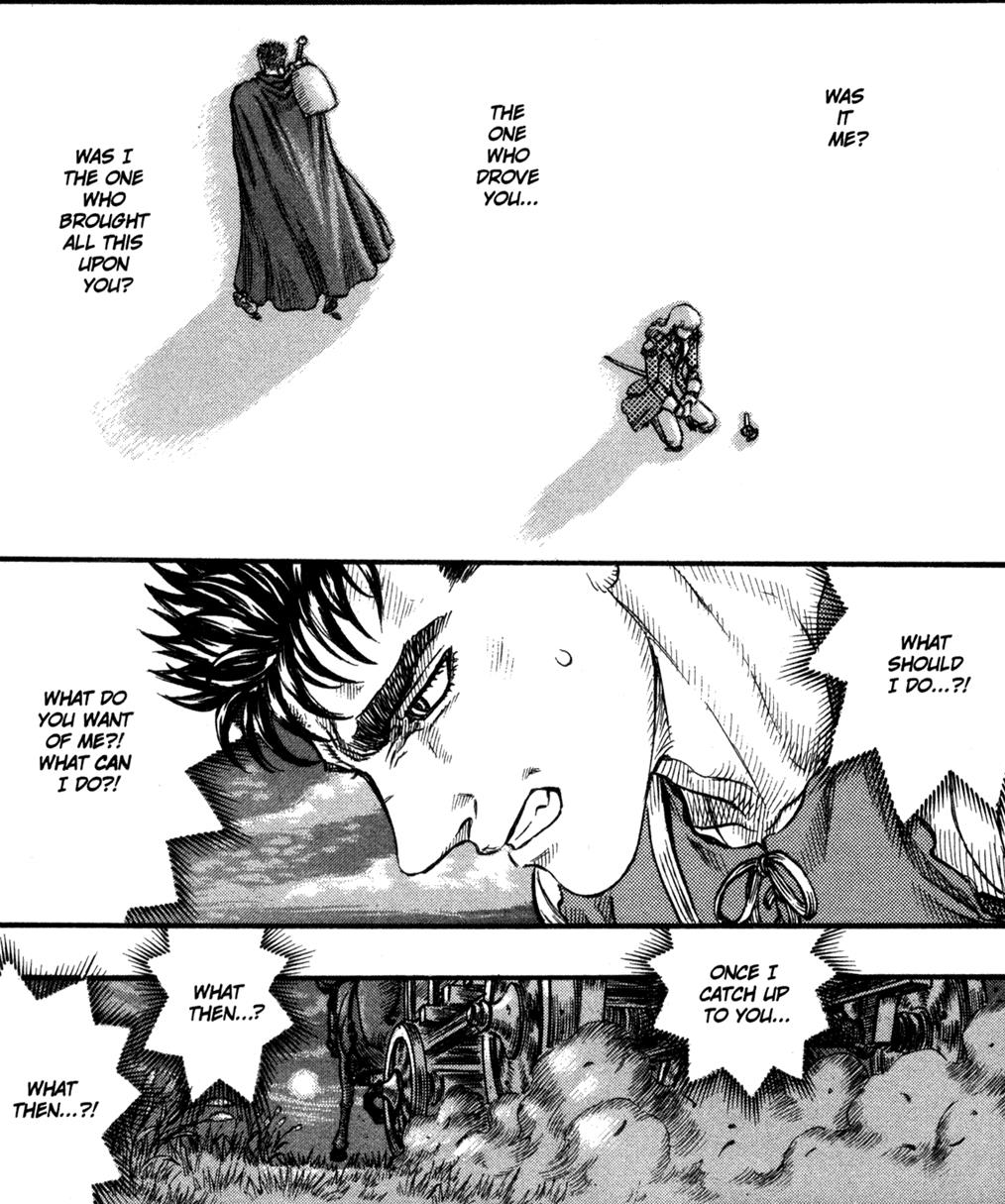
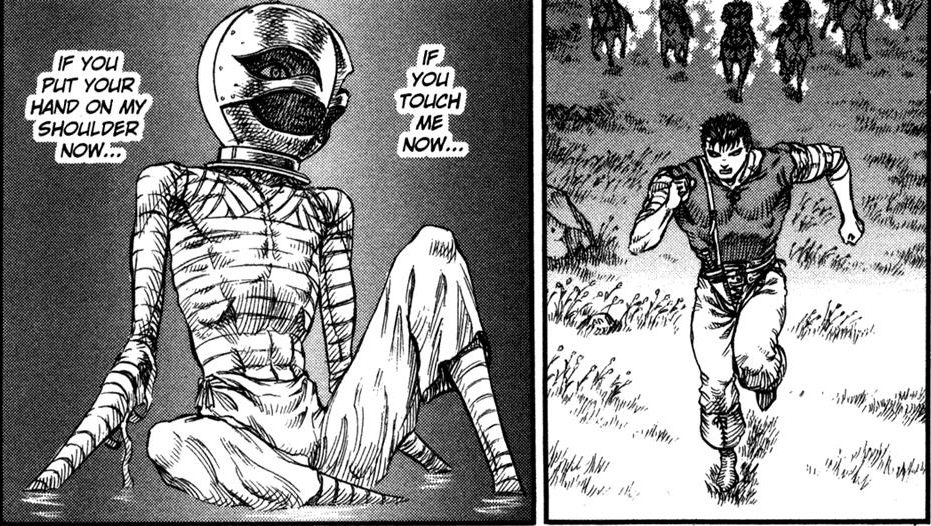
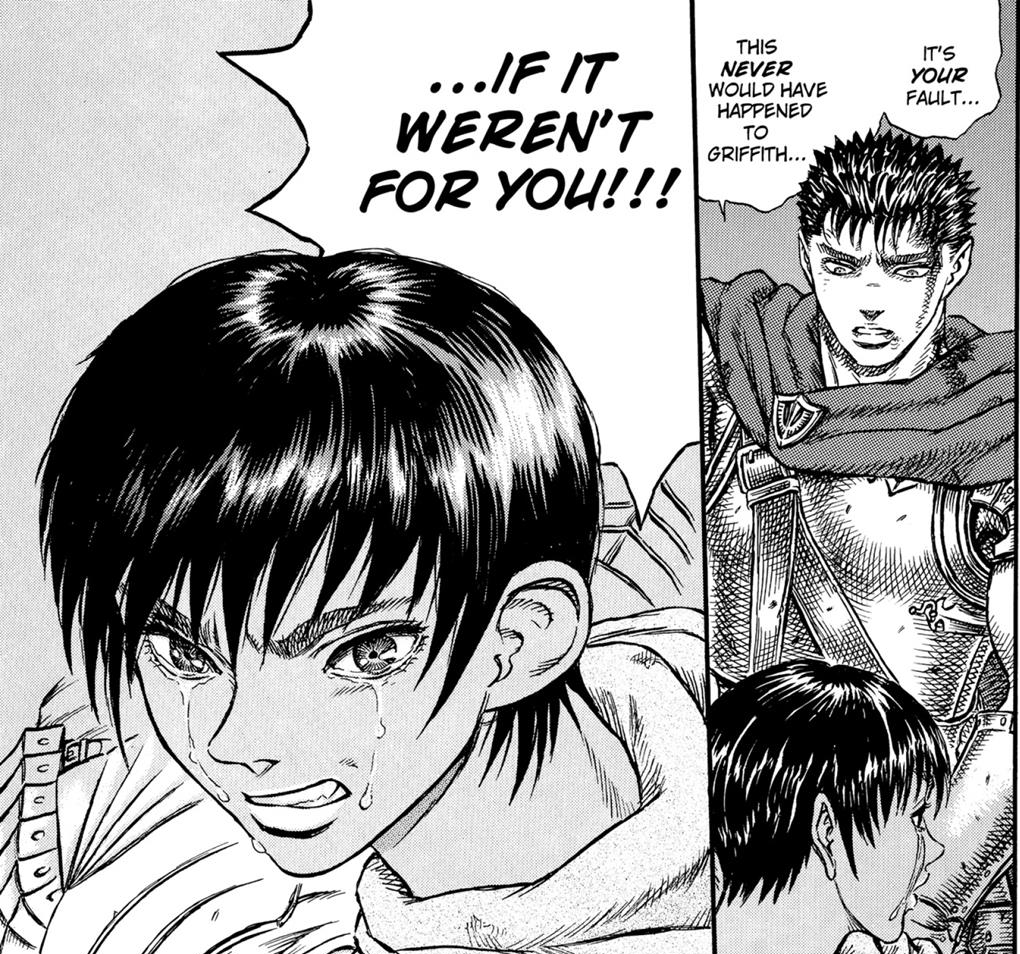
Like the fact is that this intense moment of Guts racing for Griffith, wondering what on earth he can possibly do, is a lead-up to a single touch that sends Griffith into despair. This touch is what causes the Eclipse.
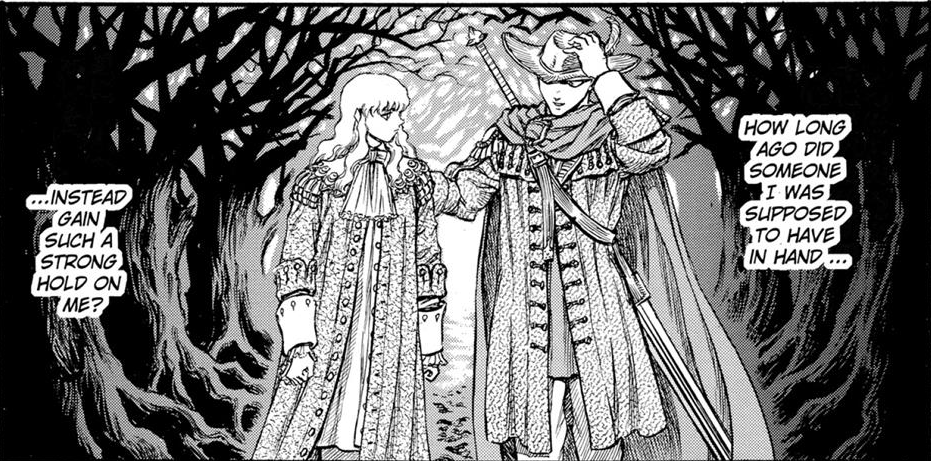
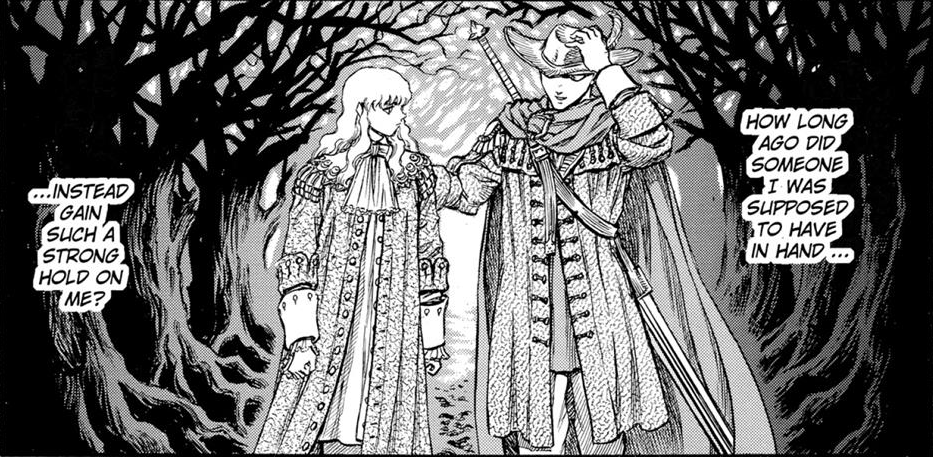
A similar physical touch marks the moment Griffith thinks of when he wonders when Guts gained such a strong hold over him:
Their first duel is the only fight either of them ever engage in, as far as I recall, featuring direct physical contact rather than swords (or other weapons) clashing, and moreover, the scene depicts the sense of a gradual physical pull between them. Before the duel, Guts wakes up from a nightmare featuring his childhood trauma, falling into a near panic as he wakes up and feels a body on top of him, until he realizes she’s a woman, not a man.
Touch is highlighted as a concept to take note of here, particularly Guts’ aversion to it.
Guts remembers Griffith as the figure on a horse that he couldn’t reach before collapsing, gazing down at him:
Then they duel. The fight begins at a distance, with swords. Griffith nearly wins without touching him, and again while on a higher plane than Guts bc goddamn Miura gets a lot of mileage out of that imagery:
But then Guts bites Griffith’s sword, they lose those swords, roll down a hill, and Guts just starts punching. We get significant commentary from onlookers highlighting the uniqueness of this fight bringing Griffith down from his heights of untouchability:
As well as from Guts:
Griffith wins with a hold, and finally:
The sequence leads up to this intense moment of physical contact: Griffith pulling him up and gazing into his eyes.
Throughout the Golden Age there aren’t a lot of casual touches between them, but when we do see them touch (pre-torture) it’s usually during a very significant moment.
(Or once, casually, right after Griffith has reminisced about this particular fight:
Not particularly emphasized, but still during a nicely fitting and illustrative moment.)
Griffith remembers another moment of physical contact between them while thinking about how he loses his composure when it comes to Guts:
And this is the scene that leads to the highest point in their relationship, when Griffith admits he had no logical reason to save Guts and Guts dedicates his sword to him in turn. Plus Casca’s outrage also serves to highlight touch as a feature of the closeness of their relationship – and that relationship’s potential to destroy Griffith(’s dream):
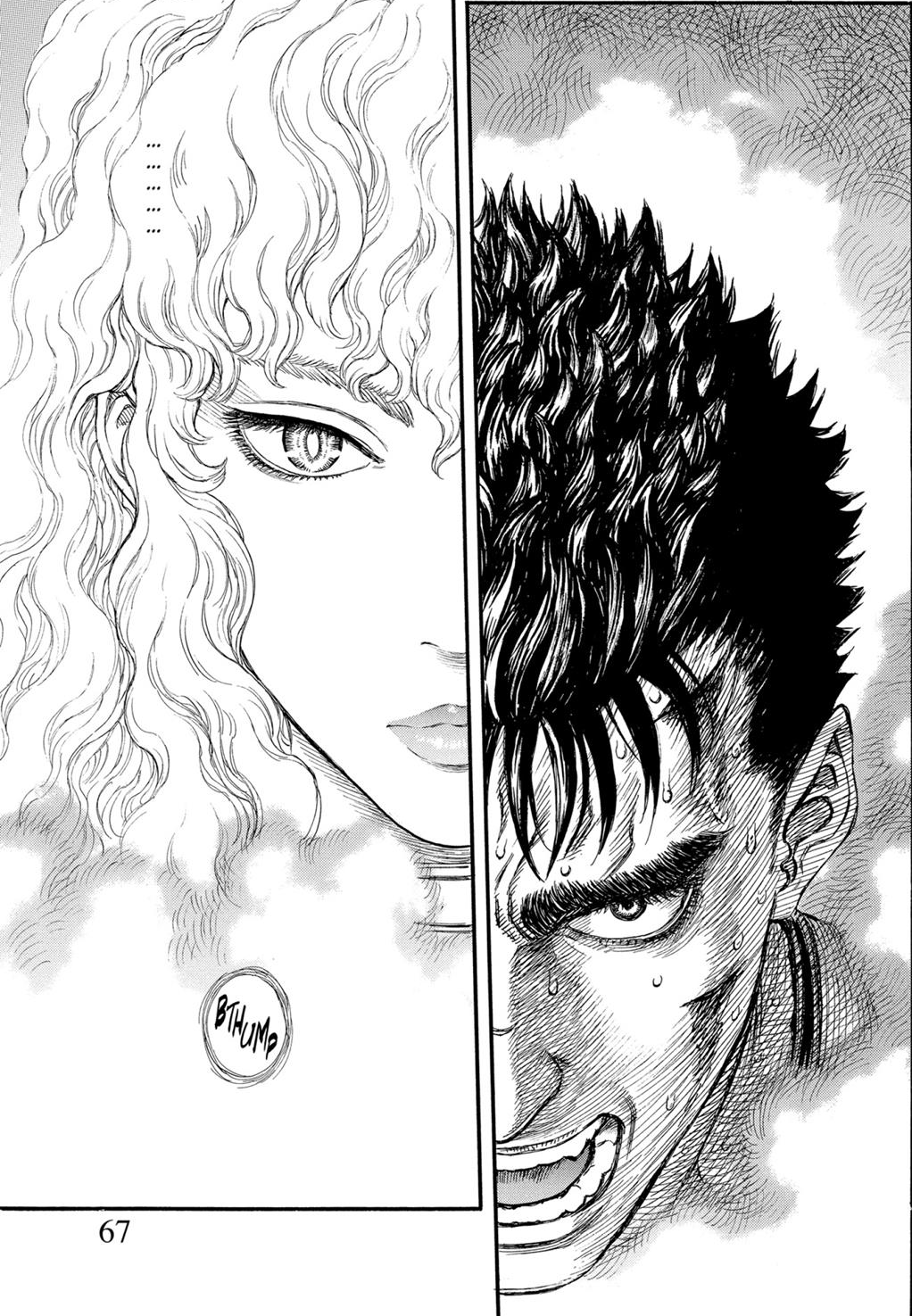
And of course, at the climactic moment of the arc as a whole, we get this moment:
Griffith reaches down to pull Guts up to him at the beginning of the first scene we see between them (a contrast to Guts looking up at a distant Femto at the top of the stairs):
We get a nice close up of their handclasp the first time Griffith saves Guts’ life (again, pulling Guts up):
A full page the very last time Griffith saves Guts’ life:
And we get another panel of their hands when Guts lets him go and falls away from him:
Which brings me to the way there is also a particular emphasis given to the lack of
touch between them, compounding the impression that the physicality
between them is significant.
For instance, in contrast to their first fight where they lost their swords, swords – which each represent their respective dreams here – uh… come between them in chapter one, foreshadowing how dreams tear them apart and also highlighting Guts’ more immediate concern that Griffith is growing distant as he gets promoted and draws closer to attaining his dream:
(also i love having an excuse to post those 2 subsequent panels)
Eyes meeting across a vast ballroom and through a window as they smile at each other, after another reminder that Guts is planning to leave very soon:
Guts’ sword falling where we later see Griffith with self-inflicted scratch-marks:
I obviously can’t skip over Griffith thinking about Guts’ departure at the exact moment he
penetrates Charlotte, followed by Charlotte reflected in his frantic
eyes, emphasizing Guts’ absence here in contrast to Charlotte’s presence. All on the same page in 4 subsequent panels. While he’s fucking Charlotte.
Like, this is by far the gayest hetero sex scene I’ve ever seen.
Guts reaching for him fruitlessly here:
Frankly, and not fun but still unfortunately significant to the story, Femto raping Casca while staring at Guts, later compounded by the Beast of
Darkness telling Guts to do the same to get closer to him.
There’s also Femto’s use of telekinesis rather than physical force to keep Guts away from him in the Black Swordsman arc, and the aforementioned staircase of inequality between them.
And of course NeoGriffith’s distance. Both literally:
And symbolically:
Physical touch emphasizes their closeness. It punctuates the strong emotions between them. It pulls Guts up and brings Griffith down until they meet together in the middle, illustrating the fact that their emotions for each other make them equals despite their predetermined + false notions of what equality is.
Again:
It’s highlighted during the moments of their relationship that signify their emotional closeness:
It’s a contrast to the distance which signifies their relationship falling apart:
For instance, Guts holding Griffith throughout like half of the post-torture content shows us that he doesn’t want to leave again long before the story tells us that directly.
Griffith asking for his armour rather than taking off his mask, placing a physical barrier between them, shows us that he wants to keep some emotional distance from Guts, because their closeness is devastating to him. And that foreshadows his choice to sacrifice Guts to escape his vulnerability. His demon form incorporates his mask and, so far, they never touch again.
Basically physical touch is one of the tools Miura uses to illustrate their intense relationship, either through its presence or its pointed, painful absence, and I just wanted to take a moment to illustrate some of that, bc I dig it.
said:
What are your thoughts about the current Griffith? In my eyes he has
become like the Snow Queen – Beautiful, yet cold and empty. Practically
unable to experience emotion and lacking in any humanity. A pretty
doll. A shell. A walking facade. What do you think?
My answer to this ties into the other thing you asked me to expand on, re: Griffith and contrasts, so I guess I’m just kind of doing both answers at once.
Basically I agree, but I think there’s more to NeoGriffith (ie post Femto, resurrected, godlike Griffith) than that.
Griffith as a human is so interesting to me in part because he’s full of contrasts, which is one of those hooks that really get me interested in a character. And those contrasts mostly stem from this attitude right here:
He hides away all of his weaknesses, his negative thoughts, the truth of what actually drives him on (guilt), his self-loathing, even from himself. He smiles and portrays an image of perfection so well that he essentially believes it himself most of the time.
So you have things like the Promrose Hall speech, where he’s fully embodying that image of himself:
vs Casca’s flashback, which is a glimpse of his darker, much more fucked up self underneath, and directly contradicts the above:
So you have the contrast between the perfect leader, the guy who can take down an army of 30,000 with 5,000, the guy who waxes poetic about how great dreams are, the guy who is this fucking cool while burning a queen alive:
And the guy who self-harms after prostituting himself to a pedophile to prevent as many deaths of his followers as possible despite claiming he doesn’t feel responsible for them, the guy who falls to pieces and destroys his own life when Guts leaves, the guy who hates himself and desperately wants to be told he’s not a monster:
And both are Griffith. Griffith isn’t just faking his confidence, he genuinely is that confident. He genuinely believes that his dream is a worthwhile pursuit in and of itself, and he can’t call any of his followers friends because they’re clinging to his dream rather than finding their own dreams.
He’s portrayed that image so fully that it’s a real part of him. But at the same time, sometimes it shatters and reveals the exact opposite underneath: the self loathing, the fear, the fact that he’s in love with Guts and has nearly lost his dream because of that love multiple times (ie nearly dying while trying to save him from Zodd, burning his own life down after Guts leaves, even going back and rescuing him personally that first week).
And that brings me to NeoGriffith, because what NeoGriffith is, is that image, and only that image, with none of the very human weaknesses behind it.
He’s described as a painting, as untouchable, etc, like fifty million times.
He’s basically become the impression he used to leave people with.
If Griffith contradicted himself – confidence vs insecurity, conviction vs self loathing, unwaveringly pursuing his dream vs Guts making him forget his dream, etc – then NeoGriffith is one side minus the other. Confidence, no insecurity, conviction, no self-loathing, the dream, no Guts.
And it’s uncanny too. He’s pursuing the dream, but he’s no longer motivated by his very human feelings of guilt (and also fear/insecurity, which we’re shown here:
I got this whole argument about dreams in Berserk being essentially shitty coping mechanisms lol, which I won’t get into now but is worth mentioning as another aspect of human Griffith that NeoGriffith lacks)
He’s lost his human flaws, and that makes him kind of disturbing imo, because those human flaws drove him, and now he’s driven by nothing, he just is.
And, just as a side note, it’s also worth noting that Femto is the other side imo – the self-loathing, the insecurity – in the sense that Femto is the embodiment of the monster Griffith believed himself to be deep down, the monster he believed Guts saw him as too, after this exchange (and then Guts leaving):
I mean it’s ultimately the final puzzle piece that makes him agree to the sacrifice:
And I 100% believe that NeoGriffith is referencing that here with his “you, of all people”:
So like, tl;dr Griffith is a land of contradictions, and that’s embodied in 2 magical fantasy transformations that make those disparate elements of him literal personifications.
NeoGriffith is the side of himself that he showed the world as a human, stripped of his humanity, and Femto is basically a personification of his own self-loathing, in which he became everything he feared himself to be, everything Guts failed to tell him he wasn’t.
But this is just like, the thematic take lol. This is what I think NeoGriffith essentially represents. But it’s also more complicated than that, because
But when it comes to like, NeoGriffith as a character, rather than a construct, who potentially still has emotions and ties to his previous life, I guess I’ll leave you with links because I don’t really have much new to say:
Basically I think there’s plenty of indication that Griffith failed to entirely purge himself of emotion and isn’t quite the serene image of perfection he seems.
there’s something to be said about how this turns into a “men vs women” type of conversation where griffith takes men’s side with his bullshit dream spiel and pretends like it’s this profound thing women will never understand
and by that i mean that it comes off as trying too hard, the same way him talking about what a ‘friend’ is to him comes off as trying too hard. before i was a little hesitant to believe that griffith feels forced into masculine roles rather than choosing to take them bc it’s the fastest way to achieving what he’s trying to achieve, but after re-examining this scene i think i feel a little differently about that
#other ppl’s meta #totally it’s posturing – more for himself than charlotte too #the image that goes with the dream which is (how does this always fit so perfectly) an attempt at a heteronormative masculine ideal #the men are like this stuff fits that so well as does charlotte suggesting ‘family or a sweetheart’ which ofc sums up what griffith #is torn between (‘family’ if you don’t want to be saccharine and include the rest of the hawks he sacrifices) and what guts ends up #abandoning for /his/ dream
@bthump what you said here, “more for himself than charlotte,” that’s exactly what i mean, somehow it didn’t register to me, until today, that the part of this where he puts up a masculine facade is ALSO for himself, and not just for charlotte. you know, when i think @yesgabsstuff and i talked about how griffith would be more feminine without all this bullshit weighing on him, i said i didn’t think his choice to present and act more masculine was one he made out of fear. and i still think that, to an extent, but there’s no denying that he felt forced into that masculine role bc …………… it’s so tightly woven together with his dream. and since it’s something he has to do for the sake of his dream, then fear also has to be involved, even if in a sort of roundabout way. that is to say, i don’t think griffith is afraid of like, getting punched or called a faggot if he wears a dress or w/e. but i think there’s no denying that he is afraid of letting this image falter, and that’s what this is really about
I feel this tbh, like imo Griffith wouldn’t really have a visceral fear for his physical safety, he’s been the best w/ a sword since he was like 10 from all appearances lol, and honestly I feel like as a peasant mercenary with the force of personality he has he would in theory be able to get away with some gnc presentation and attraction to men if all he wanted was to fight and make money. Same way Casca could lead the Hawks even though she’s a woman in the world of Berserk lol.
but his fear of failure is a major aspect – he needs the correct image while climbing higher in society, to achieve his dream.
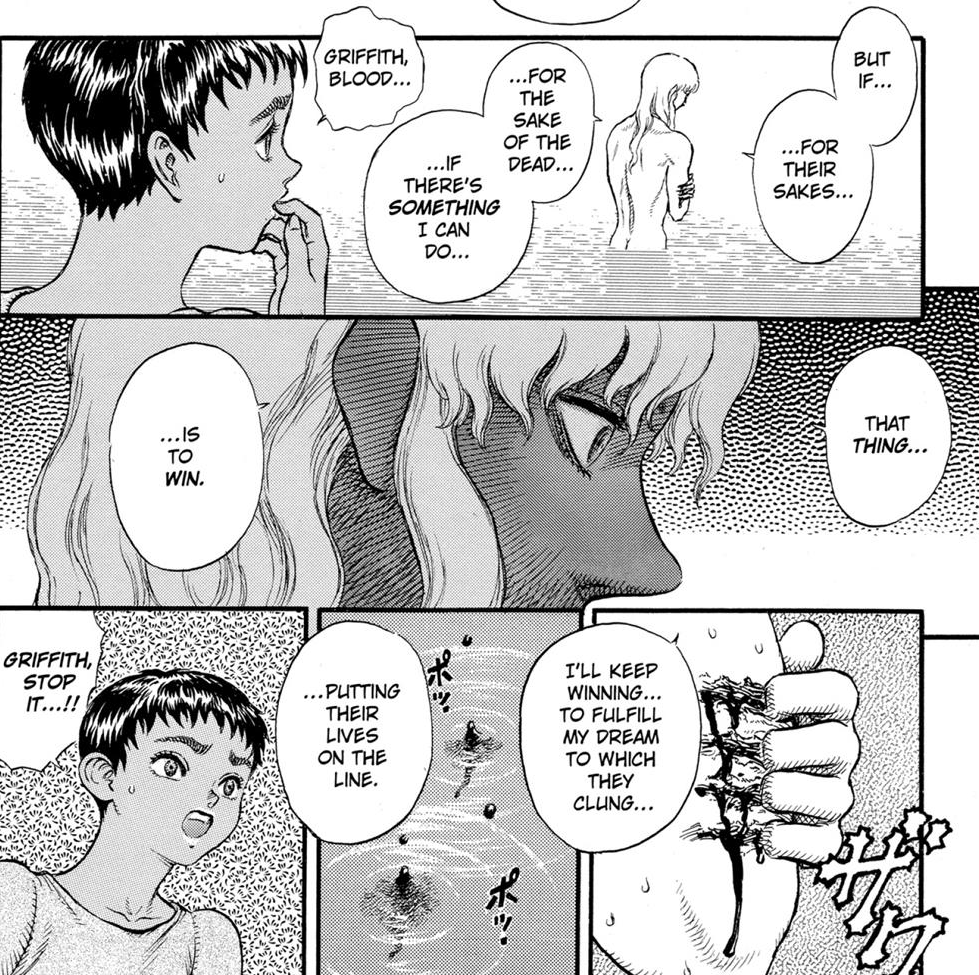
and also i think he needs the dream to justify hiding behind the image, which is partly what i get out of that speech to charlotte. it reads to me like he’s justifying his dream to himself as worthwhile in and of itself, in a contrast to how he justifies it to himself in the river w/ casca a few chapters later, as something he owes the dead.
idk it all goes into how his dream is a defense mechanism from his self loathing and a way to justify his existence, but he doesn’t think of it that way 99% of the time, he has to see it as inherently worthwhile to avoid acknowledging the actual reason (self-loathing) he’s pursuing it.
and some of that self loathing is guilt, some is a belief of his inherent worthlessness, but some is also connected to his sexuality, both in his traumatic experience with Gennon after which he called himself dirty, and his love for Guts, which is especially shown through how Guts is pitted against his dream and how Guts “made him weak” and his feelings for him led to him losing everything. Griffith’s feelings for Guts are connected to his belief of his inherent worthlessness, because they exist in opposition to his dream. (this is thematic moreso than literal)
So part of his reason for pursing the dream is to bury those parts of himself – like it goes both ways, basically, imo. He has to be a heteronormative masculine ideal for the sake of the dream, but he obsesses over the dream partly as a way to bury the parts of himself that aren’t that ideal?
um i feel like this doesn’t really make sense lol sorry. it’s hard to explain how my brain makes connections sometimes.
I think that, from the very start, Griffith’s feelings for Guts are at least as strong as his feelings for his dream. I say this because Griffith doesn’t have a pattern of desiring things or people and doing what he can to have them. Til now he’s had one thing he wants and that’s a kingdom, and now after meeting Guts he has one more thing he wants, and as soon as he’s given an opening he pursues him with equal fervour.
And from the very start, his feelings for Guts have a tendency to make Griffith forget about his dream.
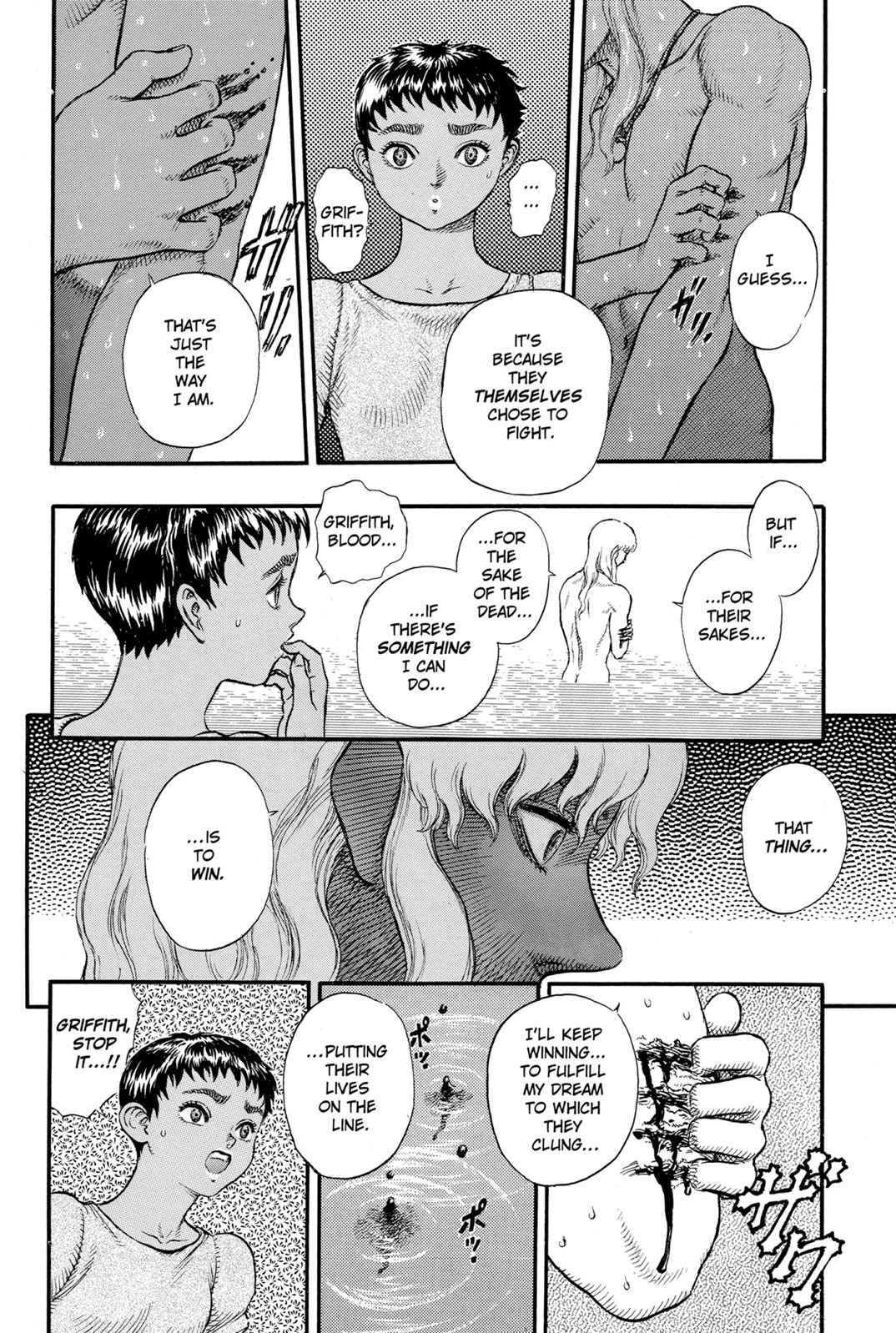
“I don’t feel at all responsible for my comrades who have lost their lives under my command. I guess… it’s because they themselves chose to fight.”
This is what Griffith says when he begins self-harming in the river. This is the number one way he rationalizes away and buries his guilt. He repeats it to the Godhand later too – “I never forced anyone to come along.”
Remember how he recruited Casca? “Whether you come along or not is your decision.” The fact that his Hawks freely choose to follow him is extremely important to him.
Now, he didn’t press-gang or kidnap Guts lol. He didn’t even suggest dueling for his loyalty – Guts himself suggested it, and I can only assume that if he hadn’t, Griffith would’ve let him walk away. But when Guts did suggest a way to win his loyalty, Griffith seized on it hard, instead of allowing Guts the same perfectly free choice to follow him the rest of the Hawks had.
Guts is explicitly the first and only person who Griffith has expressed desire for, Guts is therefore presumably the first and only person Griffith tried to sweet-talk into joining him, and it seems safe to assume that Guts is probably the only person he’d so eagerly agree to fight a duel for. His rationale of giving his followers a free choice, which is necessary to allieviate his guilt, is forgotten here – therefore his guilt is forgotten.
This is the beginning of a war between Guts and the dream in Griffith’s subconscious, that we see again and again throughout his narrative.
A week after Guts joins the Hawks, Griffith risks his life for him for the first time. The reaction to his actions here handily tells us how unprecedented this is.
Griffith ditching this dude in the hat – quite likely the guy who hired them – mid-sentence to immediately check on losses, ie whether Guts made it, to vocal surprise from both hat man and Casca.
Then he leads a back-up team to rush to Guts’ defense. And it’s geuinely risky – they escape death here by like an inch while Guts frets about the two of them weighing down the horse.
And of course Guts questions him directly while Griffith avoids answering:
And we get more helpful commentary on how surprising Griffith’s actions here are from the peanut gallery:
The next morning Guts broaches the topic again, after accepting Griffith’s initial brush-off.
This scene starts with Guts and Griffith’s first real bonding experience, and it ends with Griffith’s grandiose and iconic “I will get my own kingdom. You will fight for my cause, because you belong to me.”
The first time we read this it comes across as a kind of really off-putting and over the top statement of ownership. Guts is dazzled by it, because he’s dazzled by everything Griffith does, but it’s not surprising that so many Berserk fans see this moment as sinister and threatening to an extent. Frankly, it’s a fucking weird thing to say lmao. As Eclipse foreshadowing it’s great, but as a character moment it raises a lot of questions.
But here’s the thing: Casca’s flashback tells us exactly why he says it.
Two things happen right before this moment. First Griffith and Guts have a naked water fight and bond. Then, after an exchange about the behelit, Guts asks Griffith that question once again.
This time Griffith has an answer.
Now remember, Guts thinks this is bullshit. He directly says so three years later when he has to ask the same question yet again. This line Griffith gives him is a lie – a lie that Griffith himself may very well believe, and tbh I personally think he does, but it’s not the reason Griffith saved him.
And this fun naked bonding experience?
It’s a subtle parallel to the scene with Casca. The tone and circumstances are obviously very different, but the point of this comparison is the emotional intimacy. Both Casca and Guts are shown glimpses of the real Griffith underneath the armour, underneath the veneer of perfection he puts on. It’s not a coincidence that he’s naked in both either.
Casca’s glimpse is dark and depressing while Guts’ is just light and human – a glimpse of the child Griffith still is, entirely Guts’ equal in every relevant way. Same age, same vulnerability to buckets of water, and in the end, Guts dumps a bucket on his head and says they’re equal even. Then he asks why Griffith saved him.
After each scene, Griffith shuts them both out – he clams up and puts the mask back on when Casca tries to comfort him, and with Guts, he does this:
This happens on the very same page that Griffith makes his “excellent soldier” excuse. He segues immediately from that into his elegant statement about his dream and how Guts is totally going to die for it – when he chooses.***
What I’m saying is that it’s a distancing tactic. Somewhere deep down Griffith knows his answer to Guts’ question is bullshit. He knows he’s already prioritizing Guts over his dream, and he knows how utterly dangerous that is to his entire life plan. He represses that fact and reminds himself here that his dream is all-important and he’s probably going to send Guts to his death for it someday, and he saved Guts’ life simply because it’s his perogative to decide when, and he decided that last night wasn’t the time.
Because let’s be real here, for a mercenary leader, “I will choose the place where you die,” is a factual statement. It’s more than likely that he’ll send Guts to his death someday simply by ordering him into the battle that eventually kills him. And as we learn in the later flashback, it’s a fact of his life that takes a serious emotional toll on him. He viciously self harms while monologuing about people dying for his dream.
Like, again, it’s an incredibly weird thing to say outloud to someone, but no less true for that, and knowing what we learn about Griffith, him saying it in these specific circumstances – after bonding with Guts, after being treated like an ordinary kid rather than the symbol of success he makes himself out to be, after being questioned about something irrational and dangerous he’d just done to save Guts’ life – strongly suggests to me that he’s using the dream as a way of repressing and denying his feelings for Guts, feelings that have already taken precedence over his dream once, after only knowing him for a week.
But while he was able to keep Casca at an emotional distance, he fails entirely where Guts is involved.
Three years later the first notable plot event we see after one chapter of establishing off-screen character development and where-are-they-now-ing is Griffith risking his life for Guts again, to an even greater, more irrational extent this time.
Like, this is what defines their relationship. It begins with Griffith putting his life and dream on the line for Guts despite consciously telling Guts and himself that Guts is expendable, and three years later we pick the story back up when Griffith does it again.
And this time it’s not Griffith and Guts escaping an opposing force by the skin of their teeth together – this time Griffith and Guts lose. Guts is up against a monster, Griffith sees this, he tells the rest of the Band to run when he realizes that a volley of arrows does nothing, and he stays behind himself to try to rescue Guts. He doesn’t even order someone else to run in and grab him, he just automatically, instinctively runs to him while telling the rest of the Band to escape to safety.
There’s a reason this is the moment he recalls when thinking about how he loses his composure around Guts.
Like okay, we all know that Griffith is in love with Guts, I figure I’m probably preaching to the choir here, but it’s important to understand how huge this is. Fate ensures that they survive the encounter – Zodd sees the behelit, lols, and leaves – but Griffith didn’t know that would happen. For all intents and purposes, he’s dead here. And he’s not just laying down his life for Guts, he’s laying down his dream. Casca even makes the distinction when she yells at Guts for it in the cave later – he can go die himself on some battlefield, but she won’t let him take Griffith’s dream down with him.
When they talk about it on the staircase afterwards their relationship takes a huge turn. Guts asks again why Griffith risked his life for him, and like the previous instance three years ago, this is also the second time he questioned Griffith after failing to get an answer.
Here’s the final time Guts asks the question:
And here’s Griffith’s new answer, now that Guts has called him out on making shit up:
This time Griffith’s got absolutely nothing. He doesn’t fall back on a convenient rationalization because it simply wasn’t a rational decision, and this is the closest he can get to admitting that.
He doesn’t admit the truth either – that he risked his life and dream for Guts because he loves him and prioritizes him above the dream – probably because he himself still doesn’t realize, because he’s so disconnected from his feelings after spending most of his life burying them that he can’t recognize and identify them. But imo this is still the closest to self-aware Griffith gets before the torture chamber, so like, give him a pat on the back.
Now, I see a strong through line from this moment to another scene: the night he asks Guts to kill a man for him.
The way he asks is unusual enough for Guts to comment on it. He explains the risks, explains why he suspects Julius, and asks Guts to help him.
I’m gonna throw something out there that people joke about but is actually totally relevant:
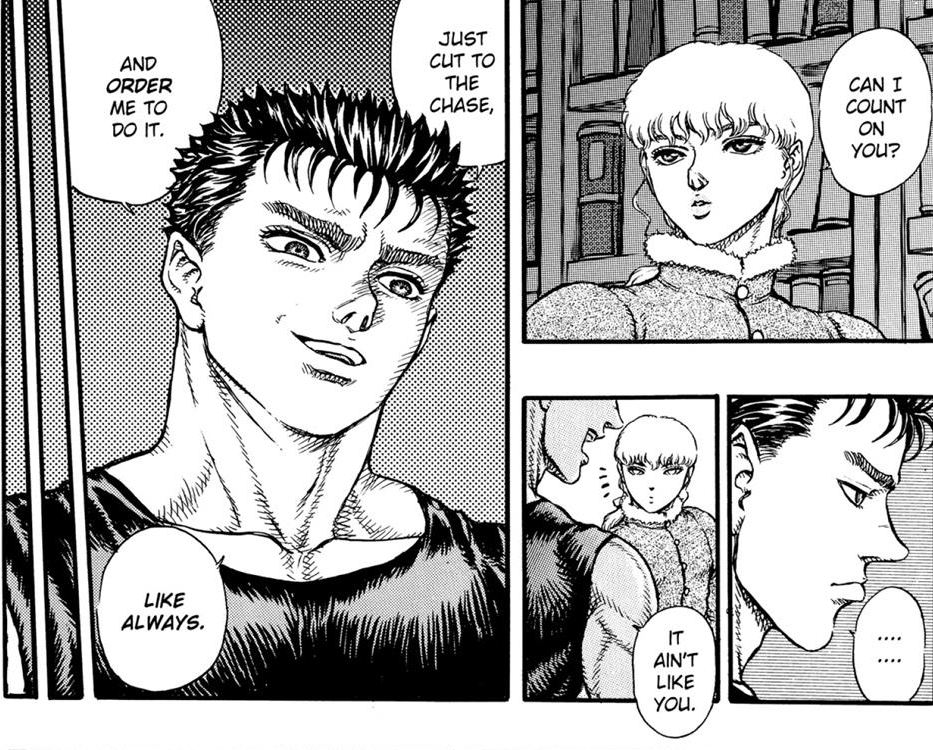
It’s dirty work. Failure isn’t permissible at all, nor is your face being seen. It’s for those reasons… that I’m asking you to do this.
The assassin can’t be recognized and can’t fuck it up, so Griffith specifically asks a huge dude with a huge sword who’s never stealthily killed anyone in his life and who immediately fucks it up to do it. Like, I’m thinking Judeau might’ve been a more solid choice for this particular mission, yk?
But those aren’t the reasons he picked Guts. The reason he picked Guts is the very first sentence: “It’s dirty work.”
This is the first time we see Griffith toss around the word “dirty” but it sure as hell isn’t the last. This is Griffith revealing a side of himself that he hasn’t revealed to anyone before, except Casca, accidentally – a side of himself that he’s ashamed of. And Guts is who he wants to reveal it to.
And this is Guts’ response.
Griffith is treating Guts like an equal in this scene, not like a soldier. In a way it’s a reversal of the waterfight scene: Guts treated Griffith like an equal and friend, and Griffith reminded himself that he’s Guts’ commander. Here Griffith is treating Guts like an equal and friend, and it’s Guts who reminds them that Griffith is the boss and he’s the subordinate.
I don’t think Guts intended to distance himself – it reads like a tension-breaking joke to me, but it’s a joke based on truth. They are a commander and subordinate, and this is a gentle rebuff and reminder of that fact to Griffith because, after risking his life for Guts and finally admitting it made no sense to do so, their actual unequal relationship has slipped from the forefront of his mind.
It’s a minor misunderstanding, and imo it wouldn’t be very important in the grand scheme of things, if it wasn’t for the next time Guts sees Griffith:
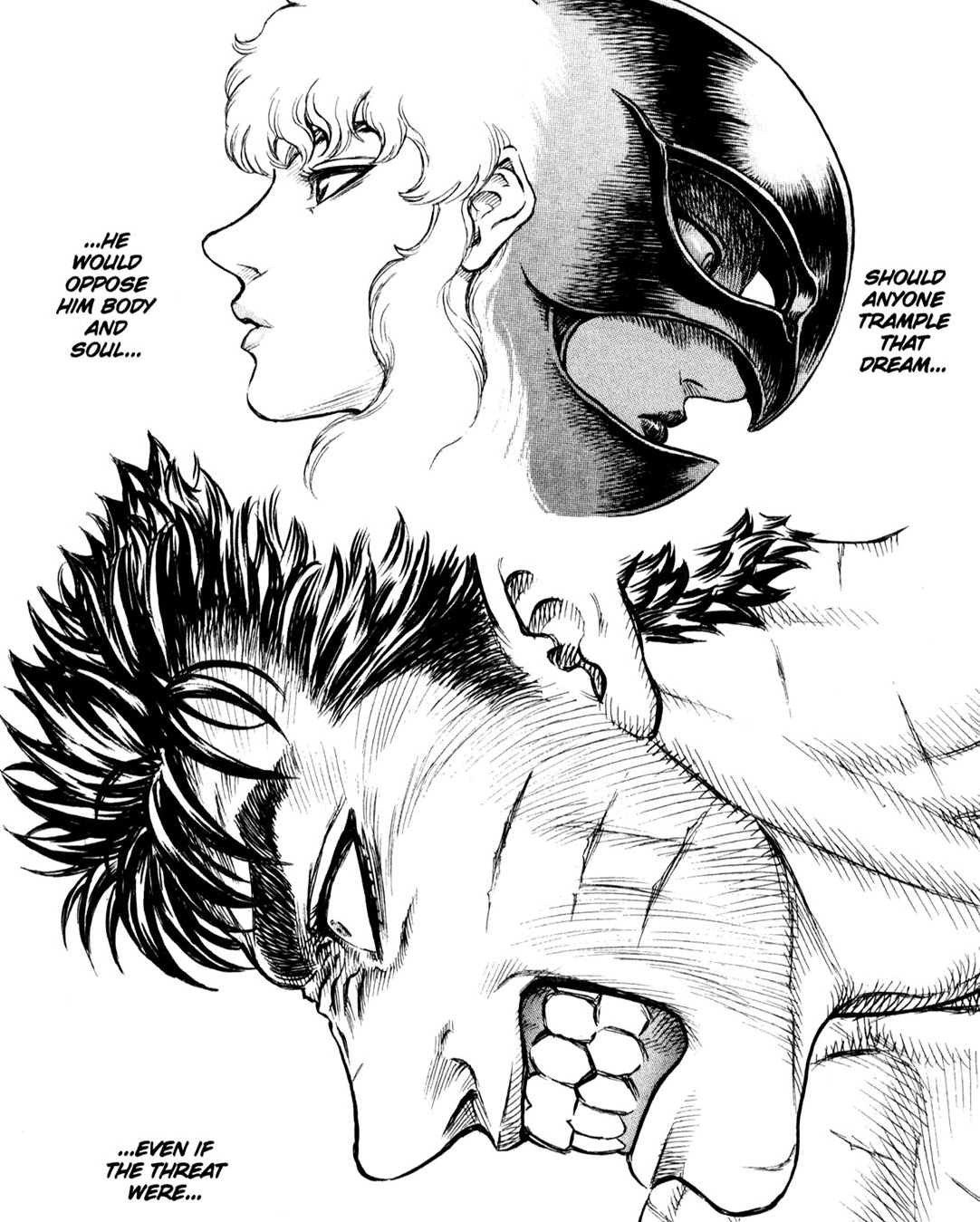
“They are… excellent troops. Together we have faced death so many times. They are my valuable comrades, devoting themselves to the dream I envision… But… to me, a friend is… something else. Someone who would never depend upon another’s dream… someone who wouldn’t be compelled by anyone, but would determine and pursue his own reason to live… And should anyone trample that dream he would oppose him body and soul… even if that threat were me myself… What I think a friend is… is one… who is my equal.”
Guts has just reminded him that while Griffith may want Guts to be his friend and equal, whether consciously or not, and may even be already subconsciously thinking of him that way, it’s not the nature of their relationship. Griffith is still his commander. He’s still the one who orders him into battle, and Guts could still die in service to his dream.
And like the waterfight to speech sequence three years ago, this is another instance of Griffith pulling back and trying to re-prioritize his dream over Guts, pushing down and repressing his actual feelings for Guts to focus on dreams.
Personally I don’t think Griffith is at all consciously aware of what he’s doing lol. I don’t think he planned to treat Guts like a friend and equal while asking him to assassinate someone, and I don’t think he actually thought to himself, “oh right, I’m his commander, not his friend.” I think it just came naturally for him to ask Guts instead of ordering him, and I think it came naturally to pontificate about how he doesn’t have friends while talking to Charlotte, and Guts reminding him that he’s his boss is at least partly why, even if Griffith himself doesn’t make that connection.
There’s a war raging between Guts and the dream in Griffith’s subconscious, and in light of being reminded that Guts views him as a superior and takes orders from him, the dream is rallying, basically.
During this whole speech Griffith is building the dream up, making it seem significant just for existing. What it does is show us how he sees himself – or, maybe more accurately, how he wants to see himself. He wants to believe that his dream is inherently noble, he needs to believe that it’s a worthy pursuit. Griffith isn’t lying to Charlotte here, so much as he’s lying to himself.
For no other’s sake vs for their sakes.
It’s easy to take the speech at face value at first, but it’s impossible when you learn more about Griffith.
The speech is about an abstract ideal, the same way his monologue about destiny was in his first scene, and it’s transformed when we learn more about him in five chapters, and are shown that the reality beneath it is much more complex. Dreams devouring dreams like storms, a life spent as a martyr to the god named Dream, Griffith finding the idea of being born and living just to live abhorrent – these are all framed as pretentious philosophical ideals. But looking back after Casca’s flashback once again gives this speech depth.
It’s his way of insisting to himself that he is what everyone believes him to be – an idealistic philosopher king waiting for his throne, justified in everything he does because it’s his perogative as a person to pursue a dream and achieving it is its own validation and proof that it was a worthy venture, rather than a monster walking a path of corpses.
I’d go so far as to argue that this is the point of Griffith’s wonderfully sinister smile when he finds out Guts killed Adonis too.
Again, it’s only five chapters before we learn that he has serious dead-child-related guilt issues, so what’s the deal? Well, the deal is that Griffith is even better at denial than he is at waging war. It’s the polar opposite of his reaction to First Kid’s death entirely for the sake of highlighting that difference.
The only two conclusions you can draw are that either Griffith has completely changed since the events Casca relates and no longer feels any guilt, or that he’s so thoroughly buried his guilt in this moment – this moment where he’s pontificating about his dream to Charlotte and building it up to her and himself – that his reaction is pleased. It’s similar to “I will decide the place where you die,” in the sense that it’s Griffith repressing his feelings by owning the inevitable cruelties of his dream.
And we know it’s not the first option, because first of all it would make that entire flashback comedically pointless, and because we see his guilt and self loathing surface again in significant moments, such as when he asks Guts, “do you think I’m cruel?”
Put another way: The dream signifies burying his heart and accepting that he’s cruel, while Guts signifies opening his heart and desperately not wanting to be a monster.
And again, we know that there’s more to this speech than what Griffith is actually saying, because we learn Griffith’s actual motivation soon after, and the entire point of Casca’s Griffith history lesson is to add those layers of guilt and self loathing and repression and let them colour everything we thought we knew about Griffith.
So now, to get back to his feelings about Guts, I want to examine Griffith’s definition of a friend in light of those guilt issues we learn about in the flashback.
To Griffith a friend is, ”someone who would never depend upon another’s dream… someone who wouldn’t be compelled by anyone, but would determine and pursue his own reason to live…”
To Griffith a friend is someone who would never depend on his dream, would never cling to his dream, would never die for his dream.
A friend is someone he cannot order into battle to die for him.
Furthermore, I want to suggest that Griffith’s, “he would oppose him body and soul, even if that threat were me myself,” clause adds another aspect to his criteria for friendship: a friend is someone who would never force Griffith to choose between him and his dream. A friend is someone who prioritizes his own dream, who understands that dreams come first and friendships come second, who can expect to be opposed if he stands in the way of Griffith’s dream, and vice versa.
Look at it this way: Guts has already forced Griffith to choose between him and his dream by nearly getting killed twice, and Guts won resoundingly both times. Because of this Guts represents an enormous threat to Griffith’s dream, because Griffith is willing to risk it for him. Three years ago Griffith said, “I will choose the place where you die,” to try to distance himself from Guts, but after Zodd he doesn’t even try to distance himself. He just tells Guts that he has no reason to put his own life on the line for Guts’ but that’s the way it is and that’s the way it’s gonna be.
Because Guts isn’t his “friend” by these standards, he’s at risk of dying for his dream. Because Griffith loves him, his dream is at risk of getting trampled for Guts.
The characters, of course, aren’t framing their decisions this way, but essentially, Guts’ answer to this conundrum is to leave to figure out a dream and become Griffith’s equal. He chooses to follow Griffith’s weird friendship criteria to the letter. But Griffith’s answer is to start replacing the dream with Guts.
2/2 So I’m a bit puzzled and I am wondering about your
interpretation, if you’ve already written a meta about that scene. What I
think is that Guts definitely sees Griffith romantically so he was
doubly heartbroken after hearing that he doesn’t see him as a friend or
equal, so he wanted to leave in order to make him care about him
seriously. But Griffith already loves Guts and respects him, so his
speech is a bit contradictory. Sorry for the long ask btw I love your
blog 🙂
Hi there 🙂 Yk, I don’t think I actually have really talked about this scene in much depth.
My general default reading of Guts and Griffith’s relationship is that they are both romantically in love with each other but neither of them actually realize that they are. (Well, I don’t think Guts has ever quite realized it, at least not consciously, but I do think that Griffith figured it out during his year of torture.)
So in my opinion, Griffith meant his friendship speech.
I also don’t think it’s a coincidence that the conversation that comes right before the assassination attempt and then Griffith’s speech in the narrative included this exchange:
Griffith asking Guts to assassinate Julius was, in a way, a gesture of friendship. It was a request for Guts to do this for him, as a favour for a friend rather than an order from a superior, and Guts picked up on Griffith’s careful phrasing and accidentally rebuffed him. I think Guts meant this as a lighthearted joke, but while we don’t get to see Griffith’s reaction to it, I’m willing to bet he took it as a rejection.
Maybe not even a purposeful rejection – but certainly a sign that Guts doesn’t see him as a friend, but sees him as a superior first. I think this leads directly to Griffith’s speech to Charlotte where he proclaims that he has no equals. Like, it’s completely accurate, whether or not it’s arrogant as well – people either look up at him as a saviour or symbol of their ability to rise in the world, or look down on him as a symbol of corruption in the system.
I also think there’s another important aspect to his speech.
What he describes to Charlotte as a friend is someone who has his own dream, separate from Griffith’s, and would pursue it even if it meant clashing with him.
To Griffith, whose life revolves around his dream and who frames things like that because it’s how he sees the world, what this translates to is that a friend is someone who won’t die in service to his dream.
I think he tries to keep an emotional distance between himself and his Hawks because, frankly, they tend to die in battle, and it fucks him up (as we see in Casca’s flashback to the dead kid and the morning after Gennon.)
So he says the Hawks aren’t his friends because he can’t think of them that way. They see him as a perfect leader, he sees them as people who he will one day send to their deaths, simply by ordering them into whichever battle eventually kills them.
So when Guts re-establishes that he sees Griffith as a leader and tells him to order him to do things instead of requesting favours, it’s a reminder to Griffith to distance himself.
Of course, it doesn’t actually work. He can’t turn off his feelings for Guts even if he tries to ignore and downplay them (also see: I had no reason at all for risking my life for you. He can acknowledge that yeah, he did do that, but he can’t acknowledge why – because he loves him – not even to himself.) Guts is still the only person who Griffith allows to see and participate in the shady shit he does to rise to the top, the stuff that makes him feel dirty. He still risks his life for Guts. He still sends a search party after Guts and Casca despite going against the wishes of the nobles he’s supposed to be sucking up to, and then ditches an important meeting to see them in person. He still expresses concern for Guts’ safety before the Battle of Doldrey. And he crashes and burns harder than anyone has ever crashed and burned after Guts leaves lol.
(Now there is an obvious contradiction in that Griffith wants to be Guts friend and equal rather than the superior who will send him to his death eventually, but also won’t let him leave the Hawks, but that’s plain old fear of rejection imo, and not understanding Guts’ reasons for leaving, and an irrational emotional implosion lol.)
AND I think there’s a third aspect that ought to be explored: Griffith can only call an equal who would fight for his own dream a friend because this definition allows him to continue prioritizing his dream. To save Guts’ life at the risk to his own, rather than let Guts be killed for his dream, is, at its core, a betrayal of his dream, and the thousands of people who’ve died for it. But if his “friend” was an “equal” with his own obsessive dream, then in theory he’d never have to choose between his friend and his dream – it would be understood that their respective dreams would be prioritized. Another reason for the “and should anyone trample that dream he would oppose him body and soul… even if that threat were me myself” clause.
At the end of the day Griffith already loves and respects Guts, of course – he has from day one – but he can’t admit that yet, not even to himself, imo, because it’s a serious, serious threat to everything he’s built his life around.
Tbh I feel like there’s a lot more to say on this topic, especially how and why Griffith represses and denies his feelings for Guts, and what his dream means to him, etc, but I think I’m definitely going to end up writing a long ass analytical post about him soon because I’m really feeling all this nitty gritty Griffith stuff at the moment lol. But yeah when it comes to Promrose Hall I think this is pretty much my thoughts on what Griffith’s speech is about.
Anyway, thanks for the message, I love talking about this kinda stuff 🙂 And ty I’m glad you enjoy my blog.
I love love looooooove Griffith’s immediate reaction to finding out Guts intends to leave. At that point I don’t think he had forgotten about Guts boss-zoning him, and him wanting to just … leave without a goddamn word only rubbed salt into that wound. In my opinion, along with impulsive irrationality fueled by pure fear, this is one of the reasons he so quickly resorted to basically saying “You can’t leave because I own you.” It’s spiteful out of hurt–if you’re going to treat me like a stranger, then I’m going to treat you like one too.
Yessss ia! And I also think that along those lines, while Griffith might not have been like hugely devastated Guts’ apparent rejection of his attempt to lower that barrier of commander/soldier between them at the time (yk he might’ve taken it as the light joke it was meant to be as well as just an incidental reminder that that’s not their relationship), after he learned that Guts wanted to leave I’ll bet he replayed that moment in his head and it turned into Guts asking to be ordered because he wouldn’t do it as a friend.
Like a judgement – I won’t voluntarily do this abhorrent dirty work for you, but I’ll do it if you order me to because I’m a soldier.
Griffith asking him instead of ordering him imo had another level of wanting Guts’ acceptance of his “dirty side.” It was a show of trust.
So I could def see “wrest yourself away by your sword,” coming from a place of spite + desperation from that angle too. You’ll only stay by my side if I order you to? Then that’s what I’ll do.
2/2 So I’m a bit puzzled and I am wondering about your
interpretation, if you’ve already written a meta about that scene. What I
think is that Guts definitely sees Griffith romantically so he was
doubly heartbroken after hearing that he doesn’t see him as a friend or
equal, so he wanted to leave in order to make him care about him
seriously. But Griffith already loves Guts and respects him, so his
speech is a bit contradictory. Sorry for the long ask btw I love your
blog 🙂
Hi there 🙂 Yk, I don’t think I actually have really talked about this scene in much depth.
My general default reading of Guts and Griffith’s relationship is that they are both romantically in love with each other but neither of them actually realize that they are. (Well, I don’t think Guts has ever quite realized it, at least not consciously, but I do think that Griffith figured it out during his year of torture.)
So in my opinion, Griffith meant his friendship speech.
I also don’t think it’s a coincidence that the conversation that comes right before the assassination attempt and then Griffith’s speech in the narrative included this exchange:
Griffith asking Guts to assassinate Julius was, in a way, a gesture of friendship. It was a request for Guts to do this for him, as a favour for a friend rather than an order from a superior, and Guts picked up on Griffith’s careful phrasing and accidentally rebuffed him. I think Guts meant this as a lighthearted joke, but while we don’t get to see Griffith’s reaction to it, I’m willing to bet he took it as a rejection.
Maybe not even a purposeful rejection – but certainly a sign that Guts doesn’t see him as a friend, but sees him as a superior first. I think this leads directly to Griffith’s speech to Charlotte where he proclaims that he has no equals. Like, it’s completely accurate, whether or not it’s arrogant as well – people either look up at him as a saviour or symbol of their ability to rise in the world, or look down on him as a symbol of corruption in the system.
I also think there’s another important aspect to his speech.
What he describes to Charlotte as a friend is someone who has his own dream, separate from Griffith’s, and would pursue it even if it meant clashing with him.
To Griffith, whose life revolves around his dream and who frames things like that because it’s how he sees the world, what this translates to is that a friend is someone who won’t die in service to his dream.
I think he tries to keep an emotional distance between himself and his Hawks because, frankly, they tend to die in battle, and it fucks him up (as we see in Casca’s flashback to the dead kid and the morning after Gennon.)
So he says the Hawks aren’t his friends because he can’t think of them that way. They see him as a perfect leader, he sees them as people who he will one day send to their deaths, simply by ordering them into whichever battle eventually kills them.
So when Guts re-establishes that he sees Griffith as a leader and tells him to order him to do things instead of requesting favours, it’s a reminder to Griffith to distance himself.
Of course, it doesn’t actually work. He can’t turn off his feelings for Guts even if he tries to ignore and downplay them (also see: I had no reason at all for risking my life for you. He can acknowledge that yeah, he did do that, but he can’t acknowledge why – because he loves him – not even to himself.) Guts is still the only person who Griffith allows to see and participate in the shady shit he does to rise to the top, the stuff that makes him feel dirty. He still risks his life for Guts. He still sends a search party after Guts and Casca despite going against the wishes of the nobles he’s supposed to be sucking up to, and then ditches an important meeting to see them in person. He still expresses concern for Guts’ safety before the Battle of Doldrey. And he crashes and burns harder than anyone has ever crashed and burned after Guts leaves lol.
(Now there is an obvious contradiction in that Griffith wants to be Guts friend and equal rather than the superior who will send him to his death eventually, but also won’t let him leave the Hawks, but that’s plain old fear of rejection imo, and not understanding Guts’ reasons for leaving, and an irrational emotional implosion lol.)
AND I think there’s a third aspect that ought to be explored: Griffith can only call an equal who would fight for his own dream a friend because this definition allows him to continue prioritizing his dream. To save Guts’ life at the risk to his own, rather than let Guts be killed for his dream, is, at its core, a betrayal of his dream, and the thousands of people who’ve died for it. But if his “friend” was an “equal” with his own obsessive dream, then in theory he’d never have to choose between his friend and his dream – it would be understood that their respective dreams would be prioritized. Another reason for the “and should anyone trample that dream he would oppose him body and soul… even if that threat were me myself” clause.
At the end of the day Griffith already loves and respects Guts, of course – he has from day one – but he can’t admit that yet, not even to himself, imo, because it’s a serious, serious threat to everything he’s built his life around.
Tbh I feel like there’s a lot more to say on this topic, especially how and why Griffith represses and denies his feelings for Guts, and what his dream means to him, etc, but I think I’m definitely going to end up writing a long ass analytical post about him soon because I’m really feeling all this nitty gritty Griffith stuff at the moment lol. But yeah when it comes to Promrose Hall I think this is pretty much my thoughts on what Griffith’s speech is about.
Anyway, thanks for the message, I love talking about this kinda stuff 🙂 And ty I’m glad you enjoy my blog.
I like that Griffith’s two examples describe both him and Guts in the future. Like Griffith isn’t into world domination now, he just wants to be a king, but it sounds like that’s where the Falconia thing/Gaiseric’s giant empire parallel is headed.
And Black Swordsman Guts is both literally tempering his giant sword by infusing it with evil ghost spirits and shit, and also metaphorically honing himself a la Godo’s metaphor for him thru his dream of revenge and fighting tougher and tougher enemies.
and when he got his lofty noble dream figured out it was inspired by Godo being a blacksmith
but at the end of the day both go hand in hand with self destruction so like Griffith was right on the money here
tbh this probably didn’t help guts’ feelings of inadequacy when he overheard griffith’s speech an hour later
irony: two dudes think of themselves as monstrous and unworthy of the other; become monsters because of it
This was actually what I took away from the fountain speech between Charlotte and Griffith the first time I watched it. Honestly the ‘Omg he’s such an asshole for not considering them friends’ was new to me until I saw others talking about it.
I once remember saying I can make everything about Berserk.
@bthump I remember you once saying something similar.
i love that this is on a britney spears gifset lmao, your talent for making anything about Berserk is impressive.
but yeah strong agree, like, Griffith doesn’t call them friends but they don’t treat him like a friend, they treat him like a leader and figurehead. even guts does when it comes down to it.
the scene between Guts and Griffith that comes right before the Promrose Hall speech was Griffith asking Guts to assassinate Julius for him, which I find really telling. Griffith words it carefully, very pointedly not giving him an order but simply making it a request – it was Griffith treating Guts like an equal and friend and co-conspirator. And Guts’ response was, “just order me to do it.”
Which yk makes sense and is a perfectly reasonable and kind of amusing and dry response, but it’s another thing Griffith could and probably did take as a mild rejection (especially if he’s looking back on their relationship after everything goes south). It was easily interpretable as Guts saying “I’m doing this because I’m your soldier, not for you.”
The fact that Guts decides to pursue an equal
relationship with Griffith after hearing the speech is what singles his
relationship with Griffith out as unique. Everyone else in Griffith’s life is content to
either look up at or down on him.
Even the Princess, his future wife,
just marvels at the speech while literally looking up at him, rather than showing any desire to find a
dream herself and become “worthy” of calling herself his equal.
Because Guts is the only one who wants to genuinely connect with
Griffith – who wants to stand beside him by achieving something of his own – Guts is Griffith’s only “true” relationship, the only
relationship he has based on real affection and genuine desire for the
person, and not just what he represents, either as a symbol of hope and achievement (for the Hawks), a symbol of security and happiness (for Charlotte) or a symbol of corruption and loss of power (for those plotting against him).
Which just makes it so wonderfully ironic that Guts is the only one who made Griffith forget his dream.


















 you're the only one