thinkin about how we never really talk about casca being ordered to sleep with guts his first night with the hawks.
it’s clear why she was ordered to do it- griffith wants guts’s favor, he wants him as an ally, he wants him, period.
and what do you do when you want someone to like you? you give…
Warning: Very long post ahead.
I know this has caused a bit of a stir since yesterday, but I’m really glad you posted this and put this particular scene under the spotlight. It does carry a lot of ugly implications, it’s often overlooked, and Casca’s perspective is an important one…so here are some of my thoughts.
I enjoyed how Griffith has been portrayed as a very lead from the front kind of a leader.
It’s kind of a contrast from most characters who fall under the Genuis-strategist trope.
Characters like Reinhard from Legend of the Galactic heroes or more recently Lelouch from Code Geass are (both) also genius military commanders but they always command from a distance, preferring to maintain their vantage point so that they can have the best view of the battlefield, they also almost never take advice from or consult anyone else and micromanage the actions of their subordinates with strict orders. We are made to understand the this distance is necessary not only because of the nature of the two characters but also to maintain objectivity and performance while giving commands. Their men in turn follow them because they consistently get results and are known to be ruthless to their enemies.
Griffith by contrast is always right on the frontline, infact his preferred formation is the arrowhead formation where he is the tip of the arrow and is actually the first one to engage with the enemy, this formation relies on the one in front to create an opening through which the rest can push through. Griffith very literally, leads by example.
He also holds meetings and consults with the other commanders on most occasions (atleast in the beginning), and by the time the battle starts most people are already in on the plan, he delegates important tasks and has an amount of trust in his people to then follow through, Griffith lays out the broad plans and then simply trusts everyone to do their best, there’s almost never any sudden mid-battle changes in instructions.
From a pure strategic view. This is actually not the ideal situation, the commander is the heart of any military campaign and should always be in a position to improvise and stay safe if possible.
But the crazy thing is what he may lack in terms of Genius, he more than makes up for in terms of pure heart something which does wonders for morale and garners a kind of loyalty that cannot be beaten by only calculations.
And I really really loved that in a world as cynical and dark as berserk’s, the most successful commander was someone who ruled through love and not fear, and dared to oppose the machiavellinism we’ve almost learnt to accept as fact.
Oh boy, what a good question! I, personally, will be Fucking Pissed if Casca doesn’t remember her experiences post-Eclipse and pre-healing. That would just be way too much of an easy out. The Eclipse was obviously the Pinnacle Of Trauma or whatever, but Casca’s been through so, so much since then. I’m working on the assumption that she does remember given the number of phallic monsters compared to the number of times men have tried assaulting her post-Eclipse. That and tiny Casca – imagery from these dream chapters has made it pretty apparent that tiny Casca represents Casca’s heart, and tiny Casca’s been there the whole time. She’s just been quiiite weak. There’s also the chapter where Casca kills a couple men even in her regressed state pretty early on, which showed that Casca is Still In There, Somewhere. Of course this could just be my “wishful” (praying for some decent writing) thinking, but, hey. Fingers crossed. I’m hopeful.
This is going to be long, so here’s a cut. This kind of ended up being a Casca post-healing character development answer more than anything, but there’s plenty of Farnesca conceptualizing in it. ;D
While Miura does her one of the greatest disservices ever done to a female character in the history of fiction, fuck me if I am not forever and deeply moved by everything to do with Caska.
She is all that stands between her comrades and her family and an ugly, ignoble death. Her pillars are gone. Her reasons for who she is and what she fights for are dwindling by the minute, and her reserves are at their lowest point, but she does exactly what she needs to do to keep the Hawks alive. She steps into the role that was never meant for her and she fulfills her duty to the utmost. She dragged herself out of death’s door and five arrow wounds to keep them safe, and she does. She keeps her men together and organized for an entire year in the absolute worst of conditions, and that is more than Guts or Griffith combined could have done. No matter what happens to her after this; that fact remains. She has nothing to live for and nothing to look forward to, but the Hawks are her duty and she will see it through.
Oh gosh, yes to all the above. We need more appreciation for Casca as a leader and for the back-breaking work she put into keeping the Hawks alive and organised during this year. Because honestly, while she may not have Griffith’s innate charm and ability to read others, I think she’s every bit as good and strong and capable a leader as he was. It’s so overlooked, but she assumed power at a moment of huge disadvantage and chaos, and went through debilitating amounts of stress in harsh conditions and still she fought on and stuck with the Hawks – her family, the people she’d grown to adulthood amongst – and kept them alive, kept them together, and kept them a fighting force to be reckoned with.
And what gets me most about Casca when contrasting her to Griffith and Guts is that she too suffers from a lost or broken dream as much as either of them, but unlike Guts and Griffith her response is never to deal with it by abandoning her friends.
I remember reading the Berserk TV tropes page and raging when they outright said in the page that Casca was weak during the time she lead the Hawks, really? Weak? Are we even reading the same manga?
It’s a no-win scenario – if Casca was written as totally stress-free and confident and super-capable during this part, people would criticise her for being unrealistic or too perfect, or see it as proof of her as some cliched wish-fulfilment fantasy token. But to write her as having flaws and failings invites people to view her as “weak” just for being portrayed as human and for having an understandably hard time with the situation.
I think it might come down to comparing her to Guts and Griffith (which is understandable considering she’s the tritagonist) rather than the Band of the Hawk, which is where I think she should stand as the character who most strongly represents and embodies the Hawks imho. I really don’t think she’s meant to be measured against Guts and Griffith because both of them were near-superhuman (and are now literally superhuman or relying on superhuman aid) in terms of skill and Casca always has been and always will be so utterly human in her endeavours and accomplishments. We’re meant to measure her against the Hawks – because she belongs among them and with them, walking on the ground and doing her finest, and still being valuable and irreplaceable despite her normality and her limits – and among them, she shines. And she’s the leader they chose too. No-one questioned her taking command after she near-singlehandedly got them out of the Midland ambush.
And it makes me rage so much too, because the point here is that she’s being strong. This is how I define strength, not in being impervious. She’s been suffering from an incredible amount of pressure and stress – and physical exhaustion – for a year. And that year began with her taking five arrow wounds – and it probably took a long time to completely heal from nearly dying, but I don’t doubt she still kept issuing orders from her sickbed. Her state here is completely realistic and understandable and I loved that she was given these moments, that a soldier’s anxiety and depression and exhaustion were so sympathetically presented, that she was so much more than the typical flawless action girl whose perfection gets measured in how much like a man she is. Casca was frail, Casca was wounded, Casca was overworked, Casca’s nerves were shot, Casca couldn’t eat or sleep from anxiety, Casca was struggling more and more to hold onto her sense of self, Casca bore responsibility for every life under her and for her soldiers’ morale too, Casca was running on nothing but hope – but she still kept going. Her reasons for doing this and putting herself through all this are gone, but it’s still the only thing that makes sense to her and gives meaning to her life, and if she quits and puts herself and her own well-being first then there’s no-one left to ensure the survival of the others.
I do have some issues with the presentation of her character too because I do feel like she’s set up to fail multiple times, I’m genuinely not sure if some of the sexism she faces is Watsonian or Doylist, and it’s also frustrating not to have more focus on her triumphs (that’s why I loved the 2nd movie for prioritising her rematch with Adon and for showing her taking command of the Hawks; both awesome scenes) over the times when she needs rescuing, or focusing on only when Casca runs into trouble rather than other characters. But her character is what makes up for that to me because so much of her pre-Eclipse arc is so beautiful and her persona – especially her flaws and vulnerabilities – is just so rounded and humane and incredibly rich and realistic, and so many of her feelings and achievements are just so moving to me.
Her treatment as a character following the Eclipse devastates me though. But I think everyone agrees with that.
note I said while leaving not by leaving. Because whether or not he should have left at all is a separate argument. He completely had the right to yes, and no, Griffith did not actually own him- but from a point of view of basic decency he fails completely.
The thing is we as readers get to know of his reasons long ago, we know it’s to do with wanting to be an equal or friend to Griffith. So does Casca, judeau, corkus…they’ve familiarised themselves with the fact.
Griffith doesn’t have a clue.
And I’ve come across people saying he overreacted to the news, but honestly?
If the person closest to you, someone you’ve nearly spent all your past several years with, someone you have countless happy memories with, someone you’ve let in on tings you’ve never told anyone- suddenly gets up and leaves town permanently, just goes and disappears from your life intentionally without as much as an explanation or goodbye, and you only get to know once you figure out everyone except you already knew, how would you feel?
Imagine your childhood best friend or long-time partner doing that.
Being devastated is not overreaction here.
It’s just that as an audience we are more forgiving of Guts’ decision because we know his reasons and that ultimately in a way he only wanted to help or be with Griffith And that he at least partially intended to come back.And we understand the value of self-discovery.
That does not make it okay in universe.
Imagine in converse,
Griffith overhearing Guts talking to Casca about wanting to leave and find his own path, deciding that to do that Guts would have to leave the band. And interpreting that Guts wouldn’t be comfortable leaving before the war is over even though he really wants to leave. So to make things simpler,
He throws Guts out of the band of the Hawk. No explanation. Just Goodbye.
Does sound like the decent thing to do? Hell no.
It’s hurtful, it’s going to leave Guts shocked and disoriented, wondering what he did wrong and completely miserable. Even though we know why he did it it’s not the right thing to do.
Which is precisely what I’m trying to get at here.
Also of course there’s the argument that Guts didn’t know how this would affect Griffith, to which I say -well- If he had no idea, why was he trying to convince himself off the opposite so hard as he walked away?
Guts already subconciously knew Griffith would have a reaction to him leaving. It’s precisely why he doesn’t talk to him about it. It’s precisely why he doesn’t look back after defeating him. Because he knew.
Atleast semi-intentionally breaking someone’s heart just because you are afraid of a hard conversation is not okay.
And it’s crazy to bring up what’s okay in the context of Berserk, I know. I mean this entire universe is a fucking mess. But some of us still do extriact moral judgement here and there. So while we are already on this sinking ship I say- Have a look at this too!
Neo-Griffith is honestly really hard for me to understand. Like what’s going on in that mind of his, it’s so difficult to tell.
I’m not really sure about offended because he didn’t seem angry to me just dissapointed and slightly deflated but I do think he was shocked, much like most of us didn’t see that slap coming.
However I don’t think that Rickert’s refusal came as a complete surprise to Griffith, he’d already considered the possibility, he’d already said “It’s possible you may hate me after knowing the truth…”
But it’s interesting that he didn’t say probable. That’s most probably Griffith’s personal desires warping the truth of the facts around him. Griffith wants to go back to that stage in his life when he had it all figured out, and the Band of the Hawk was by his side. He wants to think that Rickert may chose to join him because he Wants Rickert to join him. All his actions with the Neo Band of the Hawk reflect his desire. He’s trying to rebuild what he’s lost. But They are empty replacements, and so to have Rickert back , a real part of the past he’s trying to recreate is important to him.
It reminds me of two lines from the Manga which have been recurrent themes
“Don’t abandon what you can’t replace”
“Even if you painstakingly put something back together piece by piece it will never be the same.”
They were said with respect to Guts but I feel are highly applicable to Griffith right now too. And is I feel one of the many parallels between them that we get.
So in conclusion, yes the slap was definitely a harsh reality check for Griffith. Which is precisely why he’s playing it cool and saying it doesn’t matter. But yes he’s shaken and contemplative now.
When he first saw Rickert in Falconia, You could see the enthusiasm in Griffith’s body language. It was self delusional yes. But he dropped everything and practically ran to him. He’d obviously been looking forward to seeing him.
Also I think he’d taken it for granted that the fact that Rickert came at all meant he had already decided to accept. I mean most people don’t come all that way, braving monsters and climbing a million stairs just to deliver a well deserved slap.
He opens the conversation grandiosely, many words and poetry. Exposition and greeting. He’s already expecting things to go up from here, they have been for sometime after all. Nothing has changed he wants to believe that. Then the refusal comes and all that comes out for the rest of the interaction is a muted ‘so it is’ because I think he’s coming to come to terms with the fact that truly? Everything has changed.
@bthump Because you always have the best neo-griffith thoughts. 🙂
oh my gooood i got to the bolded bit and started practically rubbing my hands together in glee at your insight. this whole answer is amazing.
The exploration of identity with NeoGriffith has the potential to be so so good. The way it does seem like he wants Rickert to join him because having a former Hawk accept the NeoBand would be a kind of validation that he needs on some level.
The way Rickert phrases his refusal is one of my favourite moments because of the emphasis he places on how it’s not his Band, and Griffith isn’t his Griffith, and the small differences between insignias matter. And all Griffith can do is passively agree. Now that you’ve drawn the comparison between the NeoBand and those significant lines about forcing back what was and abandoning irreplacable things I am dying to see where that leads even more.
Also it occurs to me that this is the first scene we see where NeoGriff is taken aback and not in control – the way Rickert slaps him, the way he has no response to Rickert’s speech – since the very first scene where his heart started beating and he saved Casca and went ‘wtf’ to himself. Add the fact that he apparently didn’t see the slap coming despite his magic powers of being essentially untouchable, and I think it’s a fair guess that his beating heart and surviving emotions are throwing him off his game again here. (Which incidentally is another solid sign that it’s not the fetus screwing with him bc i doubt very much the fetus gives a fuck about Rickert.)
ty for tagging me! I don’t think there was really much to add to your answer so this is mostly me nodding vigorously and flailing a little lol.
Content warning: discussion of sexual assault, childhood
sexual abuse, and spoilers for the Golden Age Arc
Fantasy stories
like Game of Thrones or stories that
chronicle real dynastic power struggles (albeit in a sensational way) examine the human wreckage that can be wrought
by larger power structure that has been set up.
The personal is the political in Berserk
in a way that I think different than other low fantasy settings in that goes
the extra step of suggesting that there really is no redemption even in
surviving in that environment. . This is, I think, a function of our heroes and
our antagonist being of common birth, while most of our heroes in Game of
Thrones have family name and influence . It’s that privilege that they are
fighting for.
The tragic flaw
of our antagonist, Griffith of course is his ambition. The sin, I argue, is not so much as wanting
too much, but rather in wanting the wrong things: It’s a little scene of
exposition that revels the central pathology of Midland as a political entity.
Griffith explains to Guts what he had been told, that anyone possessing the Crimson Behelit is
destined to rule the world, and then he adds with a laugh;
“In exchange for your flesh and blood, of course.”
Griffith’s broken
human body is of course put though a physical transformation to become Femto,
but it’s the band of the Hawk and their bodies that make up the true
“flesh and blood” of the sacrifice. In the middle ages and into the
modern era there was a notion of a kind of tree that represented the state: God
at the top of course and underneath the king, and so on until you got to
inanimate objects like rocks at the bottom.
Families would naturally follow this pattern as well with the husband at
the top and women and children underneath and so on.
If you take the paternal metaphor for sovereignty
this makes sense; who else are your flesh and blood besides your men? Your
partner(s)? Berserk really emerges
then as an examination the ways that power is created and enforced in a patriarchal
hereditary monarchy. It becomes absolutely impossible to form relationships
outside of this pardam even in marginal, quasi independent communities like The
Band of the Hawk. The language of
intimacy itself has become the way that these power imbalances are maintained by
making violence and love indistinguishable linguistically from each other. It is
imbedded into the very definition of family in this universe. Given this information,
we can really look at the events of the Golden Age Arc as an parade of actions
by bad fathers.
Casca’s parents sell
her into the service of wealthy man to get her out of house. It’s impossible to say to what extent her
family knew or acknowledged that her servitude put her in danger of sexual
exploitation. Her father, (she doesn’t mention her mother) either had always
thought of her as being that disposable and didn’t care or he hoped that she
would be “smart enough” perhaps, to parrot the rape myth, to avoid
that. Yet another possibility is that he figured that if she is passed from man
to man, that she will eventually learn to charge for her trouble and make good.
Casca, of course, characteristically minimizes the impact of this abandonment
on her and her identity as a woman.
Guts is born into
chaos; He is picked up by a woman who is traveling with a band of mercenaries,
and after her death from a plague he is left in the care of her partner,
Gambino. With a malignant
sentimentality that only a specific kind of guilty conscious is capable of,
Gambino channels his rage into withholding his love from Guts and blaming him
for his mother’s illness and death. When
Guts comes home with his first earnings from a battle Gambino while
superficially complimentary is actually poised to terrorize him: He sells him
to one of his men for the night. Donavan taunts Guts during the rape that Gambino was the one
to sell him out. Guts doesn’t believe
him at the time, but of course ultimately learned that the only father he had
ever known had fed him to a monster.
The King summarily
throwing Griffith in prison and torturing him can be seen initially perhaps as understandable reaction of a parent
discovering that an adult has taken advantage of their child. As a parting
shot, Griffith suggests that perhaps the King meant to keep Charlotte for
himself. Griffith has no way of knowing that this turns out to be exactly the
case ,at least now that Charlotte, no longer a virgin, presumably sexually available now that she is
unable to be sold. This turn of events prompts Charlotte to risk everything to
bust Griffith out of jail. *
Both Guts and
Casca (as well as Griffith) turned, of course, to the life of the sword to free
them from this cycle, since it is only in physical violence that they have been
able to rise protect themselves. However, they make the assumption that this is
effective in error. The lines between being a mercenary and other kinds of
marginal labor, like prostitution become blurred by implication rather than
explicit equivocation. Aside from the oblivious instance of Griffith’s rape by
Gennon, the language of sex and battle are often used together, particularly
between Guts and Griffith.
“If I win, I put a hole in your chest as big as
this.” Guts says during their first dual.
“And if I win?”
What Guts says in response is slightly different dependant
on the translation but I have to say I’m partial to this version.
“You can have whatever you want; my sword or my
ass.”
“I rather enjoy settling things by force.” answer’s
Griffith.
There’s a wink in his voice, which is unsettling when paired
with a statement that could fairly, if fighting is sex , be read as a (cheeky?) rape threat.
The language that Griffith uses to talk to Guts about his fighting
when they are in private three years after the initial duel is the same.
“When you fight, and how you fight is all for me.
Because you’re mine.” he says softly.
When you put these things together Guts’ body in battle
really is interchangeable with an erotic Guts.
It felt terribly intimate to hear.
This of course takes us to Griffith and the Eclipse. When,
exactly is he behaving differently than a “legitimate” sovereign in
this context? Yes all of Hawks are sacrificed but in that moment, what is
really the difference between losing them all at once or losing them in pieces
in every battle? The “sacrifice” demanded of Guts and Casca is by
contrast, sexual, and at least among folks I’ve talked to about this these are
regarded as equal crimes. During the Eclipse,
I couldn’t help but think of the moment that Griffith saves her from her first
would-be rapist, (as did she).
“Do you think you have some kind of divine right?”
he yells at the man, before handing
Casca the sword.
We may have seen him
be admitted to the peerage but the Eclipse, when he is literally given the divine
license of kingship, is the true moment
where he becomes an aristocrat.
I think Guts’ tears were brought on by two things: Femto and Theresia.
The summoning of the Godhand is the first time that Guts sees Femto in the flesh since the Eclipse – literally the last time Guts looked at him, Femto had just finished raping Casca. And no matter how tough Guts may seem, the experience of being faced with Femto and the Godhand again is traumatic and triggering all in itself. And even though Guts wanted this moment and has been hunting apostles with this encounter in mind, the reality is that it’s all on their terms yet again and he’s still not actually ready for it when it happens. It stirs powerful and mixed emotions in him; the kind he hasn’t let himself feel for the past two years. And the worst part of it is that it’s not all negative emotions, because seeing Femto makes him remember the good in the past too – he even has a flashback of how Griffith used to be when he was human and Guts’ friend, and clearly still remembers Griffith with poignancy and longing, whether he wants to or not.
The thing is, I don’t think that Guts’ emotions during this scene are as clear-cut as only hatred and the urge to kill (as overwhelming as those feelings are), because when Femto taunts him and pushes his buttons by repeatedly telling Guts how worthless and pitiful he is…it works. Those words hit Guts where it hurts on a very personal level. Femto turns his attention to the Slug Count for most of the scene, and all he has to say about Guts is that he’s no threat and isn’t worth bothering with – he’s just a fly in need of swatting when the Godhand are really here for the Count and Theresia. He’s too low for Femto to even notice. Not only do those words put Guts’ dream of revenge into really harsh perspective, but he also has to suffer being ridiculed and looked down on by the one person he wanted to respect him and look well on him; the one person he would’ve given anything to stand beside as an equal once. It plays on some of Guts’ deepest insecurities and fears of being insignificant and having no value to the people he cares about, so even after everything that’s happened between Guts and Griffith, those words look like they sting and reopen old wounds (as I imagine they were meant to). So on top of everything else affecting Guts during this scene, he’s also having to deal with the fact that Griffith still has some degree of emotional power over him – including the power to hurt him.
Then Guts has to watch a sacrifice bid play out again, which means re-living the worst and most horrific thing that ever happened to him, and is faced with what’s going to happen to him after he dies. And during this whole sequence, he makes something like three different attempts to kill Femto, and he fails every single time. And not just by a little, but by enough to show that Femto is completely beyond Guts and can’t even be touched by him. It seems to prove the truth in Femto’s words about Guts being too puny and pathetic to even bother with, and how totally outmatched and useless an ordinary human is against him.
The second part of it is Theresia. It’s only after she nearly falls to her death that Guts seems to realise what he nearly did by encouraging her to kill herself. Suddenly, he seems able to see her as a person rather than a tool to use against her father, and can identify with her – because when it came down to it, even after everything she’d been through and in spite of having every reason to just give up and die, this little girl hung onto her life (literally!) with all she had and no matter how much it hurt. Even with the Dragonslayer cutting into her hands! When he sees her wounded palms, it visibly triggers a reaction in Guts and he looks really shaken by the sight of her and the pain she’s in – again, because I think he’s seeing a part of himself in her (the very next chapter, we get this moment) and it humanises her. And it turns him into the monster that causes the pain – and I think the enormity of how badly he messed up hits him right then, if only for a moment, and it’s very upsetting. Then Theresia reflects Guts even more by finding power in her anger and hate, to the point where it’s actually the thing that gives her motivation to keep living. Guts may initially seem satisfied that he gave Theresia something to live for, but as soon as his back is turned on her it all melts away, and I think it indicates that causing another person to exist like him and survive at the same cost he pays isn’t what Guts wanted.
So the whole experience is extremely disturbing and unsatisfying on every possible level, and Guts comes out of it with nothing – and after two years of searching for this chance. Rather than getting any kind of revenge, satisfaction or closure, Guts is left more distraught and outraged than ever, and is emotionally and physically exhausted by everything he’s just been through. The only thing he succeeded in doing was destroying Theresia’s innocence, and he looks bone-weary by the end of it. So it makes sense to me that he’d be full of painful feelings and memories and would be in a very emotionally raw state.
Who wouldn’t cry with all that churning inside them?
Well so far these are probably my favourite pages of the Fantasia arc (+ the slap ofc)
Rickert’s speech as a whole is just breathtaking, Rickert pointing out the difference in the insignias, the present tense of “I am led by the white-winged Griffith” showing he still respects Griffith as he was but considers this guy not to be him, Griffith’s only words are an acknowledgement of that difference – “…so it is” -, the hair over Griffith’s eyes suggesting he is feeling feelings and we just don’t get to know what they are, Rickert’s smile of pride when he talks about the Band he considers himself a part of…
it’s just so good
I personally don’t feel that whatever is being shaded over in Griffith’s face is malice.
I think it’s him having to face the consequences, or at least feel them up close for the first time after the eclipse granted him the powers to enable his escapism. I think Griffith is slowly coming to realise that the numbness he weaponised and clung to on transforming to Femto is sort of out of commission as of his rebirth.
But he’s going to pretend it’s still there for his audiences’ benefit right till the end.
I am actually looking forward to Griffith looking back on what he did and actually looking at it from the human perspective he now has. Back when he made the decision he wasn’t even close to thinking rationally , the decision was influenced by despair and the mindscape fuckery Conrad and Ubik were indulging in and I always saw Griffith’s decision more as motivated from wanting an escape from his current emotional mess rather than a grab for power–but I digress.
My point was that the Eclipse wasn’t a result of Griffith’s clear thinking or reflection which we know he has always been capable of because he wasn’t in the state of mind to be able to do that then. But now he does. Honestly Neo- Grifffith most probably has a fair bit of time on his hand s right now. And I’d love for him to get thinking.
Put in perspective the fact that the nameless bodies he’d decided to ‘pile up’ back then to try and give meaning to the cries of the mangled corpses pleading with him in his mindscape at that very moment- were not nameless or faceless.
These were people he knew, had memories with, had cared about.
And having Rickert come up and spell it out, REMIND him.
I want that to fuck him up. And I’m pretty sure it’s happening too.
Guilt has always been an emotion Griffith feels strongly, maybe even one of the strongest tributaries to his ambition.Its what caused the Gennon incident and it’s arguably what caused the Eclipse.
Bring that back Miura, Please.
P.S. – I am a hundred percent sure it was Locus not Griffith who sent Rakshas after Rickert. Like dude was raving mad about that slap.Broke a wall.
Yk, take the “so you could bury your fragile human heart” line to the count, add Puck pointing out that the Count is still human even though he denies it (like you said in that other response – apostles are in a way almost extra human, I totally agree), add Rosine fucking up because Jill was in danger, especially add Ganeshka’s terrified isolation when he ascended to a higher plane, and add Femto’s failure to kill Guts and NeoGriff’s heartbeat, and I’m js the groundwork is so laid out for NeoGriffith to start demonstrating some intriguing emotions (to the audience if not other people) that you could build a skyscraper on that foundation.
I could see him questioning his own identity after going through 3 magical transformation sequences and Rickert straight up calling him not-Griffith, the way Ganeshka started screaming “WHO AM I.” I could definitely see isolation. I could definitely see longing – for Guts obviously, for an equal in general – and of course if the guilt made a comeback (and esp after Rickert’s speech I could see that too) I’d be ecstatic.
I could see him feeling cut off from his past as a human (or viewing it like a dream a la what the Godhand said as he transformed) and growing perturbed by that rather than content.
Like okay when he became Femto his heart “froze.” Hence the “strange… I don’t feel anything” while the Band were gruesomely dying etc. How that works with wanting to hurt Guts and then not being able to kill him is anyone’s guess, but we know that when he became NeoGriffith his heart started beating again. I could accept, if Miura wants to go this direction, that he’s basically Griffith now (I mean he’s he’s made of flesh and blood again rather than astral plane evil, and his frozen heart has thawed right back up), just ascended to a higher plane of existence and therefore much more capable of distancing himself from human concerns. At least until his past comes for him.
(Also as an aside yeah I totally agree that a big part of his motivation for making the sacrifice was escaping his own emotional vulnerability – both wrt the guilt and wrt his love for Guts.)
I’ve been wondering Like is there people out there who like…don’t think of Griffith and femto as the same person you know like how some dipshits are like “oh no anakin didn’t slaughter the younglings that was darth Vader darth Vader killed anakin from a certain point of view actually” is there people who think Griffith didn’t rape casca and slaughter the entirety of the band of hawk?
That it was his fucking alter ego countess boochie flagrante
tbf unlike anakin griffith literally got an explicitly described evil injection (”a fissure in your heart will open into which evil will surge), a new body created out of the same negativity as the idea of evil, and was explicitly shown losing his capacity to feel as the Band died and he was transforming so like…
yeah i feel it’s pretty well-established canon that femto is different than griffith.
whether you’d say griffith’s dark side + extra evil + new name – ability to feel empathy and other positive emotions = technically a new person or not doesn’t really matter imo, he’s definitely shown to be magically transformed enough physically and mentally for me to be able to draw a pretty solid line between femto and griffith regardless.
I mean they don’t put it down to magic but anakin DOES actually change when he becomes a sith it’s actually shown through out the series that being apart of the dark side does change a person at least physically (I think anyway maybe that was just a theory I read..)
I know there’s a big difference between pre and post eclipse Griffith my main point here is that it was /still/ Griffith who did those things regardless of how much he changed unlike some ppl may say
I used darth Vader as a comparison mainly because I assumed it would be the most well known case
I can actually think of two characters who would probably make a better comparison for numerous reasons but since their from a series of Irish children’s novels I assumed no one would have any idea wtf I was talking about
if that’s the case than fair enough, i’ve only seen the prequels once. i guess he did get yellow eyes somehow come to think of it lol.
I mean I guess this makes this a case of semantics then? As far as I’m concerned once a character goes through a magical fantasy transformation that includes changing the way he thinks it just makes more sense for me to consider them basically different people. If that’s stated somewhere in the movies to be the case between Anakin and Darth Vader and I’ve just forgotten then I’d consider them different too.
to me saying that it was still Griffith who did those things despite changing is like saying Guts tried to slaughter his friends while wearing the berserker armour imo. Sure, it’s technically accurate, but does that mean I should hate Guts because a magical element let the part of him that wants to indiscriminately slaughter innocent people reign free? We’re shown and told in both instances that these magical fantasy processes change the way a character feels and thinks and reacts, the only difference is that Griffith was entirely subsumed by his magic evil alter ego while Guts keeps coming back bc he has a witch and a magic kid on his side. but both Femto and the Berserk armour are manifestations of a character’s dark-side augmented by magic and suppressing their light-side/humanity, so they seem pretty comparable to me.
So what do you mean when you say Griffith still did those things regardless of how much he changed? If you agree that he changed first then we’re pretty much on the same page as far as I can tell. But when that change involves an irreversible physical transformation including new name change and literal “rebirth” as he hatches from an egg, I can understand why lots of people frame that change as a new person.
Like at the core we’re talking about fantasy situations that are not applicable to real life so it really just boils down to what you make of them I guess.
To me, the answer is yes and no. In a sense, Femto is Griffith. But not quite. I’d like to think that both Femto and Neo-Griffith are a part of Griffith that makes Griffith *Griffith* (if that makes sense) and vice versa. After all, whatever Femto and Neo-Griffith did is the result of Griffith’s actions and ambition (and that causality thing when you look at it in bigger perspective). It’s like, faces—masks. The best comparison I can think of is how ancient pantheons have many facades of themselves that manifest into different forms altogether. Take Parvati, a Hindu goddess, for example. Shes a benevolent goddess who is known for her nurturing personality, but she can turn into Durga, the Goddess of death and destruction when she is consumed by dark wrath (which is why she is associated with Guts by Dhaiva in the manga). Is she still the same Goddess? Well, yes and no. And I think that kinda answer is also fitting when talking about whether Griffith/Femto is the same person/creature or not. Especially given his current godlike status IMHO.
I love this goddess comparison! Makes perfect sense to me.
And yeah I pretty much agree with you – imo Femto is Griffith’s dark side stripped of all… positivity and light, yk, and given god-like power.
So Griffith always contained Femto within him but mediated and restrained by humanity and his own conscience and love and guilt etc etc. And according to the world of Berserk this is pretty much true of everyone – everyone’s got their inner darkness. The fantasy world magic just allows it to come out and overwhelm everything else.
Guts has his hellhound which is explicitly compared to Femto in one chapter while he’s being taunted by demons, apostles become apostles by giving themselves over to their dark sides, etc.
eta: anyway yeah tl;dr to sum up I don’t think I or anyone really considers Femto an entirely separate person, like the godhand just killed Griffith and replaced him with someone entirely different and totally unrelated. I think it just comes down to what you think constitutes “a different person” in a fantasy world where rebirth is a feature.
Oh wow . The mention of Parvati and Durga kind of reminded me of
a couple of other things in Hindu mythology which may make decent parallels.
Also one slight correction maybe, I might be wrong- it’s been a
long time since I last heard these stories but Durga isn’t the goddess of Death
and Destruction, that would be Kali. Durga is the Goddess of Strength and
Righteous Fury.
All of them are what we call ‘avatar’s of Parvati. And
there’s a total of Twelve of them. And each is undoubtedly the same deity but
also noticeably different. The basic train of thought therein is that we
require different weapons and personas to win different battles. Some can be
won by care and nurturing, some can be won by educating, some can be won by
battling and some evil is so great that one must be forced to destroy
everything known to you- both loved and hated and once again create it all
anew.( Basically what Goddess Kali stands for. Kali also literally translates
to ‘the dark one’ )
And idk but now I think of it this may be relevant to some
aspects of even Golden age Griffith? And the theme of Destruction before
creation may relate a little bit to the Eclipse.
Oh and also so basically the avatars of Vishnu are fascinating
from the Idea of Evil perspective.
So there’s 9 of them one for every age. And each avatar adapts
to what is the desire and need of the living beings and humanity in the age in
which they take divine birth as messiah. The first Avatar was a Merman as most
of the living world was then underwater, other were kings, warriors, holy men
basically whatever was the desire of humanity from the Gods. and that sounds a
little like the whole ‘created from HUmanities desire’ thing happening
about now in the series.
Also side note: the ninth avatar hasn’t taken Birth yet so it’s
like a little bit of hopeful folklore passed down to kids. So if things ever
get real bad in the future, there’s a messiah whose already scheduled to come
around. Also it’s really cool how ancient pictures draw mystery guy with
futuristic looking armour.
Ok I’m totally getting carried away here but one last thing.
The concept of duality is pretty prevalent in Hindu scriptures.
Good and Evil are two sides of the same coin. The God’s Create and Destroy,
They bring joy and suffering. The Gods can be petty and selfish and the demons
be virtuous and devoted. Masculine and feminine are maleable. One arises from
the other. There’s plenty of mythological characters who change their sex and
gender.
And the heroes of the Epics are always fatally, frustratingly
flawed.
And it;s all very Berserkian to me on some levels.
I am so sorry I got really really carried away here. Most of
this isn’t relevant.
Oh except
Kali totally was pulled out of her ‘Eclipse mode’ when she accidentally
stepped on her Husband,Shiva who had purposely decided to lie down in the path
of her destructive rampage. And she went from- “Kill kill kill kill kill kill...” to
“OMG Honey, I’m so sorry, are you OKay?”
And Shiva’s like. “Yeah. Let’s just go home babe.”
And they calmly walk away leaving the other Gods to clean up the
mess.
Oooh right!! She is Kali or Mahakali when she is in that mode. But Kali is also another aspect of Durga if I’m not mistaken, Parvati became Durga when she had to defeat the demon Durg, activating this avatar. Thanks for the correction and adding more interesting points to the discussion!! Ikr, I always thought that Berserkian universe follows a lot of fascinating aspects from actual mythology in our world, I love it
Yeah in a way Parvati is the base model and Durga, Kali, Sherawali etc. Are all like battle upgraded versions. 🙂
Yeah I agree. I like the allusions to and subversions of real life mythology in Berserk.
Ding dong Femto is still Griffith but without his humanity, consumed only by his power and ambition which he chose over empathy and his fucking family. He’s not a separate entity, he still did everything he did when he transformed out of an unconscious hatred and violence that was in his soul ( and all souls in berserk) which turned conscious and was all aimed at Casca and primarily Guts. Don’t confuse these facts when looking at my page. He chose to do everything he did the moment he said “I sacrifice.”
I should add onto this that all this being said, Griffith consciously before the eclipse would never have raped Casca. I know a lot of people interpret the scene in the caravan as him trying to forcefully take her but here I choose to acknowledge it as a power play to gauge if Casca would reciprocate affection still like she would have in the past ( him knowing her feelings for him ), and also to remind her of his helplessness without her( which would mean guts and the hawks as well…). It’s manipulative, it’s awful. But he stopped the moment she refused ( which she did ). He thought it was justified to behave this way because he was mentally ill( and probably had been for a while but that’s another discussion ). Let’s not exclude the fact all his tendons were cut so his ability to move normally is difficult.
However, Griffith had an equal amount of hatred for Guts as love ( and Casca ofc, but remember Miura is a fuck who made her rape mostly man pain – not her suffering ) for leaving him and making him weak and reckless. It transferred over to jealousy when he saw Casca and Guts together, so obviously no longer needing him or clinging to his dream. So what I’m saying is he chose not to act on his hatred when they rescued him ( ex. Holding guts hand, letting the flowers go, rising up when they were being attacked by wyald, etc ) and instead embraced his humanity, but Femto as a more controlled version of Griffith stripped him of that ability and let that violence and hatred in him seep forward and manifest into the act which took place during the eclipse when he was reborn.
Griffith was fragile, mentally and physically, but like all humans in berserk, there was an unconscious darkness repressed inside him. For Guts, it is the hell hound manifested, for Griffith it is Femto made real. Femto is Griffith, but Femto is not the man Griffith was before. He was no more evil than Guts or Casca or anyone in the Golden Age arc. I could go on about this but I just wanted to be clear about Griffith’s differences pre-eclipse ( empathy ) and reborn as Femto ( power ).
ok i’ve been trying to write a long involved thing but yk what fuck it i’m gonna be pithy for once and just point something out:
to guts, neogriffith and casca evoke similar feelings. they’re both former friends, now utterly changed, walking around reminding guts of the unreachable past. he turned his focus to casca after neogriffith showed up looking like the old griffith and acting like a stranger. physically reachable but emotionally unreachable.
and i think there’s an argument in there that guts is so wrapped up in fixing casca, despite acknowledging to himself that there’s a good chance it’s not even in her best interests, in part because he can’t do anything to fix griffith.
Absolutely.
Even the narrative calls attention to this actually. That around the moment when Guts says ‘this time I promise I won’t leave you’ after Griffith leaves, instead of getting a flashback to when he left Casca behind in the cave- which is what should have been the case if these words were intended for her- he flashbacks to leaving Griffith on the snow after their duel.
And you compare to just a few panels before “this time I’m the one left behind” and the previous bit seems a continuation of this.
He’s physically putting his arm around Casca, but he’s thinking of something else, looking up in the sky where Griffith just disappeared.
And once again I hate how all the evidence I have of Guts regard is so fucking unfair to Casca .
The fact that Guts decides to pursue an equal
relationship with Griffith after hearing the speech is what singles his
relationship with Griffith out as unique. Everyone else in Griffith’s life is content to
either look up at or down on him.
Even the Princess, his future wife,
just marvels at the speech while literally looking up at him, rather than showing any desire to find a
dream herself and become “worthy” of calling herself his equal.
Because Guts is the only one who wants to genuinely connect with
Griffith – who wants to stand beside him by achieving something of his own – Guts is Griffith’s only “true” relationship, the only
relationship he has based on real affection and genuine desire for the
person, and not just what he represents, either as a symbol of hope and achievement (for the Hawks), a symbol of security and happiness (for Charlotte) or a symbol of corruption and loss of power (for those plotting against him).
Which just makes it so wonderfully ironic that Guts is the only one who made Griffith forget his dream.
Yes. Though we have to add that Guts perceives Griffith still as someone “different from a normal human being”.
His perplexed reaction that Griffith has weaknesses, when he comes back…or that he could be the reason for that.
I think it is more like…Guts wasn t aware that he didn t had to climb the mountain, but maybe just had to look at Griffith differently.
tbh i spent a good chunk of my golden age re-read pondering how guts and casca relate to griffith in different, opposing ways, and never coming to any proper conclusions
but i find it interesting that guts does see griffith as different, and godlike, and perfect (at least after overhearing the speech) while casca sees him as a vulnerable, real person with insecurities and issues of his own, and keeps trying to tell guts that.
and yet casca is the one who showers him with worship while guts treats him with irreverence, disobeying his orders, insisting they go and hang out with him after casca muses over how “distant” he is after a battle, questioning him, letting loose and acting playful around him, deliberately placing himself to protect griffith at the battle of doldrey, “he’s the only person i can’t stand looking down on me,” etc.
i have a vague idea that the discrepency between how guts thinks of him vs how guts treats him is at least partially bc guts planned to uproot his life and abandon his friends to get on griffith’s level, which lbr is a bad decision to make if you don’t believe griffith is on a level somewhere way above you, so he subconsciously ignores and deflects all indications that griffith is just a flawed person in his singleminded focus on his own “dream.”
which is similar to what i perceive griffith does wrt his own dream. like, if the castle is what shines in griffith’s mind, then griffith is what shines in guts’ mind. and i feel like griffith also has to subconsciously convince himself that his dream is worth pursuing despite the negative consequences. ~parallels
and omg yes @ your last sentence. i rly think the golden age was all about false perceptions, yk?
“i have a vague idea that the discrepency between how guts thinks of him
vs how guts treats him is at least partially bc guts planned to uproot
his life and abandon his friends to get on griffith’s level, which lbr
is a bad decision to make if you don’t believe griffith is on a level
somewhere way above you, so he subconsciously ignores and deflects all
indications that griffith is just a flawed person in his singleminded
focus on his own “dream.”
“
Especially that paragraph adresses what I thought about this three.
Guts
Yes, Guts had an interest that Griffith was really “someone above him”, since his own inferiority complex towards people like Griffith prevented him from actually considering him as a mere human being.
Because that is “something he can fix” by actually accomplishing to find his own dream. I mean what would he have done, if he had acknowledged Griffith being a mere human being like him? Guts thought that Griffith didn t really perceive him as his equal.
Griffith
And he was right. People consider Griffith as being above them or under them. There was maybe never someone that looked him straight in the eyes. (Except for Guts).
Griffith most likely felt drawn to him for that reason, but he didn t understand his own feelings. The higher he climbed the more isolated he became, the more deeds that didn t fit in the image of “the glorious hero” he had to commit.
Griffith was excited to reach his dream, but he had to swallow much “evil deeds” in order to attain it. He isolated himself voluntarily in order to be ruthless enough for his dream.
The stress must have been pretty much, Guts was the only person he could depend on, since he at least acted as if there was no much difference between them. And then this person left (in order to have a closer relationship).
But Griffith is an emotionally weak human being…I think he had to think that he “owned” Guts in that moment, when he was about to leave…Since a free human being can leave…And that directly after Griffith opened up at least a tiny bit.
Guts
I think Gut actually wished to have a purpose in his life. So finding the dream may have been not just for Griffith…Still leaving was not the best idea.
Casca
While Guts is a “fighter” in order to get what he wants, Casca more or less gave up.
Casca was interested in that thought that Griffith was a human being, because that allowed her to look at him as a man. She wished to be near him, but she never reached her goal. Griffith never let too much of his guard down…maybe she had a chance, when she saw him in the lake. But he noticed that she refused such a deed. So it is still argueable if this possibility really existed.
By the way I think it was normal that Casca was shocked.
The “fountain scene”- after that scene she drifted more torwards Guts. Guts decided to fight, while Casca gave up.
Still she was the person, who was the emotionally strongest out of the three mains.She was able to express her feelings properly towards Guts, even if she failed with Griffith.
Well I had the urge to talk about Griffith’s motivation to be king again. tbh I’ve said a lot of this stuff in various scattered posts and conversations, but I want to have it all laid out nicely in one place. And I’m using a meme question as a springboard.
Does your character have a story goal and a believable motivation to achieve that goal?
For
human Griffith I actually find his motivation for wanting to become
king one of the most interesting aspects of his story. One thing I really dig about
the way fate works in Berserk is that despite it sitting there and
pulling strings to manipulate everything, characterization and character
decisions never feel arbitrary to me.
To be honest it can kind of seem
like Griffith has no real motivation for wanting to be king and it’s
just an urge placed there by fate, but I think everything the reader
needs to know is right here:
It’s
not really that he has no original motivation, it’s that his original
motivation is fucking stupid lol. It started out as an extremely
childish “I want that” desire, possibly with a side of contrariness since he was a commoner, and because he was a child, and tenacious,
he decided to go out and get it.
Then, before he had a chance to
re-evaluate his baby dream and whether it’s a worthwhile goal, he started getting people killed for it and his resulting
(repressed) guilt lead to him doubling down on his dream, hard.
At least since
the dead kid and Gennon I’d say his motivation has been 90% “I have to
achieve this to justify the fact that a bunch of people are dead because
of it.“
This
is more of an extrapolation, but imo Griffith’s mind is working
backwards to how you’d expect – it’s not that he wants to achieve the
dream because it’s some great, all-important and shining thing in his
mind. The dream becomes great, all-important and shining because
building it up in his head is partly how he justifies all the awful
guilt-inducing shit he does to achieve it. All these people died for his
dream, therefore his dream must be special and important and worth dying for.
He says he wants to know his place in the grand scheme of things, whether he’s one of the “keys” that move the world. And to me, in conjunction with what we know of his motivation (childish ambition, followed by mounting guilt spurring him onwards), that sounds like a desperate desire to know whether all those deaths were worth it. If his destiny is to become king, then he’s justified and doesn’t need to feel guilty and can continue suppressing his guilt. If it isn’t, then it was all a waste and he has to actually deal with his inner “reality” of being a child on top of a pointless mountain of bodies.
It’s rly lucky for him that it turns out it is his destiny lmao.
I generally agree with this; particularly on the point of how he makes decisions. I see him as someone who makes an emotional decision and then his considerable intellect steps in to cover his ass so that the choice isn’t as destructive as it could be. I think however, that while his initial desire is born out of a childish desire for something out of his reach, that he earnestly believed that he could make things better as a king due to his common birth.
He has this very real emotional need it would seem to be special and to be the person to “pull themselves up by their bootstraps” in contrast to uninspired others. This could be covering up any number of emotional wounds inside him, and I think that this is as close as we get to Griffith articulating the same emotional emptiness that Guts does.
All of that pathology aside I think his natural distaste for injustice and his intelligence took these emotional needs and made them into a desire to be the philosopher King; better than a blood noble could ever be because he could actually understand people’s struggle and he would deserve to be there. I think his problem comes is that he’s using the master’s tools to take down the master’s house. He must use violence, he must look at himself as superior to others, he must cut off his human feelings in order to achieve this goal. It is literally divine right rather than what his idea of “merit” that has put him on that throne next to Charlotte. It’s terribly sad.
I totally agree! tbh I avoided going into this bc i wanted to keep the focus on guilt and childishness, but, especially in NeoGriffith’s chapters, there’s a lot of stuff about overturning the “natural order” of inequality and oppression and war etc.
Ooh plus Casca’s line while she’s telling Guts her story about how when the nobleman attacked her she thought it was just the natural order of things, until Griffith threw her a sword and rearranged her world.
And then the Eclipse is basically a mirror of that flashback scene with Femto taking the nobleman’s place and finishing what he started, so it’s a visceral, grotesque and symbolic depiction of becoming a manifestation of that “order” in his attempt to overturn it. Including the fact that he actually is chosen by God lol like he accused the nobleman of believing.
Ofc now that you’ve mentioned the master’s house quote I kinda want to wonder if it’s all eventually going to come crashing down because Griffith became what he was trying to overturn. idk.
idk the point is I solidly agree with your addition and i want it on my blog lol.
ALSO
I think that this is as close as we get to Griffith articulating the same emotional emptiness that Guts does.
The fact that Guts decides to pursue an equal
relationship with Griffith after hearing the speech is what singles his
relationship with Griffith out as unique. Everyone else in Griffith’s life is content to
either look up at or down on him.
Even the Princess, his future wife,
just marvels at the speech while literally looking up at him, rather than showing any desire to find a
dream herself and become “worthy” of calling herself his equal.
Because Guts is the only one who wants to genuinely connect with
Griffith – who wants to stand beside him by achieving something of his own – Guts is Griffith’s only “true” relationship, the only
relationship he has based on real affection and genuine desire for the
person, and not just what he represents, either as a symbol of hope and achievement (for the Hawks), a symbol of security and happiness (for Charlotte) or a symbol of corruption and loss of power (for those plotting against him).
Which just makes it so wonderfully ironic that Guts is the only one who made Griffith forget his dream.
Yes. Though we have to add that Guts perceives Griffith still as someone “different from a normal human being”.
His perplexed reaction that Griffith has weaknesses, when he comes back…or that he could be the reason for that.
I think it is more like…Guts wasn t aware that he didn t had to climb the mountain, but maybe just had to look at Griffith differently.
tbh i spent a good chunk of my golden age re-read pondering how guts and casca relate to griffith in different, opposing ways, and never coming to any proper conclusions
but i find it interesting that guts does see griffith as different, and godlike, and perfect (at least after overhearing the speech) while casca sees him as a vulnerable, real person with insecurities and issues of his own, and keeps trying to tell guts that.
and yet casca is the one who showers him with worship while guts treats him with irreverence, disobeying his orders, insisting they go and hang out with him after casca muses over how “distant” he is after a battle, questioning him, letting loose and acting playful around him, deliberately placing himself to protect griffith at the battle of doldrey, “he’s the only person i can’t stand looking down on me,” etc.
i have a vague idea that the discrepency between how guts thinks of him vs how guts treats him is at least partially bc guts planned to uproot his life and abandon his friends to get on griffith’s level, which lbr is a bad decision to make if you don’t believe griffith is on a level somewhere way above you, so he subconsciously ignores and deflects all indications that griffith is just a flawed person in his singleminded focus on his own “dream.”
which is similar to what i perceive griffith does wrt his own dream. like, if the castle is what shines in griffith’s mind, then griffith is what shines in guts’ mind. and i feel like griffith also has to subconsciously convince himself that his dream is worth pursuing despite the negative consequences. ~parallels
and omg yes @ your last sentence. i rly think the golden age was all about false perceptions, yk?
Scrolling thru my blog past this art and suddenly hit by a huge amount of love for Casca. If I could rescue one character from their shitty writing (in anything, not just Berserk) it would be her.
The more I think about it the more appealing the thought of her waking up and absolutely wrecking everything is. Like I know this doesn’t make sense because the same dude is still the writer, but there’s something viscerally satisfying to imagining her getting her mind back, gaining some impressive amount of power (Behelit, elf powerup, whatever), and metaphorically flipping the table and completely changing the trajectory of the plot as a pseudo-meta response to being locked away as a non-entity for 2 decades, and playing support for two dudes before that. I want her to cause something to happen that’s as epic and active and hardcore as her being a childlike waif for so long is passive and shitty and awful.
Idk I guess I’m mad about it so I want to see Casca angry – effectively angry.
Like all this thematic stuff about inner beasts becoming literal beasts ft Griffith and Guts, and the character I most want to see lose themselves to rage is Casca. Even if it’s depicted as a negative I would be fistpumping.
Those years of being locked away in your own head need to count for something. I’m a little sick of Casca’s romantic ‘feminisation’ arc which took place simultaneously to the Gatsca mini arc.
It’s almost as if, by virtue of realising her feminity and ‘gentleness’ Casca suddenly started getting more positive attention and began to be written as more likeable.
Like as long as she was the head strong commander who called Guts out on his shit and kept everyone in line she was the ‘salty bitch’ and suddenly she’s trembling and blushing and holding onto Guts’ cape and she’s everyone’s ‘waifu’ .
I don’t have a problem with the softness. I have a problem with how this is treated differently in the narrative than how she originally was portrayed. And one is positive and the other was rather unflattering.
omg strong agree
it was like as soon as casca became a love interest she started fretting about whether her muscles weren’t womanly, judeau talks about how she had to give up being a woman (lol jesus) as a mercinary, when she takes the healing powder to guts he also fondly thinks about how she’s “showing a soft side,” and then during the sex scene you have her getting self conscious of her scars and guts having to tell her he thinks she’s womanly enough.
like it’s run of the mill sexist stuff but still so annoying and unnecessary. i wouldn’t even dislike casca being self conscious when sex enters the picture because like, fine, she’s inexperienced, she’s different than most women in that she’s a strong mercinary, i could understand that affecting her self-image, but combined with the running commentary from judeau, plus like how you said, the way she seems to get consistently weaker and clingier and blushier, just doesn’t sit well with me.
(which isn’t to say she doesn’t still have some great moments after getting love interested up, but it’s like she has to be damseled extra hard to compensate.)
plus just in general what I love most about her seems to be more her informed attributes and a few moments of awesomeness (punching a wounded man in the stomach because she doesn’t like him, terrifying corkus, wholly commanding the respect and adoration of the Hawks, being called the 3rd best fighter in the Band who can take on ten strong men at once even if we never get to see that in action, taking command and leading the Hawks when Midland turns on them and at the start of the Eclipse, etc) so when she returns as a full character I’d just, really love to see that badass side in full epic action finally, without being weakened by her period or a drug or exhaustion, or up against an extra powerful enemy Guts needs to save her from, etc etc.
tbh I have to go with the tragedy of Guts and Griffith’s relationship throughout the Golden Age. I genuinely love so much about Berserk, after the Golden Age too, and the other characters, but honestly that arc is the best, most personally appealing tragedy I’ve ever read. Like ‘dude who’s got his life planned out perfectly and then falls in love with another dude and fucks it all up’ is my absolute favourite plot already, but then add Griffith’s guilt issues, his total divorce from his own emotions, the misunderstanding that’s built up so well on a strong foundation of character, Guts’ own complex issues, the way it’s a tragedy built on miscommunication that actually works and doesn’t feel cheap, etc.
But most of all I love how well Guts and Griffith suit and complement each other before everything goes to hell. Reading the Golden Age is like watching 2 dudes walking together down a road full of turns and forks, and there’s a hundred possible paths they could take that lead to happy destinations, but they keep choosing the turns that lead to the pit full of tigers. And you know exactly why they choose the paths they choose, it makes perfect sense based on what you know about them, which just makes the inevitable tragic end that much better. There is nothing I find more entertaining in fiction than watching characters make mistakes and understanding perfectly why they’re making those mistakes.
Like “I sacrifice” is an emotional climax so satisfying that it makes me want a cigarette.
least favourite:
the rampant misogyny tbh, among all the other shit that offends me. But if I had to pick one more specific thing as my least favourite, it would be the way Casca is sexually assaulted multiple times because Guts and Griffith want to fuck each other but can’t bc the writer won’t let them so they both assault her instead while staring directly at/thinking about how they want to be closer to the other. There are other aspects of Berserk that I’d say are more offensive, but this particular one wins because it’s so integral to the characters, the relationships between them, and the plot in general that you can’t just go ‘welp that was awful’ and then pretend it didn’t happen.
The second thing is kind of my main beef with the series too. And in a way it sometimes ruins my favorite parts as well. Because while contemplating certain parts of Guts and Griffith’s dynamic you can’t ignore the fact that their primary expression of that dynamic is through holding Casca between them as an incidental proxy and that leaves a sour taste in the mouth.
There’s some serious internalised homophobia in the narrative to be completely honest and it comes out in the scariest ways. I wonder if over the years the author has become aware of it or if it is still subconscious.
Because some of the wording used is very suggestive but the narrative always shies away from spelling it out at the last moment.
If there wasn’t a level of this restraint, we may have had a kiss or two during Golden Age, who knows? The atmosphere certainly built up to it.
But mostly particularly I am talking about the way the hound talks about Griffith. It’s very very suggestive.
Speaking of this, in that old Kentaro Miura interview, I think there’s a point where the interviewer asks if there’s romantic undertones to their relationship or something along those lines (and the translator notes that Kentaro Miura looks slightly uncomfortable and uncertain here) and Miura replies- I don’t think so, it’s not necessarily like that between boys. The intensity is normal.
I mean sure. Yes. Completely normal level of intensity that.
lmfao @ the interviewer specifically noting that miura looks uncomfortable while answering bc like
dude… dude. how do you accidentally write something this gay. sure it’s possible but on some level you have to know what you’ve done, right?
maybe it’s like the old hollywood rule where if you want 2 friends to have engaging chemistry together you gotta play them like they’re in love. miura like, hmmm i need to really sell guts and griffith as a strong friendship. better add 50 romantic tropes to make sure it’s believable.
Guts has always been so hungry for love and somehow, I think this has always been his dream from the start – to have someone want HIM, not necessarily his fighting skill whatsoever, but someone to appreciate him as a person, to trust him, to care for him, to watch his back, to just give a damn. I think Guts too had to make himself strong (just like Griffith), so he could survive in a world, where nobody gave horse shit for a young unfortunate boy. He sought love and attention in Gambino, he so much longed for the affection of his so called father, but he only ever got the opposite. Once Gambino died, Guts sort of lost himself, he belonged nowhere, so he would fight his way through the lands of the world and live day for day.
But then Griffith came along – a boy who knew nothing of Guts, yet was ready to fight to make him his. And even if Guts was irritated by it (and in his ears, none of what Griffith said probably made sense), I think in the end, we wanted to feel as if he actually belonged somewhere – and Griffith became this ‘somewhere’. Hell, it took one gesture to render Guts speechless and make him ‘obey’ (because I can’t believe he would have stayed, only cuz he lost a duel if he hated the idea of it)- it was a chance to finally get, what he wanted the most in the world – someone, who actually cared for him.
And after the Zodd encounter, we see him watch the moon, remember Griffith saying he has put himself in harm’s way for his sake and he is pondering if this is the answer he has been looking for all along. And the question is stated few chapters back, when we see the little Guts lie on the ground, after having killed Gambino – where is he going if the world has nothing good to offer? But maybe Griffith’s care and affection is this ‘good’ he longs for.
So he eventually leaves – because he wants to EARN his place by Griffith’s side – he isn’t simply aiming for a home, for warmth, he wants more – just like Griffith. Guts’s dream is, in a way, to stand by Griffith’s side and to be worthy of the care and affection Griffith has given him and not be eventually ‘left behind’ by the hawk, who always aims so high. Because by Griffith’s side is where he wants to be the most.
Another thing I would like to add is, that I don’t think Guts was unaware of Griffith’s feelings, I think in a way, he always knew. Which is I think he is rather shown to feel guilty, whenever Casca confronts him about it, than actually deny it. I think he felt guilty to be a special person to Griffith, even though he didn’t do anything to deserve it, while Casca made this her dream and fought for it. And when she told him about her life and how she came to fight for Griffith, the realisation hit even harder. He didn’t feel as if he would lose Griffith’s affection if he stayed, I think he believed he had already lost it and had to gain it back by becoming his equal.
This is amazing meta and actually makes perfect sense.
The point you bring up about guilt seems so fitting. It would explain why when Guts was leaving, he was trying so hard to convince himself that Griffith would recover from it, that it was nothing more than a stumbling stone, and imo the heightened emphasis on that really made it seem like he was convincing himself rather addressing his internal monologue to Griffith.
Also the reason why Guts refuses to look at Griffith after defeating him. (and okay from Griffith’s point of view that must have hurt like hell) I think it is because he already knew what kind of expression Griffith might be making. He just didn’t want to look at the hurt and trauma he at least subconsciously knew must be there because he knew that if he did turn around and see the slightest bit of genuine vulnerability in Griffith’s face he’d never be able to leave.
And leaving was necessary for his bigger goal of having Griffith ” look at him”.
In my opinion Guts at this point wasn’t just looking for affection anymore. As unworthy as he might have believed himself to be of it at that point, Guts knew that his friends cared about him, he knew Griffith cared too. He acknowledges as much when he says “Atleast this confirms that to you I’m still worth spilling blood for.”
I think Guts was looking for admiration here. Infact very specifically admiration from Griffith.His words along the lines of “I’m tired of always looking up at him….I want him to look at me too.” The words ‘look up at me’ are not said but at least to me they seemed heavily implied.
Somehow I got the vibe that Guts desired to have some sort of power over Griffith here. “Make him look’ ‘compelled to’ these are power words. Guts isn’t just trying to improve his chances here, he’s trying to initiate a shift in power dynamics.
Griffith effectively said that he wants to have someone who can stand up to him or put him down and Guts fully intends to be that guy. There’s actually also a shift in Guts character from this point.
It’s an arc we don’t pay as much attention to but the one year after Guts leaves, his behavior has shifted. It seems more traditionally ‘masculine’ . He seems more confident, nearly complacent , powerful, calm almost playful.
…Almost a little like the Griffith we were introduced to in the beginning of Golden Age.
And this is fairly interesting to me.
iirc the official translation goes for more of an equals feeling with Guts saying that he’s sick of looking up at Griffith from within his dream and he wants to stand beside him by achieving something of his own.
But I still get the same vibe you do tbh despite that. And I think it’s because Berserk’s take on equality, at least between Guts and Griff, isn’t that neither has power over the other, but that they both have an equal amount of power over the other. Because for them, emotional attachment is power. (”When did someone I was supposed to have in hand… instead gain such a strong hold over me?” eg).
I totally think Guts wants Griffith to love him/admire him/etc and that comes with an implicit understanding that it gives Guts power over Griffith, the same power Griffith already has over him.
Like look at this page right after Guts leaves.
“I got this idea in my head from hearing Griffith’s words. If I hadn’t… so… can I say I’ve set out by my own will?”
I rly get the sense that Guts’ immense sense of admiration for Griffith is something he desperately wants returned because it makes him feel insignificant. Contrast this to the post-Zodd scene where he pledges his sword to Griffith after the reveal that Griffith saved his life “for his sake” – there Guts is holding his sword up, looking up at the sky, open body language, determined expression and monologue, meeting Griffith’s imaginary gaze, powerful. Here Guts is curled in on himself, no sword, second-guessing himself, looking down and away from imaginary Griffith, and Griffith dwarfs him.
He needs to return to the point in time where he believed (knew) Griffith had strong feelings for him and it made him feel powerful and limitless.
Add the way he keeps himself detached from the Band when he gets back and still plans to leave right up until they rescue Griffith, and I feel like his aloofness is both a) totally very similar to Griffith, parallels which delightfully continue for the rest of the manga, and b) defensive because he wants to prove that he’s not dependent on Griffith’s feelings towards him. Well, defensive is a strong word. But I do think he’s keeping himself detached on purpose because he’s cautious against Griffith’s “hold” over him, his own (he believes unrequited) emotional attachment to Griffith, yk?
And one step further, I feel like Griffith post-torture could’ve been kind of a wake up call that this line of thinking is a little silly. That Griffith was just a person, and Guts was just a person, and they wanted an emotional connection, and all these thoughts of Griffith looking down on Guts and Guts wanting to stand by his side as an equal and believing that he wasn’t there yet etc just got in the way.
The fact is that Guts went out to become Griffith’s equal and when he got back, by any metric these two dudes employ to measure power and equality, Griffith was no longer even on the playing field. And Guts was just realizing that he threw everything away for a dream that ended up not even mattering in the end… when everything went to hell, Griffith leveled up by becoming a demi god, and they ended up back at square one playing the sequel game, mortal enemy edition.
I think you have mentioned a few times how you would like to see people exploring NeoGriffith’s mind in a similar manner to Casca’s. And I would like to add, maybe this is the reason why he is said to dread a witch more than a whole army (or something similar).
The first thing he does after being reborn is to make sure he doesn’t feel any emotions any longer – especially towards Guts. And even if he believes the reason why his heart was bthumping was the demon kid, we already saw him hesitating to harm Guts during the Eclipse – even though he was bereft of any humanity, a physical body and his heart was frozen. Or at least this is how I saw the scene.
Because this is certainty to me:
While this is hesitation:
This scene was even better in the movies.
Anyway, what I was trying to get at – while trying to tell himself he is free, he must have had a reason – doubt – to visit Guts and prove it, which only proved the opposite.
And I think, what if the reason he seems to dread witches is, that he is aware he has a weakness, after all – somewhere deep inside, spot, a place, a feeling or a memory, which once brought back to life might mean his downfall – and only magical beings like them can enter his subconscious and trigger such a change.
And another meta about this so called “Age of Darkness“, which is related to this post – what if actually making him weak again is what would cause it – similar to the Eclipse. Because we all know how he handles, when being hurt and desperate.
I want this so much.
Gr8 point about how he was specifically going after Flora – and you know, the fact that Flora got killed but her protege got away has got to lead to Schierke doing something that Griffith feared Flora would do, right?
And we’ve seen Schierke do a lot of psychic exploration, with Guts and now Casca. So I’m down with this theory.
Plus like, the concept of someone getting inside NeoGriffith’s head and altering him again – unlocking latent emotions properly, or whatever – is so good. Dude’s been through weird magic processes that alter his mind twice now, so third time’s a charm.
Also interesting thought about the Age of Darkness – I’ve been assuming it’s the whole high fantasy thing, but we really don’t know for sure, do we?
Semi-relatedly, I’ve had a thought before that while NeoGriff is the messiah/saviour of humanity/dude who grants humanity’s subconscious desires and has the power to save or damn everyone according to the lost chapter, etc, does that hold completely true if the theory that he’s incomplete (because 2 of his sacrifices escaped) is true?
Like is there a scenario where he goes against what humanity wants deep down because his remaining emotions get the better of him once again? Idk this feels like it would fit well with your (rly cool tbh) idea of a weakened/hurt NeoGriff lashing out irrationally and starting an actual Age of Darkness, so I thought I’d throw it in.
Guts has always been so hungry for love and somehow, I think this has always been his dream from the start – to have someone want HIM, not necessarily his fighting skill whatsoever, but someone to appreciate him as a person, to trust him, to care for him, to watch his back, to just give a damn. I think Guts too had to make himself strong (just like Griffith), so he could survive in a world, where nobody gave horse shit for a young unfortunate boy. He sought love and attention in Gambino, he so much longed for the affection of his so called father, but he only ever got the opposite. Once Gambino died, Guts sort of lost himself, he belonged nowhere, so he would fight his way through the lands of the world and live day for day.
But then Griffith came along – a boy who knew nothing of Guts, yet was ready to fight to make him his. And even if Guts was irritated by it (and in his ears, none of what Griffith said probably made sense), I think in the end, we wanted to feel as if he actually belonged somewhere – and Griffith became this ‘somewhere’. Hell, it took one gesture to render Guts speechless and make him ‘obey’ (because I can’t believe he would have stayed, only cuz he lost a duel if he hated the idea of it)- it was a chance to finally get, what he wanted the most in the world – someone, who actually cared for him.
And after the Zodd encounter, we see him watch the moon, remember Griffith saying he has put himself in harm’s way for his sake and he is pondering if this is the answer he has been looking for all along. And the question is stated few chapters back, when we see the little Guts lie on the ground, after having killed Gambino – where is he going if the world has nothing good to offer? But maybe Griffith’s care and affection is this ‘good’ he longs for.
So he eventually leaves – because he wants to EARN his place by Griffith’s side – he isn’t simply aiming for a home, for warmth, he wants more – just like Griffith. Guts’s dream is, in a way, to stand by Griffith’s side and to be worthy of the care and affection Griffith has given him and not be eventually ‘left behind’ by the hawk, who always aims so high. Because by Griffith’s side is where he wants to be the most.
Another thing I would like to add is, that I don’t think Guts was unaware of Griffith’s feelings, I think in a way, he always knew. Which is I think he is rather shown to feel guilty, whenever Casca confronts him about it, than actually deny it. I think he felt guilty to be a special person to Griffith, even though he didn’t do anything to deserve it, while Casca made this her dream and fought for it. And when she told him about her life and how she came to fight for Griffith, the realisation hit even harder. He didn’t feel as if he would lose Griffith’s affection if he stayed, I think he believed he had already lost it and had to gain it back by becoming his equal.
(contd) snuffed out (ironically so considering shes the one who doesnt know theyre related). basically: do you think that serpico and farnese are still reespectively knowingly and unknowingly incesting lmao?
That’s a pretty solid observation to be honest.
Hmm…I personally don’t think they are presently mutually incesting exactly. Because as you said Farnese’s interests have since shifted from the moment she ran into his arms as a teenager.
I think Farnese seeking out relationships had been for the longest time a way for her to find a meaning to herself and her own identity. Serpico was the first person in her life who seemed to have some sort of permanence in her life ( contrast with her ever absent parents and frequently changing maids and caretakers) and she was afraid of losing that and wanted to secure it.
I don’t think her offering herself naked to Serpico had anything to do with romantic attraction to him, she was rather using it as a bargaining chip to try and convince him to stay.(Stay with her and leave with her) Farnese is aware that she is hard to be around, she has scared off scores of people before, and she’s aware that she has since treated Serpico in less than kind ways, maybe because she wanted to test if he too, like everyone else would eventually leave.
But now that he hasn’t, she realises she doesn’t want him to. And she wants to give him an incentive to stay. Offering sex is her way of saying “here, this has something in it for you too.”
She’s using it as currency and it takes her a significant swallowing of pride in order to do so. So having Serpico reject her point blanc is a huge blow to both her desire of finally being free of her current lifestyle as well as the sense of power she had temporarily felt at the prospect of being able to secure him by using something that was hers to give.
I am not sure how far you are currently into the manga so I don’t want to talk about future events but let me know if there’s any other part which you’d like me to talk about with respect to Farnese specifically?
But I always read Farnese’s feelings towards serpico as dependence and affection but not as attraction. I feel what she draws from Serpico has almost always been comfort and security and she herself doesn’t necessarily want more from him but was willing to indulge in more if it allowed here to secure the comfort she derived from him.
Of course it is possible that now that her relying on Serpico for security has lessened to an extent, her feelings could morph but the current narrative has her pretty occupied with other relationships- Guts, Roderick, Casca and as of now I don’t think her feelings for Serpico have been given a chance to morph Except for the fact that her affection and concern is now manifested in more healthy ways .
Serpico though, is a whole different ballgame.
Serpico owes his identity to his relation to Farnese. It’s difficult to tell what his feelings are unless he himself spells it out for us and the one thing that is clear to us is that whatever his feelings for Farnese are- they are intense as hell.
In Serpico’s mind, his life is irrevocably entangled with Farnese’s. And he himself hasn’t quite let go of the childhood imagery they had of them both being damaged, twisted people who inevitable ended up twisting and entangling together.
And while he realises that Farnese has since grown, untwisted. He himself feels left alone and is trying his best to keep up but at the same time forcing himself to hold back and let Farnese take the decisions, she needs to take. Because once again Serpico’s self image is to do with being the provider of what Farnese needs. Serpico changes as Farnese’s requirements of him change. And yes I think your observations about Serpico’s lingering feelings is interesting because I don’t think it’s the knowledge of them being half-siblings that stopped Serpico in the woods when Farnese approached him ( they were already to self-confessed twisted for that to be that big a deal in the atmosphere that had been set up at that point) Rather I think it was the knowledge that this wasn’t what Farnese truly needed at that point which stopped him., he’d seen through her plot, he’d noticed her trembling and Serpico models his actions on Farnese’s wants we never even see his own. There is no doubt in my mind that if Farnese had ever truly wanted to start a sexual relationship with him, he would have obliged.
Would he have wanted to?
The Godhand knows.
Maybe.
I sure as hell don’t.
I’d actually really like to know your interpretation too, if you don’t mind. I haven’t had an opportunity to read a lot of Farnese- Serpico meta yet and would like to hear other views on it. 🙂
There’s nothing I can really add to be honest except my own headcanons and I’m not sure those count as meta but let me try.
A lot of Serpico’s commentary revolves around how Farnese has changed for the better but also about how he couldn’t help her.
Perhaps he hasn’t realized it (or has but hasn’t voiced it) but he had been unknowingly enabling her and her violent acts.
Serpico states many times that his desire is to keep Farnese safe (and by extension happy one would assume), the way he does this is by mostly following her orders and getting rid of obstacles that threaten her and he does without explaining his actions to her and sometimes without even telling her, Serpico hardly communicates with her directly (or perhaps doesn’t know how).
He never explains to her why he draws on duels. He never explains why he rejects her when she offers herself to him (assuming it was for the reasons you said before). When she asks him if he hates her he gives an ambiguous answer (which prompts her to slap him and reassure their relationship as master/servant). Whenever Farnese speaks of her feelings he never comforts her (at the beginning of their journey with Guts and when they go back to the Vandimion family for a while). Tries to kill Guts without her knowledge and remains weary of him for a long time.
You state before that Serpico’s identity depends on Farnese and perhaps it’s this co-dependency that might’ve lead Serpico to unknowingly enable her. She needs him for company and often violently reassures their master/servant relationship so that he will remain; he stays by her, reinforcing his own self-image as Farnese’s protector and of their lives being twisted together. He knows the things she does are wrong/unhealthy but never does anything about it.
Only when an external force (Guts) comes in and directly challenges everything Farnese knows is when she starts to change. And mind you, Serpico does try to get rid of him, why? Because he upsets Farnese and says as much. Serpico thinks he’s helping her by getting rid of any obstacles in Farnese’s way but he’s only been enabling her to continue on her destructive path. When they start traveling with Guts and Farnese messes up her duties, what is Serpico’s reaction? “I’ll take care of it”, he doesn’t allow her to overcome difficulties on her own until now.
I stated before that perhaps Serpico doesn’t know how to communicate with her in a healthy way; he still does show many times that he cares, but how is he supposed to approach her? How can he display brotherly affection, or any affection at all for that matter if he is just her servant? Or rather…he thinks she sees him as just a servant (I’d love to see what Farnese thinks of him now, she cares for him and isn’t as dependent anymore, perhaps she would even be happy to know that they’re siblings??)
I don’t think Serpico ever realized what he was doing. He loves her, he can’t say so directly so he can only express it through actions, actions that don’t always come across clearly and that aren’t/weren’t always as benefiting as he thinks.
mmmm…This is very nice.
Yes I agree with you it’s kind of like someone slipping a recovering addict suffering from withdrawal a tiny dose to try and help them.
@yesgabsstuff said: I think that Berserk’s
central conflict at least during the Golden Age is how you plan on
dealing with your shit? All of them (Casca included) minimize or reframe
what happened to them. Guts absolutely lashes out at others to deal
with his anger but they are impersonal others and it’s done in a, dare I
say, socially acceptable way so it doesn’t feel abusive. He isolates
himself. Casca throws herself into being hyper competent and into her
relationships so that she can keep a fear that would freeze her to the spot at bay. Griffith
has his dream and in case of emergencies, self destructive behavior.
That is of course until he decides to manage his helplessness by
actually becoming an abuser himself. Guts of course teeters on the edge
of this coping style too. It’s very interesting
I don’t really have anything to add to this but it’s basically perfect. I love your character insights so much. Like, damn, that bit about Guts lashing out but he (mostly) gets away with it because he’s a mercinary and later his war is with monsters. That’s so spot on and something I never would’ve thought of.
And now that you mention this about coping, it occurs to me that all the parallels he has to Griffith during the Black Swordsman arc that I noticed are in how they respectively respond to trauma. They both deny feelings of guilt, they both physically scratch themselves, they both suggest that a young dead soldier died happy, they both single-mindedly pursue a goal.
This is so interesting!
@yesgabsstuff said:
The poor man.
Seriously like he’s stuck in this hell of idealizing people that hurt
him. Even as an adult he’s not able to really see Gambino as both his
father and the person who was responsible for his rape. The Eclipse
always felt like a similar rape by proxy situation to me.
Totally, like… the way Miura writes as far as I can tell from interviews is that he doesn’t plan stuff out much, but as he goes he’s very good at recalling what he’s already written and picking up threads and using older material to enrich newer material. So while I don’t think Casca’s rape was planned from the beginning, I do think it might be purposeful that it mirrors Guts’ original trauma in that Gambino is Guts’ rapist by proxy, and Guts is Femto’s victim by proxy.
Which, disclaimer, I think is v misogynist bs and an immense disservice to Casca, but she 100% is there as a bridge between Griffith/Femto and Guts. Like if Femto’s laser stare at Guts isn’t enough then the Hound explicitly spelling it out by telling Guts to assault her to be closer to Griffith p much cinches it.
I feel like he does the same splitting
thing with Griffith after the speech. It’s very indicative of having
lived in an abusive, invalidating environment that he holds a monster
and man “who did his best” almost as two separate people in his memory.
Also, having to get up the next day as though his rape never happened is
pretty much the ultimate in invalidation. His survival as a child
certainly required him to have this idealized view of Gambino but it
takes a long time to grow out of that. He
does it to a less extreme extent with Casca too.
Oooh this is a great insight – the fact that Guts can’t reconcile the “dark” and “light” parts of a person also feels incredibly thematically relevant. In Griffith/Femto’s case they are literally almost separate people, and Guts draws a distinction between them, when, eg, he tells Rickert “that’s not the Griffith you knew.” But when it comes to Gambino, Guts is just unable to accept the fact that he betrayed him in such a horrific way. He denies it for years at first, and then when Gambino himself tells him that he sold him, it’s like he chooses to focus on the guilt of killing him and represses the fact of his betrayal.
With Griffith and the speech, it explains why, rather than realizing that the speech doesn’t invalidate the fact that Griffith still risked his life for him for no reason, it takes over his perception of Griffith to such a huge extent that he denies everything that belies it (eg do i need a reason, do you think i’m cruel, etc) as irrelevant, until it finally becomes impossible for him to dismiss all those moments. Guts is just not good at reconciling disparate parts of a person.
And with Casca it makes sense that he treats her current state as an aberration that needs to be fixed so she can return to being the person in his memories, and adds a layer to the ominous foreshadowing that he’s rushing her to ill effect when she’s dealing with the trauma in her own way on her own time.
I feel like I know Guts a little better now actually. Like, he’s still not bad at understanding people, but these are where his blind spots are.
And like Griffith
assuming he’s being abandoned because he’s “dirty” and fundamentally
unlovable? It’s both of their trauma reactions that caused all of this
to happen. (I’m not implying that any of what happened after he left was
Guts’ fault, just that his reaction triggered another.)
Ok now this is something I was actually thinking about earlier today when I was talking about how totally purposeful the gay subtext is. I didn’t go into it because it’s a weaker point and I’m not sure I have a full grasp on it, but this comment actually fills in a gap for me and makes this point more solid to me.
Because yes! Their respective traumas inform and deepen the meaning of both of their “breakups.” I’ve written an essay before on Griffith’s issues with feeling “dirty” and how that’s a direct line from Gennon to thinking Guts is walking away from him in disgust. And ofc the eclipse is a mirror of Guts’ initial trauma, Griffith is a parallel to Gambino particularly at the bitter end of his mortal life, and Guts’ inability to understand that the Hawks were his home and Griffith loved him is, like you were saying up above, the same type of thinking Guts used to deny that Gambino sold him, and probably started there.
So I don’t think it’s a huge stretch to suggest that part of the point of all the sexual trauma in these characters’ pasts is to inform some of their bad decisions in the present.
I mentioned the gay subtext and this is a little beside the actual point, but the fact that Miura heaped it on and verbally suggested it when they meet, both characters have sexual trauma, and everything bad happens because they misunderstand each other due to, one can make a solid argument for, that trauma and split up… well it seems like a pretty good depiction of how trauma can fuck up your life and future potential relationships.
I mean at its core Berserk is a story about reacting to trauma. It’s right there in the title. So it never feels irrelevant to tie things back to it imo.
You guys remember when Guts was sold to Donovan, and Donovan told him that his adoptive father Gambino sold him out. Guts went to Gambino the next day to see if it was true and Gambino was just like ‘what up, fam?’ So Guts didn’t believe that Gambino sold him out because he was like Gambino wouldn’t be acting this chill if he did. And then it turns out Gambino did sell him out.
It’s reminded me of that seen where Griffith and Guts meet at the band of the Hawk memorial grave that Rickert made. And Guts was like how dare you and Griffith was acting like it was no big deal like he hadn’t done anything wrong, Like everything was good. Do you think that Guts may on top of the pain of losing his band was like this is Gambino situation all over again and is questioning everything he ever had with Griffith.
Like it’s not just me right? This is definitely some kind of parallel, also while were on the subject, Jesus guts can’t catch a break for nothing in this world goddamn.
There’s definitely some moments between Farnese and Serpico which personally appear to me as echoes of golden age dynamics between Guts and Griffith, the wording in some cases seeming similar enough to almost seem like an intentional parallel.
But the parallels are also not extremely consistent ,especially in the frequent exchanging of the respective roles within the dynamic between Farnese and Serpico. In some cases it’s almost more of a twisting around of the original than a parallel. Taking into account that despite the similarities that I will go into in a moment, these are four very distinct characters.
The instance which immediately comes to mind when you say parallel is the instance when Farnese asks Serpico if he hates her. It’s very similar to Griffth’s- “You must think me vile.” moment.
There’s some other Farnese- Griffith parallels.
1. Using Control over specific people to deal with their feelings of loneliness or helplessness. Referring to Serpico/ Guts as property is a big part of this ,as is the fact that despite saying it neither of them actually mean it.
2. Farnese/Griffith starting as the commander, owner.
3.Self-flagellation
4. Guts love.
5.There’s actually some deeper things which I will come back to most probably.
6. A slight similarity in visual design.
7. Oh and them being turned on by very fucked up things and having some rather strange interpretations of sexuality and ending up in bizarre sexual situations.
the Guts-Serpico parallels come from them both being the concerned right hand men to these slightly volatile people.
there’s Griffith and Serpico parallels in this sort of veiled intensity and ruthlessness behind a calm facade. not to mention similar fighting styles.
And the fact that both of them are very single mindedly focussed on their goals which if interfered with make them prone to homicide. With Griffth it was the castle ( or so he thought) with serpico it’s protecting Farnese (or so he thinks)
and the Guts and Farnese parallel in that both of them start with being unsure of what their place is in the world and start to try the road to discovering themselves .
With Farnese/Griffith parallels I could also see a potential argument that they both rely on extreme adherence to a conviction as a defense mechanism. With Farnese it was her religion, with Griffith it’s his dream. I wonder if seeing the origins of how Farnese found her conviction could actually shed light on how Griffith came to hold the dream above all else tbh. yk, fear and wanting to become what’s feared. but that’s just un-backed-up speculation.
(also for point 7: what “very fucked up things” are you referring to that turn Griffith on? is that more of a Femto reference or am I completely forgetting something?)


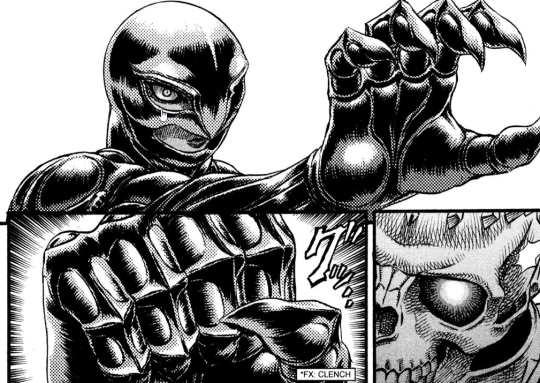


 you're the only one


