It’s… so confusing though, a close friend of mine watched the series based partially on my rec and him wanting to see it for ages and he misunderstood… basically… everything??? HOW DOES BERSERK FANDOM OUTSIDE TUMBLR FUNCTION???
honestly same, I really don’t get it. Like I can see general homophobia making ppl desperately want to downplay the gay vibes leading to as little emphasis on Guts and Griffith’s relationship, and especially Guts’ (extremely and wholly positive) feelings for Griffith as possible. Like describing Guts’ decision to leave the Hawks as “he does not want to be caught up in Griffith’s dream anymore” is technically accurate, and yet completely downplays the fact that the reason he doesn’t want to be caught up in Griffith’s dream is because Griffith is “dazzling” and he wants Griffith to “look at [him]” and he wants to feel like his equal and be regarded as a True Friend. In the terrible episode description it’s instead framed like Guts is pissed off about having to assassinate people lol.
And idk I think it might also be partially this weird desperate need to have a Hero and a Villain and have Guts prevail over the villain and ride off into the sunset with the Rescued Love Interest, because a lot of people are frankly boring and like boring stories and can’t conceive of good stories outside those basic parameters. So they twist the narrative in their head until it fits that shape, despite Guts and Casca not having anything like a traditional true love romance and Miura saying he only had Casca survive the Eclipse to keep Guts focused on revenge, despite Griffith not being a pure evil villain even after the Eclipse and certainly not before (like Miura’s directly talked about NGriff’s moral ambiguity and the way he’s not a traditional evil antagonist), despite the clearly complicated emotions that still exist between Guts and Griffith/Femto/NGriff, etc.
At my most generous I think part of the reason people choose to believe Griffith was evil all along is because Femto’s defining act is rape and people are uncomfortable seeing any good in a character who eventually becomes a rapist, tho personally the fact that he magically transforms into a demon first kind of mitigates that for me lol. (And, and I’ve ranted about this before but still, it’s also a double standard when so many of the same people go out of their way to excuse Guts when he sexually assaults Casca.)
But still idk it’s weird. Like, eg there’s so much you have to ignore to believe that Guts leaving the Hawks was fine and dandy and a good choice and Griffith was just a dick who overreacted. Pages and pages of Guts fretting about it, Casca yelling it at him, Guts regretting leaving, Guts realizing he was wrong in thinking Griffith looked down on him, Guts comparing abandoning Casca to abandoning Griffith multiple times, Guts determined not to make the same mistake again, etc etc. You can support Guts’ choice and blame Griffith all you want, but the narrative clearly does not, and it’s honestly baffling how ppl can ignore that when it’s not only discussed many times in direct words, but the whole story revolves around the fact that Guts made a mistake when he left.
Like what do you think the Golden Age is about if it’s not about a stupid misunderstanding between 2 dudes who both rly like each other and fail to realize their feelings are reciprocated and overreact and make dumb decisions because of that misunderstanding? I don’t understand what most Berserk fans see, it genuinely feels like we’re reading 2 different stories lol.
anyway speaking of moments where Griffith desperately needs someone to reassure him.
also now i’m doubling down on my theory that Griffith’s scratch marks here came shortly after “do you think I’m cruel?” rather than the day of Guts’ departure.
I spend months talking about this damn manga and Griffith and his need for validation and self loathing etc etc and I only just fucking noticed that Casca doesn’t actually say no here. She starts to say “no” automatically, then cuts herself off and asks what he was doing with Gennon. Like damn that’s actually a pretty clear “yes.”
Not that I think Casca meant it that way ofc, her heart’s in the right place and she’s a kid who’s totally out of her depth, but still, ouch. That’s like, “no! wait were you sleeping with him? bc actually my answer is dependant on your answer to that question.”
Like add this to the list of reasons Griffith sucks at opening up to people.
I think on a character level it was wishful thinking on Griffith’s part. He saw that Charlotte was still enamoured of him when she took that poison dart for him, and he seized on that fact p desperately, but deep down he knew his plan to be king was fucked and he probably wasn’t going to see her again. It’s perfectly consistent with Griffith’s characterization, he fuckin loves his denial.
Plus it tells us that he hasn’t given up. He’s still him. That moment comes right before he saves them all from an explosion by pointing out the thin wall to Pippin, and it works with that to show us that Griffith is still tenacious, still smart and ambitious and sane, and he still wants to be king even if it’s an impossible dream now. And it also sets us up for his later desperation and despair after Wyald makes his helplessness impossible to deny.
On a narrative level it’s v useful foreshadowing.
In no way does it make sense that he was planning the Hawk’s sacrifice lol, he didn’t even have the behelit at that point, even if some people for some reason believe that he knew how it worked and intended to use it.
Like… I’ve seen people take a lot of little character moments like that and twist them into “proof” that Griffith is diabolically planning to make the sacrifice, and none of them ever make sense because the idea that Griffith has been planning to sacrifice them at any point before he says “I sacrifice” undermines the entire emotional thrust of the story.
Plus it contradicts many, many stated facts, like eg you can only sacrifice people you love so much it’s like they’re a part of you, the Godhand’s explanation to Griffith, Griffith prioritizing Guts over his dream several times, Griffith’s confusion when he starts seeing demons and Eclipse references, the fact that the behelit only opens in a moment of pure despair (why would he feel despair if he knew he was about to become a God), the fact that he tried to kill himself immediately prior to the Eclipse, Griffith desperately trying to catch Guts as he falls from the big hand, and Griffith’s clearly explained motivation for making the sacrifice – like the entire sequence leading up to the sacrifice where the Godhand are talking to bb Griffith in his head makes no sense if he’s been planning it all along. How do people manage to ignore that????
Anyway tl;dr that theory’s dumb, hope this helped lol.
So how about Griffith’s self loathing and his need to change the world to basically prove himself worthy of being a leader, or even just worthy of living with death on his conscience?
Yeah I pretty much agree with you. Whenever I see someone who’s like, “I would never ever sacrifice someone I cared about no matter what,” I’m like, well that seems like a v high and untested opinion of yourself.
Idk maybe they’re just a lot more idealistic than me and believe the majority of people wouldn’t choose to sacrifice someone in a moment of pure despair, or maybe they genuinely are that self-sacrificing lol, but I’m with you – I’d say most people would. Especially in the world of Berserk, where behelits generally end up with people who have extremely strong values/desires/drives that make them more likely to sacrifice one thing for the sake of another thing. Add the fact that every apostle we see (except Count Slug’s second attempt) sacrificed someone/thing they both loved and hated in that moment, and the fact that moments of despair are tailored by fate to each individual – to be their worst moment, playing on their specific fears and insecurities etc, and yeah, I’d say just about everyone would make the sacrifice under those conditions.
And tbh one thing I love about Griffith’s narrative is that I actually find it really relatable/understandable. I think Miura did an amazing job of showing us what Griffith values, what he prioritizes, what he believes, what he feels, and how his life has driven him to the point of the Eclipse. When he says, “I sacrifice,” it’s so good because it’s been completely built up to. We got to really see all the elements that come together at that moment to make him choose the sacrifice, and it’s absolutely a realistic decision for his particular character. And personally one of my favourite things about fiction is that feeling of understanding why someone does something terrible, or evil, or stupid, or self-destructive, etc etc. I find it very cathartic, and Berserk is perfect for that.
Like it’s fair if ppl find the same thing uncomfortable or off-putting. A story about relatable/realistic people making bad choices for understandable reasons is definitely not for everyone, but that’s absolutely what Berserk is, at least the Golden Age, and misreading it as the story of an evil dude doing evil things because he’s evil doesn’t change that.
Something to think about:
While Griffith is human, Guts is an ordinary dude doing his best.
While Griffith is Femto, Guts is the Black Swordsman, traumatized, lashing out, driven by the rage inside of him.
While Griffith is NeoGriffith, Guts shifts away from rage and revenge towards personal growth.
Plus, each of Guts’ character shifts is a direct result of Griffith. Becoming Griffith’s soldier helps Guts come out of his shell, helps him grow as a person and accept the friendships of those around him, helps him be a responsible leader and dedicated comrade, and inspires him.
Guts becomes the Black Swordsman because of Femto’s actions, because of his desire for revenge and need to exorcise the rage and hurt inside him.
And Guts decides to take Casca to Elfhelm, gaining friends and chilling out along the way because NeoGriffith “abandoned” him.
I don’t have a real conclusion to draw but I’m throwing this out there anyway. Parallels, reflections, etc.
actually you’re the only person who’s sent anything so this works out ❤
character: hate them | don’t really care | like them | LOVE them | REALLY FUCKING LOVE THEM
ship with: Guts ofc
brotp: hmmm. Guess I gotta go with Zodd. Griffith may have no friends but at least he has a giant monster he can ride around on.
general opinions: Griffith exemplifies like a million of my favourite tropes and he’s one of my favourite fictional characters of all time. Ambitious emotionally repressed + morally dubious person brought down by intense overwhelming love, like, it’s the epitome of my shit. I love how complex he is, and I love how tragic his narrative is, and I love how repressed and stupid he is, and I love how gay he is, and I love how emotionally vulnerable he is in brief moments when he loses control, etc etc.
I love this as an introduction to Griffith so, so much.
It establishes the bare bones of his philosophy and his motivation in the first two pages, in a way that’s not untrue, but also exists to start the audience off with an assumption that Miura then complicates as we learn more about Griffith. We start off thinking of him as driven by grandiose thoughts of destiny, and wanting to be part of this true elite, beyond nobility. Again, not untrue, but as we learn more about him, we learn how much of a driving role guilt plays in this philosophy. “Martyrdom for a merciless God. What a waste. On the battlefield, the life of a common soldier isn’t worth even a single piece of silver.” We see later how much this weighs on him, how driven he is to make that martyrdom not wasteful.
But even better than that, this brief scene starts with philosophical questions, but the real point, the real establishing character moment, is, “you’re the first person I’ve ever spoken to like this.” It’s such an effective contrast that sums up Griffith’s entire narrative arc throughout the Golden Age. The dream vs Guts. We establish the dream here, but even more important than that, we establish that Guts is singular to Griffith.
The keys speech builds to that final statement, it practically serves as a handy preamble to our first direct depiction of what Guts is to Griffith, and I love it.
“guts had a harder life than griffith” uuuuuuuuuu why cant people read lmfao
ikr
idk i think it boils down to the fact that we’re with Guts more, we see his traumas and hard times in detail, while we’re generally told about Griffith’s rather than shown, and with him we only see the after effects.
but like any way you slice it i feel like a year of constant torture and permanent loss of the use of your limbs and ability to speak is worse than Guts’ eclipse trauma, which largely revolves around stuff that happens to other people (dead friends, traumatized girlfriend). Yeah Guts lost a limb but he got a canon to replace it, and it’s his choice to go out and shoot monsters with that canon instead of taking Godo’s sage advice and chilling out with the friends he has left.
tbh I agree that this is part of why people respond more positively to Guts and negatively to Griffith. Griffith’s narrative ended in succumbing to despair and becoming a monster, while Guts’ nickname is “struggler” lol. People absolutely respond more positively to a narrative about fighting and persisting against all odds than a narrative about losing everything and essentially selling your soul because you feel like you’re out of options.
However, that said, I think this misses a few important points.
Like for one, to describe Griffith as embracing Femto while Guts resists the Beast of Darkness is kind of, well, loaded and not entirely correct. Griffith didn’t embrace Femto, he embraced his dream and the guilt it caused and seized the one chance he had to make tens of thousands of deaths that weigh on him meaningful.
Like, one thing I love about Griffith’s narrative is that his motivation – to ensure that thousands of people didn’t die for nothing – is heroic. In most stories that would be considered noble. Berserk twists that, because Miura likes to play with morality this way. Griffith’s noble, quite respectable goal, and his relatable and sympathetic emotional motivation (guilt) are what lead him to darkness.
Miura isn’t showing us a character who cheerfully embraces his own inner darkness, he’s showing us a character who becomes a demon ironically because of his desire to be a good person. What ultimately convinces him to make the sacrifice isn’t the promise of power, or rejuvination – it’s to ensure that so many people didn’t die for no reason.
Griffith and Guts’ narratives are different. They exist to pose different questions about what it means to be evil/human/good. But they aren’t comparable on a characterization level.
Guts hasn’t had a moment of pure despair where he’s given a choice to live out his life wholly dependant on others, mute and helpless, wracked with irreconcilable guilt and about to lose the last thing that matters to him, or sacrifice people for the sake of a goal they, among thousands of others, chose to die for, to make those deaths meaningful.
Instead, Guts has a sinister jiminy cricket telling him to murder and rape people. And Griffith doesn’t have a particularly vocal and belligerent hawk taunting him, he has a moment of despair, ordained by causality, orchestrated by the Idea of Evil for the sole purpose of having him choose to make the sacrifice.
Guts and Griffith are different people, but Guts is not inherently better or more moral than Griffith. Griffith frets about killing people for his dream, Guts tells him murder is nbd. Griffith prioritizes Guts over his dream several times before that final moment of pure despair during the Eclipse, and Guts prioritizes revenge over Casca several times before finally giving up on revenge after NeoGriffith blows him off. Griffith prostitutes himself to a pedophile at a young age to prevent as many deaths in the line of duty as he can, while Guts doesn’t really give a fuck about people dying unless he personally knows and cares about them (or if they’re children). Guts describes his dream to Casca as “I just did my own thing,” while Griffith describes his dream to Casca as, “for the sake of the dead… if there’s something I can do… that thing is to win.”
Ultimately, Griffith’s narrative illustrates a man succumbing to evil in the pursuit of good, while Guts’ narrative illustrates a man struggling to balance the good and evil within himself. The only relevant personality difference between them is that Griffith is driven towards a goal by guilt, essentially living for the dead, and Guts is living for himself and the people he personally cares about.
And to address another of your points, Guts has not had a harder life than Griffith. Maybe he’s had a harder childhood – we don’t see much of Griffith’s but it’s a fairly safe assumption – but after killing Gambino?
The narrative takes the position that during the Golden Age, Guts actually had it fairly easy compared to Griffith. Guts’ years with the Hawks are his happy place. Griffith on the other hand had a huge emotional burden on his shoulders, his guilt caused him to self harm, he had the aforementioned encounter with a pedophile bc he was driven by guilt, he had to hone himself to his limits to achieve his goal. Constantly dealing with nobles, constantly fighting at the head of his army, figuring out battle plans, carrying out assassinations that added to his guilt, maintaining an immaculate image of himself, and emotionally closed to everyone except, rarely, Guts. I mean like, the stakes of the climactic battle of the Golden Age is the risk of Griffith being captured as a sex slave lol, and he not only knows it, he incorporates it into his battle plan, like, dude is under a lot of pressure.
And of course, that’s nothing compared to a year of constant torture. Even after the Eclipse, Guts has never experienced anything on that level. Griffith was only barely sane at the end of it, totally physically helpless, mute, he’d lost everything he valued including, he thought at the end, Guts. He tried to kill himself right before the behelit opened.
Like, sorry, Guts has had a hard life, but it doesn’t compare to Griffith’s year of hell. Especially considering that, post-Eclipse, Guts had the option to bow out any time and live in relative peace and comfort with Rickert and Erika (which everyone and their dog points out to him), and now has the option to hang out in peace and comfort in Elfhelm that he probably also won’t take.
Idk basically this is a long way of saying that yeah, thanks to the thematic purposes of their narratives Griffith’s is about succumbing to evil in pursuit of good and Guts’ is about trying to find a balance between good and evil, and at a shallow glance that makes Guts look more respectable than Griffith, but that doesn’t actually reflect on their personalities, their morals, or their personal struggles.
I wrote what basically amounts to a response to this a little while ago (focused on why ppl hate Griffith more than Guts), so rather than just re-writing that I’ll link it. (tw for discussion of rape)
But like, in addition to that, ikr?
I mean one of the central premises of Berserk is that everyone is capable of great evil and humanity is kind of a hot mess, and that’s exemplified in both Guts and Griffith. Like just like Griffith always had the potential for Femto in him, Guts has the Beast of Darkness, and both manifest in violence and rape. Guts is absolutely no better than Griffith, and I’d personally say he’s worse considering that he assaults his traumatized, infantalized, sort-of-girlfriend twice without transforming into an embodiment of evil first.
like look at this
In Berserk the behelit helps certain chosen ones gain power, but you don’t exactly need it to be evil, and part of the point of Guts’ narrative is that at times he’s getting pretty close to indistinguishable from a monster, behelit or no, magic armour or no.
But he’s the protag, fans identify with him, and while Griffith’s fucked up acts lead up to a magical transformation into a monster, Guts’ fucked up acts seem likely to be leading to redemption and growth. There’s nothing intrinsic in Guts and Griffith’s characters that leads one to monsterism and one to self improvement, it’s not like one has more good qualities and the other has more evil qualities – it’s literally just circumstance and the fact that Berserk’s God chose Griffith as his jesus figure, not Guts. But it affects how readers see them and respond to them.
I mean ffs we see Guts do worse things than several apostles. Right now, based on what we see them do in the manga, fuckin Zodd is a “purer” character than Guts lmao. The idea of mixing fandom purity politics and Berserk of all things, which at the end of the day amounts to getting judgy based on which sexually abusive character someone likes more, is incredible to me.
I’m doing an essay in my Comp class and I chose to argue that people shouldn’t say “Griffith did nothing wrong”
I’d like to get a little survey done, so could you reply to this post saying “Griffith did everything wrong”, “Griffith did some things wrong”, or “Griffith did everything wrong”?
I won’t judge any answers and you don’t have to explain your viewpoint, just please help me out with this?
tl;dr: I need feedback to see how split the fandom is over Griffith and his actions for an essay
(please help, I’m begging you)
It’s a redundant topic since Berserk is about grey morality and Griffith definitely did wrong and bad things, so I guess my answer would be “Griffith did some things wrong”.
Griffith did some things wrong.
i feel like ‘griffith did nothing wrong’ is a purposefully inflammatory meme more than anyone’s earnest argument. like i hang out with a lot of griffith fans and i’ve personally never seen anyone genuinely argue that griffith did nothing wrong, even if you don’t include femto in that.
until now!
griffith did nothing wrong – because in the world of berserk he has divine right, his choices and actions have been predetermined by the world’s god, which fulfills humanity’s subconscious desires. griffith is the chosen saviour or doomer of humanity, chosen by humanity’s god, which is a manifestation of the collective will of humanity, and therefore everything griffith and femto and neogriffith does is humanity’s will.
nothing he can do is therefore wrong within the context of Berserk’s reality, because everything he does is what must happen according to God.
I mean from this perspective you can argue he did some things wrong from a moral standpoint bc he’s basically the avatar of humanity and humanity is kind of fucked up. but yk from a purely fictional theological standpoint, griffith/femto/neogriffith is doing everything exactly right.
(disclaimer: griffith did some things wrong, femto is an evil monster, and neogriffith is mysterious but also kind of a dick by any standard of logic or morality.
my 100% earnest answer for your survey is Griffith did some things wrong.)
[Insert Ganeshka’s backstory of isolation and fear here.]
eh? eh?
ok honestly I’m just throwing shit at the wall but Ganeshka’s lonely freakout really really intrigues me, that plus the talk of light and dark reminds me both of Griffith in the torture chamber and Griffith as he’s transforming into Femto, and while yeah NeoGriff’s “within darkness that true light is discovered” bit is much more metaphysical (yk more to do with the fact that Griffith had to become Femto to become the saviour of humanity, probably), the fact that it’s in response to Ganeshka’s total loss of himself and everyone around him, the fact that the light Ganeshka longs for has shifted from something he considers his enemy to the only connection he has in an unknowable lonely world just… resonates man. I love it.
“You can see. Because he who bears the light exists in the deepest shadow.” Ganeshka can see NeoGriffith’s true form because he’s the only one on the same plane of existence of him, and that plane is defined by despair – despair opens the behelit that makes him an apostle, despair in the face of an inevitable loss sends him into that reincarnation thing to become a god, and his brief existence as a god is defined by existential terror and isolation. In a way he and NeoGriff are both made out of the same stuff the Idea of Evil is made out of. that’s the “darkness” imo.
And despair is the darkness of the torture chamber (give or take the lightning blazing within him that is Guts) and it’s what Griffith succumbs to when he sinks into darkness and becomes Femto.
Also
while the “light” referred to might more literally be Griffith-as-godly-saviour, bringer of peace to humanity or whatever, I’m thinking it works as a symbol of that longing for connection.
like idk the way I take Berserk’s use of light and darkness as symbols is, essentially, darkness is the despair that opens the behelit and light is what you sacrifice. darkness – the swirling negative emotions that make up the idea of evil. light – connection, love, joy, family, peace, brotherhood yadda yadda yadda. or at least the potential for those things.
Griffith/Femto appears right after Ganeshka’s backstory of being unable to connect with anyone around him because of his paranoia – loneliness and fear. He gives Ganeshka that brief sense of connection before his death as the light envelops him.
I’m basically just thinking outloud in a disorganized way here bc tbqh I have such a hard time sussing out what “It’s within darkness that true light is discovered” means in the overall context of Berserk. Like, other than Griffith going ‘lol I’m evil but also saving the world.’ that’s too reductive. But I think longing (darkness) for connection (light) maybe works for me? thanks to Ganeshka’s whole thing being isolation.
Yeah it’s really unfortunate bc he’s such an interesting complex character and I wish more people appreciated that. Tho I have a few ideas on why so many Berserk fans ignore most of the text and write Griffith off as evil from the start.
I mean obviously the biggest one is that Femto’s defining act of evil is rape. And tbh I put the blame pretty squrely on Miura for that one lol, like, I can’t actually blame anyone for being unable to feel sympathy for or enjoy the complexities of a character who later turns into a monster and rapes another major character.
Like the problem with using sexual assault as your major illustrative example of the ~darkness in the hearts of men~ or whatever is that it’s pretty damn common for people to have experienced it themselves, or know someone who has, and therefore reactions to a depiction of rape are inevitably a lot more visceral than reactions to say, murder or torture. Even if Griffith is depicted as a sympathetic, three dimensional, very interesting character throughout the Golden Age, I can’t blame anyone for not giving a fuck and just hating him anyway because his evil alter ego’s first act was rape. People ignoring your good writing is a price you pay as a creator for using rape as shock value and cheap drama.
(Plus when you add his badly written night with Charlotte to the mix, like, again, I can’t blame anyone for going “fuck this guy” and not caring about his depth of character. Like I don’t think the night with Charlotte is meant to be read as rape because there are zero indications that we’re supposed to think it’s skeevy or even potentially morally dubious once Charlotte gets into it – to me it reads like a badly written bodice-ripper type scene where the woman just has to get turned on and then she forgets propriety and enjoys herself – but again, that’s on Miura and his sometimes shitty writing.)
However, that said, from what I’ve seen the vast majority of Griffith haters still love Guts, who also sexually assaults the very same character (except Guts hadn’t even just been magically transformed first, and the first time he sexually assaulted her was long before the hound ever made an appearance), so like, when so many people condemn one character and excuse another for the same thing, there’s obviously something else at work.
So putting aside the rape, I think there are a lot of other factors as to why Griffith is so hated while very few of his haters extend that ire to Guts as well.
Like, for starters, Griffith is gay, or at the very least, gay coded and feminine in appearance and clearly in love with the protagonist, which definitely makes a lot of straight cis dude fans uncomfortable and a lot less likely to be able to empathize with him, judging by the offensive nicknames they tend to use for him.
But then there’s also just the way Griffith lies to himself, which, if you tend to take things at face value in a story, is going to give you a serious misunderstanding of his character. Eg, a lot of fans think that when he tells Casca he doesn’t feel guilty for the deaths of the people who follow him he’s being genuinely truthful and sociopathic lol, ignoring the fact that he’s self-harming grotesquely during that conversation, among other hints that he’s deluding himself. Lots of people take character dialogue as ultimate truth, missing other context clues that are often more revealing.
And then there’s the fact that he ends up betraying the protagonist and becoming an antagonist, and a lot of people just aren’t interested in moral grey stories so they project black and white values onto it. So since Griffith/Femto/NeoGriff is the antagonist, everything he’s done must have been evil and he must’ve been solely motivated by selfish desire for power, and they’ll twist the story to find support for that. Like I’ve seen people who take Griffith’s “I will choose the place that you die” as evidence that he’s been planning to sacrifice everyone for power from the very start lol, even though that makes zero sense, just because they need Griffith to have been villainous all along or the story doesn’t fit their moral framework.
Like, while Berserk takes a general moral stance that a person’s actions shape them, a lot of people believe that a person’s actions reveal their true, innate nature deep down. So, to them, Griffith sacrificing the Band isn’t an act that turns him into a monster, it’s an act that reveals he’s always been a monster and now the veneer of humanity has been removed. Yk, the kind of fans who say that if Griffith was a good person he wouldn’t’ve sacrificed his friends, because no good person would ever do that, as though Good and Evil are qualities a person is born with. Which I consider to be an extremely boring way of looking at fiction, and a troubling way of viewing morality, and totally at odds with what Miura’s attempting to say, but people will always bring their own philosophy to the table.
Similarly I think that, at least for some people, this is why Guts’ frankly evil actions get totally downplayed or written off – because he’s the protagonist so he has to be A Good Person. Therefore he had to have been possessed by an evil spirit when he assaulted Casca (despite the fact that the first time was in Godo’s spirit-repelling cave and most people forget that even happened, and the second time was in broad daylight without a ghost in sight or any visual indication that Guts was anything other than himself.) Or they say it’s okay because Guts stopped before actually penetrating her, and he’s had a hard life, and cut him a little slack and let him get back together with Casca bc he’s a good person and he deserves to be happy blah blah horrifying blah.
idk I’m definitely not accusing everyone who hates Griffith and flattens his character of being a hypocrite lol, like I said, there are plenty of possible reasons to view him as evil, and some are totally reasonable. But yk there is kind of a double standard at work when people love Guts and hate Griffith and I think it’s worth looking at why that might be.
Okay we’re finally on the last part of this giant self indulgent monster. Here I’m going to get into why I prefer to interpret Guts and Griffith’s relationship as mutual gay pining as opposed to one-sided, how I think the sexual attraction between them fits into the existing themes, and in general what makes it really work for me.
I wrote this thing because while I feel like a lot of fans can agree that there’s at least a strong indication that Griffith’s feelings for Guts aren’t strictly hetero, even lots of fans who acknowledge the gay subtext see it as one-sided. So I wanted to put a spotlight on Guts’ side of things.
And tbh, even ignoring all the stuff I’ve talked about so far, it boils down to one point: one-sided pining just doesn’t fit into the rest of Guts and Griffith’s relationship.
For me, the Golden Age tragedy works so well because it rests not on incompatibility or irreconcilable differences, but on a misunderstanding: both Guts and Griffith fail to realize that the other loves him.
This is just facts – you can call the love platonic if you must, since Miura never went beyond subtext with the romance, but that’s the plot of the Golden Age in a nutshell.
And if, like me, you think it’s pretty clear that Griffith the gay coded villain who irrationally risks his life for Guts multiple times, who is so gay Guts had to ask during their very first conversation and Griffith didn’t answer, so gay he thinks about Guts while having sex, so gay his feelings for Guts kept him sane during a year of torture, so gay that Guts is cheer captain and Casca’s on the bleachers, is romantically in love with Guts, then it follows that Guts’ feelings must also be romantic in nature.
Because again, this isn’t a story about unrequited love. The Golden Age is about two dudes who had a great relationship but fucked it up because they both misunderstood what that relationship was and failed to communicate. It’s not about a gay dude tragically in love with his straight bff. If attraction is part of Griffith’s feelings for Guts, then attraction is part of Guts’ feelings for Griffith.
The final arc of the Golden Age, after Guts returns from his stupid vacation, largely revolves around Guts’ slow realization that he was wrong when he thought Griffith looked down on him and didn’t care about him:
He’s realizing that Griffith’s breakdown after he left, Griffith losing his dream because he left, ultimately means that he didn’t need to leave at all, because Griffith didn’t look down on him. Griffith needed him. Griffith loved him.
Griffith’s corresponding misundertanding is that he didn’t know Guts left to become his equal, and almost certainly believed he left because he couldn’t stand to be around him after seeing Griffith’s “dirty side.”
This is a bit less straightforward because Guts gets most of the focus in the story, but I’ll do my best to briefly explain my reasoning.
Guts and Griffith’s final interaction together before the duel, that we get to see, is this night:
Griffith needs emotional reassurance in a revealing and intimate moment of vulnerability, and Guts fails to provide it. Instead of telling Griffith that no, he doesn’t think he’s cruel, he tells him something more akin to “yes but it’s necessary for your dream, remember?”
Griffith’s expression in the “You’re right,” panel is straight up the saddest thing I’ve ever seen, it might actually be my favourite image Miura’s ever drawn ngl. I love it so much.
Compare to how he looks at a dead kid before deciding the kid’s death means he has to have sex with a predatory pedophile, and then self-harms in the river the next morning while claiming he doesn’t feel guilty:
Down to framing and hair over his eyes these panels are so similar that I fully believe “You’re right,” is a purposeful call-back to this, giving us the necessary context to understand what Griffith is feeling.
This night of assassinations is Griffith’s corresponding Promrose Hall moment, imo. If only for a moment, he forgets his dream because what Guts thinks of him is more important, and when, instead of reassuring him, Guts reminds him that the path to his dream is paved with cruelty, he looks like all his self loathing hits him at once.
Also dude has a serious and depressing propensity for calling himself dirty.
So when we next see him and he’s falling apart because Guts is leaving, this is the context we have for his extreme reaction: his self loathing, the way he asks for reassurance, and the way he looks when Guts brings up his dream instead of giving him that reassurance.
Look at the moment Griffith is remembering here: “It’s funny… you’re the first person I’ve ever spoken to like this.”
It’s ironic because we know exactly what Guts thought of him then, but Griffith is convincing himself that Guts hated him from the first glimpse he saw of the real Griffith, the Griffith no one else gets to see. The vulnerable, “dirty,” needy Griffith, the Griffith who questions his place in the world, the Griffith falling in love with Guts.
And like Guts, Griffith has no idea how Guts truly feels about him.
So yeah, this is why I think their feelings, all their feelings, from platonic to sexual and everything in between, are mutual. Because the point is that they’re two idiots who love each other but, thanks to their low self esteem, can’t see that they’re loved in return.
Which brings me to themes and shit, and why Guts and Griffith being sexually attracted to each other fits into Berserk like a puzzle piece.
Berserk is, at its core, about reactions to trauma. It’s right there in the title. Like every major adult character has childhood trauma that fucks them up. Serpico, Farnese, Casca, Guts, and Griffith.
When it comes to the Golden Age trio:
Casca was assaulted by a nobleman and saved by Griffith.
Griffith prostituted himself to a pedophile in a fit of extreme guilt while he was at most on the young end of teenaged, called himself dirty and self harmed afterwards.
Guts was raped by a soldier his abusive adoptive father sold him to.
Casca’s reaction to her trauma is to idolize Griffith as her saviour to the point where she has no sense of identity outside of him and helping him achieve his dream.
Griffith’s reaction is self-loathing, emotional repression (”I don’t feel guilty,” he says, while Casca begs him to stop hurting himself), and the beginnings of a vicious cycle in which he is driven to achieve his dream to make all the “underhanded” “dirty” things he does for it, and all the deaths on his head, worthwhile.
Guts’ reaction is his desperate desire to be loved and respected coupled with a mistrust of people.
All these traumas result in the bad decision pile-up that eventually leads to the Eclipse.
Guts’ desire to be loved and respected coupled with past experience making it all too easy for him to believe he’s not is why he ignores a mountain of evidence that Griffith loves him in favour of one overheard speech about how he has no friends, and then decides that it’s a good idea to abandon all his friends, including Griffith, in order to try to become his equal and earn his affection.
Griffith’s self loathing leads him to believe that Guts is abandoning him bc he’s desperate to get away from him after seeing some of his darker sides that he’s ashamed of. His emotional repression means he has no ability to understand or express his extreme emotional reaction to this. So he lashes out through a framework he does understand (”rules of the battlefield,” as Judeau says), then falls into despair, crashes and burns, and ends up in a torture chamber.
And Casca’s lack of identity leads to her transfering her obsession from Griffith to Guts – complete with sword metaphor – after they sleep together, which leads to her mistakenly prioritizing Guts’ previously expressed “dream” to go off and fight people, the same way she once prioritized Griffith’s dream, which leads to Griffith overhearing her telling him to leave, which leads to the Eclipse.
My point is that the Golden Age arc is basically the story of three traumatized people whose adverse reactions to their traumas fuck their relationships up. Because it’s a dark fantasy story ft gods and monsters and fate etc, fucking up their relationships results in the Eclipse.
This is a perfectly good story by itself. It doesn’t need sexual repression added to it, but at the same time, boy does sexual repression fit right in.
I think that, whether it’s intended by the author or not, Guts and Griffith are both extremely easy to read as repressed gay*** men.
Griffith’s got a whole narrative about his dream, a dream which he can only achieve through hetero marriage, being pitted against his love for a man. He does stupid irrational shit for Guts and Casca berates Guts for it because he could “take Griffith’s dream down with [him].” Overhearing him talking about his dream to Charlotte is what makes Guts decide to leave. Guts is the only one who makes him forget his dream. He has to sacrifice Guts, “burying his heart,” to attain his dream. Even when he becomes the saviour of the world as NeoGriffith, he still has to marry a woman to seal the deal on his dream.
The dream is associated with emotional repression and Guts is associated with emotional expression.
As for Guts, I just wrote over 10k words about his attraction to a man and 5k of those were about how his het romance revolves around his attraction to a man so I’m not going to reiterate all that. There are a few particularly noteworthy things about Guts and his narrative that scream repression to me though that I’ll mention.
The way it’s his deep, subconscious, instinctive id side, the Beast of Darkness, urging him to pursue Griffith, complete with a dark sexual undertone. (Relevant reminder: I’m only arguing that the gay is there, by accident or by design, I’m not arguing that it’s a positive portrayal lol.)
The way Guts’ statement to Casca after sex that only her touch was okay in the beginning is a) incorrect as I’ve shown earlier, and b) irrelevant bc the reason she was able to touch him was solely because she’s a woman, as we know from the way his burgeoning panic subsides when he realizes she’s not a man – and ever since then she’s been the only woman he knows. So it doesn’t feel like much of a jump to suggest that he had sex with Casca because she’s literally the only person he knows with whom sex wouldn’t automatically trigger him.
The way his matchmaking of Griffith and Casca seemed to be an attempt to get Casca to take his place, with the added layer of romance that he couldn’t envision for himself.
The way, in their first interactions, Guts seems transfixed by Griffith’s appearance, comments on his pretty face, suggests sex if he loses in a way that seems informed by his rape trauma, but then is once again entranced by Griffith, rather than angry or afraid or any other potential negative emotion you’d think he’d feel, when he does lose. This whole sequence gives me the impression that he wants to bone Griffith but can’t acknowledge it and can only relate the concept of same-sex desire to his trauma.
And, for both Guts and Griffith, the way their respective traumas are depicted is particularly relevant. I’ve explained how each formative traumatic experience gave these two a pile of issues that fuck up their relationship. But the thing is, none of those issues (for Guts a need to be loved and respected and a default belief that he isn’t; for Griffith emotional repression, guilt, and self loathing) are intrinsically tied to rape. For Guts, it’s Gambino’s betrayal of him that fucks him up, not the specific sexual nature of that betrayal. For Griffith, it’s the realization of the weight of his dream and the way he “dirties” himself for it – later examples of acts that make him feel “dirty” are assassinations, so there’s no narrative reason his first act has to be traumatic, non-consensual (as he’s a child) sex.
And this isn’t a critique of that, I actually think it’s great to see characters who have backstories involving rape without it being the sole thing that defines them. For every character it’s part of a tapestry of childhood trauma, not the only important part, or even the most important part.
But it’s really, really easy to fill in the blanks for how formative sexual trauma specifically also has a hand in informing the nature of and contributing to the destruction of Guts and Griffith’s relationship. We’re not explicitly shown or told this, but imo it is suggested when they first meet.
Guts makes the duel, and his first real meeting with Griffith in general, about sex by uncomfortably asking if Griffith’s gay and offering himself to him if he loses. Here either the narrative is choosing to deliberately point out that Griffith and Guts have some gay undertones going on in our introduction to their dynamic because this informs our understanding of the rest of their relationship going forward, or the narrative is choosing to remind us of Guts’ sexual trauma here because that trauma informs the rest of their relationship going forward. Or both.
It’s also suggested in the way we learn Griffith’s backstory with Gennon right before Casca finally expresses her jealousy of Guts and comes this close to telling Guts that Griffith is in love with him:
By revealing this backstory in the lead-up to this revelation of why Casca resents Guts, Griffith’s trauma and his feelings for Guts are tied together the same way Guts bringing up sex when he first duels Griffith ties his trauma to their relationship.
And the way these traumas may inform their relationship is that neither of them are capable of acknowledging or even recognizing their love and attraction.
Let’s be real here: if Guts and Griffith’s relationship was romantic there’d be no Eclipse.
This is what really makes the subtext and the idea that both of them are repressed dudes in love work for me. This is the number one reason I ship it: because they work so well together.
We’re shown exactly how compatible they are. The tragedy of the Golden Age is predicated on both of them failing to recognize the other’s feelings, but what makes it a real tragedy is the inherent lost potential when their relationship falls apart.
All Guts truly wanted was someone he loved, who loved him back and treated him with compassion and respect.
And he got that! That’s exactly who Griffith was to him, exactly how Griffith fulfilled his emotional needs.
Guts remembers the night he killed Gambino before dedicating his sword to Griffith. This is when Guts decides that maybe the Band – maybe Griffith – is what he’s been looking for. A home. Love. Someone to look his way – more than that, someone who cares about him enough to lay down his life for him.
This is the truest moment of Guts and Griffith’s relationship, imo. There’s no misunderstanding getting in the way and muddying the waters – there’s only Griffith admitting he had no reason to risk his life for him and casually saying he’d do it again (”each time I put myself in harm’s way for your sake”), and Guts recognizing how significant that is, and dedicating himself to him in return.
Right here and now Guts has everything he’s always wanted. Later he overhears the Promrose Hall speech and re-evaluates his relationship through a false lens, but as I said back at the beginning of this post, Guts eventually realizes that he was right the first time.
Now again this is less straightforwardly stated and relies more on my own interpretation, but I think Griffith’s corresponding issue that matches Guts’ desire to be loved is his desire to be truly seen and accepted.
He wants Guts to be privy to his dirty side and to want to remain at his side anyway. In order to fulfill his dream Griffith has to constantly project an image of perfection.
His reaction to Casca seeing him in a moment of extreme vulnerability is:
There are countless references to Griffith looking like something out of a fairytale, there’s his carefully constructed perfect-fiancee image he shows Charlotte, his perfect infallible leader image he projects to the Hawks. He’s a symbol to everyone – to the Hawks and the peasants etc who love him he’s a symbol of change for the better, of soaring up; to his opponents he’s a symbol of corruption and change for the worse, a “parasite.” To his rapist(s)*** he’s a symbol of perfect beauty. People either look up at him or down on him. When he says he has no equals, in fairness, it’s because no one treats him as an equal. In their last scene together before the speech even Guts had reframed a request from a friend into an order from a superior (”It ain’t like you. Just cut to the chase and order me to do it.”)
But Guts is still unique because he wants to be Griffith’s equal. He wants to “stand beside him,” he wants to consider Griffith a friend and treat him like a real person and not a symbol. And, more than anyone else, he does.
Guts dumps a bucket of water over his head in his first week with the Hawks while they laugh together. Guts disobeys orders constantly to the point where Griffith just plans around Guts’ impulses and Casca gets pissy about how much he gets away with. Casca sees Griffith as distant and unreachable after a battle, but Guts scoffs and takes her to go hang out with him. During their homoerotic duel, Guts punches him and says, “I bet that’s the first time that pretty face’s ever been hit,“ showing only irreverence for the image everyone else is obsessed with.
And this is the one man out of tens of thousands who makes Griffith forget his dream.
This is the foundation their relationship is built on. Love and respect, and irreverence and equality. They both come closer than anyone else to providing what the other needs. And they both help the other grow:
Griffith gives Guts a supportive environment, his trust and belief, his love and affection, and Guts grows into a responsible person who leads a group of men who freaking adore him, who cares for the people around him and lets them in instead of being standoffish, who is able, until an overheard speech, to accept that he is loved and that he has value.
Guts gives Griffith attitude, playfulness, irreverence, etc, and Griffith is able to trust him, is able to allow himself to be vulnerable around him and show his insecurities. He’s able to be himself with Guts.
Plus Guts makes him forget his dream. And Griffith’s dream is bullshit, it’s absolutely terrible for him, it’s a huge weight on his psyche, it’s built on guilt and a need for validation from the universe. But after three years, it’s Guts he turns to for validation instead. Griffith asking Guts “do you think I’m cruel?” is so pivotal because in that moment Griffith’s desire for Guts’ regard outweighs his dream. Guts has to remind him about his dream, and that reminder hurts.
Griffith raises Guts up and Guts brings Griffith down to earth a little, and they come so close to meeting in the middle – but, to bring this post back to my point, they never quite do.
Guts brushes off Griffith’s attempts to treat him as an equal (asking him to help him out by killing a man and Guts telling him to order him to do it; asking if Guts thinks he’s cruel and being reminded of his dream; Guts becoming blind to Griffith’s showings of love after overhearing the speech) and Griffith doesn’t seem able to recognize or admit his own feelings for Guts until spending a year in a torture chamber.
But yk what if they could’ve just fucking boned at some point all those problems would’ve been solved. Literally. That’s my argument in a nutshell: if Guts and Griffith could’ve recognized their romantic and sexual feelings for what they are, and acted on them, they would’ve lived happily ever after. And if they didn’t both have significant trauma related to same-sex desire, not to mention all the other traumatic factors contributing to their awful emotional intelligences and self esteems, they probably could have.
Realistically of course that’s not how relationships work, there’s never any happily ever after guarantee, but this is a story, and we’re given enough information about their relationship to draw the corresponding conclusion that if they were open about their feelings with each other, if they had grown closer instead of being pulled apart by misunderstandings, they would’ve been very happy together.
And I don’t mean to say that sex would automatically fix everything either – just that the story implies that if they had both been able to recognize that their feelings of love and adoration were returned by the other, Guts wouldn’t’ve felt the need to leave to earn Griffith’s friendship through finding his own dream, the second duel wouldn’t’ve happened, and Griffith wouldn’t’ve ended up in a torture chamber for a year. And being able to take the step to turn their relationship romantic and sexual is a natural part of figuring this out.
And while there’s no real reason Griffith would have to choose between his dream and Guts, it’s worth pointing out that the driving conflict of his narrative is Guts vs the dream, and Guts effectively wins.
Guts was replacing the function of the dream in Griffith’s mind. Griffith was beginning to seek out Guts for validation instead of trying to prove himself worthy by achieving an arbitrary goal. He says Guts made him forget his dream. In the torture chamber he reflects that the dream grows dull next to Guts.
Would he have been able to give it up and find contentment in a relationship with Guts? It’s a hard sell, but we’re shown the building blocks that support this conclusion. We’re explicitly told that Guts is more important to him than his dream, so yeah, absolutely in theory Griffith could’ve quit the stupid dream given a choice between it and Guts. Hell we saw him make that choice when he risked his life for Guts during the Zodd thing. And if you believe that part of his motivation for sleeping with Charlotte, at least subconsciously, was self-sabotage, he threw the dream away then too.
The Godhand only came down to offer him the sacrifice option when Griffith believed Guts was going to leave him again, and even then he had to be physically separated from Guts, had to be totally physically helpless and mute after a year of torture, and had to be taken on a fun guilt trip by the Godhand before he sacrificed him. And the final emotional reason Griffith chose to sacrifice Guts wasn’t because the dream was more important to him, it was because Guts was. “You’re the only one… who made me forget my dream.”
So yeah I think it’s absolutely possible, even plausible, that if Griffith was more self aware and capable of recognizing his feelings and acting on them he would choose Guts over the dream.
And obviously if Guts got together with Griffith – if Griffith gave up his dream for Guts, or prioritized Guts over his dream by, say, choosing him over Charlotte, or maybe even something as low-key as Griffith jeopordizing his ambition by beginning a relationship with Guts behind Charlotte’s back – Guts would know exactly how much he meant to Griffith, a la the rooftop scene. The speech would be meaningless in comparison to Griffith risking or losing the dream for him. Guts would be 100% secure in the knowledge that he is valued and loved.
But, thanks to Guts and Griffith’s traumas, they failed to recognize the possibilities in their relationship, they fell victim to self-doubt and insecurities, and they ruined everything. And that lost potential is what makes the tragedy so effective to me.
Like I said, this is already what their story is about, subtext or no subtext, platonic or romantic. Griffith could’ve chosen Guts over his dream platonically too (again), in theory. But the subtext adds another, very fitting layer to the story. It slots in neatly with the concept of missed opportunities and lost chances, and it fits with the characters’ histories and particular sex-related issues. And, having just written a 10k series of posts pointing out about half the subtext (Guts’ side), I think there’s a solid argument for considering sexual attraction part of the package.
One final thing I want to mention, from an out of universe perspective, is that one of my problems with Berserk is that every single textual instance of same-sex desire is evil and predatory and harmful. So I like the idea that the absence of gay sex between our two main characters
is what caused the Eclipse. Their mutual desire (or Griffith’s ~evil jealous~ desire) didn’t cause everything to go wrong, it was the fact that they failed to act on it that ruined everything. It doesn’t balance it out obviously, but reading the story this way just makes it more enjoyable for me.
tl;dr in conclusion Berserk is gay, Guts wanted to bone Griffith, and if he had Berserk would’ve been a much happier story.
*** I’m saying “gay” because this is my project and I hc both of them as gay. But if you see one or both as bi, more power to you.
*** The torturer’s “we were like husband and wife” sounds pretty suggestive to me but it’s left in creepy implication so who knows.
Thank you everyone who has read, liked, reblogged, and/or commented directly or in tags, etc ❤
Yeah I think Griffith + Femto is morally grey if you combine them into one entity (which… I guess is just saying Griffith is morally grey lol since Femto is his dark side unleashed or w/e). I’m v curious about how NeoGriff fits in. One theory I have is that if Femto is Griffith with all the “good” parts of his humanity stripped away, then maybe NeoGriff has the “evil” parts stripped away too, and all that’s left is like, a heart full of neutrality (and whatever feelings made him call off Zodd and save Casca from rocks), making him the perfect fulfiller of humanity’s desires.
bc you’re right, he hasn’t done anything malicious. He’s been darkly pragmatic in eg sending apostles after Flora, but that’s not really any different than Guts and Griffith assassinating the queen from his point of view.
Ofc NeoGriff could just be Femto in a human suit who’s gotten better at concealing his petty side, who knows?
Also wrt Femto negating Griffith’s good deeds, ia – I think especially the rape is meant to be a v direct contrast to Griffith saving her from attempted rape the first time. The movie even uses the same Casca point of view shot to make the connection painfully clear. Though I don’t necessarily think that’s deliberate on Femto’s part (tho it could be) so much as the narrative drawing a strong contrast between Griffith and Femto. Griffith was Casca’s saviour, Femto then destroyed her, that kind of thing. Femto was a part of Griffith, but always tempered by Griffith’s ideals and morals, so stripping that part of him away is shown by negating his good deeds.
There’s also the way he literally replaces the nobleman who tried to rape Casca – he says, “do you think you’re chosen by God?” to him when he saves her. Now it turns out Femto literally has been chosen by God. Coupled with Berserk’s cynical take on religion, God being the Idea of Evil, etc, you get the sense that divine right isn’t any better or more noble than the class system enabling predators.
But again NeoGriff is all about that divine right and he hasn’t done anything malicious yet so the ultimate message might end up being more complicated than that.
(also i just want to be clear that theorizing about why miura had femto rape casca during the eclipse isn’t me saying i think it was a good writing choice. it makes sense in context of berserk’s themes, but that’s bc casca’s character is defined by rape and rape attempts from beginning to end, which sucks)
Lol I’m glad he doesn’t hate Griffith, it always sucks when your friends hate the characters you like. But yeah I definitely agree that his theory doesn’t really make sense. Though at the moment I only have manga related reasons because I haven’t watched the entire anime in years and years.
tbh the main thing I’d want to say in response is that if Griffith was evil all along and secretly planning to sacrifice his friends from the start then Berserk is a really boring story.
Like in what way is a story about a sinister dude manipulating his friends for power more interesting than a story about a dude with good intentions being driven to the point where he feels like sacrificing his friends is the correct moral choice?
Or how is a story about a dude whose bff turned out to be a lying dick all along better than a story about two dudes who love each other (platonically if he doesn’t ship it) accidentally ruining their relationship through a complex character-based misunderstanding and being torn apart in an epic way?
Berserk is great because its characters are complex and interesting and have a ton of layers, and interpreting Griffith as evil all along just makes it shallow and boring.
Though if you want concrete evidence that Griffith isn’t evil I’d point out stuff like Griffith asking Guts “do you think I’m cruel?” and Guts being the one to reassure him that killing people is nbd and his dream is worth it. And Griffith risking his life (and, consequently, his dream) for no reason to save Guts from Zodd. I mean I guess if you think Griffith somehow knows what the behelit is you could argue that he knew he’d survive, but lol.
There’s Griffith ignoring the nobles to rescue Guts and Casca, which is also a risk to his dream because he’s supposed to be sucking up to them.
There’s Griffith self harming while denying his feelings of guilt, which is the most obvious indication that he has extreme feelings of guilt I’ve ever seen (especially in combination with the aforementioned “do you think I’m cruel?”)
There’s Griffith reaching to grab Guts as he falls during the first few minutes of the Eclipse, even despite Guts being the source of his despair.
tbh the problem is that if his premise is “Griffith knew he needed sacrifices so he valued his friends lives only so he could sacrifice them later,” those examples still might not convince him. You could show him this bit from the manga (idk if it’s repeated at all in the anime):
Griffith’s sacrifice canonically wouldn’t work if he didn’t feel genuine love for them, and if he’s been planning to sacrifice them the whole time then he obviously doesn’t really love them. For him to be able to sacrifice Guts and Casca etc he has to care about them so much it’s like they’re part of him.
Also there’s always the fact that the Godhand had to take him on a guilt trip and convince him that he has to sacrifice his friends for the sake of thousands of people who already died for his dream, which would hardly be necessary if he already knew how the behelit worked and wanted to sacrifice everyone anyway.
(oh and btw if he’s thinking Griffith’s “I will choose the place where you die” line is an indication that he’s evil and knows about the sacrifice, the better explanation for that is that it’s a reference to Griffith’s guilt for leading people, like that one kid, to their deaths. he’s owning that fact, because as a mercenary leader it’s p much true – people die in the battles he fights on the road to his dream. by stating it up front he’s denying and repressing his feelings of guilt. It also sets up the mentality that leads to him making the choice to sacrifice, and it’s foreshadowing. But it doesn’t mean Griffith literally knows he’s going to sacrifice Guts in a magic ritual – it means he’s already mentally prepared to sacrifice his followers in battle for his dream.
Mental preparation that, as we saw in flashback, came with a dose of self-harm and sacrificing himself as well in a way by sleeping with a predatory pedophile, so, hardly an indication of evil.)
Guts: tbh… his tenacity – his
attitude that you have to see things through to the end, and how in most
stories this would be shown to be a virtue, but in Berserk while it is
often shown as admirable, it’s also one of his biggest flaws at times.
It’s there in touching moments, like when teenage Guts risks his life to
take a flower to a hill, and it’s also there when he vows revenge and
abandons Casca and Rickert to go off on a two-year monster hunting
spree. It’s there when he insists on getting Casca magically healed
despite Skull Knight’s warnings and his own musing that things could
turn out very bad if her sanity is forced back. It’s there when he
becomes obsessed with becoming Griffith’s equal, explicitly ignoring all
evidence that Griffith already cares for him. It’s there every time he
refuses to die.
The closest Guts came to abandoning a course
of action once he’d decided on it is when he switched from his “dream”
to realizing he wants to stay with Griffith, right before the Eclipse,
and that would’ve been the best thing Guts could’ve done, if he’d had
the chance. Switching from revenge to helping Casca is close too (and
pretty explicitly paralleled to leaving Griff vs returning and staying),
but he’s doing it with the thought in his head that it’s temporary
(”when this journey ends, I’ll…” [pictures Griffith]), and his
tenacity is still there in how he’s not letting doubts and warnings
deter him from fixing Casca, so it’s a bit of a double-edged sword.
Idk man I love Guts’ doggedness, both as a virtue and a flaw.
My
favourite Guts moment though, now that’s difficult. I’ll go with one of
the best early moments, during the Black Swordsman arc, for the sake of
making things easy. It’s my first favourite moment, at least:
Like
half his bones are broken, he couldn’t do more than crawl on his
stomach and beg for attention before this when faced with the object of
his revenge obsession, but he stands up and marches up the stairs with
his sword when Femto says he’s beneath his notice. I love him.
Griffith:
Griffith is one of my all-time favourite characters period so narrowing
it down to one thing is hard, but I think if I had to settle on one it
would be his emotional repression? The way he doesn’t realize he’s in
love with Guts until it’s too late, the way he refuses to acknowledge
his feelings of guilt and self-loathing, the way he comes so close to
getting more emotionally healthy and open with Guts at his side but then
Guts leaves without a word and everything falls to pieces, the way he
falls back on the fact that he “won” Guts in a duel and fights for him
again because he can’t articulate why he can’t stand the thought
of Guts leaving, the way he self-sabotages himself into a dungeon
because he’s so unfamiliar with his own emotions that he can’t deal with
his feelings after Guts leaves, etc.
Funnily enough, in contrast
to that, I think my favourite Griffith moment (lbr my favourite Berserk
moment) is probably his moment of greatest self-awareness:
But like the reason this monologue is so effective is because
he’s so emotionally repressed, and it took him a year of nothing but
torture and self reflection for him to recognize his feelings. It makes
this moment really, really shine.
Casca: I love that
she genuinely commands respect among the Hawks. It’s one of the few
really satisfying aspects of her character role and her treatment by
other characters to me – from Corkus getting scared and apologizing when
she threatens him, to Griffith giving her the most important job in his
capture Doldrey ploy, to the Hawks stepping back so she can take out
Adon herself and cheering her on, to being able to rally the Hawks as
their leader in the most panic-inducing circumstances, etc etc.
I think my all-time favourite Casca moment is this:
God she deserves this moment of glory.
Farnese: I love
her “you just have to become a storm yourself” thing. The way her
reaction to fear is to join the thing that frightens her and become the
frightening thing. I loved it when it lead to her doing terrible things
like burning people alive and I loved it when it lead to her doing great
things like joining Guts and learning to defend herself and Casca and
becoming a witch.
My favourite Farnese moment is a pretty obvious one but what can I say it’s so good:
Fighting
off a demon tiger taking out whole crowds with a swipe of its paw, with
a candlestick, at a fancy ball, man, how can you not love her?
Serpico:
I like the contrast between his chill and diplomatic
go-with-the-flow-ness vs how solid and immovable he is when it comes to
protecting the people he loves, and how what ties those contrasts
together is a willingness to be hurt for their sakes, from dueling
people to a draw to avoid feelings of resentment towards Farnese, to
standing between her and Berserker Guts.
My favourite Serpico moment is:
Putting
himself in danger while defusing a tense situation with that chill
diplomacy. And not even for Farnese, but for Guts this time.
I like that Griffith’s two examples describe both him and Guts in the future. Like Griffith isn’t into world domination now, he just wants to be a king, but it sounds like that’s where the Falconia thing/Gaiseric’s giant empire parallel is headed.
And Black Swordsman Guts is both literally tempering his giant sword by infusing it with evil ghost spirits and shit, and also metaphorically honing himself a la Godo’s metaphor for him thru his dream of revenge and fighting tougher and tougher enemies.
and when he got his lofty noble dream figured out it was inspired by Godo being a blacksmith
but at the end of the day both go hand in hand with self destruction so like Griffith was right on the money here
consider the following:
tbh this probably didn’t help guts’ feelings of inadequacy when he overheard griffith’s speech an hour later
irony: two dudes think of themselves as monstrous and unworthy of the other; become monsters because of it
Man ia Guts’ love for Griffith is ignored way too much, but also yeah reducing Griffith’s love for Guts down to ~evil possessiveness~ is one of my pet peeves.
imo he’s possessive because he’s stunted emotionally (like most of Berserk’s cast lol), but that doesn’t mean he only loves Guts as an asset, it means he has v little ability to recognize and compartmentalize his emotions so he responds to extreme feelings generally pretty badly.
Like Guts is compared to Griffith’s dream a lot which to me is saying that when Griffith fell in love with Guts he’d never felt so strongly about anything else, other than his dream. (”I want you, Guts.” “Griffith’s never said a thing like that… not to anybody!”) And because his whole raison d’etre is seizing his dream, now that something else makes him feel the same amount of need and desire, he “must obtain” him. He has no other frame of reference for what he’s feeling lol.
But in actual action he’s not controlling. Guts does whatever the fuck he wants in battle and Griffith plans around it, eg. Griffith asks Guts to help him out with his assassinations, which the narrative specifically draws attention to, and Guts is the one who wants it to be an order. Griffith risks his life and dream for Guts multiple times and can never explain why. Griffith, according to Casca, doesn’t control Guts enough as a leader. Griffith self-consciously asks Guts if he thinks he’s cruel for asking him (or maybe ordering him after Guts’ response to Griffith phrasing it as a question for the first assassination) to help him with the bonfire assassinations. Griffith’s whole speech about friendship is about desiring an equal who he doesn’t own, and can’t control, and his monologue in the torture chamber is about realizing that Guts was that person.
I really love Griffith’s inner monologue during the second duel because it’s such a powerful emotional breakdown imo, and it feels so childish to me. It seems like he’s falling back on “you can’t leave, I own you” because he has nothing else, no other way to respond to the thought of being abandoned, no other way to contextualize what he’s feeling. He’s clinging to a sense of ownership bc it’s the only part of his relationship to/feelings for Guts he really understands, and it’s a defense against the uncontrollable messiness of his feelings – a way to repress his love and need and feelings of rejection and loss and self-loathing, and a way to repress his realization of “when did someone I was supposed to have in hand… instead gain such a strong hold over me?” – that ultimately fails.
It just feels so consistent with the childish aspects of Griffith’s character, and the part of him that represses his emotions until they seep out in horrifying ways (eg self harm, risky sex, thinking it’s better to risk killing Guts than to let him “reject” him, etc).
Idk basically I like Griffith’s possessiveness because it’s a flaw that rears its ugly head to fuck up his relationship with Guts, and is actually entirely counter-productive to the relationship he genuinely wants with Guts (equality). But it’s nowhere close to the be-all end-all of his feelings for him.
yk i think about this scene when i think about why griffith would’ve fallen for guts, bc i tend to think that at least part of the reason is that guts treats him like a person, rather than as a beacon of hope or portent of doom lol. which is exemplified when he dumps a bucket of water on his head.
but man how about why guts fell for griffith? guts, who never got to be a kid, who was trained as a mercenary since like age 4, never had any friends growing up, no one around his own age. he’s never played with friends before. like this is probably the first time he’s ever had fun with someone his own age.
If Griffith wanted someone to treat him as a person(/equal), well, that’s also what Guts wants, just from the opposite side. Griffith gets too much regard, positive and negative, and Guts doesn’t get enough, positive or negative.
Like sure this scene ends with Griffith talking about becoming a king and Guts looking up at him, blinded by the sun, but the potential is right here.
I think I pretty much agree – idk if I’ve really seen Griffith fans like this myself, but yk I’m sure they’re around.
tbh I feel like a lot of villain fans do this to avoid The Discourse about the ~evils of woobifying~ etc and I understand that. Fandom is fucking weird about moral purity rn and treating fictional characters as if they’re real people, and it’s hard in a lot of fandoms to talk about liking a villain without constantly putting a “BTW I’M NOT APOLOGIZING FOR THEM THEY’RE VERY EVIL AND BAD I JUST ENJOY VILLAINS” disclaimer up every time. So I sympathize w/ that urge. Fandom makes it hard to just enjoy characters without holding them up as either pure as the driven snow or irredeemably evil from birth.
But if they’re genuine about loving Griffith entirely because he’s oh so evil, then of all the antagonists to love Griffith makes v little sense to me bc before he becomes a demon he’s like… fine. He’s not a great person but he’s not a bad person, he has noble intentions, flaws and virtues, he’s a v good well-rounded character. I know a lot of people think Griffith was moustache-twirling evil all along but yk, they’re objectively wrong so lol.
Then after he becomes a demon he’s a petty evil dick for all of two appearances, one of which is a gratuitously depicted, grimdark-drama-for-the-sake-of-drama rape scene, and if that scene is what makes you love Griffith/Femto I’m definitely like gonna side-eye you. And I mean I don’t see anything wrong with liking Femto – I like Femto lol bc his pettiness mixed with inability to kill Guts is extremely amusing to me, plus his makeup is on point (and I love all gnc villains out of spite), but it’s very much despite the rape, not because of it.
And then as NeoGriff he comes back seemingly neutral, fulfilling the subconscious desires of humanity and committing no great acts of evil again. So yeah if you like super evil dark villains Griffith/Femto/NeoGriff is an odd choice to me.
Oh and as an aside I could kind of get liking him for his evil villainry if you liked him as Griffith and then felt personally betrayed when he sacrificed everyone. Like that was gr8 writing and feeling rly pissed off and then impressed by how mad you are, making you like him as a character bc of the emotional ride he took you on, makes sense to me. But I feel like that’s not really what you’re referring to.
So I guess tl;dr my answer boils down to it sounds p silly to me but I guess it depends on their exact reasons lol.
Guts leaves because Griffith can’t express how he feels. Griffith has sex with Charlotte in an attempt to seize his dream, having lost Guts, (of course this act of striving for his dream is represented by heterosexual sex) and ends up trapped in a dungeon.
@bthump Didn’t wanna do this on your post but this part caught my eyes … To be honest I’ve never thought of Griffith having sex with Charlotte as him trying to quickly seize his dream because, surely he must have known what the consequences would be? He didn’t do a good job sneaking in or sneaking out, he didn’t even try to make sure they’re not caught together. Had he impregnated her he probably would have had to marry her, but the king would still hate his guts, which goes against what he was initially trying to do, that is, charm his way into the royal family. When he was caught, he didn’t seem particularly perturbed. It almost seemed like an act of defiance because he got discovered so easily and didn’t even care. That led me to believe that the sex with Charlotte was more an act of self-harm and self-sabotage than anything else. Thoughts?
Oh yeah my thoughts on Griffith sleeping with Charlotte are that it’s way more complex than I went into here. But I do think that Griffith’s like, conscious intention is pursuing his dream. I definitely think he’s subconsciously self-sabotaging, but I think a lot of his surface-level motivation is like, he cares about 2 things in the world: Guts and becoming king, and Guts just abandoned him, so he’s throwing himself into the other like he’s trying to prove it’s more important to him.
Tho btw I went into mainly the self-sabotage/self-harm aspect pretty in depth here if you’re interested. obvious warning for het applies but there aren’t any pics at least lol. though i didn’t even really say anything about Griffith’s behaviour, it’s mostly drawing parallels, so good points about how careless he is, and his non-reaction to getting caught.
Also I’ve never actually thought about the possibility of Griffith impregnating her actually tbh, that’s an interesting thought. Idk what would happen realistically in a medieval setting but I feel like it would make sense if they found out Charlotte was pregnant without knowing who (assuming she didn’t say it was Griffith) the King might theoretically be more willing to marry her off to anyone who’d keep quiet about it and raise the kid as his own, giving Griffith an in. So I could maybe see that being a possibility in his mind going in.
Tbh that does make a lot of sense. The reason my mind never quite went there, though, is because even though in that scene Griffith is in no state of mind to be strategising, the fact that having sex with the princess is a bad idea should be simple enough to occur even to someone who’s going through what he is. So my line of thought was less along the lines of, Guts left so he’s trying to quickly seize the other thing he cares about, and more like, Guts left so he’s throwing everything into the fire. Because, I get Griffith is pretty cool in a pinch, and probably, you know, didn’t want to give those guards the satisfaction of seeing him break down or whatever, but like I mentioned his reaction to getting caught was so ……… almost nonexistent. In a way, it looked like he’d given up. And of course that can be explained quite well in your scenario, but I just can’t help but feel like, even though everything is crumbling around him, his reaction to his last chance of achieving his dream being crushed right in front of him should have been a tad more explosive. (And as I’m typing this I keep thinking, but he cares about Guts more so now that he’s gone who the fuck gives a shit, but that keeps bringing me back to my original theory of him destroying everything while he’s on a roll.)
Though, having read your post on Heterosexuality as the Main Villain of Berserk, I can’t stop thinking about this one thing you said along the lines of, “sex with Charlotte represents his dream.” This is where I feel my theory falls apart because, you’re so right about that, and with that fact in my mind him having sex with Charlotte to ruin the prospects of achieving his dream seems contradictory. Just in a writing sense.
But yeah, I haven’t read the post you linked me to yet (I’m about to), so I’m super sorry if you’ve answered some of my questions there.
Nah I’m like, almost completely on board with you. I think the only way I might see it differently is that I see Griffith as like… very intellectually detached from his own emotions? He feels emotions very strongly but I don’t think he’s very capable of identifying them, maybe bc he’s so emotionally repressed. So I think he absolutely is directly sabotaging himself, he just wouldn’t think to frame his actions that way, and instead hides behind a veneer of “this totally makes sense as a thing I should be doing” to himself, even though it’s a clear lie that wouldn’t hold up to a second of self-examination.
I often see Griffith as operating under like, a duality of lying to himself to justify emotional outbursts, thinking one thing and feeling another. Like when he ripped up his arms in the river, I don’t think he was only lying to Casca, I think he genuinely believed that he didn’t feel guilt and was instead acting on pure logic lol, and he genuinely believed he was totally fine when he forced himself back under control and put a hand on Casca’s shoulder. Or like, when he saved Guts from Zodd, I don’t think he was thinking at all, and because he had no possible logical justification he just refused to think about it, or come up with any answer better than “um no reason.”
So like eg if instead of guards he’d run into Casca the next morning, a la the morning after Gennon, she could say something like, “holy shit are you so fucked up that Guts left that you’re trying to get yourself killed?” and Griffith’s response would be, “um no winning Charlotte’s affection is part of the path to my dream, I don’t care at all that Guts left, the dead kid Guts leaving right before this was just a coincidence obviously, I’m fine nbd.” But at this point his justification is so weak it’s more along the lines of his “no reason” to Guts.
So I think like, his non reaction to the guards, plus the way he goaded the king into whipping him shortly after, is because emotionally he’s past the point of despair and this is what he wanted to happen, even if he didn’t consciously recognize it.
Idk I guess I just can’t rly see him admitting to himself, at least not until later when he’s doing some soul searching in that dungeon, that fucking Charlotte is self-destruction I guess, even if that’s clearly what it is. It strikes me as too self aware and honest for him lol.
But like, idk this is basically just my headcanon lol, not rly meta or anything, and I kinda just took the opportunity you provided to talk about it. I don’t think there’s any objectively right answer bc there’s no real way to know what he’s thinking, and based on his behaviour it does make sense for him to be aware of the consequences and accepting of them. So your take also makes sense and is also less convoluted than mine. I’m just rly into Griffith’s ability to deny shit to himself lol.
Well this originally started out as a jokey take on how heterosexuality is the True Villain of Berserk, but then I was like, shit this actually works surprisingly well and is kind of depressing. So now I’m doing it more seriously. This isn’t meant to be some grand unifying theory of Berserk lol, it’s not even close to airtight or anything, the story just happens to lend itself weirdly well to this particular reading.
So here’s how Griffith’s narrative works as an almost certainly accidental, yet imo somewhat relatable, metaphor for being closeted and repressed:
The only way for him to realize his dream is to marry the princess. War, battles, glory, promotions, even the Eclipse, those are all stepping stones that enable him to one day marry Charlotte. Marriage is the only door to his dream. Even when he becomes saviour of the world, he’s still gotta marry a woman to make it official.
Griffith’s all-encompassing, all-important dream is embodied by heterosexual marriage.
Set up in perfect opposition to that dream, the only one who makes him forget about it, and the one he has to sacrifice to attain his dream, is Guts, the man he’s in love with.
So it should be pretty apparent how that central conflict lends itself to a closeted gay man torn between obligation and desire kinda reading, right?
The details don’t do much to counter it either. It’s Charlotte’s presence that creates the rift between Guts and Griffith – she’s there, refocusing Griffith’s attention from Guts to his heteronormative goal during their significant, romanticized staircase conversation when Guts asked why Griffith would risk his life for him and Griffith failed to give him a reason. And she’s the one Griffith directs the speech to, inadvertantly convincing Guts that he doesn’t care about him and making Guts decide to leave.
The dream is also defined by emotional repression. To achieve it Griffith has to project a perfect image of himself to everyone – the nobles, Charlotte, the hawks, everyone. When Casca catches him in a moment of vulnerability and watches him injure himself in a river he snaps out of it, represses, and acts like nothing happened afterwards. Guts is the only person he willingly allows to see him less than perfect – when he’s conducting assassinations, for instance. He opens up to him in emotional vulnerability when he asks “do you think I’m cruel?” In that moment, Guts suggests that Griffith’s emotional expression of vulnerability is incompatible with achieving his dream – “Ain’t this part of the path to your dream? You believe that, don’t you?”
Guts is able to walk away and abandon Griffith because Griffith can’t tell him how he feels, he can’t tell Guts why he risked his life for him and he can’t tell him that he wants him to stay. Casca even points out that they should stop and talk things out, and we the reader know that their rift is based entirely on a misunderstanding that could be cleared up so talking things through would actually achieve something – but she’s dismissed, and they duel instead.
So a dichotemy is set up between the dream/Charlotte/heteronormativity, and emotional repression vs Guts the man Griffith loves, and expressing his feelings for him.
The tragedy of Berserk is that repression wins.
Guts leaves because Griffith can’t express how he feels. Griffith has sex with Charlotte in an attempt to seize his dream, having lost Guts, (of course this act of striving for his dream is represented by heterosexual sex) and ends up trapped in a dungeon. There he both finally admits to himself that Guts is more important to him than his dream and fittingly loses the ability to communicate at all. He’s also, to top it off, locked away behind a mask modeled after the helmet he wore while pursuing his dream. After losing Guts and having sex with Charlotte he’s not just choosing not to express his emotions, he’s forced to remain silent and hidden.
After he’s rescued the mask stays on and words remain unspoken. A lot of shit happens and eventually he has a breakdown. And interestingly, it’s not just the prospect of Guts leaving again that causes him to finally break from reality. It’s also the thought of Casca staying.
After overhearing Guts and Casca he envisions himself chasing his dream again (and isn’t it fitting that it’s described as playing? ie not real, a make-believe expression of himself), and then he sees himself – and here it gets really depressing – seemingly married to Casca. He’s still helpless and unable to communicate, as though he’s caged inside of himself. In his vision Casca wears a dress, has hung up her sword, and is raising a son with him, named after the man Griffith is in love with. Griffith is dressed up and attractive again. It’s terribly picturesque in a idealistic heternormative way. Casca leans down to kiss him and then spoonfeeds him, all the while he’s silent and motionless and seems lost as all he thinks to himself is that the peace and quiet isn’t so bad.
Tbh if you’re reading Griffith as a gay man this dream comes across as a nightmarish metaphor for being trapped in repression, trapped in a heterosexual marriage and societal expectations, his voice, body, and even his own mind lost. It’s disturbing.
And in the soup made by Casca is the behelit.
The thing is that the behelit isn’t the escape from that nightmarish vision it seems to be at first – it’s an embodiment of it. What happens when Griffith summons the Godhand, sacrifices the Band and most notably Guts, and becomes a demon?
His heart is frozen. He’s later reborn with the sole purpose of becoming a wholly emotionless, utterly perfect image of himself – the image he’d tried to project as a human: a perfect saviour, a perfect leader, and a perfect fiancee, straight out of a fairytale. One half of a perfect heterosexual couple, ruling a perfect kingdom.
Femto’s new body incorporates the mask he was forced to wear in the torture chamber. The transformation doesn’t fix the problem caused by his broken body or his lost tongue, it doesn’t return his ability to express his feelings to him, it rips them out from the source – it destroys his emotions so he has nothing left to express. “This peace and quiet… isn’t so bad.”
When Griffith chose to sacrifice Guts he didn’t choose freedom or personal empowerment – he chose to remain a voiceless, tortured man in a locked cell, he just removed his ability to feel pain or long for more.
(Or tried to at least. Time will tell how his newly bthumping heart figures into everything.)
Disclaimer: I don’t think this works as like… a great, sensitive and thoughtful depiction of the effects of internalized homophobia on a gay man lol. Berserk is offensive and homophobic af and choosing to read it like this doesn’t fix that problem at all. I just kind of dodged some of the worse stuff but yk, there’s no way around the fact that griffith/femto/ngriff is a gay-coded antagonist and most of his villainy revolves around that coding.
Also I’m mostly closeted myself so there’s definitely some projection going on here. That’s partially the point of this. I don’t relate fully to this narrative but some aspects of what I wrote do hit home, and hopefully that comes across and this doesn’t feel exploitative.
“You should have known. This is the man I am. You of all people.”
NeoGriffith’s “you of all people” imo is a reference to “ain’t this part of the path to your dream? You believe that, don’t you?” The moment the Godhand shows Griffith to convince him to make the sacrifice, because Guts was prioritizing his dream more than Griffith was and telling him to do whatever’s necessary to achieve it. And the moment that made Griffith believe that Guts saw how dirty/cruel/etc he was and decided to leave him because of it.
That’s what Griffith thinks. NeoGriffith seems a little bitter about it, probably thanks to that beating heart making him less unemotional than he’d like.
Guts doesn’t actually think that. To him the kind of man Griffith was was someone who cared about people, who did some fucked up shit for his dream but felt bad about it and needed reassurance, and who was driven to a point of desperation where he’d sacrifice his friends bc Guts left him and he was tortured for a year (”[Was I] the one who drove you…? Was I the one who brought all this upon you?”)
I find it rly curious that “You of all people,” leads directly, on the same page even, to Guts thinking about NeoGriffith saving Casca, and looking like he’s wondering about it.
It’s obvious that Guts still sees NeoGriff as a monster, given how pissed off he was about his ‘lol idgaf’ attitude towards the Eclipse and the fact that it’s still a struggle not to slip back into revenge mode. But he did watch NeoGriff save Casca from falling rocks for no apparent reason, and now he’s thinking about it while thinking about NeoGriffith saying he should’ve known what kind of man he is.
I mean if you go along with my explanation that part of why Griffith was so devastated when Guts left is bc he was convinced that Guts saw him the way he saw himself,
as a cruel and filthy monster climbing over corpses to get to a castle,
then what Griffith did when he made the sacrifice is choose to transform into and fully embody that version of himself, wiping away everything about him that belies it (or trying to). “You should have known. This is the man I am. You of all people.”
tl;dr Guts left because he admired and loved Griffith, Griffith thought he left because he was disgusted by him, and NGriff is referencing his belief here.
In that final page I think Guts dismisses the issue and decides to focus his attention on Casca – after this as far as I remember he doesn’t think about NGriff’s weird contradictory behaviour again. But I have to wonder if it’s going to come back with a vengeance, alongside the fact that Guts and Griffith both have very different perceptions of what kind of man Griffith was.
i was browsing thru all the pages i have saved looking for smthn to talk about and this one here hit me with the sudden thought:
what if those scratch marks aren’t from that day, but earlier?
idk the way we’re in the midst of the sex scene and then Griffith’s first startling, intruding memory isn’t Guts leaving but Guts saying “you believe that, don’t you?” back after the assassination, followed by the reveal of the marks on Griffith’s shoulder made me go hmm.
Last time I talked about those scratches I mentioned that Griffith showed up at Charlotte’s window in the same clothes he was wearing during the duel so if the marks came from that day you have to imagine him holing up in his room, taking his clothes off, self-harming, and then redressing – which is fine, but it’s an extra step you have to add yourself as a reader, and therefore a little counter-intuitive.
Whereas the placement of panels here feels like cause and effect to me.
Last time we saw Griffith self harming it was while talking about his “blood-soaked dream,” after doing something that makes him feel dirty for the sake of that dream. This time we see SI marks after a panel in which Guts reminds him about that dream and calls his resolve into question, after doing something that makes him feel dirty for the sake of the dream (the assassinations).
Why does Guts question his resolve? Because Griffith needed emotional reassurance from Guts – he needed Guts to tell him he wasn’t cruel for involving him, for “dirtying” Guts by proxy, essentially (”I involved you in this filthy scheme… and I didn’t even get my hands dirty.”) Like I think he needs reassurance that he isn’t dragging Guts down or making him feel dirty himself by virtue of being close to him, and involving him in the darker aspects of his rise to the top. And Guts’ response to that is only to remind him that it’s necessary.
So my point is that “do you think I’m cruel” is another version of “is it… too dirty?” Is he dirty, are people going to feel disgusting too if they get close to him, if they know about what he’s done?
So imagine: Guts tells Griffith, hey, w/e man all this fucked up shit is necessary for your dream. You believe that, don’t you? Griffith does this:
And then he thinks about Guts’ words while he’s getting ready for bed that night or bathing the next morning, thinks about what he’s done and what he’s had Guts do for the sake of his dream, thinks about Guts asking, “you believe that, don’t you?” and tears up his shoulder, convincing himself that he does believe it, the same way he tore up his arms in the river as he talked himself through how necessary it is to dirty himself for his “blood-smeared” dream.
(And it’s been a month since then but lbr if he’s scratching as deep as he did last time those marks would still be very visible here.)
And then Guts leaves. And Griffith thinks it’s because he feels dirty by proxy, because Griffith revealed too much of himself and Guts didn’t like what he saw, because of his dream.
Griffith remembers, “you believe that, don’t you?” and he remembers Guts walking away.
He’s remembering when he hurt himself and why, he’s telling himself, “yes I believe it, it’s necessary, even if it’s why you left my dream is worth it. This is the evidence.” He traces those marks but this time he doesn’t scratch himself.
He’s finally lost his conviction, because losing Guts isn’t worth it and there’s no way he can convince himself that it is.
(this is kind of built on a lot of stuff i wrote here lol, hopefully it makes sense without that but just in case there’s a pseudo part one.)
ps if griffith already had those self-inflicted marks on his shoulder when guts won the duel a hair’s breadth away from wounding griffith exactly on that spot… well griffith self harms as an expression of his feelings of guilt and to drive himself towards his dream. feels symbolic of guts obliterating that dream and being a stronger force than griffith’s guilt, at least for a while.
look how surprised griffith is by the hawks’ outpouring of emotion when they learn he’s not dead after all.
guts never asked him, he only thought it, but i think that it
wouldn’t’ve even crossed griffith’s mind that faking his own death is
cruel to the hawks. he’s worried about whether asking guts to kill people for him is cruel, not about whether keeping the hawks in the dark is.
this is after he succeeded, after he’s paved
their way, and when he’s no longer useful to them as a military leader. i
don’t think he ever thought they actually cared about him beyond that
enough to be distraught over his “death.”
Yeah I once talked about this in a conversation with someone here, where the other person held the argument that Griffith was an extremely self- entitled person who was aware of his influence and used it knowingly. And they actually made really good points. But then I brought up this incident in my mind.
And I’ve realised that there is a pattern regarding Griffith looking really surprised whenever someone does something for HIM.
There’s this. There’s how surprised he looks when Charlotte starts crying after he gets shot. When Charlotte takes the dart for him. When Guts defends him in front of the Godhand.
And it’s crazy. That for someone who says things like ‘thereby have I held so many lives in this hand’ he’s strangely unaware of the affect he has on others and mostly of the autonomous actions they may take, independent of him, for him.
As confident as Griffith is in his ability to manipulate situations and people, he has very low expectations of them.
Griffith never expects anyone to care. Hell he never even expected that anyone would ever rescue him from the tower. He didn’t expect Guts to come back.
I think Griffith has conditioned himself to not expect or hope for things which are beyond the things he knows he can Induce on his own.
Which is why even the simplest unpredicted kindness throws him so off balance.
Yeah ia!
And not to sound like someone who reduces Griffith down to sociopath tendencies lol but I think part of it is that people genuinely caring for him is beyond his ability to control?
Like when he thinks about how he’s always been different than other people, some ppl hate him and some ppl love him but no one can disregard him, etc, it boils down to what he can do for people or to them. It’s his charisma inspiring people or intimidating people, and it’s the way he’s a bug in the heavily structured class system that either gives people hope or makes people afraid of him bringing change.
Idk if I really noticed surprise when Charlotte freaked out over the arrow, but definitely when she took the dart for him I got the sense that he was very taken aback bc like… he’d crafted this perfect boyfriend image around her to make her fall for him, but she still loved him after that image fell apart and he was no longer able to appear perfect to her.
Which is also partly why Guts leaving destroyed him so hard – bc once again Guts was an exception who got to see more facets of Griffith, including the less likeable and realer ones, making his response to Griffith a genuine reflection of him and outside of his control.
Yk like if someone hates you because you’ve made yourself hatable to them deliberately (eg griffith climbing the social ladder) that’s nbd, but if someone hates you because they know you, that’s tough, and it’s worse for Griffith than most people because he doesn’t let anyone else know him. Of course Guts doesn’t hate him, but yk, Griff thinks he does.
And relatedly I think Griffith receiving affection and love post-torture would’ve been a huge game-changing deal for him (and probably really emotionally intense and difficult to take too) because of this attitude, but beyond a few moments here and there misunderstandings made shit go south before Guts had the chance to demonstrate his love (Guts defending Griff from the Godhand was a gr8 moment but by then it seemed like too little too late).
Like if someone loves you because you’ve made yourself a perfect wonderful leader to them, that’s nbd, if someone loves you when you’ve been totally broken physically and nearly broken mentally and emotionally that’s a lot more meaningful. Especially if it’s Guts, because again, Guts is the one who’s seen him at his least likeable.
Idk basically this is my take on Griffith being super emotionally defensive and guarded, part 2048392002


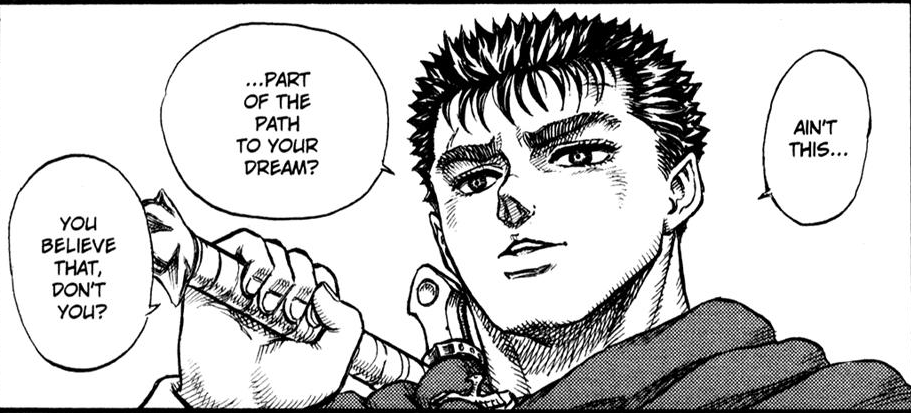


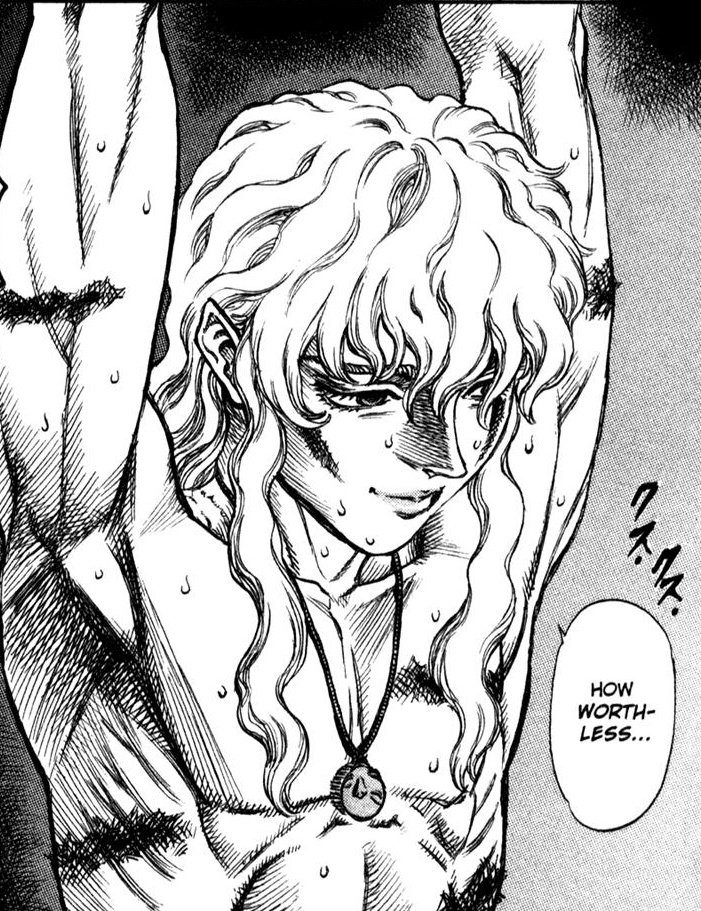


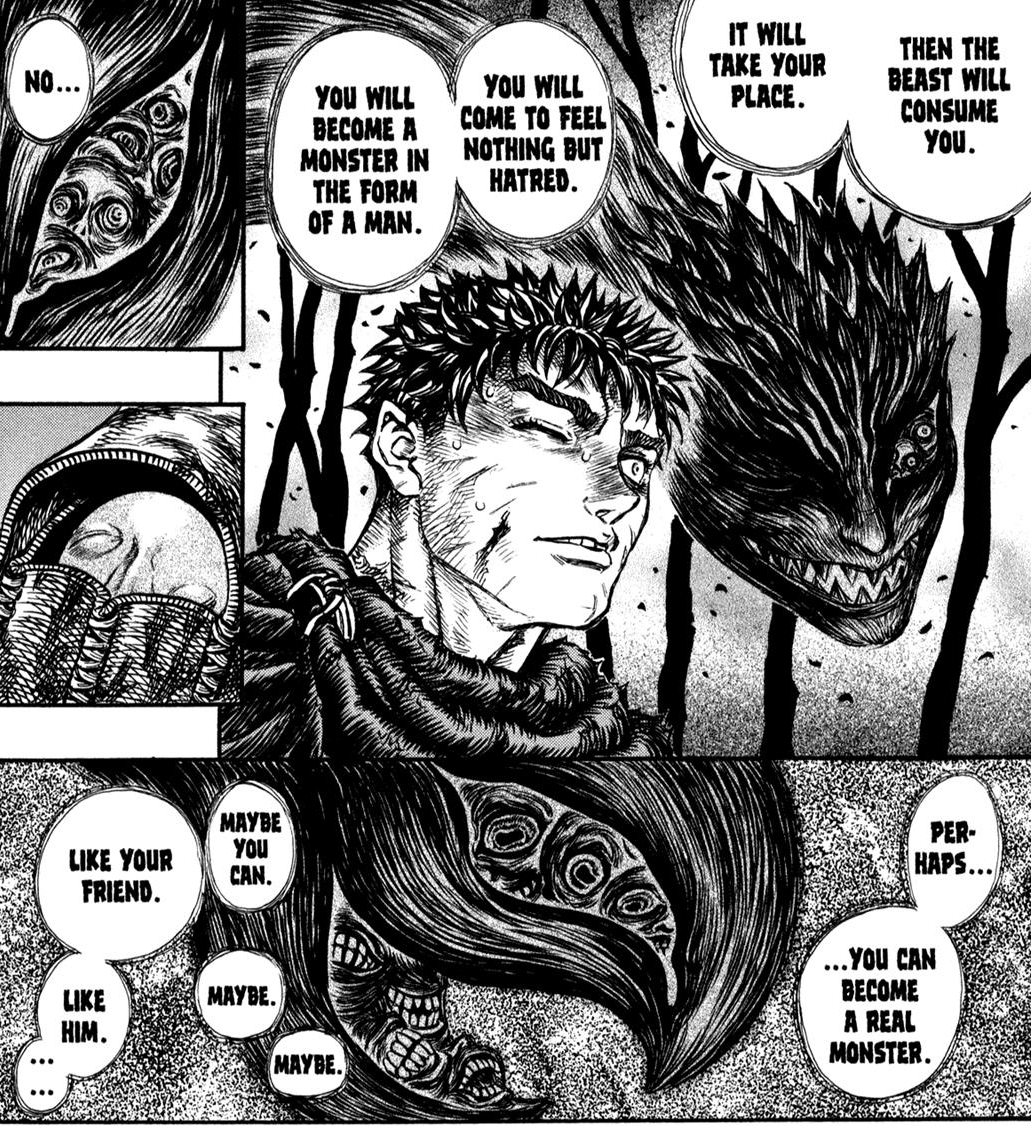


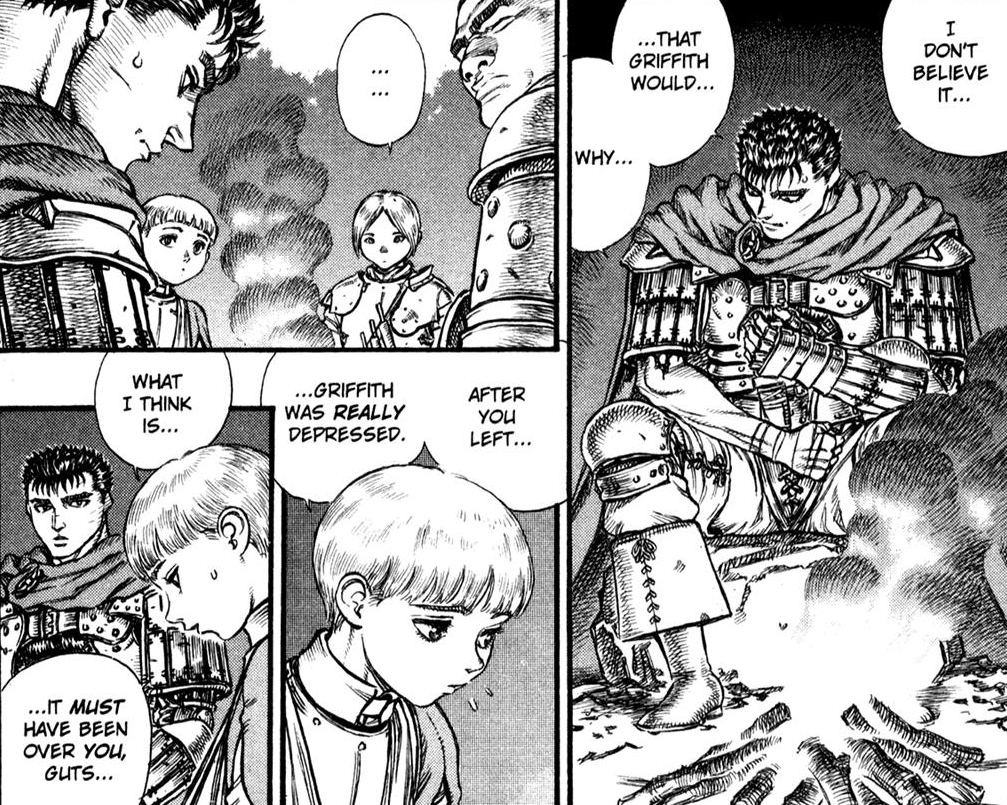


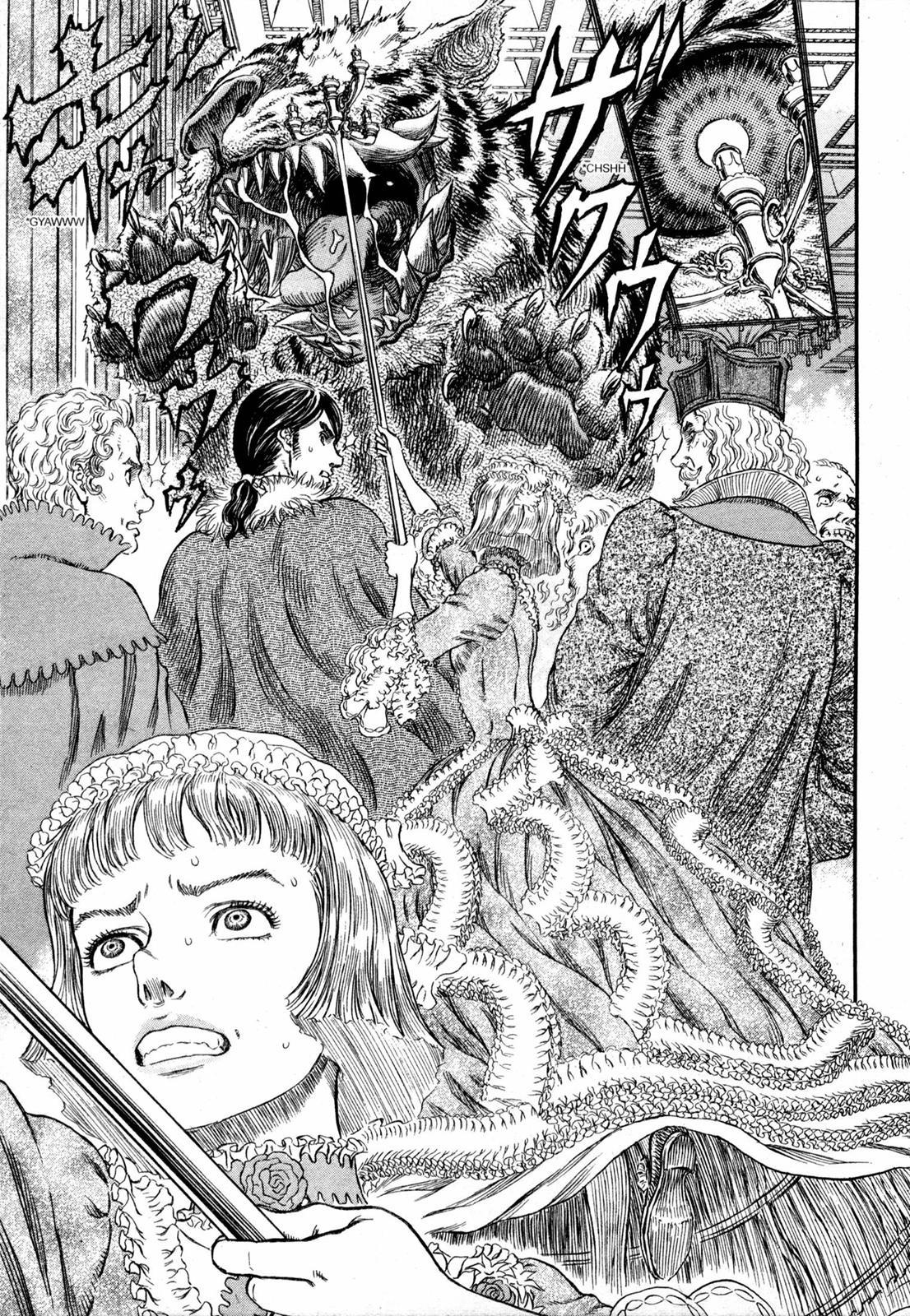

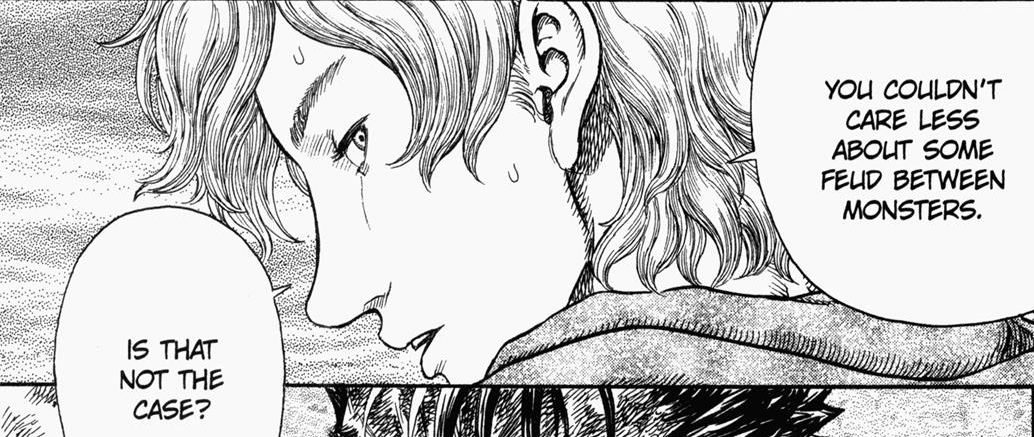

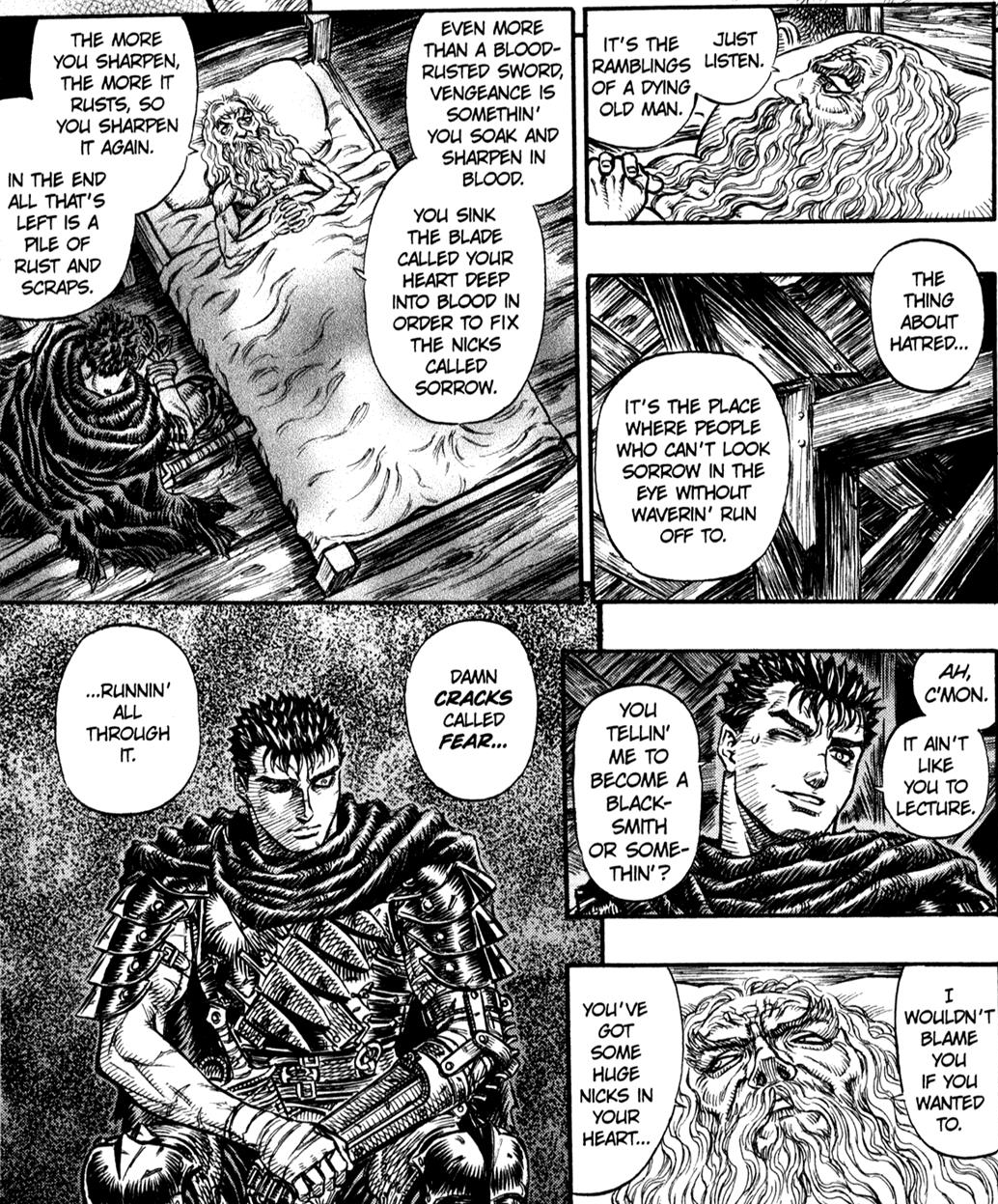


 you're the only one