i think berserk is walking that “revenge will destroy you” route and im not against a kind of emotional catharsis here but that would ideally be between guts and griffith and like that kind of reconciliation (given thats the angle were taking here) would leave an awful taste in my mouth bc of the eclipse rape lol.
tbh this is why i hope berserk isn’t so much going for a ‘revenge is bad and futile’ thing as it’s going for a ‘guts getting revenge in this particular case is bad and futile because it’s not his right to get revenge for the eclipse and also he wants revenge for the wrong reasons, ie bc it’s an easy outlet for his very complex feelings, but casca’s the hawk representative who never abandoned the band and also the person who suffered most so she’s the one who should get revenge.’
kind of suggested in part here at least:
and yea youre right about the
railroading thing ughhgh that really gets me (im a broken record but it
reminds me of vriska and like that shit gets me). it feels pretty hallow
when you have to acknowledge this in the context of the whole story
especially bc griffiths helplessness to the waters of fate and destiny
isnt emphasized as overtly tragic as it really is. which is a valid
storytelling choice ic it just, again, gets me.
also femto is the consequence of guts actions and its clearly framed that way idk what people get out of insisting otherwise.
yeah i feel you, griffith’s narrative is so sad to me, but a lot of what’s tragic about it isn’t in your face.
and yeah it’s like, you can say guts didn’t deserve to experience the eclipse, which is obviously true bc v few people deserve that shit, and def not for making a mistake based on low self esteem lol, but narratively it’s the consequence of his actions bc berserk is a very dark story. guts is the main character who actively made a choice which set all the tragedy dominos falling. it’s even ironically fitting – his choice to “abandon” the hawks and griffith resulted in losing everyone permanently.
like i think ppl equate saying the eclipse/femto/griffith’s breakdown/etc is a consequence of guts’ actions to saying either a) guts deserved to suffer and/or b) if this happened in real life it would be right to blame guts for everything lol, neither of which are statements that necessarily follow the first one, and are clearly untrue. but fiction operates by different rules than reality.
though actually while i’m on this subject, I do kind of have a big issue with how this frames griffith.
cut bc this probably doesn’t really make sense lol, i’m rambling and i’m not entirely sure how to explain my thought process lol
like, if pre-eclipse griffith was a symbol of guts’ potential to have fulfilling relationships and find a place where he belongs, that guts then totally fucked up by “abandoning,” and post-eclipse neogriffith is a symbol of guts throwing away his potential to have fulfilling relationships by pursuing a stupid self-destructive dream, then there’s a bit of an awkward contradiction:
during the golden age, guts distancing himself from griffith was a bad thing that caused all his problems. after the eclipse, guts distancing himself from griffith is the narratively correct choice. this makes technical plot sense because in between griffith transformed into a demon lol, but thematically i think it’s unsatisfying.
griffith has essentially been replaced with guts’ protective relationship with casca. he fucked up and abandoned her, just like he fucked up and abandoned griffith, but now he’s making up for it by sticking around and protecting her – something he never got a chance to do w/ griffith. like, there was no magical cure to heal griffith, no long journey of personal growth, nada.
ignoring who could be
blamed for what if berserk happened in real life, bc this has nothing to do with morals or literal interpersonal responsibilities, from a fictional
storytelling perspective guts destroyed griffith when he made the wrong
choice by leaving. griffith’s year of torture and then eclipse causing
despair is the direct consequence of guts’ narrative mistake, and femto/ngriff
is an antagonist of guts’ own making.
so to then say that the right
thing for guts to do is to try to forget about him rubs me the wrong
way. it’d be one thing if griffith was dead and there was nothing guts
could do except try to avoid repeating his mistakes, but he’s alive and
currently acting on the world in a capacity that is, at least by some
standards, negative lol. the way stories work, that’s guts’ problem to
fix.
so if the thematic takeaway is that guts should just ignore
neogriffith and move on, and if he goes back to obsessing over him
that’s bad, then… i’m not satisfied with that lol.
also like, if the manga
decided to draw a very clear and explicit dividing line between human
griffith and neogriffith, essentially declaring everything human
griffith represented to guts as dead, that would also be one thing, but miura deliberately muddies the waters both by teasing the audience about
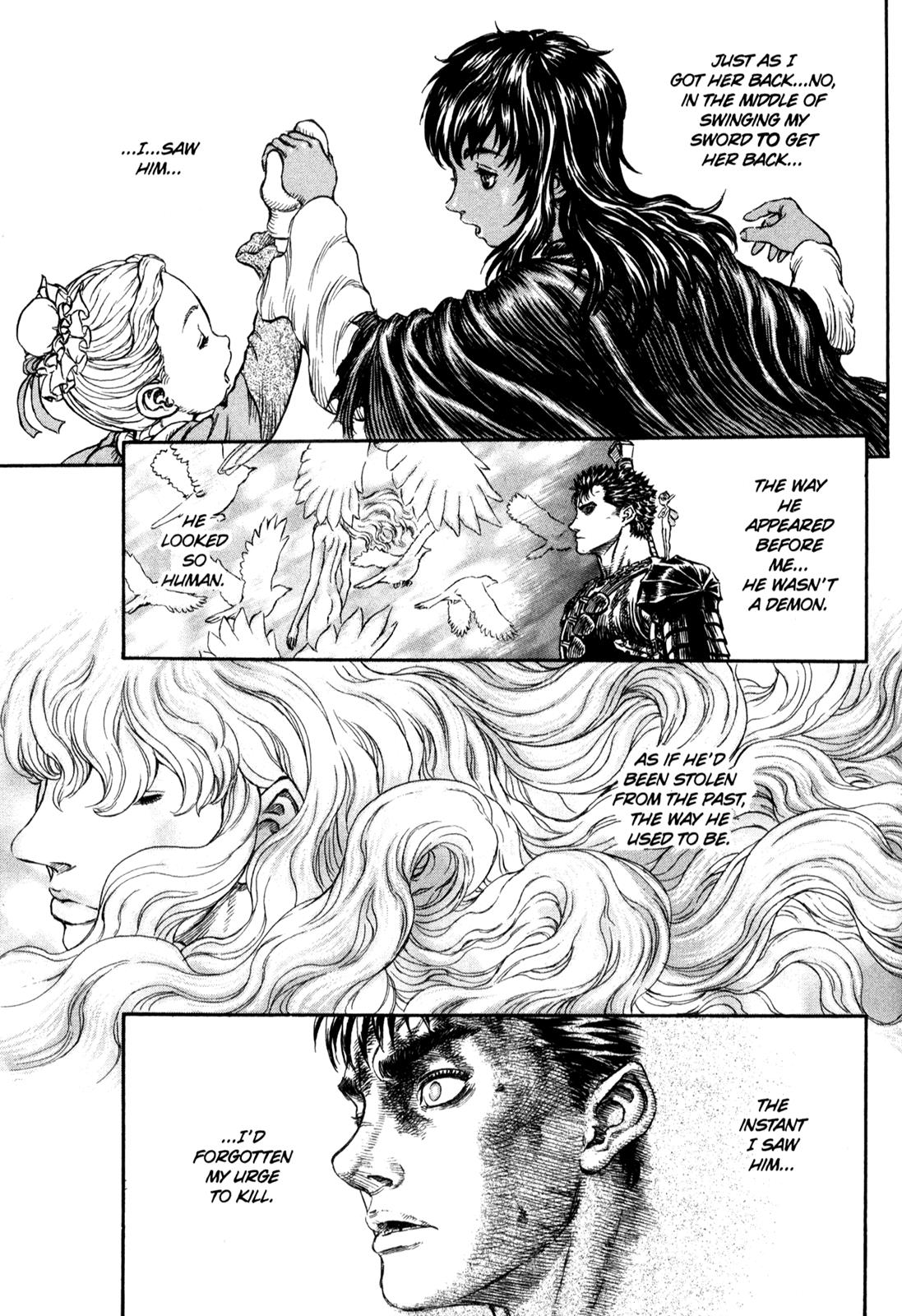
his beating heart and by guts’ emotional conflict a la “the instant I saw him I’d forgotten my
urge to kill,” and “longing,” and by continuing to utilize the light/dark imagery for their relationship, and having guts reminisce about original griffith after seeing him, etc.
so there’s this sense to me that neogriffith is simultaneously a symbol of guts’ self destructive dream (revenge, fighting stronger and stronger enemies, becoming griffith’s equal) and a symbol of guts’ mistake in pursuing that dream the first time – a symbol of what he threw away by leaving – and to me it feels unsatisfyingly contradictory.
and then on a purely emotional level lol it frustrates me that if the moral of the story really is that guts needs to move on and forget about the past and griffith and focus on the relationships he does have, then that means griffith was essentially a casualty of guts’ one step forward two steps back style character development. a character, from the perspective of his relationship to guts, who existed to be a consequence of guts’ mistake and teach guts a lesson through his destruction. and that just strikes me as unfair lol. idt guts should get to move on when griffith never had the opportunity – OR when griffith did take his opportunity ie the sacrifice, if we’re counting that, because then griffith moving on is evil but guts moving on is good.
and yeah maybe it’s a statement about moving on by suppressing your emotions vs moving on by forming new relationships, but griffith was railroaded by the narrative lol, he never got the chance to move on by forming new relationships, he was irreparably fucked the day after guts left. so if that’s the case then it’s weak.
but idk maybe i’m looking at this from entirely the wrong perspective. idk i’m just thinking outloud again rly. and until we find out what happens when casca has her mind back, it’s too early to draw any real conclusions anyway.
I like that we get Griffith’s monologue just one chapter before Guts starts to put it all together for himself, neatly referencing the same moments, and nearly coming to the same conclusion.
Yeah I think this is a pretty common conception of Griffith tbh. I’m not sure exactly why you feel this way, but I’ve seen lots of people taking it as read that he’s like, power-obsessed, or a control freak, and that impacts how they see his character.
But I don’t see that at all tbh. I’m going to like, rly briefly summarize how I feel, bc I have a lot of long versions that expand on these points (eg here and here and ofc here if you want the nearly thesis length take lol) if you want more explanation.
Basically Griffith wants power for a reason. He doesn’t want power for the sake of power, he wants power to achieve a goal, a goal that he feels he needs to achieve because of guilt.
A significant aspect of Griffith’s narrative is about how being a leader, being responsible for lives, being distant from everyone who follows him so he can maintain an image, etc, is a burden that takes a huge emotional toll on him.
Griffith is kind of trapped in this paradigm of control and being controlled. He has to be in control for the sake of his dream, in control of himself, in control of others as a leader, but again like, a big point of his narrative is that it’s a burden on him, and at least subconsciously, he wants out. Being a leader who always has to portray the correct image isolates him, being responsible for lives lost fills him with guilt, and he’s stuck because his entire sense of worth revolves around achieving his dream.
And by being controlled I’m referring to the way fate absolves him of guilt, and how he learns it was his destiny and everything he’s ever done was puppeteered by God and he’s nothing more than a pawn, etc. This holds true even as Femto and NeoGriffith, kind of ironically – at his most powerful he is aware that he has no control at all. Like, most of NeoGriffith’s apparent powers seem to be just this intrinsic knowledge that whatever he wants to do is what he’s destined to do, and therefore he can’t be harmed or stopped or prevented from doing what he wants.
(There’s probably also something to be said about Griffith’s powerlessness post-torture, but idk that basically boils down to Griffith still being responsible for that mountain of corpses, but not having the power to follow through and justify it. control vs no power, vs say ngriff’s power but no control. idk this is too long already lol, vague musing on that is enough for now.)
Umm okay to get back to my point, basically imo Griffith is kind of pushed and pulled between the burden of having too much control and the paradoxical freedom of having no control, and his desire for an equal seems to me to be like, an escape from these two extremes. Someone whose life he doesn’t control, who pursues their own reason for being, who Griffith can’t order to their death, who Griffith doesn’t have to wear a mask for – and someone who would fight him if their dreams ever clashed. Valuable as a friend and as an enemy as someone independent of him, who he has no power over and who has no power over him – or who they each have an equal amount of emotional power over.
Lol okay this was all very theme-y rather than based on characterization. So as for like, actual depictions of Griffith wanting Guts as an equal, you have moments like asking him to kill Julius rather than ordering him, the water fight, “it’s funny… you’re the first person I’ve ever spoken to like this” after explaining his thoughts on fate and wanting to know what he’s destined for, “do you think that I’m cruel?”, refusing to rein him in during battle to Casca’s consternation, reminiscing fondly on the duel he almost lost, risking his life and dream for Guts, basically his emotional dependence on him in general.
And wrt his tantrum when Guts leaves, often cited as Griffith’s control-freakiness at work lol, it’s actually another instance of Griffith wanting Guts as an equal, but compilcated by knowing that the reality of their relationship is that Griffith is Guts’ boss, and moreover, he won his loyalty in a fight. He has a breakdown because he sees Guts leaving as a rejection and a statement on their entire relationship – he thinks Guts only stayed with him because Griffith won that duel, and it horrifies him and affirms his belief that he’s cruel, but also narrows his options down to “let him go or win him in another duel” lol, when what he actually wants is for Guts to choose to stay because he wants to stay. (Again, I’ve written about this at great length here if you want more evidence for this reading.)
so that wasn’t as short as I was hoping it would be lmao. But yeah basically the way I see Griffith is that being in control is a burden to him, and he wants an equal/friend because he wants someone whose life he doesn’t control to know him and freely choose him, not as a figurehead but as a person. And he wanted that someone to be Guts.
I’ve probably touched on it before but hell if I can remember where or
how much lol, and I like talking about this so I’ll totally share my
thoughts here.
I think the main reason, which I generally come back to, is because Guts doesn’t treat Griffith with the same awe and reverence the rest of the Hawks tend to treat him with.
Their relationship is very wrapped up in power dynamics – Guts joining the Hawks after losing a duel to him, Guts feeling inadequate after Promrose, Griffith stuck on a pedestal wanting someone to share in the aspects of his rise to power that he feels he has to keep hidden from the rest of the Hawks, Griffith proclaiming none of the Hawks are his friends because they aren’t his equals, “how long ago did someone I was supposed to have in hand… instead gain such a strong hold on me?”, Guts internally waxing poetic about how untouchable and perfect Griffith is until remembering moments where Griffith was extremely vulnerable w/ him, etc etc.
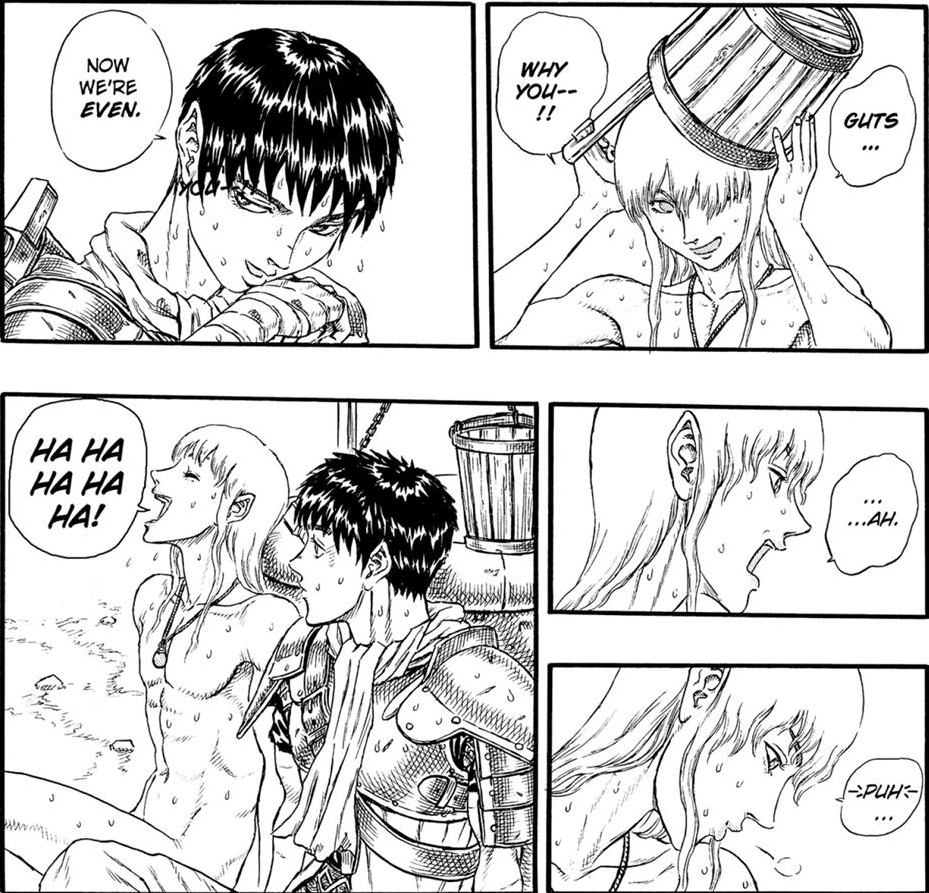
This is a moment when they both felt like they were equals. “Now we’re even.” Just two kids having a water fight.
Griffith distances himself shortly after this with his speech about his dream, but I feel like it kind of encapsulates them. There are all these artificial power dynamics standing in their way – leader/soldier, dude with a dream/dude without a dream, griffith trying to maintain an image/guts buying into that image after overhearing the Promrose speech – but at their core they’re just two people who have a strong connection.
This shows through when Guts treats Griffith’s orders as suggestions and gets chewed out by Casca, when Griffith asks him to assassinate Julius like a favour rather than an order, when Griffith risks his life and dream for Guts, when Griffith asks if Guts thinks he’s cruel, when Guts says Griffith can take off the mask since it’s just the two of them, etc. All these little glimpses of equality that can never last – and every time they fall by the wayside in favour of reinforcing the power dynamics, it leads to tragedy.
Like
But someone has to win the duel they insist on fighting.
lol I think I kinda veered off topic. But basically Guts is the one person who comes closest to treating Griffith as a person rather than a figurehead, and this marks their relationship as different, and brings them closer than Griffith is with anyone else. It’s why Guts is the person Griffith chooses to help assassinate people. You can even see this in Guts’ decision to leave – Casca hears the speech too and pretty much resigns herself to playing second fiddle, but Guts decides to do whatever it takes to become Griffith’s equal, misguided as his reasoning was.
Yk, rather than upholding the artificial dream criteria of equality, ignore it and recognize that it’s just getting in the way of actual equality.
Buuuut that explains like, why Griffith came to rely so heavily on Guts, and let him be the only person to see underneath the mask of perfection. It doesn’t explain why he was so drawn to Guts in the first place, or why he risked his life to save him the very first time, after only knowing him like a week.
Honestly idk lol. I think this was partially meant to be a little ironic, coming right after the Black Swordsman arc – showing that what fascinates Griffith about Guts is exactly those qualities Guts embodies to an extreme extent as the Black Swordsman, and which Femto claimed to have no interest in.
Overall I think it’s definitely the case that Griffith is enamoured of these traits of Guts’ – his stubbornness, his willingness to do anything to win, the way he faces danger head on, etc. I’m not entirely sure what that says about Griffith though, or even if it’s intended to reflect on Griffith’s character beyond that irony of how Guts is at his most “interesting” by this criteria when he’s Griffith’s enemy.
Though…
I wonder if it still kind of comes back to that equality.
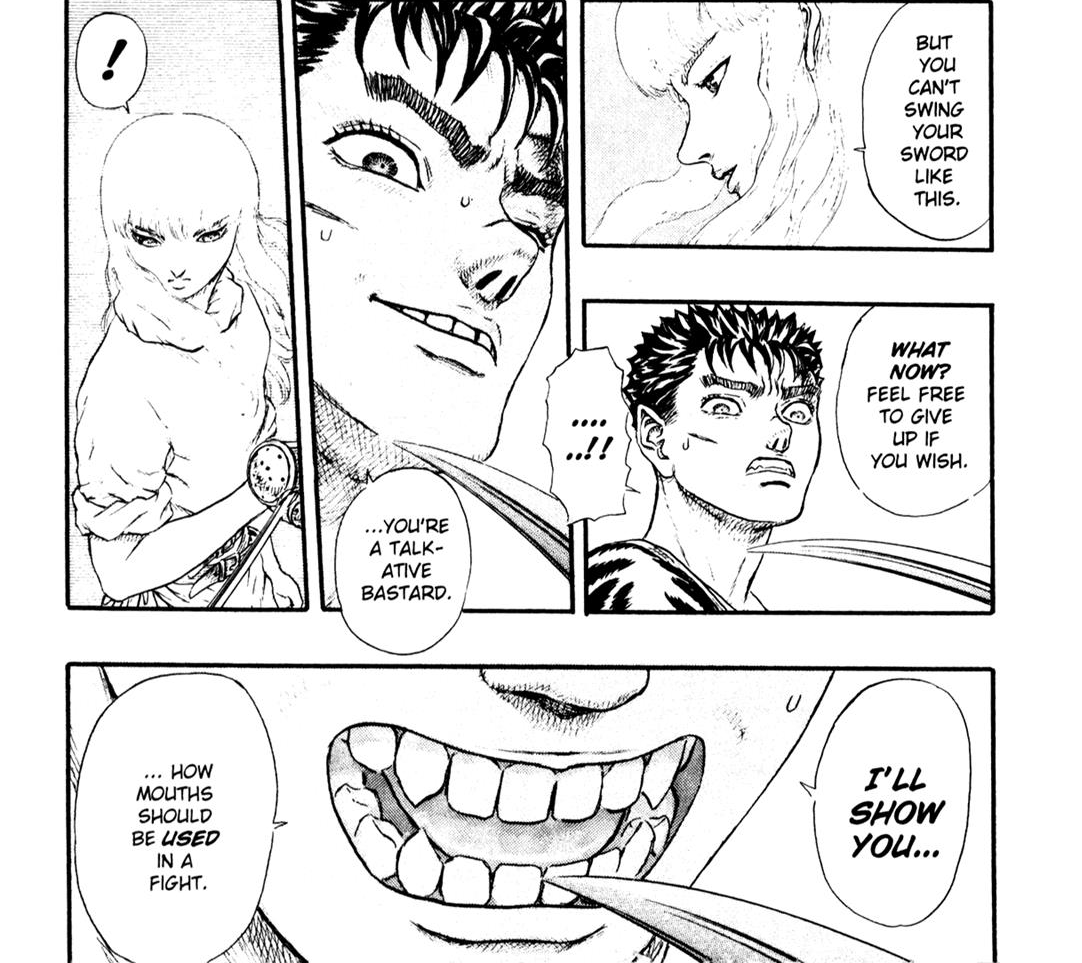
The fight Griffith reminisces fondly about is the one where he got punched in the face and nearly lost because the other dude bit his fucking sword and pushed him off a hill lol.
Like it kind of comes down to Griffith being knocked off his pedestal, and Guts having the ability to do that?
Ooooh and that makes the second duel really interesting. Guts is the only person Griffith has lost a fight to, and that maybe straight up symbolizes his love. Like Guts walked away after demonstrating exactly what Griffith loves most about him.
Idk lol this has kind of devolved into me just like musing outloud, sorry.
And actually I do know I talked about the whole equality thing more here (this is the 2nd part of a very long analysis lol) if you feel like reading more of my thoughts on that lol. I kind of want to sit down and think about how the duels and Guts’ “struggler” thing fit in more now lol.
Anyway ty for the question and comments, and I hope you had a lovely day when you sent this lol, and are having another lovely day now!
I love the Golden Age as a continuation of the Black Swordsman arc so much. Guts taken aback by Griffith’s interest in him when they first meet vs Guts absolutely fuming from Femto professing a lack of interest.
i can’t believe i’ve written multiple long posts about casca and guts trying to replace griffith with each other and i never noticed that visual parallel when they each save her til now
like i’ve been v vocally back and forth on whether casca becoming guts “sword” is intentionally negative or meant to be seen as a positive symbol of moving on from griffith, and noticing that last panel just put me way more firmly on the “negative” side lol
I’m gonna block you, which is why I capped this message instead of responding directly, but I do actually want to take a sec and answer your questions first lol, because hey it’s an excuse to talk about this shit, responding to these basic attempts at takedowns can occasionally be useful as validation for other shippers lol, and the first one is actually kinda worth discussing.
first question
Guts and Griffith both ended up opening up to Casca about their respective traumas because she happened to be there at a point when they were both particularly vulnerable.
Guts didn’t sit down with Casca and consciously decide to tell her his life story, Guts had a violent flashback during sex, strangled Casca, and then rambled about his childhood in a daze while hardly even noticing she was in front of him until she touched him and he jumped and realized what he’d just said and done.
If he’d been hitting Griffith from behind instead of Casca the exact same thing probably would’ve happened.
And if Guts had been around back then and happened upon Griffith in the river after seeing him with Gennon the previous night, the exact same thing probably would’ve happened then too, give or take Guts’ response to the “am I dirty” question.
And neither of these dudes would’ve brought these subjects up without a catalyst to anyone, including each other. Griffith because he’s repressed about it, and Guts because it wouldn’t even occur to him as something worth sharing until he’s mid-flashback.
And Griffith did have an equivalent conversation with Guts, when he asked, “do you think that I’m cruel?” That also had a catalyst, ie, they just carried out some assassinations together, but it was just as vulnerable and intimate a question as Griffith’s “am I dirty?” to Casca.
So basically the answer is: just because Guts has never had a flashback in front of Griffith doesn’t mean he’s not comfortable with him.
second question
well for a start, here are a few:
Also the entirety of the Count’s backstory in chapter 7. And a bunch of panels I skipped because I’m lazy and I’ve already posted a million collections of Gay Berserk Moments.
third question
he hasn’t chosen to sleep with a man bc a) trauma, b) he doesn’t even consciously recognize his own feelings for griffith, his subconscious beast of darkness is the one telling him he’s longing for him etc, c) even if he did figure it out during the golden age he doesn’t think he’s worthy of griffith lol there’s a whole arc about that, d) he’s only had sex twice in his life give him a chance, e) most relevantly, he’s the protagonist of a story in a seinen mag written by and for presumably hetero men.
hooo boy ok long story short, it’s a coping mechanism. I personally think it’s likely it started out as childish whimsy, and when people started dying to achieve it (he became a mercenary leader when he was still a kid) it became an absolutely necessary goal because those deaths would only be justified if he achieved it.
I also think it’s possible that it just straight up started out as a coping mechanism, a dream of a paradise where he has the power to make whatever changes he wants to the world, to fix whatever plagued him as a child – poverty, nobles abusing their power, lives being bought and sold, whatever. Either way, the guilt as motivation came afterwards, and then consumed him.
It’s all there in his monologue to Casca in the river. I think Miura actually did a great job of fleshing his dream out, but it is largely between the lines, rarely outright stated.
like here we learn that people dying for money, on the whims of those more powerful than them, bothers him:
Here we find out that he has let himself be bought and sold for the sake of saving as many lives as he could, showing us that he has a personal stake in why people’s lives being treated as commodities and subject to the whims of nobility bothers him:
Here we find out that he feels like he has to achieve his dream for the sake of the dead:
Here we see the kingdom directly depicted as an escape from the darkness of the real world:
Here we find out that he wanted to do something, change something, with the power of the throne (the monster is war):
And knowing what we know about Griffith’s feelings of guilt, his disgust at nobility, and what Falconia ends up looking like, it’s reasonable to conclude that he wanted to have the power to carve out a place where people aren’t exploited by those more powerful than them.
And, as an aside, it’s largely talked about in a selfish and dark way because Griffith himself denies this deeper meaning. It’s personal, it’s vulnerable, it doesn’t fit the image of the perfect leader of the Hawks, and therefore we only see glimpses of how he really feels in his more vulnerable moments. He frames it to himself as just something he wants just for the sake of wanting something, because it’s noble to have a goal, but we’re shown enough glimpses through that misleading and shallow explanation to figure out the truth – that it’s a coping mechanism born out of guilt with a side of a deep-seated desire for a safe place where people are treated equally.
If you want the long version, I wrote this a little while ago:
shit you know what else would’ve been a really good moral grey moment if it was focused on? griffith having the bandits he hired to kidnap foss’ daughter killed.
like, he had to do that because they would’ve been a risky loose end otherwise, it genuinely was part of the path to his dream, and he left their money on their corpses out of guilt, but that is like, a perfect symbol of treating lives as commodities.
but it wasn’t even the focus of griffith asking guts if he’s cruel! the focus was on getting guts to help him kill people, not essentially hiring people to die for him, which we know is the source of like all his guilt. miura even mitigated that for some reason by having the bandits go ‘ho ho ho we’re shitty people who will totally blackmail griffith at some point’ before guts kills them lol.
but yk even griffith just being a mercenary leader is an interesting moral grey. the path to his dream, paved with corpses of people he hired to fight and die for him.
god it’s so good! he wants to have his own kingdom to change the inherently predatory social order that he himself uses as a tool to get his kingdom.
this kind of moral dilemma is what i’m about.
This is about Falconia, bodies and lives being bought and sold, the natural order of the world, etc.
tw for csa (no graphic panels but still disturbing enough for a cut imo)
The Conviction Arc shows us in broadstrokes the world humanity’s collective unconscious wants to overturn through starving crowds, dungeons filled with tortured ‘heretics,’ rampant plague and the desire for a saviour, and nobles terrorizing peasants using god as an excuse, but this is the up close and personal version. Lives and bodies as commodities, weak trampled by the strong, poor ruled by the rich, and everyone accepting it as the way things are.
Our three main protagonists during the Golden Age all have very personal formative trauma that revolves around being bought and sold as a matter of course.
And Griffith’s dream, as someone wracked with guilt for lives lost in his battles, someone who has sold himself to a rich and powerful predator to save some of those lives, is to overturn this natural order of things.
And he does. Falconia is a place where children aren’t sold as sex slaves, where the powerful do not oppress the weak, where the rich don’t exploit the poor, where everyone is treated equally and with dignity, where Guts, Griffith, and Casca could’ve all had happy childhoods.
One of the important aspects of this theme re: societal power dynamics and exploitation is that these evil actions
are excused away. This is true of like, just about every abuser of power and
rapist in Berserk. Some think it’s okay because someone more powerful than
them told them they’re allowed (torturer, Wyald/probably the rest of
the apostles, Mozgus’ torturers, Mozgus and the inquisition in general
passing the buck onto God, Donovan because Gambino allowed it, etc),
some think it’s okay because that’s just the way things are (Donovan
again, Adon, Rosine’s got some of this, etc), some think it’s okay because
they’re powerful enough to do anything they want (implied with Gennon,
Ganeshka,
the Godhand, a lot of apostles, Casca’s attempted rapist nobleman), and finally some think it’s okay because the world wronged them (Gambino, apostles like Rosine again and Eggman, Jill’s dad, the baby eating heretics lmao, one could argue the King, Mozgus’ torturers again, etc).
Again, it all comes back to the “reason of the world,” the natural order of things that NeoGriff overturns. In the ordinary world these people with power can do whatever they want and justify it to themselves. In NeoGriffith’s world, they don’t. Apostles, our prime example of powerful preying on weak because they’re allowed to, no longer prey on humans, simply because of NeoGriffith’s existence.
It seems safe to assume nobles no longer exploit people either, if nobility is even still a thing in Falconia. Like granted, I’m taking some of this as read based on what we’re told Falconia is, but I feel like the apostles (and the explicit focus on equality) are a good representative example of the point of Falconia, which is to essentially fix everything we see wrong with the world in the Conviction arc and, like I laid out above, in our protagonists’ lives.
The fact is that Falconia isn’t just a utopia on a distant macro level, where the readers can look at it and go, hm seems nice I guess but w/e. On a micro level it’s a place where these horrible things that happened to the characters we personally love and care about wouldn’t’ve happened. I, at least, am emotionally invested in that utopia because of this, yk?
But here’s where I get critical of the portrayal:
Femto and the Eclipse rape is the epitome of the harmful power structure. Like, Femto hits every branch on his way down this tree lol. During his transformation he met God, God absolved him of his guilt and responsibility by telling him he can do whatever the fuck he wants and it’ll be the right thing. He’s taking the place of the nobleman he saved Casca from and exemplifying existing power structures of strong preying on weak, and it’s petty revenge.
One can easily argue that the Eclipse rape is a distillation of every abusive power structure in Berserk.
So okay, you have Falconia, a utopia that exists to eschew these power structures and create a place of equality where no one is exploited, created by a dude whose defining act is the epitome of these abusive power structures.
And frankly it’s fucking pointless. This feels like the shallowest of shallow hot takes lol. Like, oooh what if this wonderful place where all the horrible things that traumatized our favourite characters are no longer an accepted given was created by an evil demon rapist???
Like… okay? And then what? The Eclipse rape has nothing to do with the social structure of Falconia, NGriff seems to have completely delivered on his/humanity’s dream regardless, he is now the higher power making the calls and he hasn’t told everyone to do whatever they want no matter who it hurts. From what we’ve seen he’s done the exact opposite, existing as a tempering influence on the apostles who no longer prey on those weaker than them, ending the Holy See’s reign of terror, ending wars in general, and uniting people in their differences.
So it’s just like, an arbitrary evil act which creates an artificial sense of moral greyness. It has no deep meaning. I mean I suppose Miura could address it in the future – I’ve mentioned that I think it could theoretically be really interesting for Casca to visit Falconia and see the dream she devoted her life to having come to fruition because of her rapist. But even so, that doesn’t have any like… deeper intrigue. That’s interesting for Casca’s character, not as an examination of moral relativity or w/e.
Similarly, if NeoGriffith turns out to be more human than he looks he could reflect on this contradiction in a potentially interesting way.
But I can’t think of a way to make it an interesting examination of morality. It’s boring at its core imo. I mean you could argue that it’s still worthwhile on that personal character level, but let’s be real here – no amount of potentially interesting character stuff in Casca’s future is worth removing her from the story for 20 years, and anything w/ NeoGriffith would be a retread of human Griffith’s guilt issues and frankly I don’t see it happening anyway lol.
So yeah ultimately this whole egalitarian utopia created by a rapist demon thing just does not work for me at all. There’s no reason the creator of this paradise /had/ to be a symbol of this abusive power structure it exists to destroy, again, that’s just an arbitrary happenstance, not a pre-requisite to utopia building, so it doesn’t say anything about the nature of Falconia. It doesn’t say anything about utopias in general, it doesn’t say anything about those power structures that we don’t already know (ie they bad, equality good).
It’s like, fake deep tbqh.
The actual interesting and morally grey aspect of Falconia is the way world peace was achieved by setting a bunch of fantasy monsters loose on humanity, and that has nothing to do with the Eclipse rape. Like, that’s literally all you need for the moral complexity. We have world peace and a growing utopia that everyone is welcome to join, but the price is monsters everywhere, and this could not have happened without those monsters to unite humanity in fear. Is the world better or worse than it used to be?
And NGriff being a rapist, or his demon alter ego being a rapist, or whatever the deal is there, adds nothing to that question, rather, it distracts from it and devalues the actual moral ambiguity.
In fact, it makes me wonder whether Miura regrets going with rape as his way of demonstrating Femto’s evil. Because it’s been such a non-issue to the whole theme of power structures, utopias, equality, etc, that it feels like Miura is sweeping it under the rug lol – it’s less of an attempt at dark irony and more the elephant in the room. I can’t even say with confidence that Femto was intended to be a symbol of exploitative power structures, despite how obvious it seems, because it just… hasn’t impacted the themes of the story at all.
Man takes up the sword in order to shield the small wound in his heart sustained in a far-off time beyond remembrance.
While I agree that leaving behind the Hawks/his family in pursuit of proving his “worthiness” was misguided, I’m hesitant to call it a “mistake.” Living (and dying) as an accessory solely for the benefit of someone else isn’t particularly good or healthy.
I’d agree if Guts’ life with the Hawks was ever framed as “living and dying as an accessory solely for the benefit of someone else,” but it isn’t.
I assume you’re referencing this:
Which is Griffith’s answer when Guts asks why Griffith risked his life to save him.
Basically Griffith denying any emotional investment in Guts by emphasizing his role as a military leader who sends people to their deaths regularly.
Guts calls him out on basically lying here three years later, in the post-Zodd conversation.
So yeah, while this is nice foreshadowing for the Eclipse, it’s explicitly not how Griffith actually feels wrt Guts, and Guts figures that out.
Guts was never just an accessory to Griffith’s dream, and there was a point where Guts knew that perfectly well, before the overheard Promrose Hall speech fucked it all up lol.
And just to add a few more things:
even if Griffith really did see Guts as just another soldier who could help him achieve his dream, I don’t think it would necessarily be unhealthy for Guts to stay with the Hawks. Being a mercenary is a line of work, and being a mercenary with the Hawks is a line of work with much greater rewards, much greater camraderie and friendship, and a greater sense of purpose than being a mercenary with any other band. Guts comments early on about how the Hawks are different than any other mercenary band he’s fought with because they’re happier, because they have a personal stake in Griffith’s dream.
Guts doesn’t particularly care about being raised into the peerage, or even about the idea of Griffith becoming a King beyond thinking Griffith is “absolutely incredible” for having such a lofty dream and actually getting close to achieving it, but he does care about his friends, and during the three years in which he presumably felt like he was mainly just doing a job, he was happier than he’s ever been before or since.
So imo it would still be the case that Guts would find greater personal fulfillment in a mercenary band full of happy people who love him as a friend and respect him as a leader, rather than wandering around alone crossing swords with anyone who looks strong – specifically, it’s implied in a flashback during the Wyald fight, monsters like Zodd:
Again, it’s another little piece of sad irony, knowing how Guts spent two years after the Eclipse.
And lol I know this response is getting long, sorry, but w/e I love talking about this shit so one more last little thing:
Griffith also doesn’t see any of the Hawks as just accessories to his dream, let alone Guts. He cares about the Hawks more than probably any other mercenary leader.
I mean this is a dude who prostituted himself to a pedophile to prevent
as many deaths in the line of duty as possible, and self-harmed in a
river while monologuing about how he has to win for the sake of the men
who’ve died for his dream.
He represses the hell out of his guilt and emotional attachment to them, because they die a lot and if he didn’t he’d be a wreck, but the very fact that he could offer them up as sacrifices means they were all extremely important to him:
I think it really just comes down to how you interpret Miura’s facial expressions but to me this looks tender and loving.
It’s Griffith’s last glimpse of Guts, after choosing to sacrifice him but before he starts shedding pieces of himself and transforming, and seeing that love in his eyes just makes this moment for me lol.
He’s content with his decision, there’s no anguish there or second guessing or wishing it could’ve been another way. It’s maybe even relishing this last glimpse of Guts, and of being able to feel that love without it also like, causing him pain, because he knows this is the end of it.
I mean I’m just reading really into it because this is how I see Griffith and his feelings at the end of his story, but I think it fits the image.
I think your interpretation is fair and makes sense, like, he does look pleased and I think he is, but the look in his eye is just so damn tender, yk? Like he’s saying goodbye, without malice, and just drinking in the last sight of Guts he’ll ever have. I think love is definitely part of this moment.
more light imagery
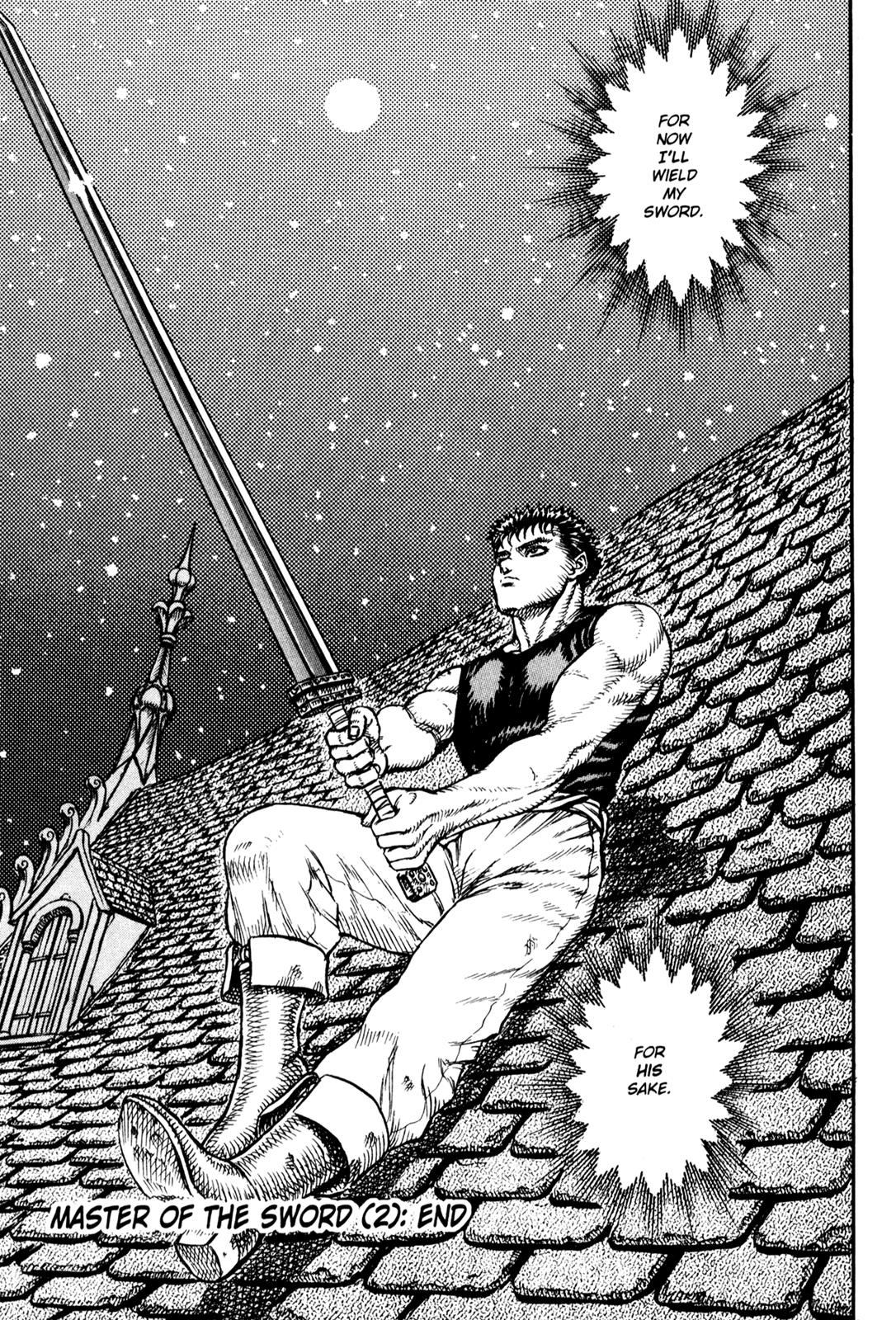
guts, looking up at the full moon and longing for a place to call home after killing gambino and fleeing:
guts, looking up at the full moon and realizing he’s found that home with the hawks:
guts, looking up into the sky a third time but there’s no moon and his home has just been completely obliterated:
soft breeze, check. leaves, check. casca gets a starry/campfire-y background while griffith gets the intense bedroom eyes and general beautification, which i feel is a fair trade.
casca gets this romanticized shot right before treating guts’ wounds; griffith gets this romanticized shot right after not having an excuse for risking his life for guts.
anyway lol this is a prime example of casca getting some of the romance cues griffith used to get once a) guts decides griffith is unreachable at the moment and b) miura decided the eclipse needed more ~drama~
Hmm, like if the toy soldier was a symbol of the boy’s dream, the magnetic knight that goes with the female figure is a symbol of Griffith’s, and leaving it with Charlotte is symbolic of the immediate loss of his dream?
Bc I could definitely see it. I actually rly like the idea of that pendant being a symbol of Griffith’s dream bc it’s another way it’s intrinsically tied to heterosexuality in opposition to his feelings for Guts, a theme I both enjoy and am depressed by.
Plus it’s fitting since after he leaves the pendant with Charlotte and gets caught he’s able to acknowledge his feelings for Guts.
I’ve assumed that it referred to wanting guts’ attention and regard, wanting guts to be focused on him, jealously guarding his relationship with guts, essentially.
but jealousy is kind of a weird word bc yk it can be synonymous with envy but also not necessarily, it can also be more possessive (like quickly double checking tells me that jealousy is more desiring to keep what you already have whereas envy is wanting what you don’t have, when they’re not used as synonyms), and context doesn’t really help here, so idk.
cause like if it is meant here as synonymous with envy then that could be interesting – he might be jealous of the way guts isn’t tied to a dream, ironically. the lack of guilt and the weight of death on his shoulders, etc.
but I guess without any additional information about the original japanese I’d still err on the side of jealous as in possessive of his relationship with guts and insecure about it, particularly considering guts and casca’s fling soon becomes an issue.
under a cut because a) this is largely about the hot button issue of griffith + sexual assault and b) it’s pretty off the cuff rather than carefully thought out so i want to reserve control over it lol
i’m gonna be honest, my biggest issue with the theme of griffith + beauty + sexual victimization is that it’s both very loud and clear, like it’s absolutely an intrinsic part of griffith’s narrative, but for some unknown reason it’s also more subtle than every other instance of sexual victimization we see? and i have no idea why miura was so coy about it but it makes it difficult and a little awkward to just take it as read
like even at the start w/ gennon. guts’ csa trauma is unambiguous – it’s violent, guts struggles and fights, etc. casca’s is also unambiguous attempted rape. she tries to run, and then is able to kill her attacker. but griffith’s is “voluntary” enough that like a majority of berserk fans don’t even see it as rape, despite gennon literally being a pedophile with a harem of child sex slaves, and griffith being a child, “who could still be called a boy in his innocence,” according to casca. the next morning griffith himself frames it as seducing gennon. also, unlike the other two instances, we don’t see what happened. All we have is Casca’s glimpse of Gennon’s hand on his shoulder and Griffith’s explanation the next morning.
And I actually have no issue at all with how it’s portrayed in canon, like anyone who isn’t a rape apologist and has an iota of reading comprehension should be able to figure out that it is rape and griffith was traumatized by it. I definitely don’t think Miura thinks Griffith freely consented or intended it to be read as ambiguous either. Griffith saying he seduced Gennon says way more about Griffith than about what actually happened. But compared to our other two protagonists and their formative traumas, it’s not nearly as in your face.
Then you have Griffith and the torturer, which is all left in creepy innuendo. Like it’s blatant enough that it seems willfully blind to assume there was no sexual assault going on, but again, it’s not like Miura shies away from depicting rape everywhere else in Berserk, so why is it only left in innuendo?
And yk what I think there’s a throughline from those – Gennon and the torturer as sexual predators obsessing over Griffith’s beauty – and both Griffith offering himself to Casca in the wagon and then Griffith’s vision of his future with Casca, t b q h. In that nightmare he’s attractive again, he’s virtually immobile, and again there’s the implication that Casca is having sex with him.
like I don’t think it’s a stretch at all to take all this together and say Griffith has some serious issues with sex even if Miura doesn’t come right out and say it like he does for everyone else.
like terrible, terrible depiction aside, this is probably the best set up for the eclipse rape we have. sex to griffith being a show of power or lack of power, and with griffith it’s always been the lack of it. with gennon, and charlotte, and casca in the wagon it’s been a trade – griffith giving them the only thing he has to offer in exchange for something they, with their greater power can give him. money, a kingdom, and… idk my reading of the wagon scene changes with the winds, but in this context i suppose it would be security, possibly griffith thinking if casca stays then guts will stay too after seeing them together.
and then this vision depicting a life like that. like the wagon scene and this nightmare seem to exist mainly to set up why the dark negative evil side of griffith would take this out on casca specifically, because griffith had just been projecting these issues onto her and when he gains power and loses his “goodness” he spitefully reverses their perceived roles.
BUT AGAIN this is both unnecessarily subtle and also a huge fucking mess thanks to how terribly written and depicted the eclipse rape was (and also the depction of the charlotte scene doesn’t help lbr) so I feel like i’m making shit up to make griffith more sympathetic lol. even though i’m like 90% sure it’s purposeful and also it doesn’t rly make griffith more sympathetic because i wholeheartedly sympathize with him even without all this lol, and femto is a literal demon made of evil so it doesn’t make him more sympathetic either. it just kind of ties a lot of themes together.
My thoughts very much line up with yours. I tend to think being raised in an environment that was probably physically dangerous as well as living through periods of involuntary starvation probably cultivated his detachment. Also I’m not sure he thought of himself as attractive? Like he might see his looks as a vulnerability since the folks that have given him attention for it have hurt him.
yeah ia with this.
i’m sure he knows he’s attractive and probably cultivates it since yk he’s trying to marry a princess, but i don’t think it’s something he’d like, be proud of or that would feed his ego or anything. i think he’d deliberately try to see it in a utilitarian way rather than having any feelings about his looks, positive or negative, bc the less rational feelings he does have would probably be negative – beauty is an asset to achieving his dream (not just in marrying charlotte but also looking the part of the hero of midland and gaining general acceptance), but it’s also something he associates with being preyed on by gennon, so he focuses on the first part.
No idea, and tbh I kind of like the fact that we never see them. It gives Griffith kind of a force of nature feel, where his actions and personality are based more in themes than in like, a more down to earth kind of characterization – all we really know is that he’s a street kid with a childish dream who never let that dream go.
I know I’ve had some fun conversations about who Griffith’s parents might’ve been and how they might’ve affected him for whatever amount of his childhood they were there for, and I think there are a lot of great headcanons and stuff. The one I generally default to is that he never knew his dad and his mother was a prostitute, because I feel like that kind of backstory could inform how he feels about sex as a transaction and bodies/lives being bought and sold, which is something his dream is kind of based on changing.
But ultimately I’m glad that canon never gives us an answer lol.
huh, this isn’t rly something I’ve ever thought about, interesting question.
I’d say that in general he’d think about it in a utilitarian way – he knows what he’s capable of with it and he’d work to keep it that way. that includes fighting and being able to seduce a princess, or whoever else may be necessary. it’s a tool.
you could probably make a good argument for him having some issues with it/detachment from it though, that could feed into him thinking about his body as a tool rather than a part of him. like, looking at the way griffith said he seduced gennon eg, it seems like a way of removing himself from what actually took place – rather than thinking of it as gennon using him, griffith used a tool (his body) to get what he wanted, that kind of thing. a way of granting himself a sense of autonomy and detaching himself from the body which he’s washing in the river and thinking of as dirty now.
plus i feel like that attitude would make for some interesting character study-ish thought processes during his torture, with both the pain inarguably tying his body to him (also possibly related – his self harming habit?), and the torturer’s fetishization of his physical beauty, and afterwards when his body is no longer useful as a tool and he’s grown so used to the pain he feels numb and “like [his body is] floating in mid air.”
and ngl neogriffith’s feelings towards his body could also be interesting. femto was like, on the astral plane, his body was arguably not even real, but then neogriffith incarnates in flesh and blood again. he’s probably more concerned about his feelings lol, but he’d likely be like, super detached from his physical form, due to having lived on another plane of existence and being a pseudo god or w/e, and also literally untouchable. now it truly is nothing more than a tool, and one that can’t be broken or forcibly tied to him because no one can even inflict pain on him.
and therefore his thought processes could be extremely interesting if/when he is touched. though for me interesting is basically griffith lying badly to himself about not caring/not feeling/etc.
holy fuck this just hit me like a brick. the way “do you think i’m cruel” is slightly separate from the other two memories, coming after Guts stops denying it and begins thinking “is this…”
“do you think that I’m cruel?”
“is this… what you wanted?”
it’s the moment griffith has least wanted this.
guts’ answer is what the godhand use to convince him to agree. it’s the moment that could’ve changed what happened here, if griffith had gotten a different answer.
ngl while my “official” take is that the dream started out as a stupid kid’s fantasy and snowballed horrifically and gained deeper significance as a coping mechanism/escape after the kid’s death and gennon (i’m pretty sure we’ve had some conversations about this ages ago lol), every time I read the scene where he saves Casca I’m like, nope there’s gotta be something else going on there.
He just lays everything out so plainly (”does being born of the nobility mean you’ve been chosen by god?” “if you have something to protect, take up that sword,” “you know how to fight already, don’t you?” “you might die you know,”) that it’s like, there’s no way the kid’s death and gennon was his wake-up call to how shitty the world is, everything’s already in place right here.
Like I guess it can’t be more than headcanon because if there was more to his story I’m sure Ubik would’ve said something while he was fucking with him to make the sacrifice, but chapter 16 like, establishes all of Griffith’s motivations/attitude towards nobility/making sure everyone follows him of their own choice/etc, which really seems to indicate that the kid’s death and gennon wasn’t the beginning of his bitterness re: people’s lives being bought and sold by nobles and his guilt re: ppl dying for his dream. It’s just like, an example.
lol in short, ia!
also while i’m on chapter one
idk if this is a purposeful thing but this sequence makes me think of how both guts and griffith are used to isolation in different ways, guts as a loner, swinging his sword instead of showing up to the ceremony, and griffith surrounded by people but separate from them, rising above the rest of the hawks but looked down on by the whispering nobles in the audience.
and then i remembered that time miura said griffith draws out feelings of loneliness in (current) guts and the way they’re each others’ brightest things, how they both shine in each others’ eyes and hearts, and agh
there’s something just so good and satisfying about how these two lonely idiots found each other and their relationship with each other is the only thing that fully eases that loneliness. griffith as he opens up to guts and lets him see the real him, and guts as he begins to accept that he’s maybe genuinely found a home here with griffith, after griffith saves his life again for “no reason.”
and why guts overhearing the promrose speech had such a devastating effect on him, and why guts leaving had such a devastating effect on griffith
also it makes me think of how current guts is similar to griffith – he has friends and people he relies on, but he doesn’t fully open up to them. there was even a recent reminder that farnese’s feelings for guts are similar to casca’s for griffith.
this is under a cut because it’s long, rambly, and stupid, and doesn’t even answer the question.
lol this honestly just defeats me entirely. idk man idk, I spent forever writing out an explanation for why the subject of toxic masculinity in Berserk defeats me, ie largely due to Miura’s total incoherence when it comes to misogyny, yk, the fact that’s he’s a huge misogynist himself really muddies the waters when it comes to sussing out where his misogyny ends and the characters’ misogyny begins.
Like how can I analyze toxic masculinity in Berserk when Miura frames, eg, the protagonist grabbing a woman’s tit during an argument as a cute moment? It’s absolutely possible to write useful and interesting things on the subject (shoutout to @yesgabsstuff who often has good thoughts on it), so I’m totally not saying that you’re wrong about it being important to Guts and Griffith’s characters/relationship, but the way I approach meta, from a ‘here’s what the narrative has to say on this using things like symbolism and parallels etc’ perspective, just doesn’t feel compatible, and frankly I suck at looking at stories from any other perspective lol.
But then I was like, but why can’t I write about gender roles in Berserk when I won’t shut up about things like sexual repression, which surely can’t actually be a more coherent subject?
It’s like, sexuality and Berserk? Hell yeah I got things to say. Gender and Berserk? my brain melts. idk idk idk. Maybe it’s because Miura thinks he has things to say about misogyny and gender but sucks at it, whereas the sexuality stuff could conceivably be accidental lol, and in any case is more subtle and therefore has fewer chances to be self-contradictory. And, less cynically, I’m sure there’s a cultural gap too that affects my ability to suss out what Miura is going for wrt masculinity/gender roles/etc.
And like, I feel I could almost answer this re: heteronormativity specifically, but honestly that also has a significant gendered component that I don’t feel up to tackling. Griffith as a knight in shining armour to attract Princess Charlotte and become an idealized heterosexual couple as he represses his feelings for Guts? Ok. But then when it comes to gender roles/masculinity and Griffith’s attraction to Guts I fall apart again. Is there a sense that Griffith’s attraction to Guts is partially something to shy away from because it makes him less of a masculine ideal? IDK! How does Griffith sleeping with Gennon for the sake of his heteronormative dream fit in? IDK! Does Guts shy away from his attraction to Griffith due in part to insecurity in his own masculinity? IDK! Is insecurity in his masculinity a deliberate aspect of his trauma? IDK!
I feel like his trauma absolutely informs how he leaps into danger at any given opportunity and stands against every monster he sees, which is very typically masculine, like, mb I’ve got the seed of something there (Casca wishing he’d run away sometimes? His choice to stay with Griffith in chapter 71 as turning away from fighting his own battles to regain a relationship and a sense of emotional openness that helped him heal from trauma in a much healthier way, but tragically undone by Casca urging him towards his own masculine ideal? that masculine ideal in both guts and griffith’s cases leading to an unleashed rapey dark side, and in both cases as a tragic alternative to a fulfilling relationship with each other? hmmmm) but I’m not confident in my ability to carry that thread through with an emphasis on gender roles/masculinity.
But I mean, maybe I’m just overcomplicating it lol, it’s not like everything has to fit perfectly in order to be worthwhile as a reading, and I’m not exactly married to authorial intent. Idk I’ll probably end up pondering this further and if I come up with anything I’ll definitely write it out, but as for now this is going to have to go pretty much unanswered.
tl;dr I got nothin atm, sorry anon, and idek if anything I wrote here makes sense lol.
Personally I think you should write your take on how toxic masculinity and heteronormativity affects the
characters and their relationship and @ me or link me, because I’m
interested in seeing what you have to say.
And anyone else with Thoughts on the subject should feel free and encouraged to leap in too.
The way I see it human Griffiths ambition to rule over a kingdom never truly came from him per say??? It derived from his destiny. It was his destiny, a fate he wasnt aware of, that was the driving force behind his every action, behind his every victory and the reason why it was possible for him to climb the rigid social ladder.
And I don’t think NeoGriffiths lack of humanity would be the cause behind Faconia’s fall(if it does fall)
As a human I dont
think Griffith wouldve been able to handle doing everything that
NeoGriffith did. Despite how strong Human Griffith was he was still
prone to stress, doubt and anxiety. As a human Griffith tried to be
everything that he managed to become as a godhand, perfect.
And him hiding behind his strength, charisma, and beauty did take its
toll on him as a human. Then add the stress of being the messiah to all
of humanity, old Griffith wouldnt be able to do it
tbh I never really saw fate as a reason in and of itself for any choices people make in Berserk. Everyone has their own reasons for doing whatever they do, those reasons just play perfectly into fate’s hands. At one point Flora equates fate and “encounters,” which I like because it’s basically like a perfect meld of fate and free will.
eg Guts was fated to be picked up off the side of the road by Gambino, which thoroughly shaped him as a person; Guts was fated to overhear Griffith’s Promrose Hall speech, and the reason he chose to leave was largely because of a bundle of issues Gambino left him with. So Guts and his choices make perfect sense with or without fate having a hand in his life, it just so happens that fate is there behind the scenes making sure he is shaped by the right people.
so for Griffith, God tells him that he basically shaped the entire world, and Griffith’s ancestry, in order to bring Griffith into the world with a perfect set of traits to become the next Godhand, but everything he thinks and feels and does still makes sense just as a person with his particular history. So I can’t really say he’s obsessed with his dream because it’s his destiny, he’s obsessed with his dream because he has a particularly obsessive personality and he happened to see it at the right time in his life or under the right circumstances to become fixated or w/e – because of destiny lol.
Idk it’s convoluted but you gave me an opening to explain my thoughts on fate in berserk and I took it lol.
anyway aside from that long fate tangent that’s barely related to what you said lol, ia that human Griffith wouldn’t be able to do what NeoGriffith does. For one thing he’d’ve been crushed by Ganeshka without his army of apostles. And even without that, even if he just became king of Midland the way he was planning, if Guts never left, ia that I could see a scenario where reality hits him square in the head, being king turns out to be not all its cracked up to be, he still finds his power too limited to do everything he wants to do, and he struggles a lot under the pressure.
griffith thinks he’s cruel for letting someone – guts – in and hence dragging him through the dirt with him; guts thinks he’s cruel for /only/ letting guts in… i don’t have a conclusion but hmmmm
that’s a really good observation tbh
my guess is that it highlights how much they see what griffith is doing as dirty? guts like, let’s be honest, doesn’t really at all. griffith asks him to kill a man and he’s like pshh just order me like you always do 😉 hey why don’t you tell the rest of our pals about this?? meanwhile griffith thinks he’s a filthy monster
Yeah it shows how non judgemental Guts is about it, and that he expects everyone else to be similarly non-judgemental. Maybe indicates that Guts thinks Griffith is only keeping them in the dark for… convenience or whatever, and subtly shows that he doesn’t realize it’s because of shame. Griffith explains afterwards, sort of, in his prevaricating way (”they need only feel as though they’re rising up”). Idk but it’s another sign of the gulf of misunderstanding between them for sure.
ugh it just kills me how griffith comforted casca here, even though he must have been sick to his stomach as well
and then later. you know
agh a while ago I was going to post about how the fact that Griffith’s hand on Casca’s shoulder bookends this chapter, except the second time he is very clearly repressing his feelings to seem like a strong perfect person and reassure Casca, sheds a whole lot of light on how he was probably feeling the first time he put his hand on Casca’s shoulder in chapter 17 here.
and then I forgot and this reminded me and now I’m sad again.







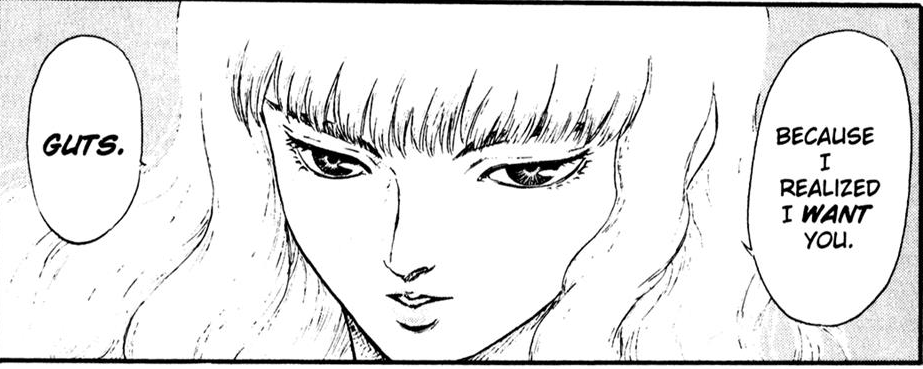


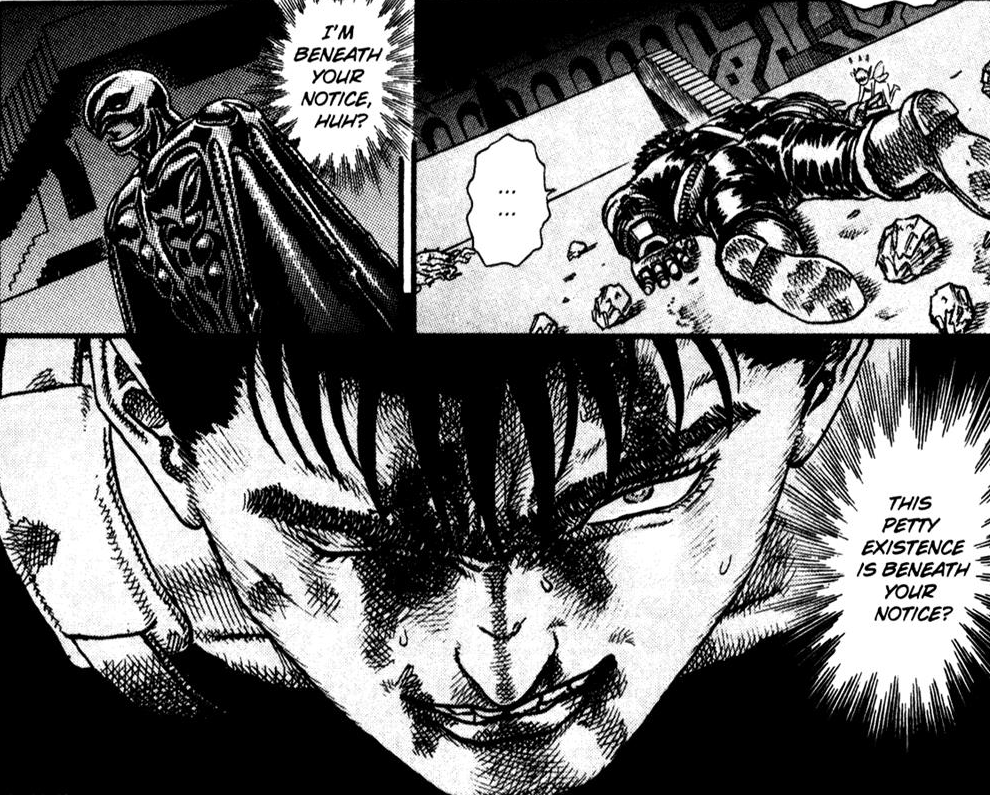


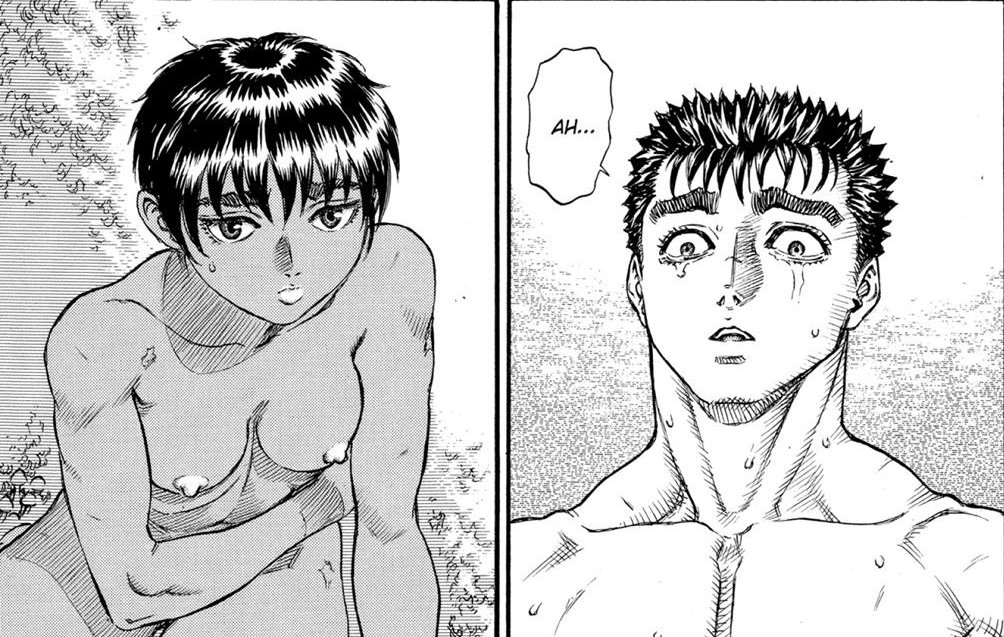
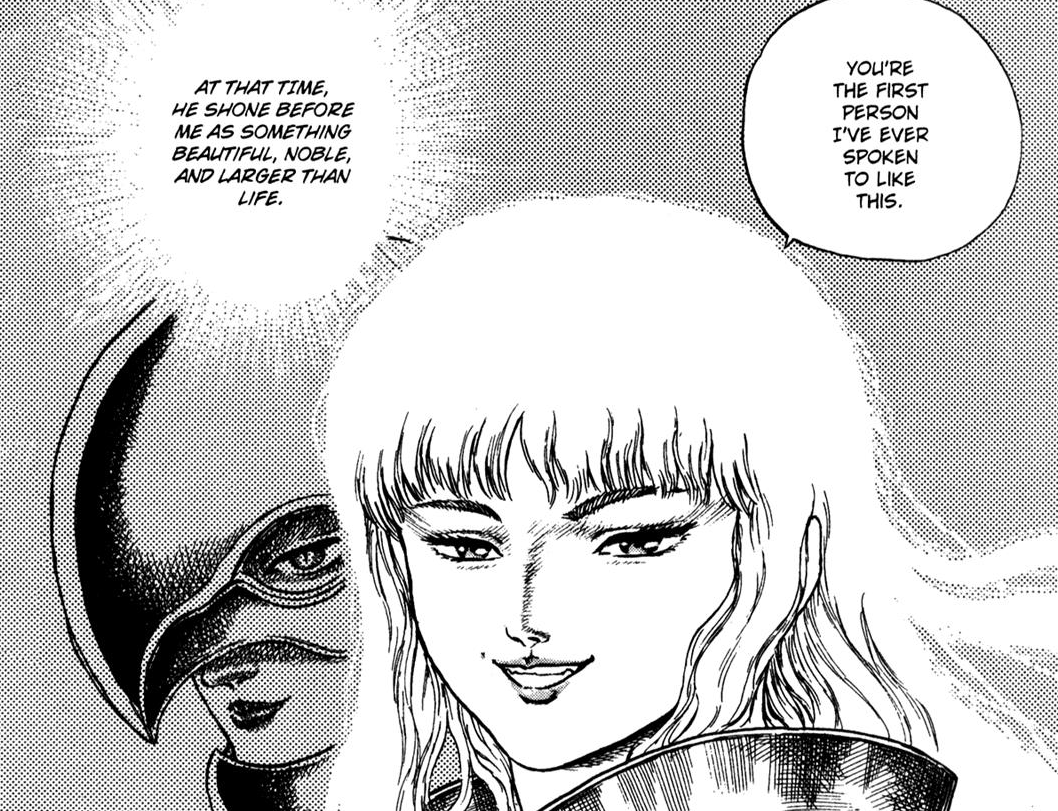













 you're the only one