mostly berserk meta. i'm into berserk mainly for griffguts and i'm a huge fan of griffith.
Tag: arc: ga
also somewhat relatedly i love the thought of all those little moments in their relationship that we know existed but never get to really see, at least not in detail, in like the 3-4 years they had before everything got all fucked
the little quiet moments pre and post battle, eating together, drinking together, chatting about nothing important, or griffith opening up to guts the way we’ve seen a few times but must’ve happened more than that, laughing together, sparring together, whatever. there’s just so much potential there.
but i’m glad that we got to see just enough of them to hint at the little chill unimportant-to-the-plot moments, just enough to get the sense of the casual intimacy of their relationship
like guts trying to see griffith after the zodd fight because why the hell shouldn’t he go visit him? or like corkus calling guts griffith’s favourite. or like guts casually reclining in griffith’s study paging thru the kama sutra while griffith talks about the assassination attempt.
or like owen’s memory
and some of the official art is gr8 for this too
and mb my favourite two examples:
like, i love that after the eclipse guts’ mournful memory of griffith is one we never actually saw, nothing particularly important, nothing relevant to the plot – just one instance of griffith glancing back at him before a battle.
and griffith’s last memory before making the sacrifice is also nothing relevant to the plot, nothing particularly important, just the two of them limping away after one battle out of a hundred together.
because it’s those moments that really, really define their relationship, moreso even than griffith saving guts from zodd or guts dedicating his sword to griffith or griffith’s breakdown when guts left or guts realizing he fucked up when he left, etc etc.
+ it’s those little details that rly sell their relationship even when we don’t get to see all that much of the casual pointless in-between moments imo. like the big important moments are incredibly good and why i ship them, but it’s just nice to know that those moments aren’t the only ones that matter.
I’ve probably touched on it before but hell if I can remember where or
how much lol, and I like talking about this so I’ll totally share my
thoughts here.
I think the main reason, which I generally come back to, is because Guts doesn’t treat Griffith with the same awe and reverence the rest of the Hawks tend to treat him with.
Their relationship is very wrapped up in power dynamics – Guts joining the Hawks after losing a duel to him, Guts feeling inadequate after Promrose, Griffith stuck on a pedestal wanting someone to share in the aspects of his rise to power that he feels he has to keep hidden from the rest of the Hawks, Griffith proclaiming none of the Hawks are his friends because they aren’t his equals, “how long ago did someone I was supposed to have in hand… instead gain such a strong hold on me?”, Guts internally waxing poetic about how untouchable and perfect Griffith is until remembering moments where Griffith was extremely vulnerable w/ him, etc etc.
This is a moment when they both felt like they were equals. “Now we’re even.” Just two kids having a water fight.
Griffith distances himself shortly after this with his speech about his dream, but I feel like it kind of encapsulates them. There are all these artificial power dynamics standing in their way – leader/soldier, dude with a dream/dude without a dream, griffith trying to maintain an image/guts buying into that image after overhearing the Promrose speech – but at their core they’re just two people who have a strong connection.
This shows through when Guts treats Griffith’s orders as suggestions and gets chewed out by Casca, when Griffith asks him to assassinate Julius like a favour rather than an order, when Griffith risks his life and dream for Guts, when Griffith asks if Guts thinks he’s cruel, when Guts says Griffith can take off the mask since it’s just the two of them, etc. All these little glimpses of equality that can never last – and every time they fall by the wayside in favour of reinforcing the power dynamics, it leads to tragedy.
Like
But someone has to win the duel they insist on fighting.
lol I think I kinda veered off topic. But basically Guts is the one person who comes closest to treating Griffith as a person rather than a figurehead, and this marks their relationship as different, and brings them closer than Griffith is with anyone else. It’s why Guts is the person Griffith chooses to help assassinate people. You can even see this in Guts’ decision to leave – Casca hears the speech too and pretty much resigns herself to playing second fiddle, but Guts decides to do whatever it takes to become Griffith’s equal, misguided as his reasoning was.
Yk, rather than upholding the artificial dream criteria of equality, ignore it and recognize that it’s just getting in the way of actual equality.
Buuuut that explains like, why Griffith came to rely so heavily on Guts, and let him be the only person to see underneath the mask of perfection. It doesn’t explain why he was so drawn to Guts in the first place, or why he risked his life to save him the very first time, after only knowing him like a week.
Honestly idk lol. I think this was partially meant to be a little ironic, coming right after the Black Swordsman arc – showing that what fascinates Griffith about Guts is exactly those qualities Guts embodies to an extreme extent as the Black Swordsman, and which Femto claimed to have no interest in.
Overall I think it’s definitely the case that Griffith is enamoured of these traits of Guts’ – his stubbornness, his willingness to do anything to win, the way he faces danger head on, etc. I’m not entirely sure what that says about Griffith though, or even if it’s intended to reflect on Griffith’s character beyond that irony of how Guts is at his most “interesting” by this criteria when he’s Griffith’s enemy.
Though…
I wonder if it still kind of comes back to that equality.
The fight Griffith reminisces fondly about is the one where he got punched in the face and nearly lost because the other dude bit his fucking sword and pushed him off a hill lol.
Like it kind of comes down to Griffith being knocked off his pedestal, and Guts having the ability to do that?
Ooooh and that makes the second duel really interesting. Guts is the only person Griffith has lost a fight to, and that maybe straight up symbolizes his love. Like Guts walked away after demonstrating exactly what Griffith loves most about him.
Idk lol this has kind of devolved into me just like musing outloud, sorry.
And actually I do know I talked about the whole equality thing more here (this is the 2nd part of a very long analysis lol) if you feel like reading more of my thoughts on that lol. I kind of want to sit down and think about how the duels and Guts’ “struggler” thing fit in more now lol.
Anyway ty for the question and comments, and I hope you had a lovely day when you sent this lol, and are having another lovely day now!
I love the Golden Age as a continuation of the Black Swordsman arc so much. Guts taken aback by Griffith’s interest in him when they first meet vs Guts absolutely fuming from Femto professing a lack of interest.
hooo boy ok long story short, it’s a coping mechanism. I personally think it’s likely it started out as childish whimsy, and when people started dying to achieve it (he became a mercenary leader when he was still a kid) it became an absolutely necessary goal because those deaths would only be justified if he achieved it.
I also think it’s possible that it just straight up started out as a coping mechanism, a dream of a paradise where he has the power to make whatever changes he wants to the world, to fix whatever plagued him as a child – poverty, nobles abusing their power, lives being bought and sold, whatever. Either way, the guilt as motivation came afterwards, and then consumed him.
It’s all there in his monologue to Casca in the river. I think Miura actually did a great job of fleshing his dream out, but it is largely between the lines, rarely outright stated.
like here we learn that people dying for money, on the whims of those more powerful than them, bothers him:
Here we find out that he has let himself be bought and sold for the sake of saving as many lives as he could, showing us that he has a personal stake in why people’s lives being treated as commodities and subject to the whims of nobility bothers him:
Here we find out that he feels like he has to achieve his dream for the sake of the dead:
Here we see the kingdom directly depicted as an escape from the darkness of the real world:
Here we find out that he wanted to do something, change something, with the power of the throne (the monster is war):
And knowing what we know about Griffith’s feelings of guilt, his disgust at nobility, and what Falconia ends up looking like, it’s reasonable to conclude that he wanted to have the power to carve out a place where people aren’t exploited by those more powerful than them.
And, as an aside, it’s largely talked about in a selfish and dark way because Griffith himself denies this deeper meaning. It’s personal, it’s vulnerable, it doesn’t fit the image of the perfect leader of the Hawks, and therefore we only see glimpses of how he really feels in his more vulnerable moments. He frames it to himself as just something he wants just for the sake of wanting something, because it’s noble to have a goal, but we’re shown enough glimpses through that misleading and shallow explanation to figure out the truth – that it’s a coping mechanism born out of guilt with a side of a deep-seated desire for a safe place where people are treated equally.
If you want the long version, I wrote this a little while ago:
The first part in particular is all about Griffith’s dream as a coping mechanism, though the other three parts expand on that a lot.
This is about Falconia, bodies and lives being bought and sold, the natural order of the world, etc.
tw for csa (no graphic panels but still disturbing enough for a cut imo)
The Conviction Arc shows us in broadstrokes the world humanity’s collective unconscious wants to overturn through starving crowds, dungeons filled with tortured ‘heretics,’ rampant plague and the desire for a saviour, and nobles terrorizing peasants using god as an excuse, but this is the up close and personal version. Lives and bodies as commodities, weak trampled by the strong, poor ruled by the rich, and everyone accepting it as the way things are.
Our three main protagonists during the Golden Age all have very personal formative trauma that revolves around being bought and sold as a matter of course.
And Griffith’s dream, as someone wracked with guilt for lives lost in his battles, someone who has sold himself to a rich and powerful predator to save some of those lives, is to overturn this natural order of things.
And he does. Falconia is a place where children aren’t sold as sex slaves, where the powerful do not oppress the weak, where the rich don’t exploit the poor, where everyone is treated equally and with dignity, where Guts, Griffith, and Casca could’ve all had happy childhoods.
One of the important aspects of this theme re: societal power dynamics and exploitation is that these evil actions
are excused away. This is true of like, just about every abuser of power and
rapist in Berserk. Some think it’s okay because someone more powerful than
them told them they’re allowed (torturer, Wyald/probably the rest of
the apostles, Mozgus’ torturers, Mozgus and the inquisition in general
passing the buck onto God, Donovan because Gambino allowed it, etc),
some think it’s okay because that’s just the way things are (Donovan
again, Adon, Rosine’s got some of this, etc), some think it’s okay because
they’re powerful enough to do anything they want (implied with Gennon,
Ganeshka,
the Godhand, a lot of apostles, Casca’s attempted rapist nobleman), and finally some think it’s okay because the world wronged them (Gambino, apostles like Rosine again and Eggman, Jill’s dad, the baby eating heretics lmao, one could argue the King, Mozgus’ torturers again, etc).
Again, it all comes back to the “reason of the world,” the natural order of things that NeoGriff overturns. In the ordinary world these people with power can do whatever they want and justify it to themselves. In NeoGriffith’s world, they don’t. Apostles, our prime example of powerful preying on weak because they’re allowed to, no longer prey on humans, simply because of NeoGriffith’s existence.
It seems safe to assume nobles no longer exploit people either, if nobility is even still a thing in Falconia. Like granted, I’m taking some of this as read based on what we’re told Falconia is, but I feel like the apostles (and the explicit focus on equality) are a good representative example of the point of Falconia, which is to essentially fix everything we see wrong with the world in the Conviction arc and, like I laid out above, in our protagonists’ lives.
The fact is that Falconia isn’t just a utopia on a distant macro level, where the readers can look at it and go, hm seems nice I guess but w/e. On a micro level it’s a place where these horrible things that happened to the characters we personally love and care about wouldn’t’ve happened. I, at least, am emotionally invested in that utopia because of this, yk?
But here’s where I get critical of the portrayal:
Femto and the Eclipse rape is the epitome of the harmful power structure. Like, Femto hits every branch on his way down this tree lol. During his transformation he met God, God absolved him of his guilt and responsibility by telling him he can do whatever the fuck he wants and it’ll be the right thing. He’s taking the place of the nobleman he saved Casca from and exemplifying existing power structures of strong preying on weak, and it’s petty revenge.
One can easily argue that the Eclipse rape is a distillation of every abusive power structure in Berserk.
So okay, you have Falconia, a utopia that exists to eschew these power structures and create a place of equality where no one is exploited, created by a dude whose defining act is the epitome of these abusive power structures.
And frankly it’s fucking pointless. This feels like the shallowest of shallow hot takes lol. Like, oooh what if this wonderful place where all the horrible things that traumatized our favourite characters are no longer an accepted given was created by an evil demon rapist???
Like… okay? And then what? The Eclipse rape has nothing to do with the social structure of Falconia, NGriff seems to have completely delivered on his/humanity’s dream regardless, he is now the higher power making the calls and he hasn’t told everyone to do whatever they want no matter who it hurts. From what we’ve seen he’s done the exact opposite, existing as a tempering influence on the apostles who no longer prey on those weaker than them, ending the Holy See’s reign of terror, ending wars in general, and uniting people in their differences.
So it’s just like, an arbitrary evil act which creates an artificial sense of moral greyness. It has no deep meaning. I mean I suppose Miura could address it in the future – I’ve mentioned that I think it could theoretically be really interesting for Casca to visit Falconia and see the dream she devoted her life to having come to fruition because of her rapist. But even so, that doesn’t have any like… deeper intrigue. That’s interesting for Casca’s character, not as an examination of moral relativity or w/e.
Similarly, if NeoGriffith turns out to be more human than he looks he could reflect on this contradiction in a potentially interesting way.
But I can’t think of a way to make it an interesting examination of morality. It’s boring at its core imo. I mean you could argue that it’s still worthwhile on that personal character level, but let’s be real here – no amount of potentially interesting character stuff in Casca’s future is worth removing her from the story for 20 years, and anything w/ NeoGriffith would be a retread of human Griffith’s guilt issues and frankly I don’t see it happening anyway lol.
So yeah ultimately this whole egalitarian utopia created by a rapist demon thing just does not work for me at all. There’s no reason the creator of this paradise /had/ to be a symbol of this abusive power structure it exists to destroy, again, that’s just an arbitrary happenstance, not a pre-requisite to utopia building, so it doesn’t say anything about the nature of Falconia. It doesn’t say anything about utopias in general, it doesn’t say anything about those power structures that we don’t already know (ie they bad, equality good).
It’s like, fake deep tbqh.
The actual interesting and morally grey aspect of Falconia is the way world peace was achieved by setting a bunch of fantasy monsters loose on humanity, and that has nothing to do with the Eclipse rape. Like, that’s literally all you need for the moral complexity. We have world peace and a growing utopia that everyone is welcome to join, but the price is monsters everywhere, and this could not have happened without those monsters to unite humanity in fear. Is the world better or worse than it used to be?
And NGriff being a rapist, or his demon alter ego being a rapist, or whatever the deal is there, adds nothing to that question, rather, it distracts from it and devalues the actual moral ambiguity.
In fact, it makes me wonder whether Miura regrets going with rape as his way of demonstrating Femto’s evil. Because it’s been such a non-issue to the whole theme of power structures, utopias, equality, etc, that it feels like Miura is sweeping it under the rug lol – it’s less of an attempt at dark irony and more the elephant in the room. I can’t even say with confidence that Femto was intended to be a symbol of exploitative power structures, despite how obvious it seems, because it just… hasn’t impacted the themes of the story at all.
While I agree that leaving behind the Hawks/his family in pursuit of proving his “worthiness” was misguided, I’m hesitant to call it a “mistake.” Living (and dying) as an accessory solely for the benefit of someone else isn’t particularly good or healthy.
I’d agree if Guts’ life with the Hawks was ever framed as “living and dying as an accessory solely for the benefit of someone else,” but it isn’t.
I assume you’re referencing this:
Which is Griffith’s answer when Guts asks why Griffith risked his life to save him.
Basically Griffith denying any emotional investment in Guts by emphasizing his role as a military leader who sends people to their deaths regularly.
Guts calls him out on basically lying here three years later, in the post-Zodd conversation.
So yeah, while this is nice foreshadowing for the Eclipse, it’s explicitly not how Griffith actually feels wrt Guts, and Guts figures that out.
Guts was never just an accessory to Griffith’s dream, and there was a point where Guts knew that perfectly well, before the overheard Promrose Hall speech fucked it all up lol.
And just to add a few more things:
even if Griffith really did see Guts as just another soldier who could help him achieve his dream, I don’t think it would necessarily be unhealthy for Guts to stay with the Hawks. Being a mercenary is a line of work, and being a mercenary with the Hawks is a line of work with much greater rewards, much greater camraderie and friendship, and a greater sense of purpose than being a mercenary with any other band. Guts comments early on about how the Hawks are different than any other mercenary band he’s fought with because they’re happier, because they have a personal stake in Griffith’s dream.
Guts doesn’t particularly care about being raised into the peerage, or even about the idea of Griffith becoming a King beyond thinking Griffith is “absolutely incredible” for having such a lofty dream and actually getting close to achieving it, but he does care about his friends, and during the three years in which he presumably felt like he was mainly just doing a job, he was happier than he’s ever been before or since.
So imo it would still be the case that Guts would find greater personal fulfillment in a mercenary band full of happy people who love him as a friend and respect him as a leader, rather than wandering around alone crossing swords with anyone who looks strong – specifically, it’s implied in a flashback during the Wyald fight, monsters like Zodd:
Again, it’s another little piece of sad irony, knowing how Guts spent two years after the Eclipse.
And lol I know this response is getting long, sorry, but w/e I love talking about this shit so one more last little thing:
Griffith also doesn’t see any of the Hawks as just accessories to his dream, let alone Guts. He cares about the Hawks more than probably any other mercenary leader.
I mean this is a dude who prostituted himself to a pedophile to prevent
as many deaths in the line of duty as possible, and self-harmed in a
river while monologuing about how he has to win for the sake of the men
who’ve died for his dream.
He represses the hell out of his guilt and emotional attachment to them, because they die a lot and if he didn’t he’d be a wreck, but the very fact that he could offer them up as sacrifices means they were all extremely important to him:
Ok, this is my long and thorough explanation of how Guts’ decision to leave the Hawks was ultimately shown to be a mistake.
I’ve been kind of meaning to write this for a while because I tend to take this statement as read in a lot of my meta and I wanted to have something to point to for the sake of clarification whenever necessary lol. Also jsyk this isn’t quite as long a read as it looks bc there are a lot of illustrative images.
And before I get into it I just want to make something clear: when I say it was a mistake I’m not saying that it’s a decision that reflects badly on Guts. It reflects many of Guts’ issues, and it stems largely from growing up with an abusive father figure, but based on the information Guts had at the time, and based on his personality and his values it was a reasonable decision to make from his perspective.
It’s just one that he ended up wholeheartedly regretting for very good reasons.
This basically rests on three premises:
1. Guts was happy and felt personally fulfilled with the Hawks.
2.
Guts chose to leave for one reason and one reason only: Griffith’s Promrose Hall speech made him feel inadequate.
3. Griffith’s speech absolutely didn’t reflect either his actual feelings about Guts or a particularly worthwhile life philosophy, and eventually Guts comes to understand this.
So let’s demonstrate the first part, starting from when Guts joined the Hawks.
Cue the waterfight scene with Griffith. And afterwards:
Then Rickert knocks him off the step and congratulates him on already having ten men under his command.
Guts is happy with the Hawks. After only a week with them he’s already chilling out about being touched, he’s feeling accepted, he’s responsible for others and he’s rising to that responsibility. He reflects on the night he killed Gambino and fled his first home, thinks “I still don’t have an answer to that question [of where am I going?]…” but then when Rickert congratulates him he thinks, “for now…”
For now, he’ll make his home with the Hawks. He tells Rickert to call him Guts and their clasped hands get their own panel. He’s forging new relationships and bonds with people, beginning to heal from past trauma, and growing as a person. He’s no longer swinging his sword just to survive, but as part of a unit, to help his friends and comrades survive and thrive too.
Three years later, when Casca accuses him of not changing since he joined them, of not caring about his comrades, he’s incensed.
He’s proud of having changed. He’s proud of his place in the Hawks, of being their raider captain, of Griffith’s faith in him. Casca’s words wound him because he has deep seated insecurities related to being an outsider.
His rivalry with Casca draws these insecurities out but overall he is very happy with the Hawks, he does care about them, and Casca insinuating otherwise pisses him off for good reason.
When Griffith nearly dies saving him from Zodd and then says he did it for no reason and implies he’d do it again without question, Guts like, basically reaches the pinnacle of his life.
And like, it is straightforward textual canon that this is everything Guts has desperately wanted all his life, thanks largely to his big pile of issues stemming from his fucked up childhood:
That is exactly what he has, and more importantly, what he understands and recognizes he has, after this staircase conversation.
When he first joined the Hawks we saw him remember that question he asked himself the night he killed Gambino and ran from his first (shitty) family: “where’m I going?”
After this conversation he remembers that night again:
He’s chosen to replace that first family, the abusive father he killed, the first mercenary band he grew up with, with the Hawks and Griffith. He has an answer to why he’s swinging his sword, and it’s not just to survive – it’s “for his sake.”
For now…
That little “for now” is important. It’s what he thought when he joined the Hawks three years ago, and it’s what he thinks now, because frankly, he is terrible at committment. This is an important part of Guts’ character. He’s slow to trust that others care about him because of his terrible childhood, and he’s very quick to believe he is unloved and unwanted. That “for now,” sets us up for the way one overheard speech makes Guts decide to rebuild his entire life from the ground up.
But hey, for now, he’s happy. He knows he’s cared for, he knows people, particularly Griffith, love and respect and value him. That to Griffith he’s worth risking his life for. He’s ready to dedicate himself to Griffith in turn. This is huge for Guts.
So yeah, he’s content and feels personally fulfilled with the Hawks and Griffith at this point in his life.
But then comes the speech.
This completely wipes away Guts’ assurance that Griffith loves, values, and respects him.
It changes everything for Guts and inarguably informs his choice to leave:
The real question worth asking isn’t why Guts decided to leave the Hawks, but why did one overheard pretentious speech about how Griffith has no friends affect Guts so profoundly that he immediately stopped viewing Griffith as a fellow human who would happily risk his life for him and began seeing him as a distant and perfect godlike figure who Guts would do anything to reach?
Like this speech comes after Griffith has literally died “for [his] sake.” In the encounter with Zodd, Griffith was dead because he instinctively ran into danger to grab Guts personally – it was only an unforseen twist of fate that allowed him to survive. And Guts knows this is significant, which is why he questions him about it, gets his answer, and dedicates himself to Griffith in return.
The speech erases that.
Afterwards, he has this incredibly unsubtle conversation with Casca:
Casca is laying down some basic facts here that add up to a confirmation of everything Guts believed when he said “I’ll wield my sword… for his sake,” on that rooftop.
Guts is the first person Griffith has ever said he wanted. Casca
hoped it was for his strength as an aid for achieving his dream, but
that is clearly not the case since he has nearly sacrificed his life –
and dream, Casca specifies – for Guts twice.
Griffith values Guts even above the dream he’s dedicated his life to, as is thoroughly demonstrated by his actions.
But Guts
completely disregards this. Casca straightforwardly tells him that
Griffith feels some unique and irrational emotions for Guts, and his
actions are proof of that, but Guts never stops to consider that maybe
Griffith’s actions speak louder than his words. At the most, what Casca’s angry monologue might do is give Guts the confidence that he’s capable of becoming Griffith’s friend, and therefore inspires him to leave.
But it certainly doesn’t make him rethink the truth or the value of Griffith’s speech to Charlotte.
I’m not going to get heavily into Griffith’s point of view here, I’ve done that very thoroughly in the second part of this giant thing
for anyone rly curious, but suffice to say his Promrose Hall monologue doesn’t have a
damn thing to do with how Griffith actually feels about Guts lol.
Guts doesn’t fit his weird and narrow definition of friend, Guts is actually far more important to him than this definition leaves room for. A friend is someone who has his own dream and would prioritize it over friendship, allowing Griffith to prioritize his own dream as well – Guts, conversely, has already taken priority over Griffith’s dream when Griffith risked it for him twice.
Griffith isn’t about to consciously admit to himself that his dream is no longer his number one priority, but our trusty commentator of their relationship, Casca, knows the score, and explains it to Guts, and completely fails to get through to him.
And the reason Guts prioritizes the speech over actual evidence of what his relationship with Griffith actually is, both in the form of Griffith saving him and Casca explaining things to him, comes back to his abusive childhood:
He is convinced that Griffith looks down on him because this is what he’s grown up expecting from people he respects and loves. He expects to be seen as worth nothing more than the money he can bring in and the fights he can win, he expects to be ostracized and seen as “cursed,” so Griffith’s speech overrides Griffith risking his life and dream to save Guts twice, it overrides Casca’s jealousy of their relationship, it overrides Griffith freaking out and refusing to let Guts leave without another duel, hell, for a while it even overrides both Casca and Rickert telling him that Griffith destroyed his life because Guts left.
He’s gone from feeling like a trusted, respected, and valued friend to feeling like nothing more than an asset to Griffith’s dream.
Remember, he did not feel discontent before the speech. In his three years with the Hawks before overhearing the speech, he felt like he’d found the place he belonged. He felt worthwhile, he felt valued as a person and not just as a soldier, and moreover, he was right to feel that way.
The Hawks do love, respect, and value him, and Griffith demonstratably values him even over his dream whether he’s able to admit that to himself or not.
And it’s only after overhearing the speech, overhearing that Griffith can only see someone as a friend and equal if they have their own obsession to pursue, that Guts starts feeling once again like he’s only fighting to survive, as we see him ponder during the 100 man fight, and here:
Before the Promrose Hall speech he felt like he was fighting for his friends and comrades, for Griffith, and he was proud of that, but now he feels like he’s worthlessly fighting for nothing. It’s incredibly depressing imo. This is straight up a result of Guts’ low self esteem, thanks to his abusive childhood.
This is Guts’ tendency to feel like an outsider rearing its ugly head. This is because he grew up being told he was cursed, used only as a source of income for Gambino, and turned on and nearly killed by Gambino and then the rest of the mercenaries. This is Guts feeling like he can’t trust any companionship to be genuine other than his sword.
Basically what happened is that Guts overheard Griffith’s speech in a moment of particular vulnerability. He’d just accidentally killed a kid and he was feeling like a monster about it. He was trying to find Griffith, probably to feel that same sense of acceptance and love he felt during the staircase conversation – he needed reassurance, and instead his world came crashing down around him and his feelings of worthlessness resurged hard.
And because of his outsider issues he extrapolates Griffith’s speech to his feelings about being part of the Hawks as a whole. Every Hawk has a dream except him, therefore he’s an outsider and doesn’t really belong.
And on some level, Guts knows this is bullshit.
It’s been one day and, now feeling the full weight of being alone again and apart from what Rickert pointedly calls his family, he’s already having second thoughts, reflecting on the warm companionship he’s giving up and acknowledging that his goal is inherently contradictory.
He wants to find his own dream so he can live for himself, when his entire reason for wanting that is to become Griffith’s equal. He’s not going out to find a dream for the sake of his own sense of independence, or because he personally also believes that a person is only worthwhile if they’re pursuing something.
He’s doing it because he overheard Griffith say that’s the only way to be his friend.
As he declares his independence from Griffith he is literally parroting Griffith’s speech here lol; it’s a giant contradiction and proof of what he mused on the night he left – he got this idea in his head by overhearing Griffith’s words, therefore he’s not actually doing it for his own sake.
Guts left for the sole reason of fulfilling Griffith’s weird and specific friendship criteria.
And after Guts comes back his whole narrative pretty much revolves around his slow and painful realization that Griffith’s speech was functionally meaningless, and yeah it turns out he did end up throwing away something irreplacable that he’ll never have again by taking off.
Like, just to underscore how significant it is that Guts lets Casca stab him as he internalizes this information, this is a huge sign of guilt. We see Guts do the same thing when the possessed kid stabs him all the way back in chapter 2. He denies feeling responsible both times, but the fact that he let himself be stabbed contradicts those words.
It takes him several days and several pretty huge anvils dropped on him before he finally accepts the fact that not only was leaving entirely unnecessary because Griffith did not actually look down on him or consider him unworthy, but by leaving he destroyed the thing he left to obtain in the first place: he left to become Griffith’s equal and when he came back, by any standards these two idiots would use to define power and worth, Guts is by far Griffith’s superior now. Entirely because Guts left Griffith is now disabled, helpless, voiceless, dreamless, powerless, and dependent.
And let’s be real, it’s a pretty damn harsh thing to accept that you not only rearranged the focus of your entire life and left your found family for no reason, but by doing so you lost the thing you rearranged your life and left your family to try to get. It’s no wonder Guts holds out for so long.
He keeps telling himself that Griffith is above the kind of emotion that would lead to him being declared a traitor one day after Guts left, that Griffith is untouchable, that Griffith has always had everything under control and always will. He insists to himself that Griffith is perfect and soaring distantly above him, because his reason for leaving is to become just like him. He has to believe it to justify his decision.
Since before he left:
to after he comes back:
But his ability to deny not just Griffith’s flawed humanity but also his devastatingly powerful feelings for him is growing weaker. Guts is beginning to realize that the fact that Guts was able to destroy him by leaving is itself proof that he didn’t need to leave.
Guts already had as strong a hold over Griffith as Griffith had over him. They were already functionally equals in this way.
Then I’ve made a huge mistake.
To make a long story short (too late), this is why Guts left:
And this is how Griffith really feels about Guts:
These two monologues exist to play off each other. Guts monologuing about his feelings for Griffith, how dazzling he is, how he needs to leave so he can be Griffith’s equal instead of feeling like Griffith is looking down on him. And Griffith’s monologue about his feelings for Guts, how the dream he’s spent every waking moment of his life pursuing pales in comparison to him, how strong Guts’ hold on him is, how he’s the sole sustenance keeping him alive.
It’s a point/counterpoint. Griffith’s monologue directly states that Guts is wrong about his reasons for leaving.
And again, I don’t think Guts’ decision to leave was actually stupid, or that it reflects badly on him. Griffith himself didn’t properly recognize his feelings for Guts until it was too late, and Guts had good reasons, both internal (a history of abuse) and external (Griffith’s stupid speech), for believing Griffith looked down on him.
But nevertheless he was still wrong, and here’s where Guts finally, finally realizes it properly, without pushing that realization away and denying it some more:
Unfortunately he realizes this about 30 seconds too late, which is what makes Berserk a tragedy.
Anyway, that’s about it. It may be worth noting that his regret over leaving informs significant chunks of the rest of his narrative, such as realizing he’s been being a dick by leaving Casca in a cave for two years:
And refusing to leave her again:
“Don’t abandon what you can’t replace. Weren’t those Godo’s parting words?”
Guts realizing he fucked up and shouldn’t’ve left the Hawks informs his most significant moments of personal growth over the series. Realizing he’s repeating that mistake is what finally sways him from the self-destructive path of rage and revenge to putting his energy into protecting Casca.
The fact that companions and loved ones are more important and genuinely healthier things to prioritize than dreams is one of the central themes of Berserk, and Guts choosing to leave the Hawks, his family, to pursue a dream, thereby losing all of his friends and loved ones, is the main illustration of this theme.
Also worth noting: the dream Guts eventually landed on was to just keep swinging his sword, getting better and stronger and fighting better and stronger enemies, except alone this time, instead of among comrades and friends. You know what that describes to a tee? The Black Swordsman arc, as is neatly pointed out after the Eclipse:
Guts would’ve been much, much better off staying with the Hawks and continuing to find personal fulfillment in his relationships and feelings of being loved and valued, but years of being told his only worth is as an asset, rather than as a person, blinded him to the truth and made it too easy for him to believe he’s looked down on.
Part of the tragedy of the Golden Age hinges on Guts’ low self esteem and inability to see that he’s loved because of it. This is what happens when you’re the protagonist of a really well-written, really tragic story: you make some wonderfully disastrous, character-revealing mistakes.
more light imagery
guts, looking up at the full moon and longing for a place to call home after killing gambino and fleeing:
guts, looking up at the full moon and realizing he’s found that home with the hawks:
guts, looking up into the sky a third time but there’s no moon and his home has just been completely obliterated:
yk i think guts is supposed to seem chill and confident and generally changed in a positive way after his year long vacation but since every moment that emphasizes his cool chill attitude makes me want to punch him i’m not 100% certain lol
like i generally take as read that guts leaving the hawks is one of those things that’s overall bad but had some positive effects, like guts being more confident and cool, since yk the moments that indicate that are things the target audience of dudes would generally agree is cool, like calmly grabbing casca’s tit while she’s yelling at him and then saying, ‘come with me’ in a nonchalant non-commital way, or like telling casca she’s too naked and distracting during the wyald fight, or constantly being a smartass dick during the competition, that kinda thing.
but then again since i generally argue that leaving the hawks was a bad decision, maybe those moments are actually meant to be off-putting. like i don’t really think so, if i was a betting person i’d place money on miura thinking they make guts cooler, but i kind of want to believe.
I dont agree with this tbh. Guts leaving the hawks was a good thing. One of the most difficult and traumatic experiences is gaining independence and discovering your own way i life. The hawks were a home for guts but learning to leave to find his own way was special for me. I used to think that him leaving was sort of “cool” and used to set the whole tough lone wolf trope, but because of how guts felt inferior to his peers, and especially griffith, leaving the hawks was the most endearing action he couldve done. Its not played for a trope or for a demographic but rather to show the journey of a man who wants to be someone he can love. Ik ur a hige guts x griffith fan and i see the obvious undertones and interactions but when i see how guts feels when he seew his own journey next to griffiths i cant blame him for leaving.
I respect your opinion and I don’t mean to reblog this just to be like ‘nah you’re wrong’ because like, I do think Miura was trying to convey both good and bad effects of Guts leaving. Like I said, though I personally think that Guts’ more confident and independent attitude is shown in insufferable ways, I feel like Miura intended it to be a positive change for him.
And in general the idea of someone leaving a place to be more independent is a perfectly valuable and potentially a very positive narrative depending on the circumstances, and I don’t want to suggest that if you found Guts’ decision to leave the Hawks to be valuable then you’re wrong, there are plenty of reasons to appreciate it.
But, because this is one of those readings that tends to inform a lot of my other posts and meta etc, I just want to kind of explain where I’m coming from and what I mean by “mistake.”
It’s not a mistake you can blame Guts for at all, because his reasons for leaving are perfectly understandable and sympathetic, but it’s a decision Guts made based on misinformation (from Griffith’s stupid speech) and his own issues – largely desperately wanting to be loved and respected and believing all too easily that he isn’t thanks to his fucked up childhood.
And like this is also something Griffith shoulders blame for, for being an emotionally obtuse idiot who doesn’t recognize his own feelings until he’s spent a year in a dungeon. But again, like Guts’ issues, I find this sympathetic and understandable too.
(And like, while yeah I obviously ship them lol, this isn’t necessarily shippy, it’s kind of just a fact of Berserk that it, and the Golden Age especially, revolves around Guts and Griffith’s relationship, platonic or otherwise. Guts chose to leave because he wanted to be Griffith’s friend – before overhearing the speech he didn’t feel inadequate at all.)
Basically it’s not a mistake in the sense that Guts should’ve known better or that Guts choosing to leave was stupid and reflects badly on him, it’s a mistake because if Guts and Griffith were less terrible at communication Guts wouldn’t’ve wanted to leave in the first place, and once he realizes that he left because of misinformation he feels a lot of regret.
I think I’m going to write a full post on this soon because it would be nice to have something to link back to when I casually throw the idea that Guts leaving was a mistake out there, because I know it’s actually pretty controversial in fandom as a whole. So if you’re interested in my further thoughts with more like, textual evidence lol, I’ll get on that, and if not then no worries and I’m more than happy to agree to disagree 🙂
yk i think guts is supposed to seem chill and confident and generally changed in a positive way after his year long vacation but since every moment that emphasizes his cool chill attitude makes me want to punch him i’m not 100% certain lol
like i generally take as read that guts leaving the hawks is one of those things that’s overall bad but had some positive effects, like guts being more confident and cool, since yk the moments that indicate that are things the target audience of dudes would generally agree is cool, like calmly grabbing casca’s tit while she’s yelling at him and then saying, ‘come with me’ in a nonchalant non-commital way, or like telling casca she’s too naked and distracting during the wyald fight, or constantly being a smartass dick during the competition, that kinda thing.
but then again since i generally argue that leaving the hawks was a bad decision, maybe those moments are actually meant to be off-putting. like i don’t really think so, if i was a betting person i’d place money on miura thinking they make guts cooler, but i kind of want to believe.
also while i’m on chapter one
idk if this is a purposeful thing but this sequence makes me think of how both guts and griffith are used to isolation in different ways, guts as a loner, swinging his sword instead of showing up to the ceremony, and griffith surrounded by people but separate from them, rising above the rest of the hawks but looked down on by the whispering nobles in the audience.
and then i remembered that time miura said griffith draws out feelings of loneliness in (current) guts and the way they’re each others’ brightest things, how they both shine in each others’ eyes and hearts, and agh
there’s something just so good and satisfying about how these two lonely idiots found each other and their relationship with each other is the only thing that fully eases that loneliness. griffith as he opens up to guts and lets him see the real him, and guts as he begins to accept that he’s maybe genuinely found a home here with griffith, after griffith saves his life again for “no reason.”
and why guts overhearing the promrose speech had such a devastating effect on him, and why guts leaving had such a devastating effect on griffith
also it makes me think of how current guts is similar to griffith – he has friends and people he relies on, but he doesn’t fully open up to them. there was even a recent reminder that farnese’s feelings for guts are similar to casca’s for griffith.
Chapter One serves to re-establish the characters’ relationships with each other after three years fighting together and foreshadow their future conflicts as their relationships change. This is especially evident during the last scene of the chapter.
The interspersing of Guts’ rote sword exercise with Griffith’s knighting as
he reaches a significant milestone on the path to his dream subtly
illustrates the eventual conflict between Griffith’s dream and his
relationship with Guts by contrasting Guts’ aimlessness with Griffith’s
ambition, ie the source of Guts’ eventual inner conflict that leads to him leaving the Hawks.
And these directly subsequent panels in particular invite a visual
comparison between Guts’ sword and the sword that represents Griffith’s dream, hinting at the way Griffith is torn between Guts and his dream.
Finally, the clear phallic imagery indicates that they want to bone the fuck down.
still wondering what’s judeau’s agenda tbh. like did he want guts to take casca away for her to be safe? this is completely true tho and one of the reasons why i dislike judeau is that he’s a gtsca shipper lol
There’s that hint before he dies that he’s in love with her, and there’s an indication that he has like… self-worth issues lol, with his “if I couldn’t be the best I’d fly in the wake of someone who was” reasoning for following Griffith, and comparing himself to Guts negatively when they were running from monsters in the Eclipse. I think it’s basically Judeau thinking he isn’t good enough for Casca and Guts would be, and seeing how hard leading the Hawks while they’re being hunted has been on her and wanting her to get away from that responsibility.
Which tbh is another indication that gtsca was a misguided mistake from the start, since Judeau’s reasoning for arranging their hookup in the first place is stupid and based on low self esteem.
There’s also shades of a parallel between Judeau trying to get Guts and Casca together and Guts trying to get Casca and Griffith together, and I will personally argue forever that Guts throwing Casca at Griffith was because he didn’t feel like he was good enough for Griffith, rather than not good enough for Casca. I mean, that is his entire reasoning behind his decision making at that point in the story, after all.
Thinking he’ll be worthy of Casca when he’s Griffith’s equal is a random quick aside spurred on by Judeau right before he leaves and imo framed as though Casca being in love with him would be a sign that he’s made it as Griffith’s friend and equal, rather than wanting to be Griffith’s friend and equal to get with Casca lol, which has never been a factor.
In the fourth and final part of this exploration of the tug of war between Griffith’s dream and his love for Guts, I’m going to look at how Griffith ultimately ends up choosing the dream over Guts despite the fact that Guts is more important to him – or, more accurately, because Guts is more important.
I’m starting by diving right into what is, hands down, my favourite part of Berserk.
The small battles we fought on the cobblestone when we were still young. The small victories we achieved. The many sparkling junk spoils we plundered.
In the evening… staring up from the back alley of brothels and taverns, where the sun never shines, I saw something. Shimmering against the setting sun, it was the brightest thing I had ever seen.
I made up my mind. The junk I would get for myself… would be that thing.
Darkness.
Deep darkness without even a trace of light.
How much time has passed since I was cast into this darkness…?
An eternity… but it also seems like an instant… All my senses are numbed and I can’t feel a thing. What of my body? It’s like it’s floating in mid-air. Have I retained my sanity? Did I go insane long ago?
Only him.
Like lightning on a dark night, he rises up within me, blazing. And again and again like a tidal wave, an infinite number of feelings surge upon me. Malice, friendship, jealousy, futility, regret, tenderness, sorrow, pain, hunger… So many recurring, yearning feelings. That giant swirl of violent emotions in which none are definite but all are implied. That alone is the bond which keeps my consciousness from vanishing amidst the numbness.
I know that I’m different from other people. Those I’ve met can by no means disregard me. They always view me with either a look of good will or animosity. I know that the good will forms into trust or fellowship and the animosity into awe or possibly dread. Thereby have I grasped… the hearts of so many in these hands.
…But why is it when it comes to him I always lose my composure?
He was the reason I’ve been thrown into this darkness, and now he’s the sole sustenance keeping me alive. Out of so many thousands of comrades and tens of thousands of enemies, why just him…?
How long ago did someone I was supposed to have in hand… instead gain such a strong hold on me?
Because you’re in love with him, oh my god.
At the end of the day, that’s what it boils down to. That’s the difference between Griffith shutting Casca out and letting Guts in. That’s why Casca has been jealous of Guts. Casca wanted to be Griffith’s emotional support, something indispensible to his dream – she wanted to be the one to “change him that way” – and learning that her feelings for Griffith were romantic all along points pretty conclusively imo to envying Guts for being the person Griffith loves, rather than her.
I’m going to be honest here: as much as I’ve been taking it as read that Griffith is in love with Guts (and, tbqh, vice versa) I wasn’t actually planning to make it a central point of this meta. I genuinely thought, going in, that I could focus on Guts as an emotional crutch and shield against his self loathing, as I’ve been doing so far. Yk, Griffith allows himself to become dependant on him because he loves him, but the point is the emotional dependency, not the love, right?
Fuckin wrong.
The climax of Griffith’s narrative can’t be understood without not just acknowledging that Griffith is in love with Guts, but recognizing it as the whole point and his central motivation.
This is going to be important later, but for now I’m stating that up front and I figure this is a good place to do so because, between Casca’s confession to Guts and Griffith’s monologue, it’s basically Miura spelling out the fact that this love is Griffith’s strongest motivating factor.
(And, just as an aside, despite the fact that it’s never explicitly defined, I’m calling it romantic love because a) it is, b) like, it just fucking is lol. I feel like you have to jump through hoops and twist yourself in knots to call it platonic. Without assuming that straightness is the default, saying Griffith is in love with Guts is genuinely the most straightforward, clear and concise way of reading this relationship to me. All my points hold true if you call it platonic love so ultimately you do you, but if I called it that I’d be being disingenuous.)
This monologue is our re-introduction to Griffith after a year of nothing but torture, darkness, and self-reflection. It’s the definitive statement on his relationship to Guts and how it compares to the dream now, after he’s lost both.
And the dream barely rates a mention. The matching visual of the shining/vivid thing, and the way Griffith opens the monologue by describing the dream as the brightest thing he’d ever seen, prime the reader to expect that the one vivid thing is the dream. That after losing Guts, Griffith has returned to obsessing over the dream in deluded desperation, or is maybe lamenting its demise.
But it’s a pure bait and switch because Guts is all-important to him now. Despite Guts’ rejection, despite the loss, despite the fact that he’s partially blaming Guts for having been tortured for a year, next to him the dream grows dull.
A core point of this meta was basically to show how this has been true from the very start. It’s not that Guts only outshines the dream when the dream has been lost to him, it’s that, after losing both the dream and Guts and being forced to confront himself, stripped of all those defenses that help keep him in denial, Griffith is finally able to understand, too late, what has been most important to him all along.
And this remains true. From Guts rescuing him to Griffith choosing to sacrifice him for the dream, Guts is still more important.
But if Griffith’s story up until Guts leaves has been about how his relationship with Guts had begun to replace his dream as the thing he turns to in order to shield himself from his weaknesses – guilt, self-loathing, the weight of lives on his shoulders, etc – then his story when Guts returns follows the opposite trajectory:
it’s about how he returns to his dream as his armour against his feelings for Guts.
And the place we’re starting from is Griffith letting go of his dream.
Back near the beginning Zodd gave Guts a prophecy:
If you can be said to be a true friend of this man… then take heed… When his ambition collapses… death will pay you a visit! A death you can never escape!
Because Zodd is a dramatic asshole. But the thing is, Griffith’s ambition has collapsed. His dream’s dead. The closest he can get to it before literal magic intercedes in his life is in moments of self-delusion, like when he told Charlotte he’d return to her, and when he snapped and chased a hallucination. But in the cold light of day, aware and relatively sane, he knows his dream is gone. Charlotte could still be over the moon for him and it’s not going to help him gain her kingdom without a tongue or working limbs, and he does know it.
And when Griffith watches the castle disappear over the horizon and lets the flowers in his hands go as his symbolic child self runs away from the brightest thing he’d ever seen rather than towards, when Griffith lets go of his dream, he’s… okay.
The Godhand don’t make an appearance. The behelit doesn’t come back and start screaming. Griffith is continuing on. This is acceptance. We’ve already seen the monologue about how the dream barely matters to him in comparison to Guts after all, so this isn’t too surprising either.
And then fucking Wyald shows up.
This fight’s significance to Griffith’s narrative is in his distance from the others, his alienation in being the only one who can’t pick up a sword to fight, and his helplessness as he desperately tries to do something to help Casca and Guts and can’t even manage to tear himself away from his minders, particularly in contrast to the fight against Zodd.
Eg:
Guts compares this fight to the Zodd fight a lot. When he’s briefly knocked out we see a flashback to a discussion with Erica where he talks about Zodd and Erica suspects he wants to fight him again. We see Guts thinking about Zodd as his only other frame of reference for a real live monster. And we see him think about Zodd when it comes to his and Griffith’s partnership specifically.
This emphasizes the difference between that fight and this current fight. Namely:
Whereas when Griffith tried to rescue Guts from Zodd they then squared off and faced him together, when Guts saves Casca he tells her to get lost and insists on taking Wyald one on one, because he’s got a score to settle.
Compared to the fight with Zodd, which led to the most positive and hopeful moment of their relationship – Griffith admitting he had no rational reason to leap into danger and save Guts, and Guts realizing he may have found what he’s been looking for ever since he killed Gambino – this fight with Wyald is a showcase of Griffith’s enforced distance and isolation from everyone, especially Guts.
If Griffith saving Guts from Zodd was the pinnacle of their relationship, the truest and most revealing moment of how Griffith feels, leading to Guts’ subsequent acceptance of those feelings and dedication to him in turn, then Guts pointedly fighting Wyald alone highlights the low point they’ve entered where they’re forcibly separated by Griffith’s broken body and voicelessness. They’ll never be a team again.
The chapter right after the fight is a heartbreaking mix of hope and despair. It begins, very appropriately, with Charlotte telling Anna that Griffith said he’d come back to her. Logically, like I’ve said, Griffith was deluding himself at that point. He accepts that his dream is gone a few hours later when they make it out of the sewer tunnels.
But by bringing it up and explaining that moment here, at the beginning of this chapter, it serves handily as ominous foreshadowing, and, even better, it’s a reminder that Griffith has always clung to his dream as emotional self-defense, and it still “smoulders from the bottom of [his] heart.”
The thing is, the comparison between Wyald and Zodd isn’t solely for the sake of contrast. It’s also a reminder of that pinnacle of their relationship, of
Griffith risking his life and dream for Guts, of Guts feeling like he’d found that indefinable thing he’d been searching for ever since he killed Gambino. It’s a sign of hope that the potential for their relationship isn’t lost. They’ve lost their ability to fight side by side, but their relationship isn’t predicated on just being able to fight together, or Griffith’s leadership, or the structure of the Hawks. It’s based on genuine love and mutual respect, and that isn’t gone.
Despite everything, they can still smile at each other. This scene demonstrates the potential they have just as two people who love each other, and gives readers vain hope for their future as it simultaneously sows the seeds for the destruction of their relationship.
The mask/helmet is a symbol of his former role as the leader of the Hawks, and hence, a symbol of everything that entails: the dream, repression, isolation, the image of perfection, everything I’ve been talking about for way too high a wordcount now. All those defense mechanisms.
Guts saying it’s okay for Griffith to take off the mask since it’s just the two of them is, therefore, an extremely loaded statement. Guts is offering Griffith the opportunity to be vulnerable, to be himself, no image, no mask, no leadership position, just the two of them, as equals, in each other’s company. He’s offering acceptance of Griffith, weakness and vulnerability and physical damage and all.
Instead of accepting, Griffith asks for his armour. It’s a way of reinforcing the barrier between them, and hiding his vulnerability.
The great thing about this chapter is that I don’t have to work to justify any of this because it’s literally called, “Armor to the Heart,” lol. Telling Charlotte he’d return was denial for the sake of guarding his heart against the reality of having lost everything he’d once strived for, and asking for his armour is a more literal version of that. Once Guts puts it on him he starts awkwardly denying reality too – such as telling Griffith he’ll be able to swing a sword soon.
Rather than Griffith being able to accept the truth of what’s happened – that he’s vulnerable, he’s helpless, he can no longer win for the sake of the dead, everything he’s worked for is lost – and maybe find consolation in Guts’ acceptance of him and love for him despite that, he tries to keep hiding behind the old image of perfection, the way he used to. This is basically a futile version of Griffith smiling and telling Casca, “it’s nothing.”
When Wyald returns like a bad penny, he really gets to the heart of what it means for Griffith to manufacture this image of himself to hide his vulnerability behind, and boy is it devastating:
Griffith is a symbol. He has deliberately cultivated that ideal image of himself as the perfect leader, a knight in shining armour. It keeps him distanced and detached from everyone except Guts, who has been allowed to see through it. His allies see him as a symbol of hope and change for the better, his enemies see him as a symbol of corruption in the system and change for the worse, Gennon sees him as a symbol of perfect beauty, Charlotte sees him as a symbol of a perfect relationship, and his Hawks see him as a symbol of their rise to glory.
And, of course, it all leads back to Griffith’s dream. It’s the reason it’s necessary to become this idealized image, rather than a real person. It’s an intrinsic part of his ascent to the throne.
And it’s part of how he convinces himself that he’s all right, “it’s nothing.” It helps him deny his emotions and bury them. If he can convince everyone else he’s perfect, he can convince himself. That mask of perfection is an intrinsic part of his defense against his self-loathing.
This is what he tried to hide behind when he asked Guts to dress him in his armour, and this is what Wyald strips away from him now.
He’s lost nearly every defense he has against his own self-hatred. His dream is dead in the water and he failed to prove that everything he’s done and all the lives lost in his wake were worthwhile sacrifices. He’s not one of the mover shakers of the world, he’s just an ordinary person who wanted to be special and couldn’t stand the weight of guilt on his shoulders.
Now he’s helpless and dependent; not only did he wholly fail the people who follow him, he is now reliant on them, without anything even to offer in exchange. Wyald pretty much takes away his last lingering ability to deny this.
To Griffith, this is as close to hell as you get without dying first. He didn’t keep winning for the sake of the dead, he lost, for good. He failed everyone, dead and alive, and his very existence is worse than worthless, it’s a burden on others (from his point of view).
I’d say that this couldn’t be a more perfectly tailored hell for Griffith if someone designed it that way, but, well, someone did design it that way.
Then the next scene just doubles down.
Honestly there are a shitload of possible readings of this scene, many of them not even mutually exclusive, and I think there are a number of complex factors that feed into it, but I’m landing on one for the purposes of this meta.
Based on what I perceive of Griffith’s own feelings of self-worth and his current headspace, and particularly the way the scene with Wyald right before serves as a literal and metaphorical stripping away of everything that gives Griffith a sense of worth, I think one solid reading is that he’s offering himself to Casca here because it’s the only thing left of himself that potentially has worth to someone.
Like I’ve seen other Berserk fans call this an attempted rape as a matter of course, which couldn’t be further from the truth, and not only because he literally stops when Casca says stop, and is physically incapable of even taking his clothes off. It’s not a sneak preview of the Eclipse rape, it’s a huge, pointed contrast.
This is Griffith at his lowest. He’s broken, desperate, and he feels worthless. He’s not trying to fuck Casca because he wants to, it’s because at one point that’s what she wanted.
He moves on her right after overhearing her tell Guts that she just wants to be held, after she contemplates her shaking hands and remembers how Griffith had once been able to comfort her with just a hand on her shoulder. Contextually the set-up of this scene points to Griffith desperately wanting to be that person who could comfort Casca once again, instead of being the person who needs comfort.
I also think there’s a precedent that sets this scene up with Casca comforting Guts sexually and thinking, “not just being given to… maybe I can give something as well.” The difference between giving and being given to is a recurrent theme, and I think this scene draws on it.
But he is the one who needs to be comforted. He no longer has the power or the position to be the one offering comfort. Casca refuses his sexual offer, and as he trembles above her, she lays her hand on him, in a role-reversal that just highlights everything of his past self that he’s lost.
If Griffith’s ability to once put on the mask of perfection and comfort Casca even in the midst of his own despair was a demonstration of strength, this is a humiliating demonstration of complete and utter weakness and uselessness. It seems that now he’s nothing to Casca, once his most devoted follower and admirer, except a victim who needs to be taken care of.
Guts’ hand on his shoulder in Tombstone was a sign of his emotional vulnerability to Guts specifically, because of the unique nature of their relationship. It was a symbol of Guts’ hold on him and Griffith’s weakness in loving him. Casca’s hand on Griffith’s back now is a sign of Griffith’s vulnerability in general. His armour’s been stripped off, his dream is gone, everything he once relied on to help him repress his self loathing has been ripped away, and now he can’t offer Casca anything; he can only accept her comforting hand.
Griffith has one thing left: Guts, and the possibility of absolution to be found in his love, if Guts does still love him. If Griffith needed to hear that he wasn’t cruel back in Tombstone of Flame, now he desperately, desperately needs to hear that he’s worth something to someone. That he isn’t just a cruel monster who piled up a mountain of corpses and then couldn’t even climb it all the way, who is now just a useless inconvenience to everyone with the weight of thousands of bodies on his shoulders.
And I believe, despite everything, that Guts would’ve been enough. Narratively, we’re told that he could’ve been enough. Griffith’s torture chamber monologue, Griffith letting his dream go, the way “I’ll st-” is placed on a panel of Griffith sleeping through it, conveying a sense of missed opportunity perfectly:
And the way Guts realized he fucked up by leaving only seconds after Griffith has overheard them.
Note that this line is a conclusive call-back to Guts musing on this statement a few pages earlier, making it clear that it refers to his regret over leaving, and how by leaving he threw away the thing he wished for in the first place:
If there wasn’t at least the possibility for Griffith to find some kind of happiness in a life with Guts at his side despite losing everything else, none of this would matter. Guts finally making the right choice by deciding to stay just as Griffith thinks he’s going to leave again would be dramatically pointless.
And this is a tragedy, so despite all these hope spots, this happens:
And Griffith just fucking breaks.
What do you fear in this place? asks the version of Griffith who still has a dream, and then he points to another place, a place where Griffith could leave his fears behind.
Like this is literally right after he overhears Casca telling Guts to leave. This was the part I struggled with until I just went with my gut, backed up, and realized that this isn’t actually about Griffith’s self-loathing, or his fears of being worthless or a burden. It’s not about being stripped of his coping mechanisms.
This is about being in love with Guts. This is about the visceral fear of Guts leaving him again, not because of how it might reflect on Griffith as a person with or without worth, but because he loves Guts so much he can’t bear the thought of a life without him.
Griffith’s dream is a coping mechanism. This page conveys that concept as clearly as anything. “What do you fear in this place?” Run away from it, towards your dream, your kingdom, the safe place you’ve fantasized about all your life, the place where you have the power to make things better.
He desperately chases his hallucinatory vision of his dream, and then he has a vision of a potential future:
And, true to form, the defining aspect of this short, three-page sequence isn’t the loss of Griffith’s dream or his helplessness and dependency. It’s not about his self-loathing or being unable to hide his weakness behind armour and a mask of perfection. It’s Guts’ absence. The point is that Griffith is here, with Casca, and Guts is elsewhere.
“With you and the boy… just the three of us.” Like their kid is even named after Guts, just to highlight the actual Guts’ absence as emphatically, and depressingly, as possible. The first image is Griffith surrounded by Miura’s patented black panel of symbolic isolation, Casca brings up Guts and wonders where he is, then reiterates that it’s “just” the three of them. In a total of three pages containing almost no other information what we’re given is Griffith with Casca and a nightmare kid named after the man he loves, Guts gone, and Griffith’s total mental and emotional detachment from the world.
And then he wakes up and immediately tries to kill himself.
What does Griffith fear in this place?
The first time Guts left him he ran to Charlotte, the means of achieving his dream, for comfort, denial, escape from reality, and self-destruction.
This time he tries to turn to his dream again, but it’s nothing more than a hallucination that segues into a nightmare in which Guts has left him behind, and with no dream to escape to, no armour or mask bury his heart under, no coping mechanisms left, he loses himself. “This peace and quiet isn’t so bad,” he thinks, barely even aware, his life stretching out ahead of him, without Guts.
That is, after all, the one difference between now and the torture chamber. He’d lost his dream, his tongue, the use of his limbs, his self-worth, ability to hide behind an image, and Guts then, too, and the Godhand never showed. But Griffith thought he would eventually die in the torture chamber – even if the King specified that he live through a year, that’s a lot less than a lifetime. Now he’s faced with a full life in this state, apart from Guts.
And I want to make this distinction clear. The prospect of losing Guts is what sends him into suicidal despair. It’s not the loss of his dream or the stripping away of the persona he hid under – in other words, it’s not the loss of the coping mechanisms he used to rely on that drives him to despair. Losing those is likely what makes suicide, and then sacrifice, seem like the only possible escape from his despair, hence the set-up with Wyald and Casca hammering home the fact that he’s lost all his ways of guarding his heart, but it’s not the source of that despair. The source is Guts.
Guts was replacing the dream as Griffith’s defense against self loathing. But that does not make Guts just one more coping mechanism to lose. He’s not the final straw that broke the camel’s back, he’s the whole bundle of hay.
The premise of the first three parts of this meta was that his relationship with Guts helps Griffith deal with the immense weight of everything he’s done on the path to his dream, and had the potential to fully replace achieving the dream as Griffith’s way of not hating himself.
Well the premise of this part is that the reason Guts could’ve replaced the dream is because Griffith is in love with Guts, incredibly, all-consumingly in love with him, and now that is what he needs help coping with. There’s no getting around this lol, and no way of downplaying it either.
We know this because of how his nightmarish vision of a life with Casca highlights Guts’ absence instead of, eg, his self loathing, or his lack of an image to hide behind, or his guilt, or being a burden to Casca (hell, in his imagination she’s explicitly content.) We know it because it’s the words, “even if it’s alone, you have to go,” that make Griffith snap. We know it because the entire narrative of the Golden Age has largely been devoted to establishing that Griffith feels unprecedented, incredibly powerful feelings for Guts, and this is the payoff.
We know it because Berserk thoroughly foreshadowed the Eclipse during the Black Swordsman arc, and it was absolutely not subtle about about love as a motivation:
I’ve written a post fully explaining this already so I’m not going to be that thorough here, but suffice to say, through images like Femto there on “so that you could bury your fragile human heart,” through Puck’s direct questions and statements, through the entire point of this scene being to hint at Guts’ backstory, etc, it’s made very clear that the Count and Griffith/Femto are parallels.
And we know it because of what drives Griffith past that final point of despair that opens the behelit.
Sorry for posting practically the whole scene, but damn, don’t you just want to bask in it?
After everything – the loss of his dream, the torture, the loss of his voice and working limbs, the loss of his image, of his escape, of his denial, of his pride, and the loss of Guts – what finally plunges him into the kind of despair that creates a demonic demigod is the touch of Guts’ hand. Specifically his hand on Griffith’s shoulder.
What does Griffith fear in this place? What drives Griffith into despair?
Love.
It’s the understanding how utterly fucking gone he is for Guts. That hand on his shoulder signifies Griffith’s vulnerability to Guts because of his feelings, and it’s that touch that finally opens the behelit.
To split hairs, what drives him to despair is not believing that Guts will leave him, it’s knowing that if Guts leaves him, the loss will destroy him.
After all, it already happened once.
He was the reason I’ve been thrown into this darkness, and now he’s the sole sustenance keeping me alive.
And Griffith’s vision of the future shows us a version of what he believes will happen: if the first time Guts left his body was destroyed, the second time the rest of him will follow. We saw him existing in a seemingly permanent state of semi-dissociation, maybe living entirely in daydreams (”daydreaming again…”), barely aware of the present.
Love is the source of Griffith’s despair – the overwhelming, horrifying, life-destroying vulnerability of love.
So Griffith turns back to his first defense mechanism to escape it.
Now, I don’t want to downplay the role Griffith’s guilt plays in the sacrifice. I didn’t write three posts about Griffith’s issues only to completely ignore them at the climax of his arc just because love happens to take centre stage.
So let’s briefly recap.
Griffith is filled with guilt and self-loathing; his dream was a way of repressing those feelings with the belief that one day his very existence, and everything he’s done during that existence, would be justified. One day Guts came along and instead of continuing to live in repression and emotional denial he fell in love and started opening up. This made him vulnerable and “weak,” so when Guts seemingly rejected him because of everything Griffith hates about himself, his dream was no longer enough for him to retreat to. So he crashed and burned. Now he’s stripped of all his defenses and the horror of that vulnerability to love has sent him into pure despair.
And now some cenobite looking assholes have joined the party and they’re telling Griffith ex-fucking-zactly what he’s spent most of his life desperately hoping to one day hear, in some form or another:
And despite being plunged into crimson-behelit-opening despair by his love for Guts, despite already being told everything he wants and needs to know – that he’s been chosen by God, all is not lost, he has another chance, and to take it what he has to do is sacrifice the Band – he still irrationally, desperately prioritizes Guts when his life is in danger yet again:
This is such a tragic moment, because this is the last time Griffith chooses Guts over the dream. And, once again because he loves Griffith, Guts is the one who lets go of his hand, falling away from Griffith into darkness like a lost beacon.
So, separated from Guts, the Godhand bring Griffith up to the palm of the hand and then they proceed to play him like a fiddle, knowing exactly which buttons to push, in their exploration of his self-loathing and guilt.
Like, they’re not lying to Griffith, technically. What Ubik and Conrad are doing is playing to Griffith’s shame and guilt. They are showing Griffith his own image of himself:
Griffith sees himself as a stupid kid scaling a mountain of corpses to get to a castle. He’s consumed by guilt, which is why he can’t stop – because if he does, if he apologizes, if he repents, everything will come to an end, and that mountain of people will have died for nothing.
We already know this, of course.
The Godhand show Griffith his own perception of himself, and tell him that it’s completely accurate.
So of course, of course we have to revist the moment Griffith asked someone if they see him the same way he does, in the hopes of getting a different answer:
With Guts, Griffith could’ve taken a different route. He could’ve learned not to see himself as a monster. In showing Guts the worst of himself and being accepted, he could’ve accepted his own self-worth, independent of achieving a dream.
I mean, let’s be real here: Griffith has no real reason to feel as guilty as he does, or as driven for the sake of the dead as he does. He’s right when he says that the Hawks chose to follow him. The only people whose deaths he forced were enemies trying to kill him, give or take a pedophile who wanted to capture him as a sex slave rather than kill him, and a kid whose death was an accident and not on his orders, even if it did work out great for him. He’s a military leader, but so is Guts, so is Casca, hell so is Rickert technically, and none of them feel any guilt about the people they kill in battle, or the men they send to their deaths.
It’s heavily suggested that Griffith wants a kingdom in order to create a place of equality, where people’s lives and bodies aren’t bought and sold. (”What a waste. On the battlefield, the life of a common soldier isn’t worth even a single piece of silver.”) When he eventually does get a kingdom that’s exactly what it is, and it exists to grant the deep desire of humanity as a collective – in other words, the people who fought and died for it considered it worth fighting and risking their lives for. It’s not just Griffith who wants this kingdom, according to the narrative, it’s humanity – certainly the non-elite majority of humanity.
Griffith thinking of himself as a monster, and the Godhand calling him one, is Griffith’s own personal self-loathing bullshit talking, not an objective moral judgement, or Miura’s moral judgement.
Like, Miura deliberately shows us that the Godhand are fucking with him, telling us that chapter 77′s magical mystery tour through “the reality within his conscious realm” is highly manipulative and far from objective:
If Guts – any close, intimate, revealing, and genuine relationship really, but Griffith’s with Guts is the one this is about – was Griffith’s potential to see himself differently, to judge himself less harshly through the eyes of another, then the Godhand is a reinforcement of Griffith’s self-loathing.
Guts could’ve told Griffith he wasn’t cruel, wasn’t a monster, that he genuinely loved and admired him even while knowing all those things Griffith is ashamed of, and left so he could be more like him and become a friend to him. But he didn’t, and now the Godhand are using his words to tell Griffith that he is cruel, he is a monster – and that it’s necessary to be.
(And, just to be clear, this isn’t a judgement of Guts. He has his own giant pile of issues contributing to this world-destroying misunderstanding, and I feel like I fully understand his reasons for every mistake he made, and I love him for them lol, just like I love Griffith for his contribution of issues to this enormous fuck up. But this is about Griffith’s side of things, not Guts’.)
So, if Guts could’ve been a healthier way for Griffith to be absolved of guilt by altering his perspective of himself, the Godhand absolves Griffith of guilt through the method I described way back in part one of this thing:
by giving him a divine seal of approval.
If it be reason that destiny transcend human intellect and make playthings of children… it is cause and effect that a child bear his evil and confront destiny.
This is your destiny, kid. You’re not responsible for anything, you have no reason to feel guilty. You’re a horrible monstrous person piling up corpses to reach a castle, but hey, it’s okay – that’s your predetermined role in life. So you’re absolved, just as long as you roll with fate, add some more bodies to the pile, and double-down on that whole monster thing.
This is everything Griffith has always wanted.
Turns out he’s special after all. Everything he’s done that he hates himself for is justified because in the end he was meant for greatness. All those dead people can still achieve the thing they died for, all the dirty things he’s done were worthwhile, even his torture and despair was part of the wheel of fate and has meaning. All he has to do to sign off is agree to sacrifice a group of people who already pledged their lives to him, who he led and fought beside in full knowledge that they might one day die on his orders, for the sake of his dream, anyway.
And also Guts.
I don’t think I need more evidence that Guts is special and stands alone among the rest of the sacrifices, but I do want to point out that right before the Eclipse Miura emphasizes that Guts is no longer a part of the Hawks.
Guts fights his own battles. Unlike the rest of the Hawks, he has very deliberately removed himself from Griffith’s dream so he can be Griffith’s friend and equal instead of his underling. Back with Casca he said he wants to, “draw the line… keep things separate.” And, “I’ve made up my mind. I’ll never entrust my sword to another again. I’ll never hang from someone else’s dream.”
This distinction between Guts and the rest of the Hawks is significant because he is not being sacrificed for the same reason as the rest of the Hawks. He’s not being sacrificed as an underling, as one more necessary evil on the path to his dream. Once again, Guts stands apart to Griffith.
I tend to think of the sequence from Griffith reaching the palm of the hand to “I sacrifice,” our very last scene with original, fully human Griffith, as a mirror to our very first scene with Griffith in structure.
That first scene was much shorter, but similarly 90% of it revolved around Griffith’s dream and the philosophy of fate and vindication behind it, building up to the moment that he said, “it’s funny… you’re the first person I’ve ever spoken to like this.”
90% of this sequence revolves around Griffith’s dream, his guilt issues, his self-loathing, and Void validating it all and vinidcating him, telling him he’s one of those keys that shape the world after all. And it all builds up to this:
Among thousands of comrades and tens of thousands of enemies… you’re the only one… You’re the only one… who made me forget my dream.
Griffith has a lot of very good reasons to say yes to the sacrifice. I sure hope somewhere in this fuckload of words about those reasons I’ve managed to show that it makes perfect logical sense for him to take the Godhand up on their offer.
And yet, the final, climactic reason given – the moment all this logic builds to, is emotional. You made me forget my dream.
Ultimately Griffith has two reasons for making the sacrifice:
1. achieve his dream, pile up some more bodies, reach the castle, let fate absolve him of guilt.
2. fuck you, Guts.
Griffith overhearing Casca telling Guts to leave, Guts’ hand on Griffith’s shoulder sending him into despair, the Count parallel, the sheer amount of Griffith’s narrative that revolves around his life-destroying, irrational feelings for Guts, the final conclusive statement from human Griffith… I feel like, given everything, it’s impossible to deny this aspect of Griffith’s motivation.
Again, the dream is an escape. In making the sacrifice, Griffith is falling back on all of his defense mechanisms to escape the pain in his heart, the pain of love.
“You’re the only one… You’re the only one… who made me forget my dream,” is a tender, tragic statement of love, and it’s also an accusation. How dare you be necessary to me, how dare you be able to destroy me just by leaving, how dare you make me love you.
It’s because of that love that Griffith lost everything, because he needed Guts, Guts made him weak, and Guts abandoned him. It’s because of that love, because he thought Guts was leaving again, that Griffith felt the worst despair of his life and tried to kill himself.
GOD he’s so in love. And that’s what he’s he’s trying to carve out of himself and escape from, by making the sacrifice. His fragile human heart.
It’s another form of self-destruction. The way he “destroyed himself,” by throwing himself at his dream when Guts left the first time mirrors the way he’s destroying himself now, with the exact same motivation behind it.
He becomes the monster he’s always believed himself to be. His armour and the mask – the one he wore in the torture chamber, the one mockingly modeled after his White Hawk persona – become an exoskeleton. Femto embodies Griffith’s self-loathing. Every part of himself Griffith hated, every reason he thought he was cruel, every assassination he was ashamed of, every body paving the way to his dream, is what Femto is made of, and his shame, his self-hatred, his love, his guilt, his despair, have all been shattered and torn away.
And if Femto is Griffith’s self-loathing, then NeoGriffith is the image of perfection.
In making the sacrifice and burying his heart, Griffith became the embodiment of everything he hated in himself, and everything those who never truly knew him admired about him. The cruelty, the monstrosity, the ruthlessness, the filth; the beauty, the immaculate perfection, the charisma, the sense of singularity.
He destroyed himself and became the false conception of Griffith.
Give or take.
Welp, that does it. I’m not going to really get into anything Femto or NeoGriffith has done or said, because this is about human Griffith’s character and narrative. Griffith’s final act as a whole person was choosing to sacrifice Guts for his dream, and lbr you couldn’t ask for a more narratively satisfying send off, so that’s where I’m ending this. And tbh if I went any further it’d lean way more towards critique than analysis anyway.
Ultimately the Golden Age is Griffith’s story. Guts may be the protagonist, but it’s Griffith’s feelings, actions, and choices that drive the plot. Griffith kickstarts the narrative and he ends it. And Griffith’s story is about falling in love. It’s about how love can strengthen you and help you overcome the worst of yourself, and it’s about how love can make you weak, vulnerable, and desperate for an escape. And, because it’s a tragedy, it’s about how and why Griffith chooses escape and succumbs to the worst of himself rather than overcoming his flaws through a mutually supportive relationship with Guts.
tyfyt
ty everyone who’s commented or said things in tags, liked these posts, etc, i really appreciate it and it’s v heartwarming to know people enjoyed reading this ❤
To Griffith, the dream is emotional security. It’s assurance that if he’s dirty, then it’s because it’s necessary to be so, so he can keep winning for the sake of the dead. It’s a way for him to repress his guilt and self loathing, because when he gets that kingdom-shaped seal of approval, it will have been worth it.
So when I say that Griffith’s relationship with Guts is beginning to replace the dream, that’s what I mean – rather than relying on the dream to reassure himself that everything he’s done, even his very existence, is worthwhile, he could rely on Guts for that. He starts opening up to Guts, rather than repressing through his dream.
Despite Griffith’s Promrose Hall speech, nothing actually changes on his end. He prioritizes Guts above the dream again when he sends a search party after him and Casca despite the nobles he’s trying to suck up to telling him he shouldn’t. He drops everything during the Battle of Doldrey to have a quiet panic attack when Guts’ sword breaks. His first reaction upon achieving a huge milestone on the path to his dream when the Band is officially integrated into the royal army is to find Guts and share the moment with him.
And boy I love how the chapter that depicts Griffith’s moment of triumph for his dream ends with Griffith just smiling at Guts across a vast ballroom.
The story between Promrose and the end of the war is filled with little moments that are suggestive of Griffith’s reliance on Guts. Another of my favourites:
I just hope he stays calm and composed.
Casca worried that volunteering to defeat an army of thirty thousand with five thousand men might be an act of recklessness because a predatory pedophile who took advantage of Griffith’s extreme self loathing when he was like fourteen is the leader of that army? Naaaaaah impossible, Griffith would never let that faze him. Oh and speaking of Griffith being calm and composed, this is my last battle, it’s almost time to leave.
But those moments are just for spice. Tombstone of Flame is where the real meat of this analysis is.
This is the second night of assassinations, and it’s a neat mirror to the first. Where Guts came away from Julius’ assassination consumed with inadequacy, self-loathing, and generally feeling like a monster, now it’s Griffith who comes away totally fucked up and filled to the brim with self hatred.
Between Promrose and Tombstone we learn Griffith’s backstory. This adds to the mirror image effect between these assassinations by revealing Griffith’s insecurities to us so we can understand his perspective, and it serves as its own parallel to this scene.
And this is the scene where we see that not only does Guts surpass the dream in importance to Griffith, but he could have potentially become a much more emotionally healthy alternative to it. This is where we see how Griffith could have not just prioritized Guts, but replaced the function of the dream with his relationship with Guts.
And I want to emphasize the emotionally healthier part. One of Berserk’s most consistent themes imo is that relationships with others are a superior way of dealing with your issues compared to dreams and swords.
eg, Godo, our favourite dispenser of wisdom, has some pretty telling lines to that effect.
You
were right beside those irreplacable things… yet you couldn’t bear to
immerse yourself together in sorrow with them. So instead… you ran
away so that your own malice could burn inside you.
Guts’ personal growth post-Eclipse is associated with making friends; his backsliding and mistakes are associated with going off on his own to fight monsters; he begins to overcome his revulsion to touch when he becomes part of the Hawks;
on the rooftop after the Zodd conversation Guts recalled the night he killed Gambino and wondered if this was the answer he’d been searching for since then (family) before dedicating his sword to Griffith; part of his healing process for his childhood trauma is talking about it to Casca; etc. And Guts and Griffith’s relationship is very much included, even though it’s far more of a tragic missed opportunity.
The second half of Tombstone of Flame Part 2, aka my favourite chapter of Berserk, abruptly shifts tone from triumph and pure badassery to quiet, contemplative vulnerability halfway through. As a chapter I feel like it really encompasses the highs and lows of Griffith’s character, from defeating his enemies and cooly predicting Foss’ actions to wrap everything up in a neat little bow, to highlighting his guilt, self-loathing, and emotional dependency on Guts.
Here, Griffith opens up to Guts in an intensely vulnerable moment.
I involved you in this filthy scheme… and I didn’t even get my hands dirty. I left all the dangerous, taxing work to you…
Idiot! What kinda question’s that for the guy who killed a hundred men?
This is another scene the significance of which cannot be overstated. There’s so much to unpack here I hardly know where to start. Like… this is the moment. This is what Griffith flashes back to when he’s fucking Charlotte and burning his life down around him. This is a moment Guts remembers when slowly realizing that Griffith loves him. This is exactly what the Godhand shows Griffith to get him to agree to make the sacrifice. Guts remembers this after Griffith makes the sacrifice. This moment is the linchpin of Berserk.
This is both a mirror to Guts overhearing the Promrose Hall speech, and a call-back to Griffith in the river after Gennon.
So first, the set-up of this chapter recalls Promrose Hall strongly. It’s the second night of assassinations, Promrose Hall took place on the first night. When Guts assassinated Julius he came away from that encounter wracked with guilt over accidentally killing Adonis as well, strongly and traumatically reminded of his childhood, and basically thinking of himself as a monster in a way inseparable from his own childhood trauma:
Guts is consumed with self-loathing, comparing himself to monsters like Zodd overtly, and like Donovan symbolically. He’s also reminded of killing Gambino, like, basically this event just brings a pile of old issues crashing down on Guts’ head.
In a concussed daze he wants nothing but to find Griffith, presumably for reassurance. I don’t want to get too heavily into Guts’ side of things here, but remember that this is shortly after he dedicated himself to Griffith when Griffith told him he risked his life for him for no reason. I think it’s safe to say that he wants that reassurance again, he wants to feel the same sense of being valued and respected that he got during that staircase conversation.
And instead he overhears Griffith telling Charlotte that he has no friends. More to the point, what he gets is Griffith’s dream blocking the emotional bridge that Guts is trying to cross like a damn troll.
In Tombstone, Guts and Griffith assassinate the Queen and this time it’s Griffith who turns to Guts for emotional reassurance in a moment of vulnerability.
The way killing Adonis reminds Guts of his many, many issues is echoed in the strong parallel between Tombstone and Griffith in the river. We don’t get to see what’s going through Griffith’s head the way we see into Guts’, but we can infer an awful lot based on this comparison.
In the river, Griffith asked someone for reassurance after doing something he considers shameful for the sake of his dream.
Casca’s response isn’t all that reassuring.
She cuts herself off in the process of automatically reassuring him and instead she asks why he was with Gennon. This is totally understandable and not at all something I blame Casca for lol. She’s a kid, she’s understandably disgusted at the thought of Griffith having sex with Gennon willingly knowing that he’s a pedophile, and she’s out of her depth in a highly charged, difficult discussion. But that doesn’t change the fact that Griffith probably took her answer as a “yes.”
Griffith then goes into his self-harming dream spiel, as he reiterates to himself exactly why it was worth it to dirty himself for his dream while tearing open his arms. What may have been his first attempt to open up to someone else in a moment of extreme emotional vulnerability was shut down, inadvertently, so he violently returns to his original justification and defense measure, his dream.
The saddest thing about Tombstone, to me, is that this time Guts brings up the dream for him.
Ain’t this part of the path to your dream? You believe that, don’t you?
Guts’ answer is a depressing double-whammy of both implicitly agreeing that Griffith is cruel, and reminding him that the cruelty is necessary to achieve his goals. This second time we see Griffith try to open up to someone is also shut down, inadvertently, and the fact that Guts is the one to bring up his dream this time rather than Griffith tells us that the dream wasn’t even on his mind. Guts’ answer comes as a very painful reminder.
Like, imo this is huge. In the first part of this meta I tried to show how wholly reliant Griffith is on his dream. It’s what he clings to as his shield against his intense self-loathing and guilt. It’s a way for him to tell himself that everything awful and dirty that he’s done was worth it, and that one day he’ll be able to prove that.
Well this moment shows Griffith forgetting all that in the face of Guts’ potential acceptance, until Guts reminds him and his self loathing comes crashing down on him all at once.
If his dream was what he turned to for validation from fate or some higher power, then now Guts is who he turns to for validation. He needs Guts’ reassurance that he isn’t cruel. He needs Guts to see his “dirty side” and continue to remain by his side – that is all the validation he needs now. Not fate, not a kingdom, just love.
The same way the only thing Guts needed in order to feel like he was where he belonged wasn’t his own dream, but the knowledge that Griffith loved him, the knowledge that he had after their staircase conversation about Zodd, and which dissolved after Promrose.
But instead Guts, with Griffith’s dream on his mind getting in between them again, says the wrong thing and Griffith looks the exact same way he looked when he felt like he was responsible for a kid’s death.
So, to sum up, Griffith feels self-loathing, tries to open up to other people to assuage his sense of self-loathing in the hope that, having seen him at his worst, they don’t see him as filthy/cruel the way he sees himself, and each time his self loathing is only reinforced. The first time he clings to his dream in lieu of Casca’s reassurance, while the second time Guts is the one who brings up his dream, in so many words pushing Griffith away and telling him to cling to the dream instead of him.
Each time the dream serves as a replacement for real human connection and love.
The first time Griffith was able to close himself off, place a hand on her shoulder, and tell Casca, “it’s nothing,” when he realized how emotionally vulnerable he was in that moment. But when it comes to Guts, he’s much too far gone to separate himself and play the perfect leader.
Now, as opposed to putting the mask of perfection on and saying, “it’s nothing,” with Guts he says:
Unlike Promrose Hall, Guts putting the dream in between him and Griffith and thwarting Griffith’s efforts to open up to him and take comfort in his potential reassurance doesn’t immediately ruin their relationship. I’d say that Griffith is very accustomed to seeing himself as a monster by now, so while Guts’ implicit confirmation of that fact is incredibly fucking depressing considering what could have been, it’s nothing Griffith didn’t expect to hear.
Guts remains the man allowed to see behind the mask and into the real him.
And then there’s this contrast:
This is depicted as a cute moment, but it’s also indicative of how utterly weak and emotionally vulnerable Griffith is now that he’s let Guts in. With Casca he was still able to step back and remove himself, put the mask back on, and be the one to comfort her despite clearly needing it more.
Now Guts is the one to put his hand on Griffith’s shoulder. It’s not depicted as a hugely significant and character revealing action the way this moment in the river is, but it’s a perfect illustration of what Griffith finally realizes after it’s too late:
And it’s exactly the moment Miura uses to show us how emotionally vulnerable Griffith has become to Guts. Griffith couldn’t separate himself when he tried, and now he doesn’t try, he just accepts Guts’ assessment that his cruelty is necessary with a sad smile, and intends to continue on with Guts at his side.
Finally, there’s seemingly one thing missing from this comparison between Griffith in the river and Griffith in Tombstone of Flame: the self harm.
But, well, it’s not actually missing, we just don’t get to see it until a month later:
And the reason we’re not shown Griffith’s self-harm scratches*** until this scene is because it’s actually another big contrast between Griffith’s reaction to Casca and his reaction to Guts.
Presumably, based on the other parallels I drew between Tombstone and Casca’s flashback, and based on the placement of these panels – Griffith’s memory of Guts reminding him about his dream and questioning Griffith’s resolve followed immediately by our first glimpse of those scratch marks on Griffith’s shoulder – Griffith self-harmed at some point closely following the assassinations.
One can imagine it following exactly the same pattern we saw with Casca: Griffith asks someone if they think he’s X thing he hates about himself, doesn’t hear a no, and then some time following he reinforces his resolve, tells himself that it’s ok, it’s necessary for him to do these dirty, cruel things for the sake of achieving his all-important dream, for the sake of the people who have given their lives for it, for the sake of making their sacrifices meaningful, etc, while self-harming. Just like he did in the river.
The contrast comes now, after Guts has left.
Griffith could probably convince himself after Tombstone that the things he does for the sake of his dream are necessary and important and it’s worth becoming a monster to achieve his goal. “You believe that, don’t you?” Guts had to remind him, but Griffith agrees. “You’re right.”
But after Guts leaves him?
When Guts leaves, Griffith takes it as a rejection. Those little moments that by themselves never ruined their relationship or amounted to more than mild rebuffs have probably turned into wholesale condemnations in Griffith’s mind. Guts saying, “just order me to do it,” goes from a mild reminder that they don’t have an equal relationship to, “I won’t dirty myself voluntarily, but I’ll do it if you order me to because that’s my job.” Guts saying, “ain’t this part of the path to your dream?” turns into, “your dream is paved with cruelty and I’m sick of being dragged through the dirt with you.”
Griffith winning Guts’ loyalty in a fight turns into Guts being forced to associate with him, and leaving as soon as he’s accomplished what he thinks Griffith wanted him for, thereby fulfilling his end of the bargain.
The moment Griffith is remembering here is our first glimpse of them together. “It’s funny… you’re the first person I’ve ever spoken to like this.” It’s a memory of Griffith choosing to open up to someone and share his innermost thoughts for the very first time. And he’s convincing himself that Guts was disgusted by him from the very first glimpse he got of the Griffith underneath the perfect image, and wanted to escape him since the beginning.
Ironically, we know exactly how Guts felt in this moment: “At that time he shone before me as something beautiful, noble, and larger than life.” It makes the choice of this particular memory all the more painful.
The other thing this particular memory signifies is Griffith’s driving motivation behind his dream. This is the scene where he tells Guts all about his belief in fate and his desire to know what he’s destined for – it’s our first indication of what Griffith’s dream means to him. It’s a contrast: Griffith then, just beginning to open up to Guts and explaining the pragmatic philosophy behind his dream, and Griffith now, falling to pieces because he believes Guts is rejecting him.
In other words, Griffith then, reliant on his dream, vs Griffith now, reliant on Guts.
The very fact that Griffith is the one challenging him, refusing to let Guts go without a fight demonstrates how far the dream is from Griffith’s mind. Remember how important it is for the Hawks to choose to follow him? How even when Guts first joined, the duel and the stakes were chosen entirely by Guts and Griffith just went along with it? Now that’s not even a factor. The feelings of guilt lying just below Griffith’s surface don’t matter at all in the face of Guts leaving. Griffith is now so far beyond distancing himself from Guts with reminders that he may die for his dream that he’s willing to risk killing him directly, in an irrational attempt to negate Guts’ rejection.
“I guess it’s because they themselves chose to fight,” is a careful rationalization, and Griffith is no longer anywhere close to capable of rationalization in this moment. This is what happens when the emotions he buries and spends his life denying burst to the surface. Despite being more emotionally open with him than he’s ever been with anyone before, he’s never put a label on his feelings for Guts and never even identified them to himself. He asks Guts, “do I need a reason each time I put myself in harm’s way for your sake?” he tells Guts, “it’s for those reasons that I’m asking you to do this,” he tells Guts, “you’re rough enough to share this with. To the end,” he tells Guts, “you’re the first person I’ve ever spoken to like this,” but he never tells Guts that he cares for him, prioritizes him, trusts him, loves him, and I don’t think he’s ever told himself either.
Having ignored and rationalized away his emotions for most of his life, now he’s finally run out of logic and rationalizations. He has no experience dealing with feelings like this because he lives in denial of them; I genuinely don’t think he himself understands what he’s feeling or why as Guts announces that he’s leaving, so he ends up lashing out through an established framework that he does understand, that Guts himself once suggested as a way to win his loyalty, that, might I point out, Judeau, Corkus, and Pippin all think is reasonable, and Guts is reassured by lol.
Griffith won Guts in a fight, so Griffith will keep Guts through another fight, because he can’t bear the thought of Guts rejecting him.
Which brings me back to the scratch marks on his shoulder.
He remembers the moment Guts implicitly agreed that Griffith is cruel and called his resolve into question. “You believe that, don’t you?”
A month earlier his answer was yes. He scratched himself and told himself that everything was necessary for the sake of his dream.
Here’s his answer now:
No.
He doesn’t scratch himself – he traces the marks, trying to remind himself that yes, it’s worth becoming a monster for the sake of his dream, even if it drove Guts away… but it isn’t. Now instead of self-harming he curls up and cries. No blood this time, just tears.
Griffith scratching himself is tied to affirming his dream and repressing his feelings of self-loathing, and the pointed absence of scratching here tells us that he can no longer affirm his dream or repress his self-loathing. It’s not worth dirtying himself for, it’s not worth the deaths on his head, it’s not worth becoming a monster, because that, he believes, is why Guts left, and nothing was worth losing Guts, not even his dream.
This whole sequence with Charlotte*** is Griffith’s attempt to fall back on his dream after losing Guts. Charlotte represents his dream perfectly – Judeau even reminds the audience of that fact in the chapter preceding the second duel (chapter 34). The key to his dream is Charlotte, and Griffith showing up at her window is an irrational attempt to attain his dream now, no matter how premature it is, because he is in dire need of the emotional reassurance his dream provides him.
Guts is gone, seemingly having rejected him, and Griffith retreats to his dream the way it’s always been a defense against his self-loathing and a way of repressing his emotions.
Take all the frightening and sad things… and cast them into the fire.
But again, it doesn’t work this time – it’s not enough to cope with the loss of Guts.
I think there is also a strong component of self-destruction here. Griffith knows how risky sleeping with Charlotte is, she even points it out while he’s standing in a tree outside her window. The King alludes to Griffith “destroying himself,” as well, and everyone and their horse except Corkus, stubbornly, connects Griffith’s meltdown after Guts left to the way he and the Hawks are declared traitors the next morning. It may not be a planned suicide, but it’s an act of self-immolation just the same, and something Griffith did knowing the risks full-well.
It’s no surprise when he lands himself in a dungeon.
Oh this chapter. This chapter this chapter this chapter. I’ll admit, it’s been giving me some trouble, not because it doesn’t fit with my point, but because it fits too well lol. I debated for a long time whether I’d try really delving into it or whether I’d omit some stuff and just like, ignore the fact that I genuinely believe this is the meaning behind it.
But lbr I’m taking the first option, as hard as it’s been to find a way to talk about this shit that doesn’t like… give entirely the wrong impression, because it’s basically the capstone to this part of Griffith’s character arc, and therefore this part of this meta, and it encapsulates everything about Griffith’s self-loathing perfectly.
Everything he calls the King out on is something he hates about himself.
You’ve lived on by resigning yourself to the monster [war] you envision. But you’ve by no means tried to harness that monster.
The second part is fairly obvious. The King was born to the throne and didn’t even bother to use his power for anything worthwhile. Griffith wasn’t born into that power but he spent his life trying to attain it, and just as he was about to succeed he threw it away, ultimately accomplishing nothing. “This is… worthless.”
The first part, the mockery of the King’s feelings for Charlotte, was the part that tripped me up for a while, because frankly, it’s such a parallel to Griffith’s feelings for Guts, to the point where when I tried to write this section while ignoring it it felt like a really glaring omission, but oh man, let’s be real here, it’s unpleasant as fuck.
I’m choosing to give Miura the benefit of the doubt because while I don’t think he’s above comparing gay pining to incestuous rape, I do think, as I’ve said, that this scene is about Griffith’s self loathing, and Griffith considering his own feelings to be just as pathetic and grotesque as the King’s lust for his daughter makes a depressing kind of sense to me.
First I want to explain why this parallel is so clear to me because I’d hate to look like I’m making this up. First of all, once we’re agreed that the King bemoaning the weight of lives on his shoulders and assuming Griffith has no idea what that’s like, and getting a very knowing look from Griffith in response, is as clear a parallel as you get, I feel like it’s impossible to ignore how neatly obsessive love for someone fits in as well.
Griffith’s feelings for Guts have been defined by giving himself in exchange for him, risking his life and his dream/kingdom for him, as Casca points out at every possible opportunity. And now he finally has given up a kingdom for him – or at least, because of him.***
We know why Griffith is in that dungeon. Griffith knows why he’s in that dungeon. (“He was the reason I’ve been thrown into this darkness”) Casca knows why he’s in that dungeon. (“Because you left us! Because you abandoned Griffith!”) Rickert, a little kid, knows why he’s in that dungeon. (“What I think is… it must’ve been over you, Guts.”) Eventually even Guts gets a clue. (“Was I the one who brought all thisupon you?”)
Like, just to reiterate the main point of this meta, Griffith’s narrative so far is about becoming emotionally reliant on Guts as a defense against the weight of death on his shoulders, instead of the dream which had been his defense until Guts. This scene is about the King’s emotional reliance on Charlotte as a defense against the weight of death on his shoulders instead of using the “sword called the throne” to defend himself against that weight by doing something worthwhile with it – something to justify what the King’s subjects have been dying for.
And it’s no coincidence that the throne is described as a sword.
In Berserk, swords are coping mechanisms. Griffith is mocking the King for his emotional dependence on someone else to shield his heart rather than using his “sword” for that purpose, which is, of course, exactly what led to Griffith ending up in a dungeon.
The King goes on this diatribe:
I would give myself… even this kingdom in exchange for her! She’s my whole life!
What value is there in this world? Wars rage on and the people’s lives are lost like they were insects! After how many decades of war and how many tens of thousands of corpses, we’ve finally built a time of remembered peace, but it’s only for an instant! On the underside, the monster named war is always seeking new blood, starting to brew itself anew! In the face of that monster, the will of one land’s king is powerless! The wisdom of one man is folly! And yet I cannot cease being king! There’s no way I can stop! In this… blood stained, meaningless world… if there is one single ray of hope to be found… it is… warmth. Only warmth covers and protects me from this world.
You’ve taken that one flower that gives me that warmth… and plucked it! Unforgiveable!
Alas, my poor Charlotte. I’ve brought her up for seventeen years. She knowing no impurity… now that she’s given herself up to the sport of a commoner… I’d rather that… rather that…
Directly from the King lamenting that monster called war and the lives lost to it, to declaring Charlotte his one defense against the world. His one means of protection from the weight of “the lives of all the people, all on [his] shoulders.”
Again, Guts was becoming Griffith’s defense against his feelings of guilt. A large portion of Griffith’s story revolves around how his relationship with Guts is in part a coping mechanism, a defense against self-loathing.
And not in a negative way – remember, compared to dreams and swords as coping mechanisms, finding emotional support in a connection with someone else is by far the superior option, according to Berserk as a whole.
Griffith’s expression of his feelings for Guts wasn’t altogether healthy, because Griffith is not altogether emotionally healthy lol. He’s an extremely repressed guilt-ridden obsessive dude who self harms and thinks achieving an arbitrary goal will justify his existence, and who fell in love, had no way to understand those feelings, and became very emotionally dependent without even noticing.
Hence freaking the fuck out, challenging Guts to a duel and thinking as he strikes that he’d rather kill him than let Guts reject him. But despite that, overall, we’re shown that Griffith’s feelings for and relationship with Guts could’ve helped him grow as a person, had their relationship been given a chance to flourish without misunderstandings getting in the way.
I’m pointing all this out because I’m trying very hard to avoid coming across like I’m saying that Griffith’s relationship with Guts is at all equivalent to the King’s relationship to his daughter.
Griffith and Guts’ relationship falls apart because of a failure to communicate and because neither realize that their feelings are mutual. Griffith believes that Guts is rejecting him when he leaves, but we the readers know that in reality Guts is leaving entirely because he loves Griffith and wants to be worthy of his friendship.
I believe that the parallel here between Griffith and Guts and the King and Charlotte is so utterly loathsome because it reflects how Griffith feels about himself, not because it’s anything close to an objective parallel or a commentary on relying on relationships with other people as a means of emotional support.
The King is nothing more than a lonely, miserable man who can’t find any reason to live beyond the one person he loves, while Griffith threw his life away over Guts’ perceived rejection, and he knows it. As much as he represses, he can’t deny this – when he curls up and weeps beside Charlotte, that’s Griffith failing to deny his feelings for Guts, and he later describes him as the reason he’s been thrown into the darkness of the torture chamber, and the sole sustenance keeping him alive. Griffith is realizing that somewhere down the line his life had switched from revolving around the dream to revolving around Guts, and he thinks it’s pathetic.
The distinction Griffith makes between the King wanting Charlotte to have him rather than having Charlotte is relevant too. I used to take this line as little more than Miura feeling like he needed to justify why the King eventually flees instead of continuing his sexual assault attempt – ie because Charlotte’s rejection was too much to bear – but it works within the framework of Griffith’s feelings for Guts very well, particularly in light of the second duel.
I mean
And again like, ngl I hate to do this lol, like I said I’m not thrilled by this parallel, but fuck, it works perfectly and I do think it’s deliberate:
The King attacking Charlotte is a parallel to Griffith challenging Guts to the second duel. In a way. Again, not an objective way, not in a way that’s truly comparable – hell, we get Guts’ inner monologue and he’s literally comforted by Griffith’s challenge while Judeau and co think it’s perfectly reasonable as former mercenaries – but within Griffith’s self-loathing mindset where he sees himself as a rejected monster, he sees himself in the King and his fucked up attraction to Charlotte. The King’s subsequent attack and “rejection” by Charlotte mirrors Griffith’s perception of attacking Guts and then being left, rejected, in the snow.
Griffith makes the distinction between having and wanting to be had because everything about his own breakdown revolves around Guts’ perceived rejection of him. Griffith thinks Guts sees him as a monster, and, through their duel, from Griffith’s perspective, Griffith was trying to keep Guts with him despite that rejection, against Guts’ will. In hindsight, removed from the heightened emotions of the moment, he believes his actions to be as pathetic as the King’s lust for Charlotte. He tried to “have” Guts against his will, when what he wanted was to be “had” by him – wanted by him, loved by him, accepted by him. He wanted Guts to want to stay with him, not to be forced to stay.
And of course, the supreme irony is that Guts did love Griffith, and that’s exactly why Guts was leaving. He wanted Griffith to want him, he just didn’t recognize Griffith’s irrational actions as a show of desperate need until it was too late. This is directly stated in the text several times, so I’m not going to try to justify this statement through a big tangent about Guts’ decision to leave. Here’s one of the most self-explanatory moments where Miura tells us what happened from Guts’ perspective:
So, again, the King attacking Charlotte is not an actual objective parallel; it’s a parallel when filtered through Griffith’s false framing of what happened between him and Guts as a vicious rejection, which makes sense because Griffith is the one bringing it all up and condemning both the King and himself.
At the end of the day I don’t particularly care whether “If I can’t have him, I don’t care,” is taken as a super dark moment or barely a drop in the pond when it comes to dark things people do in Berserk. Judge Griffith harshly for it or go ‘meh people try to kill each other in Berserk all the time, he wasn’t even trying so much as accepting the possibility,’ I just want to draw a clear distinction between that and a father trying to rape his daughter, which I think is fair.
And now the King’s final condescending judgement.
“Such a worthless matter.” We know what that worthless matter is. The King thinks it was lust for Charlotte that landed him there, but we (and half the cast of Berserk, vocally) know that it was his feelings for Guts.
And on the very next page we transition to the King’s assault of Charlotte. The King is doing some projecting himself here – he mocks Griffith for destroying himself over lust for Charlotte (Guts) which is what the King immediately proceeds to do. This attempted rape decimates him as a person; the next time we see him he looks like he’s aged thirty years, and he’s growing senile – just as Griffith is tortured to irreversible physical damage after Guts’ rejection.
After Charlotte wakes up and screams a horrified no, we return to Griffith for the last page of the chapter:
Charlotte’s assault is perfectly bookended by Griffith in the dungeon, and the repetition of “worthless,” a word used three times in this chapter.
The first time it refers overtly to the King not utilizing his power to justify his existence and assuage the guilt on his shoulders, instead comforting himself with Charlotte, with the implication that this is how Griffith feels having thrown away his dream over Guts.
The second time the King uses it to refer to the matter that Griffith destroyed himself over, ie stupid, impulsive actions based on feelings for another person. The King thinks it’s Charlotte, but we know it’s Guts.
The third time is how Griffith feels about himself, a final conclusive statement after his mockery of the King’s feelings for Charlotte, the King’s accidental mockery of his feelings for Guts, and Charlotte’s assault. The way this chapter is structured essentially tells us that the attempted rape scene applies in some way to Griffith’s final declaration of his own worthlessness, and hopefully I’ve made a convincing case for how it’s an illustration of his self-loathing regarding his feelings for Guts.
Griffith, thrown into the darkness of the dungeon, may as well have been plunged into his own self-loathing. “Worthless.”
SO! What’s left? The torturer rips off Griffith’s behelit a short while later, nicely symbolic of the lost dream. A year passes. Guts returns. And Casca neatly condenses this enormous meta into the four sentences I stole for titles and writes the conclusion to this section for me:
Griffith had to make himself strong – remember, that refers to the way he represses his emotions and projects his image of perfection, the way he smiled at Casca and put his hand on her shoulder after violently self harming.
Guts made Griffith weak because Griffith was starting to open up to him rather than repressing those emotions and relying solely on his dream to defend against everything that haunts him. Do I need a reason? It’s for those reasons that I’m asking you to do this. Do you think that I’m cruel?
After being rejected by Guts and believing that Guts sees him as a monster, the promise of his dream was no longer enough for him to rely on, and he crashed and burned in an implosion of self-loathing and feelings of worthlessness.
Griffith’s no good without Guts anymore because his feelings for Guts made him weak. He came to rely on Guts to sustain his heart, because people need other people, and Guts was the person Griffith needed.
Wish Casca could’ve written this whole thing for me, it would’ve been a lot shorter and neater lbr.
That’s the end of Part Three. The next and final part is going to explore how Guts growing more vital to Griffith than the dream leads, contrary to expectations, to Griffith sacrificing Guts for his dream.
*** There is a common misconception that this is one big, thick scar rather than scratch marks, probably thanks to the anime depicting it as such, but frankly, the anime got it wrong. There is zero reason for Griffith to have a scar there, and it would have no significance – Guts’ sword didn’t touch him, and if it had he’d have either a bruise or a gaping wound lol, not a scar. They are two parallel lines that you can see Griffith trace with two fingers right as he starts crying, and since we already know Griffith has a tendency to scratch himself, this leaves no doubt to me that they are two scratch marks, not one big mark of unknown origin.
*** I think the scene with Charlotte is deeply flawed, and I’m treating it as consensual sex in this analysis because I believe that’s what Miura intended it to be read as, despite shitty, misogynist, tropey writing. More on that here, if you’d like a further explanation.
*** I remember an old conversation I had with I think @yesgabsstuff and @mastermistressofdesire where one of you suggested that Griffith burning his life down by fucking Charlotte could be interpreted as a childish act of bargaining, at least subconsciously. Griffith trying to trade his dream for Guts. And I’m js, that rang true to me and this comparison made me remember it.
i love these kinds of questions! but please prepare yourself because this is going to be long and incoherent
so, to be perfectly honest, i know this is a cop out but all griffith scenes are my favourite scenes?
if i had to pick a few that stand out the most, however, i love griffith & guts’ first and last duels so much
these panels especially, but also:
i also LOVE:
this whole entire thing. all of it, every panel, every word, i love it.
then there’s the entire sequence starting with him overhearing casca telling guts to leave again and ending with him sacrificing everyone. love all of that, especially: his suicide attempt which breaks my heart whenever i re-read it, the moment when guts is approaching him and he’s thinking “stay away!!!” and his thoughts leading up to the sacrifice, about how guts outshone his dream.
this obvious parallel
also, needless to say, i have a complicated relationship with his nightmare wherein he is in a lifesucking heterosexual marriage with casca .. lol.
another big scene for me is, obviously, the bthump scene. i love it so much. i love how he came to guts to check if he still had feelings. very subtle. and then he was like “ok sweet i don’t have feelings bye” and then he had a feeling. I LOVE IT.
OH and allllllll of those femto + black swordsman interactions from the nonnumerical chapters. kisses fingers like a chef.
those are the first few scenes that come to mind, honestly. but there’s a lot of other gems too, like his and guts’ very first meeting when he tells guts that he wants him, that moment when he shows guts the behelit smiling like a little kid, that time he was talking to guts about their duel and how fun it was and just looked really fond, every time he risked his life for guts and every time he lied about his reasons, that time he gave julius a dangerous smile (and every time he talked shit about the nobles), when he asked guts to do him the favour of killing julius, these two scenes god
the scene with casca in the lake, that moment when guts’ sword broke in the middle of their important fight and he looked like … idk what that emotion even was, probably fear? that moment he told gennon he meant nothing to him, god that scene when he sets the room with the queen inside on fire and takes off the ribbon tying his hair …… all of his little smiles and glances @ guts. all of his little 😮 moments.
i’m not fond of the fuck scene with charlotte for obvious reasons, but i do like how he was thinking about guts and also afterwards when he just … curls in on himself and starts crying. that destroyed me.
this isn’t a scene people talk about a lot but i love when he tells charlotte’s gross father off? he just knows … exactly which buttons to push. and we didn’t even know he had all this dirt on the king until that scene, i just love it so much
i love that moment when they find him in the torture chamber and he wakes up and sees guts. puts his hand on his neck, but then guts starts crying, and his hand slides down to guts’ instead. fuck me.
AND ok you already know about this ‘cause we’ve talked about it but:
this moment of clear, undeniable jealousy. love.
obviously i love his little private moment with guts in the carriage. i love neo-griffith’s mind-numbingly boring tea parties, and his talk with rickert. … like i said, i love pretty much any scene where griffith showed up in the manga lol.
if you ask me why … i apologise ’cause this isn’t going to be anything profound, really, but i just love him as a character, literally everything about him. looking at this array, i seem to prefer scenes where he loses control and shows some kind of intense emotion, generally directed towards guts. but i also love the scenes of clear emotional repression, be it him telling guts he doesn’t really have a reason for risking his life to save him, or him telling himself and everyone else that he doesn’t feel guilty for all the lives that were lost for his cause. i love his messy emotions, whether he tries to hide them or they take over him completely and cause him to make his disastrous decisions. i love his impulsivity, i love his jealousy, i love his guilt. i just love him so much.
i feel like i already know a few of your favourite scenes but still wbu? feel free to ramble @ me like i just did @ you
Yesss, ngl I asked because I’ve been craving some pure certified organic griffith positivity and I read this post with just a big grin on my face lol. so ty for the long and awesome answer ❤
Like, other than going ^^^^all of the above^^^^ I guess right now I really want to ramble about like… the genuinely good stuff. I never shut up about Griffith’s flaws, his self loathing, his guilt, his emotional repression, the way he lashes out in interesting yet horrifying ways when he can’t just repress his feelings, the sacrifice, etc…
But yk what despite how fucked up he is as a person he has a lot of good aspects that always get downplayed for the sake of villainizing him, and I want to talk about those.
Like dude wanted to create a socialist, non-discriminatory paradise in the middle ages? His goal was literally to become king so he would have the power to carve out a place where people’s bodies and lives wouldn’t be bought and sold. I’d side-eye the shit out of Miura for making that the antagonist’s motivation if it wasn’t for the fact that it’s consistently portrayed as a good thing. Still keeping my side-eye on hold tho for when we find out exactly where Miura’s going with Falconia.
And he walked the walk in addition to talking the talk. His second in command was the only woman we ever see fighting in an army in Berserk, and she joined him because he saved her from a noble who bought her. Then he got her, and a bunch of other former peasants, knighted. If Griffith had become king the normal way rather than taking the magical god route, the… idk military command. Head General? Whatever, the commander of his armies would’ve been Casca.
Like yeah there’s some ye olde sexism in the mix but that comes from every dude we see, including beloved ones like Guts and Judeau (especially Guts, yeesh).
He was a beloved commander for a reason. His strategies aren’t just brilliant, they’re a way of minimizing casualties as much as possible. Despite always having to project an image of perfection, he was able to be personable too, making the Hawks feel valued. He partied with them after victories, all he said to Casca when she was full of guilt for going into battle with debilitating cramps was “welcome back,” he got Casca to rescue Corkus from Guts and then came over and rescued Casca when that wasn’t enough, he had a personal recollection of the kid who died in the flashback who Casca didn’t know anything about, remembering the way the kid looked at him.
He hides the dark underside of his rise to power not just because he doesn’t want anyone (except Guts) to see it and judge him for it, but also because he doesn’t want the Hawks to have to worry about it.
Guts thinks it’s cruel to not let them in on the plan, but Griffith thinks it’d be cruel to burden them with the knowledge of some of the fucked up things getting them those knighthoods.
The way he says, “But for hundreds, thousands of lives to hang in the balance and myself alone not to be unclean…” which completely fails to acknowledge that his life is on the line exactly the same as everyone else’s since he leads his army at the front, but he thinks that doesn’t count, he has to do something extra basically as penance.
And like, sorry but that extra thing is literally selling himself to a child rapist, as a child, to prevent as many soldiers from dying in battle as possible. I’m like, so done with watching fandom downplay that at every turn. Also while I’m listing good deeds, personally murdering that dude.
How being in love with Guts makes him automatically do things from little stuff like asking Guts to assassinate Julius instead of ordering him to, to huge things like basically straight up dying for him w/ Zodd. I mean, Zodd won, if it wasn’t for fate Griffith would’ve died right there while running to Guts to grab his hand.
And this is after ordering the rest of the Hawks to retreat and running in alone to try to rescue Guts.
Also not just doing good things, how about being awesome? Like taking five thousand people and winning a battle against thirty thousand. Like the way it’s set up with Casca thinking that Griffith might be being reckless by volunteering because his rapist is head of that army, but it turns out that he knew he could win entirely because of his history with Gennon, basically using his predatory lust against him. Like burning a bunch of murder-plotting conservative nobles alive while doing this:
Like going through at least two days of torture without making a sound. And coming out the other side after a full year still sane because his feelings for Guts kept him going. And then saving everyone during the escape attempt despite being helpless and voiceless. Wanting desperately to be able to grab a sword and help Guts fight a giant terrifying monster.
I just love him so much and I talk about his stupidity and self loathing and emotional fucked up ness and how he succumbs to his flaws all the time and have been especially focusing on it recently due to this thing i’m procrastinating on still writing, but he has a lot of genuine virtues too and sometimes u just wanna sit back and be a Griffith apologist.
Overall I actually really like Casca’s relationship with Griffith, and I think if a) Berserk was a very different story and b) Miura didn’t make Casca’s life revolve around romantic pining, I’d really love them as a v interesting platonic brotp style relationship with lots of layers and depth.
Casca has a v unique perspective and insight on Griffith, with her combination of hero worship and the way she’s seen him at his worst (pre-torture).
She’s aware that he hides himself behind a veneer of perfection, that he feels immense guilt, that he buries his emotions. She watched him self harm in front of her after prostituting himself to a pedophile. She’s more aware of his vulnerable humanity than even Guts is.
And knowing that he’s human, seeing some of his darker and sadder flaws first hand, only makes her admiration grow. I love that. I think it’s sad for Griffith because he doesn’t know this and knowing it would’ve probably really helped with his self loathing issues, and I think it’s a little… messed up, the way Casca sees Griffith’s ability to suppress his feelings and be perfect for everyone as a strength, but it’s really interesting as a dynamic.
When it comes to Griffith’s point of view, I think it’s kind of a shame that he remained so closed off to her. Casca and Guts have very similar feelings towards Griffith, but where Casca is largely shut out after he turns and puts his hand on her shoulder in the river, Guts is let in. So Casca and Griffith feel kind of like a missed connection. Not in a romantic way, but in a “if things had been slightly different between them, they could’ve been great mutual support for each other” kind of way.
If the river scene had gone a little differently, like say if Casca had assured Griffith she didn’t think he was dirty instead of asking why he was with Gennon, or if Griffith had allowed himself to accept her comforting hug, I think Casca could’ve been solid, affirming emotional support for Griffith. If she knew about the assassinations, say, she’d’ve been fine with them. She probably would’ve been a better assassin than Guts, too, lol.
lbr, Griffith desperately needed someone to see all of him and tell him he wasn’t a monster, and Casca would’ve been great at that. For Casca’s part, she wanted someone to prioritize her and trust her enough to accept her emotional support (as we see pretty clearly in the scene where she and Guts fuck.) And I think getting this platonically would’ve been just as good or better for her than getting it with a side of sex.
But at the end of the day it was Guts who Griffith turned to (and tbqh the fact that Casca’s jealousy is explicitly because she’s in love with Griffith absolutely means that Griffith trusting Guts, prioritizing Guts, and wanting Guts to see all of him, ie exactly what Casca wanted to be to Griffith, all boils down to attraction and Griffith choosing Guts over Casca as essentially his emotional support because he’s in love with Guts and not Casca. But I digress) and Casca’s relationship with Griffith never met its full potential.
But despite that, they still have a really cute, generally fairly positive relationship before everything goes down. Griffith sends a search party not just for Guts but also specifies her when they fall off the cliff. When they get back Casca’s falling over herself apologizing and Griffith just smiles and welcomes her back. At Guts’ prompting he mentions her dress to her just to say something nice and slightly make up for letting her think he was dead. When he first saves her she becomes devoted not just because he threw her a sword, but because he helped calm her down after she killed the dude, seemed to empathize with her (”he just nodded, deeply and slowly,”) and gave her a blanket. After the rescue there’s a moment where he sees her crying near Judeau from afar and clearly wishes he was still able to comfort her.
Idk honestly their relationship isn’t perfect, it has some sadness, some missed opportunities, some dark moments (I’m talking pre-Eclipse, I’m not touching Femto bc as far as I can tell the Eclipse rape had nothing to do with Casca or Griffith’s overall relationship with her and everything to do with Guts), but overall I think it’s a sweet, mostly positive friendship.
Ok lol sorry about that essay that doesn’t even address most of your ask.
As for Casca trying to protect Griffith from getting hurt, I think it makes perfect sense from a character perspective, though I’m a little cynical when it comes to my thoughts on what Miura may have intended. Like, eg, I think Casca’s violent diatribe against Guts near the waterfall was meant to be a mix of genuine anger over the way he broke Griffith, partially projecting her own feelings of abandonment, and partially her feelings of jealousy getting involved too – why couldn’t Guts have stayed for her, and why couldn’t she affect Griffith the way Guts could? We see both issues come up shortly after – jealousy right before she tries to kill herself, and raging at Guts for (she thinks) wanting to leave her behind again after they have sex.
So I guess now I’m thinking Casca’s feelings when she tells Guts to leave are probably a complicated mixture of like, everything.
I think what you described plays a large part. She knows how Griffith feels about Guts, and that seeing her and Guts together every day would be torturous for him. Also lbr, a few days with another dude aren’t enough to erase anyone’s like, near decade of feelings for the first dude, and we see them come up again during the rescue mission, when jealousy starts creeping between Guts and Casca, so she’s not exactly over her feelings for Griffith, which includes wanting to protect him.
I think there’s also an element of Casca being self-sacrificing, telling Guts to leave to pursue his dream because she thinks Guts’ dream is the most important thing to him, and she believes Guts staying would be a sacrifice on his part.
I think Casca is aware enough of the weird love triangle between the three of them that she knows if they both stayed with Griffith things would get weird and fucked up real quick for everyone, probably especially Griffith. She’s jealous of Guts and Griffith, Griffith loves Guts and would be jealous of the relationship between him and Casca, plus he’s the most vulnerable, and I think there’s a strong indication that Guts would be caught in the middle, but probably would end up prioritizing Griffith.
AND THEN there’s another aspect to Casca pushing Guts away that I think could, at least in theory, be the strongest motivating factor, at least when it comes to my interpretation of Casca and my love of flawed female characters who make terrible choices just like the men do, which is that she’s been given an opportunity to take Guts’ role.
Now Griffith needs her. Now she’s the one who can comfort him and Griffith finally accepts her comfort. And sex is also maybe on the table which, taking the narrative at face value, is something Casca also wants.
There is a “yet,” there, ofc. I think Casca’s feelings are mixed. She genuinely wanted to leave with Guts, she was probably glad of the chance to get over her one-sided feelings for Griffith, but at the same time, she still has those feelings.
So like, ultimately, once she’s faced with the reality that Griffith desperately needs someone who loves him and she can’t just take off with Guts, there are three options available: her and Guts both stay, only Guts stays, only Casca stays.
Both her and Guts staying would be an unmitigated disaster of jealousy issues, only Guts staying would fucking suck for Casca (right now from her pov, in the long run lbr it would by far be the best option bc Casca needs to find herself away from dudes), but only Casca staying would give her something she used to desperately want, and still does want on some level.
So she tells herself Guts would be unhappy without his dream and he shouldn’t stay for his own sake, and tries to send him off, but the actual driving emotional reason is that only one of them can stay with Griffith and she wants it to be her.
(For the record I think this would’ve been a huge mistake for Casca even if the Eclipse didn’t happen. Despite Griffith’s nightmare vision I can’t imagine her being happy living a quiet domestic life with him. But what’s the point of a Berserk character if they’re not making huge mistakes?)
lol man this is a lot longer than I thought it would be, and I think a lot of this is a stretch and probably not what Miura intended, but it’s the explanation I want to land on.
Oh and finally, just to briefly hit the last two things, I’d say Casca can’t tell the difference between love and a feeling of obligation she gets when someone saves her. Both her feelings for Griffith and Guts started after being saved by them, and both manifest in wanting to comfort them and be their emotional support and give them something in return for what they’ve given her.
“Not just being given to… maybe I can give something as well.”
So while maybe Miura wanted us to believe Casca loved Guts, or could’ve fallen in love with Guts (tho idk maybe this is purposeful, I talk a lot about how I think he deliberately went a relatively non-romantic route with Guts and Casca’s hook up), I don’t think she genuinely loved him, or Griffith for that matter, in a romantic sense.
@poppy-moon because you asked a while back re: meta about casca and griffith and now I’ve written something lol. and the first half is more the positive kind of thing you were suggesting.
I think there’s a strong argument to be made that, rather than being
depicted as burgeoning true love ruined by the Eclipse for the
sake of extra tragedy, Guts and Casca getting together is depicted as a mistake from the start.
Let’s look at Guts’ conversation with Judeau, where he seems to consider the possibility of Casca as a romantic interest for the first time.
“The one who has her eye… is Griffith. That’s why… right now… I’m no good for her… like this.”
I see two possible ways of interpreting this statement. Either the narrative and Guts just reframed Guts entire raison d’etre, his whole motivation for leaving and the reason he wants to be Griffith’s equal, thanks to a few leading statements from Judeau, or Guts is framing a potential relationship with Casca as another step on the journey of becoming Griffith’s equal.
The former defies belief. We just spent 22 chapters knowing exactly why Guts wants to leave and become Griffith’s equal. There’s no mystery there, there’s no detail left to be uncovered. Suddenly doing a 180 and saying actually, he wants to leave so he can be worthy of Casca, even though he never considered Casca a romantic possibility until approximately 30 seconds earlier, would just be impossibly bad writing from an otherwise extremely solid story.
But the latter, well, that fits right in.
After they have sex, Casca symbolically becomes Guts’ sword instead of Griffith’s:
To Casca, Guts is a more open, emotionally available replacement for Griffith, as I’ve discussed in detail in this post. Guts is in fact coming closer to his goal of becoming Griffith’s equal by sleeping with Casca, because after this Casca begins to transfer her obsession with Griffith and his dream to him.
And Casca isn’t an endgame for Guts. She’s not the goal, she’s not the motivation – she’s an addition to his overarching desire to have Griffith see him as an equal. He still plans to leave to continue fighting stronger and stronger enemies after they hook up. He invites her along – just so long as she doesn’t get in the way of his more important dream:
Non-committally inviting her along mollifies her, but it doesn’t address her point lol – he’s still selfishly prioritizing his dream. She’s become support for that, just the way she supported Griffith’s dream as his “sword.” Eventually that is exactly what leads to everything crashing down around them – Casca telling Guts to leave, because his dream is all-important.
And while we then leave Guts and Casca on a sweet moment where they kiss, that very same page shifts to pure ominousness to end both the chapter and Guts and Casca’s newly changed relationship on:
Cue snake man walking around and the Behelit floating down a river on its way to a date with Griffith.
And then the next chapter returns us to Griffith, a year since the last time we saw him, and his monologue about how his feelings for Guts are so strong and bright they make even the dream fade into dullness.
Guts is trying to “unbind” himself from Griffith. In his dream speech to Casca he says he can’t stay with the Hawks because he refuses to ever swing his sword in service to another again. And Casca tells Guts that she can’t continue defending the almost broken dream of someone who may not even be alive. Both he and Casca are trying to move on from Griffith in their own ways, and they try to do this through a connection with each other.
But the thing is, if you’re writing the kind of relationship triangle where two people help each other get over a third, if you want it to really feel satisfying and right, wouldn’t you want to establish that they both should be getting over Griffith, and that a relationship with each other is a more positive step for them?
The problem is that Guts’ whole thing, his whole desire to leave to become Griffith’s equal, is motivated by wanting to be closer to Griffith lol. He wants to be someone Griffith can call a friend. And it’s based on a falsehood: he thinks Griffith looks down on him.
When this is how Griffith feels about him:
Guts trying to unbind himself from Griffith doesn’t feel satisfying when we’re immediately reminded through a passionate monologue that Griffith is just as bound to Guts as Guts is to him, and that Guts only wants to become independent of Griffith because he doesn’t know that.
As for Casca, her obsession with Griffith came at the expense of
herself. Spending a year fighting for Griffith’s dream
and leading the Hawks while he was in a dungeon drove her to the point
of suicide.
But her encounter here with Guts doesn’t solve any of
that, she just transfers her obsession and her dedication to someone
else’s dream to Guts, as we see clearly through that sword metaphor,
through the parallels I linked to earlier, and through Casca telling
Guts he has to leave because his dream is the most important thing.
Casca trying to get over Griffith and move on doesn’t feel satisfying when she immediately falls into the same self-destructive patterns with a new person at the centre of her obsession.
Guts and Casca’s romance has
its postive aspects – Guts opens up to her about his childhood trauma,
eg, and is comforted. But there’s
dissonance beneath the surface. They have sex right after Guts let Casca
stab him because a part of him realized she was right about Griffith needing him. Casca had just tried to kill herself after telling Guts that Griffith doesn’t need her, as though she can only live in relation to someone else. In
deciding to leave the Hawks together, Guts continues suppressing his
eventual revelation that leaving in the first place was a mistake.
And
Guts recalls
Gambino giving him medicine – the one act of kindness from him which
Guts latches onto to help him deny the rest of Gambino’s abuse – while Casca is compared to a sword, which to me seems like a strong, not all that positive statement on their relationship: it doesn’t fix their underlying issues, it doesn’t change anything, it just helps them live in denial of those issues – Casca’s lack of independence, Guts’ dream being a mistake*** – for a while longer.
Basically, rather than moving forward and truly healing with each other, they’re revisiting the past, repeating negative patterns, maintaining denial, and essentially, well, licking wounds.
And by trying to move on from
Griffith by taking solace in each other, they only add to Guts’ original
mistake, which is failing to realize that there was no reason for him to move on in the first
place. Guts couldn’t stand the thought of Griffith looking down on him,
but this is who he is to Griffith, as we are told immediately before and
after he has sex with Casca:
And this is when Guts finally acknowledges his mistake, about 10 seconds after Griffith overheard Casca telling him to leave:
We know that Miura didn’t
intend Guts and Casca to get together from the start, let alone for it
to be a grand true love style romance. He’s said that he hooked them up
for the sake of more Eclipse drama. And I think that the way he framed
their relationship, from its placement in the narrative to the details of the scene itself to the way it goes hand in hand with Guts’ dream, makes it feel like it’s contributing to the series of unfortunate fuck ups that lead to the Eclipse, rather than just being an incidental casualty of it.
It’s a mistake the
way Miura writes mistakes – not obviously so, with no ill intent or
obviously misguided motives behind it. Their relationship isn’t meant to
be unpleasant, it’s shown as sweet and maybe not epic, maybe not
lasting, but overall more positive than negative for them. But so was
Guts’ year long sabbatical, and we’ve seen how much he regrets that:
In Berserk characters can make the wrong decisions despite having the best of intentions, despite some good coming out of those decisions, despite doing the best they can based on what they know. And I think Guts and Casca’s relationship is shown to be one of them.
*** I think both Casca’s lack of independence and Guts’ focus on his own dream of fighting stronger and stronger enemies are at least in part poor coping mechanisms for their respective childhood traumas, which makes the sword and medicine metaphors even more apt. But to get fully into that would take its own post, and it’s not necessary to my point here, so this is just a minor aside lol.
also will i ever get over this irony
guts: i threw away my relationship with griffith because i’m in love with him but i think he looks down on me for not pursuing a dream
griffith: i threw away my dream because i’m in love with guts but i think he looks down on me for the way i’ve pursued my dream
guts comes back: hey i have a dream now… oh. guess that doesn’t actually matter now.
griffith like, hey i’ve got nothing but you to live for now… oh you’re leaving for your dream.
and like the 2 monologues are perfect counterparts to each other this way. guts explaining how dazzling griffith is and how he needs to get himself a dream so griffith will see him the same way. griffith thinking about how bright and shining guts is and how unimportant his dream is next to him.
So I think that he is trying to push those two together because he is
projecting his feelings on Casca. He wants to get them together because
he can’t insert himself in that situation. Casca is possibly a stand-in
for himself without him realizing it. That’s why he wouldn’t feel
jealous too imo. What do you think and what’s your take?
My probably-gayer-than-Miura-intended take is basically the same as yours, with the addition of Guts thinking that Casca is worthier of Griffith than he is.
From his silent and sullen reaction shots to Casca talking about him in the cave that definitely strike me as identifying with Casca’s feelings
to Casca directly telling him she’s jealous of him
to Guts feeling like all he’s good for is swinging his sword while insisting Casca has to live for something more important
to
this all seems like set-up for Guts throwing Casca at Griffith. He starts doing it after he decides to leave like he’s setting Casca up to take the place she wants, his place, at Griffith’s side, but Casca gets the addition of romance that Guts can’t begin to envision for himself thanks to repression and heteronormativity.
Also, good point about the bit where they’re both looking at him from a distance and Guts decides to take Casca down to bridge that gap for her, while he plans to leave. ia that seems like another moment of identification.
Idk basically yeah I totally agree, I think Guts is hardcore projecting, and the fact that the way he sets Casca up to take his place as Griffith’s confidante and “sword” involves shoving her into his arms, telling her to ask him to dance, telling Griffith she’s quite a sight in her dress, etc, is pretty telling.
Idk if it’s purposeful on Miura’s part, but it’s a really solid reading imo.
It’s… so confusing though, a close friend of mine watched the series based partially on my rec and him wanting to see it for ages and he misunderstood… basically… everything??? HOW DOES BERSERK FANDOM OUTSIDE TUMBLR FUNCTION???
honestly same, I really don’t get it. Like I can see general homophobia making ppl desperately want to downplay the gay vibes leading to as little emphasis on Guts and Griffith’s relationship, and especially Guts’ (extremely and wholly positive) feelings for Griffith as possible. Like describing Guts’ decision to leave the Hawks as “he does not want to be caught up in Griffith’s dream anymore” is technically accurate, and yet completely downplays the fact that the reason he doesn’t want to be caught up in Griffith’s dream is because Griffith is “dazzling” and he wants Griffith to “look at [him]” and he wants to feel like his equal and be regarded as a True Friend. In the terrible episode description it’s instead framed like Guts is pissed off about having to assassinate people lol.
And idk I think it might also be partially this weird desperate need to have a Hero and a Villain and have Guts prevail over the villain and ride off into the sunset with the Rescued Love Interest, because a lot of people are frankly boring and like boring stories and can’t conceive of good stories outside those basic parameters. So they twist the narrative in their head until it fits that shape, despite Guts and Casca not having anything like a traditional true love romance and Miura saying he only had Casca survive the Eclipse to keep Guts focused on revenge, despite Griffith not being a pure evil villain even after the Eclipse and certainly not before (like Miura’s directly talked about NGriff’s moral ambiguity and the way he’s not a traditional evil antagonist), despite the clearly complicated emotions that still exist between Guts and Griffith/Femto/NGriff, etc.
At my most generous I think part of the reason people choose to believe Griffith was evil all along is because Femto’s defining act is rape and people are uncomfortable seeing any good in a character who eventually becomes a rapist, tho personally the fact that he magically transforms into a demon first kind of mitigates that for me lol. (And, and I’ve ranted about this before but still, it’s also a double standard when so many of the same people go out of their way to excuse Guts when he sexually assaults Casca.)
But still idk it’s weird. Like, eg there’s so much you have to ignore to believe that Guts leaving the Hawks was fine and dandy and a good choice and Griffith was just a dick who overreacted. Pages and pages of Guts fretting about it, Casca yelling it at him, Guts regretting leaving, Guts realizing he was wrong in thinking Griffith looked down on him, Guts comparing abandoning Casca to abandoning Griffith multiple times, Guts determined not to make the same mistake again, etc etc. You can support Guts’ choice and blame Griffith all you want, but the narrative clearly does not, and it’s honestly baffling how ppl can ignore that when it’s not only discussed many times in direct words, but the whole story revolves around the fact that Guts made a mistake when he left.
Like what do you think the Golden Age is about if it’s not about a stupid misunderstanding between 2 dudes who both rly like each other and fail to realize their feelings are reciprocated and overreact and make dumb decisions because of that misunderstanding? I don’t understand what most Berserk fans see, it genuinely feels like we’re reading 2 different stories lol.
i’m not over how ridiculously hot griffith is in this love triangle dynamic establishing scene
like he’s so obviously the point the other two are competing for i can’t handle it
i mean the page right after just says in words what the art says in art:
like
the point of chapter 1 is to establish where the characters are at 3 years later and the important things we see are:
hawks kicking ass and rising up during the 100 years war
casca and guts both fixated on an extremely desirable griffith, griffith’s clear preference, casca’s resentment
Okay, onto the Golden Age. This part is going to go up to Promrose Hall, because that’s when Guts’ image of Griffith shifts dramatically. But from their first meeting til then, Guts’ sexual attraction to Griffith is like, painfully clear to me.
This is largely focused on visual chemistry and eroticized shots of Griffith specifically from Guts’ point of view, because there’s a lot in these first few chapters – it’s the main lens through which we’re introduced to their relationship and chemistry up close, rather than through the vague implication of their dynamic and how it ended which we saw last arc. I’ve limited myself to contextually relevant moments and really blatant shots that go above and beyond just showing that Griffith is objectively attractive, to showing that Guts feels the attraction. If I took every image of Griffith looking pretty while Guts looks at him I’d be posting half the Golden Age here.
There’s also going to be some step by step analysis of Guts’ giant boner for Griffith and how their relationship screams romance, but (hopefully) less overly detailed than chapter 7 was.
So, Guts kills Basuzo while Griffith watches intently. We know immediately that he’s the god we saw a few chapters ago because of his helmet, so we’re primed to be excited to find out how they’re going to meet and become close. We can already see that Griffith is interested in Guts, so how will Guts feel back?
It’s a bit anticlimactic actually – Guts kills Corkus’ crew, then Guts fights Casca, and finally Griffith, bored, shows up and perfunctorily stabs him.
But then Griffith takes off his helmet and Guts is treated to two and a half pages worth of sexy hair reveal, complete with two panels of tantalizing teasing first:
Note that this isn’t to tease a reveal, say, that he’s the same demon Guts was
really pissed off at in the Black Swordsman arc, and it’s not to tease his human appearance for the sake of the audience – we already know exactly who he is thanks to the helmet that keeps getting centre stage in panels, and people calling him “Griffith,” and we’ve already seen his face and hair in Guts’ flashback and while he’s lounging in the grass. This slow, sensual reveal is for Guts and only Guts. It illustrates and sets the tone for his first glimpse of Griffith, not ours.
And lbr everything about this screams love interest. The tantalizingly slow reveal, complete with long hair blowing in the wind, and two full pages worth of Guts looking at him. Guts’ first sight of Griffith illustrates exactly what he told us: he’s beautiful, noble, and larger than life. And there’s no skimping on the beauty part of that.
Then when Guts wakes up three days later and remembers he’s been stabbed the image of Griffith he first flashes to isn’t a helmeted soldier stabbing him, it’s Griffith letting his hair down.
This is what made the biggest impression on him. The sexy hair blowing in the wind.
The look on Guts’ face is a lot more complicated than “grr I’m mad bc I got stabbed.” He looks like Griffith blew his mind a little. Look how bright Griffith is too compared to the shadows over Guts’ hair and face, look at the light reflected in Guts’ eyes – it’s a nice visual set up for Guts’ later admiration of him, but right now Guts has nothing to go on but the fact that Griffith stabbed him and is also hot, so the fact that he’s shining in his mind already is more than a little suggestive.
Now comes the first duel, and man. Let’s just take a moment to look at the way the characters draw attention to the fact that things are getting pretty gay. “Because I want you, Guts.” “Are you a homo?” [gay silence.]
I can think of three reasons to have your characters come out and say, “hey that sounds gay. Are you gay?” when your story isn’t textually a gay romance. One is to follow it up with reassurance that nah it’s ok, they’re totally straight and we’re just acknowledging that yk we can see why you may think it’s gay, dear reader, and shutting that down. Two is ‘ha ha gay jokes are funny.’ And three is to plant the idea in the reader’s head and help contextualize what we’re seeing without actually confirming one way or the other.
This isn’t a one. It’s not shut down, it’s left hanging. And while it’s a lightly humourous moment due to the awkwardness, it’s not really a joke, especially because this is likely meant to reference Guts’ rape trauma, and all the gay content in the manga is played for drama, not comedy, both text and subtext. This feels like a very solid three to me.
And look at how Griffith is looking at him right before Guts asks if he’s gay. Like, no wonder the question is brought up. This is top tier visual chemistry right here. So it’s certainly worth noting that the homoeroticism inherent in intense, sultry gazes like this is acknowledged and commented on right from the start, because we’re going to be seeing a lot of intense, sultry gazes.
And speaking of Guts’ trauma, at the start of this chapter Guts wakes up from a nightmare about it, implied to be caused by the fact that there’s a naked person lying on top of him (in that his monstrous attacker melds into the form of the person on top of him as he wakes up). His panic subsides when he realizes that person is a woman, and therefore doesn’t feel like a threat to him.
Later on when he has sex with Casca he references this moment, saying to her, “When you first saved my life. For some reason… at that time… [your touch] was fine. But only with you.” I assume this is meant to be taken as romantic, an early sign that they’re ~right for each other. But it’s a re-write of what actually happened, which is that Guts was on the verge of panicking until he realized she wasn’t a man. “A woman…?”
“Only with you” is also factually incorrect.
Guts and Griffith’s exchange here before they start fighting is loaded with both sexual innuendo and direct statements. “I want you, Guts.” “Are you a homo?” “You can have what you want, my sword or my ass.”*** “I don’t dislike doing things by force.”
The duel is full of visual innuendo, and tbh I was going to avoid getting into sword imagery because while phallic symbols are an extremely well-worn literary device they’re still the lowest common denominator of gay subtext, but the stage is set so perfectly, through sexually charged dialogue and intense gazes from Griffith, for us to read the duel as a substitute for sex that the innuendo is lent a lot of extra weight for this scene.
Behold:
To summarize: Griffith gives Guts bedroom eyes, says he wants him, Guts awkwardly asks if he’s gay, Griffith doesn’t answer, Guts says Griffith can fuck him if he wins, there’s rapey undertones to the whole thing given Guts’ offer of like sex slavery and Griffith’s “doing things by force” line, the duel involves Guts neutralizing Griffith’s threatening sword by biting it, Griffith wins by dislocating Guts’ arm ie destroying his site of phallic physical power ie symbolic unmanning (and like I said, normally I wouldn’t pull out the freudian analysis but this scene fucking begs for it) which fits right in with the sexual stakes of the duel, and then Griffith does this:
And Guts is fucking dazzled. Guts looks like Griffith just swept him off his feet. That’s not disgust, or fear, or rage, or hate, or bitterness, or resentment, or humiliation, that is the Guts who describes Griffith as “beautiful, noble, and larger-than-life.”
Like what I’m saying is that, if Casca being able to touch Guts this early without him freaking out is considered romantic, what’s Griffith being able to grab Guts like this and declare that he belongs to him after literally winning his ass in a homoerotic fight considered?
Ok that’s that on the fucking gay duel. Moving on.
Imo the first really blatant instance of Guts feeling sexual attraction to Griffith as conveyed through visuals is here:
It’s not just Guts’ pov shot of Griffith’s ass – that’s pretty neutral by itself – it’s the over-the-shoulder wet and sensual look beside it, background fading to black as Griffith takes his full attention. It’s totally unnecessary and conveys zero information other than that Griffith is wet and sexy and Guts needs to take a second to focus on that fact.
For reference, there’s another very similar depiction of Griffith later on (combining the nakedness and the over the shoulder profile into one image) from another character’s point of view:
I’m not comparing Guts to Gennon at all, but I am saying that Miura is consistent in using this type of image of Griffith to portray someone’s sexual attraction to him.
Here have one more particularly iconic instance of naked back, ass, and sensual over the shoulder profile:
There is nothing not blatantly eroticized about this. And remember: this isn’t even Guts looking at NeoGriffith and NeoGriffith looking seductive, this is Guts remembering seeing a glimpse of him after he hatched on a distant hill lmao, this is Guts’ goddamn imagination, and it’s almost identical to Gennon’s memory (naked Griff with flowy hair, light, left, dude imagining him, dark, right) except that Griffith’s blushing sex face is given much more erotic detail in a second panel. Like, I can’t. This page is a QED by itself.
Plus Guts’ awkward sweat drop in the panel immediately after the naked ass shot lol.
Notice these are p much the same expressions we saw when he asked if Griffith was gay.
Which
a) tells us the homoerotic vibe here is almost certainly intentional, as if that
wasn’t obvious and b) makes it really, really easy to read this as
repression at work. Guts looks at Griffith’s naked body, zeroes in on
how hot he is, then gets uncomfortable.
And, as another aside, I just want to note that there’s no reason for their first playful and friendly bonding experience to happen while Griffith is naked. It tells us nothing about him except that he’s not self conscious (unless you think he’s trying to seduce Guts), it adds nothing thematically or symbolically or tonally beyond the homoeroticism. His nakedness doesn’t do any of the things nakedness usually does in a story like make him seem vulnerable, it doesn’t make him seem particularly human or down-to-earth (hell his most dazzling moment yet has him naked with the sun at his back telling Guts he’s gonna get his own kingdom while Guts looks up at him in awe).
The most Griffith’s nakedness here accomplishes is the above image of Guts springing an awkward boner while walking in on him, and making a bunch of Guts’ flashbacks to Griffith = Guts picturing him naked.
Thanks for that, Miura.
So now we flash forward to our first sight of them three years later:
Griffith during the battle:
Griffith as the other army retreats:
Our first look at older Griffith, unhelmeted is at the bottom of a page. The pose he’s in, drawing his helmet up, gives off cutie pulling hair behind their ears vibes, at least imho. He’s even got that under-eye blush for extra appeal here. It’s very pointedly at-odds with the helmeted conqueror of a battlefield we just saw; his beauty is deliberately emphasized in juxtaposition to his role as the leader of the “grim reapers of the battlefield.”
The next page reveals:
It’s Guts’ view of him. Our first glimpse of Griffith after three years have passed is intended to emphasize his surprisingly un-grim-reaper-like prettiness with a reveal that it’s from Guts’ perspective as he quietly watches him. After this we abruptly shift to a victory procession a few minutes later, making this brief moment stand out a little bit more. (And correspondingly our first glimpse of Guts’ face after three years is while he’s focused on Griffith.)
Then later this chapter we have Griffith looking ridiculously hot when he interrupts Guts and Casca’s argument.
Knowing what we learn later about Casca feeling jealous of Guts and the whole love triangle scenario, showing him here with that extra sensual lighting as they both turn to look at him – Guts and Casca in shadow, Griffith in the light – handily serves as a visual set-up for the concept of Guts and Casca as romantic rivals for Griffith. He’s shown here as an object of desire to them to an almost ridiculous extent, like, look at that picture.
Now I’m skipping ahead to the post-Zodd staircase scene, aka the most romantic goddamn moment in the manga.
“Tell me… do I need a reason each time… I put myself in harm’s way… for your sake?”
In that one panel where we see Griffith from Guts’ shocked point of view, Griffith is drawn more beautifully than any of the surrounding pages in the chapter. Sultry eyes, gentle breeze blowing a few leaves around and his hair back with a few sexy strands in his face, background faded away again. Hell, I’d say it’s the prettiest image of a person Miura’s drawn so far lol, including all the women. It’s not just indicative of Griffith’s attraction to Guts (yk the bedroom eyes), it’s indicative of Guts’ perspective, how he sees him, especially considering Guts’ taken-aback, dazzled expression in the panel following.
This is what Guts sees when, pressed for an explanation for his “hot-headed”ness from Guts, Griffith declares that he risked his life for him for no reason at all.
This moment is pretty objectively romantic.
To compare, here’s Charlotte looking at him in the next chapter when Griffith approaches to charm her and add to her burgeoning crush during the hunt:
Clearly showing us Charlotte’s attraction, still with the romantic floating leaves in the breeze, plain background, and extra pretty, sensual eyes. It’s romanticized using the same visual tools, but this is less sexually charged, by far. It’s bland in comparison.
And I mean later on Guts places that image in the damn moon in a moment of contemplation right before he dedicates himself to him in return:
(btw if you need a citation for “himself” rather than “his sword,” Guts’ sword is an extension of himself and his life, this is explicitly stated in chapter 48 but it’s also an obvious metaphor throughout the story. Not that it rly matters, the meaning is clear imo, but yk I’m trying to be as thorough as I can and cover all my bases.)
Ok that’s about it for part 2. We’ve gone through the particularly relevant moments that signify sexual attraction with a clear contextual reason to do so, up to around Promrose Hall. You’re gonna have to buckle in for the next part because it’s looooooong and it’s largely about how Casca and the hetero subplot figure into this.
But I’m going to play you out with a few shots of Griffith from Guts’ perspective that I couldn’t find room for and are much less contextually relevant, and yet still ott attractive, because it’s fun, and like I said, this kind of point of view image does actually stop appearing after Promrose Hall, so I think it’s worth depicting how Guts sees Griffith before and after he becomes a distant figure to him. Enjoy the sultry gazes:
But after accidentally killing a kid during an overenthusiastic assassination and then overhearing the Promrose Hall speech, Guts sees himself like this:
And views Griffith like this:
And subsequent images of him from Guts point of view just look less deliberately eroticized now that Guts has placed Griffith on a pedestal high above him, rather than seeing him as someone within reach:
He’s still beautiful, but these images convey other information first and foremost – Griffith’s pride, his delight, his vulnerability, his rage. There’s a distinct lack of the sultry vibe we used to see all the time.
This is of course just the largely subjective impression I got while re-reading from (the first) chapter 12 to the second duel, but hopefully others see it too.
*** This is the one translation I’m using that isn’t the Dark Horse version bc I’ve heard on the grapevine that it’s more literally accurate and also it’s just so good lbr.
Another thing which gets skipped over in all the animations.
Usually Griffith is shown just passively listening to the God hand as if he’s thinking about their offer and then Guts obliviously gets angry and screams at them.
Look at this panel though.
Look how fucking distressed Griffith looks. That isn’t a “wow, tell me more” face. He’s shaking. He’s terrified. He looks like He’s trying to protest their assertion that he’ll sacrifice everyone.
And THAT’S what pisses Guts of. It’s because Griffith can’t put his distress into words and has no way to verbally protest and Guts can see that.
He’s yelling on Griffith’s behalf .
Also which makes me think. Often I’ve read or maybe even said myself that if Griffith hadn’t been in the exact state he was at the start of the eclipse he may not have agreed to the terms. But EVEN in that state without manipulation he wasn’t up for it.
After that of course lol. What was fated happened and all. And everything got fucked. But I still go back to teeny details to hurt my heart.
I love this so much.
One of my favourite things about the Golden Age is that there’s such a sense that the tragedy is a house of cards that could’ve come tumbling down if anything happened differently. Of course, thanks to fate, everything worked out perfectly to lead to the sacrifice, but there’s so many missed opportunities, half-finished sentences, crossroads, coincidences, and little significant details that it always makes me think, what if X happened differently? Even up to the Eclipse.
What if Casca finished a sentence, what if the King hadn’t interrupted Guts and Griffith on the staircase, what if the maid hadn’t seen Griffith with Charlotte, what if Guts hadn’t let go of Griffith’s hand on the mountain of heads, what if Guts never told Griffith to do whatever he had to do for the sake of his dream so the Godhand couldn’t whip up that handy memory to convince him, etc etc.
Everything had to happen exactly right (or wrong) for Griffith to sacrifice Guts and the Band. That’s a big reason the moment is so narratively satisfying to me imo.
Well this originally started out as a jokey take on how heterosexuality is the True Villain of Berserk, but then I was like, shit this actually works surprisingly well and is kind of depressing. So now I’m doing it more seriously. This isn’t meant to be some grand unifying theory of Berserk lol, it’s not even close to airtight or anything, the story just happens to lend itself weirdly well to this particular reading.
So here’s how Griffith’s narrative works as an almost certainly accidental, yet imo somewhat relatable, metaphor for being closeted and repressed:
The only way for him to realize his dream is to marry the princess. War, battles, glory, promotions, even the Eclipse, those are all stepping stones that enable him to one day marry Charlotte. Marriage is the only door to his dream. Even when he becomes saviour of the world, he’s still gotta marry a woman to make it official.
Griffith’s all-encompassing, all-important dream is embodied by heterosexual marriage.
Set up in perfect opposition to that dream, the only one who makes him forget about it, and the one he has to sacrifice to attain his dream, is Guts, the man he’s in love with.
So it should be pretty apparent how that central conflict lends itself to a closeted gay man torn between obligation and desire kinda reading, right?
The details don’t do much to counter it either. It’s Charlotte’s presence that creates the rift between Guts and Griffith – she’s there, refocusing Griffith’s attention from Guts to his heteronormative goal during their significant, romanticized staircase conversation when Guts asked why Griffith would risk his life for him and Griffith failed to give him a reason. And she’s the one Griffith directs the speech to, inadvertantly convincing Guts that he doesn’t care about him and making Guts decide to leave.
The dream is also defined by emotional repression. To achieve it Griffith has to project a perfect image of himself to everyone – the nobles, Charlotte, the hawks, everyone. When Casca catches him in a moment of vulnerability and watches him injure himself in a river he snaps out of it, represses, and acts like nothing happened afterwards. Guts is the only person he willingly allows to see him less than perfect – when he’s conducting assassinations, for instance. He opens up to him in emotional vulnerability when he asks “do you think I’m cruel?” In that moment, Guts suggests that Griffith’s emotional expression of vulnerability is incompatible with achieving his dream – “Ain’t this part of the path to your dream? You believe that, don’t you?”
Guts is able to walk away and abandon Griffith because Griffith can’t tell him how he feels, he can’t tell Guts why he risked his life for him and he can’t tell him that he wants him to stay. Casca even points out that they should stop and talk things out, and we the reader know that their rift is based entirely on a misunderstanding that could be cleared up so talking things through would actually achieve something – but she’s dismissed, and they duel instead.
So a dichotemy is set up between the dream/Charlotte/heteronormativity, and emotional repression vs Guts the man Griffith loves, and expressing his feelings for him.
The tragedy of Berserk is that repression wins.
Guts leaves because Griffith can’t express how he feels. Griffith has sex with Charlotte in an attempt to seize his dream, having lost Guts, (of course this act of striving for his dream is represented by heterosexual sex) and ends up trapped in a dungeon. There he both finally admits to himself that Guts is more important to him than his dream and fittingly loses the ability to communicate at all. He’s also, to top it off, locked away behind a mask modeled after the helmet he wore while pursuing his dream. After losing Guts and having sex with Charlotte he’s not just choosing not to express his emotions, he’s forced to remain silent and hidden.
After he’s rescued the mask stays on and words remain unspoken. A lot of shit happens and eventually he has a breakdown. And interestingly, it’s not just the prospect of Guts leaving again that causes him to finally break from reality. It’s also the thought of Casca staying.
After overhearing Guts and Casca he envisions himself chasing his dream again (and isn’t it fitting that it’s described as playing? ie not real, a make-believe expression of himself), and then he sees himself – and here it gets really depressing – seemingly married to Casca. He’s still helpless and unable to communicate, as though he’s caged inside of himself. In his vision Casca wears a dress, has hung up her sword, and is raising a son with him, named after the man Griffith is in love with. Griffith is dressed up and attractive again. It’s terribly picturesque in a idealistic heternormative way. Casca leans down to kiss him and then spoonfeeds him, all the while he’s silent and motionless and seems lost as all he thinks to himself is that the peace and quiet isn’t so bad.
Tbh if you’re reading Griffith as a gay man this dream comes across as a nightmarish metaphor for being trapped in repression, trapped in a heterosexual marriage and societal expectations, his voice, body, and even his own mind lost. It’s disturbing.
And in the soup made by Casca is the behelit.
The thing is that the behelit isn’t the escape from that nightmarish vision it seems to be at first – it’s an embodiment of it. What happens when Griffith summons the Godhand, sacrifices the Band and most notably Guts, and becomes a demon?
His heart is frozen. He’s later reborn with the sole purpose of becoming a wholly emotionless, utterly perfect image of himself – the image he’d tried to project as a human: a perfect saviour, a perfect leader, and a perfect fiancee, straight out of a fairytale. One half of a perfect heterosexual couple, ruling a perfect kingdom.
Femto’s new body incorporates the mask he was forced to wear in the torture chamber. The transformation doesn’t fix the problem caused by his broken body or his lost tongue, it doesn’t return his ability to express his feelings to him, it rips them out from the source – it destroys his emotions so he has nothing left to express. “This peace and quiet… isn’t so bad.”
When Griffith chose to sacrifice Guts he didn’t choose freedom or personal empowerment – he chose to remain a voiceless, tortured man in a locked cell, he just removed his ability to feel pain or long for more.
(Or tried to at least. Time will tell how his newly bthumping heart figures into everything.)
Disclaimer: I don’t think this works as like… a great, sensitive and thoughtful depiction of the effects of internalized homophobia on a gay man lol. Berserk is offensive and homophobic af and choosing to read it like this doesn’t fix that problem at all. I just kind of dodged some of the worse stuff but yk, there’s no way around the fact that griffith/femto/ngriff is a gay-coded antagonist and most of his villainy revolves around that coding.
Also I’m mostly closeted myself so there’s definitely some projection going on here. That’s partially the point of this. I don’t relate fully to this narrative but some aspects of what I wrote do hit home, and hopefully that comes across and this doesn’t feel exploitative.
yk i mentioned b4 that the first two arcs, black swordsman and golden age, feel like a complete story
big angry dude has serious issues, then we learn what caused those issues. if the story had ended after guts declared war on all demons or after he’d suited up to go a monster huntin, well, i would’ve desperately wanted more, but tbh i think it would’ve worked
the black swordsman arc shows us guts mirroring griffith in like a million ways: self harming, walking over people on his way to his goal and justifying it to himself, feeling guilty about that, being described as someone out of a story, being obsessed with a dream, being larger than life, and of course, he picks up a behelit.
the conclusion would’ve been foregone – guts would eventually use the behelit just like griffith did, and the whole story would basically be a depressing cycle effectively told out of order.
(to make it really work it could use some editing ofc. delete the random fetus, have casca die during the eclipse rather than be raped into insanity as a dangling plot point. get rid of the godhand saying guts isn’t ordained by fate and therefore can’t become one of them. add a significant shot of the behelit at the end of the black swordsman arc. but yk in broadstrokes this is a solid tragic narrative.)
I mentioned a while ago that the first time I feel we got a real visual* glimpse of Guts’ hound-esque inner darkness chronologically was during the rescue mission.
The way he cuts out the torturer’s tongue is very reminiscent of his tendency to torture apostles before killing them imo (which probably has its origins in the way he killed Donovan), and then he just rampages through the castle like a demonic one-man army, very black swordsman ish.
Look at this imagery like:
(i love Casca’s ‘holy shit dude’ expression)
Plus you got Charlotte saying he scares her, and the Wyald fight is when everyone starts comparing Guts to a monster and saying he’s inhuman.
So I was thinking – why? Why would we get this before the Eclipse, before he starts killing ghosts and infusing his sword with Essence of Darkness, before the brand + killing monsters make him literally superhuman? Why do we get our first look at monster slaying, revenge-obsessed, black swordsman Guts a day and only a day before the main event, the point of which is to make him revenge-obsessed, even takes place?
And I want to suggest that it’s because this is it – this is Guts’ revenge spree. It’s not one revenge spree that ends, followed immediately by another unrelated revenge spree. It’s the same rage. He killed the torturer like he kills apostles, then he fought an actual apostle to defend Griffith, then the Eclipse happened and he declared war.
It’s all intimately connected in Guts’ mind and emotions:
He started off on a vengeful rampage for Griffith in part as a way of externalizing his own feelings of guilt, and he continued on a vengeful rampage against Femto/NeoGriffith, also in part as a way of externalizing his own feelings of guilt.
We know this because as he’s running towards Griffith in the torture chamber Guts thinks about how it’s his fault that Griffith is there without actually coming to a proper conclusion (if that’s the case… then I –) – and he reaches that conclusion (was I the one who brought all this upon you?) right as he’s running towards Griffith at the site of the Eclipse. Guts’ guilt is strongly associated with his rage this way. Guilt followed by external target followed by lashing out.
Idk, there’s just such a through line to me from Casca telling him it’s his fault to the Eclipse. The most significant moments of Guts’ internal thoughts are given to him processing this information and finally concluding that he fucked up right before the Eclipse begins. The Eclipse didn’t then erase his feelings of guilt, it just let him continue to repress those feelings and gave him acceptable targets to lash out at instead of dealing with his feelings.
Now this is a bold statement, but I think that in a way, rampage part 1, kill half the soldiers of Midland, and rampage part 2, kill demons, are both about Guts avenging Griffith – the latter only in part ofc, because the rest of the Hawks need to be avenged too now.
Because the thing is, I think he still sees Griffith as a victim. After finally acknowledging that Griffith did sacrifice everyone, he still looks back at him wistfully. He thinks of Griffith while flashing back to the lost Hawks after the Eclipse. He tells Rickert that NeoGriffith isn’t the Griffith he knows (incidentally something Rickert repeats to NeoGriffith later, which NGriff acknowledges). He flashes back to Griffith in the snow a lot. To Guts, Griffith isn’t his friend who turned out to be a dick, Griffith is his friend who basically committed fantasy murder/suicide after being tortured for a year because Guts broke him by leaving.
His feelings towards Femto/NeoGriff are complicated and fucked up as all hell, but while his feelings for Griffith feed into his complicated feelings for Femto/NeoGriff, his hatred for F/NG doesn’t retroactively affect his feelings towards human Griffith. They’ve remained pretty solidly longing, guilt, love, regret. He’s not thinking of Griffith kneeling in the snow and feeling rage at what he would go on to do a year later, he’s thinking of Griffith kneeling in the snow and trying to find a way to atone for it. Griffith is still explicitly part of the “campfire from those days still [burning in his] chest.”
Idk basically I just wanted to say that a part of Guts’ fuel for his revenge rampage was feeling responsible for Griffith’s pain and not being able to save Griffith from it, both the first time against Midland and the second time against the Godhand, and I chose a very long drawn-out way to do that.
* I specify visual glimpse bc i think there’s a solid argument that it’s there when he kills Donovan, based on the way he taunts him and tortures him briefly first, but we don’t have any of the ragey demonic imagery associated with Guts’ darkness there – he just looks like a kid. So I feel like it works as a point of origin for a lot of Guts’ dark vengeful urges (Donovan is the first monster he killed), but he wasn’t anywhere close to losing himself to darkness then.
The fact that Guts decides to pursue an equal
relationship with Griffith after hearing the speech is what singles his
relationship with Griffith out as unique. Everyone else in Griffith’s life is content to
either look up at or down on him.
Even the Princess, his future wife,
just marvels at the speech while literally looking up at him, rather than showing any desire to find a
dream herself and become “worthy” of calling herself his equal.
Because Guts is the only one who wants to genuinely connect with
Griffith – who wants to stand beside him by achieving something of his own – Guts is Griffith’s only “true” relationship, the only
relationship he has based on real affection and genuine desire for the
person, and not just what he represents, either as a symbol of hope and achievement (for the Hawks), a symbol of security and happiness (for Charlotte) or a symbol of corruption and loss of power (for those plotting against him).
Which just makes it so wonderfully ironic that Guts is the only one who made Griffith forget his dream.
Yes. Though we have to add that Guts perceives Griffith still as someone “different from a normal human being”.
His perplexed reaction that Griffith has weaknesses, when he comes back…or that he could be the reason for that.
I think it is more like…Guts wasn t aware that he didn t had to climb the mountain, but maybe just had to look at Griffith differently.
tbh i spent a good chunk of my golden age re-read pondering how guts and casca relate to griffith in different, opposing ways, and never coming to any proper conclusions
but i find it interesting that guts does see griffith as different, and godlike, and perfect (at least after overhearing the speech) while casca sees him as a vulnerable, real person with insecurities and issues of his own, and keeps trying to tell guts that.
and yet casca is the one who showers him with worship while guts treats him with irreverence, disobeying his orders, insisting they go and hang out with him after casca muses over how “distant” he is after a battle, questioning him, letting loose and acting playful around him, deliberately placing himself to protect griffith at the battle of doldrey, “he’s the only person i can’t stand looking down on me,” etc.
i have a vague idea that the discrepency between how guts thinks of him vs how guts treats him is at least partially bc guts planned to uproot his life and abandon his friends to get on griffith’s level, which lbr is a bad decision to make if you don’t believe griffith is on a level somewhere way above you, so he subconsciously ignores and deflects all indications that griffith is just a flawed person in his singleminded focus on his own “dream.”
which is similar to what i perceive griffith does wrt his own dream. like, if the castle is what shines in griffith’s mind, then griffith is what shines in guts’ mind. and i feel like griffith also has to subconsciously convince himself that his dream is worth pursuing despite the negative consequences. ~parallels
and omg yes @ your last sentence. i rly think the golden age was all about false perceptions, yk?
Guts has always been so hungry for love and somehow, I think this has always been his dream from the start – to have someone want HIM, not necessarily his fighting skill whatsoever, but someone to appreciate him as a person, to trust him, to care for him, to watch his back, to just give a damn. I think Guts too had to make himself strong (just like Griffith), so he could survive in a world, where nobody gave horse shit for a young unfortunate boy. He sought love and attention in Gambino, he so much longed for the affection of his so called father, but he only ever got the opposite. Once Gambino died, Guts sort of lost himself, he belonged nowhere, so he would fight his way through the lands of the world and live day for day.
But then Griffith came along – a boy who knew nothing of Guts, yet was ready to fight to make him his. And even if Guts was irritated by it (and in his ears, none of what Griffith said probably made sense), I think in the end, we wanted to feel as if he actually belonged somewhere – and Griffith became this ‘somewhere’. Hell, it took one gesture to render Guts speechless and make him ‘obey’ (because I can’t believe he would have stayed, only cuz he lost a duel if he hated the idea of it)- it was a chance to finally get, what he wanted the most in the world – someone, who actually cared for him.
And after the Zodd encounter, we see him watch the moon, remember Griffith saying he has put himself in harm’s way for his sake and he is pondering if this is the answer he has been looking for all along. And the question is stated few chapters back, when we see the little Guts lie on the ground, after having killed Gambino – where is he going if the world has nothing good to offer? But maybe Griffith’s care and affection is this ‘good’ he longs for.
So he eventually leaves – because he wants to EARN his place by Griffith’s side – he isn’t simply aiming for a home, for warmth, he wants more – just like Griffith. Guts’s dream is, in a way, to stand by Griffith’s side and to be worthy of the care and affection Griffith has given him and not be eventually ‘left behind’ by the hawk, who always aims so high. Because by Griffith’s side is where he wants to be the most.
Another thing I would like to add is, that I don’t think Guts was unaware of Griffith’s feelings, I think in a way, he always knew. Which is I think he is rather shown to feel guilty, whenever Casca confronts him about it, than actually deny it. I think he felt guilty to be a special person to Griffith, even though he didn’t do anything to deserve it, while Casca made this her dream and fought for it. And when she told him about her life and how she came to fight for Griffith, the realisation hit even harder. He didn’t feel as if he would lose Griffith’s affection if he stayed, I think he believed he had already lost it and had to gain it back by becoming his equal.
This is amazing meta and actually makes perfect sense.
The point you bring up about guilt seems so fitting. It would explain why when Guts was leaving, he was trying so hard to convince himself that Griffith would recover from it, that it was nothing more than a stumbling stone, and imo the heightened emphasis on that really made it seem like he was convincing himself rather addressing his internal monologue to Griffith.
Also the reason why Guts refuses to look at Griffith after defeating him. (and okay from Griffith’s point of view that must have hurt like hell) I think it is because he already knew what kind of expression Griffith might be making. He just didn’t want to look at the hurt and trauma he at least subconsciously knew must be there because he knew that if he did turn around and see the slightest bit of genuine vulnerability in Griffith’s face he’d never be able to leave.
And leaving was necessary for his bigger goal of having Griffith ” look at him”.
In my opinion Guts at this point wasn’t just looking for affection anymore. As unworthy as he might have believed himself to be of it at that point, Guts knew that his friends cared about him, he knew Griffith cared too. He acknowledges as much when he says “Atleast this confirms that to you I’m still worth spilling blood for.”
I think Guts was looking for admiration here. Infact very specifically admiration from Griffith.His words along the lines of “I’m tired of always looking up at him….I want him to look at me too.” The words ‘look up at me’ are not said but at least to me they seemed heavily implied.
Somehow I got the vibe that Guts desired to have some sort of power over Griffith here. “Make him look’ ‘compelled to’ these are power words. Guts isn’t just trying to improve his chances here, he’s trying to initiate a shift in power dynamics.
Griffith effectively said that he wants to have someone who can stand up to him or put him down and Guts fully intends to be that guy. There’s actually also a shift in Guts character from this point.
It’s an arc we don’t pay as much attention to but the one year after Guts leaves, his behavior has shifted. It seems more traditionally ‘masculine’ . He seems more confident, nearly complacent , powerful, calm almost playful.
…Almost a little like the Griffith we were introduced to in the beginning of Golden Age.
And this is fairly interesting to me.
iirc the official translation goes for more of an equals feeling with Guts saying that he’s sick of looking up at Griffith from within his dream and he wants to stand beside him by achieving something of his own.
But I still get the same vibe you do tbh despite that. And I think it’s because Berserk’s take on equality, at least between Guts and Griff, isn’t that neither has power over the other, but that they both have an equal amount of power over the other. Because for them, emotional attachment is power. (”When did someone I was supposed to have in hand… instead gain such a strong hold over me?” eg).
I totally think Guts wants Griffith to love him/admire him/etc and that comes with an implicit understanding that it gives Guts power over Griffith, the same power Griffith already has over him.
Like look at this page right after Guts leaves.
“I got this idea in my head from hearing Griffith’s words. If I hadn’t… so… can I say I’ve set out by my own will?”
I rly get the sense that Guts’ immense sense of admiration for Griffith is something he desperately wants returned because it makes him feel insignificant. Contrast this to the post-Zodd scene where he pledges his sword to Griffith after the reveal that Griffith saved his life “for his sake” – there Guts is holding his sword up, looking up at the sky, open body language, determined expression and monologue, meeting Griffith’s imaginary gaze, powerful. Here Guts is curled in on himself, no sword, second-guessing himself, looking down and away from imaginary Griffith, and Griffith dwarfs him.
He needs to return to the point in time where he believed (knew) Griffith had strong feelings for him and it made him feel powerful and limitless.
Add the way he keeps himself detached from the Band when he gets back and still plans to leave right up until they rescue Griffith, and I feel like his aloofness is both a) totally very similar to Griffith, parallels which delightfully continue for the rest of the manga, and b) defensive because he wants to prove that he’s not dependent on Griffith’s feelings towards him. Well, defensive is a strong word. But I do think he’s keeping himself detached on purpose because he’s cautious against Griffith’s “hold” over him, his own (he believes unrequited) emotional attachment to Griffith, yk?
And one step further, I feel like Griffith post-torture could’ve been kind of a wake up call that this line of thinking is a little silly. That Griffith was just a person, and Guts was just a person, and they wanted an emotional connection, and all these thoughts of Griffith looking down on Guts and Guts wanting to stand by his side as an equal and believing that he wasn’t there yet etc just got in the way.
The fact is that Guts went out to become Griffith’s equal and when he got back, by any metric these two dudes employ to measure power and equality, Griffith was no longer even on the playing field. And Guts was just realizing that he threw everything away for a dream that ended up not even mattering in the end… when everything went to hell, Griffith leveled up by becoming a demi god, and they ended up back at square one playing the sequel game, mortal enemy edition.


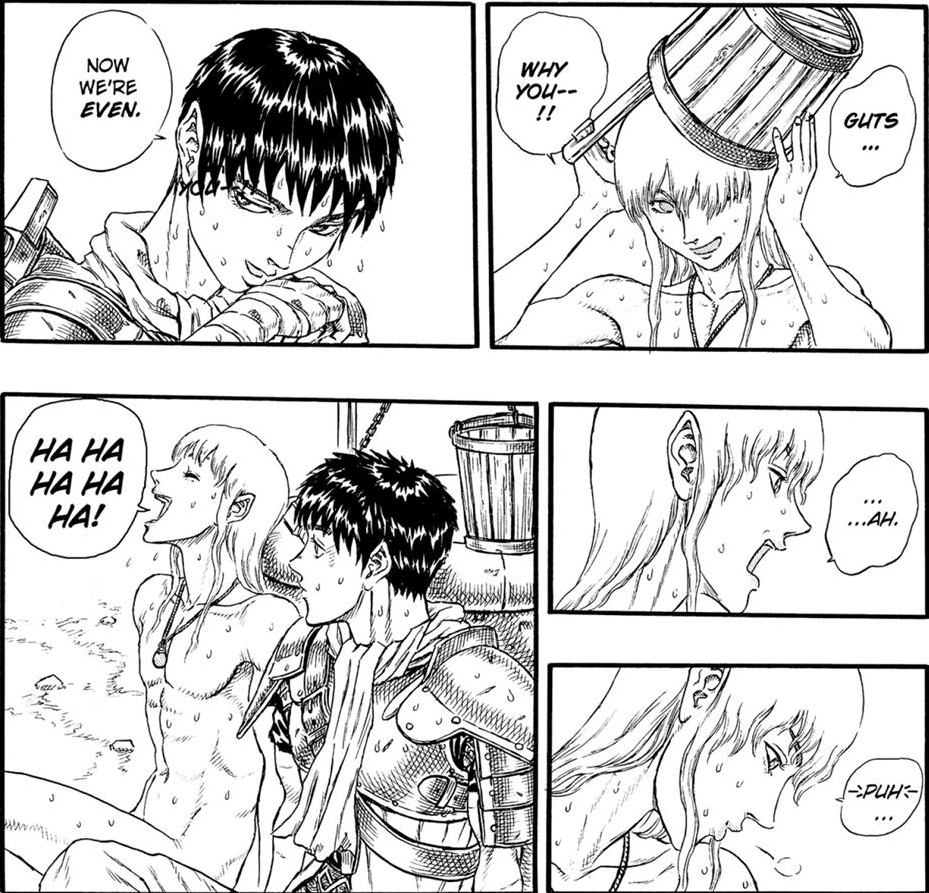

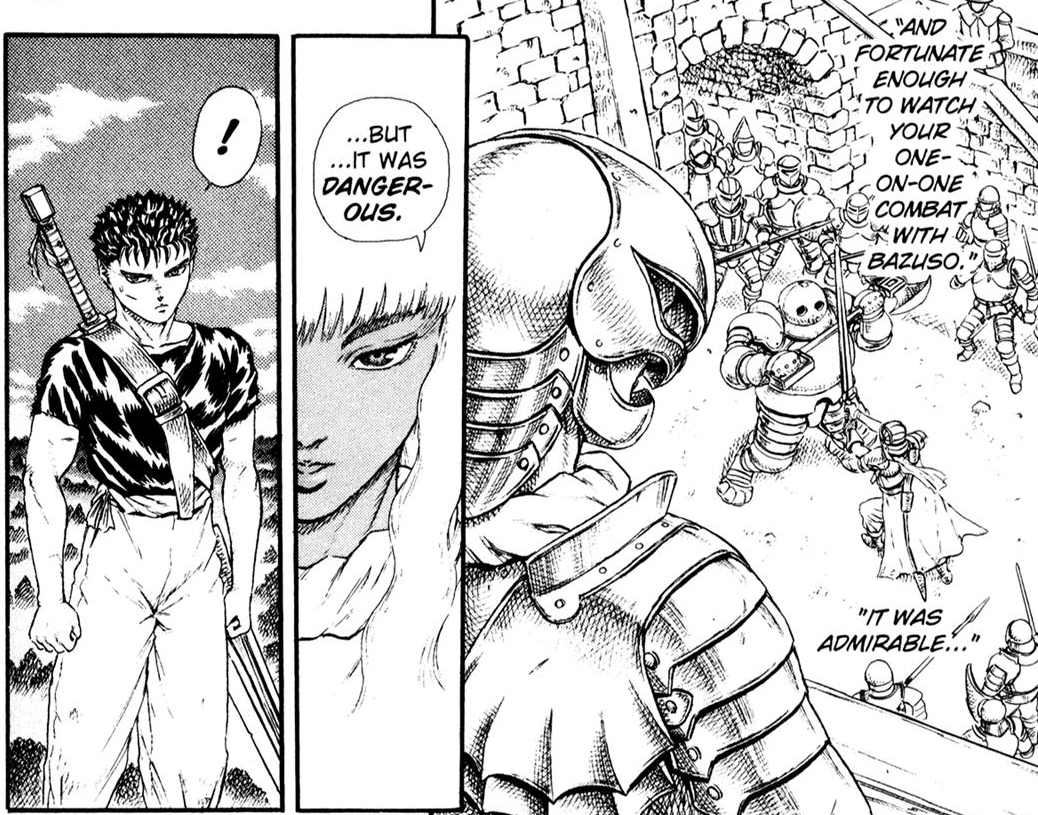


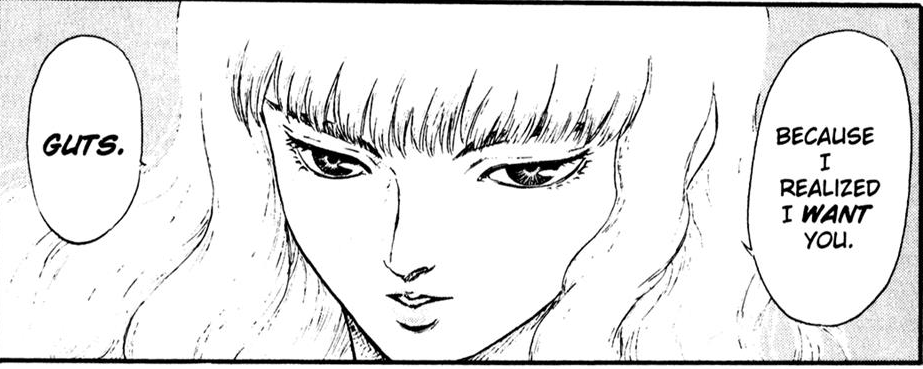


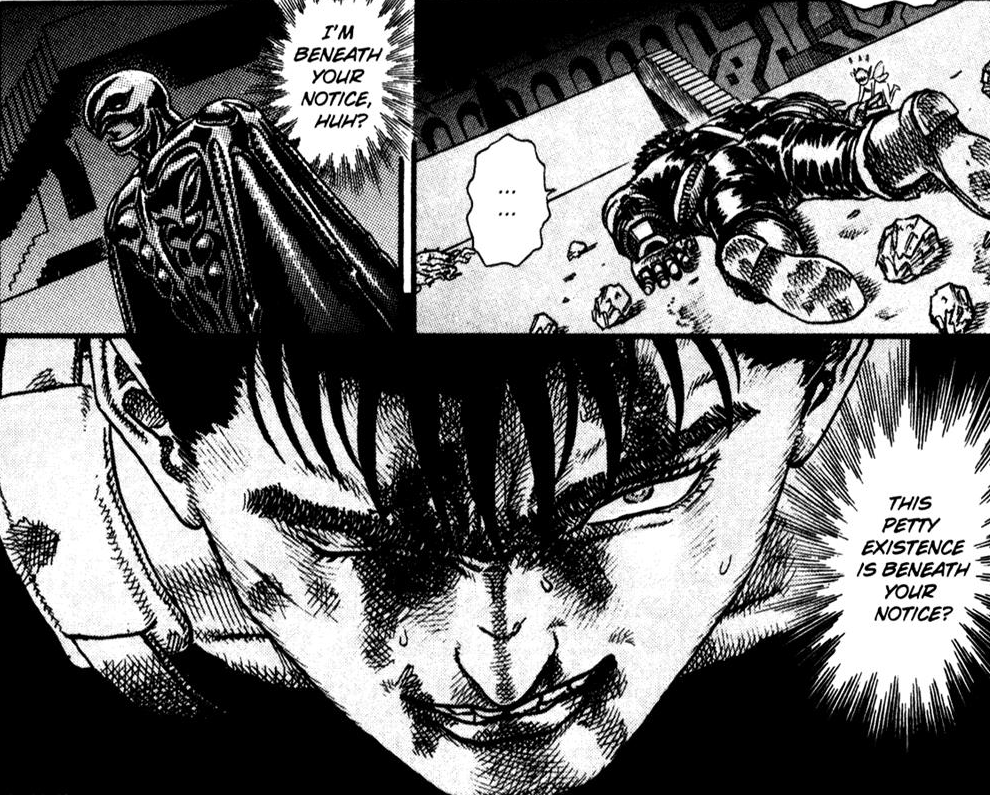


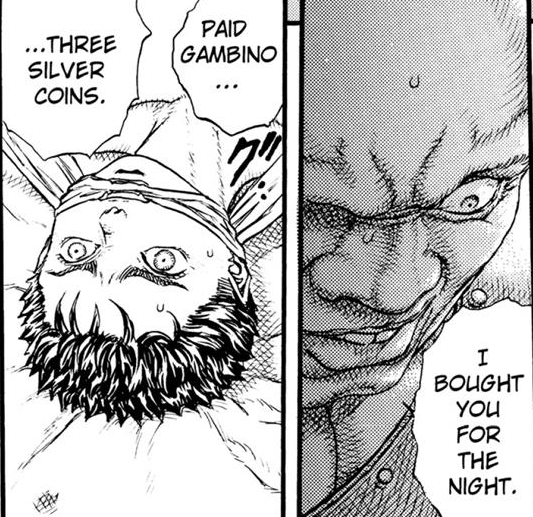


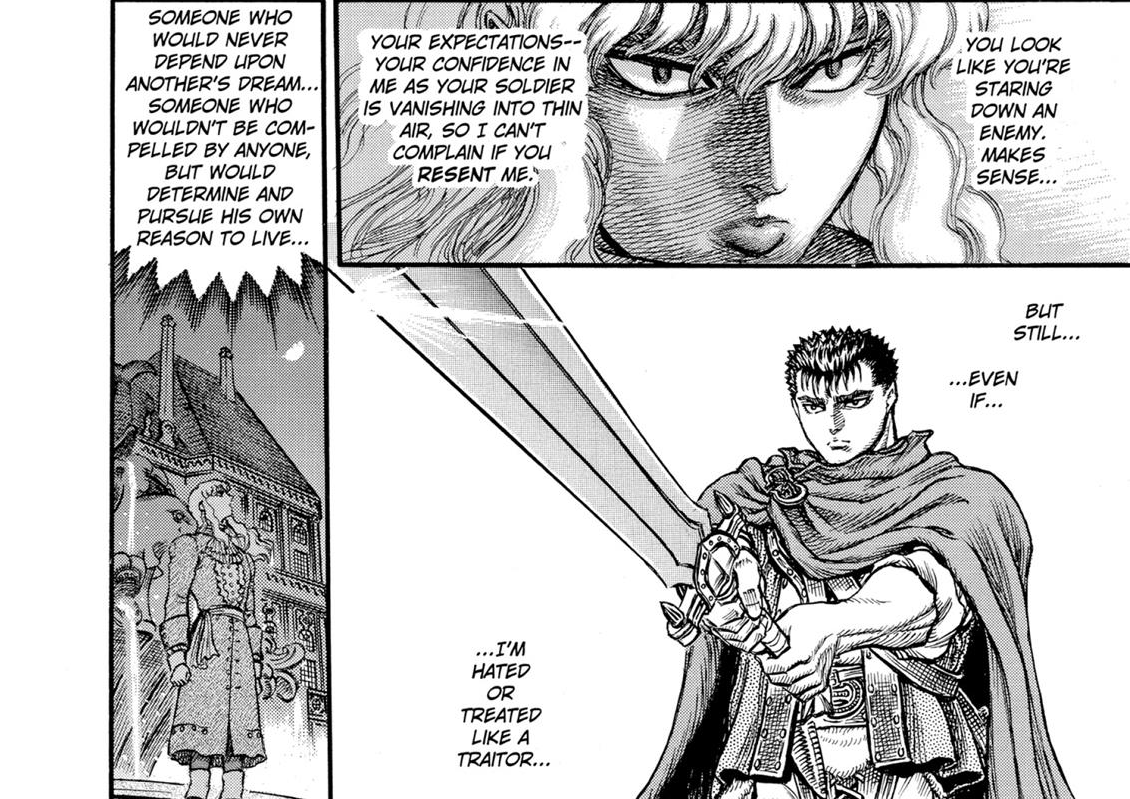


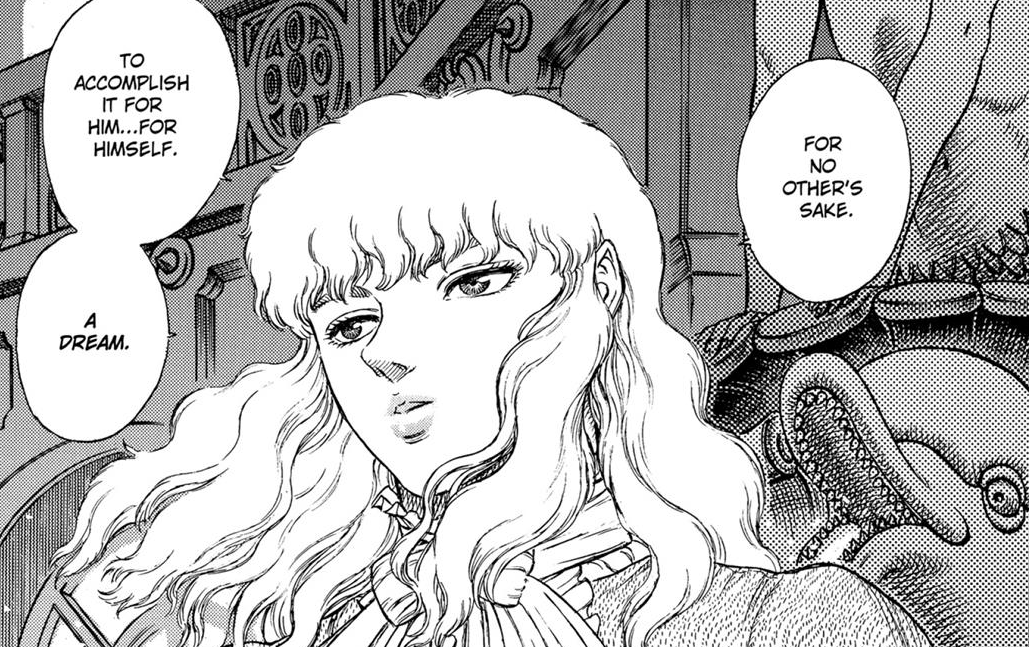


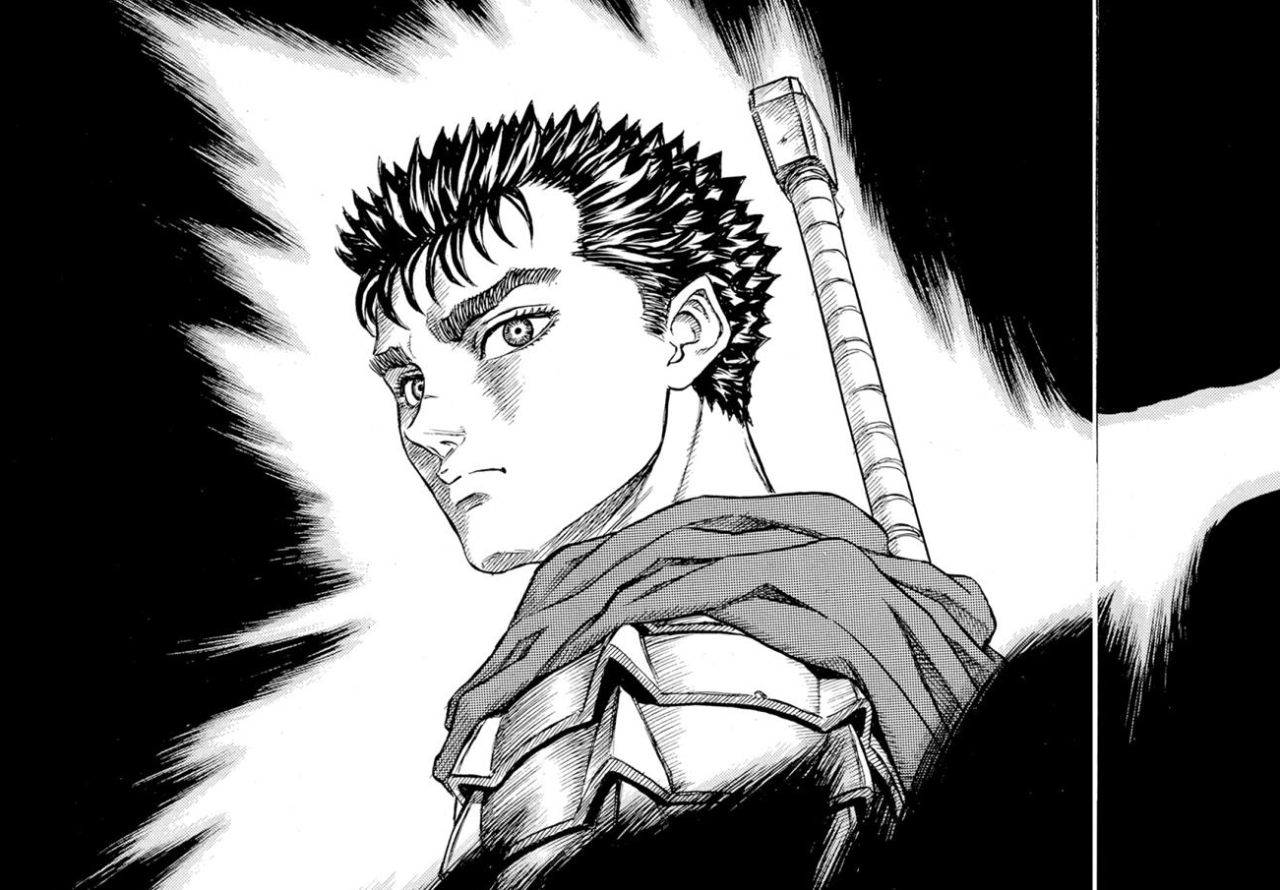
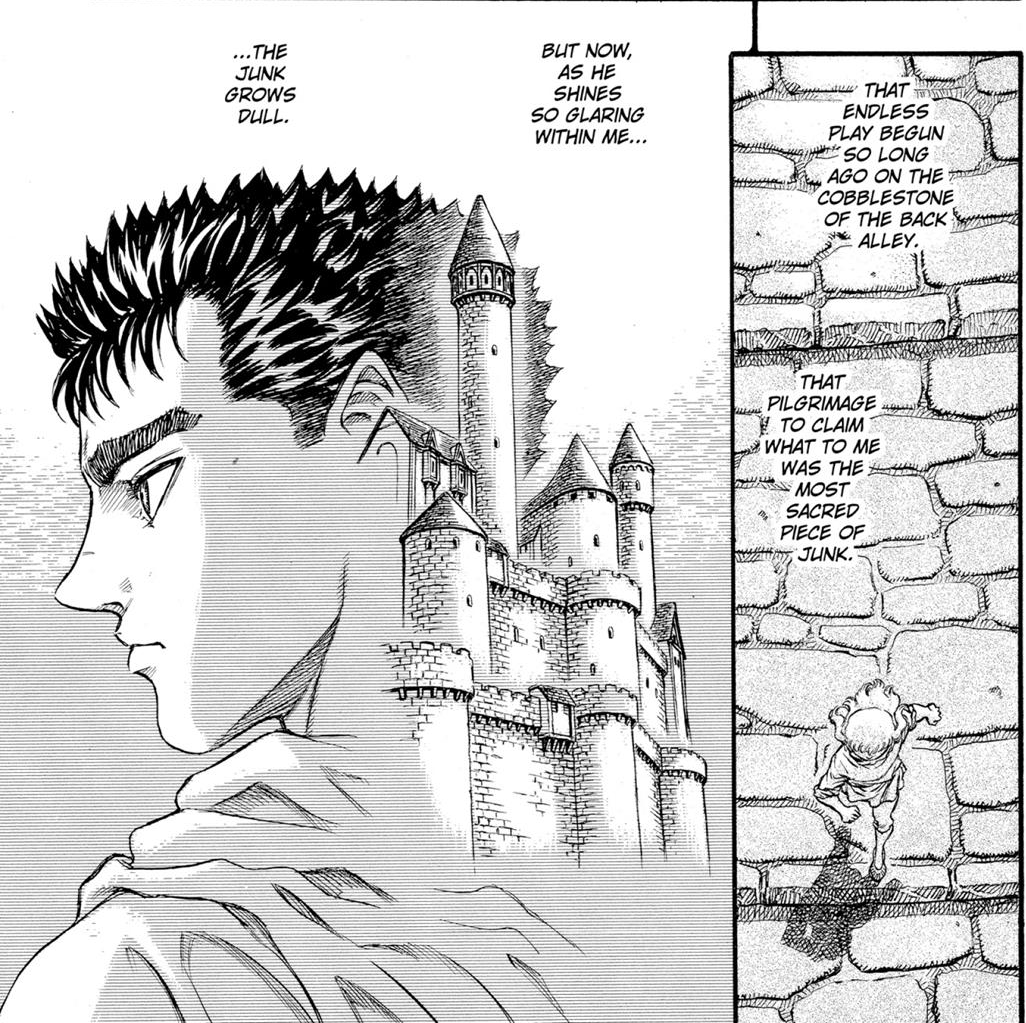


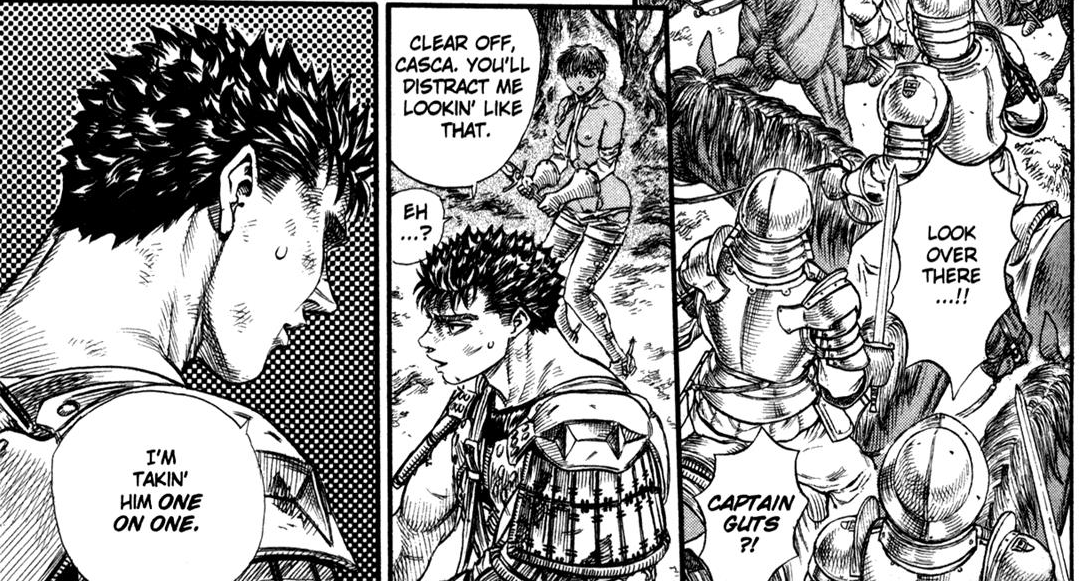
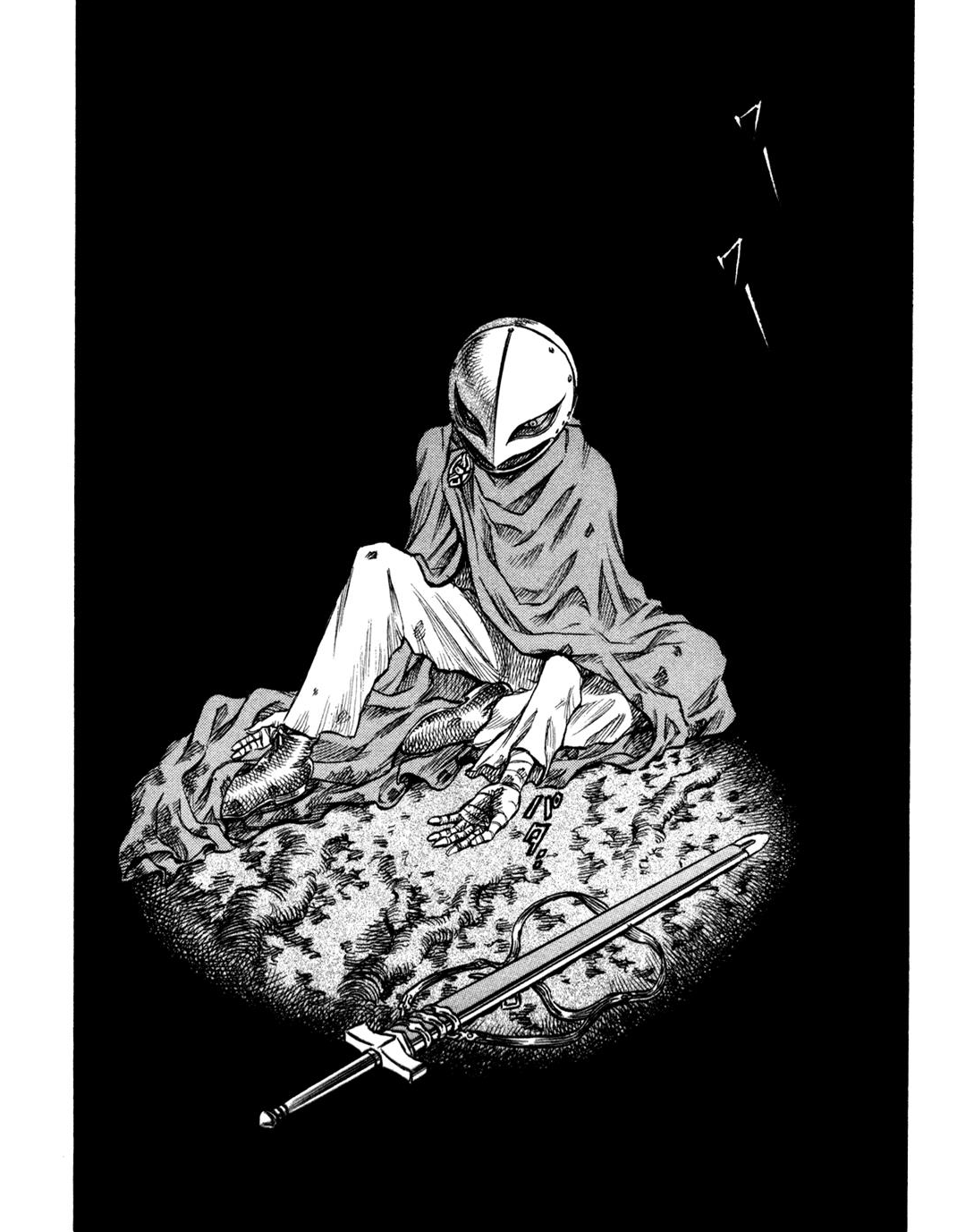


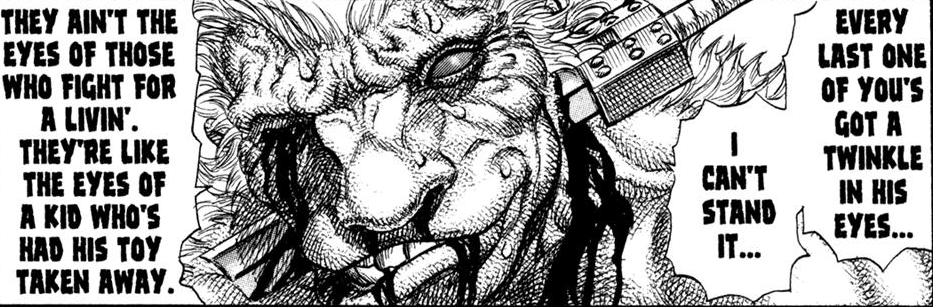


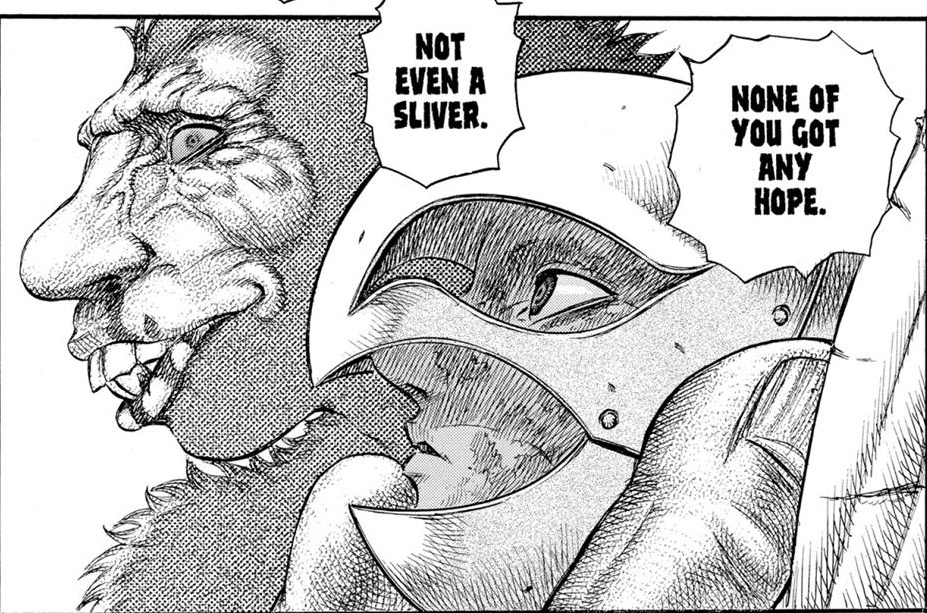


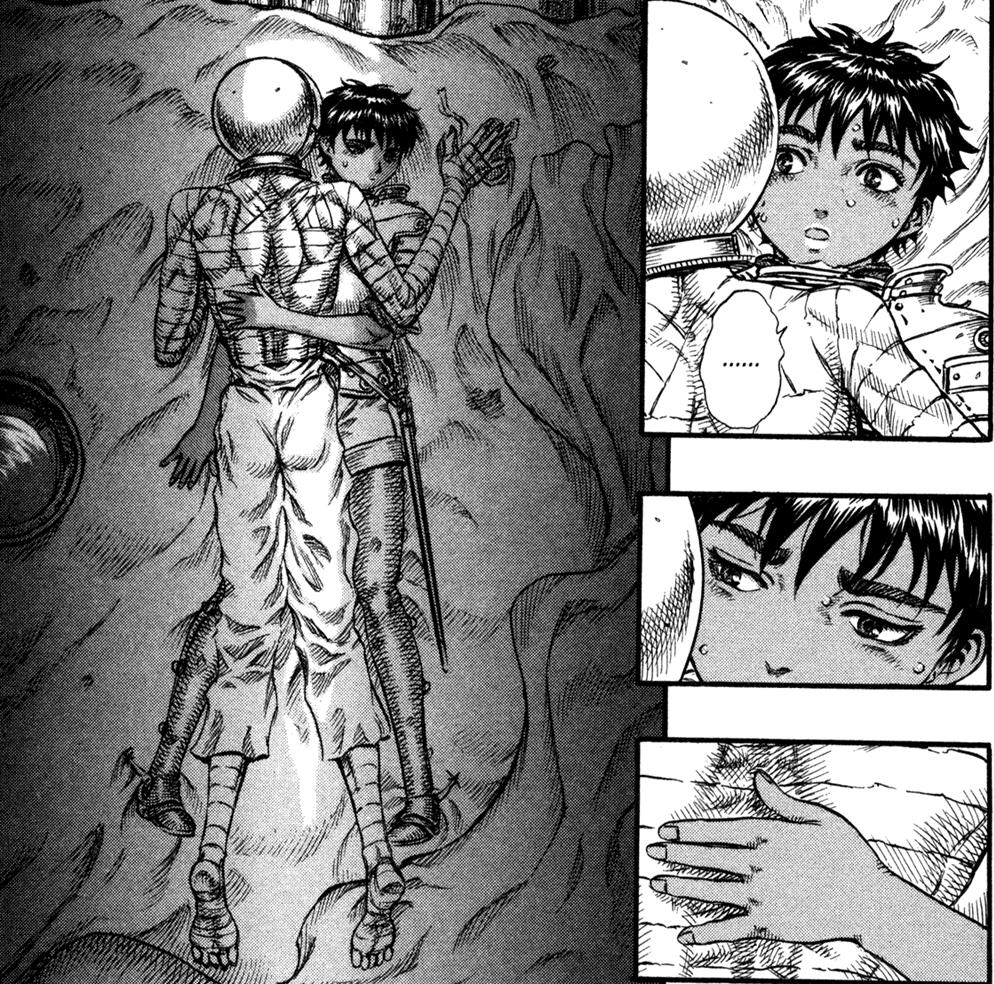
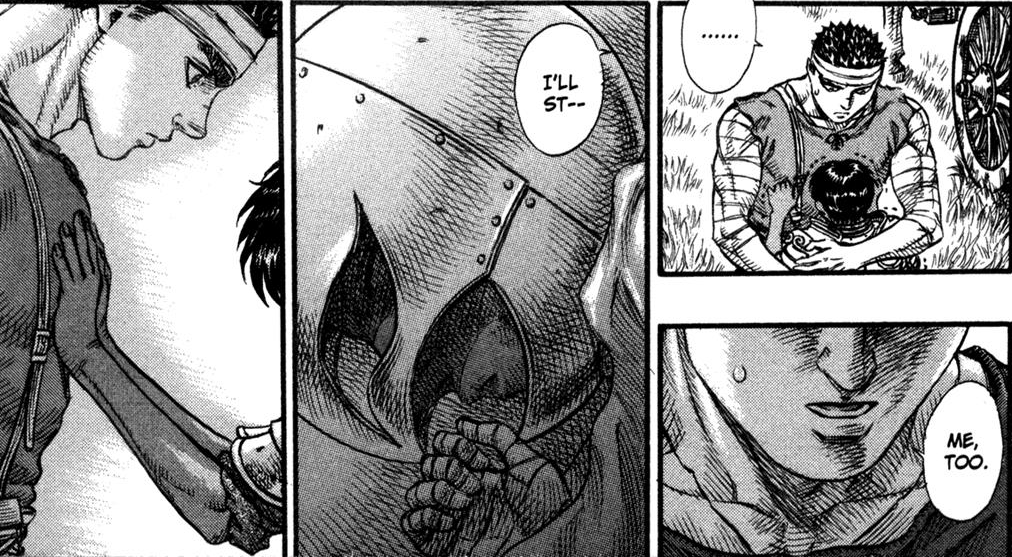


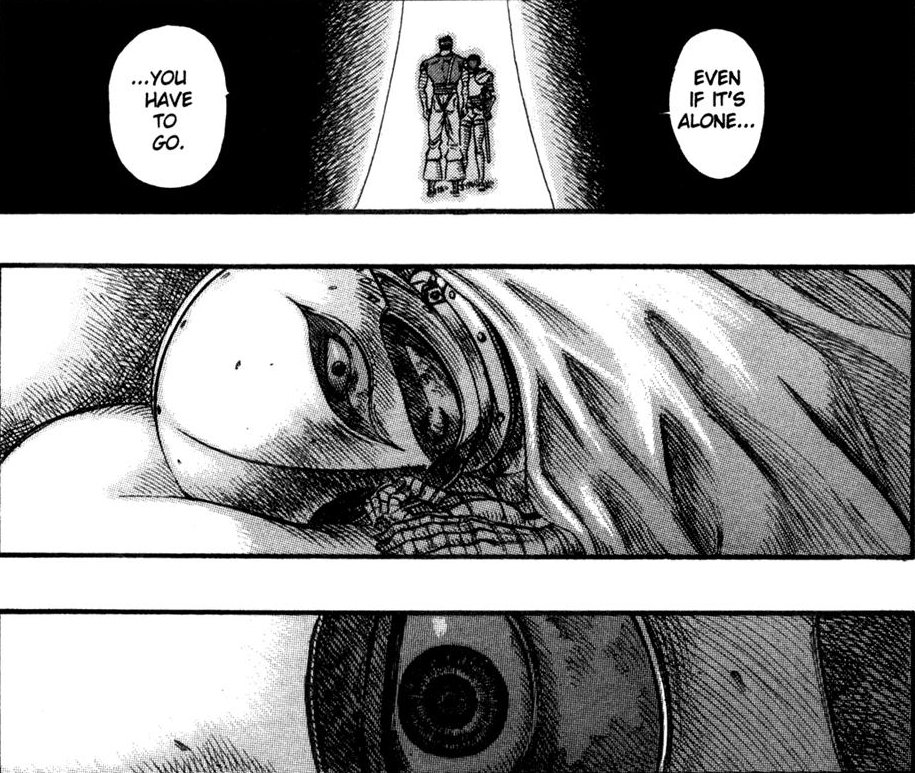


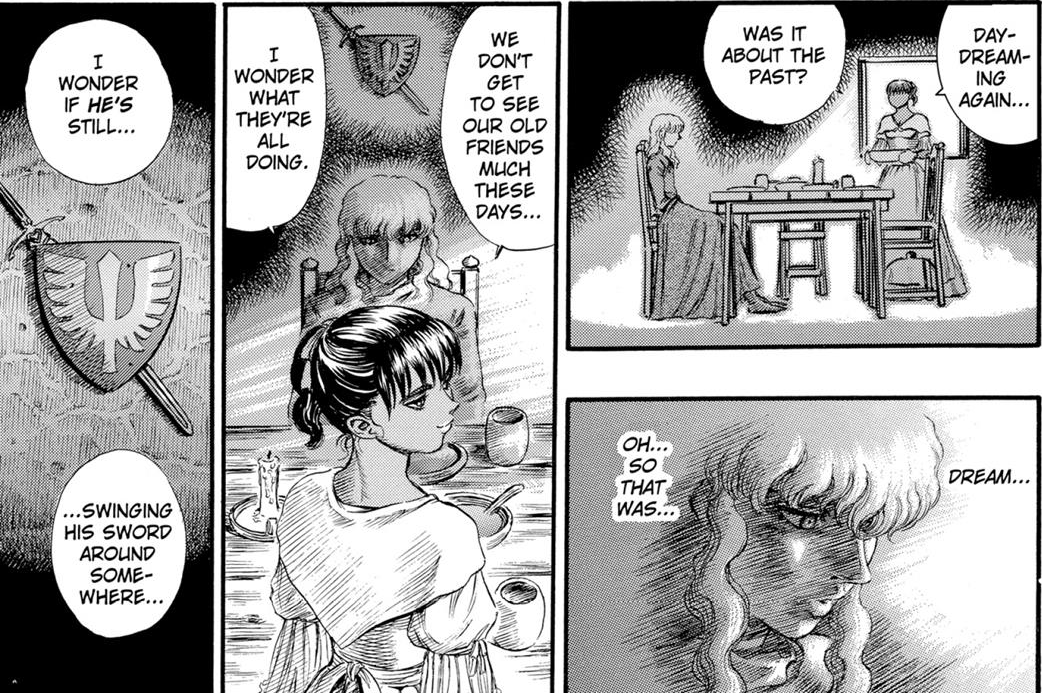


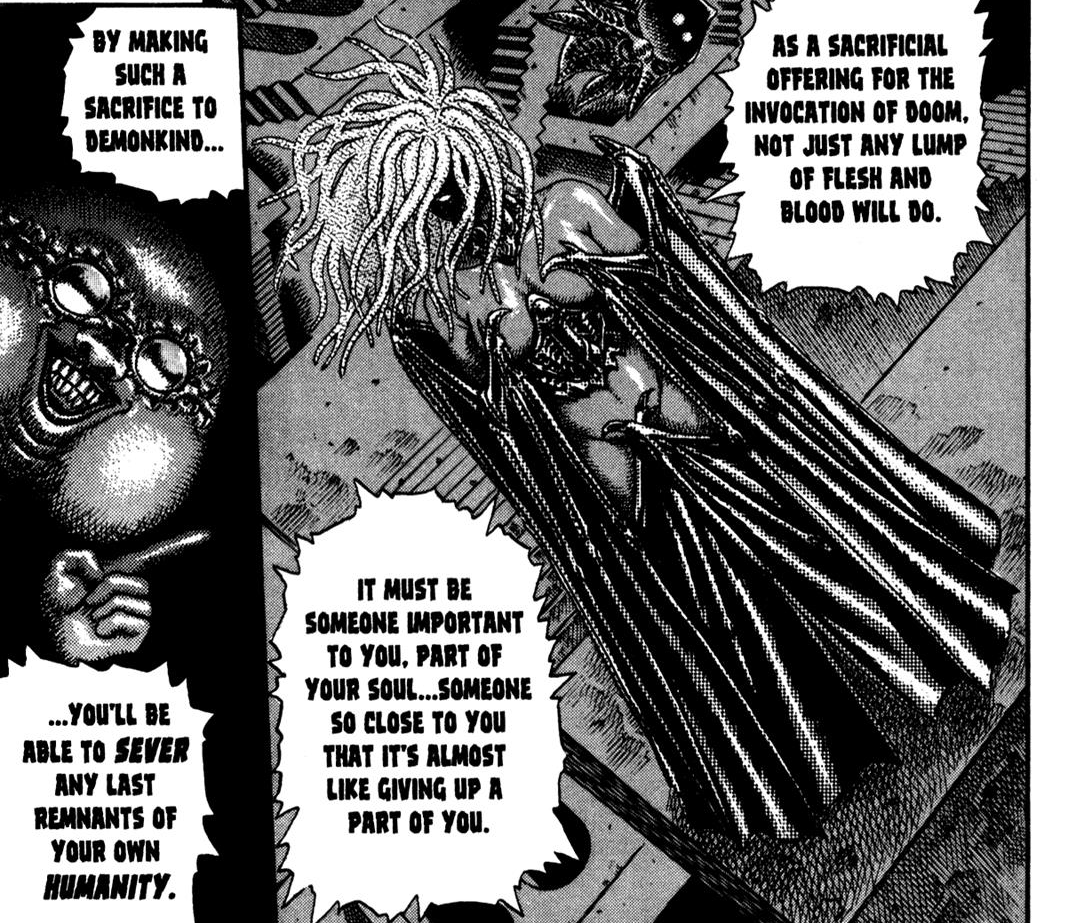
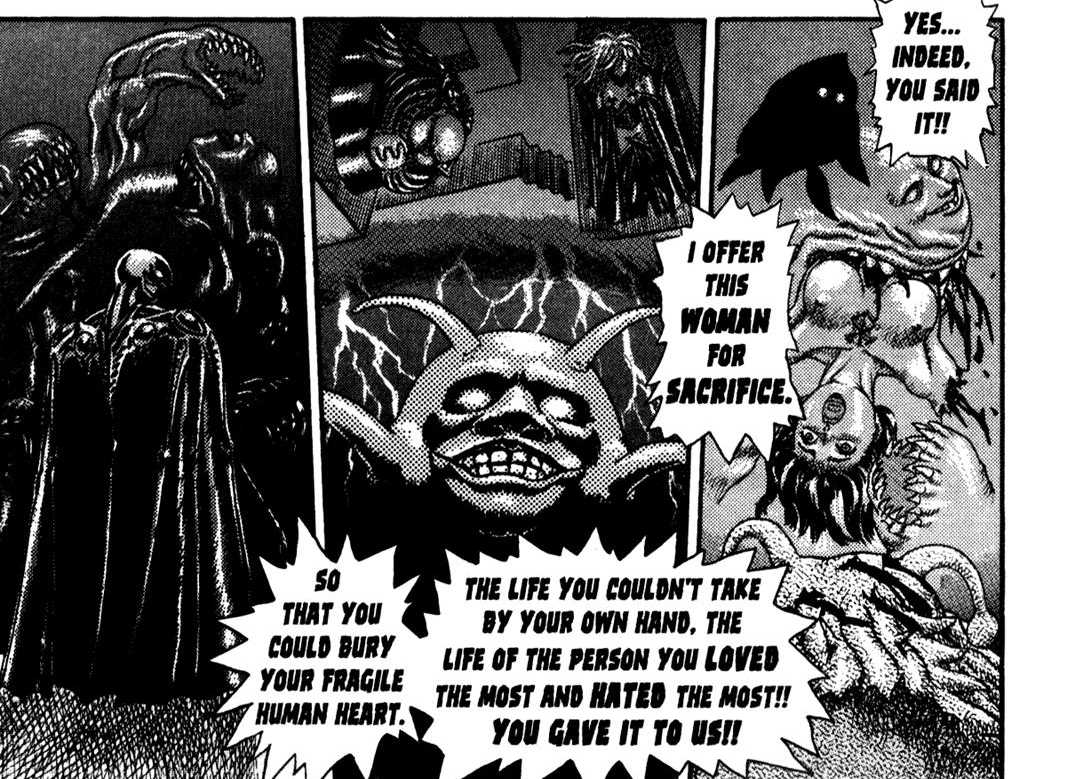


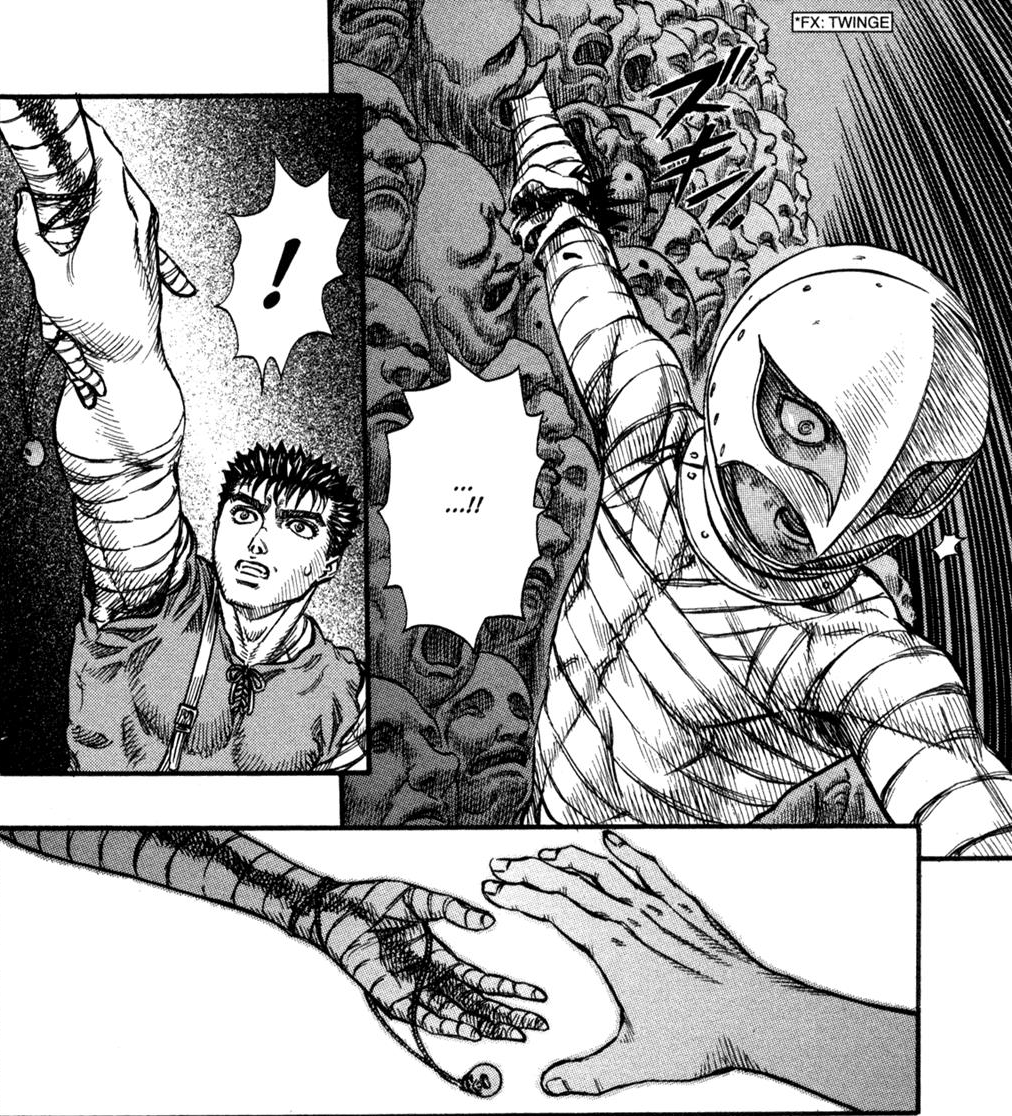
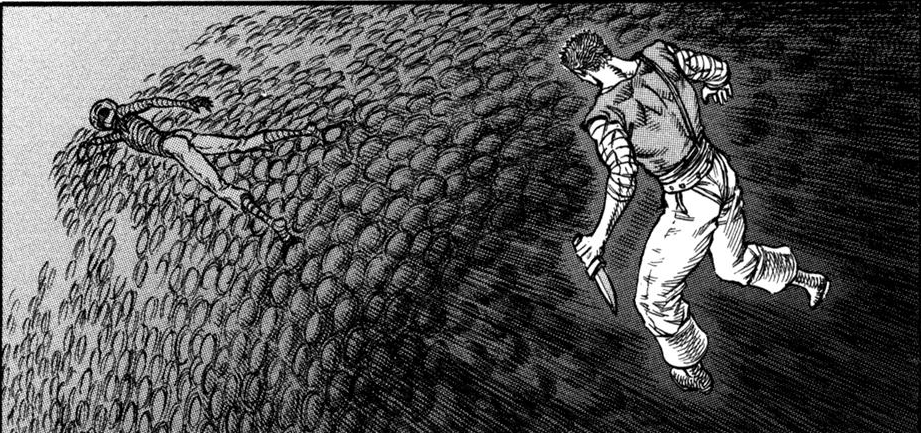


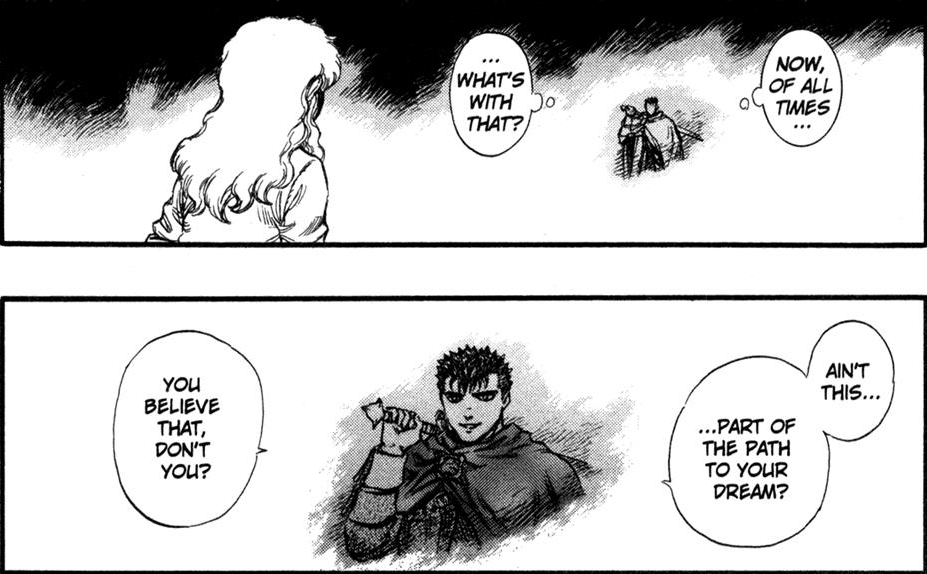


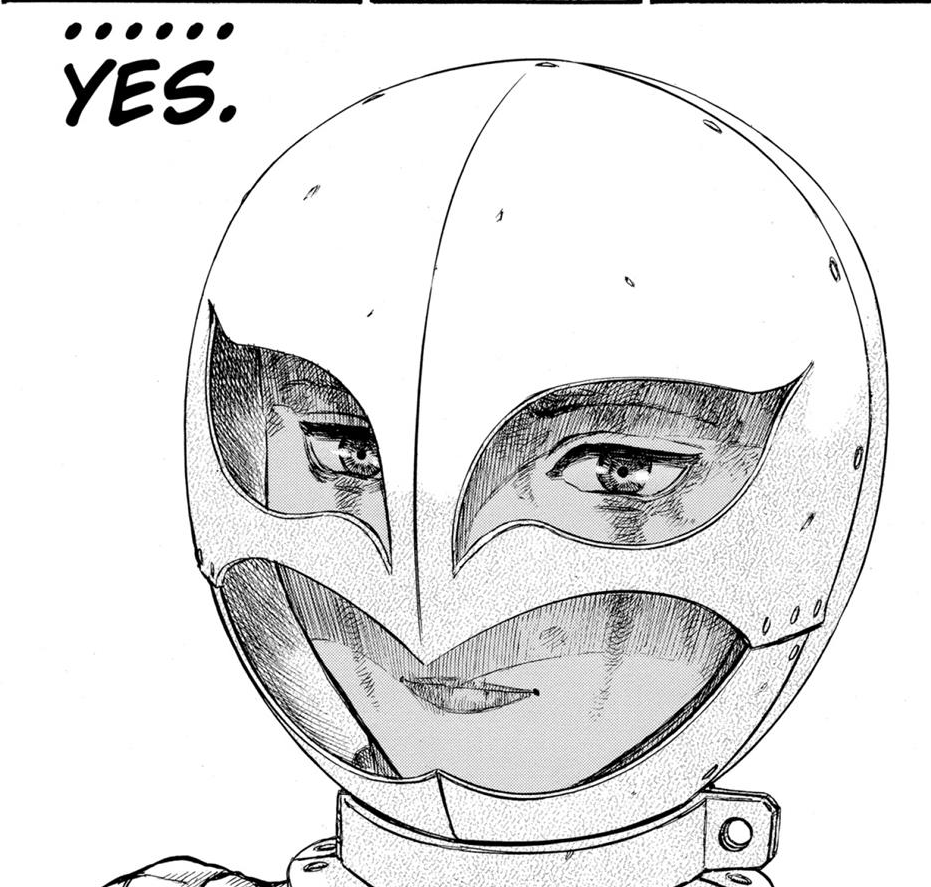


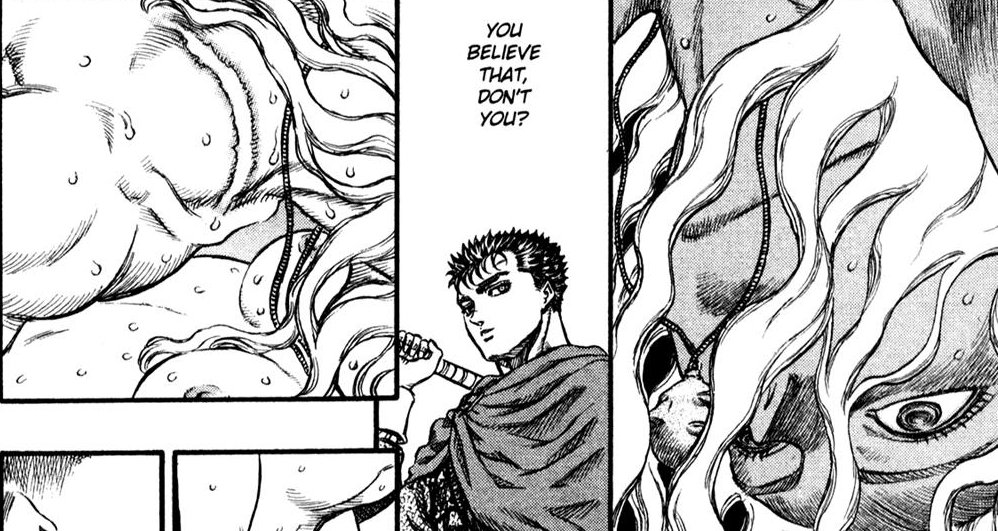


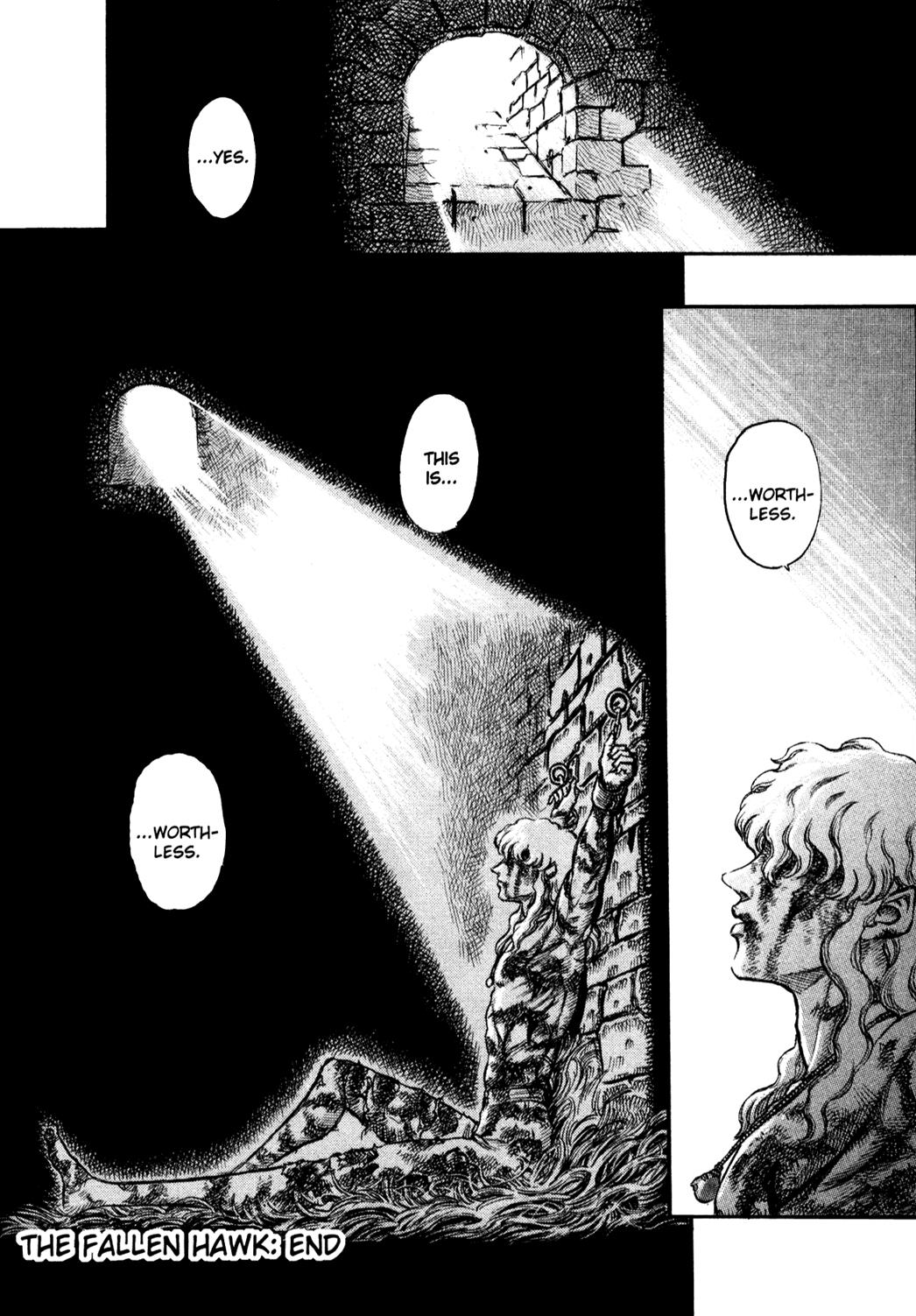


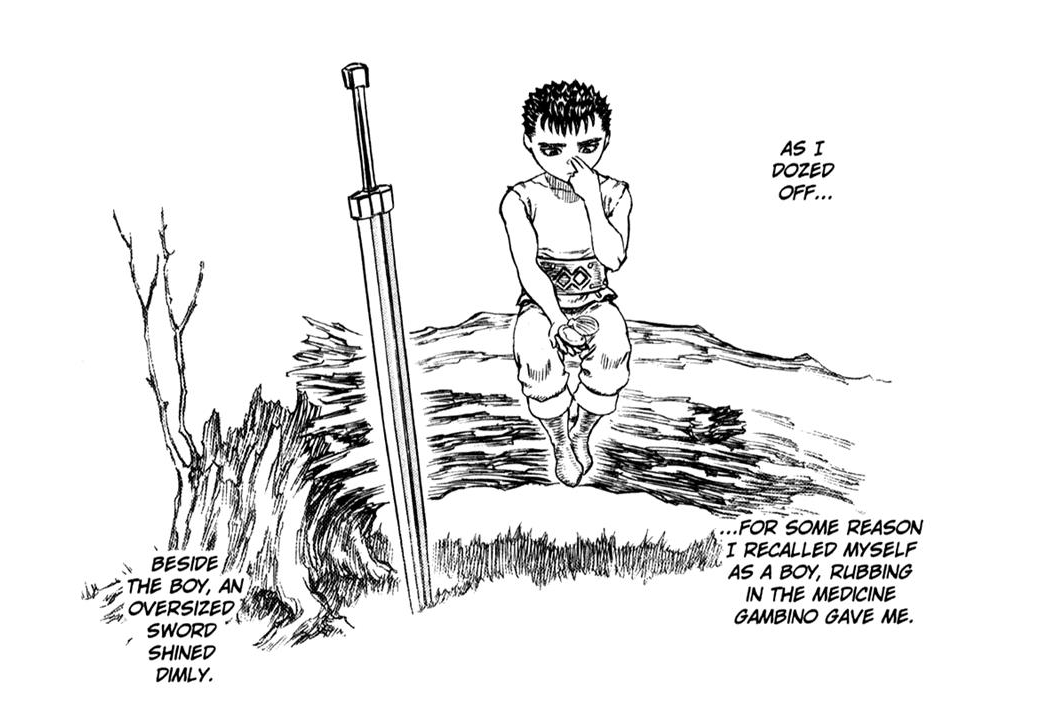


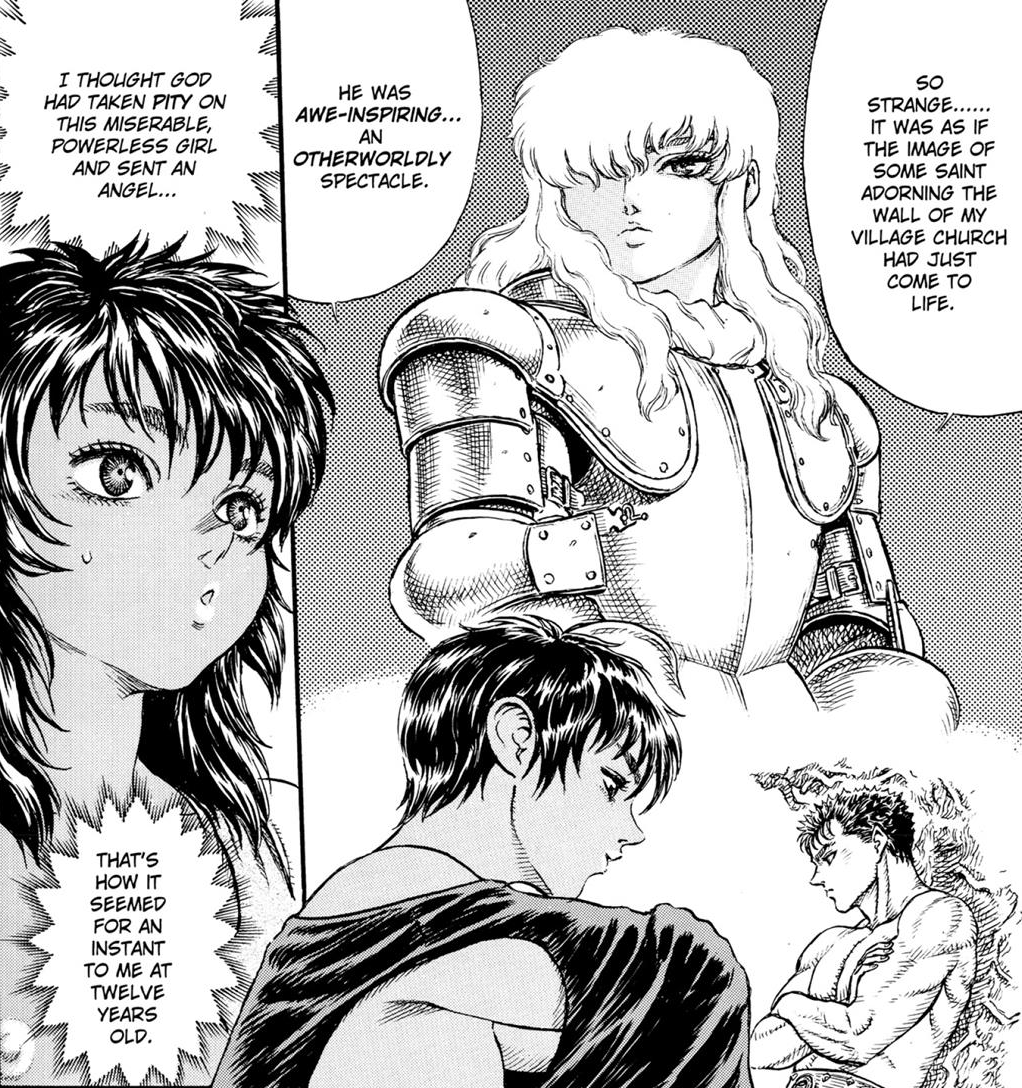


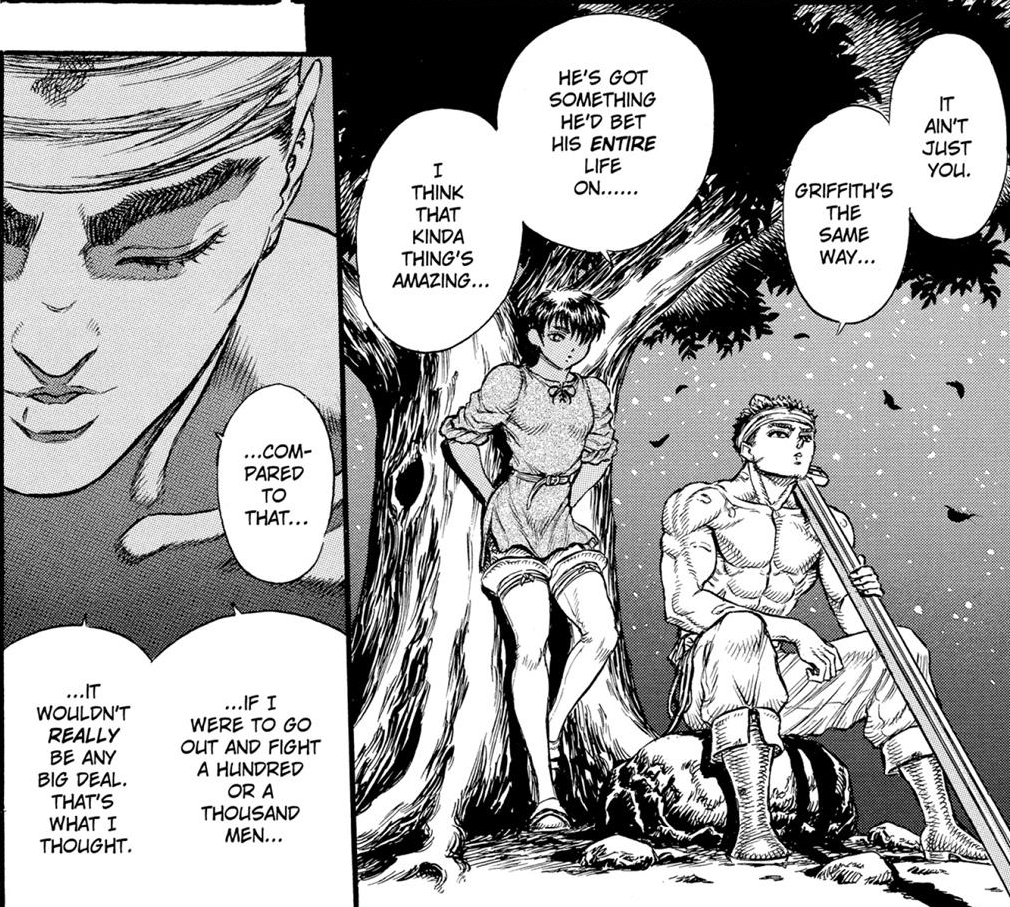

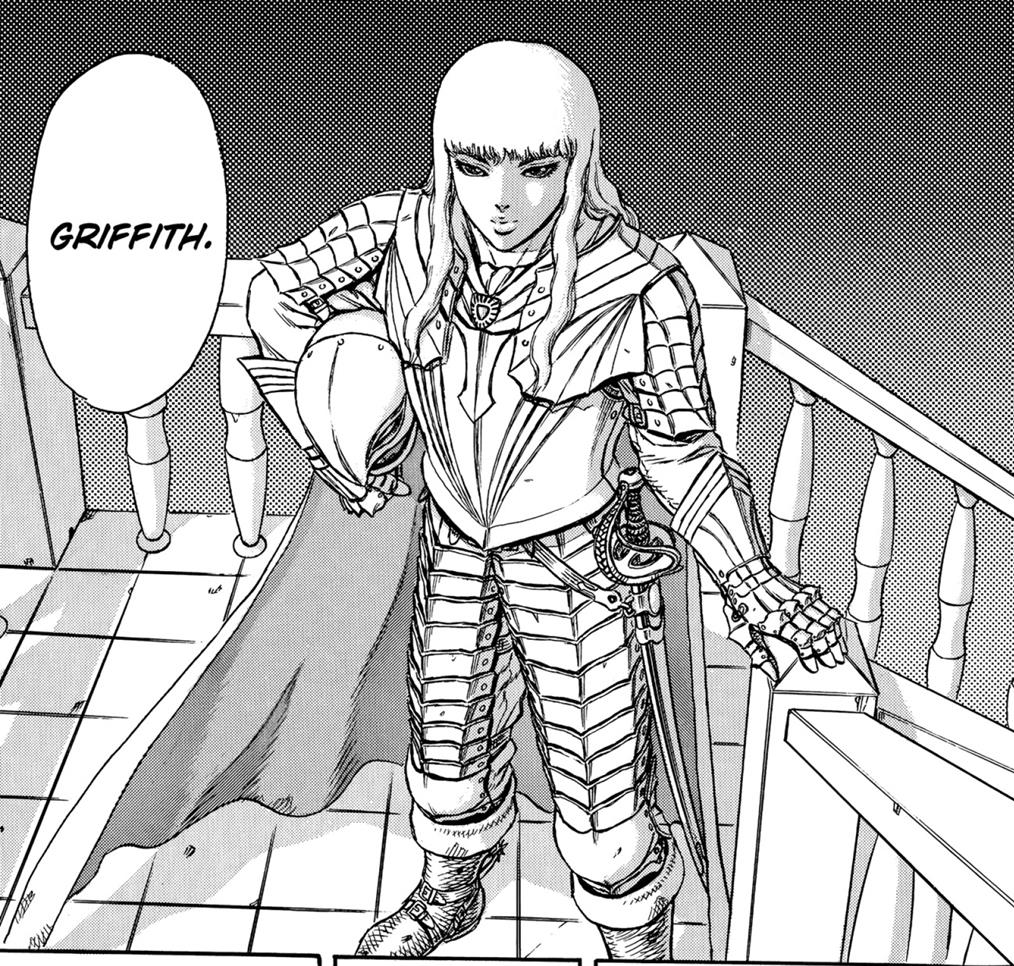


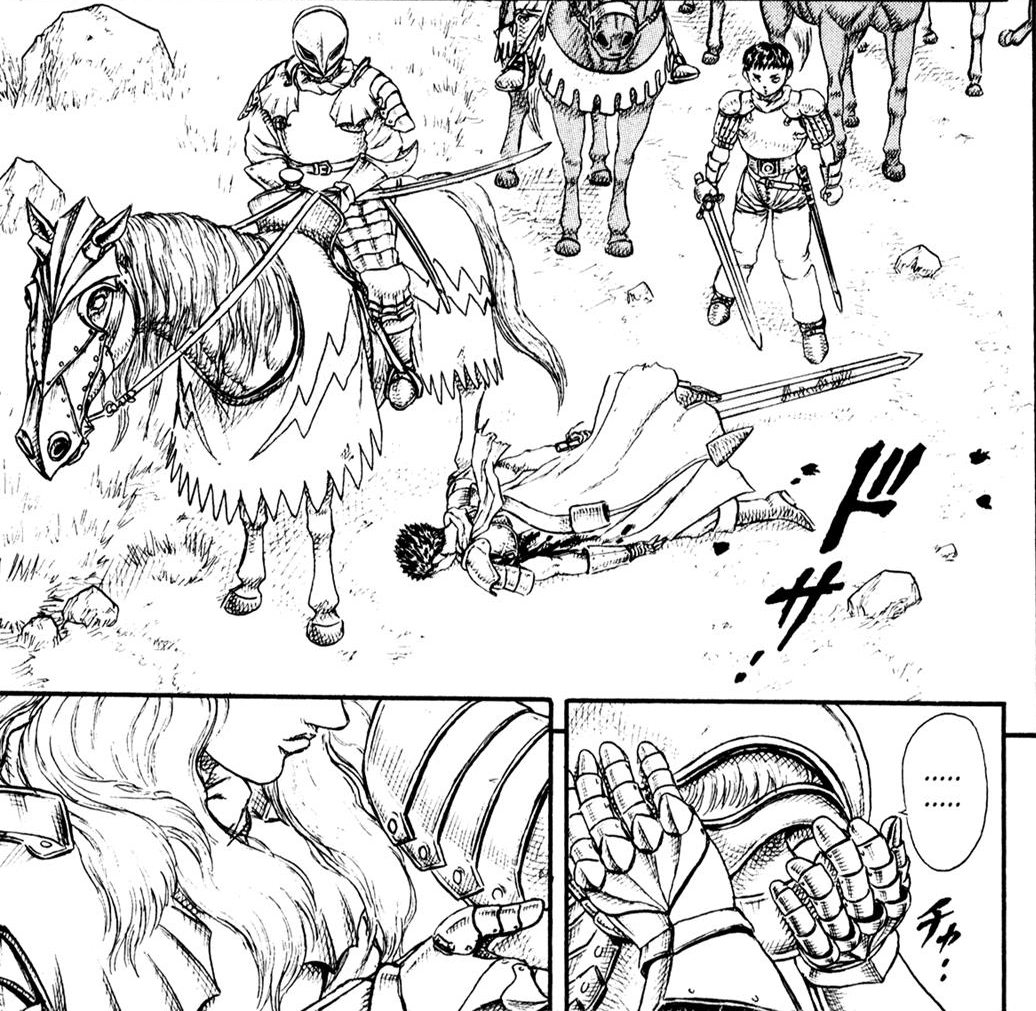


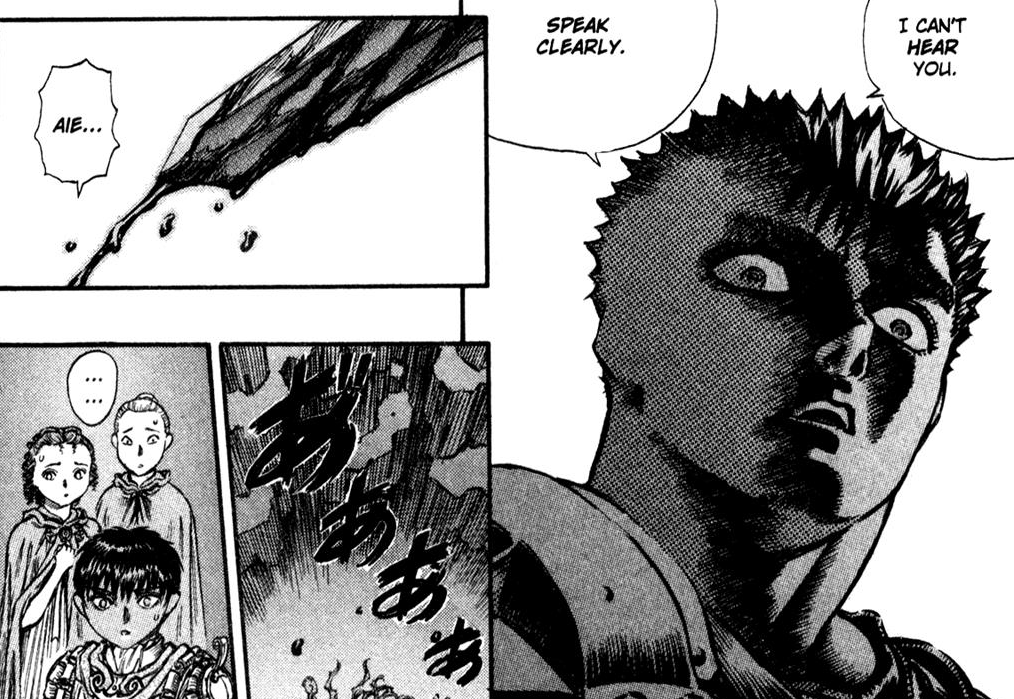


 you're the only one