mostly berserk meta. i'm into berserk mainly for griffguts and i'm a huge fan of griffith.
Tag: arc: c
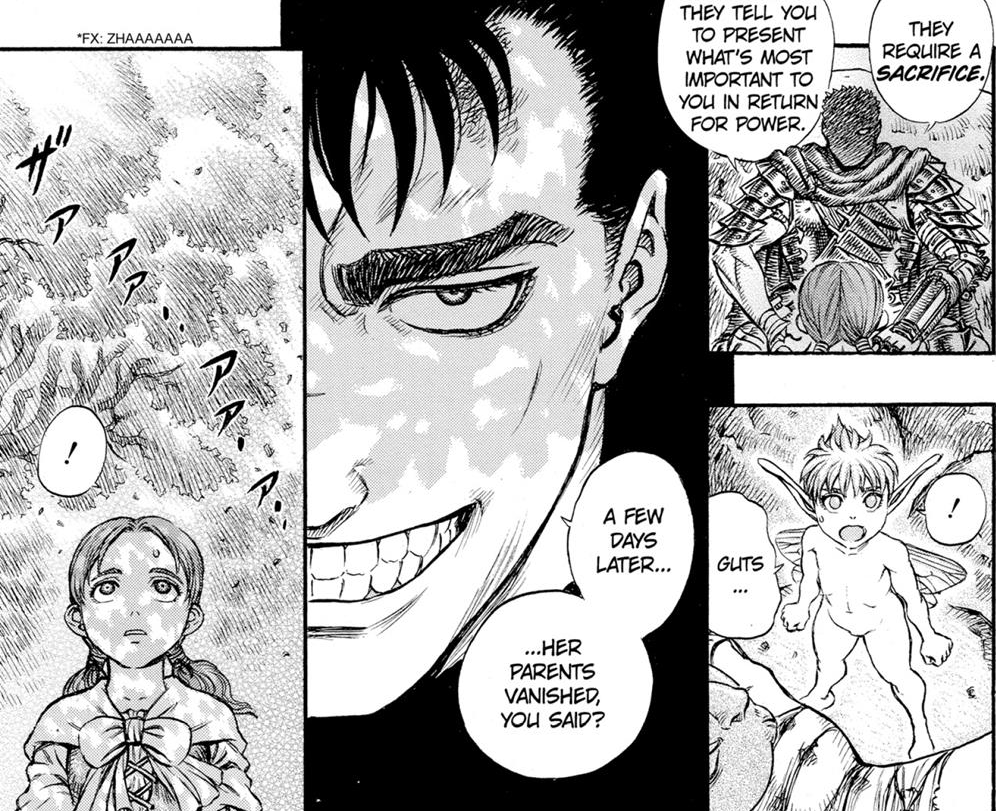
it’s been a while since i read any of the lost children arc but i looked over some of it the other day and lol, there goes my assumption that Guts doesn’t actually know that a sacrifice has to be someone’s most important person/people.
and tbh I like this way more than Guts being in the dark and regarding the sacrifice as maybe a sign he wasn’t as important to Griffith as his dream after all. It fits Guts’ attitude towards Griffith better post-Eclipse, like the way he still knows that he was as important to Griffith as he wanted to be.
And his pretty significant devastation when NeoGriffith claimed he didn’t feel anything anymore.
And while he was unconscious while the Godhand were discussing it during the Black Swordsman arc, and they didn’t really say anything that revealing that everyone could hear during the Eclipse iirc, it still makes sense for me to assume that Guts could put 2 and 2 together re: the sacrifice requirements based on what he does know. Like he missed “it must be someone important to you, part of your soul” but he heard “the life of the person you loved the most and hated the most” so, that’s still pretty indicative.
Plus it really adds a certain something to Guts’ revenge campaign.
Like with the sacrifice as active proof of his importance to Griffith, it makes me wonder about what kind of complicated feelings that, say, the brand hurting in the presence of monsters might invoke.
I think the point of gut’s changing his ideals and stating them against Mozgus is to show that he is on the path of becoming a less damaged human being. Even comparing his goals in the conviction arc to the blackswordsman arc, he started changing especially when he realized he wanted to regain casca as opposed to him wanting to hunt down neo griffith. I don’t think it’s inconsistent writing on mirua’s behalf but i think its supposed to show the beginning of gut’s growth.
Sorry, I think I wasn’t super clear because that post was kind of rambly and off-the-cuff lol, but my point is actually that it isn’t a change for Guts at all, it’s the exact same attitude – it’s just the narrative framing of that attitude has changed.
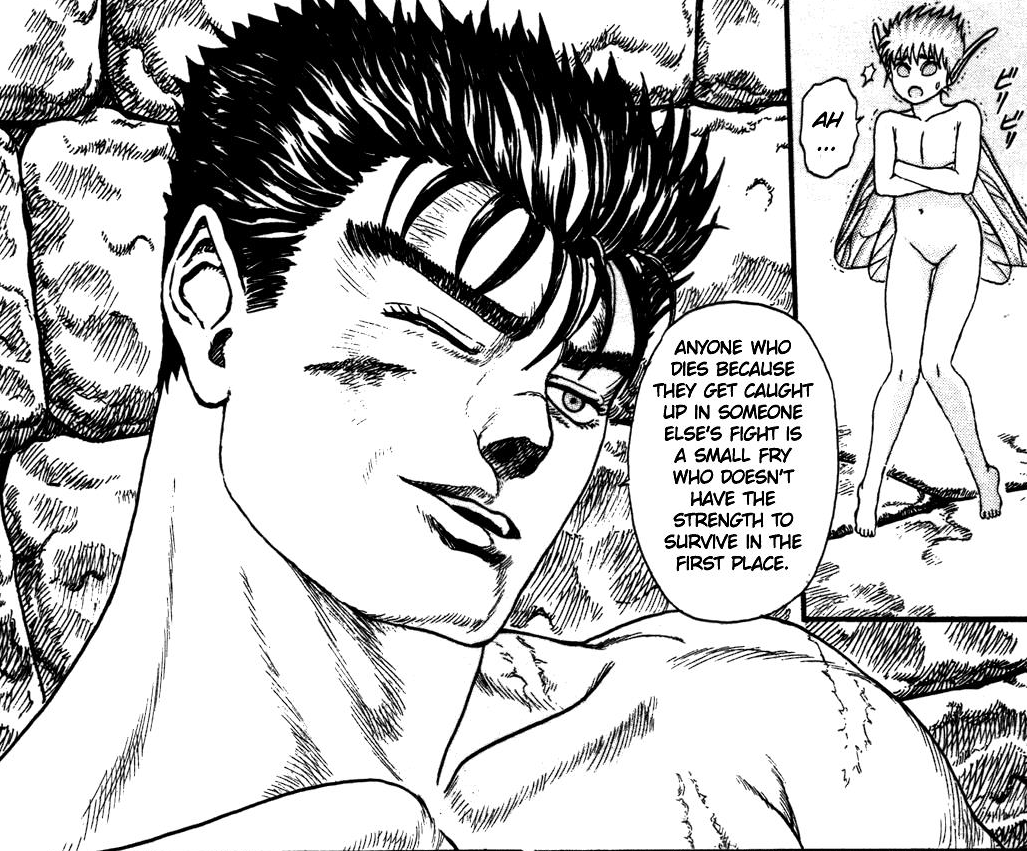
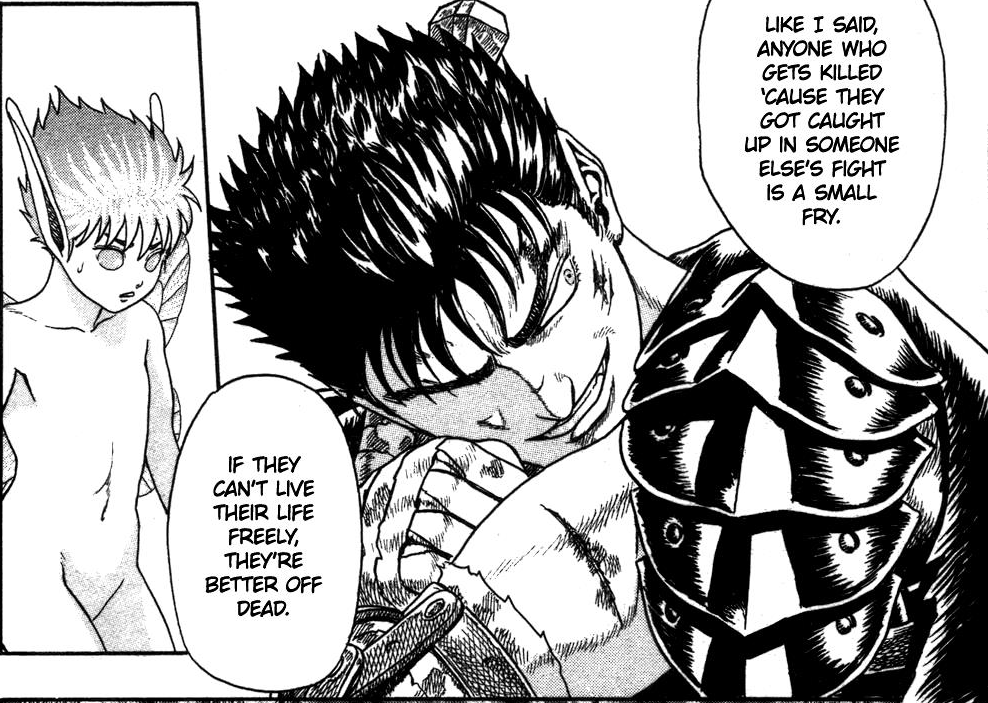
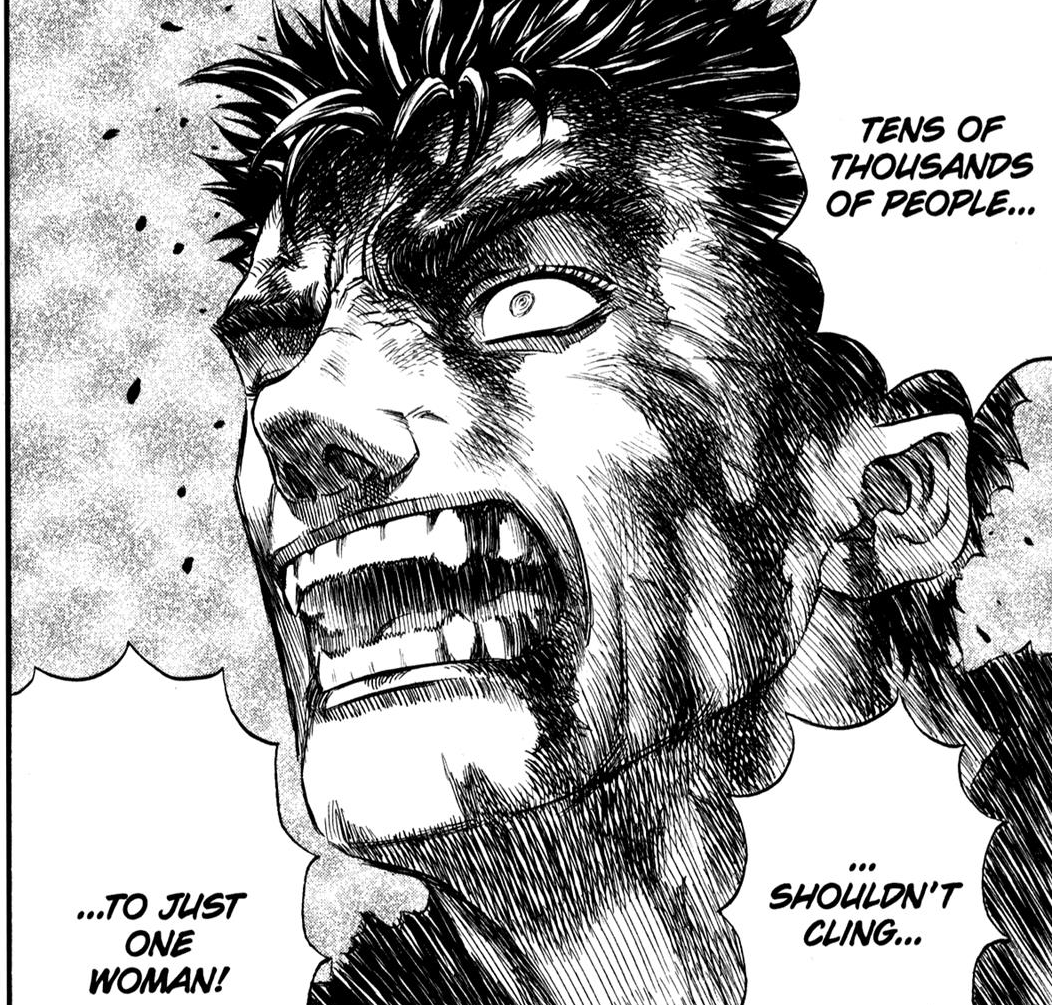
Guts saying the dude and his daughter were too weak to survive so they don’t matter is no different than Guts saying that the ten thousand refugees about to die deserve it because they’d rather bow down to a god than fight to survive or w/e
It’s just that now that’s shown to be badass rather than a fairly pathetic denial of guilt.
Consider:
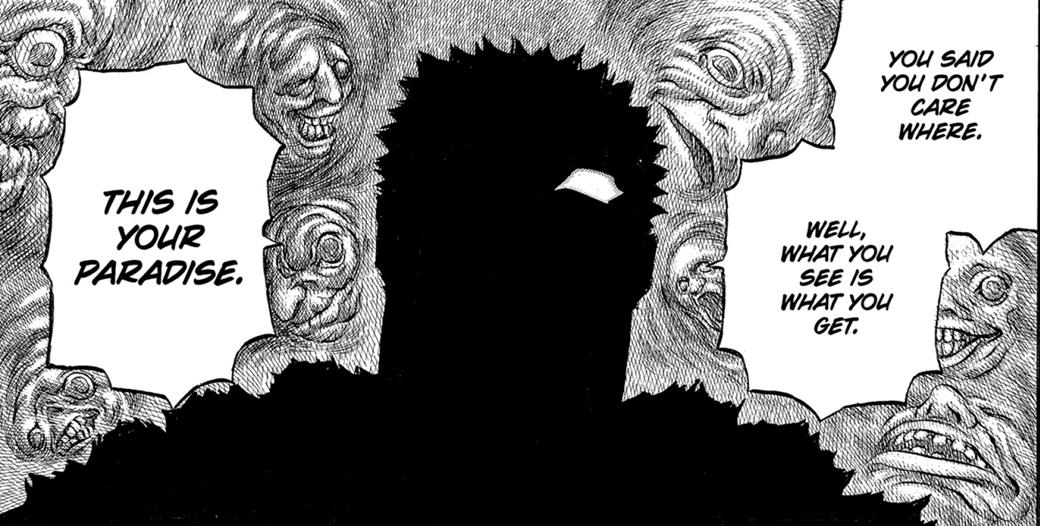
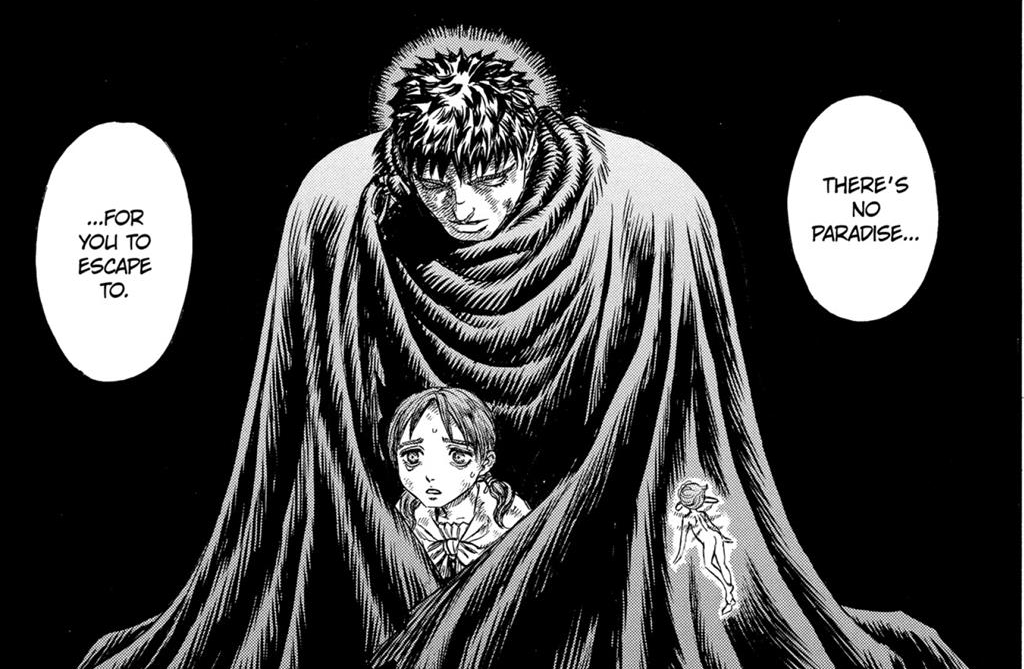
vs
It’s like the Conviction arc takes these super cynical lines from Guts which, in the Black Swordsman arc, are clearly meant to show how fucked up he is and not something we’re meant to agree with, and pretties them up or makes them sound badass and legitimizes them.
I mean it’s even the same essential circumstances: Guts’ brand calls up spirits that kill innocent people. In the Black Swordsman arc Guts feels immense guilt and covers it up with cynical bravado. In the Conviction arc, Guts and Luca both blame the dead for failing to survive.
And idk if that’s a sign if we’re maybe supposed to take the themes of the Conviction arc with a grain of salt, or if Miura’s opinions just 180ed somewhere along the way.
Like do
people deserve to die for not being strong or resourceful enough to survive
against a force stronger than them or not, Miura?
In fairness this could very well be purposeful – showing like, both the negative side and the more palatable side of Guts’ survival of the fittest thing. Similar to how we get the positive side of Griffith’s utopia where the weak are protected from harm and exploitation (which come to think of it is also partly shown to us by Luca, hmm) and the negative side (it may be great but it’s the only peaceful place to live).
But also incidentally, if you’re on Guts’ side of this whole thing, yk you gotta be strong to survive and if you’re not it’s your own problem – you can’t really have an issue with Griffith filling the world with monsters lol. The world outside of Falconia right now pretty much illustrates Guts’ philosophy to a tee.
I could see this coming up again along those lines actually. Doesn’t someone actually say that now everyone has to deal with what Guts deals with, directly comparing brand-life to Fantasia? So there you go, you got Griffith’s world (Falconia) and you got Guts’ world (Fantasia), pick one.
this isn’t a complete thought here but i wonder/hope that there’s some narrative irony happening or going to happen if anything? idk like of course the ceremony and events leading up to griffiths reincarnation as a perfect image of his dream and ideal self would try to hammer home cynicism of not needing others enough. guts kind of well with the campiness of the arc too ig. i hope this makes a little sense i haven’t read conviction in a long time.
Yeah no I get what you mean, ngl I was kind of thinking something similar while re-reading those chapters, like, everything Egg says about relationships sounds like it could come straight from a Griffith who has been burned lol. And it is the lead-up to the creation of Griffith’s perfect world, which Egg is advocating for here. So in that way it does maybe make sense to be extra cynical, reflecting back on Golden Age stuff through a whatever the opposite of rose coloured lens is.
like, maybe that’s Femto’s perception of that relationship lol.
I mean honestly this is exactly how I think Griffith thought of himself after the second duel/even tombstone of flame, word for word. And again, that’s something that could’ve changed so easily if Guts had just told him how he actually felt.
So I can’t accept it as an objective statement, but a subjective statement filtered thru bitterness + self-loathing? Kinda works.
Also yeah the extremely campy tone of this arc does kind of lend itself to more meta (in the self-referential sense, not the fandom essays sense) stuff like this imo.
My misgiving is that this seems like more thought than Miura put into it lol. But idk I should probably re-read the whole arc before I say something like that, like maybe there are indications that we’re not meant to take some of the Conviction arc themes as objective truth, and I just don’t remember/never noticed them.
every time i re-read a bit of the conviction arc i want to say something about its depiction of relationships, whether that gels with the rest of the story, etc, but it’s always so hugely daunting
in part because it seems to contradict everything i get out of the golden age lmao
like according to conviction arc themes, the fatal flaw in griffith and guts’ relationship was that it was too intense and they needed each other too much
like, according to the conviction arc
the problem here isn’t that Guts failed to understand his own importance to Griffith and therefore left, the problem was that he was important to Griffith at all. Griffith should have been able to rely on himself and no one else.
look at this:
transcription bc the writing is hard to read:
But those threatened by the dark… can by no means ever let go of a torch. All they can do is stare in blank surprise at their illuminated, disgustingly cruel selves… and continue to suffer it… And to protect their stunted self-esteem they depend on it… all the while hating it. Cravenly… deceitfully…
(They’re even both on the giant hands, and Luca and Guts both let go self-sacrificially. It’s a very direct parallel.)
Of course, this statement is extremely cynical and delivered by an antagonist. But the narrative seems to fully support it regardless:
According to the Conviction arc, Griffith was right when he said this:
And Guts was right to leave. Guts and Griffith’s problem was that they were never equals, and they admired and resented and clung to each other in turn.
I absolutely cannot reconcile the themes of the Conviction arc with the Golden Age, because that is clearly not the point of the Golden Age.
Oh but bthump, you might say, the point is that Guts and Griffith were too obsessed wtih each other while not being equals and that was a bad thing, while Guts and Casca have an equal relationship and therefore they are an example of a good relationship, just like Nina and her shitty boyfriend up there.
Well, sorry to say, the Conviction arc is also gtsca negative, here’s Casca stating the theme right before saying it also applies to her:
Stop relying on other people, Casca.
There’s also “a person hurts someone just because they’re strong” as a prelude to Guts assaulting Casca. Like, they’re not a happy healthy equal relationship either lol, either pre or post Eclipse.
Of course, it’s worth noting that the Conviction arc is very Black Swordsman-y, and therefore its “most relationships are bad, actually” message may not be wholly sincere, but may be more a reflection of Guts’ current stupidity.
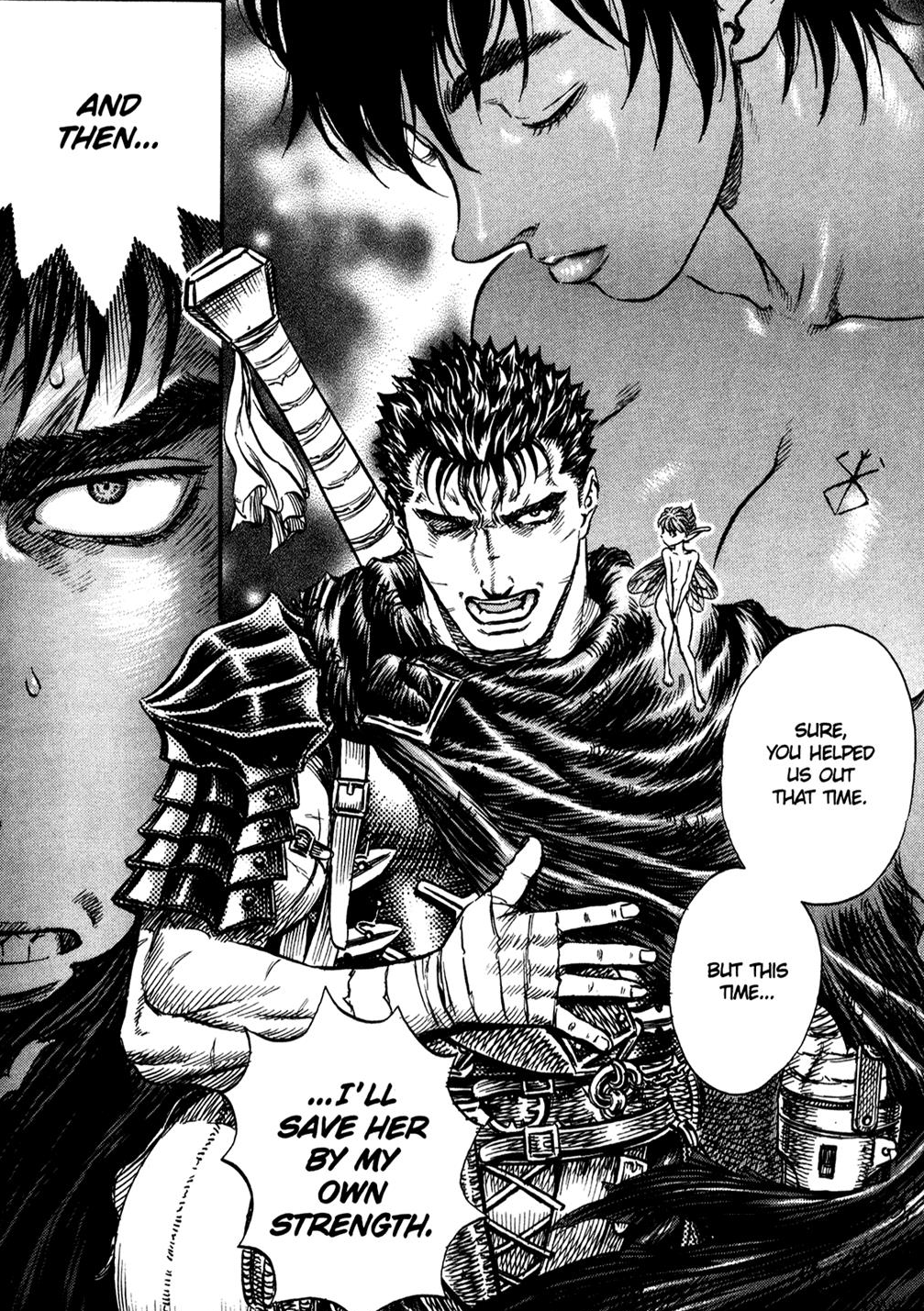
eg
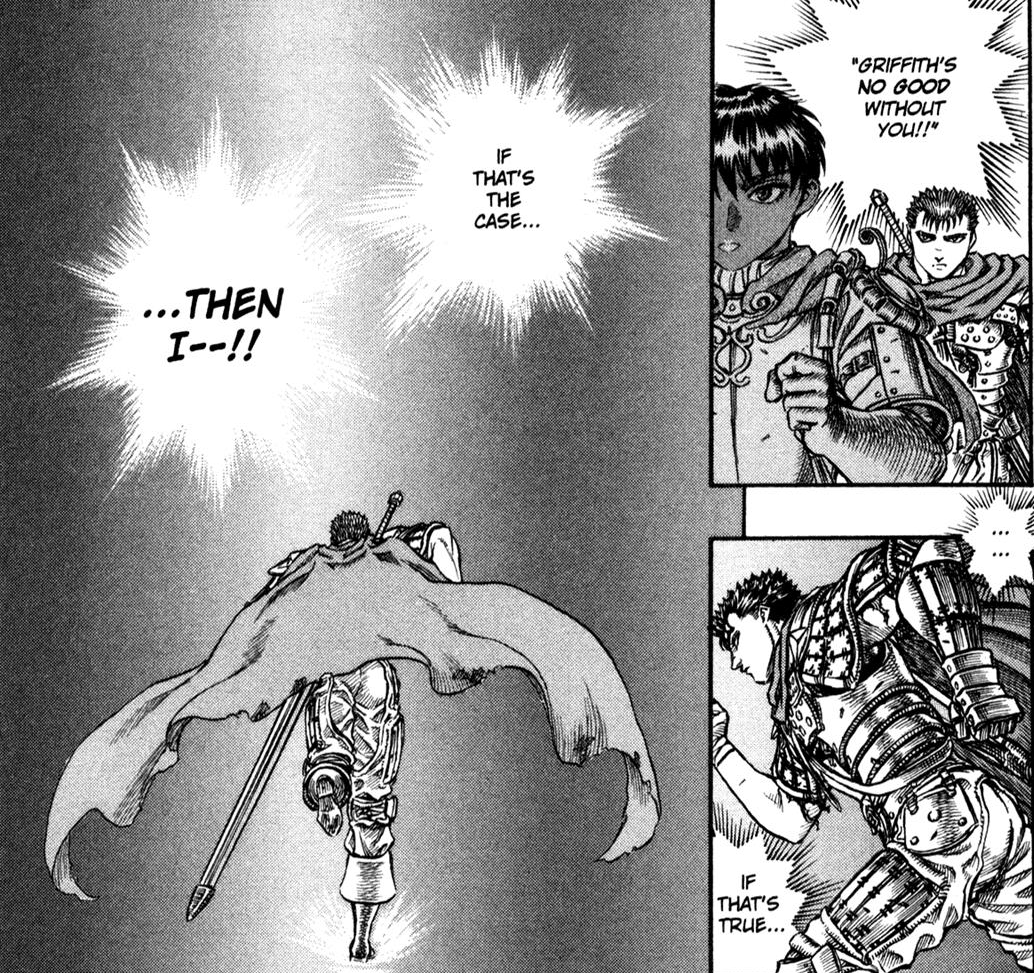
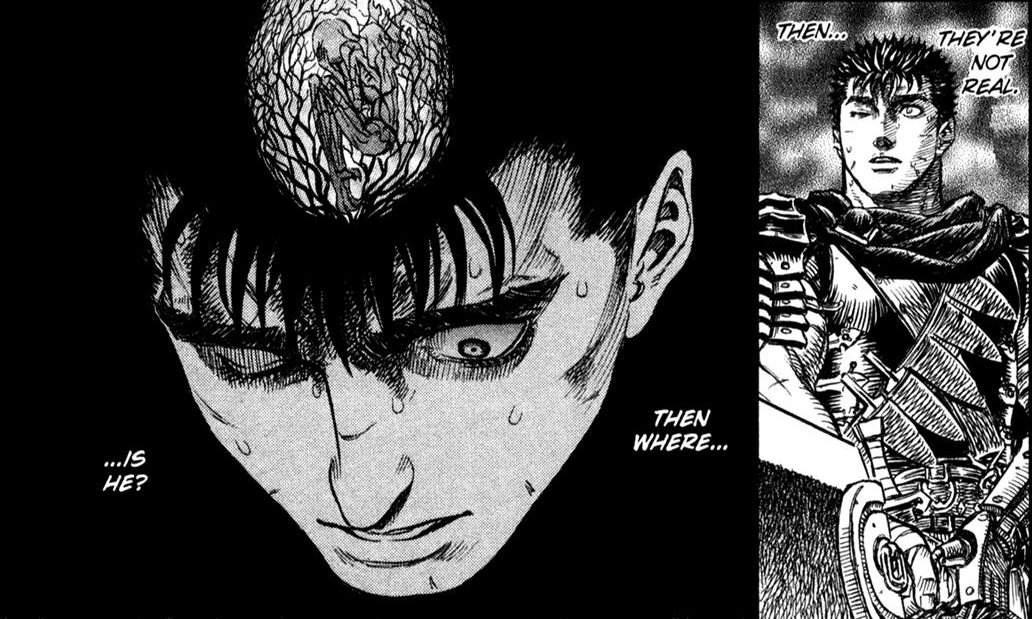
Will you? Because to me it looks like you got caught up in trying to kill incorporeal images of the Godhand and trying to find Griffith and completely forgot about her, only remembering the whole “save Casca” plan once you realized you couldn’t kill the images you were swinging at.
Yeah Guts, at a time like this you’re.
Someone else’s strength, Isidro’s, saved her.
And of course, Guts’ “I can do everything myself” stupidity continues until he sexually assaults Casca and finally realizes maybe he needs some people to rely on. It’s all bookended by the Beast of Darkness, and it’s later contradicted by Guts’ rpg group. I mean, he gains them because they’re all fucking clinging to him and considering him better than them lol. Farnese calls him her saint, Isidro idol worships him, there are parallels drawn between Guts and the group and Griffith and his followers a lot.
But again, by Conviction arc logic, the rpg group is bad. Following Guts is bad. But that’s obviously not the case.
But like, man, the Conviction arc just hammers in this shit about unequal relationships and clinging to others, resenting the torches in the darkness, etc etc etc, over and over and over. Even the religious stuff feels like a statement on unequal relationships – people clinging to a God like Nina clung to Luca like Casca clings to Griffith then Guts, like Griffith and Guts clung to each other. Like it’s hard to dismiss it all as bullshit. But it’s so fucking awful lol, I absolutely loathe it.
And it is directly contradicted by stuff like the fact that this is portrayed as good:
I half-wonder if this is an issue with Miura writing some of Berserk while depressed lol, considering how utterly cynical the Conviction arc is. Or maybe this is all going to come back front and centre and we’ll find out the rpg group is also fucked up and about to tear itself apart. I mean if a person hates someone because they’re weak and hurts someone because they’re strong, everyone in the rpg group should be full of resentment towards Guts. Come to think of it, the Hawks should’ve all hated Griffith. Falconia should hate Griffith. It should be another Tower of Conviction, by this logic, full of resentful baby-eating heretics lmao.
OR – is that a statement on the world Griffith overturns? Silat saying tyranny will always exist, that’s the reason of man, and Jarif responding with, yeah well Griffith’s world lies outside of your idea of reason. Like, Egg’s wish, and therefore humanity’s collective wish, was for an ideal world where that shit he says about relationships doesn’t apply, right?
I just don’t fucking know what the point is man. Some relationships are good, some relationships are bad, and there’s no rhyme or reason to which we’re saying are good and which we’re saying are bad, or why.
I will tell you one thing tho: according to Conviction arc logic, Guts and Griffith are each others’ gods. So that’s fun.
Also… because Guts and Griffith’s power dynamics shift over the course of the Golden Age, my conclusion that their issue isn’t that they’re unequal but that they’re idiots who don’t recognize until it’s too late that their feelings for each other make them equals, isn’t necessarily contradicted by any of this.
This is a pretty strong conclusive statement to be casually contradicted by a parallel to Nina and Luca an arc later.
Like Nina and Luca may be a bad match because Nina cares more for Luca than vice versa – Luca tends to see her as a responsibility lol. But that’s clearly not the case with Guts and Griffith.
But did Miura think about that, one wonders, because the parallels are very direct. Idk idk idk. Fuck authorial intent, whatever the hell Miura was going for, my reading still makes the most sense, contains the fewest contradictions, and is the least fucked up message.
ennnnnnnnnnnnh arguably like a city’s worth of people iirc lol. like, tens of thousands. of refugees.
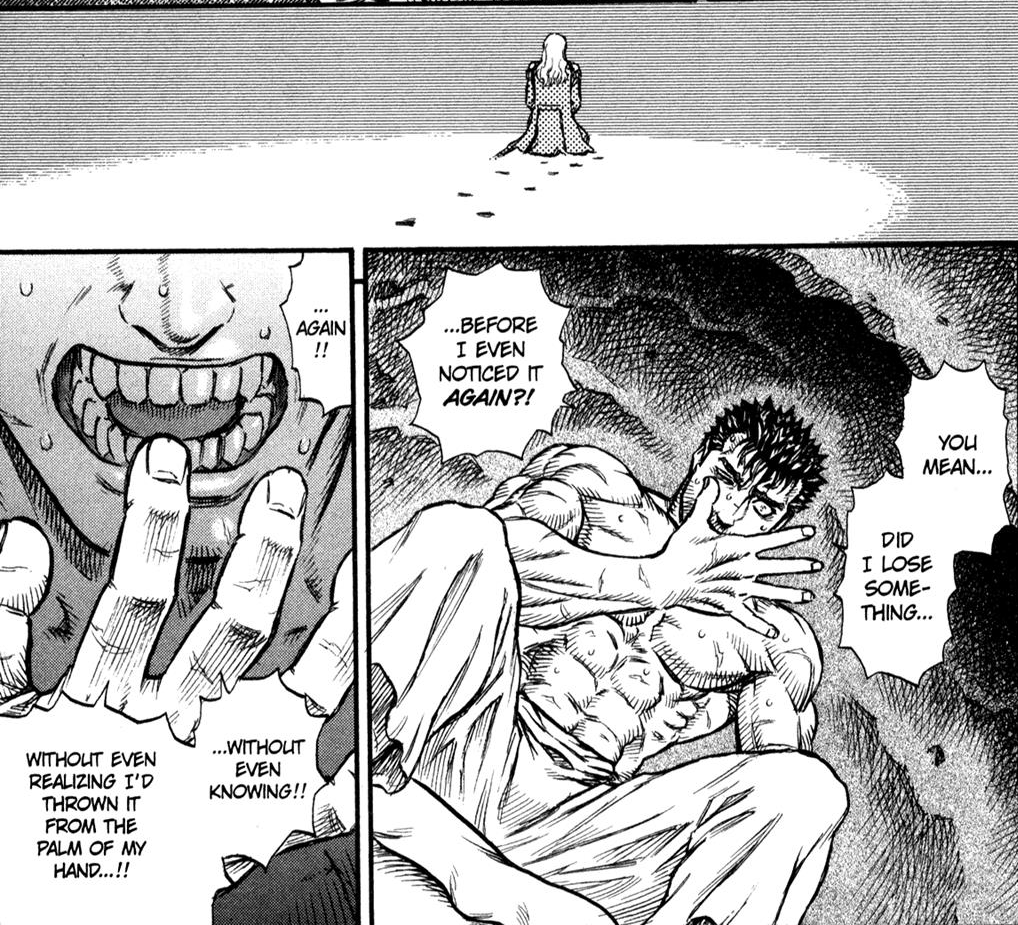
it’s a bit of a stretch to say Guts sacrificed them, but essentially yeah if either he or Casca had died then all those tortured souls wouldn’t’ve been drawn out of the ether by their two brands, which is what destroyed everyone and allowed Griffith to resurrect himself into the world
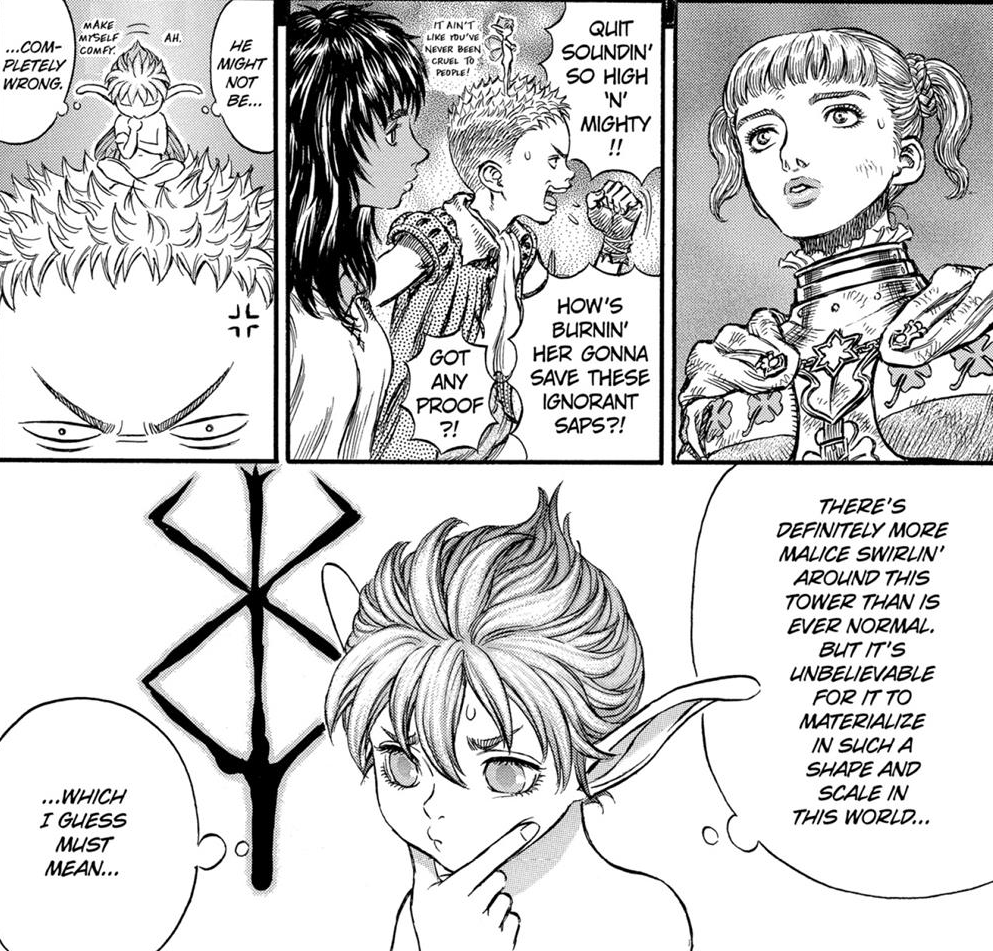
Mozgus and the townspeople were trying to kill Guts and Casca during the climactic fight, not because they knew the ins and outs of how the brands worked but because they were like, blaming them for all the ghosty shit going on and trying to pacify god or whatever. Ironically they were completely on the right track, if for the wrong reasons, bc killing either of them would’ve saved everyone.
To be fair to Guts he didn’t know this. Puck kept this shit to himself.
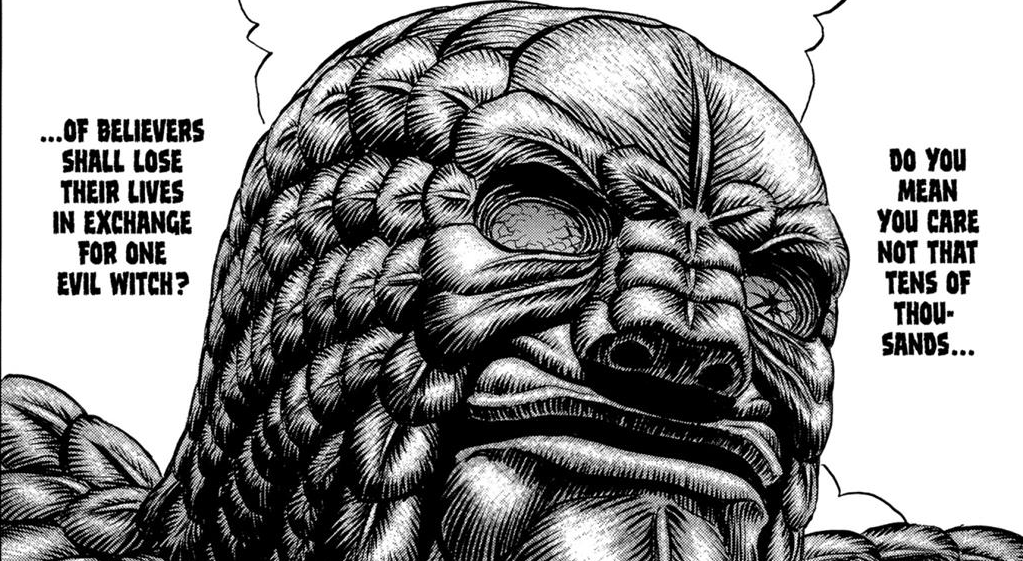
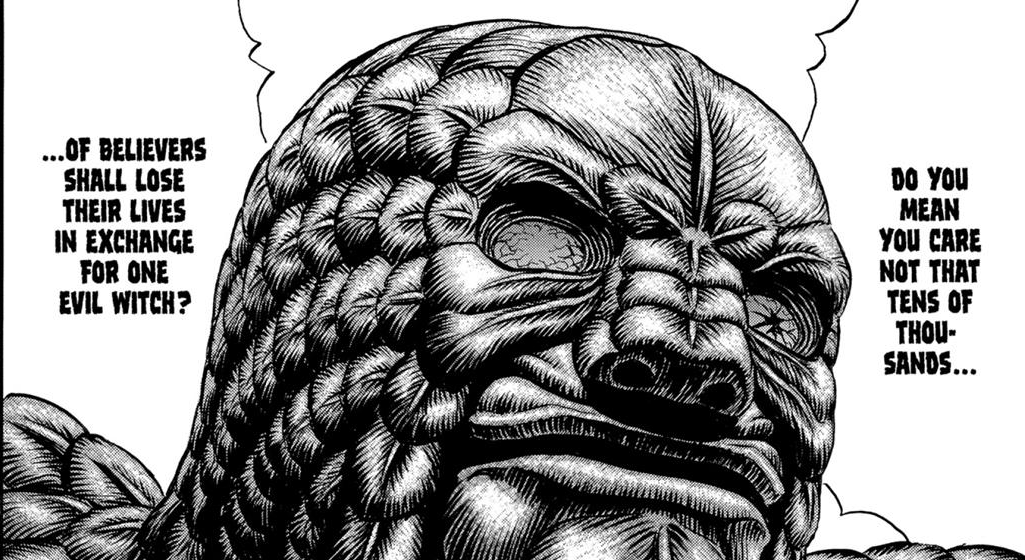
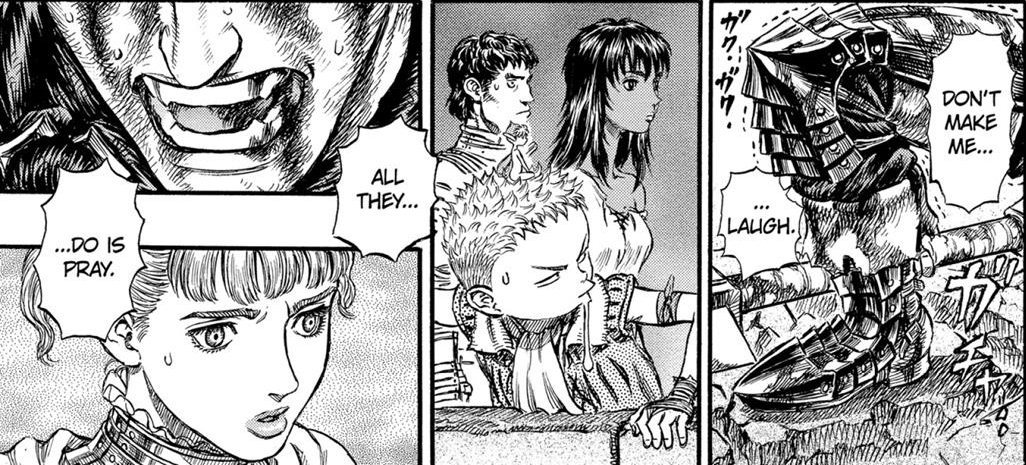
On the other hand, his attitude when Mozgus is like, don’t you care that you’re trading thousands of lives for the life of one witch isn’t “I don’t believe you” but rather “i don’t give a shit, those people suck anyway” lmao
What’s kind of fucked up is that this is the narrative’s attitude too lol, like it 100% backs up Guts here. Luca even got her little statement at the end that
everyone who acted out of faith in a higher power died, while everyone who acted out of self-preservation managed to survive. Like the
narrative really did not give a shit about these people.
Forty Hawks? The most tragic of tragedies. Tens of thousands of refugees? Fuck em, they deserve it, they are the faceless violent masses. Nothin fucked up about that. (Even though both groups end up dying because they clung too hard to their faith in someone, so by Berserk’s own ridiculously cynical logic it serves everyone right.)
It is kind of weird tho, like I wouldn’t expect Guts to give a shit
about thousands of innocent people, but I would expect him to feel some
kind of way about his part in resurrecting Griffith. But the narrative
kind of just ignores that.
Also Skull Knight’s prophecy kind of muddies the waters a bit, because he says that man cannot divert the course of the festival or w/e, but like… if Guts had jumped off that tower and killed himself, festival over. If he was like, yeah good point, and broke Casca’s neck, festival over. Femto stuck in the astral plane. Thousands of people don’t die. So idk what that’s about. Maybe it’s meant to be ironic.
After all, the mock Eclipse is a reflection of the regular Eclipse. Guts and Casca both survived the regular Eclipse, and they’re meant to survive the mock Eclipse, because their presences there is what causes it. But Guts seems to believe that he’s defying fate by surviving, and it feels like the narrative is pushing that, even though logically it’s simply not the case.
Like, the mock Eclipse follows the actual Eclipse exactly even while we’re repeating the words “it doesn’t mean it will be exactly the same” and “maybe you’re like a fish breaching the water’s surface” over Isidro saving Casca and then Guts winning against Mozgus the first time (before he levels up with rocks). Guts is still on top of a giant hand focused on Griffith while someone else is saving Casca lmao. Guts and Casca both survive, just like they survived the first time. I have no idea what the story is going for here because everything played out perfectly to imitate the first Eclipse and resurrect Griffith.
So idk maybe the point is that Guts is a stubborn dumbass who is ironically playing into actual God’s (and Griffith’s) hands by defying Mozgus and maybe eventually we’ll revisit this?
Or maybe the conviction arc is so convoluted and weird that even Miura couldn’t keep track of what he was trying to say with it lol.
My ideal ending is Femto dying in worst way possible or getting trapped in some endless loop of suffering and misery. “If Guts does happily kill NGriff without hesitation, that’ll be a v dark ending that indicates he’s lost his humanity, imo.” I like how some fans keep idealizing Guts like some sort of a righteous shounen hero… Dude is literally a savage. Look at how he treats his enemies or the apostles who have done way less shit in compare with Griffith.
I’m responding mainly to this part so I’m not c/ping the other messages (also i think your last message got cut off btw) but like, yeah Guts is a very dark character, but again that’s framed as a bad thing. We’re supposed to think he’s a huge dick during the Black Swordsman arc, eg. We’re meant to see his darkness as a sign that he’s close to becoming exactly the same as, or even worse than, the monsters he fights. He sexually assaulted Casca in part to feel “closer to” Griffith lol.
Like, my favourite Guts is when he’s at his most dark, but that would suck if the story was totally unselfaware and we were meant to cheer him on. In the first chapter when he tortures the snake dude, it’s a reversal of expectation, because we’re meant to find Guts frightening and to nearly pity the monster in that moment. Similarly when he tortures the Count in front of his daughter – except that is also much clearer in showing that Guts is pretty pathetic at that point, eg:
I think Miura kind of lost that sense of patheticness (another good example is the blatant comparisons to Vargas) after the Eclipse, which is a shame imo. But while his dark side gets a bit cooler (the Beast of Darkness, the armour), it’s still like… unambiguously negative. We’re not supposed to root for the part of him that wants to kill his friends.
Guts’ growth as a character is associated with making friends and not seeking revenge, Guts’ monstrousness is associated with going on a revenge rampage.
Anyway basically I think Berserk is more complex than a simple good vs evil revenge story. I think it’s very likely that Guts is going to backslide into revenge mode, losing himself to the armour and going after Griffith after some bad thing happens in Elfhelm, that’s like my major prediction for the future lol, but I don’t think it’s going to end with Guts self-assuredly “punishing” Griffith and living happily ever after.
Oh also there’s this:
Part of his decision to save Casca instead of keep seeking revenge is realizing he doesn’t really deserve revenge.
Like, I argue his whole Black Swordsman campaign was way less “righteously avenge the hawks and casca” and way more “I am upset so I am going to kill every monster I can find until I reach Griffith because swinging my sword makes me feel better.” And it’s an attitude he needs to grow out of.
Anyway aside from all that if anyone gets revenge and kills Griffith it should be Casca imo.
Thank you for this post. (lol I meant to say “Why you SEE it in that way” sorry).
I always saw it in that was as if he didn’t want other people to view and be shocked at what was done to his face.
Either way current Guts wouldn’t hesitate to deform Griffith’s face in an even worse way… I’d fucking love to look at what he does with him when he has the power.
If that’s the impression you get from the manga then fair enough, but that reading never occurred to me until I watched the 3rd ova lol.
And tbh I definitely think Guts would hesitate
Also letting Rickert hold him back on the Hill of Swords, deliberately trying to let go of his desire for revenge for the sake of the Elfhelm trip, and the way he really sucks at finishing this sentence:
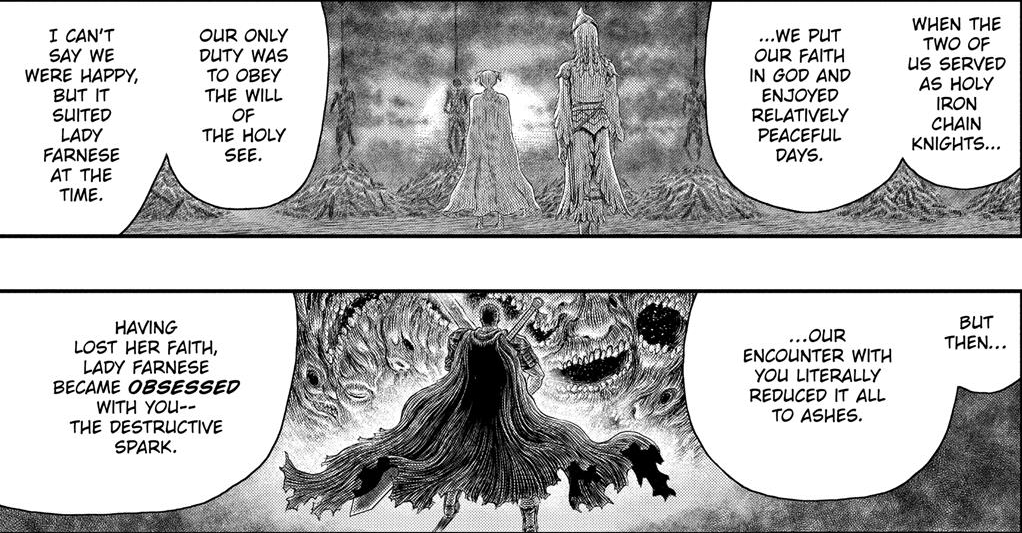
The way he separates Griffith from Femto, and usually pictures Femto as an empty faceless exoskeleton.
And only ever expresses longing and regret towards original Griffith:
And NeoGriffith looking “as if he’d been stolen from the past, the way he used to be” throws him completely off because it makes it harder to separate the different versions of him.
Basically imo his feelings towards NeoGriffith are far from simple, and I don’t think he’d find it emotionally easy to kill him.
And moreover his desire to kill is what gives the Beast of Darkness strength, so it’s framed as a negative thing in the story.
If Guts does happily kill NGriff without hesitation, that’ll be a v dark ending that indicates he’s lost his humanity, imo.
i still can’t figure this shit out
you got luca’s statement on guts and casca, followed by, on the same page
nina being a helpless baby
then followed by nina meeting joachim again and doing a 180 which it seems we’re supposed to consider a good thing, and deciding to take off with him instead.
this is interspersed with farnese deciding to follow guts and calling him her saint and prophet.
like, is this going somewhere? unequal relationships, guts and casca, guts and farnese, farnese and casca… anything?
we’ve got guts paralleling griffith in a bunch of different ways, from gaining followers by telling them “do what you want,” to wills being admiringly compared to fire, to being compared to a hero out of a fantasy, to even very recently
but it seems like none of this is… depicted as negative really. is following guts good because he struggles to live and miura thinks that’s cool while following griffith was/is bad because ??? is it just a double standard at work?
or is some payoff coming?
what is the deal w/ the conviction arc
guts and casca being at the tower of conviction together as 2 sacrifices drawing up malicious spirits etc is what sets the mock eclipse off, kills like over a thousand people, and ultimately brings about ngriff’s resurrection.
neogriffith’s existence is a direct result of guts rescuing casca
if it was fated that neogriffith show up and and eventually defeat ganeshka and create falconia etc, and it sure seems to be, then it was fated that casca not be burned at the stake there, that guts defeat mozgus and co instead of being killed, etc etc. because if either guts or casca were killed, those evil spirits would not have been able to show up and kill thousands of people as a sacrifice to bring neogriffith into the world.
so why is skull knight’s “maybe you’re like a fish breaching the water’s surface” repeated over guts kicking mozgus’ ass and isidro rescuing casca? neither of them were fated to die, they’re not defying fate by surviving.
not with that attitude
(like jesus this is such a false dichotemy. she could travel with guts for a week and get dropped off to make her own way somewhere else, or he could take her back to godo’s with him and let her learn to be a blacksmith or smthn. it’s not a choice between fighting ghosts every day vs enduring abuse. there are other options lol.
idk maybe this is supposed to say more about guts than it does jill lol, i mean this is one of the darkest points of his narrative. maybe we’ll see jill again and discover that guts’ “advice” here did her no favours.)
the end of the lost children arc fucks me up because i find rosine’s regret over sacrificing her parents and wanting to return home as she dies to be extremely sad and emotionally affecting, and very understandable and relatable as a character choice
but contrasting that to jill’s “i’m going to go home and just deal with my alcoholic physically abusive dad and his pedo friends :D” ending completely ruins it
like, if that’s presented as the alternative, yeah i give rosine a high five for sacrificing her parents and becoming a monster. good for her. fuck her parents, she should’ve been allowed to die with no regrets.
like it’s one thing for, eg, old man troll fight to talk about how dreams can be opportune escapes from reality when his reality was taking care of a sick parent and working for a living, but when your reality is an abusive family, yeah escaping from that is good, actually. and i feel like that nuance is unaccounted for in berserk lol. like you can say it’s bad to kidnap children and transform them into monsters and kill people etc without also saying it’s bad/weak/immature/whatever to want to escape from your abusive home.
and by having rosine regret the sacrifice and long for home as she dies, contrasted to jill grinning and bearing her abuse, the narrative is essentially placing the blame on rosine for not being able to cope with abuse rather than where it should be, ie, on her father for abusing his kid and orchestrating his own death.
like, the lost children arc should’ve been about condemning abusive parents but… it wasn’t, and it’s fucking bizarre really. the abusive parents are just like, generic 2 dimensional stand-ins for any kind of life struggle, and the kids get the burden of reacting to life struggles correctly. we’re not shown that the parents should’ve or even could’ve made different choices, the parents just exist as trials to test these children, essentially.
and ok fine if you want to focus on reactions to abuse, rather than the perpetuation of it, that’s fair enough, but to then condemn one kid for seizing on the only escape she had and give another kid a pat on the back for deciding not to escape but rather to just suck it up… like damn. this fucking arc lol.
This is about Falconia, bodies and lives being bought and sold, the natural order of the world, etc.
tw for csa (no graphic panels but still disturbing enough for a cut imo)
The Conviction Arc shows us in broadstrokes the world humanity’s collective unconscious wants to overturn through starving crowds, dungeons filled with tortured ‘heretics,’ rampant plague and the desire for a saviour, and nobles terrorizing peasants using god as an excuse, but this is the up close and personal version. Lives and bodies as commodities, weak trampled by the strong, poor ruled by the rich, and everyone accepting it as the way things are.
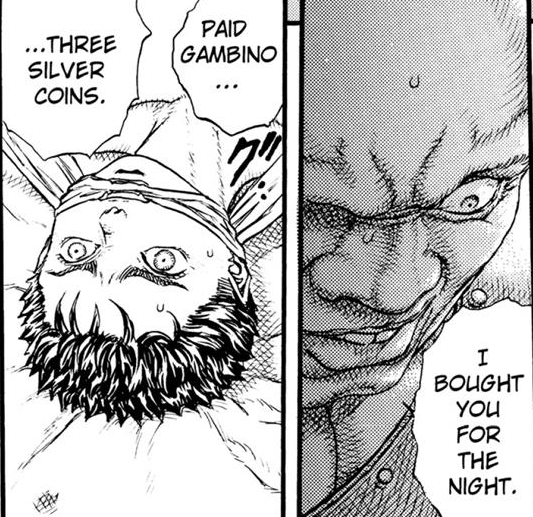
Our three main protagonists during the Golden Age all have very personal formative trauma that revolves around being bought and sold as a matter of course.
And Griffith’s dream, as someone wracked with guilt for lives lost in his battles, someone who has sold himself to a rich and powerful predator to save some of those lives, is to overturn this natural order of things.
And he does. Falconia is a place where children aren’t sold as sex slaves, where the powerful do not oppress the weak, where the rich don’t exploit the poor, where everyone is treated equally and with dignity, where Guts, Griffith, and Casca could’ve all had happy childhoods.
One of the important aspects of this theme re: societal power dynamics and exploitation is that these evil actions
are excused away. This is true of like, just about every abuser of power and
rapist in Berserk. Some think it’s okay because someone more powerful than
them told them they’re allowed (torturer, Wyald/probably the rest of
the apostles, Mozgus’ torturers, Mozgus and the inquisition in general
passing the buck onto God, Donovan because Gambino allowed it, etc),
some think it’s okay because that’s just the way things are (Donovan
again, Adon, Rosine’s got some of this, etc), some think it’s okay because
they’re powerful enough to do anything they want (implied with Gennon,
Ganeshka,
the Godhand, a lot of apostles, Casca’s attempted rapist nobleman), and finally some think it’s okay because the world wronged them (Gambino, apostles like Rosine again and Eggman, Jill’s dad, the baby eating heretics lmao, one could argue the King, Mozgus’ torturers again, etc).
Again, it all comes back to the “reason of the world,” the natural order of things that NeoGriff overturns. In the ordinary world these people with power can do whatever they want and justify it to themselves. In NeoGriffith’s world, they don’t. Apostles, our prime example of powerful preying on weak because they’re allowed to, no longer prey on humans, simply because of NeoGriffith’s existence.
It seems safe to assume nobles no longer exploit people either, if nobility is even still a thing in Falconia. Like granted, I’m taking some of this as read based on what we’re told Falconia is, but I feel like the apostles (and the explicit focus on equality) are a good representative example of the point of Falconia, which is to essentially fix everything we see wrong with the world in the Conviction arc and, like I laid out above, in our protagonists’ lives.
The fact is that Falconia isn’t just a utopia on a distant macro level, where the readers can look at it and go, hm seems nice I guess but w/e. On a micro level it’s a place where these horrible things that happened to the characters we personally love and care about wouldn’t’ve happened. I, at least, am emotionally invested in that utopia because of this, yk?
But here’s where I get critical of the portrayal:
Femto and the Eclipse rape is the epitome of the harmful power structure. Like, Femto hits every branch on his way down this tree lol. During his transformation he met God, God absolved him of his guilt and responsibility by telling him he can do whatever the fuck he wants and it’ll be the right thing. He’s taking the place of the nobleman he saved Casca from and exemplifying existing power structures of strong preying on weak, and it’s petty revenge.
One can easily argue that the Eclipse rape is a distillation of every abusive power structure in Berserk.
So okay, you have Falconia, a utopia that exists to eschew these power structures and create a place of equality where no one is exploited, created by a dude whose defining act is the epitome of these abusive power structures.
And frankly it’s fucking pointless. This feels like the shallowest of shallow hot takes lol. Like, oooh what if this wonderful place where all the horrible things that traumatized our favourite characters are no longer an accepted given was created by an evil demon rapist???
Like… okay? And then what? The Eclipse rape has nothing to do with the social structure of Falconia, NGriff seems to have completely delivered on his/humanity’s dream regardless, he is now the higher power making the calls and he hasn’t told everyone to do whatever they want no matter who it hurts. From what we’ve seen he’s done the exact opposite, existing as a tempering influence on the apostles who no longer prey on those weaker than them, ending the Holy See’s reign of terror, ending wars in general, and uniting people in their differences.
So it’s just like, an arbitrary evil act which creates an artificial sense of moral greyness. It has no deep meaning. I mean I suppose Miura could address it in the future – I’ve mentioned that I think it could theoretically be really interesting for Casca to visit Falconia and see the dream she devoted her life to having come to fruition because of her rapist. But even so, that doesn’t have any like… deeper intrigue. That’s interesting for Casca’s character, not as an examination of moral relativity or w/e.
Similarly, if NeoGriffith turns out to be more human than he looks he could reflect on this contradiction in a potentially interesting way.
But I can’t think of a way to make it an interesting examination of morality. It’s boring at its core imo. I mean you could argue that it’s still worthwhile on that personal character level, but let’s be real here – no amount of potentially interesting character stuff in Casca’s future is worth removing her from the story for 20 years, and anything w/ NeoGriffith would be a retread of human Griffith’s guilt issues and frankly I don’t see it happening anyway lol.
So yeah ultimately this whole egalitarian utopia created by a rapist demon thing just does not work for me at all. There’s no reason the creator of this paradise /had/ to be a symbol of this abusive power structure it exists to destroy, again, that’s just an arbitrary happenstance, not a pre-requisite to utopia building, so it doesn’t say anything about the nature of Falconia. It doesn’t say anything about utopias in general, it doesn’t say anything about those power structures that we don’t already know (ie they bad, equality good).
It’s like, fake deep tbqh.
The actual interesting and morally grey aspect of Falconia is the way world peace was achieved by setting a bunch of fantasy monsters loose on humanity, and that has nothing to do with the Eclipse rape. Like, that’s literally all you need for the moral complexity. We have world peace and a growing utopia that everyone is welcome to join, but the price is monsters everywhere, and this could not have happened without those monsters to unite humanity in fear. Is the world better or worse than it used to be?
And NGriff being a rapist, or his demon alter ego being a rapist, or whatever the deal is there, adds nothing to that question, rather, it distracts from it and devalues the actual moral ambiguity.
In fact, it makes me wonder whether Miura regrets going with rape as his way of demonstrating Femto’s evil. Because it’s been such a non-issue to the whole theme of power structures, utopias, equality, etc, that it feels like Miura is sweeping it under the rug lol – it’s less of an attempt at dark irony and more the elephant in the room. I can’t even say with confidence that Femto was intended to be a symbol of exploitative power structures, despite how obvious it seems, because it just… hasn’t impacted the themes of the story at all.
hohoho
so i did what i said i was going to do, re-read most of the elfhelm chapters to see if i could figure anything out.
and idk how solid this is, especially considering how biased in favour of it i am lol, but i came up with this theory last night
So in 345 they’re all sitting around a table having a nice chat about important spirit realm shit.
The world tree is a “dragon’s road.”
The behelit also creates a dragon’s road.
Just want to point out the little specification of “at your side” and the shot of the behelit in Guts’ pouch vs the way Guts’ cloak billows to give us a view of that pouch as he walks towards Casca.
SO dragon roads.
Schierke pipes up with a question absolutely no reader was ever curious about and is therefore probably very relevant:
With me so far? These spirit woods are lands associated with spirit trees, like Flora’s. These trees feed off the world tree like parasites, keeping it pruned to manageable levels until Griffith destroyed a bunch of them to make way for his high fantasy genre shift.
The world tree is a dragon’s road – it’s not a real tree, it’s a fissure between realms:
Again, the same kind of thing the behelit creates.
Eventually they head on over to Danann’s palace, which turns out to be a giant cherry tree:
It’s a really impressive spirit tree, maybe the last surviving one, or one of the last at least. Elfhelm is probably its associated spirit woods.
Danann specifies that Guts and Casca’s first meeting will take place right by her spirit tree.
And check out the last image of the most recent chapter:
Quite an ominous shot of that tree.
Bear in mind that Danann sensed that Casca was afraid of Guts and refused to let him join Schierke and Farnese in her dreams because of this. It seems a bit strange that as soon as Casca wakes up she’s sending her straight to Guts then, doesn’t it?
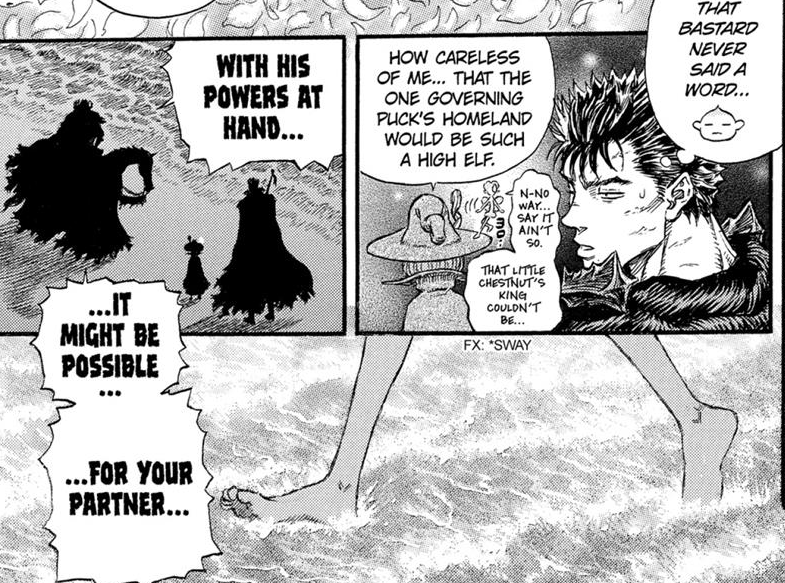
Also bear in mind that Skull Knight, who reminds Puck of the elves and is implied to be the Elf King’s oracle, is the one who both told Guts the Elf King could heal Casca, and warned him that “there’s no guarantee your wish will be her wish.”
Schierke thinks the oracle is the Moonlight Boy, because she doesn’t know it’s Skull Knight. But this is how we know that “oracle” is connected to the Elf King. And this is how we know it’s Skull Knight:
And check out this vaguely ominous thread that hasn’t been picked back up yet. Is someone using Guts…? Skull Knight, or the person Skull Knight is playing messenger for – the Elf King? (tbh it looks like he’s justifying it to himself by saying whether he interferes or not causality has the final say anyway. calling Guts “a factor.” A factor in what? What is being facilitated, and by whom? Maybe someone who understands the flow of causality, who is using it for their own ends?)
I also want to note that I had zero memory of Flora asking if Skull Knight is using Guts lmao, the only reason I went back to this part was to prove that SK is the Elf King’s oracle. But I am super stoked that it fits my theory perfectly.
SO yeah the Elf King’s oracle is the one telling Guts this. Seems probable that Danann has been planning to try healing Casca’s mind since long before they showed up on her doorstep asking her to.
Also of note in this scene with Skull Knight on the beach:
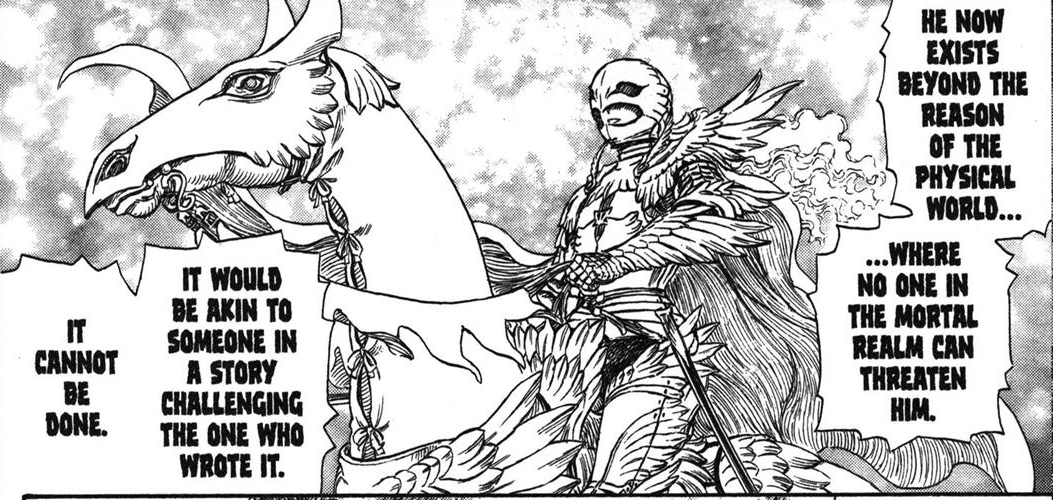
This is the explanation for why NeoGriffith had Flora killed.
To
confront him, one must also exist outside the story. Who exists outside
the story to some extent that we know of? Skull Knight, the branded, and witches.
AND one more thing of note in this scene is Skull Knight warning Guts about the armour:
All this foreshadowing is thrown into the same chapter, and I think it could be all tied together.
So, my theory:
Danann is using Casca and Guts, for two possible reasons, maybe both:
1. By healing Casca’s mind and sending her to meet Guts right beside her spirit tree, she knows or hopes that Casca’s memories will send her into despair right there, with the behelit at hand, thereby opening a dragon’s road right beside her powerful spiritual tree thing which feeds on dragon’s roads. Maybe giving Danann and Elfhelm a boost of energy/spiritual power for something.
2. Weapons.
If Casca becomes an apostle, she will be branded, ergo a step outside the reason of the world and able to harm Griffith. She will be powerful. And Griffith will have a weakness against her – that whole wacky fetus thing that made him save her life. It’s entirely possible that Danann knows this, as she has scryers checking things out.
(Granted Casca would also have her own weakness against him, that demon instinct which recognizes NeoGriffith as a messiah, buuut I’m js Ganeshka’s reaction to him was rather similar to Casca’s old feelings, which she’s had several years of experience dealing with and ignoring. Plus he’s responsible for destroying her life and everything that traumatized her into insanity, and Danann has a lot of magic. That potential weakness isn’t the be all end all, is what I’m saying.)
There’s also the foreboding foreshadowing regarding Guts succumbing to the armour. Skull Knight’s warning back there, the Beast of Darkness taunting him here
and this scene
which directly connects Casca regaining her sanity and ~doing something~ ominous to the Beast of Darkness lying in wait. And I feel like Casca choosing to make a sacrifice like Griffith did and become a monster would be a pretty solid incentive for Guts to succumb to his inner beast.
And I’m js Beast of Darkness Guts, with his own foot outside the reason of the world thanks to the brand, and lbr Femto/NGriff’s own host of issues that led to him letting Guts go three times so far, would also be a powerful weapon.
It’s also worth noting that we’ve been warned time and again about the dangers of Guts succumbing to the armour, losing his humanity, etc, and he’s been saved every single time he reaches a danger point by Schierke, or the Astral Kid, or whatever. At some point he has to actually succumb properly, at least for a while, for long enough to shake up the narrative and have Consequences, or there’s no point to all this ominous foreshadowing.
Elfhelm is opposed to NeoGriffith and Falconia and the whole merging of planes thing, it’s suggested that Guts is being used by Skull Knight, who seems to be allied with/working for the Elf King, and all these little ominous moments fit together very well.
Plus let’s be real here – Skellig is obviously too good to be true.
Like, I don’t think there’s a dark underbelly to Skellig, any more than I think there’s a dark underbelly to Falconia. I don’t think they’re secretly killing children or Danann’s going to transform into a cackling demon or that the cloying wholesomeness is all a performance to trick Guts and co lol. But I do think that despite the cutesy elf antics and unicorns and sentencing Magnifico to dishwashing duty etc, they would be very capable of ruthlessness. This is Berserk, after all.
tbh I’m really feeling the behelit dragon’s road thing, all those expository details in the recent chapters add up v neatly.
And I think the weaponizing Cacsa and/or Guts theory is a little more of a stretch, more of a “well it would logically follow” rather than having directly suggestive evidence of its own, but still fits nicely imo. And boy, would that not twist the whole revenge theme in an interesting way? If there’s another secondary antagonist who wants Guts and/or Casca to go and kill NeoGriff for their own reasons? Maybe even for the greater good – but at the expense of our protagonists?
you think the torturers being outcasts collected by and devoted to mozgus is supposed to be a preview of neogriff’s apostles/war demons
tbh actually it makes sense bc it’s easy to view mozgus and neogriff as foils. like they both got that sinister angelic thing going on but their differences are more light-shedding than any similarities – the whole conviction rebirth arc was largely about outcasts and creating enemies out of other groups to strengthen your group (ie religion) while the point of falconia is to unite humanity with literal fantasy monsters as the enemy. mozgus’ outcasts tortured people, griffith’s save people. mozgus condemned most people, griffith accepts everyone. mozgus upheld the status quo and the way of the world (those with power trample those without) while griffith creates a world with a new status quo
and this is humanity’s deepest desire so it’s basically a direct response to mozgus and people like him dividing and conquering and demonizing outsiders and upholding nobility while making the lower classes suffer etc.
there’s a whole false god vs true saviour w/ divine right vibe i get from this comparison. and i mean the true saviour is still a largely cynical depiction since berserk is in part a criticism of religion, “god” included, but neogriff’s utopia is a lot less easy to denounce as fucked up and evil than mozgus’ inquisition thing.
























 you're the only one