Well this originally started out as a jokey take on how heterosexuality is the True Villain of Berserk, but then I was like, shit this actually works surprisingly well and is kind of depressing. So now I’m doing it more seriously. This isn’t meant to be some grand unifying theory of Berserk lol, it’s not even close to airtight or anything, the story just happens to lend itself weirdly well to this particular reading.
So here’s how Griffith’s narrative works as an almost certainly accidental, yet imo somewhat relatable, metaphor for being closeted and repressed:
The only way for him to realize his dream is to marry the princess. War, battles, glory, promotions, even the Eclipse, those are all stepping stones that enable him to one day marry Charlotte. Marriage is the only door to his dream. Even when he becomes saviour of the world, he’s still gotta marry a woman to make it official.
Griffith’s all-encompassing, all-important dream is embodied by heterosexual marriage.
Set up in perfect opposition to that dream, the only one who makes him forget about it, and the one he has to sacrifice to attain his dream, is Guts, the man he’s in love with.
So it should be pretty apparent how that central conflict lends itself to a closeted gay man torn between obligation and desire kinda reading, right?
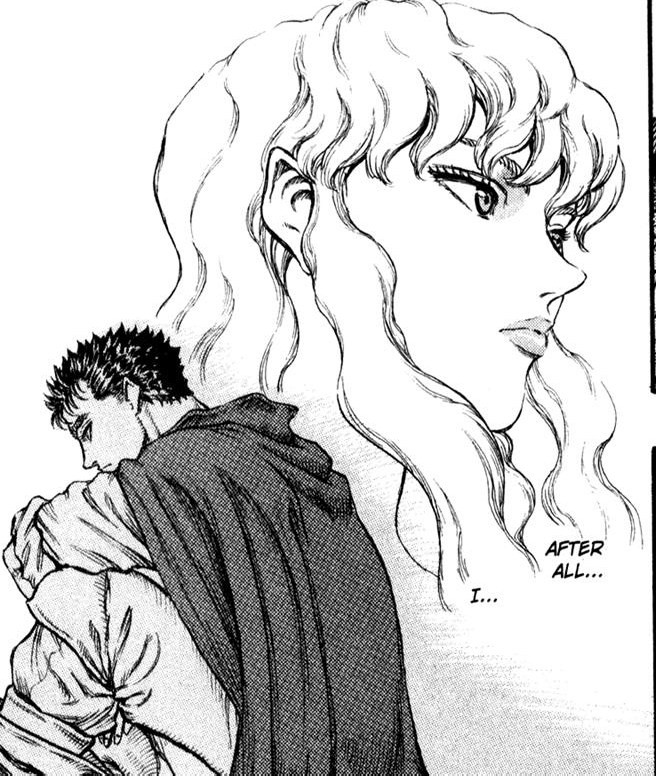
The details don’t do much to counter it either. It’s Charlotte’s presence that creates the rift between Guts and Griffith – she’s there, refocusing Griffith’s attention from Guts to his heteronormative goal during their significant, romanticized staircase conversation when Guts asked why Griffith would risk his life for him and Griffith failed to give him a reason. And she’s the one Griffith directs the speech to, inadvertantly convincing Guts that he doesn’t care about him and making Guts decide to leave.
The dream is also defined by emotional repression. To achieve it Griffith has to project a perfect image of himself to everyone – the nobles, Charlotte, the hawks, everyone. When Casca catches him in a moment of vulnerability and watches him injure himself in a river he snaps out of it, represses, and acts like nothing happened afterwards. Guts is the only person he willingly allows to see him less than perfect – when he’s conducting assassinations, for instance. He opens up to him in emotional vulnerability when he asks “do you think I’m cruel?” In that moment, Guts suggests that Griffith’s emotional expression of vulnerability is incompatible with achieving his dream – “Ain’t this part of the path to your dream? You believe that, don’t you?”
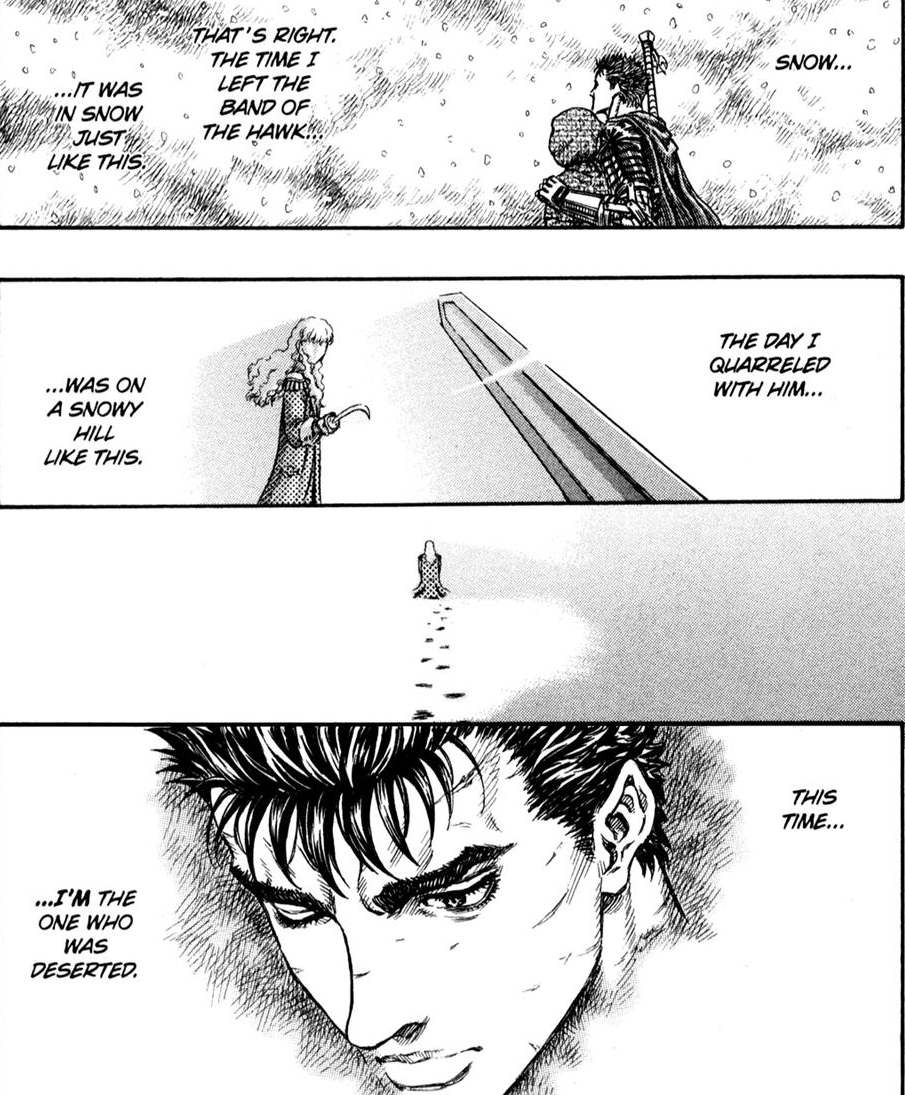
Guts is able to walk away and abandon Griffith because Griffith can’t tell him how he feels, he can’t tell Guts why he risked his life for him and he can’t tell him that he wants him to stay. Casca even points out that they should stop and talk things out, and we the reader know that their rift is based entirely on a misunderstanding that could be cleared up so talking things through would actually achieve something – but she’s dismissed, and they duel instead.
So a dichotemy is set up between the dream/Charlotte/heteronormativity, and emotional repression vs Guts the man Griffith loves, and expressing his feelings for him.
The tragedy of Berserk is that repression wins.
Guts leaves because Griffith can’t express how he feels. Griffith has sex with Charlotte in an attempt to seize his dream, having lost Guts, (of course this act of striving for his dream is represented by heterosexual sex) and ends up trapped in a dungeon. There he both finally admits to himself that Guts is more important to him than his dream and fittingly loses the ability to communicate at all. He’s also, to top it off, locked away behind a mask modeled after the helmet he wore while pursuing his dream. After losing Guts and having sex with Charlotte he’s not just choosing not to express his emotions, he’s forced to remain silent and hidden.
After he’s rescued the mask stays on and words remain unspoken. A lot of shit happens and eventually he has a breakdown. And interestingly, it’s not just the prospect of Guts leaving again that causes him to finally break from reality. It’s also the thought of Casca staying.
After overhearing Guts and Casca he envisions himself chasing his dream again (and isn’t it fitting that it’s described as playing? ie not real, a make-believe expression of himself), and then he sees himself – and here it gets really depressing – seemingly married to Casca. He’s still helpless and unable to communicate, as though he’s caged inside of himself. In his vision Casca wears a dress, has hung up her sword, and is raising a son with him, named after the man Griffith is in love with. Griffith is dressed up and attractive again. It’s terribly picturesque in a idealistic heternormative way. Casca leans down to kiss him and then spoonfeeds him, all the while he’s silent and motionless and seems lost as all he thinks to himself is that the peace and quiet isn’t so bad.
Tbh if you’re reading Griffith as a gay man this dream comes across as a nightmarish metaphor for being trapped in repression, trapped in a heterosexual marriage and societal expectations, his voice, body, and even his own mind lost. It’s disturbing.
And in the soup made by Casca is the behelit.
The thing is that the behelit isn’t the escape from that nightmarish vision it seems to be at first – it’s an embodiment of it. What happens when Griffith summons the Godhand, sacrifices the Band and most notably Guts, and becomes a demon?
His heart is frozen. He’s later reborn with the sole purpose of becoming a wholly emotionless, utterly perfect image of himself – the image he’d tried to project as a human: a perfect saviour, a perfect leader, and a perfect fiancee, straight out of a fairytale. One half of a perfect heterosexual couple, ruling a perfect kingdom.
Femto’s new body incorporates the mask he was forced to wear in the torture chamber. The transformation doesn’t fix the problem caused by his broken body or his lost tongue, it doesn’t return his ability to express his feelings to him, it rips them out from the source – it destroys his emotions so he has nothing left to express. “This peace and quiet… isn’t so bad.”
When Griffith chose to sacrifice Guts he didn’t choose freedom or personal empowerment – he chose to remain a voiceless, tortured man in a locked cell, he just removed his ability to feel pain or long for more.
(Or tried to at least. Time will tell how his newly bthumping heart figures into everything.)
Disclaimer: I don’t think this works as like… a great, sensitive and thoughtful depiction of the effects of internalized homophobia on a gay man lol. Berserk is offensive and homophobic af and choosing to read it like this doesn’t fix that problem at all. I just kind of dodged some of the worse stuff but yk, there’s no way around the fact that griffith/femto/ngriff is a gay-coded antagonist and most of his villainy revolves around that coding.
Also I’m mostly closeted myself so there’s definitely some projection going on here. That’s partially the point of this. I don’t relate fully to this narrative but some aspects of what I wrote do hit home, and hopefully that comes across and this doesn’t feel exploitative.
@yesgabsstuff @mastermistressofdesire I’ve mentioned this essay b4 and I believe you’ve both expressed interest in a complete version so voila.






 you're the only one