speaking for myself I’m very done w/ reactions to rape in berserk that take away entire characters so I hope this doesn’t happen. losing casca for 20 years was enough, I don’t want to lose charlotte too from just hearing about it lol.
and ngl the last thing I want to see is Miura depicting Charlotte learning about Femto raping Casca. Learning NGriff is actually a demon now has potential, adding Charlotte trying to deal with her fiance/husband/whatever having raped someone is way too real and I don’t trust Miura an iota with that kind of character conflict considering how he’s handled the fallout of the eclipse rape so far.
Like I think it’s a little ridiculous that the Count got a chance to make two sacrifices, and it’s probably a case of early installment weirdness bc I don’t think that actually makes sense wrt what we know about how sacrifices work (like what was going to happen if the Count did sacrifice Theresia? He’s already one of the more powerful apostles we’ve seen)
But I do think it’s definitely meaningful that the Count falls into despair, and not just an accidental contradiction lol. The further on we go the more depth apostles get, from pure evil snakeman to three dimensional count who still has loved ones to sympathetic rosine to zodd and irvine getting the same thematic inner beast vs man stuff guts gets.
Not to mention Femto letting Guts escape, and lbr I know we’re all hoping this is going to come full circle wrt NeoGriffith.
This is about Falconia, bodies and lives being bought and sold, the natural order of the world, etc.
tw for csa (no graphic panels but still disturbing enough for a cut imo)
The Conviction Arc shows us in broadstrokes the world humanity’s collective unconscious wants to overturn through starving crowds, dungeons filled with tortured ‘heretics,’ rampant plague and the desire for a saviour, and nobles terrorizing peasants using god as an excuse, but this is the up close and personal version. Lives and bodies as commodities, weak trampled by the strong, poor ruled by the rich, and everyone accepting it as the way things are.
Our three main protagonists during the Golden Age all have very personal formative trauma that revolves around being bought and sold as a matter of course.
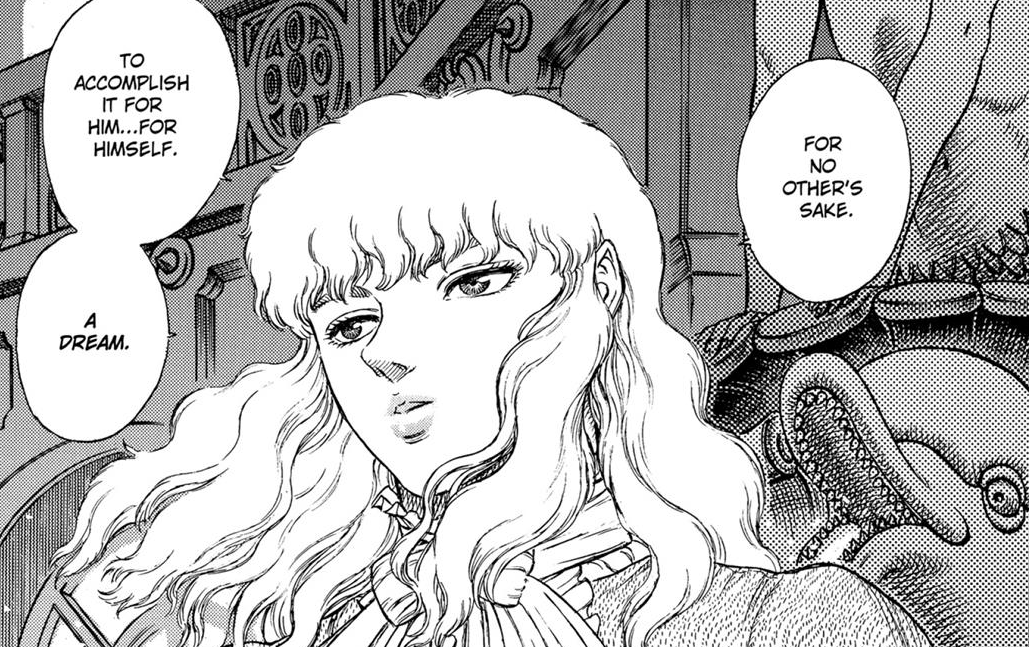
And Griffith’s dream, as someone wracked with guilt for lives lost in his battles, someone who has sold himself to a rich and powerful predator to save some of those lives, is to overturn this natural order of things.
And he does. Falconia is a place where children aren’t sold as sex slaves, where the powerful do not oppress the weak, where the rich don’t exploit the poor, where everyone is treated equally and with dignity, where Guts, Griffith, and Casca could’ve all had happy childhoods.
One of the important aspects of this theme re: societal power dynamics and exploitation is that these evil actions
are excused away. This is true of like, just about every abuser of power and
rapist in Berserk. Some think it’s okay because someone more powerful than
them told them they’re allowed (torturer, Wyald/probably the rest of
the apostles, Mozgus’ torturers, Mozgus and the inquisition in general
passing the buck onto God, Donovan because Gambino allowed it, etc),
some think it’s okay because that’s just the way things are (Donovan
again, Adon, Rosine’s got some of this, etc), some think it’s okay because
they’re powerful enough to do anything they want (implied with Gennon,
Ganeshka,
the Godhand, a lot of apostles, Casca’s attempted rapist nobleman), and finally some think it’s okay because the world wronged them (Gambino, apostles like Rosine again and Eggman, Jill’s dad, the baby eating heretics lmao, one could argue the King, Mozgus’ torturers again, etc).
Again, it all comes back to the “reason of the world,” the natural order of things that NeoGriff overturns. In the ordinary world these people with power can do whatever they want and justify it to themselves. In NeoGriffith’s world, they don’t. Apostles, our prime example of powerful preying on weak because they’re allowed to, no longer prey on humans, simply because of NeoGriffith’s existence.
It seems safe to assume nobles no longer exploit people either, if nobility is even still a thing in Falconia. Like granted, I’m taking some of this as read based on what we’re told Falconia is, but I feel like the apostles (and the explicit focus on equality) are a good representative example of the point of Falconia, which is to essentially fix everything we see wrong with the world in the Conviction arc and, like I laid out above, in our protagonists’ lives.
The fact is that Falconia isn’t just a utopia on a distant macro level, where the readers can look at it and go, hm seems nice I guess but w/e. On a micro level it’s a place where these horrible things that happened to the characters we personally love and care about wouldn’t’ve happened. I, at least, am emotionally invested in that utopia because of this, yk?
But here’s where I get critical of the portrayal:
Femto and the Eclipse rape is the epitome of the harmful power structure. Like, Femto hits every branch on his way down this tree lol. During his transformation he met God, God absolved him of his guilt and responsibility by telling him he can do whatever the fuck he wants and it’ll be the right thing. He’s taking the place of the nobleman he saved Casca from and exemplifying existing power structures of strong preying on weak, and it’s petty revenge.
One can easily argue that the Eclipse rape is a distillation of every abusive power structure in Berserk.
So okay, you have Falconia, a utopia that exists to eschew these power structures and create a place of equality where no one is exploited, created by a dude whose defining act is the epitome of these abusive power structures.
And frankly it’s fucking pointless. This feels like the shallowest of shallow hot takes lol. Like, oooh what if this wonderful place where all the horrible things that traumatized our favourite characters are no longer an accepted given was created by an evil demon rapist???
Like… okay? And then what? The Eclipse rape has nothing to do with the social structure of Falconia, NGriff seems to have completely delivered on his/humanity’s dream regardless, he is now the higher power making the calls and he hasn’t told everyone to do whatever they want no matter who it hurts. From what we’ve seen he’s done the exact opposite, existing as a tempering influence on the apostles who no longer prey on those weaker than them, ending the Holy See’s reign of terror, ending wars in general, and uniting people in their differences.
So it’s just like, an arbitrary evil act which creates an artificial sense of moral greyness. It has no deep meaning. I mean I suppose Miura could address it in the future – I’ve mentioned that I think it could theoretically be really interesting for Casca to visit Falconia and see the dream she devoted her life to having come to fruition because of her rapist. But even so, that doesn’t have any like… deeper intrigue. That’s interesting for Casca’s character, not as an examination of moral relativity or w/e.
Similarly, if NeoGriffith turns out to be more human than he looks he could reflect on this contradiction in a potentially interesting way.
But I can’t think of a way to make it an interesting examination of morality. It’s boring at its core imo. I mean you could argue that it’s still worthwhile on that personal character level, but let’s be real here – no amount of potentially interesting character stuff in Casca’s future is worth removing her from the story for 20 years, and anything w/ NeoGriffith would be a retread of human Griffith’s guilt issues and frankly I don’t see it happening anyway lol.
So yeah ultimately this whole egalitarian utopia created by a rapist demon thing just does not work for me at all. There’s no reason the creator of this paradise /had/ to be a symbol of this abusive power structure it exists to destroy, again, that’s just an arbitrary happenstance, not a pre-requisite to utopia building, so it doesn’t say anything about the nature of Falconia. It doesn’t say anything about utopias in general, it doesn’t say anything about those power structures that we don’t already know (ie they bad, equality good).
It’s like, fake deep tbqh.
The actual interesting and morally grey aspect of Falconia is the way world peace was achieved by setting a bunch of fantasy monsters loose on humanity, and that has nothing to do with the Eclipse rape. Like, that’s literally all you need for the moral complexity. We have world peace and a growing utopia that everyone is welcome to join, but the price is monsters everywhere, and this could not have happened without those monsters to unite humanity in fear. Is the world better or worse than it used to be?
And NGriff being a rapist, or his demon alter ego being a rapist, or whatever the deal is there, adds nothing to that question, rather, it distracts from it and devalues the actual moral ambiguity.
In fact, it makes me wonder whether Miura regrets going with rape as his way of demonstrating Femto’s evil. Because it’s been such a non-issue to the whole theme of power structures, utopias, equality, etc, that it feels like Miura is sweeping it under the rug lol – it’s less of an attempt at dark irony and more the elephant in the room. I can’t even say with confidence that Femto was intended to be a symbol of exploitative power structures, despite how obvious it seems, because it just… hasn’t impacted the themes of the story at all.
Well I would love to see a terrifyingly vicious Casca. I don’t think it would rly make sense for her to have ptsd flashbacks as a fighting aid (then again what about Casca’s trauma does make sense? bc yeah that did happen once in canon lol so like w/e) but yk just generally channeling three years worth of repressed rage into violence would be extremely satisfying.
in the tradition of everyone telling you about music and berserk the mountain goats whole album transcendental youth has many gutscore songs on it? see “amy aka spent gladiator” and “spent gladiator 2” theyre perfect pre the band of the hawk and post eclipse guts, respectively.
i’ve listened to a lot of their individual songs but never an album, ty i’ll have to sit down and check it out! And I did just listen to the two songs you mentioned and omg yeah they are extremely painfully Guts.
I’d never heard it before now, but yeah I get what you mean. Some of the lines def give me kind of a Griffith right before he starts the transformation into Femto vibe.
i have another big post in my drafts that’s like, half examination of what falconia means in the context of the world of berserk and half ‘here’s another reason the eclipse rape is terrible writing that adds nothing and significantly detracts from most aspects of the story’ and let me tell you it makes it extremely frustrating to talk about the story post-eclipse sometimes
you either feel like you’re ignoring the elephant in the room or you have to spend half your post addressing it. like, fuck off miura, you hoisted yourself by your own dumb edgelord petard and it’s innocent readers like me getting stuck navigating your bad decision making. i resent it.
these people just think that everything griffith is doing is all part of some evil master plan to end the world or ruin humanity or whatever even though hes never had any motivation of incentive to do such
that being said, it
definitely puts more of a stake in how they view guts fight lol? even if
they are ignoring literally everything else the story has told us and
rational common sense that a sudden reveal in the plot that griffith is
actually Evil (like. evil in the big bad villain way) would be
satisfying.
you mean wouldn’t be satisfying, right? bc yeah v true lol
it wouldn’t even be a reveal (we all saw the eclipse), it would just be a bizarre, tonally fucked up back and forth… weird thing. well, moreso than griffith’s narrative already is lol
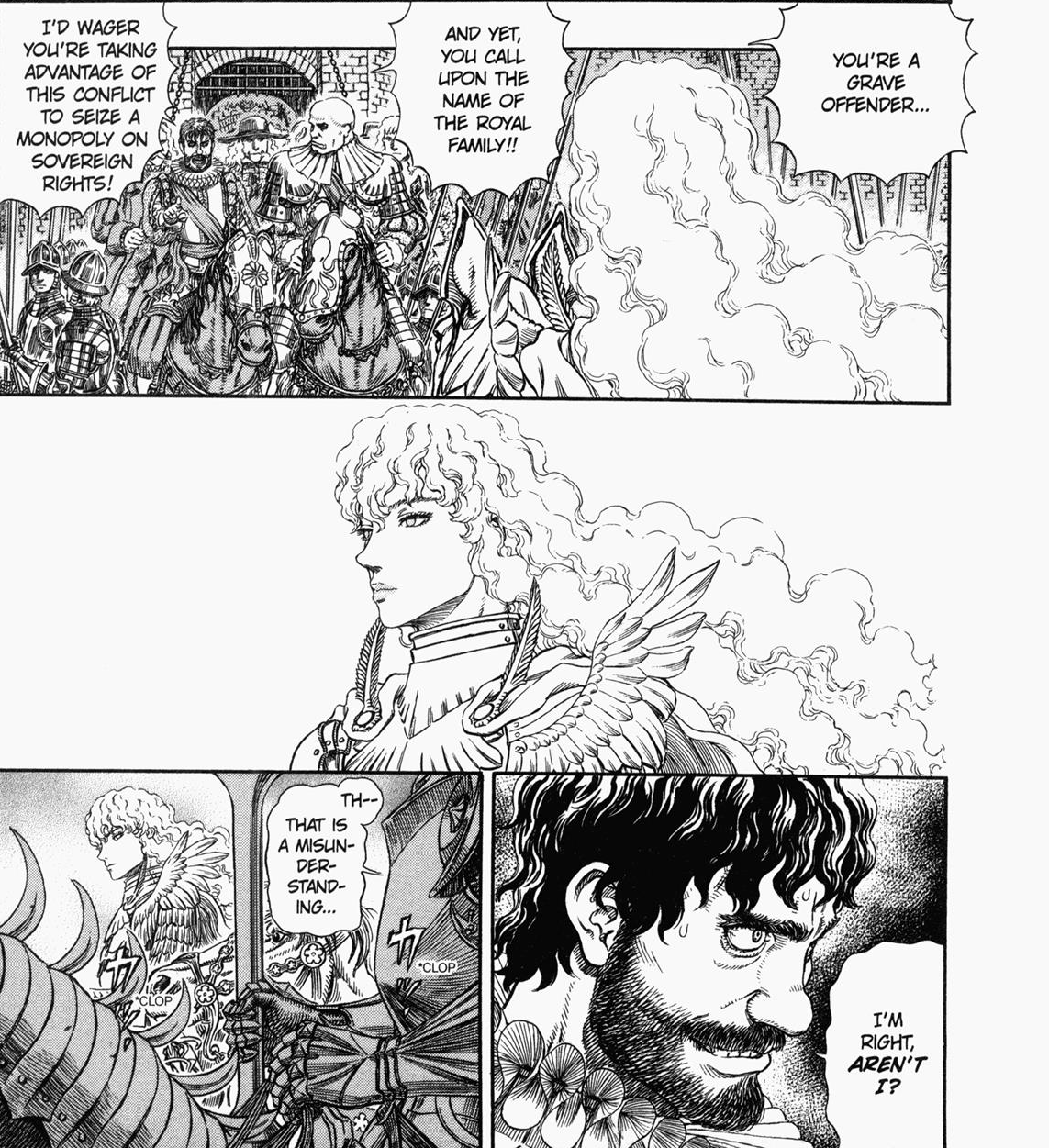
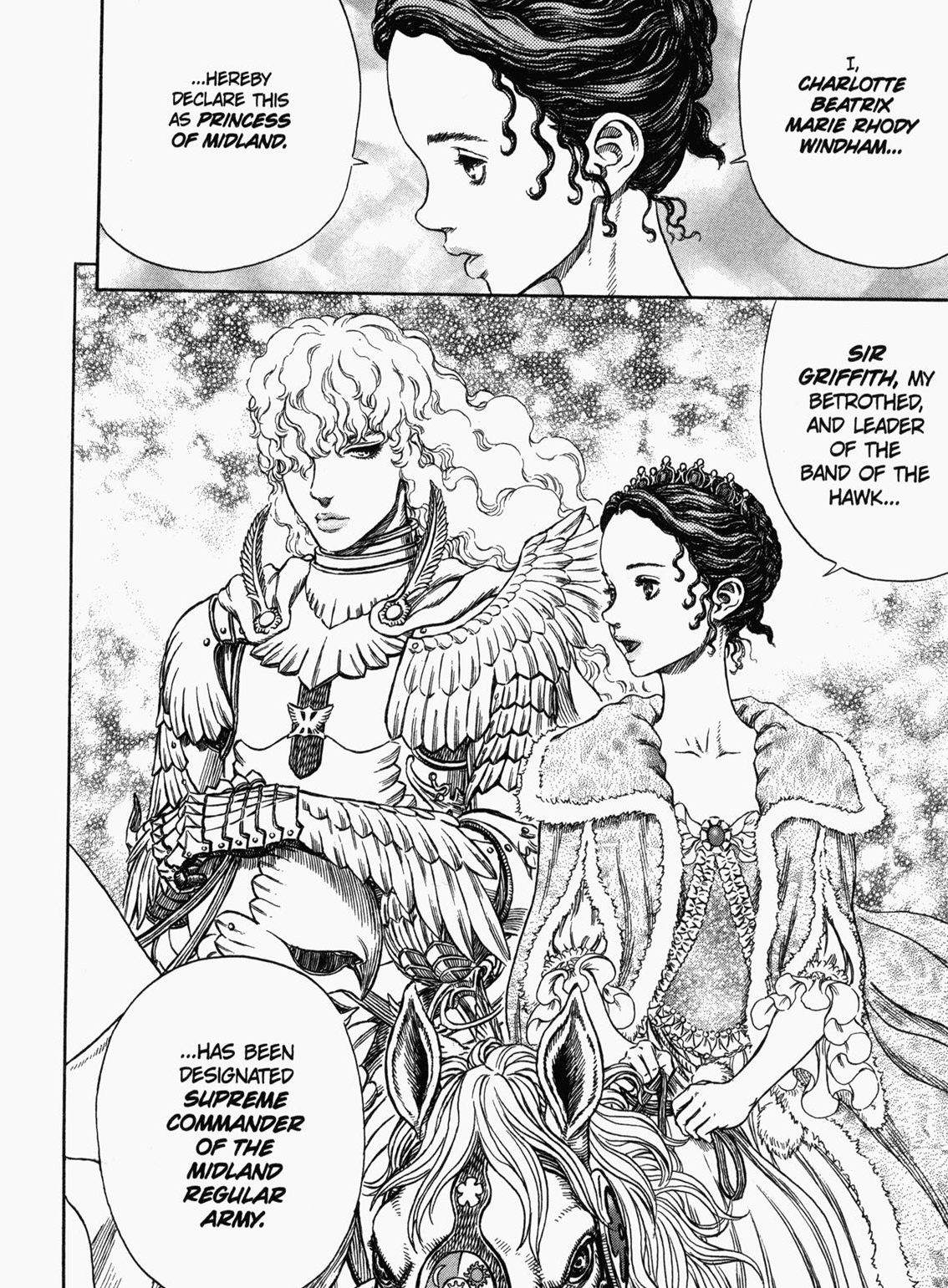
like we get moments like this during the millenium falcon arc:
it’s just not framed as a tense bad vibey moment w/ an evil dude manipulating a bunch of poor innocent people so he can get a kingdom, it’s framed as ‘lol fuck you noble assholes, griffith’s back and this time he’s getting his utopia, high five’
like do other people basically read a scene like this with sinister horror movie music playing in the background?
i mean i completely get if (general) you can’t ignore the eclipse rape in your perception of the story, but i feel like if you can’t do that, then your berserk is fundamentally at odds with miura’s berserk, since he has diligently ignored it throughout the entirety of neogriffith’s narrative, without a single fuck given for the kind of awkward tonal pall it casts over everything.
i wonder what it’s like to read neogriffith’s narrative thru the lens of guts = good griffith = evil
bc one notable thing about how miura has been writing griffith’s side of the story since he was resurrected is that ngriff is treated as the protagonist – a distant, unemotional protagonist to be sure, we’re never in his head or anything, but still a protagonist
like that’s how the story is structured and beated. griffith’s allies are all interesting and sympathetic and three dimensional; griffith’s triumphs are treated as such, his enemy gets a chapter of sympathetic backstory but is undoubtedly the antagonist. griffith striding in and intimidating ganeshka into turning his army away is good, ganeshka leveling up and becoming an eldrich horror is bad, the human soldiers going “oh shit the war demons are all monsters what the fuck” is a tense moment and sonia telling them to stfu and just get along relieves that tension, etc.
like it’s no coincidence that we see flora’s assassination as part of guts’ side of the story, because it’s a darker moment and seeing it thru guts’ eyes allows miura to depict it as such. if we saw it thru griffith’s narrative it would’ve looked more akin to griffith and guts assassinating the queen back in the golden age.
and also it makes the second time their narratives intersect, on the docks when guts and zodd team up to fight ganeshka, very… interesting as a contrast to the fight outside flora’s house. enemies to reluctant allies.
anyway yeah basically i feel like ngriff’s millenium falcon narrative would read like, in a very bizarre way if you’re not going along with treating him as a protagonist during it. like, tonally it would be nonsensical and probably very frustrating.
i love the detail of guts’ eye dripping blood here
it’s a symbol of despair that’s rly effective in illustrating guts’ feelings here (moreso than the run imho lol) despite not actually having any literal correlation to his emotions – yk bc it’s reminiscent of griffith crying blood after the behelit opened – and it’s gr8 that it comes right after that last memory of griffith.
it’s like a little mirror. each the source of the others’ despair.
Man takes up the sword in order to shield the small wound in his heart sustained in a far-off time beyond remembrance.
While I agree that leaving behind the Hawks/his family in pursuit of proving his “worthiness” was misguided, I’m hesitant to call it a “mistake.” Living (and dying) as an accessory solely for the benefit of someone else isn’t particularly good or healthy.
I’d agree if Guts’ life with the Hawks was ever framed as “living and dying as an accessory solely for the benefit of someone else,” but it isn’t.
I assume you’re referencing this:
Which is Griffith’s answer when Guts asks why Griffith risked his life to save him.
Basically Griffith denying any emotional investment in Guts by emphasizing his role as a military leader who sends people to their deaths regularly.
Guts calls him out on basically lying here three years later, in the post-Zodd conversation.
So yeah, while this is nice foreshadowing for the Eclipse, it’s explicitly not how Griffith actually feels wrt Guts, and Guts figures that out.
Guts was never just an accessory to Griffith’s dream, and there was a point where Guts knew that perfectly well, before the overheard Promrose Hall speech fucked it all up lol.
And just to add a few more things:
even if Griffith really did see Guts as just another soldier who could help him achieve his dream, I don’t think it would necessarily be unhealthy for Guts to stay with the Hawks. Being a mercenary is a line of work, and being a mercenary with the Hawks is a line of work with much greater rewards, much greater camraderie and friendship, and a greater sense of purpose than being a mercenary with any other band. Guts comments early on about how the Hawks are different than any other mercenary band he’s fought with because they’re happier, because they have a personal stake in Griffith’s dream.
Guts doesn’t particularly care about being raised into the peerage, or even about the idea of Griffith becoming a King beyond thinking Griffith is “absolutely incredible” for having such a lofty dream and actually getting close to achieving it, but he does care about his friends, and during the three years in which he presumably felt like he was mainly just doing a job, he was happier than he’s ever been before or since.
So imo it would still be the case that Guts would find greater personal fulfillment in a mercenary band full of happy people who love him as a friend and respect him as a leader, rather than wandering around alone crossing swords with anyone who looks strong – specifically, it’s implied in a flashback during the Wyald fight, monsters like Zodd:
Again, it’s another little piece of sad irony, knowing how Guts spent two years after the Eclipse.
And lol I know this response is getting long, sorry, but w/e I love talking about this shit so one more last little thing:
Griffith also doesn’t see any of the Hawks as just accessories to his dream, let alone Guts. He cares about the Hawks more than probably any other mercenary leader.
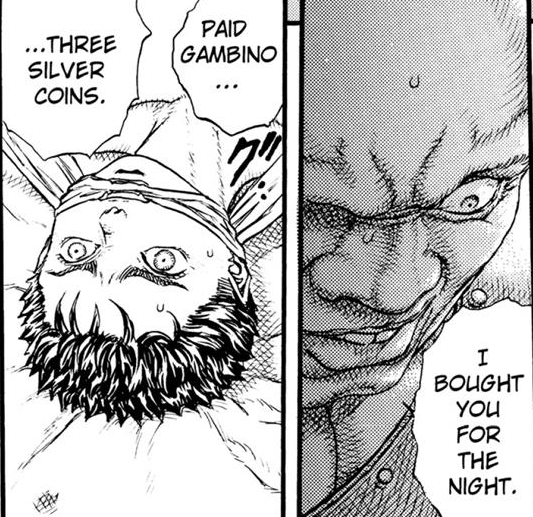
I mean this is a dude who prostituted himself to a pedophile to prevent
as many deaths in the line of duty as possible, and self-harmed in a
river while monologuing about how he has to win for the sake of the men
who’ve died for his dream.
He represses the hell out of his guilt and emotional attachment to them, because they die a lot and if he didn’t he’d be a wreck, but the very fact that he could offer them up as sacrifices means they were all extremely important to him:
@marley-manson sorry i wrote it in second person so i didnt have to give the narrator a name or anything but hhhhhhhhhh i actually want to make a longer fic on this prompt later bc it gave me some Ideas. nyway here u go!
I think it really just comes down to how you interpret Miura’s facial expressions but to me this looks tender and loving.
It’s Griffith’s last glimpse of Guts, after choosing to sacrifice him but before he starts shedding pieces of himself and transforming, and seeing that love in his eyes just makes this moment for me lol.
He’s content with his decision, there’s no anguish there or second guessing or wishing it could’ve been another way. It’s maybe even relishing this last glimpse of Guts, and of being able to feel that love without it also like, causing him pain, because he knows this is the end of it.
I mean I’m just reading really into it because this is how I see Griffith and his feelings at the end of his story, but I think it fits the image.
I think your interpretation is fair and makes sense, like, he does look pleased and I think he is, but the look in his eye is just so damn tender, yk? Like he’s saying goodbye, without malice, and just drinking in the last sight of Guts he’ll ever have. I think love is definitely part of this moment.
Ok, this is my long and thorough explanation of how Guts’ decision to leave the Hawks was ultimately shown to be a mistake.
I’ve been kind of meaning to write this for a while because I tend to take this statement as read in a lot of my meta and I wanted to have something to point to for the sake of clarification whenever necessary lol. Also jsyk this isn’t quite as long a read as it looks bc there are a lot of illustrative images.
And before I get into it I just want to make something clear: when I say it was a mistake I’m not saying that it’s a decision that reflects badly on Guts. It reflects many of Guts’ issues, and it stems largely from growing up with an abusive father figure, but based on the information Guts had at the time, and based on his personality and his values it was a reasonable decision to make from his perspective.
It’s just one that he ended up wholeheartedly regretting for very good reasons.
This basically rests on three premises:
1. Guts was happy and felt personally fulfilled with the Hawks.
2.
Guts chose to leave for one reason and one reason only: Griffith’s Promrose Hall speech made him feel inadequate.
3. Griffith’s speech absolutely didn’t reflect either his actual feelings about Guts or a particularly worthwhile life philosophy, and eventually Guts comes to understand this.
So let’s demonstrate the first part, starting from when Guts joined the Hawks.
Cue the waterfight scene with Griffith. And afterwards:
Then Rickert knocks him off the step and congratulates him on already having ten men under his command.
Guts is happy with the Hawks. After only a week with them he’s already chilling out about being touched, he’s feeling accepted, he’s responsible for others and he’s rising to that responsibility. He reflects on the night he killed Gambino and fled his first home, thinks “I still don’t have an answer to that question [of where am I going?]…” but then when Rickert congratulates him he thinks, “for now…”
For now, he’ll make his home with the Hawks. He tells Rickert to call him Guts and their clasped hands get their own panel. He’s forging new relationships and bonds with people, beginning to heal from past trauma, and growing as a person. He’s no longer swinging his sword just to survive, but as part of a unit, to help his friends and comrades survive and thrive too.
Three years later, when Casca accuses him of not changing since he joined them, of not caring about his comrades, he’s incensed.
He’s proud of having changed. He’s proud of his place in the Hawks, of being their raider captain, of Griffith’s faith in him. Casca’s words wound him because he has deep seated insecurities related to being an outsider.
His rivalry with Casca draws these insecurities out but overall he is very happy with the Hawks, he does care about them, and Casca insinuating otherwise pisses him off for good reason.
When Griffith nearly dies saving him from Zodd and then says he did it for no reason and implies he’d do it again without question, Guts like, basically reaches the pinnacle of his life.
And like, it is straightforward textual canon that this is everything Guts has desperately wanted all his life, thanks largely to his big pile of issues stemming from his fucked up childhood:
That is exactly what he has, and more importantly, what he understands and recognizes he has, after this staircase conversation.
When he first joined the Hawks we saw him remember that question he asked himself the night he killed Gambino and ran from his first (shitty) family: “where’m I going?”
After this conversation he remembers that night again:
He’s chosen to replace that first family, the abusive father he killed, the first mercenary band he grew up with, with the Hawks and Griffith. He has an answer to why he’s swinging his sword, and it’s not just to survive – it’s “for his sake.”
For now…
That little “for now” is important. It’s what he thought when he joined the Hawks three years ago, and it’s what he thinks now, because frankly, he is terrible at committment. This is an important part of Guts’ character. He’s slow to trust that others care about him because of his terrible childhood, and he’s very quick to believe he is unloved and unwanted. That “for now,” sets us up for the way one overheard speech makes Guts decide to rebuild his entire life from the ground up.
But hey, for now, he’s happy. He knows he’s cared for, he knows people, particularly Griffith, love and respect and value him. That to Griffith he’s worth risking his life for. He’s ready to dedicate himself to Griffith in turn. This is huge for Guts.
So yeah, he’s content and feels personally fulfilled with the Hawks and Griffith at this point in his life.
But then comes the speech.
This completely wipes away Guts’ assurance that Griffith loves, values, and respects him.
It changes everything for Guts and inarguably informs his choice to leave:
The real question worth asking isn’t why Guts decided to leave the Hawks, but why did one overheard pretentious speech about how Griffith has no friends affect Guts so profoundly that he immediately stopped viewing Griffith as a fellow human who would happily risk his life for him and began seeing him as a distant and perfect godlike figure who Guts would do anything to reach?
Like this speech comes after Griffith has literally died “for [his] sake.” In the encounter with Zodd, Griffith was dead because he instinctively ran into danger to grab Guts personally – it was only an unforseen twist of fate that allowed him to survive. And Guts knows this is significant, which is why he questions him about it, gets his answer, and dedicates himself to Griffith in return.
The speech erases that.
Afterwards, he has this incredibly unsubtle conversation with Casca:
Casca is laying down some basic facts here that add up to a confirmation of everything Guts believed when he said “I’ll wield my sword… for his sake,” on that rooftop.
Guts is the first person Griffith has ever said he wanted. Casca
hoped it was for his strength as an aid for achieving his dream, but
that is clearly not the case since he has nearly sacrificed his life –
and dream, Casca specifies – for Guts twice.
Griffith values Guts even above the dream he’s dedicated his life to, as is thoroughly demonstrated by his actions.
But Guts
completely disregards this. Casca straightforwardly tells him that
Griffith feels some unique and irrational emotions for Guts, and his
actions are proof of that, but Guts never stops to consider that maybe
Griffith’s actions speak louder than his words. At the most, what Casca’s angry monologue might do is give Guts the confidence that he’s capable of becoming Griffith’s friend, and therefore inspires him to leave.
But it certainly doesn’t make him rethink the truth or the value of Griffith’s speech to Charlotte.
I’m not going to get heavily into Griffith’s point of view here, I’ve done that very thoroughly in the second part of this giant thing
for anyone rly curious, but suffice to say his Promrose Hall monologue doesn’t have a
damn thing to do with how Griffith actually feels about Guts lol.
Guts doesn’t fit his weird and narrow definition of friend, Guts is actually far more important to him than this definition leaves room for. A friend is someone who has his own dream and would prioritize it over friendship, allowing Griffith to prioritize his own dream as well – Guts, conversely, has already taken priority over Griffith’s dream when Griffith risked it for him twice.
Griffith isn’t about to consciously admit to himself that his dream is no longer his number one priority, but our trusty commentator of their relationship, Casca, knows the score, and explains it to Guts, and completely fails to get through to him.
And the reason Guts prioritizes the speech over actual evidence of what his relationship with Griffith actually is, both in the form of Griffith saving him and Casca explaining things to him, comes back to his abusive childhood:
He is convinced that Griffith looks down on him because this is what he’s grown up expecting from people he respects and loves. He expects to be seen as worth nothing more than the money he can bring in and the fights he can win, he expects to be ostracized and seen as “cursed,” so Griffith’s speech overrides Griffith risking his life and dream to save Guts twice, it overrides Casca’s jealousy of their relationship, it overrides Griffith freaking out and refusing to let Guts leave without another duel, hell, for a while it even overrides both Casca and Rickert telling him that Griffith destroyed his life because Guts left.
He’s gone from feeling like a trusted, respected, and valued friend to feeling like nothing more than an asset to Griffith’s dream.
Remember, he did not feel discontent before the speech. In his three years with the Hawks before overhearing the speech, he felt like he’d found the place he belonged. He felt worthwhile, he felt valued as a person and not just as a soldier, and moreover, he was right to feel that way.
The Hawks do love, respect, and value him, and Griffith demonstratably values him even over his dream whether he’s able to admit that to himself or not.
And it’s only after overhearing the speech, overhearing that Griffith can only see someone as a friend and equal if they have their own obsession to pursue, that Guts starts feeling once again like he’s only fighting to survive, as we see him ponder during the 100 man fight, and here:
Before the Promrose Hall speech he felt like he was fighting for his friends and comrades, for Griffith, and he was proud of that, but now he feels like he’s worthlessly fighting for nothing. It’s incredibly depressing imo. This is straight up a result of Guts’ low self esteem, thanks to his abusive childhood.
This is Guts’ tendency to feel like an outsider rearing its ugly head. This is because he grew up being told he was cursed, used only as a source of income for Gambino, and turned on and nearly killed by Gambino and then the rest of the mercenaries. This is Guts feeling like he can’t trust any companionship to be genuine other than his sword.
Basically what happened is that Guts overheard Griffith’s speech in a moment of particular vulnerability. He’d just accidentally killed a kid and he was feeling like a monster about it. He was trying to find Griffith, probably to feel that same sense of acceptance and love he felt during the staircase conversation – he needed reassurance, and instead his world came crashing down around him and his feelings of worthlessness resurged hard.
And because of his outsider issues he extrapolates Griffith’s speech to his feelings about being part of the Hawks as a whole. Every Hawk has a dream except him, therefore he’s an outsider and doesn’t really belong.
And on some level, Guts knows this is bullshit.
It’s been one day and, now feeling the full weight of being alone again and apart from what Rickert pointedly calls his family, he’s already having second thoughts, reflecting on the warm companionship he’s giving up and acknowledging that his goal is inherently contradictory.
He wants to find his own dream so he can live for himself, when his entire reason for wanting that is to become Griffith’s equal. He’s not going out to find a dream for the sake of his own sense of independence, or because he personally also believes that a person is only worthwhile if they’re pursuing something.
He’s doing it because he overheard Griffith say that’s the only way to be his friend.
As he declares his independence from Griffith he is literally parroting Griffith’s speech here lol; it’s a giant contradiction and proof of what he mused on the night he left – he got this idea in his head by overhearing Griffith’s words, therefore he’s not actually doing it for his own sake.
Guts left for the sole reason of fulfilling Griffith’s weird and specific friendship criteria.
And after Guts comes back his whole narrative pretty much revolves around his slow and painful realization that Griffith’s speech was functionally meaningless, and yeah it turns out he did end up throwing away something irreplacable that he’ll never have again by taking off.
Like, just to underscore how significant it is that Guts lets Casca stab him as he internalizes this information, this is a huge sign of guilt. We see Guts do the same thing when the possessed kid stabs him all the way back in chapter 2. He denies feeling responsible both times, but the fact that he let himself be stabbed contradicts those words.
It takes him several days and several pretty huge anvils dropped on him before he finally accepts the fact that not only was leaving entirely unnecessary because Griffith did not actually look down on him or consider him unworthy, but by leaving he destroyed the thing he left to obtain in the first place: he left to become Griffith’s equal and when he came back, by any standards these two idiots would use to define power and worth, Guts is by far Griffith’s superior now. Entirely because Guts left Griffith is now disabled, helpless, voiceless, dreamless, powerless, and dependent.
And let’s be real, it’s a pretty damn harsh thing to accept that you not only rearranged the focus of your entire life and left your found family for no reason, but by doing so you lost the thing you rearranged your life and left your family to try to get. It’s no wonder Guts holds out for so long.
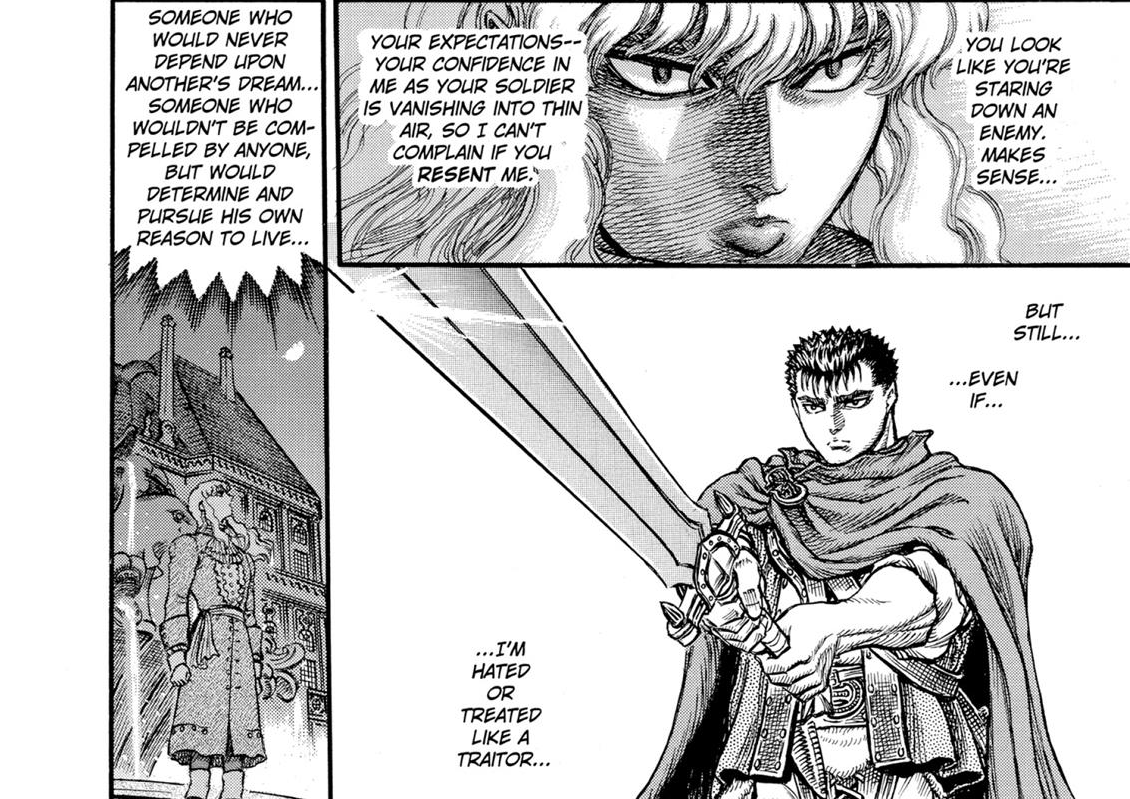
He keeps telling himself that Griffith is above the kind of emotion that would lead to him being declared a traitor one day after Guts left, that Griffith is untouchable, that Griffith has always had everything under control and always will. He insists to himself that Griffith is perfect and soaring distantly above him, because his reason for leaving is to become just like him. He has to believe it to justify his decision.
Since before he left:
to after he comes back:
But his ability to deny not just Griffith’s flawed humanity but also his devastatingly powerful feelings for him is growing weaker. Guts is beginning to realize that the fact that Guts was able to destroy him by leaving is itself proof that he didn’t need to leave.
Guts already had as strong a hold over Griffith as Griffith had over him. They were already functionally equals in this way.
Then I’ve made a huge mistake.
To make a long story short (too late), this is why Guts left:
And this is how Griffith really feels about Guts:
These two monologues exist to play off each other. Guts monologuing about his feelings for Griffith, how dazzling he is, how he needs to leave so he can be Griffith’s equal instead of feeling like Griffith is looking down on him. And Griffith’s monologue about his feelings for Guts, how the dream he’s spent every waking moment of his life pursuing pales in comparison to him, how strong Guts’ hold on him is, how he’s the sole sustenance keeping him alive.
It’s a point/counterpoint. Griffith’s monologue directly states that Guts is wrong about his reasons for leaving.
And again, I don’t think Guts’ decision to leave was actually stupid, or that it reflects badly on him. Griffith himself didn’t properly recognize his feelings for Guts until it was too late, and Guts had good reasons, both internal (a history of abuse) and external (Griffith’s stupid speech), for believing Griffith looked down on him.
But nevertheless he was still wrong, and here’s where Guts finally, finally realizes it properly, without pushing that realization away and denying it some more:
Unfortunately he realizes this about 30 seconds too late, which is what makes Berserk a tragedy.
Anyway, that’s about it. It may be worth noting that his regret over leaving informs significant chunks of the rest of his narrative, such as realizing he’s been being a dick by leaving Casca in a cave for two years:
And refusing to leave her again:
“Don’t abandon what you can’t replace. Weren’t those Godo’s parting words?”
Guts realizing he fucked up and shouldn’t’ve left the Hawks informs his most significant moments of personal growth over the series. Realizing he’s repeating that mistake is what finally sways him from the self-destructive path of rage and revenge to putting his energy into protecting Casca.
The fact that companions and loved ones are more important and genuinely healthier things to prioritize than dreams is one of the central themes of Berserk, and Guts choosing to leave the Hawks, his family, to pursue a dream, thereby losing all of his friends and loved ones, is the main illustration of this theme.
Also worth noting: the dream Guts eventually landed on was to just keep swinging his sword, getting better and stronger and fighting better and stronger enemies, except alone this time, instead of among comrades and friends. You know what that describes to a tee? The Black Swordsman arc, as is neatly pointed out after the Eclipse:
Guts would’ve been much, much better off staying with the Hawks and continuing to find personal fulfillment in his relationships and feelings of being loved and valued, but years of being told his only worth is as an asset, rather than as a person, blinded him to the truth and made it too easy for him to believe he’s looked down on.
Part of the tragedy of the Golden Age hinges on Guts’ low self esteem and inability to see that he’s loved because of it. This is what happens when you’re the protagonist of a really well-written, really tragic story: you make some wonderfully disastrous, character-revealing mistakes.
@madchen said:
i literally just went
to see if i could finally see griffiths dick and confirm my Dick
Headcanons but i can barely see anything… this is misogyny and
homophobia against me specifically somehow
i think they drew it at 2 different sizes anyway lol it looks like a shower in the first cap (as far as u can tell w/ the shitty quality lol) and a grower in the 2nd
this is what happens when your character ref sheets aren’t anatomically correct










 you're the only one