Thesis statement of this goddamn thesis: Guts is sexually attracted to Griffith.
Now, this is long. This is the shortest part of a four-part series, and this isn’t a short post. And basically my intention is to show why I find it so incredibly easy to read Guts as attracted to Griffith, and explain how this reading adds layers of meaning that fit neatly within Berserk’s themes and enrich the story. I’m not going to speculate on Miura’s motives for adding a ton of gay subtext, like, it could be anything from trying to be as gay as possible without pissing off his publishers to it all being totally coincidental and meaningless with an alternate explanation for every point I have, or anywhere in between.
My point is only that Berserk readily lends itself to gay readings, with a focus on Guts’ sexual attraction to Griffith (as I feel like it tends to be neglected in favour of interpretations that Griffith has a one-sided crush.)
Part one covers the Black Swordsman stuff and the way Guts and Griffith’s relationship is revealed to the audience, part two covers the first several chapters of the Golden Age with a focus on visuals and how Guts sees Griffith, part three tackles Casca’s role in the story, and part four is more of an overview on why I think reading Berserk through a gay lens works so well.
So here we go.
Part One – Our Introduction to the Concept of Guts and Griffith
We’re introduced to Guts and Griffith’s relationship near the end of the Black Swordsman arc. Before the appearance of the Godhand we know that Guts is really fucking angry, we know he’s monster slaying because he’s out for revenge, we know he’s looking for a group called “the Godhand,” and thanks to Puck spelling some stuff out we know that he’s also sad and deeply afraid that he’s fighting a losing battle.
The comparison to Vargas hints that maybe he lost some loved ones, plus an eye and a limb to an apostle which is close enough to the truth to be decent foreshadowing.
But it’s not until the Godhand show up as the Count’s about to die that we learn what’s really going on with Guts. The information is given to us surprisingly straightforwardly, and the way the information is revealed to us is pretty telling.
The first six chapters have been teasing the mystery of what happened to Guts to piss him off so much, from the way we kick off in media res, to hints about his issues and trauma (eg the aforementioned Vargas comparison, the way he lets the possessed corpse of the kid stab him, etc), to Puck directly asking what the hell happened to him outloud for the benefit of the audience. We start to get our answer in chapter 7.
The Godhand that Guts has been searching for shows up, Femto front and centre, and Guts’ rage is directed right at him. When Guts screams “Griffith!” at him we see Puck asking “Griffith? Who’s Griffith?”
My point with this is just to emphasize that the driving hook of the Black Swordsman arc is the build-up of the mystery and what makes Guts tick, the tension pretty much entirely coming from the audience wondering why Guts is so obsessed with revenge, and the reveal of the sacrifice is the climax of this arc.
And our example of a sacrifice, which we are explicitly told is also what happened between Guts and Griffith? A husband and wife.
In fact, the sacrifice that serves the main purpose of setting us up for Guts’ story is the only sacrifice of a romantic partner we ever see – the rest are all parent/child, weirdly abstract a la Eggman sacrificing “the world,” and ofc Guts and Griffith’s undefined, suggestive thing.
The details of this sequence make the parallels stand out even more.
First of all, before we learn much of anything, we see Guts’ reaction to Griffith/Femto. The rage we expect:
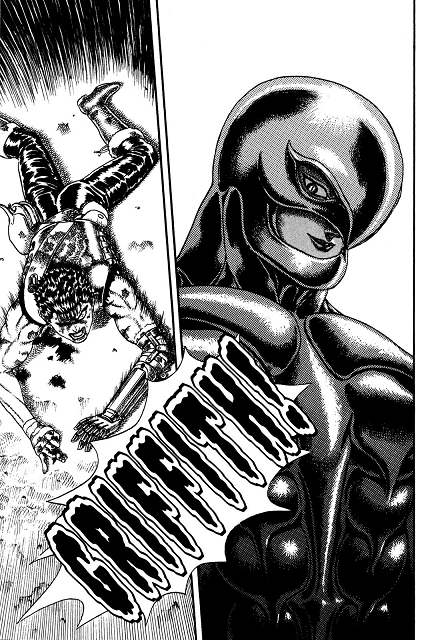
Guts taken aback and offended, which is less expected:


And then begging for attention when Femto turns away from him to address the matter at hand, which should definitely come as a surprise for a first time reader:
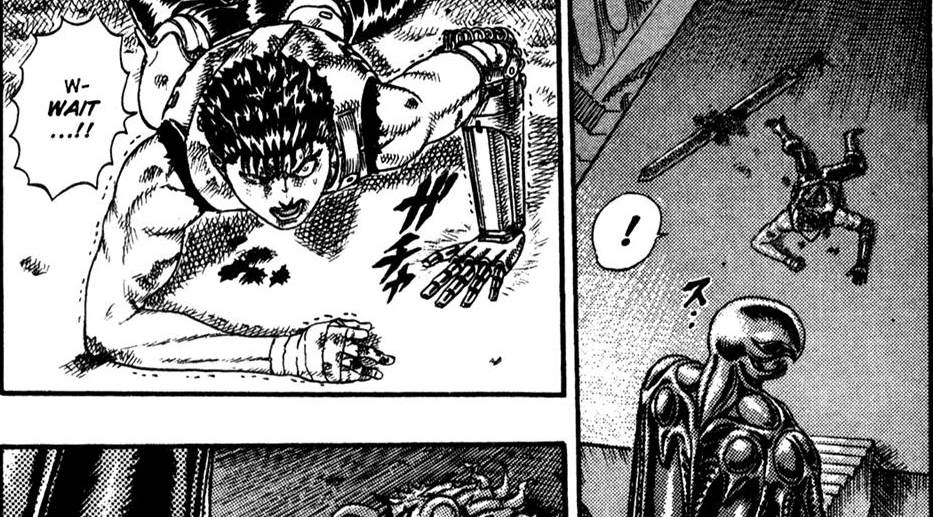
The audience is expecting rage and violence, and what we get is neediness. Guts, more than anything, wants Femto’s attention.
Guts is finally spurred into action when Femto directly says he doesn’t give a fuck:


(Something, btw, that Guts is still brooding about a chapter later lmao:
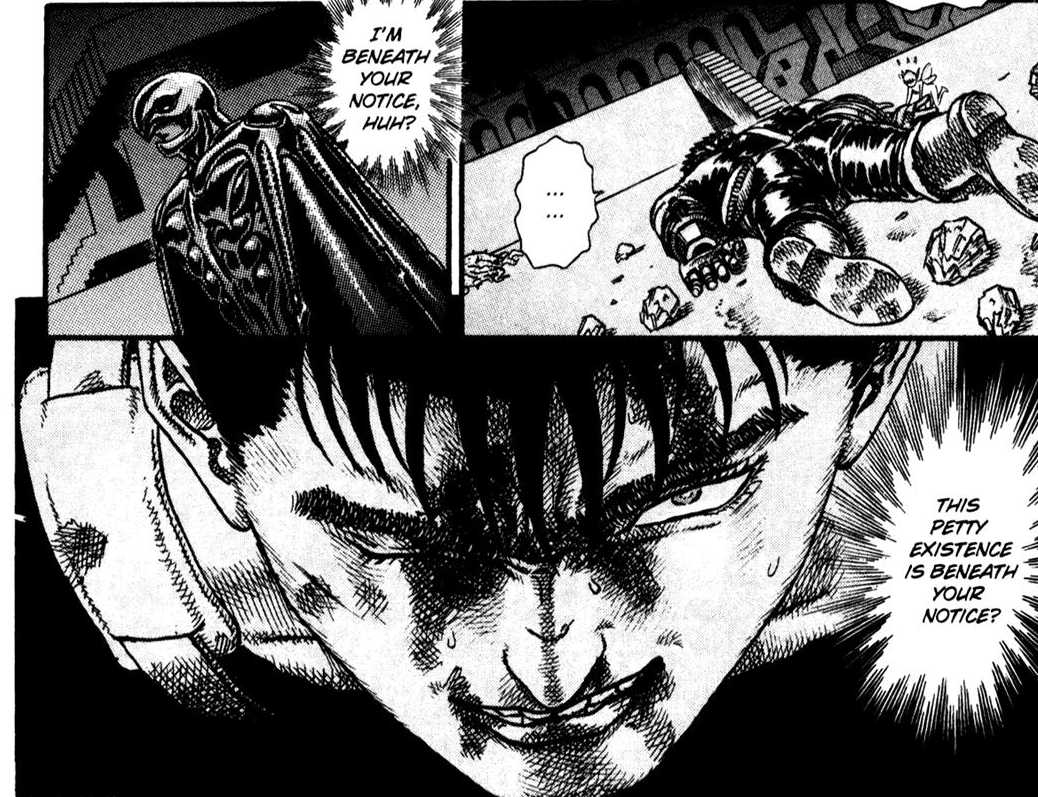
like, this arc couldn’t be more blatant about Guts wanting Griffith/Femto’s attention.)
But even now the focus is on the potential for more revealed backstory, not on Guts’ attempt at turning talk into action.
Throughout this arc the audience is lead to expect a dramatic, action-packed, and revealing confrontation between Guts and the object of his ire. By the time we get to the climax, Guts can barely stand, we discover the guy he’s mad at is a god he can’t even touch, and his feelings are a lot more complex and vulnerable than just rage and fear of failure. The focus is taken away from possible action and given to hints of backstory. When Guts is standing with sword in hand, advancing on Femto, these are the moments that pique our interest:


Guts makes a very impressive stand considering how fucked up his body is but he can’t even touch Femto before getting telekinesised against a wall. A fight is out of the question – Guts’ willpower, and what spurs him on and makes him fight through the pain, are what the audience is meant to be interested in.
After Guts is magically thrown against a wall we get more hints. The Count tries to offer Guts as an offering. Slan tells him, The boy is merely your enemy. As a sacrificial offering for the Invocation of Doom, not just any lump of flesh and blood will do. It must be someone important to you, part of your soul… someone so close to you that it’s almost like giving up a part of you.
Femto points at Theresia.

That should be more than enough, right? We’ve learned like, everything we need to know. Griffith/Femto is responsible for the brand of sacrifice on Guts’ neck, therefore he sacrificed Guts at some point, therefore they were close friends or maybe related, but Griffith betrayed Guts for demonic power, now Guts is real mad and Griffith has become a monster, as you do.
But we don’t stop there.
Now, in fairness, this does pad out the chapter and give us more build-up to the Count’s decision wrt Theresia. Miura obviously needed something to make the pacing work. And hey Ubik likes to fuck with potential sacrificers and make them feel like shit, so it makes sense for him to start telling everyone the Count’s backstory for funsies. But it’s here that the implications really ramp up, which tells us what the real point of this sad backstory is.
It’s during this story that Guts wakes up:


We get some pissed off reaction shots from him as they all watch the drama:


On the image of monster Count eating his wife:

And in the panels immediately following:

Here’s when Femto is most explicitly compared to the Count. That thoughtful over-the-shoulder look in reaction to Ubik’s words – The life of the person you loved the most and hated the most! – tells us everything we need to know. Especially since Femto’s been absent for the last few pages of Godhand reactions and this is our first image of him (aside from one long shot of the back of his head) since Ubik started telling the story, despite getting several reaction shots from the rest of the Godhand. This panel feels significant, and it exists to tell us that Ubik’s words fully apply to him as well.
And, while this is pretty obvious I’ll note it just in case, it’s only after Ubik’s story is over that Guts is like, “oh yeah,” and asks Puck to heal him so he can hold a sword, so those reaction shots are all about Guts reliving painful memories and not about his injuries or getting Puck’s attention.
Basically, the Count being told to sacrifice Theresia tells us what a sacrifice is and who it applies to, but the Count and his wife are our window into Guts and Griffith’s turbulent past, as we can clearly see by how they react to it, and how the narrative and visuals frame the story in relation to them.
And, if you already know the plot of Berserk, you should also be able to see some parallels here – “a family, the very picture of happiness.”
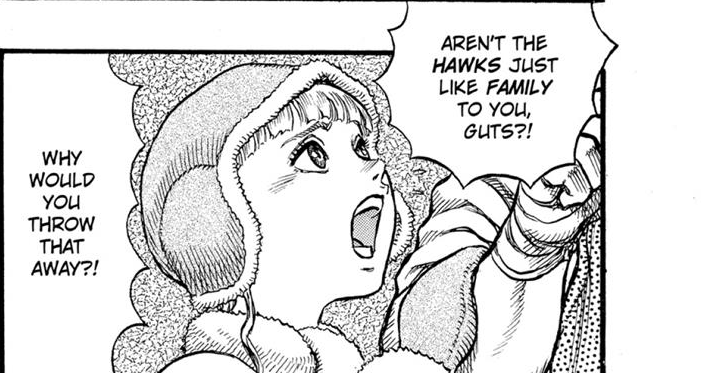
When it comes to infidelity, I actually don’t think that jealousy was Griffith’s main source of despair, but boy do these many panels of Griffith watching Guts and Casca and looking upset between the rescue and the Eclipse demonstrate that it was a factor. Eg:


Part of the point of the Count’s backstory is to show that it’s not lust for power that leads to someone making a sacrifice, or at least, not necessarily – the Count wanted to bury his human heart. He felt betrayed; his wife was the direct cause of his suicidal despair, and he was desperate to escape that despair.


As Guts was the direct cause of Griffith’s despair. The behelit only opens when Guts touches Griffith again – not after losing his dream, not after losing the use of his limbs or his tongue, not even after believing he was losing Guts again too – but the touch of Guts’ hand.
Guts eventually recognizes how Griffith’s feelings for him caused his despair as well.
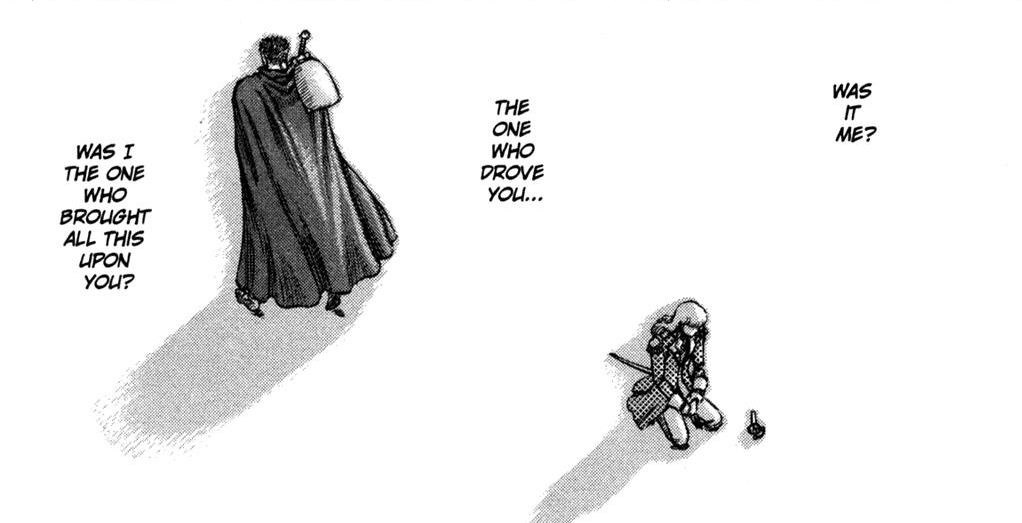

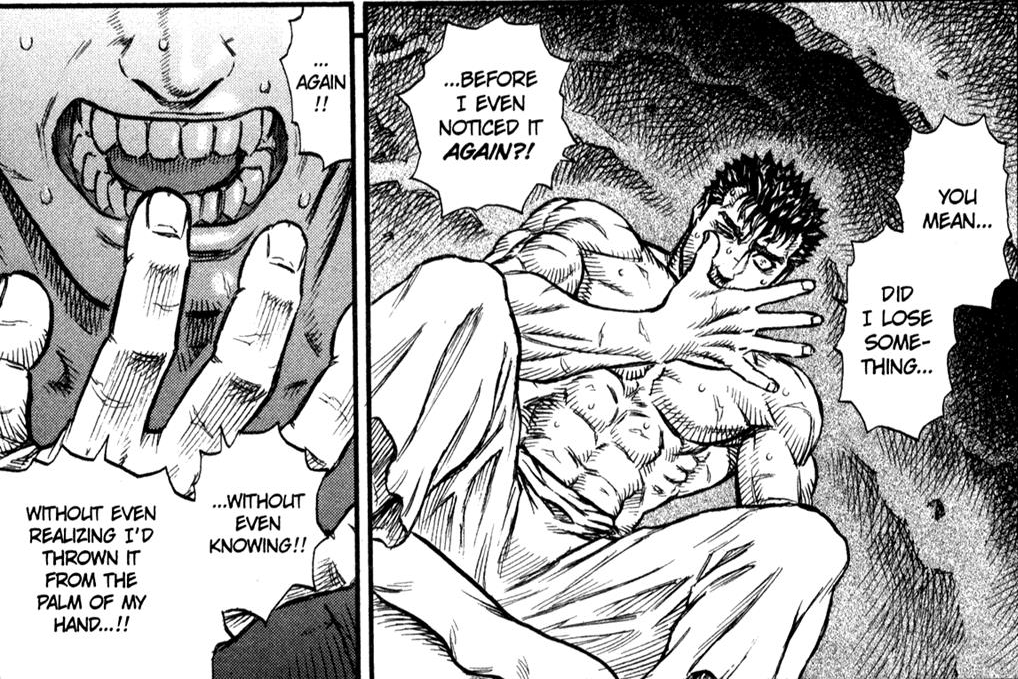
All things considered, the Count’s sacrifice is certainly closer to Guts’ story than any other sacrifice we’ve seen, making it pretty fitting as our first introduction to Guts and Griffith’s epic love/hate relationship.
Plus as a bonus:

Griffith has been described as half of Guts as well in the same sacrificial context:

Just fyi.
This whole first arc has been building up to a climactic reveal about Guts’ past and the reason for his revenge quest, from pacing and emphasis to Puck, the audience expy, straightforwardly asking, “what happened between those two?” And the answer we’re given is that something similar to the Count’s backstory happened.
So now the apparent answer to Puck’s question is, “oh, well, I guess they were like in love, but then some shit went down, maybe Guts betrayed Griffith? Idk, Guts must’ve done something that made Griffith fall into pure despair and decide to sacrifice him to become a demon. So Guts is pissed off because Griffith branded him and now he has to fight ghosts all the time. Cool.“
And really, does anything in the following 344 chapters disabuse you of that notion? Sure it’s a lot more complex, there’s a lot of additional factors, but that’s the bare bones of it in a nutshell.
So then the next chapter opens on our very first glimpse of Guts and original flavour Griffith together. Early days, Guts is his 15 year old self pre 3 year flash forward. Still sullen lol. Griffith gives his keys that set the world in motion speech which, while illuminating thematically, is paced to set up this particular, emotionally revealing moment:

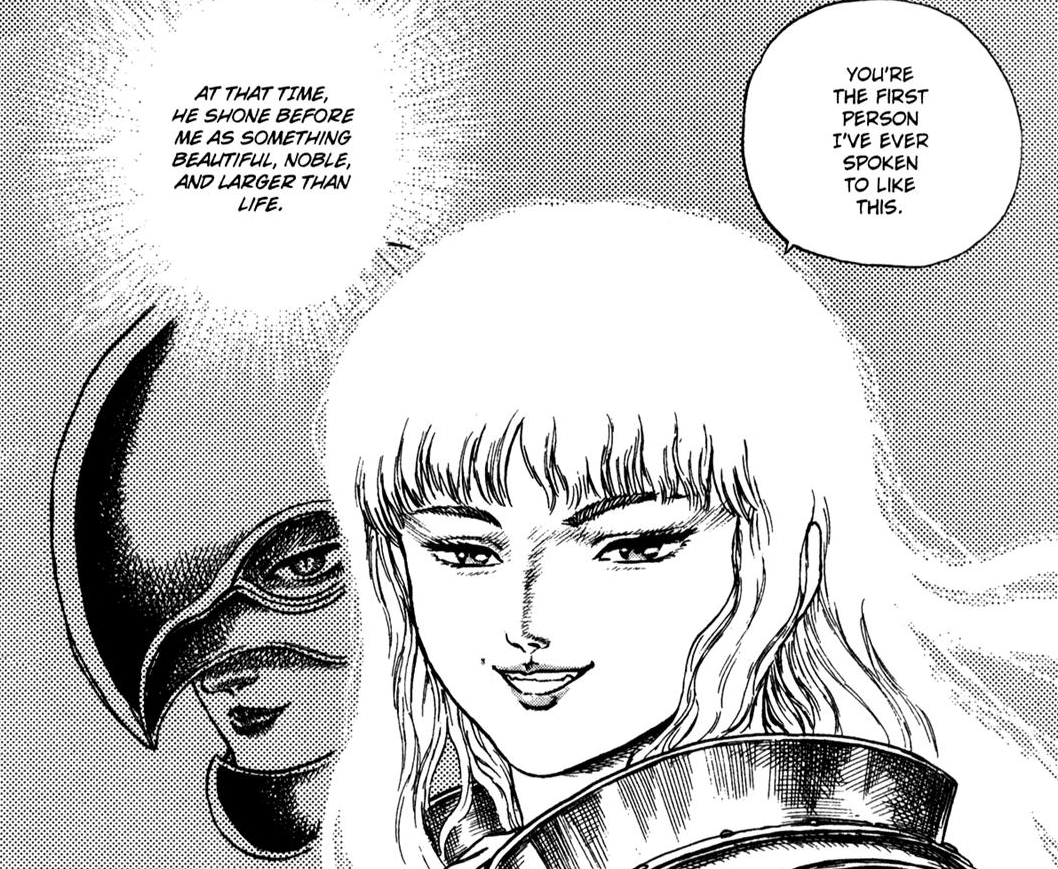
With the additional context of the parallel we’ve just seen between the Count and his wife, how does this come across? I mean come on, from Griffith’s side we have the statement that Guts stands alone as closer to him than anyone else has ever been, already – he’s the first and only person Griffith has ever felt comfortable voicing his internal thoughts to, his deep desire to know who he is at his core and what he’s capable of.
From Guts side we have “At that time he shone before me as something beautiful, noble, and larger than life.”
This reads as the beginning of a romance as far as I’m concerned, and not a one-sided one. Griffith’s quote tells us they have a uniquely close and emotionally intimate relationship, Guts’ quote tells us it’s a relationship that encompasses admiration/awe and thinking about how “beautiful” the other is.
The best illustration Miura came up with to introduce us to the nature of their epic love/hate relationship is a happy marriage broken by betrayal. And it’s not just because Griffith is in love with Guts (which hopefully we can all agree is fairly obvious), because, even beyond Guts’ neediness when confronted by Femto and the many suggestions of his complex not-just-rage emotions, I mean the first thing we see after 20 pages worth of that married couple parallel is Guts calling Griffith beautiful.
And boy do the first seventeen chapters of their relationship demonstrate that Guts is calling him beautiful for a reason.
ETA 18/03/24: mildly retooled the parallels to the Golden Age part because i realized on re-read that i skipped the most blatant one

 you're the only one